
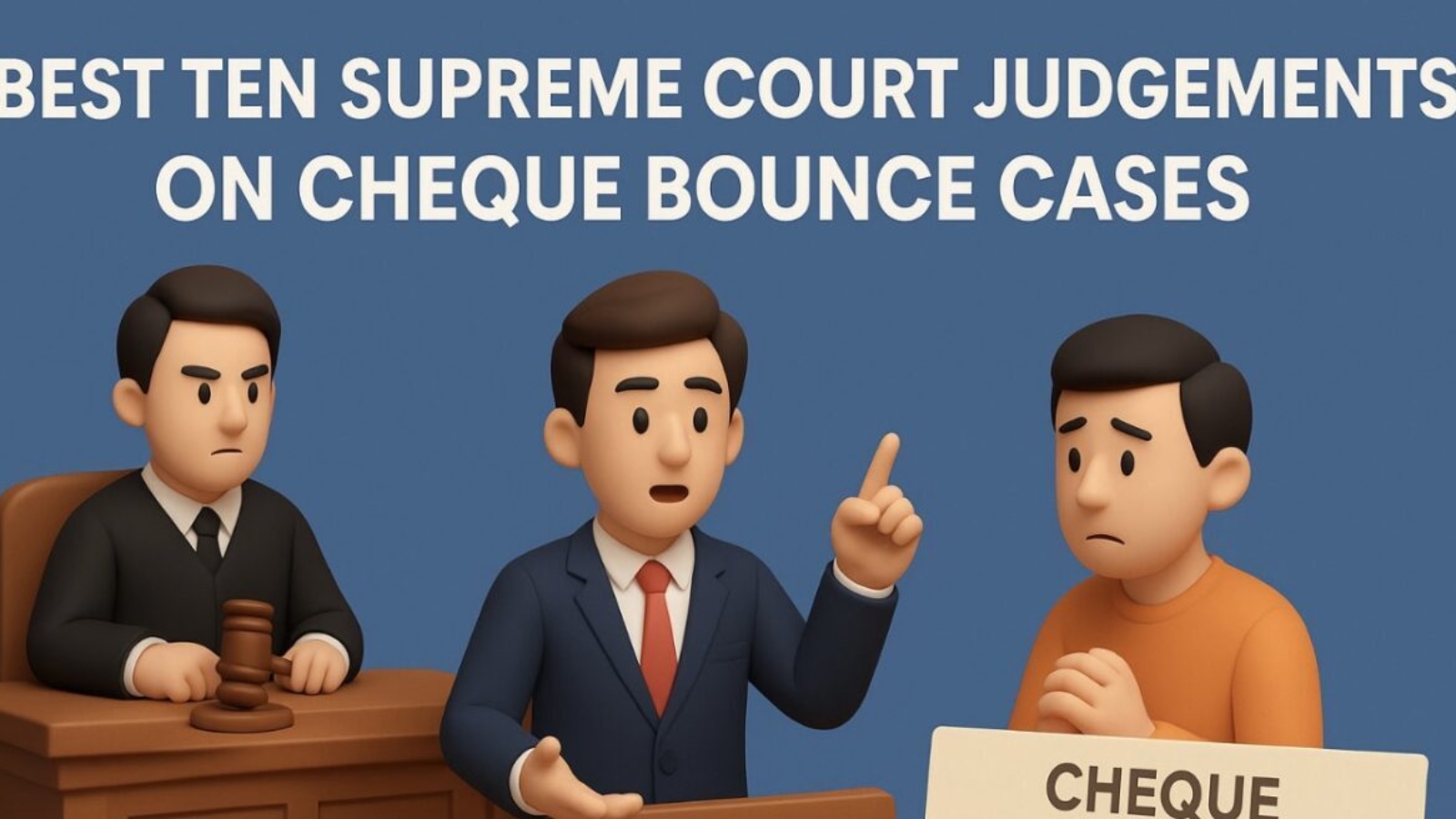
Section 138 NI Act Acquittal Guide: Top 10 SC Judgements & Defence Tactics for Accused in Cheque Cases.
Cheque bounce litigation under Section 138 of the Negotiable Instruments Act is one of the most common criminal prosecutions in India. Yet, an accused is not always liable merely because a signature appears on the cheque. The Supreme Court has repeatedly clarified that presumptions under Sections 118 & 139 are rebuttable, and a smart, prepared and strategic defence can secure honourable acquittal.
Here are the Top 10 Supreme Court Judgments that every defence advocate must know while representing an accused in cheque bounce matters.
1. Basalingappa v. Mudibasappa (2019)
Key Notes:
- The Court clarified that the presumption of legally enforceable debt is rebuttable.
- Accused can rebut presumption through probabilities, not necessarily by producing defence evidence.
- Cross-examination alone can be sufficient to demolish complainant’s case.
Use in Court:
Ideal when complainant has poor financial capacity or vague loan story.
2. Rangappa v. Sri Mohan (2010)
Key Notes:
- Landmark ruling affirming that the presumption includes existence of debt, but accused can rebut it scientifically.
- Defence needs to show preponderance of probability, not proof beyond reasonable doubt.
Use in Court:
Perfect base case for arguing the standard of rebuttal.
3. Kumar Exports v. Sharma Carpets (2009)
Key Notes:
- Mere issuance of cheque does not automatically establish liability.
- If complainant fails to prove foundational facts, accused gets benefit.
Use in Court:
Best for cases involving security cheques.
4. K. Subramani v. K. Damodara Naidu (2015)
Key Notes:
- Complainant must independently prove his financial capacity.
- Failure to show source of funds weakens prosecution.
Use in Court:
Very useful when complainant alleges huge cash loan without documents.
5. John K. Abraham v. Simon C. Abraham (2014)
Key Notes:
- If complainant is inconsistent about date, amount, or transaction details, prosecution collapses.
- Courts must ensure basic foundational evidence is present.
Use in Court:
Use when complainant’s story is contradictory.
6. Krishna Janardhan Bhat v. Dattatraya Hegde (2008)
Key Notes:
- Accused has constitutional right not to be convicted unless case is proved beyond reasonable doubt.
- Presumption does not extend to loan amount unless proved.
Use in Court:
Strong citation for arguing constitutional fairness & reasonable doubt.
7. Rohitbhai Jivanlal Patel v. State of Gujarat (2019)
Key Notes:
- Though presumption is strong, if complainant’s evidence is hollow, presumption fails.
- Complainant cannot rely on presumption alone.
Use in Court:
Great for challenging weak documentary support in complainant’s case.
8. M.S. Narayana Menon v. State of Kerala (2006)
Key Notes:
- Defence can rely on probable alternative theories, such as repayment, business transaction adjustment, etc.
- Personal testimony of accused can be enough if probable.
Use in Court:
Very useful for framing alternative narratives.
9. P. Rasiya v. Abdul Nazer (2022)
Key Notes:
- Blank cheque defence is permissible.
- Cheque issued as security that was misused may lead to acquittal.
Use in Court:
Important when signatures admitted but liability denied.
10. Dashrath Rupsingh Rathod v. State of Maharashtra (2014)
Key Notes:
- Though modified later by amendment, it established important concepts of jurisdiction and procedural fairness.
- Useful when complaint is filed in wrong jurisdiction leading to miscarriage of justice.
Use in Court:
Good for pointing out jurisdictional defects or procedural abuse.
My View: How to Defend the Accused Like a Pro in Cheque Bounce Cases
Representing an accused in cheque cases is an art. It’s not merely about denials — it’s about strategy, timing, and systematic demolition of the complainant’s story.
Here is my professional strategy:
1. Challenge Financial Capacity
Most cheque bounce prosecutions collapse when the complainant cannot prove:
- Source of funds
- Bank withdrawal proof
- Income documents
- ITR entries
Ask targeted questions in cross-examination.
2. Pinpoint Contradictions
Every cheque case has weak points:
- Date of loan
- Mode of transaction
- Absence of written agreement
- Unnatural conduct of lender
Highlight these inconsistencies.
3. Use Security Cheque Defence Properly
If cheque was given:
- for business dealings,
- for loan security,
- for property/security agreements,
then there is no legally enforceable debt on the cheque date.
4. Demand Original Documents
Make complainant produce:
- Original promissory notes
- Ledger accounts
- WhatsApp chats
- Bank statements
Their absence creates reasonable doubt.
5. Smart Use of Cross-examination
Most acquittals come from cross-examination alone.
Focus on:
- Financial capacity
- Knowledge of accused
- Exact date/mode of loan
- Circumstances of issuing cheque
A well-planned cross turns the entire case.
6. Highlight Unnatural Conduct
Ask:
- Why give lakhs in cash without agreement?
- Why no witness?
- Why no earlier complaint?
These questions build doubt.
7. Use Standard of Proof
Remind court that:
- Accused needs only probability
- Complainant needs certainty
This principle alone wins half the cases.
Conclusion
These ten Supreme Court judgments form the backbone of every strong defence under Section 138 NI Act. An effective advocate doesn’t simply deny the transaction but strategically dismantles the complainant’s case using law, logic, probabilities, and precise cross-examination.
Cheque bounce defence is not about proving innocence —
it’s about demonstrating doubt, exposing inconsistencies, and showing that prosecution has failed its legal duty.
With the right approach, an accused can secure a clean and honourable acquittal.
- A complete advocate’s guide on winning cheque bounce cases. Read the top 10 Supreme Court judgements on acquittal with key notes and defence strategies.
- Master cheque bounce defence with the most powerful Supreme Court judgements on acquittal. Clear notes, legal reasoning, and practical tactics for advocates.
- Learn the best Supreme Court rulings that help secure acquittal in cheque bounce matters. A practical, lawyer-focused guide with notes and defence insights.
- Top 10 Supreme Court citations on cheque bounce acquittal explained with defence strategies, legal notes, and expert tips for lawyers fighting Section 138 cases.
- Discover the 10 most important Supreme Court judgements on cheque bounce acquittal. A complete defence guide for advocates representing accused in Section 138 NI Act cases.
Consult an experienced advocate to determine the most suitable mode of service based on the facts of your case and court practice.
Contact me for Consultation :- 9899085554, 9811885554
Ankit Gaurav Kainth Advocate, Dwarka Court, Chamber No.728, 7th Floor, Dwarka, New Delhi
https://share.google/4r7kHm3s4da3OS9rS
FOLLOW US FOR MORE LEGAL UPDATES ON :-
[…] Supreme Court Judgments → […]
[…] Supreme Court Judgments → […]
[…] Supreme Court Judgments → […]
[…] Supreme Court Judgments on Cheque Bounce Defence […]
[…] Supreme Court Judgments → […]
[…] Supreme Court Judgments on Cheque Bounce Defence […]
[…] Supreme Court Judgments on Cheque Bounce Defence […]