Which court should hear your commercial recovery claim in Delhi? This guide explains the monetary thresholds, pre-filing interest, valuation requirements and territorial checks before choosing a district Commercial Court or the Delhi High Court.
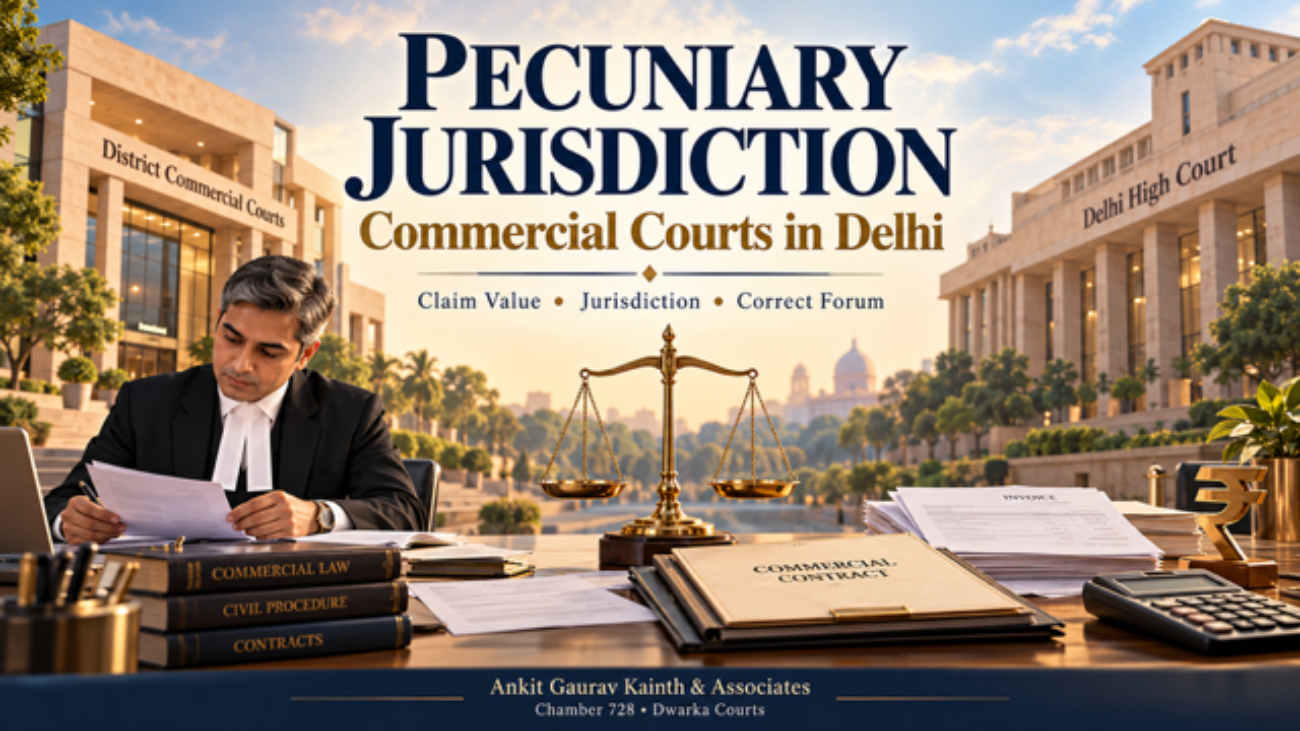
Which court should hear your commercial recovery claim in Delhi? This guide explains the monetary thresholds, pre-filing interest, valuation requirements and territorial checks before choosing a district Commercial Court or the Delhi High Court.

Introduction – First legal consultation in Dwarka Court
A first legal consultation is your opportunity to explain the dispute, have the available papers reviewed and understand the next steps. Whether the concern involves unpaid money, a cheque bounce notice, a property dispute, a matrimonial matter or a police notice, preparation helps your advocate assess the situation more accurately.
For your first legal consultation in Dwarka Court, bring a short chronology, relevant documents, notices, existing court orders and a written list of questions. If a deadline or hearing is approaching, mention it when arranging the appointment.
You do not need to arrive with a complete understanding of the law. Your preparation should help explain what happened, what records are available and what needs attention.
First Consultation Quick Checklist
✓ One-page chronology of events
✓ Important agreements/notices/orders
✓ FIR or police notice, if applicable
✓ Payment and bank records
✓ Case/CNR number for existing proceedings
✓ Latest court order
✓ Relevant WhatsApp/email records
✓ List of questions
✓ Any approaching deadline/hearing
✓ Identification/details of all parties
Practical observation from litigation practice:
In first consultations, the most useful file is not necessarily the largest one. A short chronology together with the latest order, relevant notice, agreement and a few key communications often helps identify the immediate issue faster than an unsorted bundle of documents. Once the principal issue is understood, the remaining record can be examined systematically.
1. Prepare a Short Chronology of Events
Write a one- or two-page account in date order. Identify:
Separate facts you personally know from information received from someone else. Mark uncertain dates as approximate.
For example, in a payment dispute, record when the agreement was made, when goods or services were supplied, when payment became due and what reminders or replies followed. Match each important event to a supporting document where available.
A clear chronology helps your advocate ask focused questions and identify gaps in the record.
2. Organise the Relevant Documents
Bring readable copies and keep originals available for inspection where appropriate. Arrange papers by date and add a simple index if the file is large.
| Type of matter | Documents to organise for consultation |
| Civil or money recovery | Agreement, payment proof, bank entries, correspondence, notices and details of the amount claimed |
| Commercial dispute | Contract, purchase orders, invoices, delivery or service records, ledger, payment records and relevant emails |
| Cheque bounce | Cheque or available copy, return memo, notice, service records, transaction documents and court papers if proceedings have started |
| Criminal or bail matter | FIR if available, police notice, complaint, relevant orders, previous applications and documents explaining your role |
| Matrimonial or maintenance | Marriage-related records, existing petitions and orders, relevant income and expense records, and documents concerning children |
| Property dispute | Available title documents, agreements, site plan, possession records, photographs and relevant notices or orders |
This is a preparation guide, not a mandatory filing checklist. The documents needed depend on the facts and stage of the matter. Bring what is available and identify anything missing.
If originals are handed over for retention, record which documents were supplied and obtain an acknowledgment.
3. Bring the Complete Record of Any Pending Case
For an existing case, keep the following ready:
Mention connected proceedings, previous applications, settlements, undertakings and any order against you. A recent order may make sense only when read with the earlier record.
When seeking a second opinion, include the papers already filed and explain the current procedural stage.
4. Flag Urgency When Booking the Appointment
Tell the office immediately if you have an approaching hearing, a notice requiring a response or appearance, a recent adverse order, an arrest-related concern or threatened dispossession.
Share the relevant notice or order, its date and when you received it.
Do not wait for a perfectly organised file before seeking advice about an urgent issue.
Do not assume that booking a consultation, sending documents or discussing a settlement extends a legal deadline.
5. Preserve Digital Records Carefully
Keep original emails, messages, attachments, payment records, photographs and recordings in their existing form. Preserve the device or account holding the original material where possible.
Screenshots may help explain the situation, but should not be the only version retained when fuller records are available. Keep surrounding messages so the context is clear.
Do not edit, delete, fabricate or selectively alter material. Ask your advocate what further preservation or formal documentation may be needed.
Share sensitive records through the channel agreed with the office.
6. Explain What You Want to Achieve
Your objective may be:
Explain the practical priorities as well: urgency, budget, business disruption, family circumstances and your willingness to consider settlement.
The consultation can then examine whether the desired outcome is supported by the available facts and what further information is needed.
7. Share the Complete Facts
Disclose earlier disputes, unfavourable messages, payments received, documents you signed, previous settlements and connected cases.
An assessment based on incomplete facts can change substantially when the other side produces missing material.
If you do not remember something, say so instead of guessing. Let your advocate distinguish between facts, assumptions and allegations.
8. Questions to Ask During the Consultation
A written list helps you remember what matters most.
| Question | What it helps clarify |
| What are the main issues in my matter? | The legal and factual concerns requiring attention |
| Which documents or facts are missing? | What you should collect next |
| Is any immediate step or deadline involved? | The urgency of the situation |
| What options should be considered? | The possible courses of action |
| Which court or authority may be appropriate? | Where the matter may need to proceed |
| What weaknesses or difficulties should I understand? | The limitations of the available case |
| Is a negotiated resolution worth exploring? | Whether settlement deserves consideration |
| What work would the proposed fee cover? | The scope of the engagement |
| Who will coordinate documents and updates? | The communication arrangements |
| What should I do after this meeting? | Your immediate responsibilities |
Ask for explanations in language you understand. A consultation should help you make an informed decision; it cannot establish the outcome of a future court proceeding.
9. Clarify Fees and the Scope of Work
Before the appointment, confirm the consultation charge, duration, payment arrangements and whether advance document review is included.
If further work is proposed, clarify whether the quotation covers drafting, filing, hearings, applications or other stages. Ask about court fees and other expenses separately.
Do not assume that paying for a consultation includes drafting a reply, filing proceedings or appearance at the next hearing.
Confirm the agreed work and fee terms in writing.
10. What to Expect from the First Meeting
Depending on the available material, the first meeting may identify the central issue, gaps in documentation, urgency and possible next steps.
Some matters require detailed reading, legal research or additional records before a considered opinion can be given. Confirm whether a written opinion is included or would be a separate assignment.
Before leaving, note:
Preparing for an Online or Telephone Consultation
For a remote consultation, send clearly named, readable files through the agreed channel. Put the chronology and any urgent notice or order first.
Check the appointment time, internet connection and privacy of your surroundings. Keep the documents open during the discussion.
Confirm whether an in-person meeting or inspection of originals may be needed later.
Common Preparation Mistakes
Avoid bringing an unsorted bundle without the latest order, sending cropped photographs of important documents, concealing adverse facts or relying entirely on memory for dates.
Do not assume that a similar case has the same remedy, cost or outcome. Explain your own facts and let the advice follow the record.
What to Avoid Before Your Legal Consultation
Before your consultation, avoid:
| Before Filing a Case | Commercial Disputes | Cheque Bounce | Bail Matters | Property Disputes | Contact & Appointment |
|---|---|---|---|---|---|
|
Questions Before Filing a Case
Understand the issues to consider before starting litigation. |
Commercial Court Disputes
Read about business contracts and recovery disputes. |
Cheque Bounce Case Guide
Understand notices, transaction papers and case stages. |
Bail Matters in Dwarka Court
Read about police papers and bail-related assessment. |
Property Dispute Guide
Understand the relevance of title, possession and property records. |
Consultation Arrangements
Confirm your appointment, meeting location and documents required. |
Frequently Asked Questions
Can I consult an advocate before receiving a legal notice?
Yes. You can seek advice about an existing concern before a notice or case arrives. The consultation may help identify documents to preserve and matters needing further assessment.
Can I attend if some documents are missing?
Yes. Bring what you have and list the missing records. Initial guidance may be possible, although a fuller assessment may need more documents.
Should I bring originals or photocopies?
Bring readable copies and keep originals available for inspection where appropriate. If originals are retained, obtain an acknowledgment identifying them.
Can a family member attend on my behalf?
A family member can help explain the background and arrange documents. The advocate may still need to speak directly with the person concerned and clarify authority to receive instructions or share information.
How long does a first consultation take?
It depends on the complexity of the matter and the volume of documents. Confirm the appointment duration and fee beforehand.
Will consultation automatically include court representation?
Confirm the engagement terms. Consultation, drafting, filing and court appearances may be separate assignments.
Should I wait until all papers are collected?
If there is urgency, seek advice with the available papers and identify what is missing. Do not postpone raising an approaching deadline merely to complete the file.
Can an advocate promise the result at the first meeting?
A responsible assessment discusses the available material, options and uncertainties. Court outcomes depend on the evidence, applicable law and judicial determination.
Can I send documents before the legal consultation?
Answer briefly that documents can be shared through the channel agreed with the office and urgent orders/notices should be identified first.
What should I send first if I have hundreds of pages?
Answer: chronology, latest order, pleading initiating the matter, relevant notice/FIR/agreement and the documents directly connected with the immediate issue.
Consultation Details
Ankit Gaurav Kainth & Associates
Chamber No. 728, 7th Floor, District Court Dwarka, Sector-10, New Delhi.
For appointment arrangements, use the Contact Us page. Confirm the meeting location, consultation fee and documents to share beforehand. Mention any urgent hearing or notice when making the appointment.
Contact numbers: 9899085554, 9811885554
Disclaimer: This article provides general information about preparing for a legal consultation. It is not a case-specific legal opinion. The appropriate advice depends on the facts, documents and applicable law.
Published: 5 October 2026 | Last reviewed: 5 October 2026
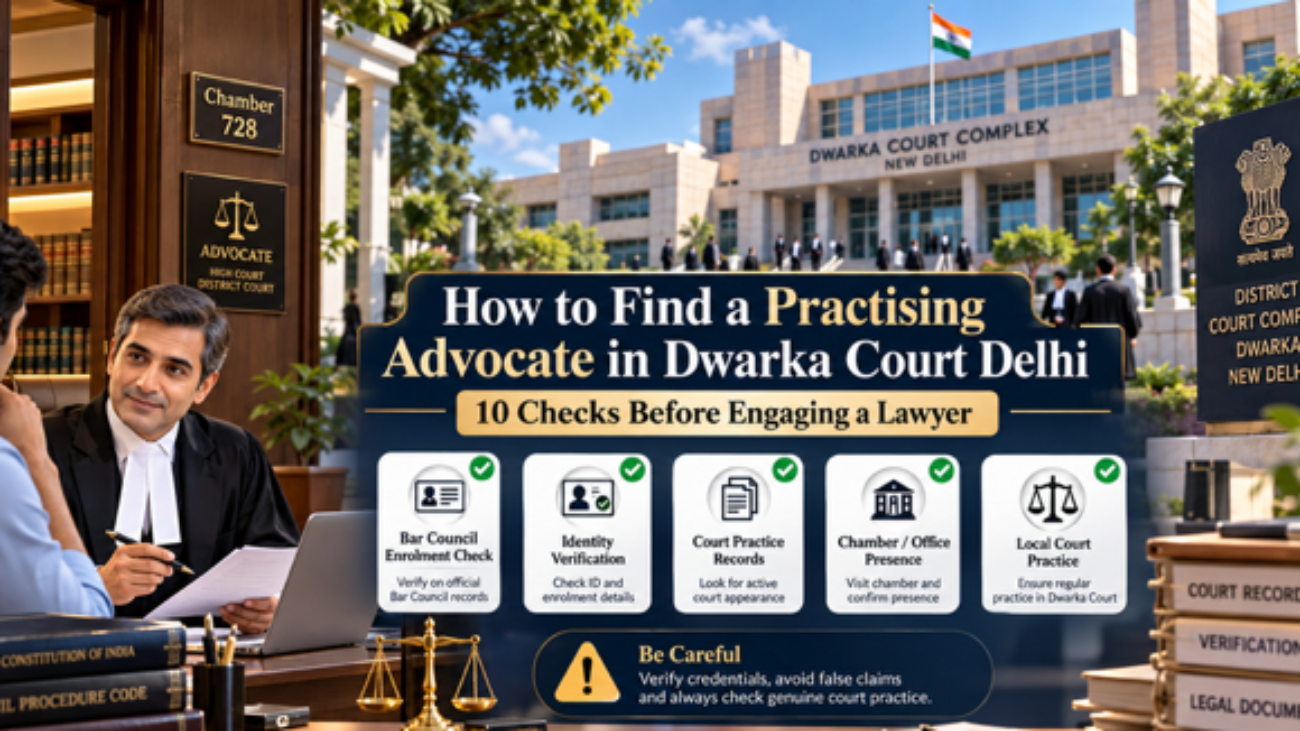
Introduction – Practising Advocate in Dwarka Court Delhi
Searching online for an advocate in Dwarka Court is easy.
Verifying whether the person you find actually practises law and has a genuine professional connection with Dwarka Courts requires a little more care.
A search for terms such as “Advocate in Dwarka Court”, “Lawyer Near Dwarka Court” or even “Best Advocate in Dwarka Court Delhi” can produce websites, advertisements, directory listings, social-media profiles and business listings.
However, appearing prominently on Google is not the same thing as having an established litigation practice before Dwarka Courts.
A prospective client should therefore look beyond rankings, photographs, reviews and promotional claims.
The more useful questions are:
Is the person enrolled as an advocate?
Can the enrolment details be independently verified?
Does the advocate actually practise before Dwarka Courts?
Is there evidence of an established professional presence in the court?
Can the advocate explain the court, jurisdiction and procedure relevant to my case?
This practical guide explains 10 checks a client can make before engaging an advocate in Dwarka Court, Delhi.
1. Start With the Most Important Check – Bar Council Enrolment
The first question should not be:
“How many Google reviews does the advocate have?”
It should be:
“What is the advocate’s Bar Council enrolment number?”
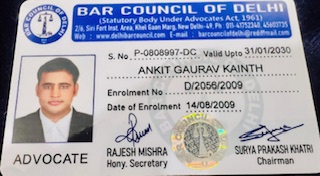
An advocate enrolled with the Bar Council of Delhi ordinarily has an enrolment number that can be checked through the Bar Council’s official records.
The Bar Council of Delhi presently provides an online Enrolment Status facility through which enrolment details can be searched using the enrolment number and year.
This is substantially more meaningful than relying only on:
These things may form part of an advocate’s online presence, but they are not substitutes for professional enrolment.
Practical client question
Before paying substantial professional fees, ask:
“May I have your Bar Council enrolment number for my records?”
A client can then independently verify the information through the appropriate official source.
2. Understand the Difference Between Bar Council Enrolment and Bar Association Membership
This distinction is extremely important.
The Bar Council of Delhi and the Dwarka Court Bar Association do not perform the same function.
Bar Council enrolment concerns the advocate’s professional enrolment.
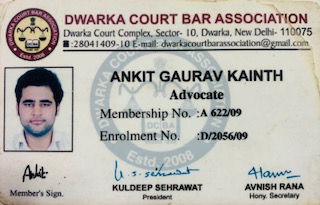
The Dwarka Court Bar Association is a local association connected with advocates practising at the Dwarka Courts Complex.
Therefore, a person should not be described as an unauthorised advocate merely because he or she is not a member of a particular local Bar Association.
At the same time, where somebody represents that they have an established and regular Dwarka Court practice, membership or registration with the local Bar Association can be a useful additional indicator of their professional connection with that court.
Official Dwarka Court material itself distinguishes between a BCD enrolment number and a DCBA registration number.
Clients should therefore understand the difference:
Bar Council enrolment → professional enrolment
Local Bar Association membership → evidence of association with a particular court Bar
The second should not be mistaken for the first.
3. Ask Whether AIBE / Certificate of Practice Requirements Apply
Clients sometimes hear expressions such as:
“Certificate of Practice”
“AIBE certificate”
“Bar Council licence”
and assume that they all mean exactly the same thing.
They do not.
The All India Bar Examination framework and Certificate of Practice requirements apply according to the applicable Bar Council of India rules and the advocate’s enrolment circumstances.
The Bar Council of Delhi presently also provides an online AIBE-data search showing whether its records reflect the relevant AIBE status.
Therefore, where applicable, a client may ask the advocate about:
Bar Council enrolment + AIBE status + Certificate of Practice requirements.
At the same time, a client should not assume that a particular AIBE entry is required in exactly the same manner for every advocate irrespective of when and under what regime the advocate was enrolled.
Verification should be based on the rules applicable to that advocate.
4. Does the Advocate Actually Practise in Dwarka Court?
This is a different question from enrolment.
An advocate may be legally enrolled but primarily practise somewhere else.
There is nothing improper about an advocate appearing in different courts.
However, if a professional profile specifically represents the person as an established Dwarka Court advocate, a client may reasonably ask about the advocate’s regular practice there.
Useful questions include:
Which types of matters do you regularly handle in Dwarka Courts?
Where is your chamber or regular meeting place?
Do you regularly appear before the Civil, Criminal, Family, Commercial or NI Act Courts here?
Can you explain where my type of case is ordinarily dealt with?
Someone who regularly litigates before a particular court will generally understand its working environment, filing process, court structure and procedural requirements.
5. Check for a Genuine Professional Presence at Dwarka Court
Dwarka Courts Complex is situated at Sector 10, Dwarka, New Delhi and serves, among other matters, cases connected with the South-West District and IGI Airport jurisdiction.
A litigant searching specifically for a lawyer established at Dwarka Court can ask where the advocate normally works from.
Evidence of an established local professional presence may include:
However, one important qualification is necessary:
Having a chamber is not compulsory proof of being a genuine advocate.
Not every practising advocate has an allotted court chamber.
Therefore:
No chamber ≠ fake advocate.
But where someone specifically represents that they have a long-established practice inside Dwarka Court, asking for the location of that professional establishment is perfectly reasonable.
6. Ask for the DCBA Registration Details Where Local Membership Is Claimed
Dwarka Court has its own recognised Bar Association.
Official court material records the Dwarka Court Bar Association, and its office is situated in the Lawyers Chamber Block at the court complex.
Where an advocate claims to be a member of the Dwarka Court Bar Association, the prospective client can ask for the relevant membership or registration details.
This is especially useful where a website or profile repeatedly represents the person as:
“Dwarka Court Advocate”
“Practising in Dwarka Court”
or
“Based at Dwarka Courts.”
Again, this requires an important distinction:
DCBA membership should be treated as supporting evidence of local professional association—not as the sole legal test of whether a person is entitled to practise law.
7. Look for Evidence of Actual Court Work—Not Merely Online Marketing
An attractive website can be created quickly.
An Instagram page can be created in minutes.
Hundreds of articles can now be produced with digital tools.
Actual litigation practice leaves a different professional footprint.
Depending upon the case and availability of public records, a client may find an advocate’s name appearing in:
Delhi District Courts and the eCourts system provide considerable public case information.
No single order proves the scale or quality of someone’s practice.
Likewise, absence from a simple internet search does not prove that an advocate is not practising.
But a consistent court record can provide stronger evidence of actual litigation activity than marketing claims alone.
8. Ask the Advocate to Explain Your Case Before Discussing Promises
A useful test of professional experience is surprisingly simple:
Ask the advocate to explain the legal process.
For example, if the dispute concerns property, ask:
Which court has jurisdiction?
Do I require injunction, possession, declaration, partition or another remedy?
For a criminal matter:
Is anticipatory bail, regular bail, quashing, discharge or trial defence presently relevant?
For a cheque-bounce case:
Are we at notice, summoning, appearance, Section 145(2), evidence, arguments or appeal stage?
For a commercial recovery dispute:
Does the Commercial Courts Act apply? Is pre-institution mediation relevant? What documents need disclosure?
A genuine practising lawyer should be able to explain:
facts → jurisdiction → legal remedy → documents → procedure → possible risks → next step.
That is considerably more valuable than hearing:
“Don’t worry, I will win the case.”
No responsible advocate can guarantee what a court will ultimately decide.
9. Treat “Best Advocate” Rankings, Reviews and Social Media as Secondary Information
Online information is useful.
Clients routinely use:
to discover advocates.
There is nothing inherently wrong with that.
The problem arises when online visibility is treated as professional verification.
A high-ranking website does not establish Bar Council enrolment.
A five-star review does not prove regular appearances before a particular court.
A photograph outside a court building does not establish an office or chamber there.
A social-media following does not establish litigation experience.
Therefore, use online information as the starting point—not the final verification test.
A sensible verification sequence is:
Online Search
↓
Advocate’s Full Name
↓
Bar Council Enrolment
↓
Applicable AIBE/COP Status
↓
Actual Area of Practice
↓
Dwarka Court Connection
↓
Court Record / Local Presence
↓
Consultation
↓
Fee & Scope of Engagement

10. Insist on Professional Transparency About Fees and Case Handling
Before formally engaging an advocate, clients should understand who will handle the matter and how professional fees will operate.
Ask:
Who will primarily handle my case?
Who will appear on the next date?
What work is included in the professional fee?
Are drafting, filing and hearings charged separately?
Will additional applications involve additional fees?
How will I receive court orders and information about the next date?
Where appropriate, obtain the fee understanding in writing and retain receipts or payment records.
Clients should also maintain their own copies of:
Professional transparency is often a much better indicator than advertising language.
Red Flags Clients Should Not Ignore
No single factor automatically establishes misconduct or lack of professional status.
However, additional verification may be sensible where somebody:
refuses to disclose an enrolment number;
provides professional details that cannot be independently matched;
claims to have a chamber but refuses to identify it;
claims long-established Dwarka Court practice but cannot clearly explain the relevant court procedure;
uses different professional names across different platforms without explanation;
pressures the client to immediately transfer substantial money without explaining the scope of work;
makes guaranteed-result claims;
claims special personal influence over judges, police officers or court staff;
or discourages the client from independently checking court and professional records.
The correct response to doubt is not accusation.
It is independent verification.
Is Delhi Bar Association Membership Necessary for a Dwarka Court Advocate?
This is another common source of confusion.
Delhi has different Bar Associations connected with different court complexes.
For example, the Delhi Bar Association is associated with Tis Hazari Courts, while Dwarka has the Dwarka Court Bar Association.
Accordingly, a client should not ask:
“Are you a member of Delhi Bar Association?”
as though this were a universal licensing requirement for every practising advocate in Delhi.
A more accurate question is:
“Where are you enrolled, and which local Bar Association or court do you ordinarily practise with?”
The regulator and the local professional association should not be confused.
Can You Verify an Advocate Through Google Reviews?
Reviews can help a client understand other people’s reported experiences.
They may provide information about:
communication;
accessibility;
professional manner;
responsiveness; or
the kind of cases a lawyer handles.
But reviews cannot independently prove professional enrolment or regular court practice.
Therefore:
Reviews should supplement verification—not replace it.
Does a Dwarka Court Chamber Prove Someone Is a Practising Advocate?
An established chamber inside the court complex is useful evidence of professional presence, particularly when combined with Bar Council enrolment and local court practice.
However, chamber allotment is not the statutory test of whether someone is an advocate.
A genuine advocate may practise without an allotted chamber.
The better approach is to consider several pieces of information together:
Enrolment + professional identity + local practice + court activity + office/chamber + consultation quality + transparent engagement.
Why Local Court Practice Can Matter
Different courts operate under the same substantive and procedural laws, but regular litigation before a particular court gives an advocate familiarity with practical matters such as:
filing;
scrutiny;
listing;
court locations;
certified copies;
administrative branches;
video-conferencing arrangements;
record inspection;
mediation;
process service; and
day-to-day procedural requirements.
Local familiarity should never be portrayed as special access or influence.
Its legitimate value is procedural familiarity and accessibility.
That distinction is important.
10-Point Checklist Before Engaging an Advocate in Dwarka Court
Before finalising your advocate, check:
1. Full professional name
2. Bar Council enrolment number
3. Enrolment status through an official source
4. AIBE / Certificate of Practice position where applicable
5. Actual areas of litigation practice
6. Regular connection with Dwarka Courts
7. DCBA membership details if local membership is claimed
8. Chamber, office or other professional establishment
9. Evidence of genuine court practice where reasonably available
10. Clear consultation, fee structure and case-handling process
None of these factors should be considered in isolation.
Together, however, they can help a litigant make a substantially better-informed decision.
| Supporting Page / Blog | Suggested Anchor Text | Where to Place the Link | Search Intent | Why It Supports This Article | Internal Link |
|---|---|---|---|---|---|
| Advocate Near Dwarka Court | Advocate Near Dwarka Court | Section: Does the Advocate Actually Practise in Dwarka Court? | Local / Commercial | Connects the verification guide with your principal local-practice service page. | Read Page |
| Before Filing a Case in Dwarka Court Delhi | questions to consider before filing a case in Dwarka Court | Section: Ask the Advocate to Explain Your Case | Informational | Moves clients from advocate verification to jurisdiction, limitation, evidence and case preparation. | Read Guide |
| Criminal Defence Lawyer in Dwarka | criminal defence practice in Dwarka Court | Example concerning bail, FIR, discharge and criminal trial | Service / Criminal | Supports the point that clients should verify relevant subject-matter experience. | Read Page |
| Property Lawyer in Dwarka Court | property litigation in Dwarka Court | Example concerning injunction, possession, declaration and partition | Service / Property | Demonstrates why selecting an advocate with relevant litigation practice matters. | Read Page |
| Cheque Bounce Lawyer Dwarka Court | Section 138 NI Act practice in Dwarka Court | Example concerning cheque-bounce procedure | Service / NI Act | Supports your discussion about checking whether the advocate regularly handles the relevant case category. | Read Page |
| Traffic Challan Cases in Dwarka Court | traffic challan proceedings in Dwarka Court | Section discussing actual local court procedure | Informational / Service | Adds another concrete example of court-specific procedure and local litigation practice. | Read Page |
Frequently Asked Questions
How can I check whether somebody is enrolled as an advocate in Delhi?
The Bar Council of Delhi provides an online facility for searching enrolment information using the advocate’s enrolment number and year.
Is Dwarka Court Bar Association registration compulsory to appear in Dwarka Court?
Local Bar Association membership and professional Bar Council enrolment are different matters. DCBA membership can provide useful evidence of association with the local Bar, but it should not be represented as the sole statutory requirement for appearing before Dwarka Courts.
Should I ask an advocate for his or her enrolment number?
Yes. There is nothing unreasonable about a client asking for professional identification before establishing a professional relationship.
Is having a chamber in Dwarka Court compulsory?
No. A chamber can demonstrate an established professional presence, but not every genuine practising advocate has an allotted chamber.
Can I check whether a lawyer regularly appears in court?
Depending upon the matter and availability of public information, judicial orders, eCourts records and other court documents may provide useful information about appearances.
Should I choose a lawyer merely because Google shows the lawyer first?
No. Search position can help you discover a professional, but it should not replace verification of enrolment, experience, relevant practice and professional identity.
Is the lawyer with the highest number of reviews necessarily the most appropriate lawyer for my matter?
Not necessarily.
A client’s requirements depend upon the nature of the case.
A lawyer handling criminal bail every day may not be the appropriate choice for a complicated commercial dispute, just as a matrimonial lawyer may not necessarily conduct cheque-bounce appeals regularly.
Look for relevant practice, not merely visibility.
Final Takeaway
Finding an advocate online has become easier.
Verifying the advocate remains the client’s responsibility.
Do not select an advocate merely because a profile repeatedly uses expressions such as:
“Best Advocate in Dwarka Court”
“Top Lawyer in Delhi”
or
“No. 1 Advocate.”
Instead, verify what can actually be verified.
Start with:
Bar Council enrolment.
Then examine:
applicable AIBE/COP position → relevant practice → Dwarka Court connection → Bar Association association → professional establishment → court work → consultation quality → fee transparency.
A professional legal practice should be capable of standing on verifiable credentials, actual litigation work and transparent client communication—not merely advertising claims.
About the Practice
Ankit Gaurav Kainth & Associates is a litigation practice based at Dwarka Courts, Sector-10, New Delhi.
The practice handles civil, criminal, matrimonial, property, cheque-bounce, commercial and connected litigation before Dwarka Courts and other courts in Delhi.
Clients seeking representation may independently verify professional credentials and discuss the nature, jurisdiction and procedural requirements of their matter during consultation.
Professional verification should always come before professional engagement.
Disclaimer
This article is intended for general legal awareness and client education. It does not allege that any particular advocate, website, profile or legal-service provider is unauthorised or engaged in misconduct. Bar Council enrolment, AIBE/Certificate of Practice requirements and Bar Association membership are distinct matters and should be verified through the relevant official authority. Local Bar Association membership or possession of a chamber should not, by itself, be treated as the legal test of entitlement to practise. The article does not constitute legal advice or guarantee any legal outcome.
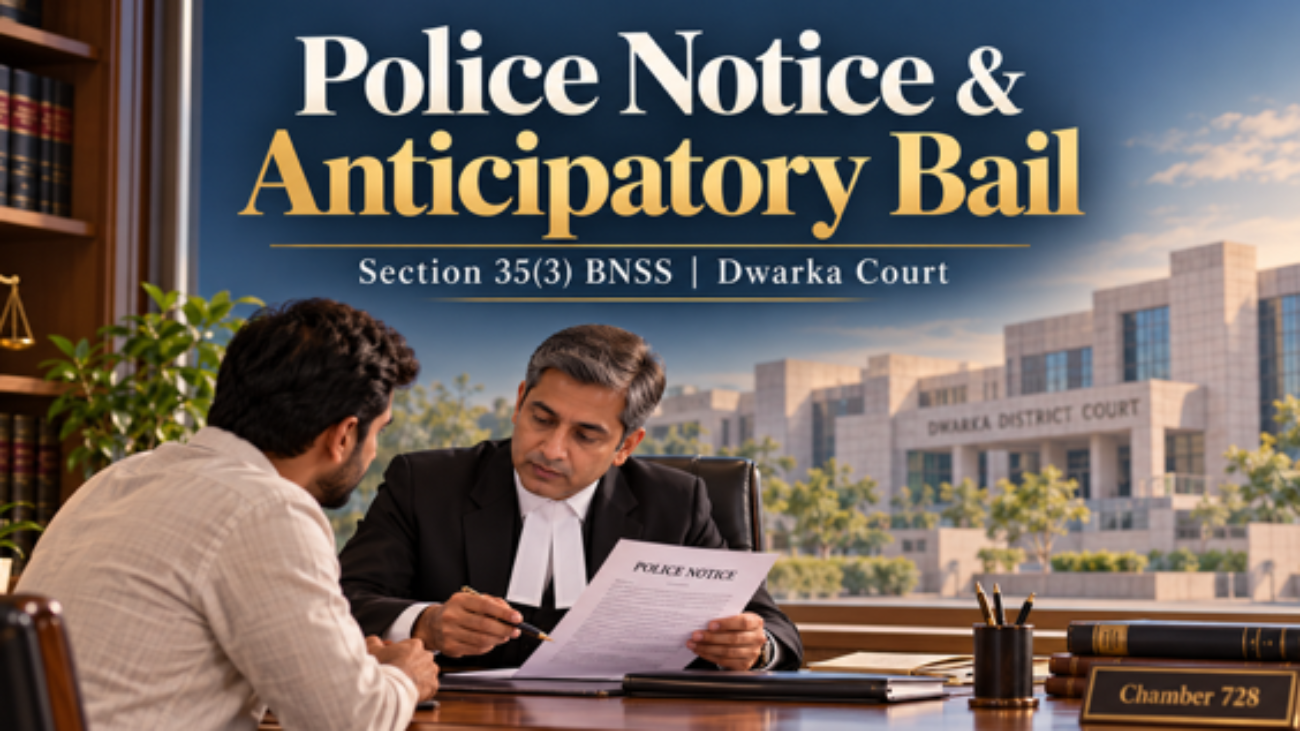
Anticipatory Bail After Section 35(3) BNSS Notice – Explained
Receiving a police notice under Section 35(3) of the Bharatiya Nagarik Suraksha Sanhita, 2023 (BNSS) can create an immediate question:
“If the police have issued me a notice instead of arresting me, do I still need anticipatory bail?”
The answer is not the same in every case.
A Section 35(3) BNSS notice generally indicates that the Investigating Officer is presently requiring you to appear and cooperate with the investigation rather than immediately arresting you. However, the notice should neither be treated as an arrest warrant nor as a permanent guarantee that arrest can never take place.
The correct approach is to examine:
Where such apprehension exists in relation to a non-bailable offence, an application for anticipatory bail may be considered under Section 482 BNSS before the competent Court of Session or High Court.
This article explains the practical relationship between a Section 35(3) BNSS police notice and anticipatory bail in Dwarka Court.
What Is a Notice Under Section 35(3) BNSS?
Section 35 BNSS deals with circumstances in which the police may arrest a person without warrant.
Under Section 35(3) BNSS, where arrest is not required under Section 35(1), the police officer is required to issue a notice directing the concerned person to appear before the officer or at another specified place.
In practical terms, the notice may require you to:
The important point is:
A Section 35(3) BNSS notice is a notice to appear and cooperate. It is not itself an order of arrest.
The Supreme Court has clarified in the context of offences punishable with imprisonment up to seven years that issuance of notice under Section 35(3) is the rule, whereas arrest should operate as an exception based upon statutory necessity.
Section 35(3) BNSS Has Replaced the Earlier Section 41A CrPC Framework
Persons familiar with the earlier Code of Criminal Procedure may remember a Section 41A CrPC notice.
Under the present BNSS framework, the corresponding arrest-and-appearance provisions are contained in Section 35 BNSS.
Therefore, in criminal matters governed by the BNSS, lawyers, accused persons and investigating agencies should ordinarily refer to Section 35(3) BNSS, rather than continuing to describe every police appearance notice as a “41A notice”.
Older cases and proceedings may, however, continue to refer to Section 41A CrPC depending upon their applicable procedural regime.
What Has the Supreme Court Said About Section 35(3) BNSS?
The law regarding arrest has developed considerably around the principle that:
The existence of a power to arrest does not mean that arrest must automatically follow.
In Satender Kumar Antil v. Central Bureau of Investigation, the Supreme Court, while examining Section 35 BNSS, reiterated important safeguards concerning offences punishable with imprisonment up to seven years.
Broadly stated, the Court explained that:
The Supreme Court’s 2026 consideration of the provision further reinforces the distinction between investigation and unnecessary arrest.
Does Receiving a Section 35(3) Notice Mean You Cannot Be Arrested?
No.
This is one of the most important distinctions to understand.
Receiving a Section 35(3) notice substantially affects the legal position, particularly where the recipient properly complies with it, but it should not be interpreted as an unconditional or permanent guarantee against arrest.
Section 35 must be read as a whole.
Broadly:
Section 35(4)
A person receiving the notice is required to comply with its terms.
Section 35(5)
Where the person complies and continues to comply with the notice, arrest in respect of the offence referred to in the notice is restricted, unless the police officer records reasons and forms the opinion that arrest is necessary.
Section 35(6)
Where a person fails to comply with the notice or is unwilling to identify himself, the police may consider arrest subject to the statutory requirements.
Therefore:
Compliance is extremely important, but the existence of the notice is not an absolute immunity from arrest.
What Is Anticipatory Bail Under Section 482 BNSS?
Anticipatory bail is a pre-arrest legal remedy.
Section 482 BNSS enables a person who has reason to believe that he or she may be arrested on accusation of having committed a non-bailable offence to approach the High Court or Court of Session seeking a direction that, in the event of arrest, the person be released on bail.
Anticipatory bail therefore operates differently from regular bail.
Anticipatory Bail
Sought before arrest where a genuine apprehension of arrest exists.
Regular Bail
Ordinarily sought after arrest or custody.
The purpose of anticipatory bail is not to prevent investigation. A court granting anticipatory bail may impose conditions requiring the applicant to:
Do You Automatically Need Anticipatory Bail After Receiving a Section 35(3) Notice?
No.
Filing anticipatory bail mechanically after every Section 35(3) notice may be unnecessary.
The question should instead be:
Is there a genuine and reasonable apprehension that the investigating agency may arrest me despite the notice or because circumstances have subsequently changed?
If the notice has been issued, you have been cooperating, the offences fall within the statutory framework governing notice, and there is nothing indicating an intention to arrest, immediate anticipatory bail may not necessarily be required.
However, certain developments can materially increase the risk of arrest.
When Should You Seriously Consider Anticipatory Bail After a Section 35(3) BNSS Notice?
1. When the Police Indicate That Arrest May Follow
If during communication with the Investigating Officer you are expressly informed, or surrounding circumstances reasonably indicate, that arrest is being contemplated, immediate legal assessment becomes important.
Anticipatory bail should not be based on imaginary fear.
But a specific, credible and reasonable apprehension of arrest is legally relevant.
2. When a Co-Accused Has Already Been Arrested
Suppose several persons are named in an FIR.
You receive a Section 35(3) notice, while another accused facing similar allegations is arrested after joining investigation.
This development may materially alter the risk assessment.
A lawyer should compare:
The arrest of another accused does not automatically entitle you to anticipatory bail, but it may help demonstrate that your apprehension of arrest is not merely speculative.
3. When Police Allege That You Are Not Cooperating
One of the most common grounds advanced against an accused is alleged non-cooperation.
For example, the Investigating Officer may allege that you:
Such allegations should be addressed carefully.
Maintain records of your attendance and communications wherever possible.
If you appeared whenever required, preserve material showing:
A vague allegation of non-cooperation should be distinguished from genuine refusal to participate in investigation.
4. When Custodial Interrogation Is Being Claimed
The prosecution may oppose anticipatory bail on the ground that custodial interrogation is necessary.
This frequently arises where allegations concern:
The defence must address why custody is or is not genuinely required.
Merely writing that the applicant is innocent is usually insufficient.
A properly prepared anticipatory bail application should address the prosecution’s likely case on custodial interrogation.
5. When You Missed an Earlier Section 35(3) Notice
Ignoring a police notice is usually a poor strategy.
If you have missed a date for genuine reasons, such as:
communicate promptly and preserve proof.
Repeated unexplained failure to join investigation may be relied upon by the prosecution to argue that the accused is avoiding investigation.
If several notices have already been issued and not complied with, obtain legal advice urgently before the next step.
6. When the FIR Contains Non-Bailable Offences and Arrest Appears Imminent
Anticipatory bail principally concerns apprehended arrest in relation to a non-bailable offence.
Therefore, before filing an application, examine:
The wording of the police notice alone cannot decide whether anticipatory bail is required.
The complete FIR and statutory provisions must be examined.
7. When Police Seek Recovery From You
Allegations concerning recovery can substantially influence a bail hearing.
For example:
The prosecution may argue that custody is necessary to make the recovery.
The applicant may respond, depending upon the facts, by demonstrating that:
Every case is fact-specific.
Example: Section 35(3) Notice in a Cheating or Business Dispute
Consider a complaint arising from a failed business transaction.
An FIR alleges cheating. A director, employee or business associate receives a Section 35(3) notice.
Before deciding whether anticipatory bail should be filed, examine:
This is why a bail strategy should be built around documents and the specific role of the accused, rather than generic claims that the FIR is false.
Can Police Arrest You When You Appear Pursuant to a Section 35(3) Notice?
The legal framework does not permit the notice mechanism to be treated casually.
For offences within the statutory category, the Supreme Court has emphasized that notice is the rule and arrest is an exception.
Where the recipient appears and continues to comply with the notice, Section 35(5) assumes particular importance.
However, depending upon the facts, arrest may still be considered if the Investigating Officer forms the legally required opinion and records reasons supporting the necessity of arrest.
Therefore, before appearing, particularly where circumstances suggest a genuine arrest risk, obtain a case-specific legal assessment.
Can Anticipatory Bail Be Filed Even After You Have Joined Investigation?
Yes, where the legal requirements for anticipatory bail are otherwise satisfied.
Joining investigation does not extinguish the possibility of seeking anticipatory bail.
In fact, cooperation may sometimes become an important circumstance for the Court to examine.
An applicant may demonstrate:
However, joining investigation does not create an automatic entitlement to anticipatory bail.
Can You Seek Interim Protection While the Anticipatory Bail Application Is Pending?
Depending upon the facts and circumstances, an applicant may request interim protection from arrest while the anticipatory bail application is being considered.
Whether interim protection is granted depends upon the judicial assessment of the case.
The Court may direct the applicant to:
An interim order should never be treated as final anticipatory bail unless the order itself says so.
What Will the Dwarka Court Consider in an Anticipatory Bail Application?
No single formula decides anticipatory bail.
Depending upon the case, the Court may consider:
Nature and Gravity of Allegations
A serious allegation may require closer scrutiny, though seriousness alone does not determine every bail application.
Specific Role of the Applicant
A bail application should distinguish the applicant’s actual role from broad allegations against multiple persons.
Need for Custodial Interrogation
The prosecution may be required to explain what investigative purpose requires custody.
Cooperation With Investigation
Attendance pursuant to Section 35(3) notices may become relevant.
Possibility of Absconding
Permanent residence, employment, family ties and conduct may be considered.
Possibility of Influencing Witnesses
The Court may impose conditions preventing contact with witnesses.
Documentary Evidence
Agreements, messages, emails, bank statements and other contemporaneous documents can materially affect the bail assessment.
Criminal Antecedents
Previous criminal involvement, where relevant, may be considered.
Conduct of the Parties
Events before and after registration of the FIR can become relevant.
Documents to Collect Before Filing Anticipatory Bail
If you have received a police notice and apprehend arrest, keep the following material ready where applicable:
Do not fabricate, alter or retrospectively create evidence.
Preserve original electronic records.
Should You Carry Your Documents to the Police Station?
Do not take an unorganised bundle of documents and attempt to explain the entire defence orally.
First identify:
Particularly in financial, business, cyber and property-related cases, a properly indexed documentary record may be more useful than an unstructured oral explanation.
What Should You Not Do After Receiving a Section 35(3) Notice?
Avoid these common mistakes:
Do Not Ignore the Notice
Failure to attend without justification may create complications.
Do Not Delete WhatsApp Chats or Emails
Deletion may create evidentiary problems and allegations of destruction or manipulation of evidence.
Do Not Threaten the Complainant
Do not call the complainant or witnesses attempting to pressure them.
Do Not Fabricate Documents
A false document can create problems substantially worse than the original allegation.
Do Not Sign Something Without Reading It
Read any statement, acknowledgement or document before signing.
Do Not Assume the Notice Gives Permanent Protection
Circumstances can change during investigation.
Do Not File Anticipatory Bail Merely as a Ritual
There should ordinarily be a genuine apprehension of arrest and a properly developed factual and legal basis.
Section 35(3) Notice vs Anticipatory Bail: Understanding the Difference
| Section 35(3) BNSS Notice | Anticipatory Bail under Section 482 BNSS |
| Issued by investigating police | Granted by Court |
| Requires appearance/cooperation | Protects against arrest subject to bail order |
| Part of investigation procedure | Judicial pre-arrest remedy |
| Does not determine guilt | Does not determine guilt |
| Does not automatically end investigation | Does not stop investigation |
| Compliance is important | Conditions of cooperation may be imposed |
| Not absolute immunity from arrest | Operates according to terms of judicial order |
Practical Timeline After Receiving a Section 35(3) Notice
Stage 1 – Receive the Notice
Check:
Stage 2 – Obtain Legal Assessment
Determine:
Stage 3 – Prepare Documents
Prepare a chronology and documentary record.
Stage 4 – Join Investigation
Appear as lawfully required unless a competent legal adviser recommends an appropriate court remedy based upon exceptional circumstances.
Stage 5 – Monitor Developments
Pay attention to:
Stage 6 – Consider Anticipatory Bail
If circumstances give rise to a genuine apprehension of arrest in a non-bailable matter, consider approaching the competent court under Section 482 BNSS.
Anticipatory Bail in Dwarka Court
Where the FIR and territorial jurisdiction fall within the South-West District of Delhi, anticipatory bail may ordinarily be considered before the competent Sessions Court at Dwarka Courts, subject to the precise allocation of the matter.
Dwarka Courts handles criminal matters connected with the South-West District, subject to applicable administrative and jurisdictional arrangements.
Police stations falling within the relevant Dwarka Court jurisdiction include several stations such as:
Jurisdiction should always be verified from the FIR, police station and current court assignment before filing.
What Should an Effective Anticipatory Bail Application Contain?
A strong anticipatory bail petition should not merely state:
“The applicant is innocent and has been falsely implicated.”
That sentence alone contributes very little.
A properly prepared application should ordinarily address:
1. Complete Chronology
Explain events in date-wise sequence.
2. Applicant’s Precise Role
Separate your role from that of other accused persons.
3. Police Notice and Compliance
Attach and explain the Section 35(3) notice.
Mention dates on which investigation was joined.
4. Documentary Defence
Identify contemporaneous documents contradicting or contextualising allegations.
5. Custodial Interrogation
Explain why custody is unnecessary, where factually sustainable.
6. Recovery
Deal specifically with any alleged recovery.
7. Criminal Antecedents
Disclose accurately where required.
8. Cooperation
State willingness to continue joining investigation.
9. Apprehension of Arrest
Explain the factual circumstances making the apprehension genuine.
10. Appropriate Conditions
The applicant may undertake to comply with lawful conditions imposed by the Court.
Frequently Asked Questions
1. I received a Section 35(3) BNSS notice. Does that mean an FIR has definitely been registered?
Not necessarily in every factual situation merely because you have received a communication described as a notice. Read the document carefully and verify the FIR or complaint details, police station, sections and investigating officer.
2. Is Section 35(3) BNSS notice the same as anticipatory bail?
No.
A Section 35(3) notice is issued by the police as part of investigation.
Anticipatory bail under Section 482 BNSS is a judicial remedy granted by a Court of Session or High Court.
3. Can I be arrested after complying with the notice?
Compliance is legally important and Section 35(5) provides protection subject to its terms. However, arrest is not absolutely impossible if legally permissible circumstances subsequently justify it and the required reasons are recorded.
4. Should I file anticipatory bail before going to the police station?
Not automatically.
First examine whether there is a genuine and reasonable apprehension of arrest. Relevant circumstances include the offences involved, arrest of co-accused, police conduct, previous notices, alleged recovery, custodial-interrogation claims and your role in the FIR.
5. Can I get anticipatory bail from Dwarka Court?
If the criminal matter falls within the appropriate territorial and subject-matter jurisdiction, an application under Section 482 BNSS may be filed before the competent Court of Session at Dwarka Courts. Jurisdiction should be verified from the FIR and police station.
6. What happens if I ignore a Section 35(3) notice?
Non-compliance can adversely affect your position. Although the Supreme Court has clarified that non-compliance does not automatically mandate arrest, it may become a circumstance considered by the investigating agency and Court.
7. Does appearing before police amount to surrender?
Ordinarily, appearing pursuant to a statutory notice to join investigation is not the same thing as surrendering before a court. The precise legal consequences depend upon what occurs thereafter.
8. Can the police call me repeatedly after issuing a notice?
Investigation may require further attendance. The lawfulness and reasonableness of repeated directions should be evaluated according to the facts and the terms of the notices issued.
9. Can anticipatory bail be granted even if police say custodial interrogation is required?
The prosecution may argue that custody is necessary, but the Court independently examines the basis of that contention along with the complete facts. Merely using the expression “custodial interrogation” does not by itself decide the application.
10. Does anticipatory bail stop the police investigation?
No.
Anticipatory bail protects liberty according to the terms of the judicial order. Investigation can continue and the applicant may be required to cooperate.
The Most Important Question Is Not “Have I Received a Notice?”
The better question is:
“After examining the FIR, notice, investigation and my conduct, is there now a genuine possibility of arrest requiring judicial protection?”
A Section 35(3) BNSS notice should generally be treated as an opportunity to cooperate with investigation while carefully protecting your legal position.
Where the person complies with the notice and continues to cooperate, the statutory protections concerning arrest assume considerable significance.
But where circumstances change—for example, a co-accused is arrested, police allege non-cooperation, custodial interrogation is demanded, recovery is sought, or arrest is expressly indicated—a prompt assessment of anticipatory bail under Section 482 BNSS may become necessary.
| Anticipatory Bail | Police Notice | Bail in Fraud Cases | Police Investigation | High Court Bail | Dwarka Court Guide |
|---|---|---|---|---|---|
| Bail Lawyer in Dwarka Court | Police Notice: What to Do Immediately | Bail in Fraud / Section 318 BNS Cases | Police Investigation Process | Anticipatory Bail After Sessions Court Rejection | Before Filing a Case in Dwarka Court |
Legal Assistance for Section 35(3) BNSS Notice and Anticipatory Bail in Dwarka Court
At Ankit Gaurav Kainth & Associates, we handle criminal litigation and bail matters before Dwarka Courts and other competent courts in Delhi.
Assistance in a police-notice or pre-arrest matter may include:
Our chamber is situated at Chamber No. 728, Dwarka Court Complex, Sector-10, New Delhi.
Mobile number :- 9899085554, 9811885554.
Every anticipatory bail matter depends upon its own allegations, evidence, stage of investigation and applicable statutory provisions. No particular result can be guaranteed merely because a Section 35(3) notice has been issued.

Cheque bounce settlement in Dwarka Court | Explained
A cheque-bounce dispute often leaves both parties asking a practical question: can the money be paid on workable terms and the litigation brought to an end?
For the complainant, the priority is receiving the agreed payment. For the accused, the concern may be arranging funds, negotiating instalments and understanding how the pending Section 138 case will be closed.
Signing a settlement, making payment and obtaining a court order closing the proceedings are separate steps. A properly prepared settlement should address all three.
This guide explains cheque bounce settlement in Dwarka Court, including mediation, instalments, written terms, compounding costs and what happens if a party defaults.
1. Can a Cheque Bounce Case Be Settled?
Yes. Section 147 of the Negotiable Instruments Act, 1881 makes offences under the Act compoundable. This provides the statutory basis for resolving a Section 138 prosecution through compounding.
However, the parties should distinguish between:
Step What it involves Settlement Agreement on how the dispute will be resolved Payment Performance of the agreed financial obligations Compounding and disposal The competent court passing the appropriate order A private agreement should clearly identify the complaint, cheque, parties, payment obligations and steps to be taken before the court.
For the wider procedure, read our Cheque Bounce Cases in Dwarka Court guide.
2. Does Paying the Cheque Amount Automatically Close the Case?
No. Payment alone does not give an accused an automatic right to have a pending case compounded without the complainant’s consent.
In A.S. Pharma Pvt. Ltd. v. Nayati Medical Pvt. Ltd. & Ors., decided on 23 July 2024, the Supreme Court reaffirmed the importance of the complainant’s consent for compounding. Exceptional constitutional relief should not be confused with ordinary compounding before the trial court.
An accused who has made payment should preserve the proof and seek the appropriate court order. A complainant should ensure that the statement made before the court accurately records what has been received and what remains payable.
3. Can the Settlement Amount Be Paid in Instalments?
Parties can negotiate an instalment arrangement. The proposed schedule should be financially realistic and acceptable to both sides.
A written instalment settlement should specify:
- The total settlement amount.
- Credit for payments already received.
- The initial payment.
- Each instalment amount and exact due date.
- The permitted payment method and beneficiary details.
- Whether interest and expenses are included.
- How payment will be acknowledged.
- The consequences of delay or default.
- When the parties will seek final court orders.
Illustration: Parties agree to settle for ₹6 lakh, payable as ₹2 lakh initially and four monthly instalments of ₹1 lakh.
The agreement should clarify whether the ₹6 lakh includes earlier payments, when each instalment falls due and what happens after the last payment clears. These figures are illustrative; they are not a standard court formula.
Delivery of a post-dated cheque should not be casually treated as receipt of cleared funds.
4. How Can Mediation Help in Dwarka Court?
In a pending matter, parties can request consideration of a referral to mediation. A mediator assists them in exploring an agreed resolution.
Before attending mediation, prepare:
- The complaint and latest court orders.
- A statement of the amount claimed and disputed.
- Details of payments already made.
- A realistic settlement proposal.
- A list of connected cases.
- Appropriate authorisation where a company is involved.
Clarify whether the proposed agreement concerns one cheque, several complaints or the entire financial relationship.
A mediated settlement should be placed before the referring court for the necessary statements and orders. The parties must check what the court has actually accepted and directed.
5. A Delhi High Court Judgment Arising from Dwarka Courts
In Professional Technical Services v. Pavitra Milk Products Pvt. Ltd. & Ors., CRL.M.C. 1105/2019, decided on 19 August 2025, the Delhi High Court examined a mediated settlement arising from a Section 138 complaint before Dwarka Courts.
Applying Dayawati v. Yogesh Kumar Gosain, the Court explained the importance of judicial acceptance and recording of the settlement before invoking the criminal-court enforcement mechanism. The necessary judicial acceptance was absent in that case.
Practical lesson: Keep both the signed settlement and the court order dealing with it. A mediation agreement should not be assumed to have become an enforceable payment direction merely because it has been signed.
6. What Should a Written Cheque Bounce Settlement Contain?
A clear settlement anticipates the questions that may arise after signing.
Settlement clause What it should specify Dispute it helps prevent Parties and authority Correct names and authority of company representatives Disagreement about who is bound Case details Complaint numbers, court and parties Confusion about which proceedings are covered Cheque details Cheque numbers, dates and amounts Uncertainty about the instruments being settled Settlement amount Treatment of principal, interest, expenses and earlier payments Competing calculations of the balance Payment schedule Exact amounts, dates and payment method Disagreement about when payment became due Payment proof Receipts, transaction references and acknowledgment Denial or incorrect allocation of payments Default Any grace period and lawful consequences Unclear rights after a missed instalment Court proceedings When and how appropriate orders will be sought Assuming that the case has already ended Connected claims Claims expressly settled or preserved Unintended waiver of other rights Deposits and originals Treatment of court deposits and original instruments Double counting and document disputes Broad expressions such as “all disputes settled” should be checked carefully against the actual transactions and pending cases.
7. What Are the Compounding Costs?
In Sanjabij Tari v. Kishore S. Borcar & Anr., 2025 INSC 1158, decided on 25 September 2025, the Supreme Court revised the earlier graded compounding-cost guidelines.
Paragraph 38 sets out the following framework:
Stage at which the cheque amount is paid Guideline on additional compounding costs Before recording the accused’s defence evidence Trial court may permit compounding without costs or penalty After defence evidence but before trial judgment 5% of the cheque amount Before Sessions Court or High Court in appeal or revision 7.5% of the cheque amount Before the Supreme Court 10% of the cheque amount These costs are separate from professional fees, court deposits and the payment negotiated with the complainant. Their application and any request for variation must be considered by the court. Compounding or waiver is not automatic.
Before finalising terms, obtain a clear calculation distinguishing the settlement balance, money already received, deposits held and additional costs.
8. Should the Complainant Seek Closure Before Full Payment?
The timing requires careful assessment.
A complainant accepting instalments should understand what protection remains if the case is disposed of before every payment clears. The accused should understand which obligations survive and which court directions still require compliance.
Before agreeing to early closure, examine:
- The amount still outstanding.
- The reliability of the payment arrangement.
- Any security offered.
- The default clause.
- The proposed court order.
- The remedy available if payment stops.
Do not assume that a disposed-of complaint will automatically revive simply because the settlement contains a revival clause.
The agreement should distinguish an ongoing payment arrangement from a request for final compounding.
9. What Happens if the Accused Defaults After Settlement?
The appropriate remedy depends on the settlement terms and procedural history.
The first questions are:
- Is the original complaint still pending?
- Did the court formally accept and record the settlement?
- Has a final disposal order already been passed?
- What obligations and remedies were recorded?
Delhi High Court authority distinguishes a private settlement from one judicially accepted for enforcement through the criminal process. That distinction matters when deciding the remedy after default.
Preserve the settlement, relevant orders, bank records, payment ledger and communications concerning default.
A missed instalment does not automatically produce arrest, imprisonment or a fresh conviction. The appropriate application and legal process must be examined.
If a replacement cheque is dishonoured, its consequences also require separate assessment. The effect of the settlement on the original complaint must be considered before pursuing further proceedings.
10. Can a Cheque Bounce Case Be Settled After Conviction?
Settlement and compounding may be considered at the appellate stage, subject to the competent court’s order. The Supreme Court’s revised guidelines expressly address appeals and revisions.
However, a private agreement does not itself set aside a conviction or suspend a sentence.
The parties should address:
- The pending appeal or revision.
- The conviction and sentence.
- Fine or compensation.
- Money deposited or released.
- Any required refund or adjustment.
- The appropriate final court order.
Settlement discussions should not displace urgent advice about appeal limitation or compliance with existing directions.
Read our Criminal Appeal Guide for Dwarka Court for the wider appellate framework.
11. What Happens to Money Already Paid or Deposited?
Prepare a separate reconciliation of:
- Payments made directly to the complainant.
- Interim compensation paid under Section 143A.
- Money deposited during appeal under Section 148.
- Deposits still held by the court.
- Amounts already released to the complainant.
The settlement should explain which amounts are credited and what further court directions are required.
Money lying in court is not necessarily money already received by the complainant. Sections 143A and 148 have their own statutory framework, which must be considered when recording adjustments.
12. Documents to Prepare Before Settlement Discussions
Organise the following documents:
Document Why it matters Complaint and annexures Identifies the allegations and transaction Cheque and return memo Identifies the instrument and dishonour Legal notice and reply Records the demand and response Latest court orders Establishes the current procedural stage Bank statements and receipts Shows payments already made Agreement, invoices or ledger Helps reconcile the underlying liability Earlier settlement documents Identifies previous obligations Connected case details Helps define the settlement’s scope Company authorisation Establishes authority to negotiate and sign Judgment and appeal papers, where applicable Helps address post-conviction procedure A one-page statement can make negotiations clearer: amount claimed, amount disputed, payments received, deposits held, proposed settlement and proposed payment dates.
13. Common Mistakes to Avoid
- Relying entirely on an oral promise.
- Agreeing to an unrealistic instalment schedule.
- Failing to credit earlier payments.
- Leaving the default clause unclear.
- Assuming mediation excuses the next court appearance.
- Treating a signed agreement as proof of case closure.
- Overlooking connected civil claims or other cheque complaints.
- Failing to address court deposits.
- Leaving the treatment of original cheques uncertain.
Continue addressing court appearances and existing directions unless appropriate relief has been granted.
Related Guides for Cheque Bounce Settlement in Dwarka Court Section 138 Overview Legal Notice Accused’s Defence Interim Compensation Appeal Proceedings Civil Recovery Cheque Bounce Cases in Dwarka Court Understand the notice, complaint, trial and settlement stages.
Legal Notice and Reply Guide Review the notice and response before negotiating terms.
Section 138 Defence Guide Consider the evidence and defence when evaluating settlement.
Section 143A Interim Compensation Identify interim payments when reconciling the settlement balance.
Criminal Appeal Procedure Understand the wider appeal and sentence-suspension framework.
Suit for Recovery of Money Consider connected civil claims when defining settlement scope.
Frequently Asked Questions
Can I settle for less than the cheque amount?
Parties may negotiate a mutually acceptable amount. There is no automatic entitlement to a discount. Any agreement must still be addressed through the appropriate court procedure.
Can the complainant refuse instalments?
Yes. A complainant can decline a proposed instalment settlement. Offering instalments does not, by itself, suspend the proceedings.
Does settlement mean admitting guilt?
Settlement discussions and a formal guilty plea are different. Understand any admission, undertaking or statement before signing it or having it recorded.
Does one settlement close every case between the parties?
Not automatically. Identify each proceeding and specify the steps required for its disposal. A general statement should not replace case-specific orders.
How long does settlement take?
There is no fixed timeline. Agreement on terms, availability of funds, instalment duration and court scheduling affect completion.
Can I stop attending court once I have paid?
Do not assume so. Confirm whether a disposal order or exemption has been granted and comply with any directions that remain in force.
Legal Assistance for Cheque Bounce Settlement in Dwarka Court
At Ankit Gaurav Kainth & Associates, cheque-bounce matters are examined with reference to the transaction, supporting documents, payment history and current court stage.
Settlement work may include reviewing proposed terms, preparing a payment reconciliation, assisting in mediation and seeking appropriate court orders.
For an assessment, organise the complaint, latest order and payment records so that the proposal can be evaluated against the actual case.
Ankit Gaurav Kainth & Associates
Chamber No. 728, Dwarka District Court, New DelhiThis article provides general legal information. Advice and procedure depend on the documents, settlement terms and court orders in the individual matter.
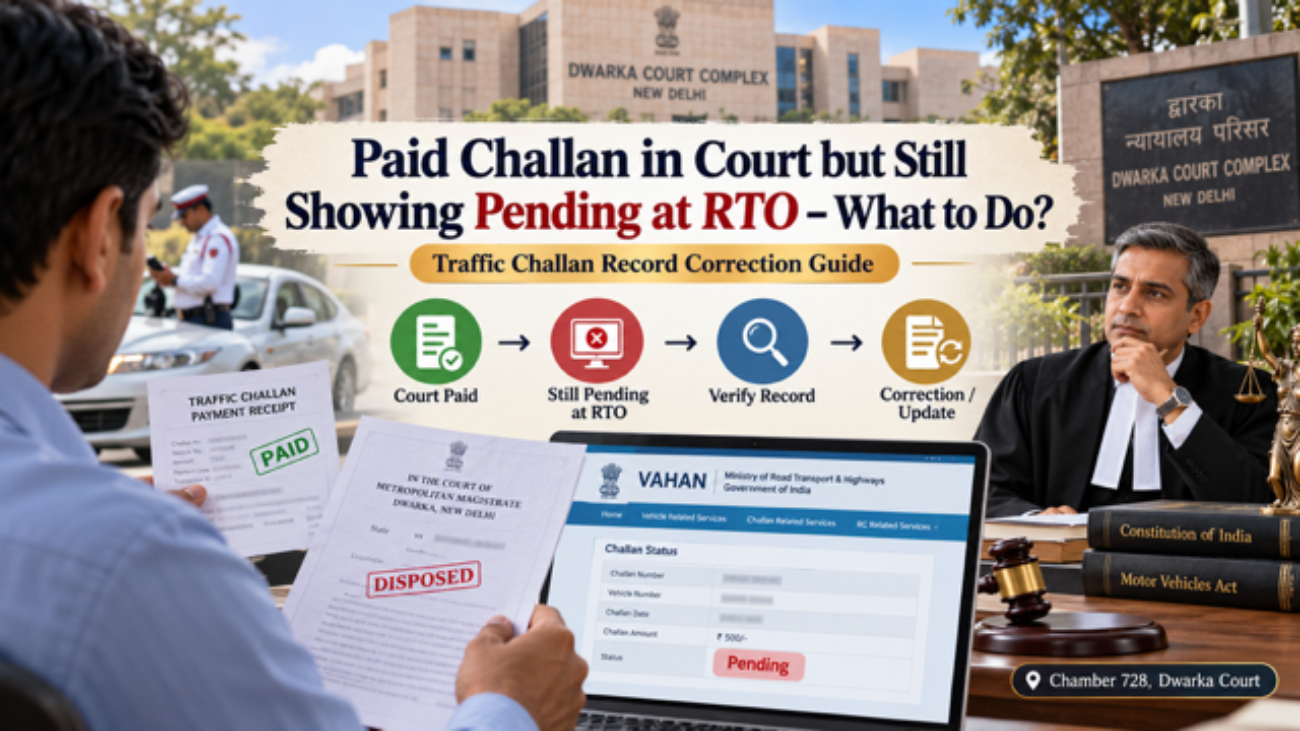
Introduction – Paid Challan in Court but Still Showing Pending at RTO
Traffic Challan Paid but Not Updated in RTO, VAHAN or eChallan Records? A Practical Delhi Guide
You appeared before the Court. The traffic challan was disposed of. The fine was paid. You have the court order or payment receipt.
But days or weeks later, the same challan is still showing as pending against your vehicle or driving licence.
The problem may become more noticeable when you try to:
This situation does not necessarily mean that the challan has to be paid again.
The first task is to identify where the challan has been disposed of, where the payment is reflected and which database is still showing it as pending.
A court record, Delhi Traffic Police record, Virtual Court record, eChallan record and VAHAN-related record may not always display exactly the same information at the same time.
The problem should therefore be approached systematically.
Quick Answer: What Should You Do?
If a traffic challan has already been paid or disposed of by a Court but still appears as pending:
The correct route depends upon where the mismatch is occurring.
Why Can a Paid Challan in Court but Still Showing Pending at RTO Still Show as Pending?
Several different situations can produce the same apparent problem.
1. Court Has Disposed of the Challan but Online Record Has Not Updated
A challan may have been disposed of before a Traffic Court, Evening Court, Lok Adalat or other competent court, but the updated disposal information may not yet be reflected in the electronic system being checked by the vehicle owner.
The first question should therefore be:
What does the actual court record say?
If the order records payment/disposal, preserve a copy carefully.
2. Payment Was Made but Transaction Status Is Still Unclear
Sometimes the problem is not the judicial order but the payment record.
Verify:
A bank debit alone should not be treated as the only proof of disposal.
Keep the official payment acknowledgement wherever available.
3. Challan Was Transferred to Virtual Court
Traffic challans can be transmitted to the Virtual Court system.
If that has happened, checking only one portal may create confusion.
The vehicle owner should determine:
Important
If a particular challan has already been paid through the proper court/Virtual Court channel, do not knowingly make a second payment merely because another screen continues to display “pending.”
First verify the records.
4. There May Be More Than One Challan
Another common source of confusion is multiple challans against the same registration number.
For example:
A person checking only the vehicle number may believe that the earlier payment has not been updated.
Always compare the individual challan number, not merely the vehicle registration number.
5. Vehicle Number or Challan Details May Not Match Correctly
Before filing any grievance, compare the details appearing on:
Even a mismatch in the challan being referred to can result in unnecessary correspondence.
6. Court Disposal and RTO/VAHAN Status Are Two Different Issues
This distinction is extremely important.
A traffic challan is one matter.
The status of a vehicle-related service before the Transport Department or VAHAN system is another.
Therefore, where the challan itself has been correctly shown as disposed of but an RTO/VAHAN transaction remains blocked, the issue may require a separate correction or representation before the concerned transport authority.
Do not assume that obtaining the court receipt alone automatically resolves every linked administrative process.
Step-by-Step: What to Do When a Paid Challan Still Shows Pending
Step 1 – Identify the Exact Challan
Record the:
Take a screenshot of the screen currently showing the challan as pending.
This creates a clear before-correction record.
Step 2 – Obtain Proof of Court Disposal
Preserve whichever documents are applicable:
The most important document is normally one which connects the specific challan number/vehicle/case with the final disposal or payment.
Step 3 – Verify the Challan on Official Portals
Do not depend upon screenshots received through WhatsApp, third-party applications or random payment websites.
Check the status on the applicable official platform.
Depending upon the challan, this may include:
Compare the status appearing on each relevant official system.
Step 4 – Verify the Payment Transaction Separately
Where payment was made digitally, confirm whether the transaction itself is shown as successful.
Keep:
If the transaction failed but the bank account was debited, that is different from a case where the transaction succeeded but the challan continues to show as pending.
The grievance should describe the correct problem.
Step 5 – Check Virtual Court Status
If the challan was transferred to Virtual Court, search using the available particulars such as:
Download or preserve the final status wherever possible.
If the Virtual Court record itself shows successful disposal but another portal shows the challan as pending, attach that record to your representation.
Step 6 – Raise an Online Grievance
Where an incorrect pending status continues, submit a grievance through the appropriate official channel.
The complaint should be precise.
Avoid simply writing:
“Challan paid but still showing pending. Please clear.”
Instead mention:
Challan No. ______ relating to Vehicle No. ______ was disposed of/paid on ______ before/through ______. The payment/disposal record is enclosed. The challan continues to appear as pending on ______. Kindly verify the disposal and update/correct the electronic record.
Attach the relevant proof.
Keep the grievance number and screenshot after submission.
Step 7 – If Necessary, Contact the Relevant Virtual Court/Court Authority
If the mismatch appears to originate from the court or Virtual Court record itself, the matter may require clarification from the concerned judicial/Virtual Court support mechanism.
The representation should identify:
Do not send incomplete complaints from different email addresses without maintaining a record.
Step 8 – If the Challan Is Cleared but RTO Work Remains Blocked
This is the situation many vehicle owners find especially confusing.
Suppose:
Court status: Disposed
Traffic challan status: Paid/Disposed
RTO/VAHAN service: Still blocked
At this stage, repeatedly approaching the Traffic Court may not solve the issue if the remaining problem is in the transport database or a pending transaction.
The vehicle owner should identify the particular RTO/VAHAN service affected.
For example:
A written representation may then be submitted to the concerned Transport/RTO authority enclosing the disposal proof.
Documents You Should Keep Ready
Before seeking correction, prepare one PDF/file containing:
1. Registration Certificate
Clear copy of RC.
2. Driving Licence
Where the challan is connected with the licence.
3. Original Challan
The original or downloaded challan.
4. Court Order
Order recording disposal/payment where available.
5. Payment Receipt
Court/Virtual Court/eChallan receipt.
6. Transaction Details
Transaction ID or bank reference.
7. Current Pending-Status Screenshot
Preferably displaying the date.
8. Previous Grievance
If already submitted.
9. Grievance Acknowledgement
Ticket/complaint number.
10. RTO/VAHAN Error Screenshot
If a vehicle-related service is being prevented.
Keeping these records together considerably simplifies verification.
Paid in Court but No Receipt Available – What Then?
Do not rely only on memory that the fine was paid.
Try to identify:
The judicial record or online case record may need to be checked.
Where an order is available but the receipt has been misplaced, the order itself may help establish what happened, depending upon its contents.
Challan Disposed of in Lok Adalat but Still Showing Pending
Preserve the Lok Adalat settlement/order.
Then check whether the exact challan referred to in that order is the challan that continues to show pending.
If yes, submit the order along with the grievance.
Do not confuse another outstanding challan with the challan that was settled in Lok Adalat.
Challan Paid in Evening Court but Still Pending
The same basic process applies:
Evening Court disposal record → payment proof → challan-number verification → online status → grievance/correction.
Where a large number of challans were dealt with together, prepare a separate table containing each challan number and its corresponding disposal status.
This prevents one unresolved challan from being confused with several already disposed matters.
I Sold the Vehicle but an Old Challan Is Still Showing – What Should I Check?
First verify the date of:
Do not simply assume liability based upon the present possession of the vehicle.
Ownership, registration records, the identity of the driver and the nature/date of the alleged violation may all be relevant depending upon the circumstances.
Separate legal advice may be required where ownership itself is disputed.
Can a Pending Challan Affect an NOC?
Pending traffic challans can become relevant when an NOC or related transport service requires clearance of outstanding challans.
This is why an incorrectly continuing “pending” entry should not be ignored merely because the fine has already been paid.
If the record is incorrect, seek correction with documentary proof rather than paying the same liability twice merely to complete another transaction.
Should You Pay the Challan Again to Save Time?
Generally, do not make a duplicate payment without first verifying why the challan remains pending.
If payment has already been made against the same challan, preserve the first receipt and seek correction.
A second payment may create an additional refund/reconciliation problem instead of solving the underlying database issue.
What If the Challan Itself Is Wrong?
That is a different situation.
If the allegation, vehicle number, location, photograph, identity of the vehicle or other material particulars are incorrect, the question is not merely about updating a paid challan.
The challan may need to be challenged or disputed.
That should be examined before making payment because voluntary payment/disposal can affect the practical options available thereafter.
Read our related guide:
How to Challenge a Traffic Challan in Dwarka Court
When Should You Consider Legal Assistance?
Many straightforward database corrections can be pursued directly by the vehicle owner.
Legal assistance may become useful where:
The objective should first be to identify whether the problem is judicial, payment-related, traffic-database-related or RTO/VAHAN-related.
How We Assist in Traffic Challan Record Problems at Dwarka Court
At Ankit Gaurav Kainth & Associates, we assist clients with traffic challan matters connected with Dwarka Courts and Delhi.
Depending upon the circumstances, assistance may include:
Not every paid-challan status problem requires litigation.
The first step should usually be document verification and identification of the authority whose record requires correction.
| S. No. | Related Page / Blog | Recommended Anchor Text | Why It Supports This Page | Best Placement | Internal Link |
|---|---|---|---|---|---|
| 1 | Traffic Challan Cases in Dwarka Court | Traffic Challan Cases in Dwarka Court | Main traffic-challan service page and parent page for this supporting article. | Introduction and conclusion | Read Guide |
| 2 | How to Challenge Traffic Challan in Dwarka Court | Challenge an Incorrect Traffic Challan | Useful where the problem is not merely an RTO update but the challan itself is disputed. | Section: What If the Challan Itself Is Wrong? | Read Guide |
| 3 | Evening Court vs Lok Adalat for Traffic Challan | Evening Court vs Lok Adalat for Traffic Challans | Explains two routes through which traffic challans may be disposed of. | Lok Adalat / Evening Court sections | Read Guide |
| 4 | Advocate Near Dwarka Court | Advocate Near Dwarka Court | Provides the local-service connection for users whose traffic matter requires court verification or appearance. | Legal assistance section | View Page |
| 5 | Criminal Defence Lawyer in Dwarka | Criminal Defence Lawyer in Dwarka | Relevant where the traffic incident develops beyond a routine challan into criminal proceedings. | Serious traffic-offence section | View Page |
| 6 | Death Caused by Negligent Driving in Dwarka Court | Criminal Case After a Serious Road Accident | Separates ordinary challan matters from serious road-accident cases involving criminal proceedings. | When Legal Assistance May Be Required | Read Guide |
Frequently Asked Questions
1. I paid my challan in Court. Why does it still show pending?
The exact reason has to be identified. The court may have disposed of the matter while another electronic record has not yet reflected the disposal, or a different challan may still be pending.
2. Should I pay the challan again?
Not merely because one screen continues to show “pending”. First verify whether the same challan has already been paid and obtain the payment/disposal record.
3. How do I prove that my challan was paid?
Useful documents can include the court order, payment receipt, Virtual Court receipt, transaction number and official challan status.
4. Can I check a traffic challan through Virtual Court?
Where the challan has been transferred to Virtual Court, its status can be searched through the Virtual Courts system using the permitted search particulars.
5. What if the bank account was debited but the payment status is pending?
Check the official transaction/payment-verification facility and preserve the bank reference and transaction details. A bank debit does not by itself establish that the challan was successfully disposed of.
6. Can a pending challan create difficulty during vehicle transfer?
An unresolved challan or an incorrectly pending record can become relevant during certain vehicle/RTO processes. The exact effect depends upon the service being requested and the record appearing against the vehicle.
7. Can a pending challan affect an NOC?
Clearance of pending traffic challans can be relevant to traffic NOC-related processes. If a paid challan is incorrectly shown as outstanding, seek correction with proof of disposal.
8. What if I have five challans and paid only four?
The fifth challan may continue to cause the vehicle number to appear as having pending challans. Verify every challan separately by challan number.
9. Can an advocate appear for a traffic challan matter?
Depending upon the nature of the proceeding and applicable court requirements, legal representation may be possible. Some matters may still require personal participation or compliance by the concerned person.
10. Can a wrong traffic challan be challenged instead of paid?
Potentially, yes. An incorrect challan should be examined before payment. The appropriate procedure depends upon the allegations, evidence and stage of the challan.
11. What if my court order says disposed but VAHAN is still not allowing my transaction?
First verify that the challan record itself has been updated. If it has, identify the exact VAHAN/RTO transaction that remains blocked and submit the disposal proof to the appropriate transport authority or use the applicable grievance mechanism.
12. How long does correction take?
There is no single period that can safely be promised for every case. It depends upon the authority, nature of discrepancy and whether the relevant disposal/payment record is already available electronically.
Practical Checklist
Before approaching any authority, confirm:
✓ Correct challan number
✓ Correct vehicle registration number
✓ Court disposal order available
✓ Fine/payment receipt available
✓ Transaction reference available
✓ Current status screenshot saved
✓ Virtual Court status checked, if applicable
✓ Traffic/eChallan status checked
✓ RTO/VAHAN issue identified separately
✓ Grievance acknowledgement preserved
This simple checklist can prevent repeated visits and unnecessary duplicate payments.
Conclusion
A traffic challan that has already been paid or disposed of by a Court should not be treated as a fresh liability merely because another online record still displays “pending”.
The important task is to establish the chain:
Challan → Court/Virtual Court → Disposal → Payment → Traffic Database → RTO/VAHAN Record
Find the point at which the information stops matching.
Then approach the authority responsible for that particular record with the challan number, disposal order, payment receipt and supporting documents.
For matters connected with Traffic Challan Cases in Dwarka Court, disputed challans, court appearances or unresolved disposal records, proper document verification at the beginning can avoid unnecessary repeat payments and procedural confusion.
Author: Advocate Ankit Gaurav Kainth
Practice: Civil & Criminal Litigation
Chamber: Chamber No. 728, Dwarka Court, Sector 10, New Delhi
Disclaimer
This article provides general legal and procedural information. Traffic challan, court, Virtual Court and Transport Department procedures can depend upon the nature of the violation, status of proceedings and applicable administrative system. The article should not be treated as legal advice for a particular matter.
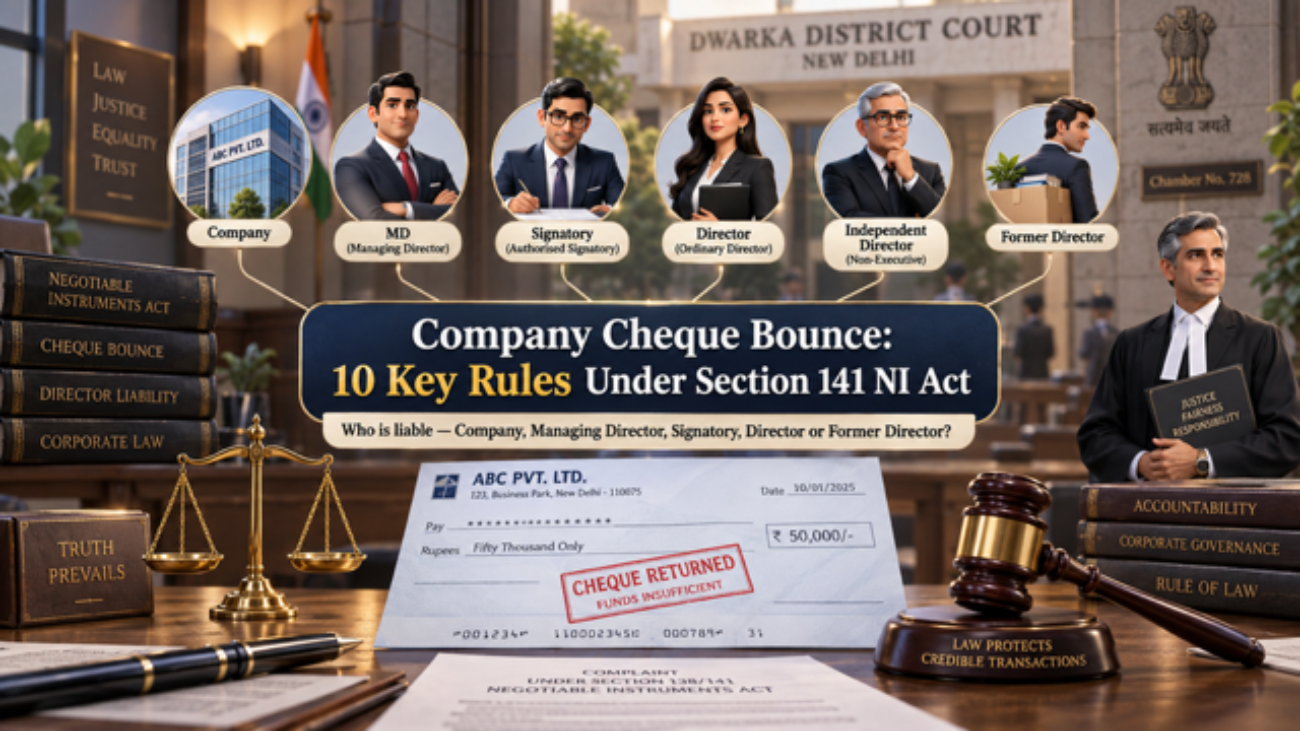
Introduction – Cheque Bounce by a Company or Director
When Can a Director, Managing Director, Authorised Signatory or Former Director Be Personally Prosecuted for a Company Cheque?
A cheque issued by a company may carry the name of the company, but when that cheque is dishonoured, an important question immediately arises:
Can every director of the company also be prosecuted under Section 138 of the Negotiable Instruments Act, 1881?
The answer is no.
Section 141 NI Act creates a special form of vicarious liability in cases where the cheque is issued by a company. However, merely describing someone as a “Director” does not automatically make that person criminally liable for every cheque issued by the company.
The legal position depends upon the person’s designation, actual role, responsibility for the company’s business, involvement in the transaction, whether the person signed the cheque, the allegations made in the complaint and the relevant documentary record.
The Supreme Court has repeatedly emphasised that Section 141 is a provision creating vicarious criminal liability and its statutory requirements must therefore be satisfied before liability can be imposed.
For businesses, companies, directors and complainants dealing with cheque-bounce litigation before courts in Delhi, including Dwarka Courts, understanding these distinctions can fundamentally affect how a Section 138 complaint should be filed or defended.
1. What Is Section 141 of the Negotiable Instruments Act?
Section 138 NI Act deals with dishonour of cheques issued toward discharge of a legally enforceable debt or liability, subject to fulfilment of the statutory requirements.
Section 141 deals specifically with offences committed by companies.
Broadly, where a company commits an offence under Section 138, liability may extend beyond the company to persons who, at the relevant time, were in charge of and responsible to the company for the conduct of its business.
Section 141 also separately deals with situations where the offence occurred with the consent or connivance of, or because of neglect attributable to, a director, manager, secretary or other officer.
The Negotiable Instruments Act continues to contain Sections 138 to 148 as the principal statutory framework governing cheque-dishonour proceedings, with Section 141 specifically titled “Offences by companies.”
This distinction is important because criminal liability of company officials cannot ordinarily be presumed merely from their designation.
2. Is Every Director Liable When a Company Cheque Bounces?
No.
One of the most important principles under Section 141 is that:
Directorship alone does not automatically create criminal liability.
The Supreme Court has distinguished between a person who merely holds the office of director and a person who was actually in charge of and responsible for conducting the company’s business at the relevant time.
The complaint must therefore contain legally sufficient allegations against the director sought to be prosecuted.
In K.S. Mehta v. M/s Morgan Securities and Credits Pvt. Ltd., 2025 INSC 315, the Supreme Court reiterated that non-executive and independent directors cannot be made vicariously liable merely because they are directors. The Court examined whether there were specific allegations connecting the directors with the company’s financial affairs and the transaction underlying the dishonoured cheques.
Therefore, simply writing:
“Accused Nos. 2 to 5 are directors of the company”
may not, by itself, establish the statutory basis required for prosecution.
3. What About a Managing Director or Joint Managing Director?
The position of a Managing Director or Joint Managing Director is materially different from that of an ordinary director.
The Supreme Court has recognised that the very designation of Managing Director or Joint Managing Director ordinarily indicates that the person is in charge of and responsible for the conduct of the company’s business.
Accordingly, the pleading requirement applicable to an ordinary director is not identical.
In S.P. Mani and Mohan Dairy v. Dr. Snehalatha Elangovan, the Supreme Court discussed earlier authorities including K.K. Ahuja v. V.K. Vora and reiterated the distinction between Managing Directors, cheque signatories, ordinary directors and other company officers.
This is why a complaint should not treat every person associated with a company as belonging to the same legal category.
4. Is the Person Who Signed the Company Cheque Personally Liable?
The authorised signatory occupies another important category.
Where a director or officer has actually signed the dishonoured cheque on behalf of the company, his or her position is materially different from a non-signatory director.
The Supreme Court has consistently recognised that a person who signs the cheque on behalf of the company can be proceeded against in accordance with Section 141.
In K.K. Ahuja, as discussed by the Supreme Court in S.P. Mani, the Court explained that a director or officer who signed the cheque does not stand in the same position as an ordinary non-signatory director.
Therefore, while reviewing a company cheque-bounce case, one of the first documents that should be examined is the cheque itself:
Who actually signed it?
That answer may substantially affect the legal analysis.
5. What Must Be Alleged Against an Ordinary Director?
For an ordinary director who did not sign the cheque, Section 141 requires careful scrutiny of the complaint.
The Supreme Court has repeatedly emphasised the requirement that the person sought to be made vicariously liable must have been both:
in charge of the company, and
responsible to the company for the conduct of its business
at the relevant time.
The Supreme Court’s 2025 discussion in K.S. Mehta referred to Hitesh Verma v. Health Care At Home India Pvt. Ltd. and emphasised these as twin requirements under Section 141(1).
A complainant should therefore avoid mechanically arraying every individual whose name appears in the company’s corporate records.
The complaint should be drafted after examining the actual roles of the persons sought to be prosecuted.
Similarly, a director receiving summons should closely examine whether the complaint contains the necessary allegations concerning his or her role.
6. Can a Non-Executive or Independent Director Be Prosecuted?
A non-executive or independent director does not enjoy absolute immunity merely because of that designation.
However, the Supreme Court has made it clear that mere designation is not enough.
In K.S. Mehta v. Morgan Securities, the appellants were non-executive directors. The Supreme Court considered factors including their lack of involvement in the financial transaction, absence of signatures on the dishonoured cheques, corporate records reflecting their non-executive roles and absence of specific allegations connecting them with the company’s financial affairs.
The Court held that mere attendance at board meetings did not automatically establish control over financial operations and quashed the proceedings against them.
This makes the 2025 judgment particularly important for current Section 141 litigation.
A complaint should identify the factual basis for alleging responsibility.
A director, on the other hand, should examine whether corporate records contradict the allegations made in the complaint.
7. What If the Director Resigned From the Company?
Resignation can be highly relevant, but the date and documentary record must be carefully examined.
The important question is not merely:
“Did the person resign?”
The more important questions include:
When did the person resign?
When did the relevant transaction take place?
When was the cheque issued?
Who authorised the transaction?
What was the person’s role at the relevant stage?
What do the Registrar of Companies records show?
Was the person involved in the financial decision or cheque issuance?
Documents such as MCA/ROC records, Form DIR-12, board resolutions, appointment and resignation documents, bank mandates and corporate governance records may therefore become important.
The Supreme Court’s analysis in K.S. Mehta demonstrates the importance that contemporaneous corporate records can assume when examining whether a director was genuinely involved in the relevant financial affairs.
A resignation defence should therefore be supported by documentary evidence rather than merely asserted orally.
8. Must the Company Itself Be Made an Accused?
This is another fundamental issue in Section 141 litigation.
The Supreme Court in Aneeta Hada v. Godfather Travels & Tours Pvt. Ltd. held that, for prosecution based on vicarious liability under Section 141, arraigning the company is ordinarily imperative because commission of the offence by the company is the condition precedent for fastening vicarious liability on others.
The Supreme Court has subsequently reiterated this principle while recognising that legally exceptional situations may require separate consideration.
Therefore, before filing a complaint involving a company, the complainant should carefully determine:
Who is the drawer of the cheque?
Is the company properly described and arrayed?
Who signed the cheque?
Which directors or officers are sought to be prosecuted?
What is the legal basis for proceeding against each of them?
A drafting error at this stage can create substantial litigation later.
9. What Is the Difference Between Section 141(1) and Section 141(2)?
Section 141 operates through more than one route of liability.
Under Section 141(1), liability may extend to a person who was in charge of and responsible to the company for the conduct of its business when the offence occurred.
Section 141(2), however, deals with circumstances where the offence is shown to have been committed with the consent or connivance of, or is attributable to neglect by, a director, manager, secretary or other officer.
The Supreme Court has explained that officers who do not fall within the first category may still attract liability where the necessary allegations and evidence concerning consent, connivance or neglect bring the case within Section 141(2).
Therefore, the precise allegations in the complaint matter.
It is not enough to merely reproduce everyone’s designation from the MCA website.
10. Can a Director Approach the High Court for Quashing?
Potentially, yes—but quashing is not automatic merely because the accused describes himself or herself as a sleeping, independent or non-executive director.
The High Court examines the complaint, allegations and, in appropriate cases, reliable documentary material.
Older Supreme Court judgments refer to petitions under Section 482 CrPC because those proceedings arose under the Code of Criminal Procedure, 1973.
The Bharatiya Nagarik Suraksha Sanhita, 2023 came into force on 1 July 2024, and the corresponding provision preserving the High Court’s inherent powers is Section 528 BNSS.
A director considering such proceedings may need to examine material including:
the complaint, summoning order, cheque, bank documents, company master data, Form DIR-12, board resolutions, bank-authorisation documents, resignation records, corporate filings and correspondence relating to the underlying transaction.
Whether quashing is appropriate depends upon the facts and legal position of the individual case.
Company Cheque Bounce: Role-Based Liability at a Glance
| Person | General Section 141 Issue |
| Company | Primary corporate drawer/offender where statutory requirements are satisfied |
| Managing Director / Joint Managing Director | Position itself ordinarily indicates responsibility for conduct of business |
| Cheque Signatory | Signature on behalf of company creates a materially different basis of liability |
| Ordinary Director | No automatic liability merely because of designation |
| Non-Executive Director | Requires examination of specific allegations and actual involvement |
| Independent Director | Mere status or board attendance does not automatically create liability |
| Former Director | Relevant dates, role and resignation records must be examined |
| Manager/Secretary/Other Officer | Liability depends upon requirements of Section 141(1) or allegations under Section 141(2), as applicable |
Important Documents in a Company Cheque Bounce Case
Whether representing the complainant or the accused, company cases should ordinarily be examined through the documentary record rather than merely from the names mentioned in the complaint.
Important material may include the dishonoured cheque, return memo, statutory notice, company master data, Form DIR-12, board resolutions, bank mandate, authorised-signatory documents, loan or supply agreements, invoices, ledger accounts, emails, WhatsApp communications, resignation records, annual returns and other corporate filings.
These documents may help answer three central questions:
Who incurred the liability?
Who authorised or signed the cheque?
Who was actually responsible for the company’s business at the relevant time?
Supreme Court’s 2025 Judgment: Why K.S. Mehta Matters
K.S. Mehta v. M/s Morgan Securities and Credits Pvt. Ltd., 2025 INSC 315 is particularly relevant because it reinforces the distinction between corporate designation and actual responsibility.
The Supreme Court noted that the appellants had neither issued nor signed the dishonoured cheques and there was no material connecting them with their execution. Their role was non-executive and their corporate records supported that position.
The Court also observed that mere attendance at board meetings did not automatically establish control over financial operations. The criminal proceedings against them were therefore quashed.
The practical lesson is important for both sides.
A complainant should carefully plead the role of every director sought to be prosecuted.
An accused director should examine whether the allegations actually satisfy Section 141 and whether reliable corporate records contradict those allegations.
Frequently Asked Questions
Can all directors be named as accused in a cheque-bounce complaint?
Merely being a director does not automatically establish liability. The role of each person and the requirements of Section 141 should be examined independently.
Is an authorised signatory liable if the company cheque bounces?
A person who actually signed the cheque on behalf of the company stands on a materially different footing from an ordinary non-signatory director.
Can an independent director be prosecuted?
The designation itself does not determine the issue. Specific allegations, actual responsibility and involvement at the relevant time must be examined. K.S. Mehta is an important 2025 Supreme Court authority on this issue.
Does resignation automatically end liability?
Not necessarily. The relevant dates, nature of involvement and documentary record should be examined. A genuine resignation predating the relevant events may be significant, particularly where supported by statutory company records.
Can the company be omitted and only the director prosecuted?
Where liability is sought to be imposed vicariously under Section 141, the rule laid down in Aneeta Hada makes arraignment of the company ordinarily imperative, subject to legally recognised exceptional situations.
Can proceedings against a director be quashed by the High Court?
In an appropriate case, the High Court may exercise its inherent jurisdiction. For proceedings governed by the present procedural law, the relevant provision is Section 528 BNSS; older judgments commonly refer to Section 482 CrPC.
| Cheque Bounce Guide | What You Will Learn | Read Guide |
|---|---|---|
| Cheque Bounce Lawyer in Dwarka Court | Complete guidance on Section 138 NI Act cases, legal notices, complaints, defence, evidence, settlement and court proceedings in Dwarka Court. | Read Complete Guide → |
| Section 138 NI Act Defence | 15 important mistakes accused persons should avoid, including summons, Section 139 presumptions, Section 145(2), cross-examination, defence evidence and Section 143A. | Section 138 Defence → |
| Defence Evidence in Cheque Bounce Cases | Understand when an accused should lead defence evidence, which documents may matter and how defence evidence fits into a Section 138 trial. | Defence Evidence Guide → |
| Section 143A Interim Compensation | Understand interim compensation under Section 143A NI Act, the 20% provision and issues relevant to complainants and accused persons. | Section 143A Guide → |
| Complete Section 138 NI Act Guide | A practical overview of cheque dishonour, statutory notice, complaint filing, summons, evidence, hearings and Section 138 proceedings. | Section 138 Guide → |
| Digital Guide to Section 138 Cases | Practical defence issues involving disputed liability, blank cheques, statutory presumptions, documentary evidence and cross-examination. | Read Digital Guide → |
| Supreme Court Judgments on Cheque Bounce Acquittal | Important Supreme Court principles concerning statutory presumptions, legally enforceable debt, financial capacity and defence in cheque bounce cases. | Supreme Court Judgments → |
| Cheque Bounce Advocate in Dwarka Court | Information for complainants and accused persons seeking assistance in Section 138 NI Act proceedings before Dwarka Court, Delhi. | Cheque Bounce Advocate → |
Conclusion
A company cheque-bounce case should never be approached on the assumption that every director is automatically liable.
Section 141 NI Act requires a role-specific examination.
The company, Managing Director, authorised signatory, ordinary director, independent director and former director may each occupy a different legal position.
For a complainant, careful drafting at the beginning can prevent avoidable objections later.
For a director receiving legal notice or Court summons, the first step should be to examine the complaint alongside the company’s records, transaction documents and the person’s actual role.
The central question is not simply:
“Was this person a director?”
The more important question is:
“What was this person’s legally relevant role in the company when the transaction and offence occurred?”
That distinction lies at the heart of Section 141 NI Act litigation.
Ankit Gaurav Kainth & Associates
Advocates — Dwarka Courts, Delhi
Chamber No. 728, Dwarka District Court
Disclaimer: This article provides general legal information and does not constitute advice for any individual dispute. Liability under Sections 138 and 141 NI Act depends upon the complaint, statutory compliance, role of the accused, corporate records, evidence and facts of the particular case.
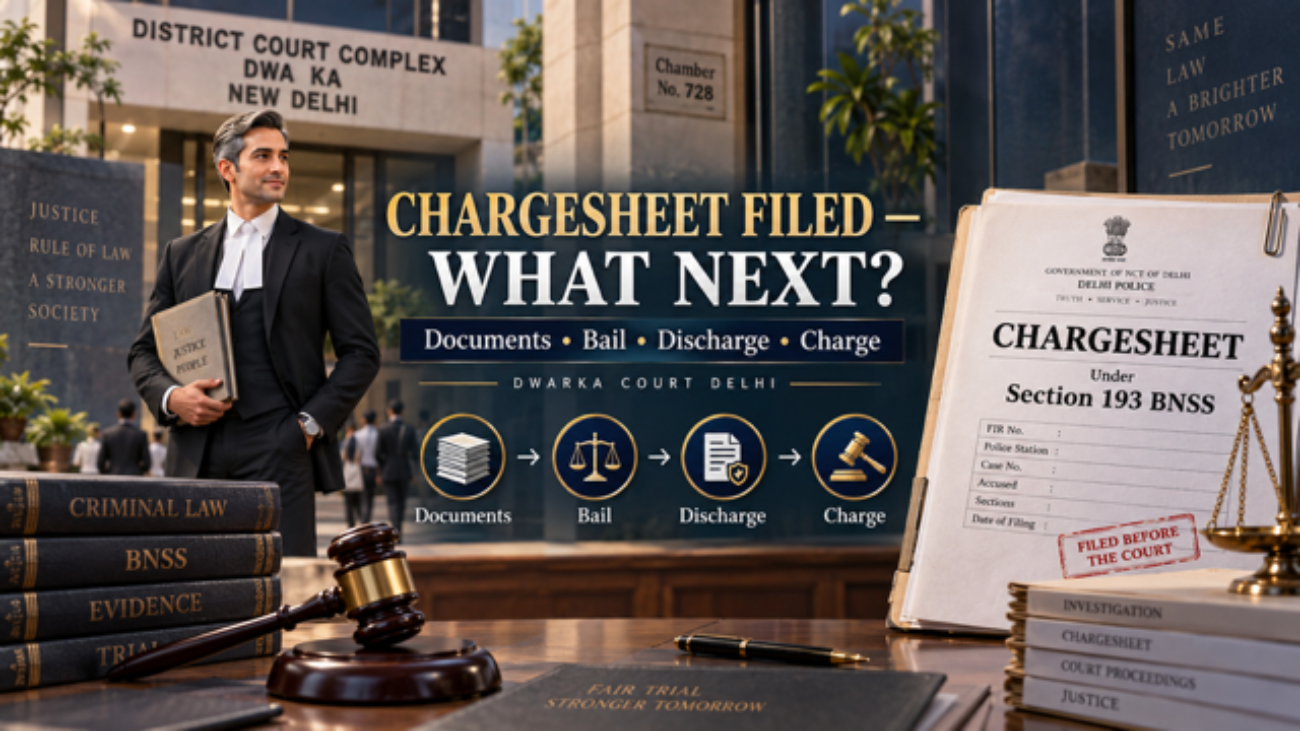
Introduction – Chargesheet filed what Next
Police have filed the chargesheet—but does that mean the criminal case against you is proved?
Understand what happens after a chargesheet is filed / Chargesheet Filed What Next, Section 193 BNSS, court cognizance, summons, bail, supply of documents, discharge, supplementary chargesheet, framing of charges and possible remedies before the Delhi High Court.
A common question after completion of a police investigation is:
“The police have filed the chargesheet against me. What happens now?”
For an accused person, receiving this information can be disturbing. However, one important distinction should be understood immediately:
A chargesheet is not a conviction.
The filing of a chargesheet means that after investigation, the investigating agency has submitted its police report before the competent Court and has taken a particular view regarding the material collected during investigation.
The Court must thereafter deal with the case according to law.
Depending upon the nature of the offence and the stage of proceedings, questions concerning cognizance, summons, appearance, bail, supply of documents, discharge and framing of charges may arise before evidence at trial begins.
Under the Bharatiya Nagarik Suraksha Sanhita, 2023, the police report on completion of investigation is governed principally by Section 193 BNSS. Section 193 also recognises further investigation and filing of further reports where additional evidence is subsequently obtained.
For a person facing criminal proceedings in Dwarka Court, this period between filing of the chargesheet and framing of charges can therefore be strategically important.
Chargesheet Under Section 193 BNSS — What Does It Contain?
Section 193 BNSS deals with the report submitted by the police after completion of investigation.
The report ordinarily contains information relating to the parties, nature of the information received, persons acquainted with the circumstances of the case, whether an offence appears to have been committed and by whom, and other prescribed particulars.
Documents and witness statements relied upon by the prosecution are also forwarded in accordance with the statutory framework.
The chargesheet may therefore contain material such as witness statements, documentary records, medical evidence, seizure documents, electronic evidence, forensic reports and other material collected during investigation.
But the defence should not examine the chargesheet merely by counting the number of documents or witnesses.
The real questions are:
What does each document actually prove? Is there admissible material connecting the accused with every ingredient of the alleged offence? Are there contradictions, gaps, missing links or assumptions in the prosecution case?
That is where meaningful chargesheet analysis begins.
1. First Obtain the Complete Chargesheet and Relied-Upon Documents
A defence strategy should normally begin with the complete record rather than with the allegations in the FIR alone.
Section 230 BNSS provides for supply to the accused, free of cost, of the police report and specified accompanying material in a case instituted on a police report. It provides that this should be done without delay and, in any event, within fourteen days from production or appearance of the accused. Electronic supply can also amount to due furnishing under the provision.
The FIR is only the beginning of the prosecution story.
The chargesheet shows what the investigation ultimately produced.
A lawyer reviewing the matter should therefore compare the FIR, complainant’s version, witness statements, documentary evidence, electronic evidence, recovery or seizure material, medical/forensic material and the final conclusions of the investigating officer.
2. Check Whether the Court Has Taken Cognizance and Issued Summons
Filing of the chargesheet and appearance of the accused are not always simultaneous events.
After receiving the police report, the competent Court deals with the matter according to the applicable procedural law. Process may thereafter be issued requiring an accused to appear.
Ignoring court summons can create a problem that did not previously exist.
An accused who has cooperated throughout the investigation should therefore not assume that because the police never arrested him, appearance before Court can also be ignored.
The procedural history needs to be checked carefully: whether cognizance has been taken, whether summons have been issued, whether they were served, the next date of hearing and whether any coercive process has subsequently been ordered.
3. Do Not Assume That Filing of the Chargesheet Automatically Requires Arrest
This issue is particularly important where the accused was never arrested during investigation and had cooperated with the investigating agency.
In Satender Kumar Antil v. CBI, the Supreme Court developed important principles concerning summons and bail for persons who had not been arrested during investigation and had cooperated.
The Supreme Court has continued to reinforce safeguards against unnecessary arrest. In its decision dated 15 January 2026, Satender Kumar Antil v. CBI, 2026 INSC 115, the Court held in the context of offences punishable with imprisonment up to seven years that notice under Section 35(3) BNSS is the rule and arrest is an exception; the statutory conditions governing arrest must still be satisfied.
This does not mean that bail is automatic in every chargesheet case. Serious offences, special statutes, previous conduct, non-cooperation, risks relating to witnesses or evidence and other circumstances can materially affect the position.
The correct bail strategy must therefore be determined from the actual sections invoked and procedural history of the case.
4. Read the Chargesheet Offence-by-Offence, Not Page-by-Page
A large chargesheet can create the impression that the prosecution case must be strong.
That is not necessarily the correct legal approach.
For every offence alleged against an accused, the prosecution must have material capable of satisfying the ingredients of that particular offence.
A proper defence review should therefore create a simple matrix:
| Issue to Examine | Defence Question |
| Alleged offence | What are its essential legal ingredients? |
| Role of accused | What specific act is actually attributed? |
| Witnesses | Is the allegation direct, hearsay or contradictory? |
| Documents | Do they genuinely connect the accused? |
| Electronic evidence | Is source, integrity and legal admissibility addressed? |
| Recovery/seizure | Is there a legally relevant recovery and proper documentation? |
| Common intention/conspiracy | What material connects the accused with the alleged common design? |
| Timeline | Do dates and events support or contradict the prosecution theory? |
This exercise often reveals the difference between an allegation and evidence capable of supporting that allegation.
5. Compare the FIR With the Final Investigation
One of the most useful exercises after receiving the chargesheet is to prepare a chronology.
Compare what was originally alleged with what investigation subsequently revealed.
Has the complainant’s version changed?
Were important allegations omitted from the earliest complaint but introduced later?
Did independent witnesses support the allegations?
Do bank records, call records, CCTV footage, messages, location data or other objective evidence support or contradict the prosecution version?
Were important persons investigated?
Was potentially exculpatory material ignored?
A defence should identify these issues before the matter reaches the charge stage rather than waiting until cross-examination begins.
6. Examine Whether a Discharge Application Is Available
The filing of a chargesheet does not necessarily mean that every accused must face a complete criminal trial.
Depending upon the nature of the case and the Court before which it is pending, the accused may have a statutory remedy of seeking discharge.
For a warrant case instituted on a police report before a Magistrate, Section 262 BNSS permits an accused to prefer a discharge application within sixty days from supply of copies under Section 230. If, after considering the police report and documents and hearing the parties, the Magistrate considers the charge against the accused to be groundless, the accused is to be discharged.
For a case triable by the Court of Session, Section 250 BNSS provides that an accused may prefer a discharge application within sixty days from the date of commitment under Section 232. If there is not sufficient ground for proceeding, the Judge may discharge the accused for recorded reasons.
Not every criminal proceeding follows identical discharge provisions. The type of case, offence, applicable statute and procedural regime should therefore be identified before choosing the remedy.
7. Understand the Difference Between Chargesheet and Framing of Charge
This distinction is frequently misunderstood.
Chargesheet: the investigating agency’s report after investigation.
Framing of charge: the judicial stage at which the Court determines whether sufficient grounds exist to put the accused on trial for particular offence or offences.
They are not the same thing.
In warrant cases instituted on a police report, Section 263 BNSS deals with framing of charge where the Magistrate finds ground for presuming commission of an offence triable under that chapter. The provision states that the charge is to be framed within sixty days from the first hearing on charge.
Accordingly, the period before charges are framed should not be treated as a procedural formality.
It may be the stage for identifying whether the prosecution material, taken according to the applicable legal standard, actually justifies putting the accused to trial.
8. Check for FSL Reports, Electronic Evidence and Other Pending Material
Modern chargesheets increasingly depend upon electronic and forensic evidence.
Cybercrime cases may involve bank trails, IP information, device analysis, WhatsApp or Telegram communications, cryptocurrency transactions, email records or digital forensic reports.
Other criminal cases may depend upon CCTV footage, call records, location information, medical evidence, DNA reports, handwriting examination or forensic reports.
A chargesheet should therefore be reviewed for what is present as well as what is absent.
If an important forensic report is still awaited, or the police propose further investigation regarding a particular aspect, that may affect how the defence approaches discharge, charge, bail or trial preparation.
9. A Supplementary Chargesheet Can Still Be Filed
Filing of the first police report does not necessarily end every aspect of investigation.
Section 193(9) BNSS expressly preserves further investigation after a report has been forwarded to the Magistrate. If additional oral or documentary evidence is obtained, a further report may be forwarded.
The proviso specifically provides that further investigation during trial may be conducted with permission of the Court and is ordinarily to be completed within ninety days, subject to extension with Court permission.
The Delhi High Court in Yash Mishra v. State of NCT of Delhi discussed Section 193(9) and recognised that further investigation may continue after the police report, subject to the statutory safeguards applicable at the trial stage.
Therefore, a defence should keep track not only of the original chargesheet but also of later supplementary reports, additional witnesses, forensic results and newly produced documents.
10. Consider Whether a Higher-Court Remedy Is Legally Available
Some cases raise issues extending beyond an ordinary discharge application.
Depending upon the facts and applicable law, questions may arise concerning jurisdiction, abuse of criminal process, absence of essential ingredients of an offence, legal bars to prosecution, settlement in legally permissible categories of cases, or other grounds capable of being examined by the High Court.
However, quashing is an exceptional remedy and should not be treated as a substitute for conducting a criminal trial merely because the accused disputes the prosecution evidence.
The correct remedy—discharge, bail, revision, quashing or defending the trial—depends upon the nature of the defect and the stage of the proceedings.
CrPC or BNSS — Which Law Applies to Your Chargesheet?
This question should now be checked carefully in every criminal case.
The BNSS came into force on 1 July 2024, but Section 531 contains a repeal-and-savings provision relating to proceedings already pending under the CrPC.
In Parvinder Singh v. Directorate of Enforcement, decided on 19 May 2026, the Supreme Court examined Section 531 and explained that its object is to avoid piecemeal application of CrPC and BNSS to proceedings saved by the provision.
Accordingly, one should not mechanically replace every old CrPC section number with a BNSS provision merely because the hearing is taking place in 2026.
The FIR date, stage of proceedings on 1 July 2024, nature of the proceeding and subsequent procedural developments may all require examination.
What Happens After Charges Are Framed?
If the accused is not discharged and the Court frames charges, the criminal case ordinarily proceeds toward trial according to the applicable procedure.
The prosecution then has to prove its case through legally admissible evidence.
Witnesses may be examined and cross-examined, documentary and electronic evidence may be proved, the accused receives the procedural protections available under law, and defence evidence may be led where appropriate.
The chargesheet is therefore important—but it is not the final determination of guilt.
Practical Defence Strategy After Chargesheet in Dwarka Court
For an accused facing a chargesheet before Dwarka Courts, Delhi, the immediate objective should be to understand the case before making the next procedural move.
The defence should know exactly what the police allege, what material supports each allegation, which documents are missing, what the witnesses actually state, whether bail issues remain, whether discharge is legally available and what happens at the next court hearing.
Preparation at this stage can shape the entire trial strategy that follows.
A chargesheet is not a conviction. This practical guide explains what an accused should examine after police file a chargesheet, including bail, summons, Section 230 documents, discharge, supplementary investigation and framing of charges under BNSS.
Frequently Asked Questions
1. Does filing of a chargesheet mean that I have been found guilty?
No. A chargesheet represents the investigating agency’s report and conclusions after investigation. Guilt can be determined only through the judicial process according to law.
2. Can I get bail after the chargesheet is filed?
Bail remains available according to the nature of the offence, applicable bail provision, conduct of the accused, previous custody or non-arrest, special statutory restrictions and other facts of the case. Filing of a chargesheet alone does not provide one universal answer.
3. Can I seek discharge after a chargesheet?
In appropriate cases, yes. The applicable discharge provision depends upon the nature of the case and Court. Sections 250 and 262 BNSS contain specific discharge provisions for Sessions cases and warrant cases on police reports respectively.
4. What is the difference between a chargesheet and framing of charges?
The chargesheet is submitted by the police after investigation. Framing of charge is a judicial determination concerning the offence or offences for which the accused should face trial.
5. Can police investigate further after filing the chargesheet?
Yes. Section 193(9) BNSS recognises further investigation and submission of further reports. Further investigation during trial is subject to the statutory requirements concerning Court permission and time.
6. Can a supplementary chargesheet add new evidence or accused persons?
Further investigation can produce additional oral or documentary evidence and may result in a further report. Its legal effect depends upon the facts, evidence and orders of the Court.
7. How quickly should the chargesheet documents be supplied to the accused?
Section 230 BNSS provides that specified copies should be supplied without delay and in no case beyond fourteen days from production or appearance of the accused, subject to the provision’s terms concerning electronic supply and voluminous documents.
8. Can a chargesheet be challenged before the Delhi High Court?
In appropriate cases, High Court remedies may be available, but the grounds and procedure depend upon the facts and stage of the case. Quashing is not an automatic remedy merely because the accused disputes the allegations.
Criminal proceedings in Delhi may involve police investigation, bail, trial proceedings, revision or appellate remedies depending upon the stage of the case. For a broader overview of our criminal, civil, commercial and appellate litigation practice, see our Advocate in Delhi practice page.
Conclusion — The Chargesheet Is a Critical Stage, Not the End of the Case
When a chargesheet is filed, the investigation has reached an important milestone—but the judicial process is still ahead.
For an accused, the next questions should be precise:
What evidence has actually been collected?
Do the alleged offences stand supported by the material?
Is bail required?
Is discharge available?
Are documents or forensic reports missing?
Can further investigation occur?
What should be argued before charges are framed?
A careful review of the chargesheet at this stage can prevent the defence from entering trial without understanding the prosecution case.
For matters pending before Dwarka Courts, Delhi, legal strategy should be based upon the actual FIR, chargesheet, relied-upon documents, applicable procedural law and orders already passed by the Court.
Author
Advocate Ankit Gaurav Kainth
Ankit Gaurav Kainth & Associates
Litigation practice based at Dwarka Courts, Delhi
Practice areas include criminal defence, bail, civil litigation, commercial disputes, matrimonial matters, cheque bounce litigation and related court proceedings.
Disclaimer
This article is intended for general legal information and awareness. It does not constitute legal advice and does not create an advocate-client relationship. Criminal procedure, bail, discharge, quashing and trial strategy depend upon the facts of each case, the offences involved, applicable special laws, the stage of proceedings and judicial orders. Readers should obtain case-specific legal advice before taking or refraining from any legal step.
Criminal proceedings can involve different stages including police investigation, bail, trial, cyber crime allegations, financial offences, cheque bounce proceedings and post-bail issues. The following guides provide more detailed information on specific criminal-law topics.
| Criminal Law Topic | What the Guide Covers | Read More |
|---|---|---|
| Criminal Lawyer in Dwarka | Main criminal-law guide covering FIRs, police investigation, arrest, bail, criminal trials, evidence, cross-examination, appeals and revisions. | Criminal Lawyer in Dwarka |
| Bail Lawyer in Dwarka Court | Anticipatory bail, regular bail, interim bail and bail proceedings in criminal and FIR matters before Dwarka Courts. | Bail Lawyer in Dwarka Court |
| Police Notice & Investigation | What to do after receiving a police notice, how to join investigation and why early document and evidence preparation matters. | Police Notice Guide |
| Police Investigation Process | Understanding investigation, evidence collection, bail, charge-sheet and subsequent criminal-court proceedings. | Police Investigation Process |
| Bail in Cheating / Fraud Cases | Bail considerations in cheating and fraud allegations, including anticipatory and regular bail and the civil-versus-criminal nature of disputes. | Bail in Fraud Case |
| Cyber Crime Bank Account Freeze | Legal issues arising when a bank account is frozen during a cyber-fraud investigation, including money-trail allegations and defreezing remedies. | Cyber Crime Bank Account Freeze |
| Frozen Bank Account – Cyber Law Judgments | Important judicial principles concerning freezing and release of bank accounts and amounts during cyber-crime investigations. | Cyber Law Judgments on Frozen Accounts |
| Bail Bonds & Surety | Bail-bond procedure, surety requirements, documents and practical issues after bail is granted. | Bail Bonds & Surety Guide |
| Cancellation of Bail | When bail may be cancelled for misuse of liberty, witness intimidation, evidence tampering or violation of bail conditions. | Cancellation of Bail Guide |
| Death by Negligent Driving | FIR, evidence, medical and mechanical material, eyewitness testimony and defence considerations in negligent-driving cases. | Negligent Driving FIR Guide |
| Cheque Bounce Lawyer in Dwarka Court | Section 138 NI Act complaints, defence, statutory notice, evidence, settlement and trial procedure. | Cheque Bounce Lawyer Dwarka Court |
| Section 138 Defence Guide | Defence of an accused in a cheque-bounce case, including presumptions, legally enforceable debt, cross-examination and documentary evidence. | Section 138 Defence Guide |
Important: Every criminal case depends upon its own facts, evidence and procedural stage. These guides are for general legal information and should not be treated as a substitute for case-specific legal advice.
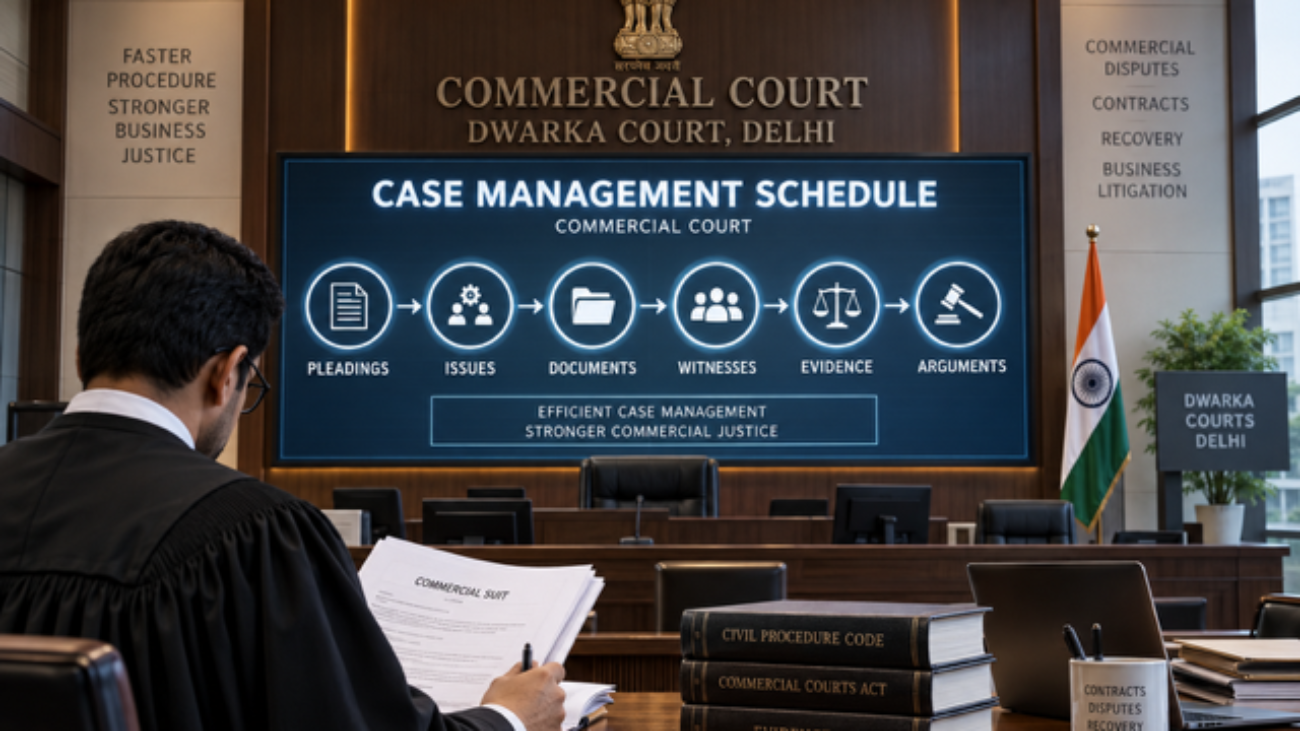

Introduction – Commercial Court Case Management Hearing Delhi
Why Order XV-A CPC Can Shape the Entire Commercial Suit Before Evidence Begins
A Commercial Court case is not supposed to proceed in the same manner as an ordinary civil dispute where dates may pass without a clear roadmap for completion of pleadings, evidence and arguments.
One of the most important procedural changes introduced for commercial litigation is the Case Management Hearing under Order XV-A of the Code of Civil Procedure, 1908, as amended for commercial disputes.
For a company, business owner, partnership firm, LLP, proprietor or individual involved in a commercial suit, the Case Management Hearing should not be treated as merely another date in Court.
It can potentially determine:
In practical terms, the Case Management Hearing can create the procedural roadmap for the remaining life of a commercial suit.
1. What Is a Case Management Hearing in a Commercial Court?
A Case Management Hearing, commonly referred to as a CMH, is a structured hearing through which the Commercial Court actively manages the progress of a commercial suit.
Order XV-A was introduced into the CPC through the Commercial Courts framework to facilitate quicker and more disciplined adjudication of commercial disputes.
The Supreme Court has also recognised that provisions such as Case Management Hearing reflect the proactive approach expected from courts dealing with commercial disputes. (SCI API)
Instead of leaving the progress of the case entirely dependent upon successive applications and adjournments, the Court can identify the matters that genuinely require adjudication and establish a schedule for moving the suit towards evidence and arguments.
For businesses involved in litigation, this is important because commercial litigation often involves substantial invoices, contracts, purchase orders, accounts, emails, banking transactions and business relationships.
Delay itself can carry a commercial cost.
2. When Should the First Case Management Hearing Take Place?
Order XV-A Rule 1 provides that the first Case Management Hearing is to be held not later than four weeks from the date on which affidavits of admission or denial of documents have been filed by all parties to the suit. (India Code)
This makes the stage of admission and denial of documents particularly important.
Before arriving at the Case Management Hearing, both parties should therefore have clarity regarding documents such as:
A party that approaches the Case Management Hearing without understanding its own documentary record may lose an important opportunity to properly frame the controversy.
3. What Orders Can the Commercial Court Pass at a Case Management Hearing?
Once the Court finds that questions of fact or law require trial, Order XV-A permits the Court to structure how that trial will proceed.
Among other things, the Court may:
This is why CMH preparation should begin before the hearing, not when counsel enters the courtroom.
A commercial litigant should already know what the real dispute is.
4. Why Is Case Management Different From an Ordinary Civil Suit?
The Commercial Courts Act was designed to introduce greater procedural discipline in commercial disputes.
| Ordinary Civil Litigation | Commercial Court Litigation |
| Progress may follow the conventional civil procedure | Greater emphasis on structured case management |
| Evidence dates may develop gradually | Court can establish an evidence schedule |
| Parties may attempt repeated procedural applications | Court can actively narrow the controversy |
| Witness planning may happen later | Witnesses may be identified during case management |
| Final arguments may arise after completion of evidence | Written and oral argument schedules can be fixed beforehand |
| Litigation is largely party-driven | Commercial Court is expected to take a more proactive managerial role |
The objective is not merely speed for the sake of speed.
The objective is to prevent unnecessary procedural delay while still preserving the parties’ opportunity to establish their respective claims and defences.
Delhi High Court has also issued a specific practice direction concerning Case Management Hearings/Pre-Trial Conferences in Commercial Courts, reinforcing their practical significance in Delhi commercial litigation. (Delhi High Court)
5. The Six-Month Framework Makes Preparation Important
One of the most striking provisions of Order XV-A is Rule 3.
While fixing dates under the case-management framework, the Court is required to ensure that arguments are closed not later than six months from the date of the first Case Management Hearing. (Indian Kanoon)
This statutory framework shows the seriousness with which commercial litigation timelines are intended to be treated.
That does not mean that every commercial suit in practice will automatically conclude within exactly six months of the first CMH regardless of circumstances.
Commercial disputes can involve complex evidence, interlocutory proceedings and other procedural developments.
However, the provision makes one point very clear:
Commercial litigation is not designed around unlimited procedural opportunities.
A plaintiff or defendant who postpones preparation can find the litigation moving faster than expected.
6. Why a Plaintiff Must Prepare Before the Case Management Hearing
Consider a company that has filed a commercial recovery suit for unpaid supplies.
The plaintiff may believe that producing invoices is sufficient.
But the defendant may allege:
Before the Case Management Hearing, the plaintiff should therefore be able to answer:
What exactly requires evidence?
For example:
If delivery itself is admitted, is a witness required merely to prove delivery?
If invoices are admitted but payment is disputed, should the evidence focus primarily on accounts and bank transactions?
If emails contain acknowledgment of dues, have those emails been properly disclosed and relied upon?
If the defendant denies the ledger, who will prove the accounts?
Good commercial litigation involves identifying these questions early.
7. Why a Defendant Should Never Treat CMH as a Routine Date
The Case Management Hearing can be equally important—sometimes more important—for a defendant.
A defendant should know precisely:
A vague written statement followed by an equally vague trial strategy can create serious difficulty later.
Commercial litigation rewards a defence that is document-driven, specific and consistent.
For example, simply stating that “nothing is payable” may carry far less strategic value than showing:
Invoice No. 143 – admitted
Invoice No. 151 – goods returned
Invoice No. 168 – payment transferred on 12 March
Invoice No. 172 – disputed because material failed inspection
That is the type of clarity which helps define the real controversy.
8. Case Management Hearing and Summary Judgment Are Closely Connected
Commercial litigation also contains an important mechanism known as summary judgment under Order XIII-A CPC.
The two procedures should not be confused.
A simple way of understanding the difference is:
Summary Judgment:
Does this dispute—or a part of it—really require a trial?
Case Management Hearing:
If a trial is required, how should that trial be organised efficiently?
Order XV-A expressly gives the Court power, before framing issues, to hear and decide a pending application under Order XIII-A. (Indian Kanoon)
Therefore, a party preparing for CMH should also ask an important strategic question:
Do all issues genuinely require evidence, or can some part of the dispute be decided without a full trial?
That assessment should be made from the pleadings and documentary record rather than as a routine litigation tactic.
9. Witnesses Should Be Chosen for a Purpose
Commercial disputes frequently generate enormous records but may require relatively few witnesses.
For example, in a ₹30 lakh unpaid-invoice dispute, the real witnesses might only include:
Calling numerous witnesses who add nothing to the actual disputed issues can prolong proceedings unnecessarily.
Delhi High Court’s procedural guidance on commercial cases specifically contemplates examining witness lists and limiting witnesses to those genuinely necessary for adjudication. (Delhi High Court)
The correct question should therefore not be:
“How many witnesses can we call?”
It should be:
“Which witness proves which disputed fact?”
10. Evidence May Proceed on a Much Tighter Schedule
Order XV-A also contemplates, as far as possible, the recording of oral evidence on a day-to-day basis until cross-examination of the witnesses is complete. (Madhya Pradesh High Court)
This is another reason parties should prepare documents and witnesses beforehand.
A company should not discover on the morning of evidence that:
Commercial litigation strategy must therefore extend beyond filing the plaint or written statement.
Trial preparation should start early.
A Practical Commercial Recovery Example
Consider the following situation:
ABC Components Pvt. Ltd. supplies machinery parts worth ₹32 lakh to XYZ Manufacturing Ltd.
ABC claims that ₹19 lakh remains unpaid.
XYZ does not completely deny the business relationship but argues that:
At the Case Management Hearing, the real controversy can potentially be narrowed to questions such as:
Issue 1
What amount is actually outstanding after admitted payments?
Issue 2
Were the allegedly defective goods formally rejected?
Issue 3
Were the returned goods received and acknowledged by ABC?
Issue 4
Are the claimed invoices supported by delivery records?
Issue 5
Is XYZ entitled to any adjustment, set-off or other defence claimed in its pleadings?
Once the dispute is properly defined, the Court and parties can identify the documents and witnesses genuinely necessary to resolve it.
That is the practical value of case management.
Plaintiff Checklist Before a Case Management Hearing
A plaintiff should ordinarily review:
Defendant Checklist Before a Case Management Hearing
A defendant should ordinarily review:
Can the Commercial Court Hold More Than One Case Management Hearing?
Yes.
Order XV-A permits the Court, where necessary, to conduct further Case Management Hearings during trial to ensure adherence to the schedule and facilitate speedy disposal. (svrkrn’s blog)
Therefore, case management is not merely a one-time procedural formality.
It can remain relevant throughout the trial.
What Happens if a Party Ignores the Case Management Schedule?
Directions passed during a Case Management Hearing should be taken seriously.
Order XV-A provides consequences for non-compliance with case-management directions. Depending on the circumstances, the Court has procedural powers including costs and, in cases of wilful and repeated non-compliance where costs are inadequate, potentially much more serious consequences concerning the claim or defence. (Indian Kanoon)
The appropriate consequence will depend upon the facts and the nature of the default.
The practical lesson is straightforward:
Do not assume that a deadline fixed in a Commercial Court can casually be ignored and repaired later.
Case Management Hearing in Commercial Court, Dwarka Delhi
Businesses operating in Dwarka, Janakpuri, Vikaspuri, Uttam Nagar, Najafgarh, Palam, Delhi Cantonment, Kapashera and other parts of South-West Delhi may find their commercial disputes coming before the competent Commercial Court depending upon territorial and pecuniary jurisdiction and the nature of the dispute.
Common commercial disputes may arise from:
The Commercial Courts Act defines a wide range of transactions capable of constituting a “commercial dispute,” but jurisdiction should be examined on the facts of each matter. (India Code)
A dispute does not become a commercial suit merely because one of the parties happens to be a company.
The nature of the transaction matters.
The Bigger Lesson: Commercial Litigation Should Be Prepared Backwards
A useful way to prepare a commercial case is to start with the final question:
What must ultimately be proved before the Court?
Then work backwards:
Final arguments
↑
Evidence
↑
Witnesses
↑
Issues
↑
Admission and denial
↑
Documents
↑
Pleadings
The Case Management Hearing sits at the centre of this process.
It connects what the parties have pleaded with what they will eventually need to prove.
For that reason, businesses should not view commercial litigation merely as filing a recovery suit or submitting a written statement.
The better question is:
What is our complete litigation strategy from pleadings to final arguments?
That is precisely where proper case management becomes valuable.
Frequently Asked Questions
1. What is a Case Management Hearing in a Commercial Court?
It is a structured hearing under Order XV-A CPC through which the Commercial Court can organise issues, witnesses, evidence, written arguments, oral submissions and the future timetable of the commercial suit.
2. When is the first Case Management Hearing held?
Order XV-A contemplates the first CMH being held not later than four weeks after all parties have filed their affidavits of admission or denial of documents.
3. What is Order XV-A CPC?
Order XV-A is the special case-management framework applicable to commercial disputes under the CPC as amended by the Commercial Courts regime.
4. Can the Court fix evidence dates during the CMH?
Yes. The Court can fix deadlines for evidence affidavits and dates for recording witness evidence.
5. Can the Court limit witnesses?
The Court can manage the witness schedule and commercial litigation procedure is intended to prevent unnecessary prolongation of trial.
6. Is the Case Management Hearing relevant only to plaintiffs?
No. It can be equally important for defendants because the defence, documentary disputes, witnesses and evidence strategy may be crystallised at this stage.
7. Can a summary judgment application be considered during case management?
Yes. Before framing issues, Order XV-A permits the Court to hear and decide a pending application under Order XIII-A.
8. Can there be another Case Management Hearing later?
Yes. The Court may hold further Case Management Hearings during trial where required to ensure adherence to the schedule and facilitate speedy disposal.
9. Can parties settle after a Case Management Hearing?
Yes. Settlement remains possible during commercial litigation. Delhi High Court’s procedural guidance also recognises exploration of settlement while managing commercial disputes. (Delhi High Court)
10. Why are documents so important in Commercial Court cases?
Commercial disputes are frequently decided around contracts, invoices, accounts, correspondence, banking records and admissions. Proper disclosure, admission/denial and organisation of these documents can substantially narrow what actually requires trial.
Conclusion
A Case Management Hearing in a Commercial Court is not merely another procedural date.
It can become the stage at which the Court transforms a large bundle of pleadings and documents into a defined litigation roadmap:
ISSUES → WITNESSES → EVIDENCE → ARGUMENTS → DECISION
For both plaintiffs and defendants, preparation before this hearing can help identify weaknesses, clarify documentary disputes, reduce unnecessary evidence and ensure that the litigation strategy is aligned with the accelerated procedural framework applicable to commercial cases.
Businesses involved in Commercial Court proceedings in Delhi should therefore approach the Case Management Hearing with the same seriousness they would attach to evidence or final arguments.
Advocate Ankit Gaurav Kainth & Associates assists businesses, companies, proprietors and individuals in commercial disputes before the Commercial Courts in Delhi, including commercial recovery suits, written statements, document strategy, interim applications, evidence and trial preparation.
This article is intended for general legal information and does not constitute legal advice. Commercial disputes should be evaluated on their individual facts, contractual documents, jurisdiction and applicable law.
Written Statement in Commercial Court with important links
| Important Topics | Text |
| Commercial Court practice page | Commercial Court Lawyer in Dwarka Court |
| Commercial Court Recovery Suit: | When Does the Limitation Period Start? |
| Commercial Lease Dispute Dwarka | Powerful Ground Every Client Should Know |
| Written Statement 120 Days in Commercial Court Recovery Suit | Important Law |
| Commercial Money Recovery Suit in Delhi | A Complete Guide for International Clients & Foreign Companies |
| The Unassailable Blueprint to Lead Defence Evidence Like a Professional in Commercial Court Cases | Advanced Litigation Strategies Every Lawyer Should Master |
| Commercial Court Is Fast | But Only If Your Lawyer Does This in Delhi Court |
| Why Businesses Lose Strong Commercial Cases Despite Having Agreements? | Experienced Commercial Court Advocate Dwarka Delhi |
| Powerful Commercial Court Recovery Case | Acquittal Strategies for Fearless Defence |
| What Happens After Receiving a Legal Notice | in a Commercial Matter? |

Introduction – Cyber Crime Anticipatory Bail Dwarka Court
Received a Cyber Cell Notice or Fear Arrest in a Cyber Fraud FIR? Understand Mule Accounts, Money Trails, Custodial Interrogation and Pre-Arrest Bail Strategy Before Dwarka Court.
A cyber crime investigation can suddenly place a person under considerable pressure. You may receive a telephone call from Cyber Cell asking you to appear, a notice under the Bharatiya Nagarik Suraksha Sanhita, discover that your bank account has been frozen, learn that a co-accused has named you, or find that money connected with an alleged online fraud passed through your bank account.
At this stage, the most important question is often:
“Can I be arrested, and should I apply for anticipatory bail before appearing before Cyber Police?”
For a person searching for Cyber Crime Anticipatory Bail in Dwarka Court Delhi, the answer depends upon much more than whether an FIR exists. The Court may examine the alleged role of the applicant, transaction trail, account control, electronic evidence, recovery requirements, cooperation with investigation, criminal antecedents and whether custodial interrogation is genuinely required.
Anticipatory bail is therefore not a mechanical remedy. It requires a case-specific assessment before arrest.
What Is Anticipatory Bail in a Cyber Crime Case?
Anticipatory bail is a judicial protection sought by a person who has reason to believe that he or she may be arrested for a non-bailable offence.
Under the present procedural law, Section 482 of the Bharatiya Nagarik Suraksha Sanhita, 2023 (BNSS) deals with anticipatory bail and permits an application before the High Court or Court of Session, subject to the statutory framework and facts of the case. (Ask Law Xperts)
The purpose is not to decide whether the applicant is innocent or guilty. It is to determine whether pre-arrest protection should be granted while investigation continues.
In cyber fraud cases, this assessment can become particularly fact-intensive because investigators often rely upon digital records, bank transactions, mobile devices, multiple account layers and alleged connections between several persons.
When Should You Consider Anticipatory Bail in a Cyber Fraud Case?
Merely receiving a police telephone call does not automatically mean that an anticipatory bail application must be filed.
However, immediate legal assessment becomes important where:
The first step should ordinarily be to understand the FIR, offences alleged and the exact role being attributed to the person.
Cyber Police Has Called Me — Can I Be Arrested?
The answer depends upon the legal and factual situation.
A police call or notice should not be ignored. At the same time, it is important to determine whether the person is being called merely for information, as a witness, as a suspect or as an accused.
A practical assessment may involve asking:
Anticipatory bail should be considered on the basis of the answers to these questions rather than fear alone.
Section 35 BNSS Notice and Anticipatory Bail
Section 35 BNSS forms part of the statutory framework governing arrest without warrant and notice of appearance in appropriate cases.
Receiving a notice does not mean that the allegation has been proved, nor should it automatically be treated as a permanent guarantee that arrest can never occur.
Compliance with a lawful notice is important, but the person should understand the allegations and preserve relevant documents before appearing.
A useful distinction is:
| Section 35 BNSS Notice | Anticipatory Bail |
| Issued during police investigation | Judicial order of protection |
| May require appearance before police | Sought from competent Court |
| Compliance may be relevant to investigation | Court may impose conditions |
| Does not decide guilt | Does not decide guilt |
| Does not itself resolve every future arrest issue | Protects against arrest according to the terms of the Court’s order |
The exact legal effect always depends upon the circumstances of the case.
Why Custodial Interrogation Matters in Cyber Crime Anticipatory Bail
One of the most important issues in cyber fraud anticipatory bail is often whether police require custodial interrogation.
Investigators may argue that custody is necessary to:
Recent Delhi High Court orders illustrate the importance given to these factors.
In Mohd Ahmad v. State of NCT Delhi, decided on 17 February 2026, anticipatory bail was declined where the prosecution alleged that ₹2,16,015 from a cyber fraud was routed through a second-layer mule account and withdrawn by self-cheque on the same day. The Court considered that the applicant’s role required closer investigation. (Indian Kanoon)
Similarly, in Ashish Rechard v. State of NCT of Delhi, decided on 11 March 2026, the Delhi High Court considered allegations concerning multiple mule bank accounts, layered transfers, recovery of cheque books/passbooks/ATM cards, alleged previous involvement and the prosecution’s contention that custodial interrogation was needed to trace the wider network and money trail. Anticipatory bail was declined on the facts of that case. (Indian Kanoon)
These cases do not create an automatic rule against anticipatory bail in cyber fraud matters. They demonstrate why the precise alleged role and investigation requirement must be addressed directly.
What If Cyber Fraud Money Entered My Bank Account?
Receipt of alleged fraud proceeds in an account can trigger serious investigation, but the credit entry by itself does not answer every issue of criminal liability.
The investigation may examine:
This distinction between account ownership and account operation can become very important.
Mule Account Anticipatory Bail in Cyber Fraud Cases
A “mule account” is commonly used by investigators to describe an account allegedly used to receive, route or withdraw money linked with fraud.
However, factual circumstances can vary considerably.
Account Knowingly Provided for Commission
The prosecution may allege that the account holder knowingly permitted another person to use the account in return for payment.
Relevant material may include chats, bank transactions, withdrawals, possession of cards and statements of other accused persons.
Account Given to a Friend or Business Associate
A person may state that another individual was operating the account. That explanation normally needs to be tested against objective records.
Important questions include:
Fraud Money Received Without Knowledge
A genuine unexplained credit may be different from repeated receipt-and-transfer transactions.
The defence may need to explain the account history and provide contemporaneous documents.
Same-Day Withdrawal
A suspicious credit followed by an immediate withdrawal may receive closer scrutiny, particularly where investigators allege that it reflects conscious participation in the money trail. The February 2026 Delhi High Court decision in Mohd Ahmad illustrates the relevance such a sequence can assume in an anticipatory-bail assessment. (Indian Kanoon)
One Suspicious Transaction vs Multiple NCRP Complaints
One disputed transaction and several cyber complaints linked with the same account may present very different factual situations.
Where investigators allege that an account appears repeatedly across complaints, they may attempt to determine whether the account was being used systematically as part of a larger fraud chain.
Recent Delhi High Court anticipatory-bail litigation continues to involve alleged mule accounts, layered transactions and multiple complaint linkages. (Indian Kanoon)
Multiple NCRP complaints do not automatically establish guilt. However, they may materially affect the seriousness with which investigators and the Court examine the account.
Joined the Investigation but Still Facing Arrest?
Simply attending the police station is not necessarily the end of the issue.
There can be an important difference between:
joining investigation and meaningfully cooperating with investigation.
Authorities may examine whether the applicant:
In Ashish Rechard, the Delhi High Court specifically noted the prosecution’s allegation that despite service of a Section 35(3) notice, the applicant had not joined investigation, among other factors relied upon while refusing anticipatory bail. (Indian Kanoon)
Accordingly, an applicant should not treat cooperation merely as a formal attendance requirement.
What If My Bank Account Was Hacked or Misused?
A person may genuinely contend that an account, SIM card or device was used without permission.
In such a situation, contemporaneous evidence can become extremely important.
Preserve:
An explanation supported by documents created before the investigation began may carry different factual significance from an unsupported explanation raised only after police contact.
Do Not Delete Chats or Reset Your Phone
A common mistake after receiving a Cyber Cell call is to panic and delete messages, reset a device or dispose of a SIM card.
That can create several problems.
First, material favourable to the defence may disappear.
Second, investigators may allege destruction or withholding of electronic evidence.
Third, it may become more difficult to establish who actually communicated with another person or operated an account.
Preserve relevant digital evidence and obtain legal advice before altering devices or accounts.
Money Trail: The Central Question in Many Cyber Fraud Cases
Cyber investigations frequently attempt to reconstruct a sequence such as:
Victim → Layer 1 Account → Layer 2 Account → Mule/Beneficiary Account → Cash Withdrawal / Further Transfer
The investigation may examine:
When preparing an anticipatory bail case, it can be useful to create a transaction chronology:
| Date | Amount Credited | Source | Withdrawal/Transfer | Destination | Explanation/Documents |
| Date | ₹___ | Account/UPI | ₹___ | Account/Cash | Supporting record |
| Date | ₹___ | Account/UPI | ₹___ | Account/Cash | Supporting record |
A clear chronology often helps identify whether the applicant appears to be a direct beneficiary, intermediary, account holder or person with no established control over the transaction.
What Factors May Support Cyber Crime Anticipatory Bail?
Depending upon the facts, arguments may include:
These factors do not guarantee bail.
What Factors Can Make Anticipatory Bail Difficult?
The prosecution may strongly oppose pre-arrest protection where it alleges:
In the March 2026 Ashish Rechard decision, allegations of layered transactions, mule accounts, prior similar involvement and the need to uncover a wider network were among the circumstances considered by the Delhi High Court. (Indian Kanoon)
Cyber Crime Anticipatory Bail Before Sessions Court
Under Section 482 BNSS, anticipatory bail jurisdiction is available to the Court of Session and High Court. (Ask Law Xperts)
Where the matter falls within the criminal jurisdiction of Dwarka Courts, the application should be prepared with reference to:
Generic bail applications can overlook the very issues that make cyber fraud cases distinctive.
Cyber Crime Anticipatory Bail Rejected by Sessions Court — Delhi High Court
Rejection of anticipatory bail by the Sessions Court does not mean that the next application should simply reproduce the earlier petition.
First examine the rejection order.
Ask:
In August 2026, the Delhi High Court considered an anticipatory-bail petition after an earlier Sessions Court rejection in a cyber police FIR, illustrating the continuing role of the High Court in appropriate cases under Section 482 BNSS. (Indian Kanoon)
The High Court application must address the case as it actually stands, including the reasoning of the earlier order.
Cyber Cell Dwarka Has Called You but You Live Outside Delhi
Cyber transactions frequently cross state boundaries.
A person may live in Uttar Pradesh, Haryana, Rajasthan, Uttarakhand, Punjab, Maharashtra or another State while an FIR is registered with a Delhi Cyber Police unit.
Do not ignore the communication merely because you reside outside Delhi.
Verify:
The appropriate pre-arrest remedy should then be considered according to the particular jurisdiction and facts.
First 10 Steps After Receiving a Cyber Cell Notice
Documents to Bring to a Cyber Crime Anticipatory Bail Lawyer
Where available, bring:
How We Assist Before Arrest
In a cyber crime pre-arrest matter, legal assistance may involve:
The defence strategy should address the actual prosecution case rather than merely state that the applicant is innocent.
Why Local Dwarka Court Experience Matters
Where a cyber crime FIR falls within the jurisdiction of Dwarka Courts, practical familiarity with the court structure, filing procedure and bail proceedings can assist in handling urgent pre-arrest matters efficiently.
Advocate Ankit Gaurav Kainth, practising from Chamber No. 728, Dwarka Court, New Delhi, has more than 18 years of litigation experience and appears in criminal and bail matters before Dwarka Courts and other competent courts, depending upon jurisdiction.
Legal advice should remain realistic. No advocate can guarantee anticipatory bail.
Frequently Asked Questions
Can I get anticipatory bail in a cyber fraud FIR?
Yes, anticipatory bail can be sought in an appropriate non-bailable case before arrest. Whether it is granted depends upon the FIR, alleged role, evidence, investigation requirements and other circumstances.
Does a Cyber Cell notice mean I will be arrested?
Not necessarily. A notice should nevertheless be taken seriously. Its contents, offences, your procedural status and the investigation should be examined before drawing any conclusion.
Can I get anticipatory bail if fraud money entered my account?
It may be possible, but the Court can examine why the money entered, who operated the account, where it went next and whether there is evidence suggesting knowledge or participation.
Can a mule-account holder obtain anticipatory bail?
There is no automatic rule. The alleged role, transaction pattern, account control, communications, recovery and cooperation may all be relevant.
What if my account was used without my knowledge?
Preserve objective evidence supporting that explanation, including bank complaints, device records, SIM-related records and contemporaneous communications.
What if several NCRP complaints are linked with my account?
Multiple complaints can increase investigative scrutiny. They do not themselves establish guilt, but the transaction pattern should be carefully analysed.
Can police arrest me even after I join investigation?
Joining investigation is an important factor, but the legal position depends upon the offences, notice framework, compliance and investigation circumstances. Appearance alone should not be assumed to resolve every arrest issue.
Should I hand over my mobile phone to Cyber Police?
Requests relating to devices should be handled according to law and the facts of the investigation. Do not destroy, reset or alter relevant electronic evidence.
What happens if Sessions Court rejects anticipatory bail?
The order should be studied to understand the reasons for rejection. Depending upon maintainability and circumstances, further relief before the Delhi High Court may be considered.
Can Delhi High Court grant anticipatory bail in a cyber crime case?
Section 482 BNSS empowers both the Court of Session and High Court to consider anticipatory bail applications, subject to the statutory framework and facts. (Ask Law Xperts)
Conclusion
Cyber crime anticipatory bail cases are increasingly decided around money trails, mule accounts, digital devices, cooperation and the specific role attributed to the applicant.
A person who receives a Cyber Cell notice or fears arrest should not wait until the situation becomes more difficult. At the same time, anticipatory bail should not be filed mechanically without understanding the FIR and investigation.
The strongest preparation usually begins by identifying the disputed transaction, preserving electronic evidence, understanding who actually controlled the account or device, documenting cooperation and addressing directly why custodial interrogation may or may not be required.
Legal Consultation for Cyber Crime Anticipatory Bail in Dwarka Court
A person facing a Cyber Cell notice, apprehension of arrest or cyber fraud FIR connected with Dwarka Court may seek a legal consultation for assessment of the FIR, transaction trail, documents and appropriate pre-arrest bail strategy.
Advocate Ankit Gaurav Kainth
Chamber No. 728, Dwarka Court, New Delhi
Mobile: 9899085554 / 9811885554
Disclaimer: This page provides general legal information and does not constitute legal advice for any particular matter. Anticipatory bail is discretionary and depends upon the FIR, offences alleged, evidence, investigation stage, jurisdiction and individual facts.
| Cyber Crime Guide | What the Reader Will Learn | Recommended Anchor Text |
|---|---|---|
| Cyber Crime Bail Lawyer in Dwarka Court Delhi | Anticipatory bail, regular bail, mule accounts, money trail, NCRP complaints, digital evidence and cyber-fraud defence. | Cyber Crime Bail Lawyer in Dwarka Court Delhi |
| Mule Account Cyber Fraud Case in Delhi: 10 Bail Factors | Bail factors where a bank account is alleged to have received, transferred or routed cyber-fraud proceeds. | Mule Account Cyber Fraud Case in Delhi |
| Cyber Cell Dwarka: Blueprint to Get Bail at the Earliest Stage | What to do after Cyber Cell involvement, including investigation, pre-arrest strategy and bail. | Cyber Cell Dwarka Bail Guide |
| Notice Under Section 35(3) BNSS from Cyber Cell Dwarka | How to respond to a Cyber Cell appearance notice and protect your legal rights during investigation. | Section 35(3) BNSS Cyber Cell Notice |
| Anticipatory Bail in Cyber Fraud Cases at Dwarka Court | Pre-arrest bail strategy where a person fears arrest in a cyber-fraud investigation. | Anticipatory Bail in Cyber Fraud Cases |
| Can Police Freeze Your Bank Account in Cyber Crime Investigation? | Police powers, account freezing and legal remedies available to affected bank-account holders. | Bank Account Freeze in Cyber Crime Investigation |
| How to Release Amount Frozen by Cyber Police from Dwarka Court | Court remedies for seeking release or de-freezing of money blocked during a cyber-crime investigation. | Release Frozen Bank Account Amount from Cyber Police |
| Supreme Court Judgments on Release of Frozen Amount in Cyber Cases | Important judicial principles concerning frozen bank accounts and release of funds in criminal and cyber cases. | Supreme Court Judgments on Frozen Bank Accounts |
| Police Investigation Process in Criminal Cases in Dwarka Court | FIR, questioning, evidence collection, arrest, police investigation, charge sheet and related criminal procedure. | Police Investigation Process in Dwarka Court |