
Introduction – Written Statement in Commercial Court
A company receives summons from the Commercial Court at Dwarka in a recovery suit claiming ₹38 lakh towards unpaid invoices.
The next hearing is several weeks away.
The director thinks:
“There is still plenty of time. We will prepare the reply later.”
That approach can be risky.
In commercial litigation, the Written Statement in Commercial Court is not merely a reply to allegations. It may become the foundation of the defendant’s documentary, procedural and trial strategy.
The first exercise should therefore be:
SUMMONS → DATE OF SERVICE → DEADLINE → DOCUMENTS → DEFENCE → DISCLOSURE → ADMISSION/DENIAL → WRITTEN STATEMENT → STRATEGY
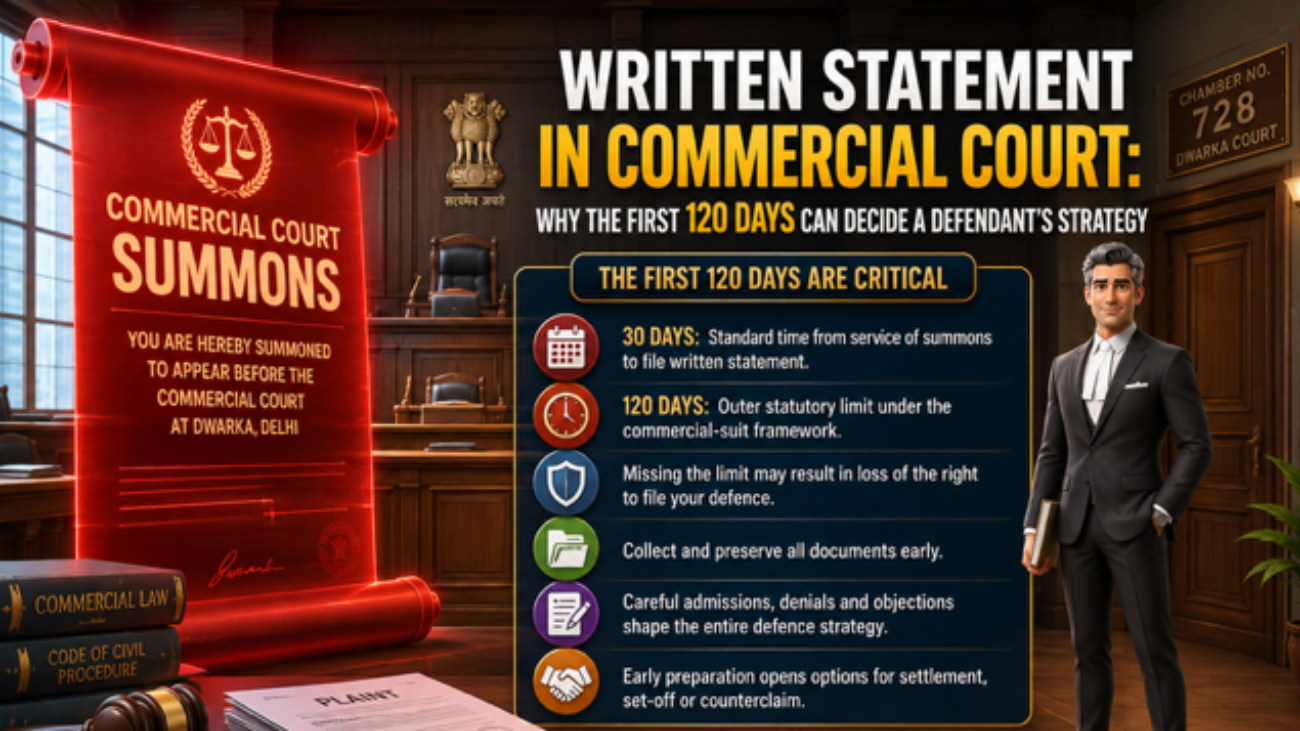
Most importantly, the statutory 120-day period should be understood as an outer limit under the commercial-suit framework—not as a target date for beginning preparation.
⚖️ Written Statement in Commercial Court: What Should a Defendant Do During the First 120 Days?
| Stage | What the Defendant Should Do | Why It Matters | Mistake to Avoid |
| 1 | Record date and mode of service | Deadline may run from service | Guessing the date later |
| 2 | Obtain complete plaint | Defence needs complete allegations | Reading summons only |
| 3 | Calculate applicable deadline | Commercial timelines are strict | Treating Day 120 as target |
| 4 | Identify preliminary objections | Jurisdiction and maintainability may matter | Using boilerplate objections |
| 5 | Collect business records | Defence is often document-driven | Waiting until drafting starts |
| 6 | Reconcile monetary claim | Claimed amount may be disputed | Accepting plaintiff’s ledger |
| 7 | Prepare admissions/denials | Vague denials may be inadequate | Denying everything mechanically |
| 8 | Organise disclosure | Commercial suits require structured disclosure | Hiding adverse documents |
| 9 | Examine set-off/counterclaim | Defendant may have independent claims | Discovering them too late |
| 10 | Finalise and file | Pleading, documents and verification must align | Last-day filing strategy |
This is a workflow. It is not an invitation to wait for Day 120.
What Is a Written Statement in a Commercial Suit?
A written statement is commonly described as the defendant’s reply to the plaint.
That description is incomplete.
A properly prepared commercial written statement may explain:
- what the defendant admits;
- what the defendant denies;
- why a particular allegation is denied;
- the defendant’s own version of the transaction;
- jurisdictional objections;
- contractual defences;
- payments and adjustments;
- limitation issues where relevant;
- documentary defences;
- set-off or counterclaim where legally available; and
- the factual basis upon which the suit will be contested.
Therefore, careless admissions can create difficulty later.
Likewise, a vague sentence such as “contents are wrong and denied” may not be a substitute for a carefully prepared paragraph-wise defence.

⚠️ Written Statement in Commercial Court: The 30-Day and 120-Day Framework
The Commercial Courts Act modifies the CPC for commercial disputes.
Under Order VIII Rule 1, read with the commercial amendments, a defendant is expected to present the written statement within 30 days from service of summons.
If that does not happen, the Court may permit filing later, subject to the statutory framework, recorded reasons and costs. However, for commercial suits governed by this regime, the amended provisions impose an outer limit of 120 days from service of summons. On expiry of that period, the statutory language provides for forfeiture of the right to file the written statement. (India Code)
The Supreme Court in SCG Contracts India Pvt. Ltd. v. K.S. Chamankar Infrastructure Pvt. Ltd. emphasised the mandatory nature of these commercial-suit amendments and held that inherent powers cannot ordinarily be used to bypass the statutory 120-day bar. (Sci API)
More recently, the Supreme Court in 2025 again described the commercial-dispute provisions as imposing an absolute embargo after expiry of the statutory 120-day period in the case before it. (Sci API)
A Delhi High Court Division Bench in August 2025 likewise upheld the consequence where no written statement had been filed within the 120-day period in a district-level commercial matter. (Delhi High Court)
The practical lesson
Do not think:
“I have 120 days.”
Think:
“My defence preparation starts on the date summons is served.”
The actual computation must still be checked from the service record and procedural history.
When Does the Written Statement Clock Start?
The date of service can become critical.
A defendant should preserve:
✅ Physical envelope
✅ Email through which papers were received
✅ Electronic service record
✅ WhatsApp/service communication where applicable
✅ Court order recording service
✅ Complete summons and plaint set
Questions may arise regarding whether summons were properly served, whether complete papers accompanied service and what the court record shows.
Therefore, do not casually state a service date from memory.
Your advocate should examine the actual record.
For district Commercial Courts such as Dwarka, one should also avoid relying on procedural rules designed specifically for original-side proceedings before the Delhi High Court unless they legally apply to the particular case.

📂 Your Documents Build Your Written Statement – Written Statement in Commercial Court
A Written Statement in Commercial Court should rarely be drafted in isolation from the underlying business records.
Suppose the plaintiff claims ₹38 lakh.
Before drafting, the defendant should collect:
- contracts;
- purchase orders;
- work orders;
- invoices;
- delivery challans;
- ledger accounts;
- bank statements;
- payment records;
- emails;
- WhatsApp conversations;
- GST-related records where relevant;
- debit notes;
- credit notes;
- returned-goods records;
- quality complaints;
- termination correspondence;
- settlement communications;
- legal notices and replies; and
- relevant internal business records.
Importantly, preserve helpful documents as well as documents that may appear adverse.
Commercial litigation is not the place to delete inconvenient emails or accounting records.
Disclosure: Why Commercial Court Defendants Must Organise Documents Early
Commercial litigation has a more structured disclosure regime.
Order XI, as substituted for commercial disputes, places significant emphasis on disclosure of documents within a party’s power, possession, control or custody.
Accordingly, document preparation should begin alongside the written statement—not several months later.
The statutory framework also requires commercial pleadings to be verified through a Statement of Truth in the prescribed manner. The law expressly provides consequences where a pleading is not properly verified. (India Code)
This is one reason why the defendant must provide complete and accurate instructions.
Do Not Deny Every Document Mechanically – Written Statement in Commercial Court
Admission and denial of documents can significantly narrow the dispute.
A defendant should distinguish between different questions:
Did I receive this document?
Did I execute it?
Are its contents correct?
Is the amount correct?
Do I dispute its authenticity?
Do I accept the document but dispute its legal effect?
These are not always the same thing.
For example, a defendant may admit receiving an invoice while disputing that the goods were accepted without objection.
Therefore, the written statement, documents and admission/denial strategy should remain consistent.-
💰 Does the Defendant Actually Owe the Amount Claimed? – Written Statement in Commercial Court
Consider this example:
Plaintiff’s claim: ₹38 lakh
However, the defendant’s records indicate:
- ₹5 lakh already paid;
- ₹3 lakh credit note;
- ₹4 lakh worth of goods returned;
- disputed contractual interest;
- quality complaints; and
- incomplete supply.
The correct approach is to reconcile:
PLAINT → INVOICES → LEDGER → BANK → PAYMENTS → CREDIT NOTES → CORRESPONDENCE
Potential issues may include:
✅ Payments ignored
✅ Partial payments omitted
✅ Incorrect interest
✅ Inflated invoices
✅ Defective goods
✅ Returned material
✅ Wrong ledger entries
✅ Contractual adjustments
✅ Incomplete performance
✅ Settlement communications
The existence of an invoice does not automatically resolve all these factual or legal questions.
Preliminary Objections Should Be Identified Early
Preparing the written statement also requires examining threshold issues.
These may include:
- territorial jurisdiction;
- pecuniary jurisdiction where relevant;
- limitation;
- contractual jurisdiction clauses;
- arbitration clause;
- maintainability;
- cause of action;
- Section 12A issues where relevant;
- contractual terms; and
- status or capacity of the parties.
However, objections should not be inserted merely because they appear in a standard drafting format.
A meaningful preliminary objection needs a factual and legal foundation.
Does the Defendant Have a Claim Against the Plaintiff?
Sometimes the defendant is not merely defending money.
The defendant may itself claim that the plaintiff caused loss through:
- defective supply;
- delayed delivery;
- breach of contract;
- incomplete performance;
- excess billing; or
- other contractual defaults.
Depending upon the facts and CPC requirements, set-off or counterclaim may need consideration.
These issues should be identified while preparing the initial litigation strategy rather than after the defence is substantially complete.
Statement of Truth: Do Not Sign the Pleading Casually
Commercial pleadings are subject to enhanced verification requirements.
Order VI Rule 15A requires verification by an affidavit in the prescribed form—the Statement of Truth. The statutory form requires the deponent to distinguish statements based on knowledge, information and legal advice and to affirm disclosure of relevant records. (India Code)
Therefore, a director, proprietor or authorised representative should carefully check:
✅ Dates
✅ Payments
✅ Documents
✅ Amounts
✅ Admissions
✅ Denials
✅ Source of factual information
The client should understand the pleading before signing it.
Why Waiting Can Damage a Commercial Defence
Even before the statutory bar becomes an issue, delay can weaken preparation.
Waiting may cause:
- rushed drafting;
- incomplete document collection;
- overlooked payments;
- missed credit notes;
- inconsistent instructions;
- poor admission/denial preparation;
- inadequate disclosure;
- unexamined jurisdiction objections;
- missed counterclaim possibilities; and
- less time for settlement analysis.
Therefore, the real danger is not merely Day 121.
It is losing the preparation time available before it.
Interim Applications Cannot Always Wait
The plaintiff may also seek:
- injunction;
- attachment;
- security;
- restraint against assets;
- deposit; or
- another interim order.
Such an application may require immediate attention even while the written statement is being prepared.
Accordingly, the advocate should review the entire case file, not only the plaint.
Summary Judgment Makes Early Defence Preparation Even More Important
Order XIII-A provides a summary-judgment mechanism for qualifying commercial claims.
Under that framework, a Court may decide a commercial claim without recording oral evidence where the prescribed test is satisfied, including the absence of a real prospect of succeeding or defending and the absence of another compelling reason for trial. (India Code)
This does not mean that every weak written statement results in summary judgment.
However, it does reinforce an important point:
Commercial litigation rewards early clarity in pleadings and documents.
🤝 Written Statement Preparation Is Also a Settlement Reality Check
Document review may reveal:
- a strong defence;
- partial liability;
- an accounting dispute;
- interest-only disagreement;
- weak plaintiff records;
- weak defendant records;
- a genuine counterclaim; or
- a sensible settlement possibility.
Therefore, a business should assess:
Claim Amount + Documents + Defence + Cost + Time + Business Relationship + Enforceability + Settlement Opportunity
Settlement is not automatically a sign of weakness.
Equally, receiving summons does not mean a defendant should settle a claim merely because a large amount appears on the first page.
⚖️ Pre-Litigation and Litigation Assistance – Written Statement in Commercial Court
Before commercial litigation, Ankit Gaurav Kainth & Associates assists clients with areas such as contract review, invoice disputes, legal notices, replies, document analysis, settlement negotiations, commercial mediation, risk assessment and evidence preservation.
Once Commercial Court summons have been received, the focus may shift to:
✅ Examining the summons and service record
✅ Reading the plaint and applications
✅ Calculating procedural timelines
✅ Preparing the written statement
✅ Preliminary objections
✅ Disclosure
✅ Admission and denial
✅ Statement of Truth
✅ Set-off/counterclaim where legally available
✅ Interim applications
✅ Evidence and cross-examination
✅ Final arguments
✅ Settlement or mediation
With 18+ years of litigation experience, our approach is to understand the transaction and documents before finalising the defence.
📍 Written Statement and Commercial Court Matters in Dwarka
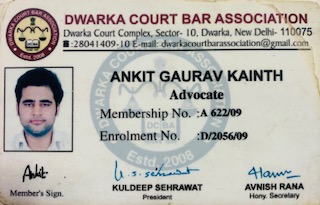
Our practice is based at Dwarka Courts, Delhi.
Local presence assists with consultation, document coordination, filing, appearances and procedural follow-up. It does not provide any special influence or preferential treatment.
Clients may approach from Dwarka Sector 6, Sector 10, Sector 12, Sector 23, Dwarka North, Dwarka South, Janakpuri, Vikaspuri, Uttam Nagar, Najafgarh, Delhi Cantonment, Chhawla, Bindapur, Baba Haridas Nagar, Mohan Garden, Palam Village, Samalka, Dabri, Jaffarpur Kalan, Kapashera and other parts of South West Delhi near Dwarka Court.
🌍 Defendant Outside Delhi or India?
A defendant in Delhi commercial litigation may be based elsewhere in India or abroad.
Businesses or directors may be located in the United States, United Kingdom, UAE, Singapore, Australia, Canada, Germany, France, Saudi Arabia or Qatar.
However, residence abroad neither creates nor eliminates Dwarka Court jurisdiction by itself.
Jurisdiction depends upon applicable law, the transaction, contractual terms, cause of action and territorial connection.
Where suitable, digital document sharing and video consultations can assist clients who are outside Delhi.
❓ Frequently Asked Questions – Written Statement in Commercial Court
1. How much time do I have to file a written statement in Commercial Court?
The commercial-suit framework ordinarily requires filing within 30 days from service of summons. Filing beyond that period may be permitted subject to statutory conditions, but the amended CPC provides a 120-day outer limit for commercial suits governed by the provision. The actual computation should be checked from the service record. (India Code)
2. What happens if a written statement is not filed within 120 days?
Under the commercial-suit amendments, the defendant forfeits the right to file the written statement after the statutory 120-day period where that regime applies, and the Court is not to take it on record. Supreme Court authority has repeatedly treated this rule strictly. (Sci API)
3. From which date is the 120-day period calculated?
The statutory language refers to the date of service of summons. However, disputes about valid service and procedural history can be fact-specific, so the court record should be examined carefully. (India Code)
4. What documents should I give my advocate?
Provide the complete summons and plaint along with contracts, invoices, purchase orders, delivery records, ledger, bank statements, emails, WhatsApp records, payment details, credit/debit notes, legal notices and settlement communications.
5. Can a defendant file a counterclaim with the written statement?
A counterclaim may be available depending upon its cause of action, maintainability and applicable CPC provisions. It should be examined early because it may affect the structure of the defence.
🏁 Conclusion
A Written Statement in Commercial Court is not merely a reply to allegations.
It is the foundation upon which the defendant’s documentary, procedural and trial strategy may be built.
The correct approach is not:
“How close can I get to Day 120?”
It is:
“What do we need to prepare from Day 1?”
Early preparation creates time to examine jurisdiction, limitation, invoices, payments, contracts, disclosure, admission/denial, counterclaims, interim applications and settlement possibilities.
Do not treat Day 120 as your filing plan. Treat the date of service as the day defence preparation begins.
📞 Written Statement / Commercial Suit Consultation – Dwarka Court
Ankit Gaurav Kainth & Associates
Advocates – Dwarka Court, Delhi
📞 9899085554
📞 9811885554
For consultation, keep ready:
✅ Summons and complete plaint
✅ Applications
✅ Evidence of date/mode of service
✅ Contracts
✅ Purchase/work orders
✅ Invoices and delivery challans
✅ Ledger accounts
✅ Bank statements
✅ Emails and WhatsApp communications
✅ Payment records
✅ Debit/credit notes
✅ Previous notices
✅ Settlement communications
Disclaimer: This article provides general legal information only. Written-statement timelines, service, jurisdiction, disclosure requirements and available defences depend upon the applicable law, court, facts and procedural record. No particular outcome is guaranteed.
Written Statement in Commercial Court with important links
| Important Topics | Text |
| Commercial Court practice page | Commercial Court Lawyer in Dwarka Court |
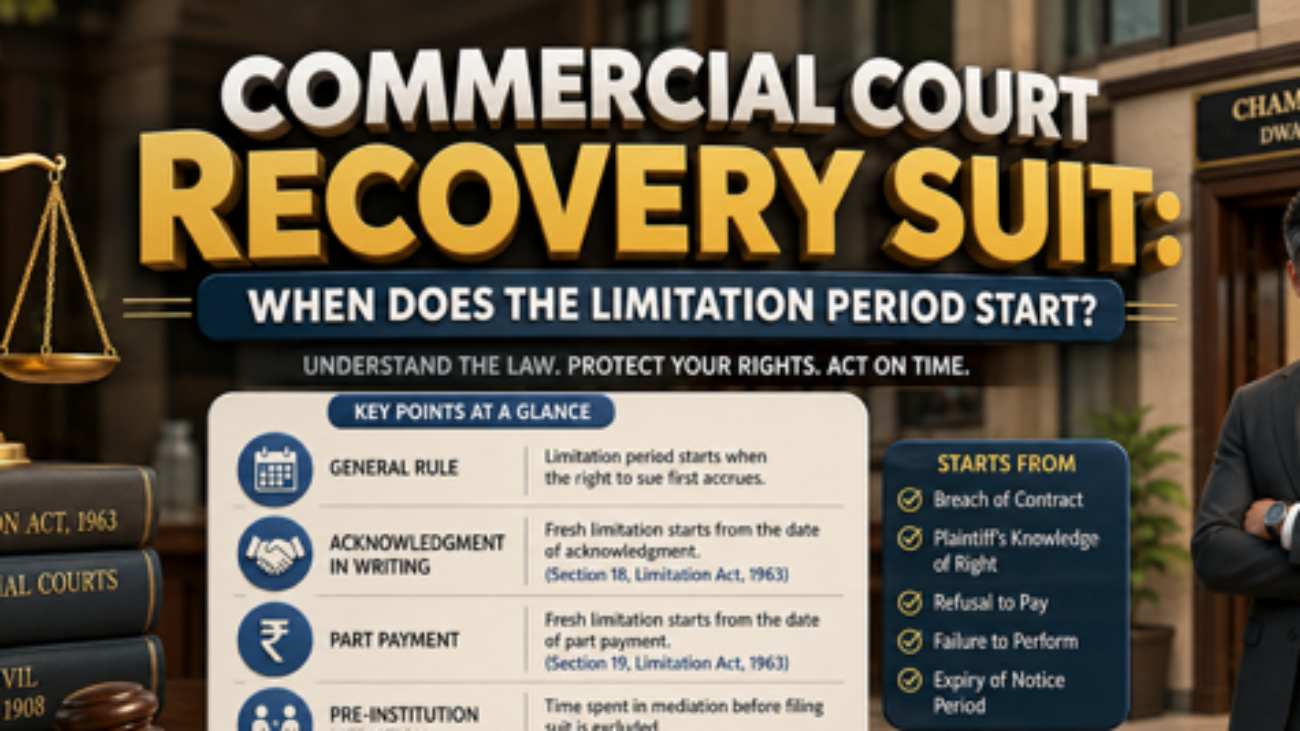
| Commercial Court Recovery Suit: | When Does the Limitation Period Start? |
| Commercial Lease Dispute Dwarka | Powerful Ground Every Client Should Know |
| Written Statement 120 Days in Commercial Court Recovery Suit | Important Law |
| Commercial Money Recovery Suit in Delhi | A Complete Guide for International Clients & Foreign Companies |
| The Unassailable Blueprint to Lead Defence Evidence Like a Professional in Commercial Court Cases | Advanced Litigation Strategies Every Lawyer Should Master |
| Commercial Court Is Fast | But Only If Your Lawyer Does This in Delhi Court |
| Why Businesses Lose Strong Commercial Cases Despite Having Agreements? | Experienced Commercial Court Advocate Dwarka Delhi |
| Powerful Commercial Court Recovery Case | Acquittal Strategies for Fearless Defence |
| What Happens After Receiving a Legal Notice | in a Commercial Matter? |