

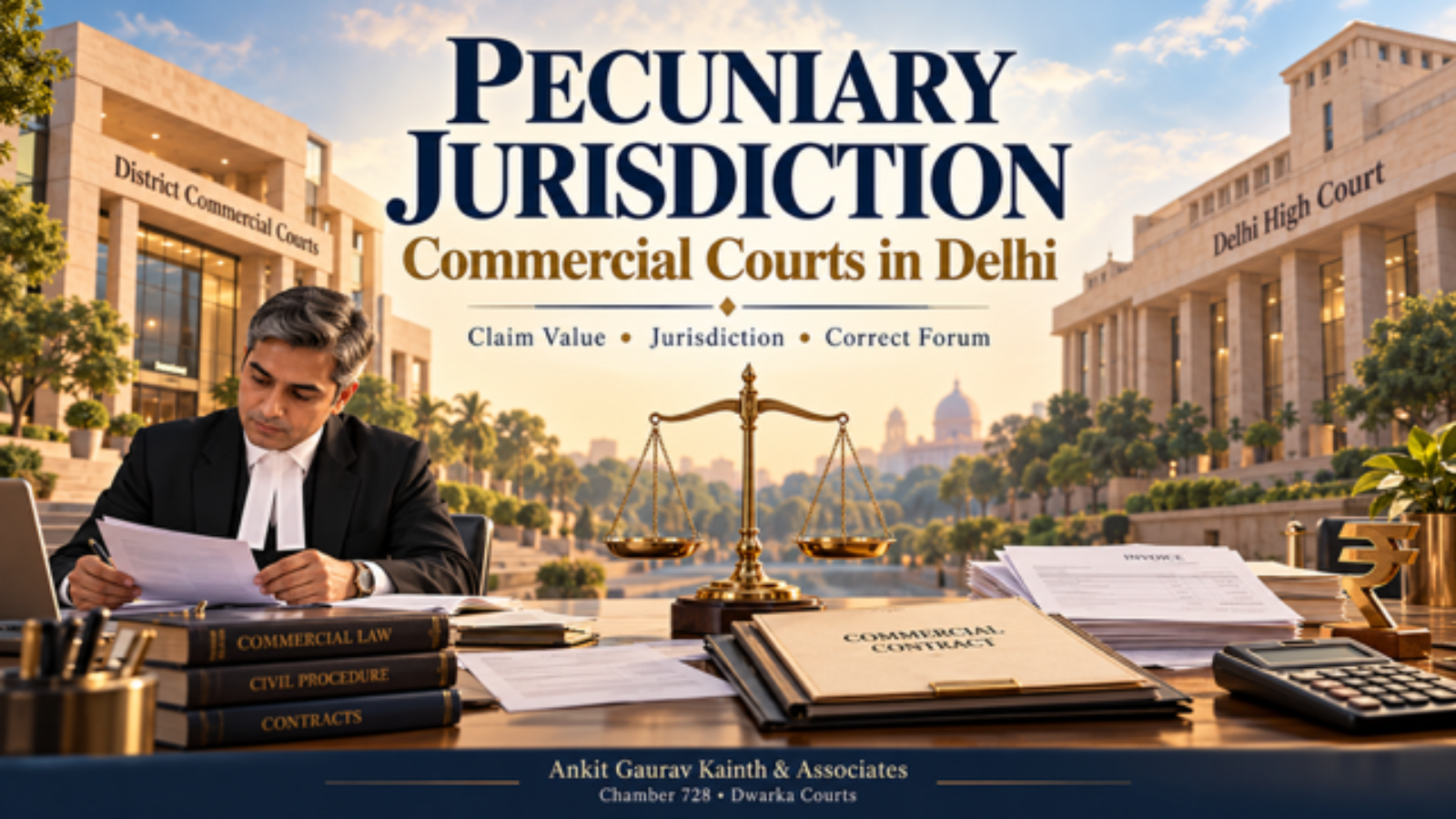
Introduction – Pecuniary Jurisdiction of Commercial Courts in Delhi
Before filing a commercial recovery suit in Delhi, identifying the correct court is as important as calculating the outstanding amount.
A business may have invoices, delivery records, agreements and correspondence supporting its claim. However, filing before a court without jurisdiction can create objections, additional expense and procedural delay.
For ordinary commercial money-recovery suits, Delhi’s district Commercial Courts generally deal with qualifying claims of ₹3 lakh up to and including ₹2 crore. Claims exceeding ₹2 crore ordinarily fall within the Delhi High Court’s Commercial Division, provided the other jurisdictional requirements are satisfied. The Delhi High Court’s district-allocation order and Section 5(2) of the Delhi High Court Act provide the relevant monetary framework.
These figures are the starting point. The nature of the dispute, legally supportable valuation, territorial jurisdiction and applicable statutory forum must also be examined.
1. What does pecuniary jurisdiction mean?
Pecuniary jurisdiction means a court’s authority to hear proceedings within particular monetary limits.
Before selecting a court, examine three separate questions:
| Jurisdictional check | Question to answer |
| Nature of the dispute | Does the transaction legally qualify as a commercial dispute? |
| Pecuniary jurisdiction | Does the suit’s legally determined value fall within the court’s monetary limits? |
| Territorial jurisdiction | What facts connect the dispute with Delhi and the particular district? |
A convenient court complex is not necessarily the competent forum.
2. What are the monetary limits for commercial money suits in Delhi?
| Properly calculated claim value | General forum position |
| Below ₹3 lakh | Ordinarily outside the Commercial Courts Act’s minimum specified-value threshold; examine the competent civil court or special forum |
| ₹3 lakh to ₹2 crore, inclusive | Competent district Commercial Court |
| Above ₹2 crore | Delhi High Court’s Commercial Division |
The district allocation is reflected in the Delhi High Court’s order dated 7 July 2018. The High Court’s ordinary original civil jurisdiction applies to suits whose value exceeds ₹2 crore. Accordingly, exactly ₹2 crore does not cross that threshold.
This table concerns ordinary commercial money-recovery suits. It should not be applied mechanically to property relief, intellectual-property proceedings, arbitration applications, appeals or matters governed by special statutes.
3. Does every recovery claim above ₹3 lakh become commercial?
No. Monetary value and commercial character are separate requirements.
Section 2(1)(c) of the Commercial Courts Act identifies the categories of commercial disputes. Qualifying supply, service, construction and other specified business transactions may fall within that definition.
A personal loan does not automatically become a commercial dispute merely because ₹10 lakh is outstanding. The underlying transaction and relief sought must be examined.
Before drafting, prepare a short explanation identifying:
- The transaction giving rise to the claim.
- The contractual obligations of each party.
- The payment or performance allegedly due.
- The statutory commercial-dispute category relied upon.
Simply describing the matter as a “business dispute” does not complete this exercise.
4. Is interest included in specified value?
For money-recovery claims, Section 12(1)(a) includes interest, if any, calculated up to the filing date when determining specified value. A claim for interest accruing during the suit or after decree is distinct from accrued pre-filing interest.
Prepare an interest worksheet showing the principal, contractual or legal basis, rate, relevant dates and payments already credited.
Illustration: crossing the minimum threshold
Assume:
- Outstanding commercial invoices: ₹2,80,000.
- Legally supportable interest claimed up to filing: ₹25,000.
- Total money claim: ₹3,05,000.
Looking only at the invoice principal would overlook a material component of valuation.
Illustration: crossing the district ceiling
Assume:
- Principal claimed: ₹1,95,00,000.
- Legally supportable accrued interest claimed: ₹10,00,000.
- Total money claim: ₹2,05,00,000.
For an ordinary commercial money suit, that total exceeds the district ceiling, making High Court jurisdiction relevant if the other requirements are met.
These examples illustrate the calculation. They do not establish that any particular interest rate or period is recoverable. Unsupported interest should not be added merely to reach a preferred forum.
5. Specified value, suit valuation and court fees
These concepts require separate consideration, even where the figures coincide in a straightforward recovery suit.
Section 12 provides rules for specified value. Jurisdictional valuation and court fees also require examination under the applicable valuation and court-fee laws.
Money recovery, possession, injunction, declaration and relief concerning intangible rights should not all be valued mechanically in the same manner. For example, the value of a property alone does not settle every question about a suit concerning that property.
Where non-money relief is sought, prepare a valuation note explaining each relief and its legal basis before finalising the plaint.
6. When can a commercial suit be filed at Dwarka Courts?
For a district-level commercial suit proposed at Dwarka Courts, identify the facts connecting the matter with the territorial jurisdiction exercised there.
Depending on the proceeding, relevant questions include:
- Where does the defendant reside or carry on business?
- Where did the material contractual events occur?
- Where did the cause of action arise?
- Does the agreement contain a jurisdiction clause?
- Does the relief concern immovable property?
The plaintiff’s residence, the advocate’s chamber or the preferred meeting location is not sufficient by itself. The relevant CPC provisions and any special statutory rules must be applied to the facts.
Keep the agreement, relevant addresses and transaction records together when preparing the jurisdiction note.
For an overview of representation and case preparation, see our commercial litigation practice at Dwarka Courts.
7. Examine mediation and dispute-resolution clauses
Read the agreement’s dispute-resolution provisions before choosing a suit. An arbitration clause or special statutory remedy may materially affect the appropriate proceeding.
Section 12A pre-institution mediation must also be examined. Commercial suits that do not contemplate urgent interim relief ordinarily require this step. Where urgency is relied upon, identify the supporting facts; merely adding an injunction prayer does not settle the question.
Jurisdiction and limitation are separate checks. Refer to the commercial recovery limitation guide when preparing the filing chronology.
8. What happens if the suit is filed before the wrong court?
A jurisdiction defect can lead to objections and return of the plaint under Order VII Rule 10 CPC for presentation before the proper court.
Return of the plaint is distinct from a decision rejecting the underlying claim on its merits. Valuation and court-fee defects can produce separate procedural consequences.
A defendant should obtain advice promptly about the appropriate objection and response deadlines. A plaintiff should not assume that filing before the wrong forum automatically protects limitation.
9. Documents to prepare before filing
A useful assessment file should contain:
- Contract, purchase orders and applicable terms.
- Invoices, delivery records and proof of performance.
- Reconciled ledger, bank entries and credit notes.
- Interest calculation up to the proposed filing date.
- Correspondence recording the dispute, admissions or denials.
- Documents supporting territorial jurisdiction.
- Arbitration and jurisdiction clauses.
- Mediation papers, where applicable.
- Evidence supporting any asserted urgency.
- A limitation chronology and valuation note.
This preparation helps explain the chosen forum and identify gaps before they become contested procedural issues.
Frequently asked questions
Can a commercial claim of exactly ₹3 lakh qualify?
Yes, subject to the commercial-dispute definition and other jurisdictional requirements. “₹3 lakh and above” correctly includes the threshold amount.
Does a commercial money suit of exactly ₹2 crore belong in the Delhi High Court?
Ordinarily, no. The general High Court threshold is a suit value exceeding ₹2 crore. Examine the complete money claim, including legally claimed accrued interest, rather than the principal alone.
Is annual business turnover the value of the suit?
No. Business turnover and the value of the relief claimed are different. Begin with the particular dispute and the relief sought.
Can I choose the court merely because it is near my office?
No. Convenience does not establish jurisdiction. Identify the facts and legal provisions that authorise the chosen court to hear the proceeding.
Is issuing a legal notice sufficient preparation?
A notice is only one part of preparation. Jurisdiction, limitation, valuation, documents, the appropriate forum and applicable mediation requirements still need examination.
About the practice
Ankit Gaurav Kainth & Associates is a litigation practice based at Dwarka Courts, New Delhi, handling commercial recovery, contractual disputes and related proceedings before competent courts. Case preparation includes examination of the transaction, jurisdiction, limitation, documents and available remedies.
Consultations may be arranged by prior appointment at the chamber at Dwarka Courts or the separate office. Bring the agreement, invoices, ledger, correspondence and a brief chronology for a document-based assessment.
Disclaimer: This article provides general legal information, principally concerning ordinary commercial money-recovery suits in Delhi. Forum selection depends on the relief, valuation, facts, applicable statutes and operative notifications. It is not a substitute for advice on a particular proceeding.
Last Legally reviewed on dt.13.10.2026
Add a Comment