

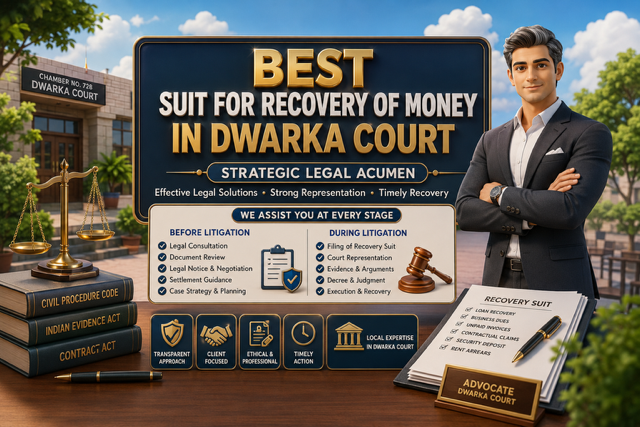
Introduction – Suit for Recovery of Money in Dwarka Court
Understanding Civil Recovery, Friendly Loans, Order XXXVII CPC, Limitation, Interest and Execution
A person may lend money to a friend or relative and receive repeated promises of repayment.
A security deposit may remain unpaid after the relationship has ended.
Money may have been transferred under a written agreement but not returned when due.
Professional fees may remain outstanding.
A person may have paid money on behalf of another and later seek reimbursement.
Or a written acknowledgment may exist showing that a specific amount remains payable.
When reminders and negotiations fail, the question becomes:
What is the correct legal proceeding for recovering the money?
Before filing a Suit for Recovery of Money in Dwarka Court, several issues should be examined:
What created the liability?
When did the money become payable?
Is the claim within limitation?
What documents prove the payment?
Has the defendant acknowledged the debt?
Was any part-payment made?
Does the claim qualify for an Order XXXVII summary suit?
Is it actually a commercial dispute instead?
Which court has territorial and pecuniary jurisdiction?
What interest can lawfully be claimed?
And if a decree is obtained, how will it be enforced?
A money recovery case should therefore begin with reconstruction of the transaction rather than simply stating:
“The defendant owes me money.”
At Ankit Gaurav Kainth & Associates, our civil litigation practice at Dwarka Courts includes ordinary recovery suits, friendly-loan disputes, security-deposit claims, contractual money claims, summary suits where legally maintainable and execution proceedings depending upon the facts and jurisdiction of the individual matter.
What Is a Suit for Recovery of Money?
A suit for recovery of money is a civil proceeding through which the plaintiff asks the Court to direct the defendant to pay a legally recoverable monetary amount.
The cause of action can arise from different relationships.
Examples may include:
- friendly or personal loan;
- written loan agreement;
- promissory note;
- refundable security deposit;
- non-commercial contractual dues;
- money paid on behalf of another person;
- professional fees;
- reimbursement claims;
- admitted financial liability;
- rent or other amounts where the appropriate civil remedy applies;
- written settlement amount;
- or another legally enforceable civil debt.
The fact that money has been transferred does not automatically mean the plaintiff will obtain a decree.
The plaintiff must establish the legal basis of the defendant’s obligation to repay or pay.
Ordinary Civil Recovery and Commercial Recovery Are Different
This distinction should now be made clearly on your website.
An ordinary civil recovery suit may arise from:
- friendly loan;
- personal financial transaction;
- refundable deposit;
- private agreement;
- reimbursement;
- non-business contractual payment;
- or another civil debt.
A commercial recovery suit may arise from a transaction falling within the Commercial Courts Act, such as qualifying business, supply, service or other commercial disputes.
The procedure can be materially different.
Commercial litigation may involve:
- Section 12A pre-institution mediation;
- Statement of Truth;
- Order XI commercial disclosure;
- stricter Written Statement timelines;
- admission and denial;
- summary judgment;
- Case Management Hearing.
An ordinary civil recovery suit should not be converted into a Commercial Court case merely because the amount is large.
Conversely, a qualifying commercial transaction should not be filed as an ordinary civil recovery suit without examining the Commercial Courts Act.
Friendly Loan Recovery
Friendly loans are among the most common ordinary recovery disputes.
Typical questions include:
- Was the money actually transferred?
- Was it a loan or a gift?
- What was the agreed repayment date?
- Was interest agreed?
- Is there a written agreement?
- Was any promissory note executed?
- Are there WhatsApp messages acknowledging the loan?
- Were any instalments repaid?
- Has the defendant admitted the liability?
- Is the claim still within limitation?
Where money was transferred through a bank account, the bank entry proves movement of funds but does not always, by itself, prove the complete legal character of the transaction.
For example, the defendant may allege that the amount represented:
- gift;
- investment;
- repayment of another obligation;
- business contribution;
- family arrangement;
- or payment for another purpose.
Therefore, surrounding correspondence and conduct can become important.
Oral Loan Versus Written Loan
A civil claim does not automatically fail merely because there is no formal loan agreement.
However, an oral transaction can create evidentiary difficulties.
The plaintiff may have to rely upon:
- bank transfers;
- WhatsApp messages;
- emails;
- witnesses;
- acknowledgments;
- repayment promises;
- part-payments;
- contemporaneous communications;
- and surrounding circumstances.
A written loan agreement can make the legal basis clearer, but even a written document must still be examined for:
amount → parties → payment → repayment date → interest → signatures → execution → admissibility.
The Court decides on evidence, not merely the heading placed on a document.
Recovery of Security Deposit
A security deposit may become refundable when:
- tenancy ends;
- licence ends;
- service agreement terminates;
- contractual purpose concludes;
- or another triggering event occurs.
The plaintiff should identify:
- amount originally deposited;
- purpose;
- agreement governing refund;
- deductions claimed by the opposite party;
- date on which refund became due;
- termination document;
- and correspondence demanding repayment.
Where the defendant claims adjustment for damage, unpaid rent or another liability, the Court may need to determine whether those deductions are contractually or legally justified.
Recovery Based on Written Agreement
Where the claim arises from a written contract, the plaintiff should identify the exact clause creating the payment obligation.
The plaint should explain:
what was agreed → what the plaintiff performed → what the defendant was required to pay → when payment became due → what remains outstanding.
Simply annexing the contract is not enough.
The pleading should connect the document with the monetary claim.
Order XXXVII CPC – Summary Suit for Recovery of Money
Some money claims may qualify for the special summary procedure under Order XXXVII of the Code of Civil Procedure, 1908.
But Order XXXVII does not apply to every recovery suit.
Broadly, it applies to specified claims such as:
- bills of exchange;
- hundies;
- promissory notes;
- debt or liquidated demand arising from a written contract;
- qualifying statutory debts; and
- guarantees concerning a debt or liquidated demand.
The plaintiff seeking summary procedure must ensure that the claim falls within Order XXXVII.
A friendly loan based only upon an oral transaction does not automatically become an Order XXXVII suit merely because the plaintiff knows the exact amount claimed.
Ordinary Recovery Suit Versus Order XXXVII Summary Suit
Ordinary Civil Recovery Suit
The defendant ordinarily files a Written Statement and the matter proceeds through the usual civil procedure.
Order XXXVII Summary Suit
The defendant must follow the special procedure prescribed under Order XXXVII and obtain leave to defend according to the applicable legal test.
This distinction can be significant.
However, Order XXXVII should not be chosen merely because it appears procedurally attractive.
The underlying claim must genuinely fall within the categories permitted by the Code.
Appearance and Leave to Defend in an Order XXXVII Suit
Order XXXVII follows a special summons procedure.
A defendant receiving summons in a summary suit should not treat it like an ordinary civil summons.
The prescribed procedure contains strict timelines for:
- entering appearance; and
- responding to a summons for judgment through an application for leave to defend.
If a defendant fails to follow the special procedure, serious consequences may follow.
A plaintiff should likewise ensure that the plaint correctly invokes Order XXXVII and does not include relief falling outside its permissible scope.
What Is a “Liquidated Demand”?
A liquidated demand is broadly a monetary liability capable of being ascertained according to the underlying written basis rather than an unquantified claim requiring assessment of uncertain damages.
For example, a written acknowledgment stating that ₹8 lakh is payable may present a very different situation from:
“I suffered approximately ₹8 lakh loss because the defendant behaved unfairly.”
The second may require proof and assessment of damages rather than simple recovery of a defined debt.
The nature of the relief matters when deciding whether Order XXXVII is available.
Limitation Is One of the Most Important Issues
A legally valid debt can become difficult to enforce through suit if limitation is allowed to expire.
Many common money claims carry a three-year limitation period, but the starting point varies according to the nature of the transaction.
For example, the Limitation Act contains different starting points for:
- money lent;
- money lent through cheque;
- deposit repayable on demand;
- money paid for the defendant;
- money received for the plaintiff’s use;
- work done;
- price of goods;
- accounts stated;
- and breach of contractual obligations.
Therefore, the question should not simply be:
“Was the transaction less than three years ago?”
The correct question is:
“Which Limitation Act provision applies, and from what event does time begin to run?”
Friendly Loan Payable on Demand – A Common Limitation Mistake
People sometimes assume that a loan stated to be “payable on demand” means limitation begins only when the lender finally sends a demand years later.
That assumption can be dangerous.
The Limitation Act specifically identifies the starting point for particular categories of money-lending claims.
The document and applicable Schedule entry should therefore be checked before waiting.
Do not postpone legal advice simply because the borrower continues promising repayment.
Acknowledgment Under Section 18 Limitation Act
A written acknowledgment can become important in recovery litigation.
Section 18 of the Limitation Act provides, subject to its requirements, that where an acknowledgment of liability is made before expiration of the prescribed limitation period, a fresh period may be computed from the date of acknowledgment.
The acknowledgment should therefore be examined for:
- timing;
- writing;
- signature or legally recognised authentication;
- identity of the person acknowledging;
- and liability acknowledged.
A message sent after limitation has already expired should not automatically be treated as though it revives every barred claim under Section 18.
Timing is critical.
Part-Payment Under Section 19 Limitation Act
Part-payment can also affect limitation where the statutory requirements are satisfied.
Section 19 deals with payment on account of debt or interest made before expiry of the prescribed period and contains its own requirements concerning acknowledgment of payment.
Therefore, where the defendant has made instalments, the plaintiff should preserve:
- bank entries;
- receipts;
- payment messages;
- acknowledgment;
- and dates.
Do not simply say:
“He paid something later, so limitation automatically restarted.”
The statutory requirements must be examined.
WhatsApp Messages and Emails as Evidence
Modern money recovery cases frequently involve electronic communications.
Messages may show:
- acknowledgment of loan;
- promise to repay;
- proposed instalments;
- dispute regarding amount;
- request for additional time;
- settlement proposal;
- or denial of liability.
Electronic records should be preserved carefully.
Deleting the original conversation and keeping only selective screenshots can create evidentiary difficulties.
Where electronic evidence is important, preservation and proof should be considered under the applicable evidence law.
Legal Notice Before Filing a Recovery Suit
A legal notice can be useful in many money recovery disputes.
It may:
- identify the transaction;
- state the amount;
- refer to relevant documents;
- demand repayment;
- record default;
- claim interest where legally supportable;
- and provide an opportunity for settlement.
However, a legal notice is not universally mandatory before every ordinary civil money recovery suit.
Whether notice is legally required depends upon the parties, cause of action and statute.
For example, proceedings against specified government authorities may involve statutory notice requirements that differ from an ordinary private recovery dispute.
A notice should therefore be sent for a legal reason—not merely because every recovery template contains one.
Settlement Before Filing
Many financial disputes can be resolved before full litigation.
A settlement may include:
- lump-sum payment;
- instalments;
- waiver of part of interest;
- agreed repayment date;
- security;
- acknowledgment of debt;
- or another documented arrangement.
But a settlement should not cause the plaintiff to ignore limitation.
If negotiations continue, the legal effect of any acknowledgment or payment should be assessed.
A verbal promise that payment will be made “next month” should not be allowed to replace limitation analysis.
Territorial Jurisdiction
A recovery suit must be filed before a court having territorial jurisdiction.
Depending upon the facts, relevant questions may include:
- where the defendant resides;
- where the defendant carries on business;
- where the loan or transaction occurred;
- where payment was made;
- where repayment was due;
- where a material part of the cause of action arose;
- and whether a legally valid jurisdiction clause exists.
A suit does not belong in Dwarka Court merely because the plaintiff lives close to Dwarka.
Jurisdiction must arise under law.
Pecuniary Jurisdiction
The amount claimed also affects the level of court before which a suit can be instituted.
Pecuniary limits are governed by the applicable statutory and court framework in force in Delhi.
The plaintiff should therefore calculate:
principal → pre-suit interest, where claimed → valuation → applicable court fee → proper court.
The plaint should not be filed until current pecuniary jurisdiction has been checked.
Court Fee in a Money Recovery Suit
Money recovery suits ordinarily require court fee calculated according to the monetary relief claimed and the applicable court-fee law.
The court fee is separate from professional fees.
Before filing, the plaintiff should clearly understand:
- principal amount;
- interest claimed up to filing;
- total suit valuation;
- court fee;
- and other filing expenses.
Inflating the claim can therefore have consequences beyond pleading strategy.
It may also increase valuation and court fee.
Interest in a Recovery Suit
A plaintiff may seek interest, but the rate should have a legal or evidentiary basis.
Potential bases may include:
- written agreement;
- promissory note;
- course of dealing;
- statutory provision;
- notice;
- or another legally recognised basis.
Section 34 CPC also gives the Court power concerning interest in a money decree.
A plaintiff should distinguish:
pre-suit interest;
interest during pendency of the suit;
and
post-decree interest.
The Court is not bound to award every interest rate written in the plaint.
Should You Claim 18% or 24% Interest Simply Because Payment Is Delayed?
Not without a proper basis.
An exaggerated interest claim can distract from an otherwise straightforward principal recovery case.
Where no contractual rate exists, the plaintiff should examine what rate can reasonably and legally be claimed.
The prayer should distinguish principal from interest so that the calculation remains transparent.
Documents Required for a Money Recovery Suit
Depending upon the case, useful documents may include:
Transaction Documents
- loan agreement;
- promissory note;
- written acknowledgment;
- receipt;
- settlement agreement;
- deposit receipt;
- contract.
Payment Evidence
- bank statement;
- NEFT/RTGS/IMPS record;
- cheque record;
- payment receipt;
- UPI record.
Communication
- WhatsApp messages;
- emails;
- SMS;
- letters;
- repayment promises.
Pre-Litigation Documents
- legal notice;
- postal receipt;
- tracking record;
- reply;
- settlement communication.
Court-Related Documents
Where connected proceedings exist:
- previous plaint;
- order;
- complaint;
- settlement order;
- cheque-bounce proceeding.
The documents should be organised chronologically.
Preparing a Transaction Chronology
A clear chronology can materially improve drafting.
For example:
10 January 2024 – ₹5 lakh transferred
15 January 2024 – borrower acknowledges receipt
30 June 2024 – agreed repayment date
10 July 2024 – borrower requests three months
25 September 2024 – ₹50,000 part-payment
15 November 2024 – written acknowledgment of balance
5 January 2025 – legal notice
This makes it easier to analyse:
- cause of action;
- outstanding principal;
- limitation;
- acknowledgments;
- part-payments;
- and interest.
A recovery plaint should tell the financial history clearly.
Defendant’s Written Statement
A defendant should not respond to a recovery suit with a blanket statement:
“Nothing is payable.”
The defence should identify:
- whether money was received;
- purpose of payment;
- whether it was loan or gift;
- amounts repaid;
- agreements;
- adjustments;
- limitation;
- jurisdiction;
- interest dispute;
- set-off;
- or another defence.
If the defendant admits receiving money but disputes the legal basis, that distinction should be explained.
A coherent defence is more useful than denial of obvious banking records.
Common Defences in Money Recovery Suits
Depending upon the case, a defendant may argue:
- money was never received;
- payment was a gift;
- payment related to another transaction;
- debt has already been repaid;
- amount claimed is incorrect;
- suit is barred by limitation;
- acknowledgment relied upon is invalid;
- court lacks territorial jurisdiction;
- plaintiff has suppressed adjustments;
- interest is unsupported;
- there is a set-off;
- or the alleged written agreement is disputed.
The plaintiff should anticipate the likely defence before filing.
Set-Off and Counterclaim
A defendant may sometimes have an independent monetary claim against the plaintiff.
For example:
The plaintiff claims ₹10 lakh.
The defendant says ₹4 lakh has already become recoverable from the plaintiff under another connected transaction.
Depending upon the legal requirements, the defendant may examine:
- set-off;
- counterclaim;
- or separate proceedings.
Limitation and court fee should be considered independently.
A counterclaim should not be filed merely to create pressure.
Can Property Be Attached Before Judgment?
Order XXXVIII Rule 5 CPC provides a protective remedy in appropriate circumstances where the statutory requirements are satisfied.
But attachment before judgment is not automatic in every recovery suit.
The plaintiff cannot simply say:
“I am afraid the defendant will not pay, therefore attach all property.”
The provision requires specific circumstances concerning an intention to obstruct or delay execution through disposal or removal of property.
It is a protective remedy, not a mechanism to turn every unsecured debt into a secured claim.
Interim Relief Should Be Evidence-Based
Where interim protection is genuinely required, the plaintiff should identify:
- specific asset;
- conduct relied upon;
- threatened disposal;
- supporting material;
- and why eventual execution may be obstructed.
Courts exercise caution because pre-judgment attachment can seriously affect the defendant.
Generic apprehension is not enough.
Evidence Stage in a Recovery Suit
If the dispute proceeds to trial, the plaintiff may have to prove:
- underlying transaction;
- payment;
- legal obligation to repay;
- default;
- amount outstanding;
- acknowledgment;
- interest basis;
- and other pleaded facts.
The defendant may produce evidence supporting repayment, gift, adjustment, limitation or another defence.
The evidence should correspond with the pleadings.
A plaintiff cannot safely rely upon a completely different transaction theory at trial from the case originally pleaded.
Cross-Examination in a Money Recovery Case
Cross-examination may focus on:
- source of funds;
- purpose of payment;
- date of transaction;
- repayment terms;
- signatures;
- messages;
- bank entries;
- part-payments;
- acknowledgments;
- interest;
- relationship between parties;
- and inconsistencies in the chronology.
In a friendly-loan case, questions about the circumstances in which the loan was allegedly advanced may become especially important.
Document preparation should therefore take place before evidence begins.

Cheque Bounce and Civil Recovery Are Different Remedies
A lender may have received a cheque toward repayment.
If that cheque is dishonoured and the statutory requirements of Section 138 NI Act are fulfilled, separate cheque-bounce proceedings may arise.
But a Section 138 complaint and a civil recovery suit are not the same remedy.
Section 138 Proceeding
Follows the Negotiable Instruments Act’s statutory framework.
Civil Recovery Suit
Seeks a civil money decree.
Different limitation periods, procedures and evidentiary questions may apply.
The existence of one remedy should not be assumed to automatically suspend limitation for another.
Recovery Suit Versus Criminal Cheating Complaint
Non-payment of money does not automatically amount to criminal cheating.
A borrower may default.
A contractual payment may remain unpaid.
That may create civil liability.
Criminal cheating requires examination of the statutory ingredients, including dishonest intention at the relevant time.
A civil recovery dispute should not be converted into criminal proceedings merely to exert pressure.
Conversely, where the facts independently disclose a criminal offence, the existence of a civil remedy does not automatically eliminate criminal law.
The remedies should be analysed separately.
Judgment and Money Decree
If the plaintiff proves the claim, the Court may pass a money decree for the amount found payable together with such interest and costs as may lawfully be awarded.
The decree should be read carefully.
It may identify:
- principal sum adjudged;
- interest;
- costs;
- and other directions.
A decree is a judicial determination of liability.
But it does not necessarily mean money will immediately arrive in the plaintiff’s bank account.
Execution – The Stage Many Plaintiffs Forget
If the judgment-debtor does not voluntarily pay, the decree-holder may need to initiate execution proceedings.
Depending upon the facts and law, execution may involve legally permissible measures against:
- bank accounts;
- movable property;
- immovable property;
- receivables;
- salary in appropriate circumstances;
- or other attachable assets.
Execution has its own procedure and possible objections.
A recovery strategy should therefore consider enforceability from the beginning.
The objective is not merely:
“Can I obtain a decree?”
but also:
“If I obtain one, how can it lawfully be satisfied?”
Settlement After Filing
A recovery suit can still settle after institution.
Parties may agree upon:
- reduced lump-sum payment;
- instalment schedule;
- interest adjustment;
- consent decree;
- mediation settlement;
- or another documented arrangement.
The settlement should clearly identify:
total amount → payment dates → mode → default consequences → treatment of suit → interest → costs.
A vague promise to pay “soon” simply recreates the original dispute.
Common Mistakes by Plaintiffs
Waiting Until Limitation Is Nearly Over
Repeated informal promises are relied upon instead of legal analysis.
Filing in the Wrong Court
Territorial or pecuniary jurisdiction is not checked.
Mixing Civil and Commercial Claims
A business claim is filed without examining the Commercial Courts Act.
Using Order XXXVII Without Eligibility
The plaintiff assumes every fixed monetary claim is automatically a summary suit.
Claiming Unsupported Interest
An excessive rate is inserted without contractual or legal basis.
Poor Evidence Preservation
Original messages, bank records or written acknowledgments are lost.
Ignoring Execution
No thought is given to whether a final decree can realistically be enforced.
Common Mistakes by Defendants
Ignoring Summons
This can create serious procedural consequences, particularly under Order XXXVII.
Denying Bank Transfers That Are Clearly Recorded
The dispute should instead address the legal purpose of the transfer where appropriate.
Failing to Preserve Repayment Proof
Cash repayments or informal adjustments become difficult to establish later.
Taking Inconsistent Defences
For example:
“I never received money”
and later:
“I received it but it was a gift.”
The defence should be identified early.
Recovery Suit Before Dwarka Court
A money recovery suit may be filed before the competent court at Dwarka only when the applicable jurisdictional requirements are satisfied.
The client’s residence alone does not create jurisdiction.
The court should be determined from:
cause of action → defendant → place of transaction/payment → applicable CPC provisions → suit valuation → current pecuniary jurisdiction.
Local court presence can assist with practical coordination.
It does not alter limitation, jurisdiction or the legal merits of the claim.
Our Approach to Civil Money Recovery
Our assessment generally follows:
Transaction → payment → legal relationship → repayment obligation → due date → limitation → acknowledgment / part-payment → evidence → jurisdiction → ordinary suit or Order XXXVII → legal notice where appropriate → plaint → defence → evidence → judgment → execution.
We separately examine whether the transaction actually belongs within the Commercial Courts framework.
This keeps ordinary civil recovery and commercial recovery properly distinguished.
| Related Page / Guide | Main Legal Issue | Recommended Anchor Text | Why It Supports This Page | Suggested Placement | Internal Link |
|---|---|---|---|---|---|
| Civil Litigation Lawyer in Dwarka Court | Plaint, Written Statement, evidence and execution | Civil Litigation in Dwarka Court | Acts as the main civil-litigation pillar supporting this specialist money-recovery page | Introduction / Civil Recovery Procedure | Read Civil Litigation Guide |
| Commercial Recovery Suit | Unpaid invoices, commercial contracts and business dues | Commercial Recovery Suit in Dwarka Court | Helps distinguish an ordinary civil money claim from a Commercial Courts Act dispute | Ordinary Civil Recovery vs Commercial Recovery | Read Commercial Recovery Guide |
| Legal Notice Advocate Dwarka Court | Demand notices and pre-litigation communication | Legal Notice for Recovery of Money | Supports the pre-litigation demand and settlement stage without implying notice is mandatory in every case | Legal Notice Before Filing | Read Legal Notice Guide |
| Cheque Bounce Lawyer in Dwarka Court | Section 138 NI Act and dishonoured cheques | Cheque Bounce Case Under Section 138 NI Act | Explains the separate statutory remedy where a cheque issued toward an alleged debt is dishonoured | Cheque Bounce and Civil Recovery | Read Cheque Bounce Guide |
| Before Filing a Case in Dwarka Court | Jurisdiction, limitation, evidence and remedy selection | Before Filing a Money Recovery Case | Supports pre-filing analysis of limitation, documents, jurisdiction and appropriate remedy | Limitation / Jurisdiction section | Read Before Filing Guide |
| Advocate Near Dwarka Court | Dwarka Court jurisdiction and court procedure | Advocate Near Dwarka Court | Provides practical Dwarka Court location and litigation information without duplicating the recovery-law content | Recovery Suit Before Dwarka Court | Read Dwarka Court Guide |
Frequently Asked Questions
What is a Suit for Recovery of Money?
It is a civil proceeding seeking a money decree based upon an alleged legally enforceable financial liability.
Can I recover a friendly loan through civil court?
Potentially yes, subject to proof, limitation, jurisdiction and the facts surrounding the loan.
Do I need a written loan agreement?
Not every civil claim necessarily requires a formal loan agreement, but absence of written documentation can make proof more difficult.
What is Order XXXVII CPC?
Order XXXVII provides a special summary procedure for specified categories of monetary claims, including certain claims based on written contracts and negotiable instruments.
Can every recovery suit be filed under Order XXXVII?
No. The claim must fall within the classes specified in Order XXXVII.
What is the limitation period for recovery of money?
Many money claims carry a three-year limitation period, but the starting date differs according to the nature of the transaction. The applicable Limitation Act entry should be identified.
Does a written acknowledgment extend limitation?
Section 18 of the Limitation Act may provide a fresh period where a valid acknowledgment is made before expiry of the existing prescribed period and its statutory requirements are fulfilled.
Does part-payment extend limitation?
Section 19 may affect limitation where payment occurs before expiry and the statutory requirements are satisfied.
Is a legal notice mandatory?
Not for every private civil recovery suit. The requirement depends upon the parties, statute and cause of action.
Can I claim interest?
Yes, where there is an appropriate legal basis. The Court determines what interest should ultimately be awarded.
Can I attach the defendant’s property before judgment?
Order XXXVIII Rule 5 provides a limited protective remedy in qualifying circumstances. It is not automatic merely because money is claimed.
Can I file both a cheque-bounce case and recovery suit?
Different remedies may potentially arise from the same transaction, but their statutory requirements and limitation periods must be examined independently.
Does winning the recovery suit mean payment is automatic?
No. If the judgment-debtor does not comply voluntarily, execution proceedings may be required.
Conclusion
A Suit for Recovery of Money in Dwarka Court should not be approached as:
“I gave money, therefore filing a case will recover it.”
A properly prepared recovery suit requires analysis of:
transaction → legal liability → repayment date → limitation → acknowledgment → part-payment → documents → jurisdiction → correct civil procedure → interest → evidence → decree → execution.
The most important distinction may sometimes be deciding whether the matter requires:
an ordinary civil recovery suit;
an Order XXXVII summary suit;
a Commercial Court recovery proceeding;
a Section 138 cheque-bounce complaint;
or another remedy.
Selecting the correct route at the beginning can prevent jurisdictional and procedural problems later.
Disclaimer: This page provides general legal information and does not constitute legal advice or guarantee recovery. Limitation, jurisdiction, court fee, interest, evidentiary requirements and available remedies depend upon the facts and documents of each individual transaction.