Which court should hear your commercial recovery claim in Delhi? This guide explains the monetary thresholds, pre-filing interest, valuation requirements and territorial checks before choosing a district Commercial Court or the Delhi High Court.
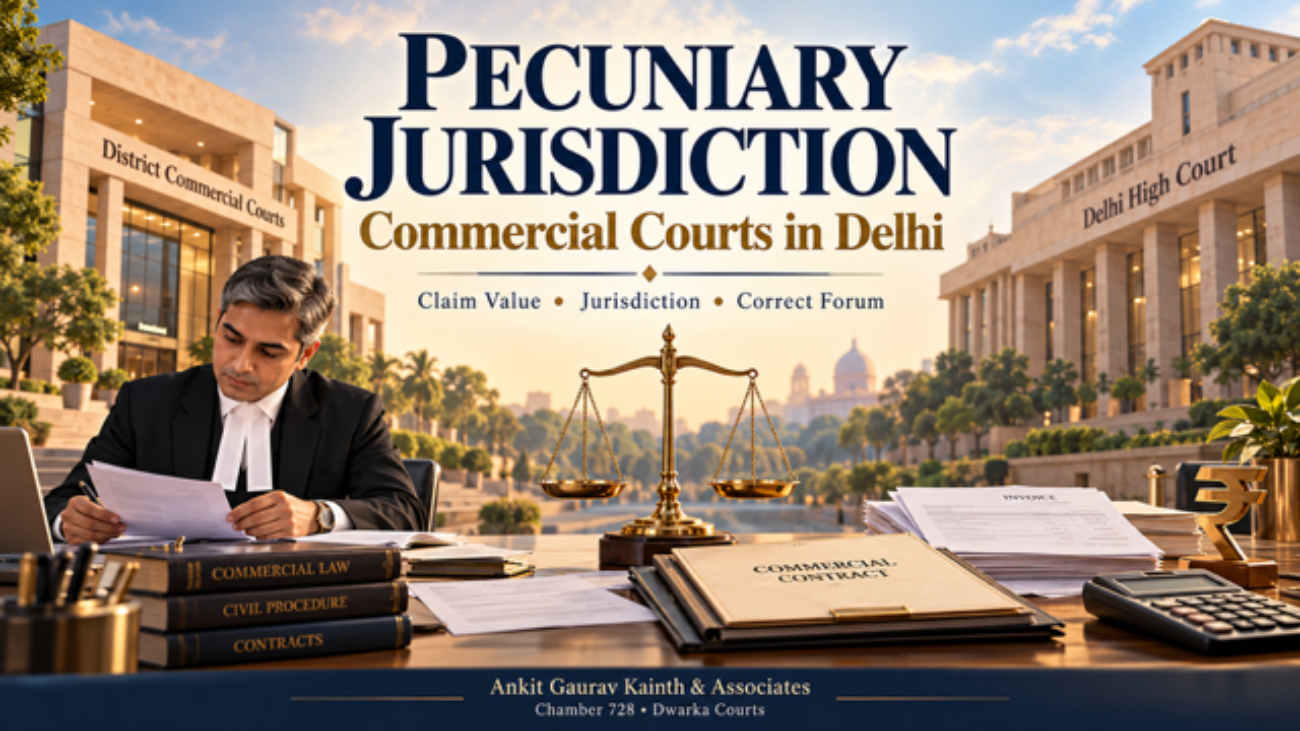
Which court should hear your commercial recovery claim in Delhi? This guide explains the monetary thresholds, pre-filing interest, valuation requirements and territorial checks before choosing a district Commercial Court or the Delhi High Court.
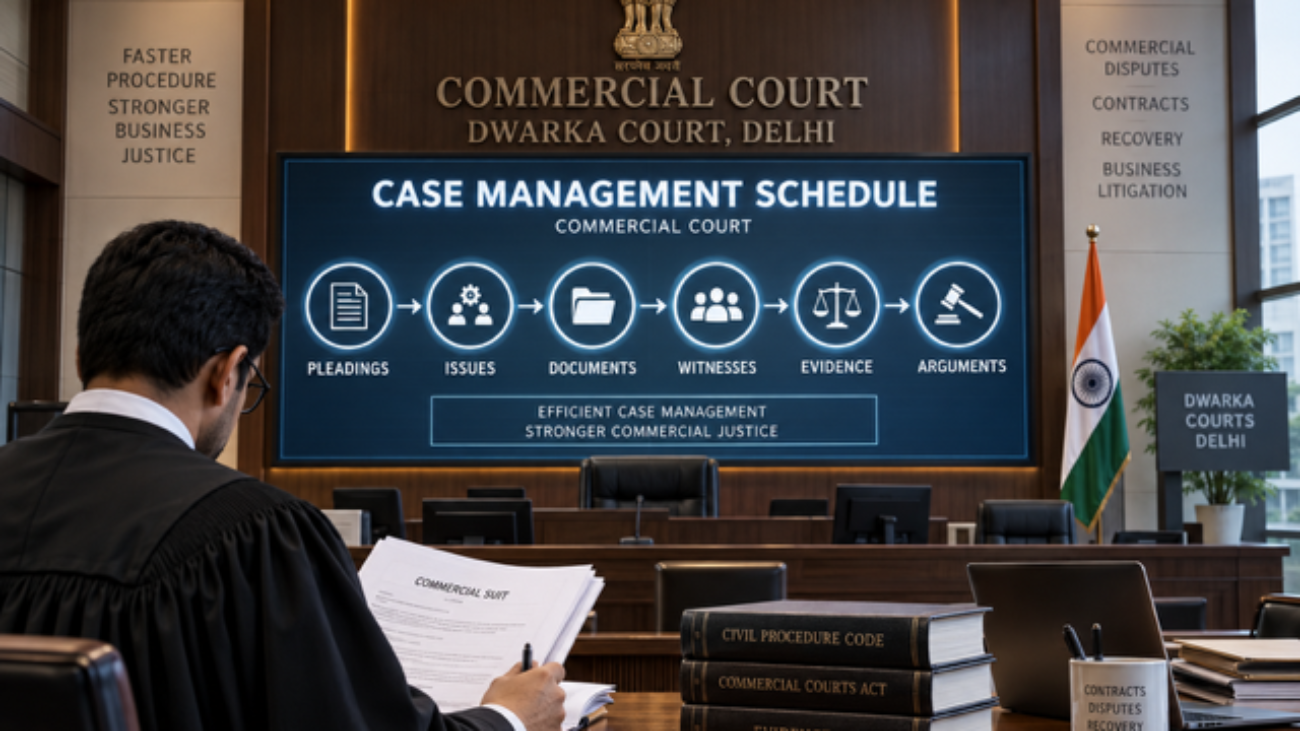

Introduction – Commercial Court Case Management Hearing Delhi
Why Order XV-A CPC Can Shape the Entire Commercial Suit Before Evidence Begins
A Commercial Court case is not supposed to proceed in the same manner as an ordinary civil dispute where dates may pass without a clear roadmap for completion of pleadings, evidence and arguments.
One of the most important procedural changes introduced for commercial litigation is the Case Management Hearing under Order XV-A of the Code of Civil Procedure, 1908, as amended for commercial disputes.
For a company, business owner, partnership firm, LLP, proprietor or individual involved in a commercial suit, the Case Management Hearing should not be treated as merely another date in Court.
It can potentially determine:
In practical terms, the Case Management Hearing can create the procedural roadmap for the remaining life of a commercial suit.
1. What Is a Case Management Hearing in a Commercial Court?
A Case Management Hearing, commonly referred to as a CMH, is a structured hearing through which the Commercial Court actively manages the progress of a commercial suit.
Order XV-A was introduced into the CPC through the Commercial Courts framework to facilitate quicker and more disciplined adjudication of commercial disputes.
The Supreme Court has also recognised that provisions such as Case Management Hearing reflect the proactive approach expected from courts dealing with commercial disputes. (SCI API)
Instead of leaving the progress of the case entirely dependent upon successive applications and adjournments, the Court can identify the matters that genuinely require adjudication and establish a schedule for moving the suit towards evidence and arguments.
For businesses involved in litigation, this is important because commercial litigation often involves substantial invoices, contracts, purchase orders, accounts, emails, banking transactions and business relationships.
Delay itself can carry a commercial cost.
2. When Should the First Case Management Hearing Take Place?
Order XV-A Rule 1 provides that the first Case Management Hearing is to be held not later than four weeks from the date on which affidavits of admission or denial of documents have been filed by all parties to the suit. (India Code)
This makes the stage of admission and denial of documents particularly important.
Before arriving at the Case Management Hearing, both parties should therefore have clarity regarding documents such as:
A party that approaches the Case Management Hearing without understanding its own documentary record may lose an important opportunity to properly frame the controversy.
3. What Orders Can the Commercial Court Pass at a Case Management Hearing?
Once the Court finds that questions of fact or law require trial, Order XV-A permits the Court to structure how that trial will proceed.
Among other things, the Court may:
This is why CMH preparation should begin before the hearing, not when counsel enters the courtroom.
A commercial litigant should already know what the real dispute is.
4. Why Is Case Management Different From an Ordinary Civil Suit?
The Commercial Courts Act was designed to introduce greater procedural discipline in commercial disputes.
| Ordinary Civil Litigation | Commercial Court Litigation |
| Progress may follow the conventional civil procedure | Greater emphasis on structured case management |
| Evidence dates may develop gradually | Court can establish an evidence schedule |
| Parties may attempt repeated procedural applications | Court can actively narrow the controversy |
| Witness planning may happen later | Witnesses may be identified during case management |
| Final arguments may arise after completion of evidence | Written and oral argument schedules can be fixed beforehand |
| Litigation is largely party-driven | Commercial Court is expected to take a more proactive managerial role |
The objective is not merely speed for the sake of speed.
The objective is to prevent unnecessary procedural delay while still preserving the parties’ opportunity to establish their respective claims and defences.
Delhi High Court has also issued a specific practice direction concerning Case Management Hearings/Pre-Trial Conferences in Commercial Courts, reinforcing their practical significance in Delhi commercial litigation. (Delhi High Court)
5. The Six-Month Framework Makes Preparation Important
One of the most striking provisions of Order XV-A is Rule 3.
While fixing dates under the case-management framework, the Court is required to ensure that arguments are closed not later than six months from the date of the first Case Management Hearing. (Indian Kanoon)
This statutory framework shows the seriousness with which commercial litigation timelines are intended to be treated.
That does not mean that every commercial suit in practice will automatically conclude within exactly six months of the first CMH regardless of circumstances.
Commercial disputes can involve complex evidence, interlocutory proceedings and other procedural developments.
However, the provision makes one point very clear:
Commercial litigation is not designed around unlimited procedural opportunities.
A plaintiff or defendant who postpones preparation can find the litigation moving faster than expected.
6. Why a Plaintiff Must Prepare Before the Case Management Hearing
Consider a company that has filed a commercial recovery suit for unpaid supplies.
The plaintiff may believe that producing invoices is sufficient.
But the defendant may allege:
Before the Case Management Hearing, the plaintiff should therefore be able to answer:
What exactly requires evidence?
For example:
If delivery itself is admitted, is a witness required merely to prove delivery?
If invoices are admitted but payment is disputed, should the evidence focus primarily on accounts and bank transactions?
If emails contain acknowledgment of dues, have those emails been properly disclosed and relied upon?
If the defendant denies the ledger, who will prove the accounts?
Good commercial litigation involves identifying these questions early.
7. Why a Defendant Should Never Treat CMH as a Routine Date
The Case Management Hearing can be equally important—sometimes more important—for a defendant.
A defendant should know precisely:
A vague written statement followed by an equally vague trial strategy can create serious difficulty later.
Commercial litigation rewards a defence that is document-driven, specific and consistent.
For example, simply stating that “nothing is payable” may carry far less strategic value than showing:
Invoice No. 143 – admitted
Invoice No. 151 – goods returned
Invoice No. 168 – payment transferred on 12 March
Invoice No. 172 – disputed because material failed inspection
That is the type of clarity which helps define the real controversy.
8. Case Management Hearing and Summary Judgment Are Closely Connected
Commercial litigation also contains an important mechanism known as summary judgment under Order XIII-A CPC.
The two procedures should not be confused.
A simple way of understanding the difference is:
Summary Judgment:
Does this dispute—or a part of it—really require a trial?
Case Management Hearing:
If a trial is required, how should that trial be organised efficiently?
Order XV-A expressly gives the Court power, before framing issues, to hear and decide a pending application under Order XIII-A. (Indian Kanoon)
Therefore, a party preparing for CMH should also ask an important strategic question:
Do all issues genuinely require evidence, or can some part of the dispute be decided without a full trial?
That assessment should be made from the pleadings and documentary record rather than as a routine litigation tactic.
9. Witnesses Should Be Chosen for a Purpose
Commercial disputes frequently generate enormous records but may require relatively few witnesses.
For example, in a ₹30 lakh unpaid-invoice dispute, the real witnesses might only include:
Calling numerous witnesses who add nothing to the actual disputed issues can prolong proceedings unnecessarily.
Delhi High Court’s procedural guidance on commercial cases specifically contemplates examining witness lists and limiting witnesses to those genuinely necessary for adjudication. (Delhi High Court)
The correct question should therefore not be:
“How many witnesses can we call?”
It should be:
“Which witness proves which disputed fact?”
10. Evidence May Proceed on a Much Tighter Schedule
Order XV-A also contemplates, as far as possible, the recording of oral evidence on a day-to-day basis until cross-examination of the witnesses is complete. (Madhya Pradesh High Court)
This is another reason parties should prepare documents and witnesses beforehand.
A company should not discover on the morning of evidence that:
Commercial litigation strategy must therefore extend beyond filing the plaint or written statement.
Trial preparation should start early.
A Practical Commercial Recovery Example
Consider the following situation:
ABC Components Pvt. Ltd. supplies machinery parts worth ₹32 lakh to XYZ Manufacturing Ltd.
ABC claims that ₹19 lakh remains unpaid.
XYZ does not completely deny the business relationship but argues that:
At the Case Management Hearing, the real controversy can potentially be narrowed to questions such as:
Issue 1
What amount is actually outstanding after admitted payments?
Issue 2
Were the allegedly defective goods formally rejected?
Issue 3
Were the returned goods received and acknowledged by ABC?
Issue 4
Are the claimed invoices supported by delivery records?
Issue 5
Is XYZ entitled to any adjustment, set-off or other defence claimed in its pleadings?
Once the dispute is properly defined, the Court and parties can identify the documents and witnesses genuinely necessary to resolve it.
That is the practical value of case management.
Plaintiff Checklist Before a Case Management Hearing
A plaintiff should ordinarily review:
Defendant Checklist Before a Case Management Hearing
A defendant should ordinarily review:
Can the Commercial Court Hold More Than One Case Management Hearing?
Yes.
Order XV-A permits the Court, where necessary, to conduct further Case Management Hearings during trial to ensure adherence to the schedule and facilitate speedy disposal. (svrkrn’s blog)
Therefore, case management is not merely a one-time procedural formality.
It can remain relevant throughout the trial.
What Happens if a Party Ignores the Case Management Schedule?
Directions passed during a Case Management Hearing should be taken seriously.
Order XV-A provides consequences for non-compliance with case-management directions. Depending on the circumstances, the Court has procedural powers including costs and, in cases of wilful and repeated non-compliance where costs are inadequate, potentially much more serious consequences concerning the claim or defence. (Indian Kanoon)
The appropriate consequence will depend upon the facts and the nature of the default.
The practical lesson is straightforward:
Do not assume that a deadline fixed in a Commercial Court can casually be ignored and repaired later.
Case Management Hearing in Commercial Court, Dwarka Delhi
Businesses operating in Dwarka, Janakpuri, Vikaspuri, Uttam Nagar, Najafgarh, Palam, Delhi Cantonment, Kapashera and other parts of South-West Delhi may find their commercial disputes coming before the competent Commercial Court depending upon territorial and pecuniary jurisdiction and the nature of the dispute.
Common commercial disputes may arise from:
The Commercial Courts Act defines a wide range of transactions capable of constituting a “commercial dispute,” but jurisdiction should be examined on the facts of each matter. (India Code)
A dispute does not become a commercial suit merely because one of the parties happens to be a company.
The nature of the transaction matters.
The Bigger Lesson: Commercial Litigation Should Be Prepared Backwards
A useful way to prepare a commercial case is to start with the final question:
What must ultimately be proved before the Court?
Then work backwards:
Final arguments
↑
Evidence
↑
Witnesses
↑
Issues
↑
Admission and denial
↑
Documents
↑
Pleadings
The Case Management Hearing sits at the centre of this process.
It connects what the parties have pleaded with what they will eventually need to prove.
For that reason, businesses should not view commercial litigation merely as filing a recovery suit or submitting a written statement.
The better question is:
What is our complete litigation strategy from pleadings to final arguments?
That is precisely where proper case management becomes valuable.
Frequently Asked Questions
1. What is a Case Management Hearing in a Commercial Court?
It is a structured hearing under Order XV-A CPC through which the Commercial Court can organise issues, witnesses, evidence, written arguments, oral submissions and the future timetable of the commercial suit.
2. When is the first Case Management Hearing held?
Order XV-A contemplates the first CMH being held not later than four weeks after all parties have filed their affidavits of admission or denial of documents.
3. What is Order XV-A CPC?
Order XV-A is the special case-management framework applicable to commercial disputes under the CPC as amended by the Commercial Courts regime.
4. Can the Court fix evidence dates during the CMH?
Yes. The Court can fix deadlines for evidence affidavits and dates for recording witness evidence.
5. Can the Court limit witnesses?
The Court can manage the witness schedule and commercial litigation procedure is intended to prevent unnecessary prolongation of trial.
6. Is the Case Management Hearing relevant only to plaintiffs?
No. It can be equally important for defendants because the defence, documentary disputes, witnesses and evidence strategy may be crystallised at this stage.
7. Can a summary judgment application be considered during case management?
Yes. Before framing issues, Order XV-A permits the Court to hear and decide a pending application under Order XIII-A.
8. Can there be another Case Management Hearing later?
Yes. The Court may hold further Case Management Hearings during trial where required to ensure adherence to the schedule and facilitate speedy disposal.
9. Can parties settle after a Case Management Hearing?
Yes. Settlement remains possible during commercial litigation. Delhi High Court’s procedural guidance also recognises exploration of settlement while managing commercial disputes. (Delhi High Court)
10. Why are documents so important in Commercial Court cases?
Commercial disputes are frequently decided around contracts, invoices, accounts, correspondence, banking records and admissions. Proper disclosure, admission/denial and organisation of these documents can substantially narrow what actually requires trial.
Conclusion
A Case Management Hearing in a Commercial Court is not merely another procedural date.
It can become the stage at which the Court transforms a large bundle of pleadings and documents into a defined litigation roadmap:
ISSUES → WITNESSES → EVIDENCE → ARGUMENTS → DECISION
For both plaintiffs and defendants, preparation before this hearing can help identify weaknesses, clarify documentary disputes, reduce unnecessary evidence and ensure that the litigation strategy is aligned with the accelerated procedural framework applicable to commercial cases.
Businesses involved in Commercial Court proceedings in Delhi should therefore approach the Case Management Hearing with the same seriousness they would attach to evidence or final arguments.
Advocate Ankit Gaurav Kainth & Associates assists businesses, companies, proprietors and individuals in commercial disputes before the Commercial Courts in Delhi, including commercial recovery suits, written statements, document strategy, interim applications, evidence and trial preparation.
This article is intended for general legal information and does not constitute legal advice. Commercial disputes should be evaluated on their individual facts, contractual documents, jurisdiction and applicable law.
Written Statement in Commercial Court with important links
| Important Topics | Text |
| Commercial Court practice page | Commercial Court Lawyer in Dwarka Court |
| Commercial Court Recovery Suit: | When Does the Limitation Period Start? |
| Commercial Lease Dispute Dwarka | Powerful Ground Every Client Should Know |
| Written Statement 120 Days in Commercial Court Recovery Suit | Important Law |
| Commercial Money Recovery Suit in Delhi | A Complete Guide for International Clients & Foreign Companies |
| The Unassailable Blueprint to Lead Defence Evidence Like a Professional in Commercial Court Cases | Advanced Litigation Strategies Every Lawyer Should Master |
| Commercial Court Is Fast | But Only If Your Lawyer Does This in Delhi Court |
| Why Businesses Lose Strong Commercial Cases Despite Having Agreements? | Experienced Commercial Court Advocate Dwarka Delhi |
| Powerful Commercial Court Recovery Case | Acquittal Strategies for Fearless Defence |
| What Happens After Receiving a Legal Notice | in a Commercial Matter? |
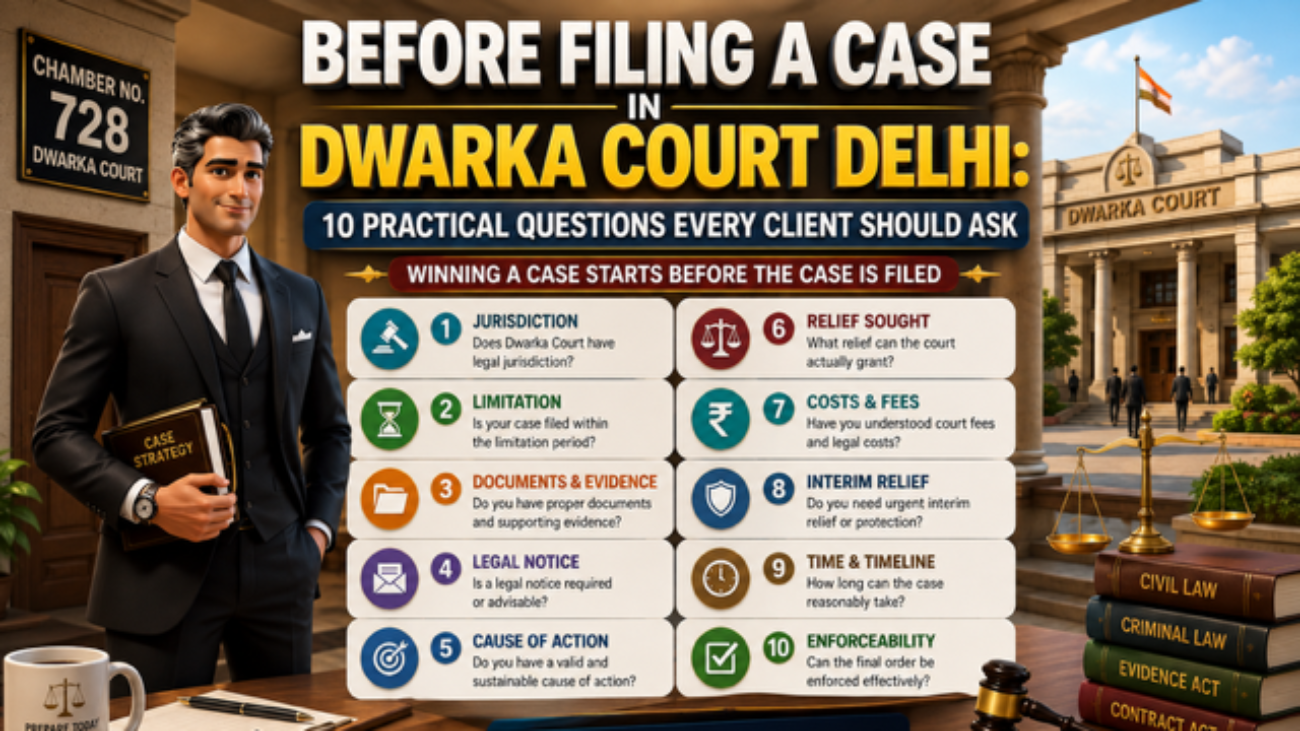
Introduction – Before Filing a Case in Dwarka Court Delhi – Ankit Gaurav Kainth 18+ Years Experience in Litigation Civil & Criminal Case
Going to court should not be the first reaction to every dispute. It should be a considered legal decision.
Before Filing a Case in Dwarka Court Delhi, a client should first understand the jurisdiction, limitation period, evidence, legal remedy, likely costs and practical purpose of litigation.
A strong case is often built before the first document reaches the filing counter.
At Ankit Gaurav Kainth & Associates, our approach is simple: first understand the dispute, then examine the documents, identify the correct remedy and only thereafter decide the legal strategy.
With 18+ years of litigation experience in Dwarka Court, we have seen an important reality:
Winning a case starts before the case is filed.
Here are 10 practical questions every client should consider – Before Filing a Case in Dwarka Court Delhi
⚖️ Quick Checklist Before Filing Your Case
| Question | Why It Matters |
| 1. Does Dwarka Court have jurisdiction? | A case must be filed before the correct court |
| 2. Is the case within limitation? | Delay may affect the legal remedy |
| 3. Do I have proper documents? | Evidence supports your allegations |
| 4. Is a legal notice required? | Some matters require or benefit from pre-litigation steps |
| 5. What is my cause of action? | The case must disclose a sustainable legal grievance |
| 6. What relief can the court actually grant? | Expectations must match the law |
| 7. What will litigation cost? | Court fees and professional fees should be understood |
| 8. Do I need urgent interim relief? | Delay may defeat the immediate purpose |
| 9. How long can the matter take? | Litigation requires realistic expectations |
| 10. Can the final order be enforced? | A judgment is useful only if it provides practical relief |
1. Does Dwarka Court Have Jurisdiction?
Before Filing a Case in Dwarka Court Delhi, the first question should be: Can this case legally be filed here?
Jurisdiction may depend on several factors. These include the nature of the dispute, location of property, place where the cause of action arose, residence or business of parties, value of the claim and applicable statute.
A convenient court is not automatically the correct court.
Therefore, jurisdiction should be examined before drafting begins. Filing before the wrong forum may lead to delay, additional expense or return of proceedings.
Being local Advocates in Dwarka Court helps us understand the practical filing system and court procedures. However, jurisdiction must still come from law and facts.
2. Is Your Case Within Limitation?
A good claim can face serious difficulty if it is filed too late.
Different proceedings have different limitation rules. Moreover, the starting point for limitation can itself become disputed.
For example, a recovery dispute, contractual claim, property dispute or appellate proceeding may involve different limitation considerations.
Therefore, Before Filing a Case in Dwarka Court Delhi, identify:
When did the right to sue arise?
Do not wait until the last few days.
Old emails, acknowledgements, payments, notices, agreements and other events may also require legal examination while determining limitation.
3. What Documents and Evidence Do You Actually Have?
Clients often tell an advocate:
“Sir, everything happened exactly as I am telling you.”
That is important. However, a court decides disputes on pleadings, admissible material, evidence and applicable law.
So ask:
✅ Is there a written agreement?
✅ Are payments reflected in bank records?
✅ Do you have WhatsApp messages or emails?
✅ Are invoices available?
✅ Are there photographs or videos?
✅ Are original documents available?
✅ Are there witnesses?
✅ What documents does the opposite party possess?
Whether you consult a Civil Litigation Lawyer in Delhi, Property Dispute Advocate, Recovery Suit Counsel, Commercial Litigation Lawyer Dwarka or Cheque Bounce Lawyer in Dwarka Court, documents can fundamentally change case strategy.
4. Should a Legal Notice Be Sent First?
Not every dispute requires the same pre-litigation step.
In some cases, a statutory notice may be necessary. In others, a carefully drafted legal notice can clarify the dispute, formally demand compliance, preserve a record or create an opportunity for settlement.
However, sending an aggressive notice without understanding the case may also disclose your strategy prematurely.
Therefore, the question is not simply:
“Should I send a notice?”
The better question is:
“What legal purpose will this notice serve?”
That is why pre-litigation consultation matters.
5. What Is Your Actual Cause of Action?
Before Filing a Case in Dwarka Court Delhi, a client must distinguish between feeling wronged and having a legally sustainable cause of action.
Courts provide legal remedies. They do not resolve every personal disagreement.
For example, a property dispute may require injunction, possession, declaration, partition or specific performance depending upon the facts.
Likewise, a commercial dispute may involve recovery, contractual enforcement or another statutory remedy.
In criminal matters, the factual allegations must disclose the ingredients of the alleged offence.
Therefore, the correct remedy starts with identifying the correct legal wrong.
6. What Relief Can the Court Realistically Grant?
This is one of the most important questions.
Clients sometimes focus entirely on proving that the opposite party acted wrongly. However, litigation should also have a clear objective.
Ask:
What exactly do I want the court to order?
Money recovery?
Possession?
Injunction?
Declaration?
Bail?
Setting aside an order?
Compensation?
Enforcement of a contractual right?
Before Filing a Case in Dwarka Court Delhi, your desired outcome should be compared with the relief that the law and chosen forum can actually provide.
A responsible advocate should explain both the strengths and limitations of the proposed proceeding.
7. Have You Understood Court Fees and Advocate Fees?
Litigation has financial implications.
Depending upon the proceeding, court fees may be linked to the nature of relief or valuation. Other procedural expenses can also arise.
Professional fees should likewise be discussed transparently.
At our office, we believe professional relationships work better when expectations are clear. Therefore, we follow a system that may include:
✅ Proper Lawyer-Client Fee Agreements
✅ Clear professional fee discussions
✅ Fee receipts and acknowledgements
✅ Transparent communication
✅ Honest and fair professional dealings
The purpose is simple: the client should understand the professional arrangement before substantial legal work begins.
8. Do You Need Immediate Interim Relief?
Sometimes the final case is not the client’s most urgent concern.
The immediate problem may be:
“The property may be sold.”
“I may be dispossessed.”
“An adverse action is imminent.”
“I need bail.”
“Important evidence may disappear.”
In such cases, the possibility of interim relief should be examined at the beginning.
For civil litigation, this could involve an interim injunction or another protective order. In criminal proceedings, clients may require advice from a Regular Bail & Anticipatory Bail Lawyer Dwarka depending upon the circumstances.
Urgency should be genuine, supported by facts and properly presented.
9. How Long Can the Case Take?
No responsible advocate should casually promise an exact date for final disposal.
The timeline can depend upon the type of proceeding, service of parties, number of witnesses, interim applications, court workload, evidence, adjournments and appeals.
Therefore, Before Filing a Case in Dwarka Court Delhi, clients should prepare for litigation as a process rather than a single hearing.
Our team assists clients during ongoing litigation through court appearances, drafting, filing, document preparation and case updates.
Moreover, we maintain communication through telephone and dedicated WhatsApp support so that clients can remain informed about their matters.
10. Can You Enforce the Final Order?
This question is often forgotten.
Suppose you obtain a money decree. Does the opposite party have identifiable assets?
Suppose you obtain an injunction. Is the order practically enforceable?
Suppose settlement is possible today. Could it provide a faster and more certain commercial solution than several years of contested litigation?
The objective should not merely be:
“I want to win.”
Instead, ask:
“What practical result will this litigation achieve?”
A legally favourable order has greater value when it can actually protect or enforce the client’s rights.
🤝 Should Settlement Be Considered Before Litigation?
Settlement is not necessarily weakness.
In suitable matters, a well-structured settlement can save time, cost and uncertainty. However, settlement should be evaluated from a position of legal understanding.
Before Filing a Case in Dwarka Court Delhi, we may examine whether negotiation, mediation, legal notice or another pre-litigation process is commercially and legally sensible.
If settlement is unsuitable or unsuccessful, litigation can then proceed with a clearer understanding of the dispute.
Pre-Litigation Assistance: Why Preparation Matters
Our work can begin before the case reaches court.
At the pre-litigation stage, we may:
✅ Understand the complete factual history
✅ Review documents and electronic records
✅ Examine jurisdiction and limitation
✅ Identify the appropriate legal remedy
✅ Consider notices and pre-litigation requirements
✅ Assess the need for urgent relief
✅ Discuss settlement possibilities
✅ Explain likely procedural steps
This process can reveal weaknesses before they become problems inside the courtroom.
Therefore, pre-litigation consultation is not merely about asking, “Can I file a case?”
It is about asking:
“What is the most appropriate legal strategy?”
Litigation Assistance After the Case Is Filed
Once litigation begins, strategy must continue.
Our work may include drafting pleadings and applications, filing proceedings, court appearances, evidence preparation, cross-examination strategy, interim applications, final arguments and regular case updates.
Clients looking for a Criminal Advocate Dwarka, Criminal Disputes Advocate Dwarka Court, Commercial Litigation Lawyer Dwarka, Lawyer in South West Delhi or Advocate in Dwarka Court should choose counsel according to the nature and complexity of their dispute.
Local court familiarity can help with coordination and procedural efficiency. Nevertheless, every case must ultimately stand on its own facts, evidence and law.
📍 Local Litigation Practice Near Dwarka Court
Our practice at Dwarka Court serves clients from Dwarka Sector 6, Sector 10, Sector 12, Sector 23, Dwarka North and Dwarka South.
Clients also approach Dwarka Court from Janakpuri, Vikaspuri, Uttam Nagar, Najafgarh, Delhi Cantonment, Chhawla, Bindapur, Baba Haridas Nagar, Mohan Garden, Palam Village, Samalka, Dabri, Jaffarpur Kalan and Kapashera.
For people searching for an advocate near Dwarka Court, local accessibility can make consultation, document review and case coordination easier.
Frequently Asked Questions – Before Filing a Case in Dwarka Court Delhi
1. What should I do before filing a case in Dwarka Court?
First, collect your documents and prepare a clear chronology. Then examine jurisdiction, limitation, evidence, cause of action, available relief and litigation costs with an advocate.
2. Do I always need to send a legal notice before filing?
No. The requirement depends upon the nature of the case and applicable law. In some disputes a notice is mandatory, while in others it may simply be strategically useful.
3. How do I know whether Dwarka Court has jurisdiction?
Jurisdiction depends on factors such as the nature of the dispute, territorial connection, property location, cause of action, valuation and applicable law. It should be examined case by case.
4. Should I settle or file a court case?
There is no universal answer. Consider the strength of evidence, urgency, value of the dispute, enforceability, cost, time and terms being offered. A legally sound settlement can sometimes be more practical than prolonged litigation.
5. Can an advocate tell me whether I will win before filing?
An advocate can assess strengths, weaknesses and available remedies. However, litigation outcomes depend upon evidence, law, the opposite party’s case and judicial determination. No outcome should be guaranteed.

Conclusion: Prepare First, Litigate Second
Before Filing a Case in Dwarka Court Delhi, ask yourself one final question:
“Have I prepared my case before deciding to fight it?”
Good litigation starts with documents, jurisdiction, limitation, evidence and a clear objective.
It also requires realistic expectations about time, cost, interim relief, settlement and enforcement.
Therefore, do not treat filing as the first step.
Preparation is the first step.
After 18+ years of litigation practice in Dwarka Court, our approach remains centred on careful preparation, professional communication and transparent dealings.
⚖️ Winning a case starts before the case is filed.
📞 Pre-Litigation Consultation – Dwarka Court Delhi
If you are considering civil, criminal, property, recovery, cheque bounce, commercial or other litigation in Dwarka Court, you may arrange a professional consultation to understand the appropriate legal remedy before taking action.
Ankit Gaurav Kainth & Associates
Advocates – Dwarka Court, Delhi
📞 9899085554
📞 9811885554
Please keep your important documents, notices, agreements, court papers and a brief chronology of events ready for consultation.
Disclaimer: This article contains general legal information and is not a substitute for advice based on the facts of a particular case. Jurisdiction, limitation, remedies, court fees, procedure and outcomes depend upon the applicable law and individual circumstances. No outcome is guaranteed.
| Important Topics | Text |
| Commercial Court practice page | Commercial Court Lawyer in Dwarka Court |
| Commercial Court Recovery Suit: | When Does the Limitation Period Start? |
| Commercial Lease Dispute Dwarka | Powerful Ground Every Client Should Know |
| Written Statement 120 Days in Commercial Court Recovery Suit | Important Law |
| Commercial Money Recovery Suit in Delhi | A Complete Guide for International Clients & Foreign Companies |
| The Unassailable Blueprint to Lead Defence Evidence Like a Professional in Commercial Court Cases | Advanced Litigation Strategies Every Lawyer Should Master |
| Commercial Court Is Fast | But Only If Your Lawyer Does This in Delhi Court |
| Why Businesses Lose Strong Commercial Cases Despite Having Agreements? | Experienced Commercial Court Advocate Dwarka Delhi |
| Powerful Commercial Court Recovery Case | Acquittal Strategies for Fearless Defence |
| What Happens After Receiving a Legal Notice | in a Commercial Matter? |
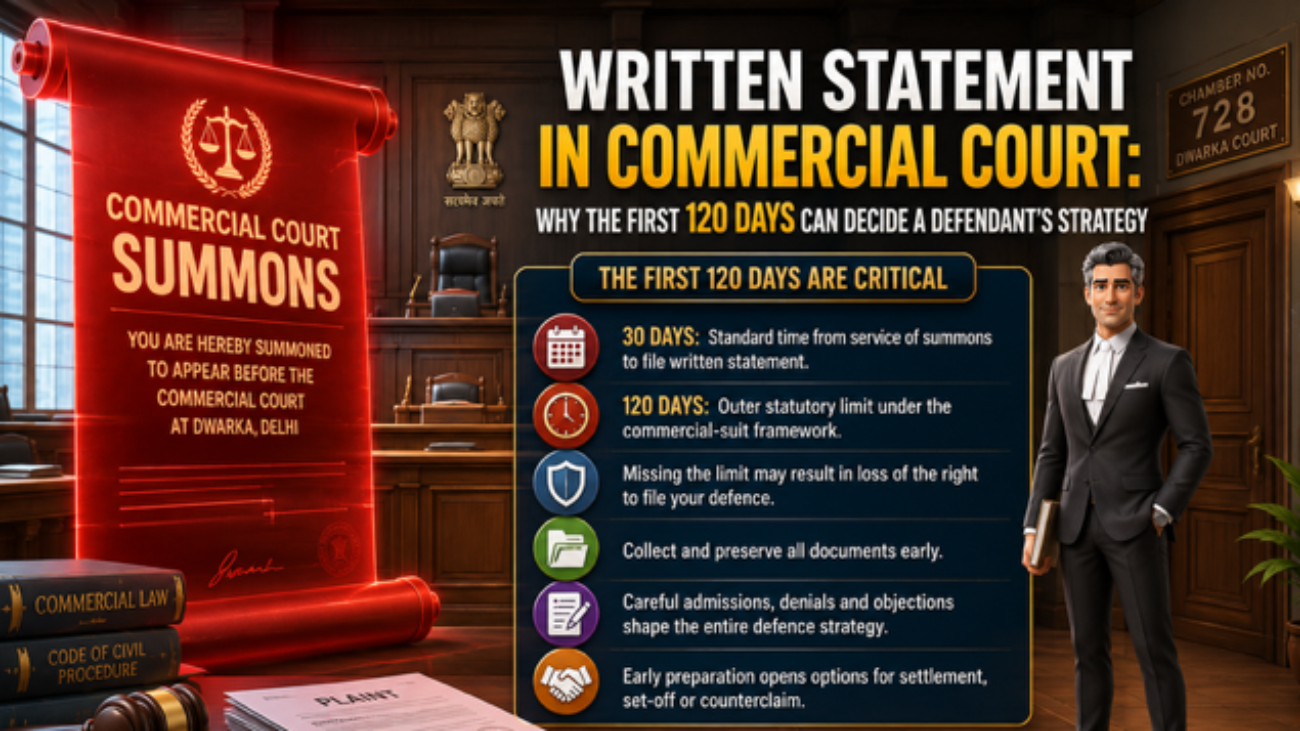
Introduction – Written Statement in Commercial Court
A company receives summons from the Commercial Court at Dwarka in a recovery suit claiming ₹38 lakh towards unpaid invoices.
The next hearing is several weeks away.
The director thinks:
“There is still plenty of time. We will prepare the reply later.”
That approach can be risky.
In commercial litigation, the Written Statement in Commercial Court is not merely a reply to allegations. It may become the foundation of the defendant’s documentary, procedural and trial strategy.
The first exercise should therefore be:
SUMMONS → DATE OF SERVICE → DEADLINE → DOCUMENTS → DEFENCE → DISCLOSURE → ADMISSION/DENIAL → WRITTEN STATEMENT → STRATEGY
Most importantly, the statutory 120-day period should be understood as an outer limit under the commercial-suit framework—not as a target date for beginning preparation.
⚖️ Written Statement in Commercial Court: What Should a Defendant Do During the First 120 Days?
| Stage | What the Defendant Should Do | Why It Matters | Mistake to Avoid |
| 1 | Record date and mode of service | Deadline may run from service | Guessing the date later |
| 2 | Obtain complete plaint | Defence needs complete allegations | Reading summons only |
| 3 | Calculate applicable deadline | Commercial timelines are strict | Treating Day 120 as target |
| 4 | Identify preliminary objections | Jurisdiction and maintainability may matter | Using boilerplate objections |
| 5 | Collect business records | Defence is often document-driven | Waiting until drafting starts |
| 6 | Reconcile monetary claim | Claimed amount may be disputed | Accepting plaintiff’s ledger |
| 7 | Prepare admissions/denials | Vague denials may be inadequate | Denying everything mechanically |
| 8 | Organise disclosure | Commercial suits require structured disclosure | Hiding adverse documents |
| 9 | Examine set-off/counterclaim | Defendant may have independent claims | Discovering them too late |
| 10 | Finalise and file | Pleading, documents and verification must align | Last-day filing strategy |
This is a workflow. It is not an invitation to wait for Day 120.
What Is a Written Statement in a Commercial Suit?
A written statement is commonly described as the defendant’s reply to the plaint.
That description is incomplete.
A properly prepared commercial written statement may explain:
Therefore, careless admissions can create difficulty later.
Likewise, a vague sentence such as “contents are wrong and denied” may not be a substitute for a carefully prepared paragraph-wise defence.
⚠️ Written Statement in Commercial Court: The 30-Day and 120-Day Framework
The Commercial Courts Act modifies the CPC for commercial disputes.
Under Order VIII Rule 1, read with the commercial amendments, a defendant is expected to present the written statement within 30 days from service of summons.
If that does not happen, the Court may permit filing later, subject to the statutory framework, recorded reasons and costs. However, for commercial suits governed by this regime, the amended provisions impose an outer limit of 120 days from service of summons. On expiry of that period, the statutory language provides for forfeiture of the right to file the written statement. (India Code)
The Supreme Court in SCG Contracts India Pvt. Ltd. v. K.S. Chamankar Infrastructure Pvt. Ltd. emphasised the mandatory nature of these commercial-suit amendments and held that inherent powers cannot ordinarily be used to bypass the statutory 120-day bar. (Sci API)
More recently, the Supreme Court in 2025 again described the commercial-dispute provisions as imposing an absolute embargo after expiry of the statutory 120-day period in the case before it. (Sci API)
A Delhi High Court Division Bench in August 2025 likewise upheld the consequence where no written statement had been filed within the 120-day period in a district-level commercial matter. (Delhi High Court)
The practical lesson
Do not think:
“I have 120 days.”
Think:
“My defence preparation starts on the date summons is served.”
The actual computation must still be checked from the service record and procedural history.
When Does the Written Statement Clock Start?
The date of service can become critical.
A defendant should preserve:
✅ Physical envelope
✅ Email through which papers were received
✅ Electronic service record
✅ WhatsApp/service communication where applicable
✅ Court order recording service
✅ Complete summons and plaint set
Questions may arise regarding whether summons were properly served, whether complete papers accompanied service and what the court record shows.
Therefore, do not casually state a service date from memory.
Your advocate should examine the actual record.
For district Commercial Courts such as Dwarka, one should also avoid relying on procedural rules designed specifically for original-side proceedings before the Delhi High Court unless they legally apply to the particular case.
📂 Your Documents Build Your Written Statement – Written Statement in Commercial Court
A Written Statement in Commercial Court should rarely be drafted in isolation from the underlying business records.
Suppose the plaintiff claims ₹38 lakh.
Before drafting, the defendant should collect:
Importantly, preserve helpful documents as well as documents that may appear adverse.
Commercial litigation is not the place to delete inconvenient emails or accounting records.
Disclosure: Why Commercial Court Defendants Must Organise Documents Early
Commercial litigation has a more structured disclosure regime.
Order XI, as substituted for commercial disputes, places significant emphasis on disclosure of documents within a party’s power, possession, control or custody.
Accordingly, document preparation should begin alongside the written statement—not several months later.
The statutory framework also requires commercial pleadings to be verified through a Statement of Truth in the prescribed manner. The law expressly provides consequences where a pleading is not properly verified. (India Code)
This is one reason why the defendant must provide complete and accurate instructions.
Do Not Deny Every Document Mechanically – Written Statement in Commercial Court
Admission and denial of documents can significantly narrow the dispute.
A defendant should distinguish between different questions:
Did I receive this document?
Did I execute it?
Are its contents correct?
Is the amount correct?
Do I dispute its authenticity?
Do I accept the document but dispute its legal effect?
These are not always the same thing.
For example, a defendant may admit receiving an invoice while disputing that the goods were accepted without objection.
Therefore, the written statement, documents and admission/denial strategy should remain consistent.-
💰 Does the Defendant Actually Owe the Amount Claimed? – Written Statement in Commercial Court
Consider this example:
Plaintiff’s claim: ₹38 lakh
However, the defendant’s records indicate:
The correct approach is to reconcile:
PLAINT → INVOICES → LEDGER → BANK → PAYMENTS → CREDIT NOTES → CORRESPONDENCE
Potential issues may include:
✅ Payments ignored
✅ Partial payments omitted
✅ Incorrect interest
✅ Inflated invoices
✅ Defective goods
✅ Returned material
✅ Wrong ledger entries
✅ Contractual adjustments
✅ Incomplete performance
✅ Settlement communications
The existence of an invoice does not automatically resolve all these factual or legal questions.
Preliminary Objections Should Be Identified Early
Preparing the written statement also requires examining threshold issues.
These may include:
However, objections should not be inserted merely because they appear in a standard drafting format.
A meaningful preliminary objection needs a factual and legal foundation.
Does the Defendant Have a Claim Against the Plaintiff?
Sometimes the defendant is not merely defending money.
The defendant may itself claim that the plaintiff caused loss through:
Depending upon the facts and CPC requirements, set-off or counterclaim may need consideration.
These issues should be identified while preparing the initial litigation strategy rather than after the defence is substantially complete.
Statement of Truth: Do Not Sign the Pleading Casually
Commercial pleadings are subject to enhanced verification requirements.
Order VI Rule 15A requires verification by an affidavit in the prescribed form—the Statement of Truth. The statutory form requires the deponent to distinguish statements based on knowledge, information and legal advice and to affirm disclosure of relevant records. (India Code)
Therefore, a director, proprietor or authorised representative should carefully check:
✅ Dates
✅ Payments
✅ Documents
✅ Amounts
✅ Admissions
✅ Denials
✅ Source of factual information
The client should understand the pleading before signing it.
Why Waiting Can Damage a Commercial Defence
Even before the statutory bar becomes an issue, delay can weaken preparation.
Waiting may cause:
Therefore, the real danger is not merely Day 121.
It is losing the preparation time available before it.
Interim Applications Cannot Always Wait
The plaintiff may also seek:
Such an application may require immediate attention even while the written statement is being prepared.
Accordingly, the advocate should review the entire case file, not only the plaint.
Summary Judgment Makes Early Defence Preparation Even More Important
Order XIII-A provides a summary-judgment mechanism for qualifying commercial claims.
Under that framework, a Court may decide a commercial claim without recording oral evidence where the prescribed test is satisfied, including the absence of a real prospect of succeeding or defending and the absence of another compelling reason for trial. (India Code)
This does not mean that every weak written statement results in summary judgment.
However, it does reinforce an important point:
Commercial litigation rewards early clarity in pleadings and documents.
🤝 Written Statement Preparation Is Also a Settlement Reality Check
Document review may reveal:
Therefore, a business should assess:
Claim Amount + Documents + Defence + Cost + Time + Business Relationship + Enforceability + Settlement Opportunity
Settlement is not automatically a sign of weakness.
Equally, receiving summons does not mean a defendant should settle a claim merely because a large amount appears on the first page.
⚖️ Pre-Litigation and Litigation Assistance – Written Statement in Commercial Court
Before commercial litigation, Ankit Gaurav Kainth & Associates assists clients with areas such as contract review, invoice disputes, legal notices, replies, document analysis, settlement negotiations, commercial mediation, risk assessment and evidence preservation.
Once Commercial Court summons have been received, the focus may shift to:
✅ Examining the summons and service record
✅ Reading the plaint and applications
✅ Calculating procedural timelines
✅ Preparing the written statement
✅ Preliminary objections
✅ Disclosure
✅ Admission and denial
✅ Statement of Truth
✅ Set-off/counterclaim where legally available
✅ Interim applications
✅ Evidence and cross-examination
✅ Final arguments
✅ Settlement or mediation
With 18+ years of litigation experience, our approach is to understand the transaction and documents before finalising the defence.
📍 Written Statement and Commercial Court Matters in Dwarka
Our practice is based at Dwarka Courts, Delhi.
Local presence assists with consultation, document coordination, filing, appearances and procedural follow-up. It does not provide any special influence or preferential treatment.
Clients may approach from Dwarka Sector 6, Sector 10, Sector 12, Sector 23, Dwarka North, Dwarka South, Janakpuri, Vikaspuri, Uttam Nagar, Najafgarh, Delhi Cantonment, Chhawla, Bindapur, Baba Haridas Nagar, Mohan Garden, Palam Village, Samalka, Dabri, Jaffarpur Kalan, Kapashera and other parts of South West Delhi near Dwarka Court.
🌍 Defendant Outside Delhi or India?
A defendant in Delhi commercial litigation may be based elsewhere in India or abroad.
Businesses or directors may be located in the United States, United Kingdom, UAE, Singapore, Australia, Canada, Germany, France, Saudi Arabia or Qatar.
However, residence abroad neither creates nor eliminates Dwarka Court jurisdiction by itself.
Jurisdiction depends upon applicable law, the transaction, contractual terms, cause of action and territorial connection.
Where suitable, digital document sharing and video consultations can assist clients who are outside Delhi.
❓ Frequently Asked Questions – Written Statement in Commercial Court
1. How much time do I have to file a written statement in Commercial Court?
The commercial-suit framework ordinarily requires filing within 30 days from service of summons. Filing beyond that period may be permitted subject to statutory conditions, but the amended CPC provides a 120-day outer limit for commercial suits governed by the provision. The actual computation should be checked from the service record. (India Code)
2. What happens if a written statement is not filed within 120 days?
Under the commercial-suit amendments, the defendant forfeits the right to file the written statement after the statutory 120-day period where that regime applies, and the Court is not to take it on record. Supreme Court authority has repeatedly treated this rule strictly. (Sci API)
3. From which date is the 120-day period calculated?
The statutory language refers to the date of service of summons. However, disputes about valid service and procedural history can be fact-specific, so the court record should be examined carefully. (India Code)
4. What documents should I give my advocate?
Provide the complete summons and plaint along with contracts, invoices, purchase orders, delivery records, ledger, bank statements, emails, WhatsApp records, payment details, credit/debit notes, legal notices and settlement communications.
5. Can a defendant file a counterclaim with the written statement?
A counterclaim may be available depending upon its cause of action, maintainability and applicable CPC provisions. It should be examined early because it may affect the structure of the defence.
🏁 Conclusion
A Written Statement in Commercial Court is not merely a reply to allegations.
It is the foundation upon which the defendant’s documentary, procedural and trial strategy may be built.
The correct approach is not:
“How close can I get to Day 120?”
It is:
“What do we need to prepare from Day 1?”
Early preparation creates time to examine jurisdiction, limitation, invoices, payments, contracts, disclosure, admission/denial, counterclaims, interim applications and settlement possibilities.
Do not treat Day 120 as your filing plan. Treat the date of service as the day defence preparation begins.
📞 Written Statement / Commercial Suit Consultation – Dwarka Court
Ankit Gaurav Kainth & Associates
Advocates – Dwarka Court, Delhi
📞 9899085554
📞 9811885554
For consultation, keep ready:
✅ Summons and complete plaint
✅ Applications
✅ Evidence of date/mode of service
✅ Contracts
✅ Purchase/work orders
✅ Invoices and delivery challans
✅ Ledger accounts
✅ Bank statements
✅ Emails and WhatsApp communications
✅ Payment records
✅ Debit/credit notes
✅ Previous notices
✅ Settlement communications
Disclaimer: This article provides general legal information only. Written-statement timelines, service, jurisdiction, disclosure requirements and available defences depend upon the applicable law, court, facts and procedural record. No particular outcome is guaranteed.
Written Statement in Commercial Court with important links
| Important Topics | Text |
| Commercial Court practice page | Commercial Court Lawyer in Dwarka Court |
| Commercial Court Recovery Suit: | When Does the Limitation Period Start? |
| Commercial Lease Dispute Dwarka | Powerful Ground Every Client Should Know |
| Written Statement 120 Days in Commercial Court Recovery Suit | Important Law |
| Commercial Money Recovery Suit in Delhi | A Complete Guide for International Clients & Foreign Companies |
| The Unassailable Blueprint to Lead Defence Evidence Like a Professional in Commercial Court Cases | Advanced Litigation Strategies Every Lawyer Should Master |
| Commercial Court Is Fast | But Only If Your Lawyer Does This in Delhi Court |
| Why Businesses Lose Strong Commercial Cases Despite Having Agreements? | Experienced Commercial Court Advocate Dwarka Delhi |
| Powerful Commercial Court Recovery Case | Acquittal Strategies for Fearless Defence |
| What Happens After Receiving a Legal Notice | in a Commercial Matter? |
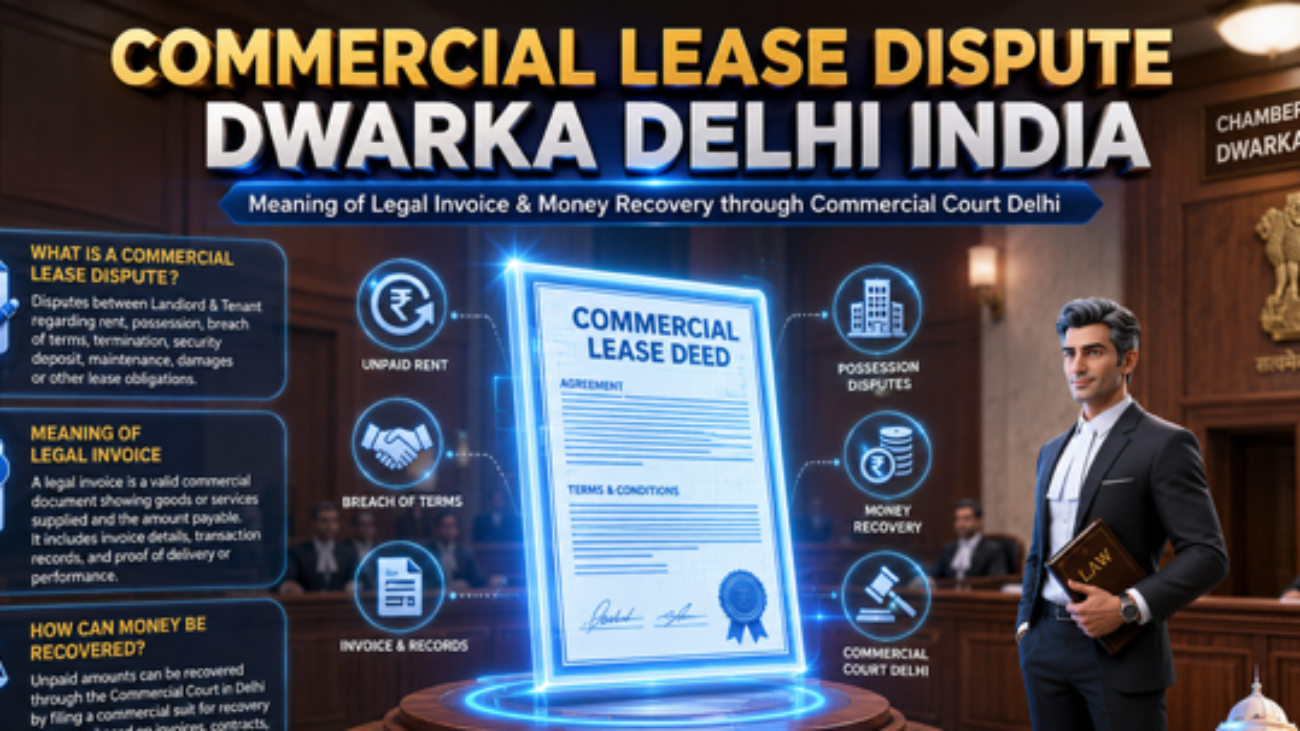
Introduction – Commercial Lease Dispute Dwarka
A commercial lease dispute Dwarka matter can affect a landlord, tenant, company, partnership firm, shop owner, office operator, or other business. The dispute may concern unpaid rent, termination of lease, possession, security deposit, maintenance charges, lock-in period, escalation of rent, damage to property, or breach of agreed terms.
Commercial lease disputes often involve substantial money. Moreover, the dispute may affect the day-to-day operation of a business. Therefore, early legal review can be important.
At Ankit Gaurav Kainth & Associates, we assist clients in commercial, civil, recovery, and property disputes before the courts in Delhi, including matters connected with Dwarka Court. With 18+ years of litigation experience, our approach is based on document review, procedural preparation, and clear communication with the client.
This article explains commercial lease dispute Dwarka matters, the meaning and importance of a legal invoice, and how eligible commercial monetary claims may be pursued before the Commercial Courts in Delhi.
Legal Disclaimer: This article is for general legal information only. It is not legal advice and does not create a lawyer-client relationship. Court jurisdiction, limitation, maintainability, and remedies depend upon the facts and documents of each case. No result or outcome is guaranteed.
⚖️ What Is a Commercial Lease Dispute?
A commercial lease is generally an arrangement under which property is used for a business or commercial purpose. It may relate to an office, shop, warehouse, showroom, commercial unit, industrial premises, restaurant, clinic, or other business property.
A commercial lease dispute Dwarka may arise when one party alleges that the other has failed to follow the lease deed or applicable law.
Common disputes may include:
However, every landlord-tenant dispute does not automatically become a Commercial Court case. The nature of the transaction, statutory definition of a commercial dispute, specified value, jurisdiction, and other legal requirements must first be examined.
📑 Commercial Lease Disputes: Quick Overview
| Issue | What May Need Examination | Possible Legal Step |
| Unpaid commercial rent | Lease, ledger, bank records | Demand/recovery proceedings |
| Tenant refuses to vacate | Termination and possession rights | Appropriate possession proceedings |
| Security deposit withheld | Lease terms and deductions | Notice/recovery claim |
| Lock-in period dispute | Contractual clauses | Claim or defence |
| Maintenance dues | Agreement and invoices | Recovery proceedings |
| Rent escalation | Escalation clause | Contract interpretation |
| Lease terminated early | Termination provisions | Damages/defence |
| Commercial invoice unpaid | Invoice and underlying transaction | Recovery action |
| Property damage | Evidence and lease obligations | Damages claim |
| Commercial suit received | Plaint and supporting documents | Defence/written statement |
Thus, a Commercial Disputes Advocate Dwarka Court should first identify the nature of the transaction before recommending a particular proceeding.
🧾 What Is the Meaning of a Legal Invoice?
The expression “legal invoice” can cause confusion because it is not, by itself, a special category of court document.
In ordinary commercial practice, an invoice is a document issued by a seller or service provider recording the amount claimed for goods supplied or services rendered. A valid commercial invoice may contain the names of the parties, invoice number, date, description of goods or services, quantity, rate, taxes, payment terms, and total amount payable.
An invoice can become an important piece of evidence in a money recovery dispute.
However, an invoice alone does not automatically prove every claim.
The court may also examine:
Therefore, if an invoice remains unpaid, the entire commercial transaction should be examined rather than relying only on the invoice.
💰 Can an Unpaid Invoice Be Recovered Through Commercial Court?
Potentially, yes.
Where the dispute falls within the definition of a commercial dispute under the Commercial Courts Act, 2015 and satisfies the applicable jurisdictional requirements, a party may be able to pursue monetary recovery through the appropriate Commercial Court.
For example, a business may have supplied goods worth ₹15 lakh. The buyer may have received the goods but failed to pay despite invoices, emails, reminders, and a statement of account.
The supplier may then consider a commercial recovery action, subject to limitation, jurisdiction, pre-litigation requirements, and the facts of the transaction.
A Recovery Suit Commercial Court Counsel can examine whether the claim belongs before a Commercial Court and what documents are required.
⚖️ How Can Money Be Recovered Through Commercial Court in Delhi?
The process normally begins much before the suit is filed.
Step 1: Review the Commercial Transaction
First, the agreement and transaction should be examined.
In a commercial lease dispute Dwarka, this may include the registered or unregistered lease document, rent receipts, bank entries, notices, correspondence, possession documents, security deposit records, and invoices.
For business recovery matters, purchase orders, invoices, delivery records, emails, ledgers, and bank statements may become important.
Step 2: Determine Jurisdiction
The correct court must be identified.
Territorial jurisdiction may depend upon factors such as the defendant’s location, contractual terms, place where the cause of action arose, property location, and other legally relevant circumstances.
The pecuniary and statutory requirements must also be checked.
Therefore, merely because one party lives in Dwarka does not necessarily mean that every commercial case can be filed in Dwarka Court.
Step 3: Check Limitation
Limitation can determine whether a claim is maintainable.
The starting point of limitation may vary depending upon the transaction, payment obligations, acknowledgment, part payment, or other facts.
Accordingly, a client should avoid waiting until the last moment.
Step 4: Examine Pre-Institution Mediation
Section 12A of the Commercial Courts Act may require pre-institution mediation in commercial disputes that do not contemplate urgent interim relief, subject to the applicable law and facts.
This stage should not be treated as a mere formality.
A settlement at the pre-litigation stage can sometimes save both parties significant time and litigation expense.
Step 5: Prepare the Commercial Suit
If settlement does not occur and litigation is appropriate, the pleadings and supporting documents must be prepared carefully.
Commercial litigation follows stricter procedural requirements than an ordinary casual recovery claim.
Document disclosure, statements of truth, pleadings, electronic evidence, and other procedural requirements may become important.
Step 6: File and Pursue the Matter
Once filed, the matter proceeds according to the applicable Commercial Court procedure.
Depending upon the case, issues may involve admission and denial of documents, discovery, case management, interim applications, evidence, cross-examination, summary judgment issues, final arguments, decree, and execution.
🏢 Commercial Lease Dispute Dwarka: Landlord’s Perspective
A commercial landlord may approach a lawyer because rent has remained unpaid or because the tenant has allegedly breached the lease.
The first question should not simply be, “How quickly can we file?”
Instead, the documents should answer:
What does the lease provide?
For example, does it contain a lock-in clause? What is the notice period? Was the lease properly terminated? Are rent and maintenance separately payable? Is interest contractually provided? Was a security deposit paid?
Therefore, in a commercial lease dispute Dwarka, a landlord’s case may require careful calculation of:
Rent arrears + maintenance + utilities + contractual dues + damages, where legally sustainable − security deposit/adjustments = amount claimed.
The exact claim must be based on the contract and applicable law.
🛡️ Commercial Lease Dispute Dwarka: Tenant’s Perspective
A tenant or respondent may also have substantial defences.
For example, the landlord may claim an amount that the tenant disputes. The tenant may allege that payments were ignored, the security deposit was not adjusted, possession had already been returned, services were not provided, or the contractual calculation is incorrect.
Thus, a respondent should not ignore a commercial suit or legal notice.
Commercial Court timelines can be strict.
A Commercial Court Lawyer in Dwarka Court assisting a respondent may examine:
The defence should be based on documents rather than assumptions.
🤝 How We Assist Before Litigation – Commercial lease dispute Dwarka
Pre-litigation work can often determine the direction of the dispute.
We assist both persons asserting claims and persons defending claims.
For a claimant, this may involve reviewing the lease, invoices, ledger, notices, emails, payments, limitation, and recoverable amount.
For a respondent, we may examine whether the demand is legally and factually sustainable and identify available defences.
Our pre-litigation assistance may include:
✅ Document review
✅ Legal consultation
✅ Identification of relevant issues
✅ Assessment of jurisdiction
✅ Limitation review
✅ Calculation of claimed dues
✅ Review of lease and commercial agreements
✅ Drafting or responding to legal notices
✅ Settlement discussions
✅ Pre-institution mediation preparation
✅ Litigation planning where required
This is especially useful in a commercial lease dispute Dwarka, because an early review can expose missing documents or incorrect calculations before proceedings begin.
⚖️ How We Assist During Commercial Litigation
Once proceedings start, careful case management becomes important.
For a claimant/petitioner/plaintiff, assistance may include preparing pleadings, filing documents, seeking legally available interim relief, handling evidence, responding to the defence, conducting cross-examination, addressing applications, arguing the matter, and pursuing execution where a decree is obtained.
For a respondent/defendant, assistance may include reviewing the plaint immediately, preparing the written statement within the applicable legal framework, filing supporting documents, challenging unsupported claims, conducting cross-examination, making appropriate applications, and presenting final arguments.
A Commercial Litigation Lawyer must understand not only substantive law but also procedure.
📍 Why Local Representation Near Dwarka Court Can Help
Our practice is based in and around Dwarka Court, Delhi. We have 18+ years of litigation experience and regularly deal with court filing, hearings, procedural requirements, cause lists, certified records, and day-to-day litigation work.
Being local advocates can provide practical convenience when urgent filing, document coordination, court appearances, or procedural follow-up is required.
However, local presence does not determine the outcome of a case. Cases succeed or fail on their facts, evidence, applicable law, and judicial determination.
Clients searching for an Advocate in Dwarka Court, Lawyer in South West Delhi, Civil Litigation Lawyer in Delhi, Property Dispute Advocate, or Commercial Court Advocate Delhi should consider experience, communication, transparency, and the nature of the dispute.
📞 Communication and Professional Transparency
Litigation can become difficult when clients do not know what is happening in their case.
Therefore, our professional approach focuses on:
⚖️ Professional standards
📞 Prompt communication
✅ Reasonable responsiveness
📱 Dedicated WhatsApp communication for case coordination
📄 Written lawyer-client fee agreements
🧾 Fee receipts and acknowledgements
💼 Transparent fee discussions
🤝 Fair and professional dealings
📑 Regular sharing of relevant case updates
Fee arrangements depend upon the nature, complexity, stage, and requirements of each matter.
We believe that clarity regarding professional fees and scope of work should begin at the start of the engagement.
📍 Commercial Lease Dispute Dwarka and South-West Delhi
Clients involved in commercial and property disputes may approach Dwarka Courts from different parts of South-West and West Delhi, subject always to actual legal jurisdiction.
These areas include Dwarka Sector 6, Dwarka Sector 10, Dwarka Sector 12, Dwarka Sector 23, Dwarka North, Dwarka South, Janakpuri, Vikaspuri, Uttam Nagar, Najafgarh, Delhi Cantonment, Palam Village, Dabri, Bindapur, Mohan Garden, Chhawla, Baba Haridas Nagar, Samalka, Kapashera and Jaffarpur Kalan.
Accordingly, persons searching online for a lawyer near Dwarka Court may first seek consultation to determine the correct legal forum.
🌍 Commercial Disputes for Clients Living Outside Delhi or India
A person or company does not necessarily need to be physically based in Delhi merely to obtain legal advice regarding a Delhi dispute.
Subject to applicable procedural requirements, clients located elsewhere in India or overseas can initially share documents electronically and take consultation through telephone or video conference.
We may receive enquiries concerning Delhi litigation from clients residing or conducting business in countries such as:
United States, United Kingdom, Canada, Australia, United Arab Emirates, Singapore, Germany, France, New Zealand and Saudi Arabia.
However, whether a case can actually be instituted in Delhi depends upon jurisdiction and the facts of the dispute, not the client’s nationality or residence.
❓ Frequently Asked Questions
1. What is a commercial lease dispute?
It is a dispute arising from a commercial leasing arrangement, such as disagreement over rent, possession, termination, security deposit, lock-in period, maintenance, damages, or other lease obligations.
2. Can unpaid commercial rent be recovered through Commercial Court?
It may be possible where the dispute qualifies as a commercial dispute and the statutory and jurisdictional requirements are satisfied. The lease and supporting records should first be examined.
3. Is an invoice enough to win a money recovery case?
Not necessarily. An invoice can be important evidence, but the court may also examine the contract, purchase order, delivery records, ledger, emails, bank entries, acknowledgment, and other evidence.
4. Is pre-institution mediation compulsory?
Section 12A of the Commercial Courts Act can require pre-institution mediation where the commercial suit does not contemplate urgent interim relief, subject to the applicable legal position and facts.
5. Can a defendant contest an incorrect commercial recovery claim?
Yes. A defendant can raise legally available objections and defences. However, Commercial Court procedure contains important timelines, so the court papers should be reviewed promptly.
⚖️ Conclusion
A commercial lease dispute Dwarka can involve much more than unpaid rent. Questions concerning termination, possession, invoices, security deposits, contractual obligations, damages, jurisdiction, limitation, and Commercial Court procedure may arise together.
Similarly, an unpaid invoice does not automatically translate into a successful decree. The underlying commercial transaction must be supported by appropriate documents and evidence.
Whether you are asserting a claim or defending one, early document review can help identify the real legal issues.
With 18+ years of litigation experience in Dwarka Court, our focus is on careful preparation, transparent communication, procedural compliance, and professional representation for eligible commercial, civil, recovery, and property disputes.
📞 Legal Consultation – Dwarka Court, Delhi
For consultation regarding a commercial lease dispute Dwarka, commercial recovery claim, unpaid invoice, lease dispute, or defence to a Commercial Court case, you may contact:
Ankit Gaurav Kainth & Associates
⚖️ Advocates – Dwarka Court, Delhi
📱 9899085554
📱 9811885554
Consultation and representation remain subject to conflict checks, review of documents, jurisdiction, professional terms, and applicable law.
| Important Topics | Text |
| Commercial Court practice page | Commercial Court Lawyer in Dwarka Court |
| Commercial Court Recovery Suit: | When Does the Limitation Period Start? |
| Commercial Lease Dispute Dwarka | Powerful Ground Every Client Should Know |
| Written Statement 120 Days in Commercial Court Recovery Suit | Important Law |
| Commercial Money Recovery Suit in Delhi | A Complete Guide for International Clients & Foreign Companies |
| The Unassailable Blueprint to Lead Defence Evidence Like a Professional in Commercial Court Cases | Advanced Litigation Strategies Every Lawyer Should Master |
| Commercial Court Is Fast | But Only If Your Lawyer Does This in Delhi Court |
| Why Businesses Lose Strong Commercial Cases Despite Having Agreements? | Experienced Commercial Court Advocate Dwarka Delhi |
| Powerful Commercial Court Recovery Case | Acquittal Strategies for Fearless Defence |
| What Happens After Receiving a Legal Notice | in a Commercial Matter? |
Introduction – Written statement 120 days in Commercial Court
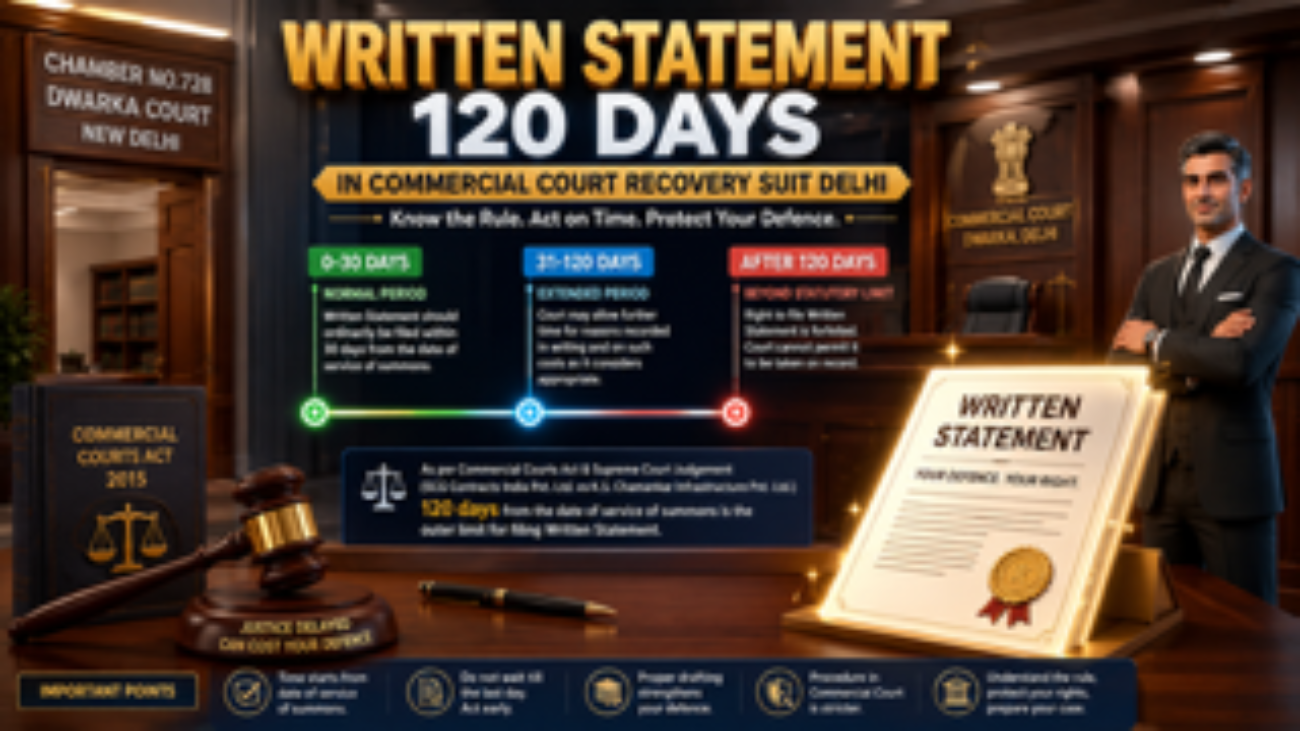
Commercial recovery suits move under a stricter procedural framework than ordinary civil litigation. Therefore, a defendant who receives summons from a Commercial Court should not treat the matter casually. One of the most important deadlines concerns the written statement 120 days in Commercial Court rule.
In a commercial dispute, the written statement is ordinarily required within 30 days from service of summons. The Commercial Courts framework permits the Court, for reasons recorded and ordinarily subject to costs, to allow filing beyond 30 days. However, the outer limit is 120 days from the date of service of summons. After expiry of that period, the defendant forfeits the right to file the written statement and the Court cannot permit it to be taken on record.
For businesses, companies, proprietorships, partnerships and individuals involved in recovery litigation in Delhi, this deadline can substantially affect the defence.
With 18+ years of litigation experience, our practice at Dwarka Court deals with civil and commercial disputes from the pre-litigation stage through trial and related proceedings. This article explains the rule, its practical effect, and why both plaintiffs and defendants should act quickly.
⚖️ What Is the Written Statement 120 Days Rule in Commercial Court?
A written statement is the defendant’s formal defence to the plaintiff’s suit.
It is not simply a general reply. It ordinarily contains preliminary objections, paragraph-wise responses, admissions and denials, the defendant’s factual case, legal objections and other relevant defences.
Under the CPC as amended for commercial disputes, the normal period is 30 days from service of summons. If the written statement is not filed within 30 days, the Court may permit further time for reasons recorded in writing and on such costs as it considers appropriate.
However, the crucial point is this:
120 days is the outer statutory limit in a commercial suit.
The Supreme Court in SCG Contracts India Pvt. Ltd. v. K.S. Chamankar Infrastructure Pvt. Ltd. explained that after 120 days from service of summons, the defendant forfeits the right to file the written statement and the Court has no power to extend that period.
Therefore, the written statement 120 days in Commercial Court rule requires immediate attention after service.
📊 Written Statement Timeline at a Glance
| Stage | Time Period | Practical Position |
| Service of summons | Day 0 | Timeline begins from service |
| Normal filing period | Up to 30 days | Written statement should ordinarily be filed |
| Extended period | Day 31–120 | Court may permit filing, for recorded reasons and potentially costs |
| After 120 days | Beyond statutory limit | Right to file written statement is forfeited |
| Defendant’s priority | Immediately after service | Consult counsel and organise defence documents |
| Plaintiff’s priority | Track service carefully | Monitor expiry of defendant’s filing period |
Thus, parties should never assume that adjournments will automatically protect the defendant’s right to file a defence.
🚨 Why 120 Days Can Change a Commercial Recovery Case
Commercial litigation is designed around stricter timelines and structured case management. Therefore, delays that may appear routine in ordinary litigation can carry serious consequences.
Suppose a company files a commercial recovery suit based on invoices, purchase orders and unpaid bills. The defendant receives summons but spends several weeks internally discussing the dispute.
Another month passes while documents are collected.
The defendant then changes counsel.
Meanwhile, the statutory clock continues to run.
This is why a Commercial Court Lawyer in Dwarka Court should ideally be approached immediately after the summons and complete case papers are received.
The first question should often be:
When and how were the summons served?
That date can be crucial.
⚖️ Supreme Court on the 120-Day Deadline
The leading authority is SCG Contracts India Pvt. Ltd. v. K.S. Chamankar Infrastructure Pvt. Ltd.
The Supreme Court examined the amendments applicable to commercial disputes and held, in substance, that the written statement should ordinarily be filed within 30 days. A further period can be allowed within the statutory framework. However, after 120 days from service of summons, the defendant forfeits the right to file the written statement.
Accordingly, the written statement 120 days in Commercial Court requirement is not an ordinary procedural deadline that parties should expect to be extended indefinitely.
Interestingly, the Supreme Court also dealt with an Order VII Rule 11 application in that case. The decision makes an important practical point: pursuing such an application cannot be used as a device to recover a lost opportunity to file the written statement.
Therefore, defence strategy and written-statement preparation should ordinarily proceed without unnecessary delay.

📑 What Should a Defendant Do After Receiving Summons?
First, preserve the summons, envelope, electronic communication and other material relevant to service.
Next, collect the complete commercial record.
This may include:
✅ Agreements and contracts
✅ Purchase orders
✅ Invoices
✅ Delivery challans
✅ Bank statements
✅ Ledger accounts
✅ Emails and correspondence
✅ WhatsApp communications
✅ Notices and replies
✅ GST-related records where relevant
✅ Payment acknowledgements
✅ Settlement communications
✅ Board or company records, where applicable
A Recovery Suit Commercial Court Counsel should then study the plaint and documents before preparing the defence.
Every material allegation should be addressed carefully. Moreover, admissions and denials should not be drafted casually.
🔎 A Written Statement Is More Than a Simple Denial – Written statement 120 days in Commercial Court
A weak defence often says:
“Wrong and denied.”
That may not adequately deal with a detailed commercial claim.
A properly prepared written statement may require examination of issues such as:
Therefore, the written statement 120 days in Commercial Court issue is not merely about filing something before the deadline. The defence should also be properly prepared.
🏢 Commercial Recovery Suits: Assistance to the Plaintiff
The 120-day rule is important to plaintiffs as well.
A business seeking recovery should prepare its case before litigation wherever possible. A Commercial Court Advocate Delhi may first examine the transaction, contractual documents, limitation, jurisdiction, correspondence and available evidence.
Where applicable, the requirement of pre-institution mediation under Section 12A of the Commercial Courts Act must also be considered, subject to the statutory framework and the nature of relief sought.
Pre-Litigation Assistance for Plaintiffs
Before filing, we may assist a client in:
A strong recovery case starts with documents, not merely allegations.
🛡️ Pre-Litigation Assistance for Defendants
Businesses sometimes know about a potential recovery dispute even before the suit is filed.
For example, they may receive a legal demand notice or a mediation notice.
That stage can be valuable.
We may review the alleged liability, obtain the client’s version, organise correspondence and identify possible defences before litigation begins.
Thus, early consultation with a Commercial Disputes Advocate Dwarka Court can reduce last-minute drafting after summons are served.
⚔️ Assistance During an Ongoing Commercial Recovery Suit
Once proceedings begin, the strategy changes.
For the Plaintiff
Our work may include:
Importantly, the plaintiff should track the defendant’s written-statement timeline.
If the statutory period expires, the legal effect of the written statement 120 days in Commercial Court rule should be brought before the Court appropriately.
For the Defendant
The immediate priority is often the defence.
We examine the date of service, pleadings, documents, limitation, jurisdiction, commercial nature of the dispute and the plaintiff’s calculation.
Thereafter, the written statement and connected documents should be prepared without waiting for the outer deadline.
In commercial litigation, 120 days should be treated as the outer boundary, not the target filing date.
⏰ Do Not Wait Until Day 119 – Written statement 120 days in Commercial Court
This is a simple but important point.
A defendant may have 120 days as an outer limit, but that does not mean waiting until the last few days is good litigation strategy.
Documents may be missing. Company officials may need to provide instructions. Bank records may take time. Old emails may need to be retrieved. Accounts may require reconciliation.
Moreover, the Court may require reasons for delay beyond the initial 30-day period.
Therefore, early preparation is safer and more efficient.
📍 Why a Local Advocate in Dwarka Court Can Help
Commercial litigation involves more than drafting.
Daily procedural work matters too.
As local Advocates in Dwarka Court, we regularly work within the court system and understand filing procedures, scrutiny, listing practices, case files and day-to-day court processes.
Our Chamber is situated in Dwarka Court, Delhi. Therefore, urgent procedural issues can often be attended to efficiently, subject of course to court working, filing requirements and applicable rules.
For a client searching for a Commercial Court Lawyer in Dwarka Court, local accessibility can be especially useful when a statutory deadline is approaching.
📞 Client Communication and Professional Working
Commercial disputes often involve substantial financial records. Consequently, communication between client and counsel is important.
Our professional working system focuses on:
✅ Quick responsiveness
✅ Dedicated WhatsApp communication
✅ Availability on call, subject to professional commitments
✅ Clear discussion of litigation stages
✅ Reasonable and transparent fee structure
✅ Proper Lawyer-Client Fee Agreements
✅ Fee receipts and acknowledgements
✅ Honest and transparent professional dealings
✅ Regular sharing of important case updates
We believe clients should understand what is being filed, why it is being filed and what the next procedural stage is.
⚖️ 18+ Years of Litigation Experience in Dwarka Court
Commercial litigation requires knowledge of civil procedure, evidence, contracts, recovery law and courtroom strategy.
With 18+ years of experience in Dwarka Court and litigation practice, we assist clients in commercial recovery matters as well as connected civil disputes.
Our work may overlap with areas handled by a Civil Litigation Lawyer in Delhi, Property Dispute Advocate, Commercial Litigation Lawyer, Recovery Suit Commercial Court Counsel, Lawyer in South West Delhi, and Advocate in Dwarka Court, depending upon the nature of the dispute.
Each matter, however, must be assessed on its own facts and documents.
📍 Commercial Court Assistance Near Dwarka Court
Clients approach Dwarka Court from several parts of South West and West Delhi.
These include Dwarka Sector 6, Dwarka Sector 10, Dwarka Sector 12, Dwarka Sector 23, Dwarka North, Dwarka South, Janakpuri, Vikaspuri, Uttam Nagar, Najafgarh, Palam Village, Delhi Cantonment, Chhawla, Bindapur, Baba Haridas Nagar, Mohan Garden, Samalka, Dabri, Jaffarpur Kalan and Kapashera.
Accordingly, parties searching online for a commercial lawyer near Dwarka Court may find local representation convenient for conferences, document review and court appearances.
Jurisdiction, however, depends upon the facts and applicable law, not simply the client’s residence.
🌍 Commercial Clients Outside Delhi and India – Written statement 120 days in Commercial Court
Commercial disputes in Delhi may involve companies, NRIs, overseas directors, exporters, importers or parties living outside India.
Subject to the facts, procedural requirements and need for personal appearance, coordination can also be undertaken with clients based elsewhere in India or abroad.
International clients may approach from countries such as:
United States, United Kingdom, Canada, Australia, United Arab Emirates, Singapore, Germany, France, New Zealand and Saudi Arabia.
Documents and conferences can often be coordinated electronically. However, every case has different procedural requirements.
❓ Frequently Asked Questions – Written statement 120 days in Commercial Court
1. What is the written statement 120 days in Commercial Court rule?
In a commercial suit, the written statement should ordinarily be filed within 30 days from service of summons. The statutory framework permits further time in appropriate circumstances, but not beyond the outer limit of 120 days from service.
2. Can a Commercial Court accept a written statement after 120 days?
The Supreme Court in SCG Contracts India Pvt. Ltd. v. K.S. Chamankar Infrastructure Pvt. Ltd. held that after 120 days from service of summons, the defendant forfeits the right to file the written statement and the Court cannot extend that period.
3. From which date are the 120 days calculated?
The statutory language refers to the date of service of summons. Therefore, determining the legally relevant service date can be extremely important in a disputed case.
4. Can filing an Order VII Rule 11 application stop the written-statement deadline?
A defendant should not assume so. SCG Contracts specifically indicates that an Order VII Rule 11 application cannot be used as a device to retrieve a lost opportunity to file the written statement.
5. Should I wait until 120 days to file my written statement?
No. The normal filing period is 30 days. The 120-day period is the outer limit under the commercial procedure. Early drafting gives counsel time to examine documents, prepare proper admissions and denials, and formulate the defence.
🏁 Conclusion – Written statement 120 days in Commercial Court
The written statement 120 days in Commercial Court rule can have a decisive procedural impact on a commercial recovery suit.
For defendants, delay can result in forfeiture of the right to place the written statement on record. Therefore, summons should never be ignored.
For plaintiffs, careful tracking of service and procedural deadlines can be equally important.
Commercial litigation rewards preparation. Contracts, invoices, ledgers, emails, payment records and pleadings should be examined early. Moreover, parties should understand the stricter procedure applicable to commercial disputes rather than treating them like ordinary civil suits.
Whether you are seeking recovery of commercial dues or defending a commercial recovery claim, timely legal advice can help identify the correct procedural strategy.
📞 Commercial Court Legal Consultation – Dwarka Court, Delhi
For consultation regarding a commercial recovery suit, written statement, business dispute or related commercial litigation before the competent courts in Delhi:
Ankit Gaurav Kainth & Associates
⚖️ Advocates – Dwarka Court, Delhi
📞 9899085554 | 9811885554
📍 Chamber No. 728, Dwarka Court, New Delhi
Clients may contact the office for an appointment and document review. The legal strategy and fee structure are discussed according to the nature and requirements of each matter.
Disclaimer: This article is published solely for general legal information and awareness. It does not constitute legal advice, solicitation or an assurance of any result. Commercial disputes depend on their individual facts, documents, limitation, jurisdiction and applicable law. Readers should obtain independent legal advice based on the facts of their case.
| Important Topics | Text |
| Commercial Court practice page | Commercial Court Lawyer in Dwarka Court |
| Commercial Court Recovery Suit: | When Does the Limitation Period Start? |
| Commercial Lease Dispute Dwarka | Powerful Ground Every Client Should Know |
| Written Statement 120 Days in Commercial Court Recovery Suit | Important Law |
| Commercial Money Recovery Suit in Delhi | A Complete Guide for International Clients & Foreign Companies |
| The Unassailable Blueprint to Lead Defence Evidence Like a Professional in Commercial Court Cases | Advanced Litigation Strategies Every Lawyer Should Master |
| Commercial Court Is Fast | But Only If Your Lawyer Does This in Delhi Court |
| Why Businesses Lose Strong Commercial Cases Despite Having Agreements? | Experienced Commercial Court Advocate Dwarka Delhi |
| Powerful Commercial Court Recovery Case | Acquittal Strategies for Fearless Defence |
| What Happens After Receiving a Legal Notice | in a Commercial Matter? |
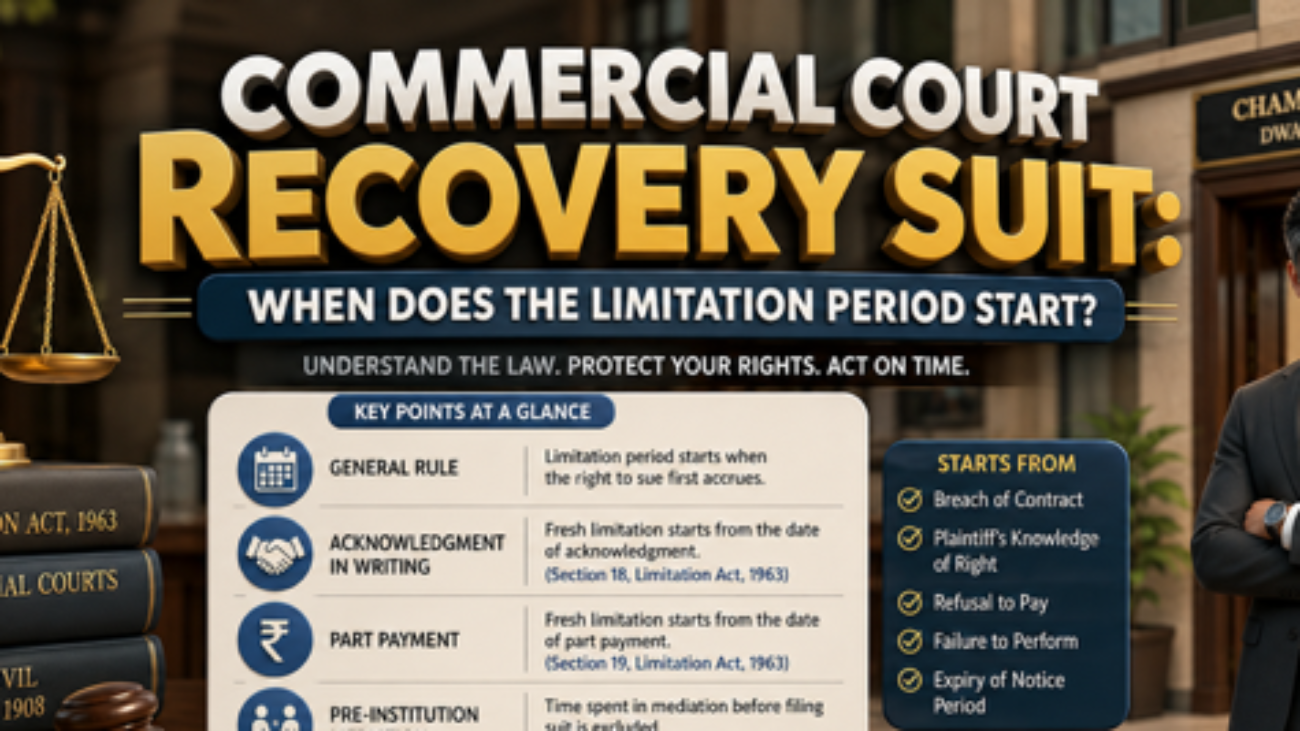
Introduction: Commercial Court Recovery Suit – Why Limitation Matters in Money Recovery ⚖️
If a business, company, firm or individual has to recover money under a commercial transaction, one of the first legal questions is simple: when does the limitation period start? A Commercial Court Recovery Suit is not only about proving that money is due. It is also about filing the claim within the period allowed by law.
In many ordinary money recovery claims, the limitation period is three years, but the exact starting point depends on the nature of the transaction, the agreed payment date, the cause of action, and the documents available. Therefore, a person should not assume that every money claim automatically gets three years from the date of the invoice or agreement.
The Limitation Act, 1963 contains different limitation rules for different causes of action. In addition, a written acknowledgment of liability made before expiry of limitation can result in a fresh period of limitation under Section 18. A qualifying part-payment can also have an effect under Section 19.
This article explains the issue in a practical way for businesses and clients considering a Commercial Court Recovery Suit in Delhi and other parts of India.
What Is the Limitation Period for a Commercial Recovery Suit?
For many suits seeking recovery of money based on contracts, accounts or similar obligations, the applicable limitation is commonly three years. However, the date from which those three years are counted is critical.
The starting date may depend on when the money became legally due, when payment was refused, when a stipulated period expired, or another event specified by the applicable Article of the Limitation Act. Therefore, limitation must be examined from the documents and facts of each case.
A Commercial Court Recovery Suit filed after limitation may face a serious legal objection. Thus, early legal review is important even when the client believes that the debt is clear.
When Does the Limitation Period Start? 🔎Commercial Court Recovery Suit
The key principle is that limitation normally runs from the date prescribed by the relevant provision of the Limitation Act. In a contractual money claim, this often means the date on which the amount became due and payable.
For example, if a written contract says that payment must be made within 30 days of delivery, the limitation analysis may begin with the date on which the contractual right to demand payment arose. If the contract contains several invoices or instalments, each amount may require separate examination.
Moreover, a demand notice does not automatically create a new limitation period. The legal effect of a notice depends on the underlying cause of action and the applicable law.
Quick Table: Understanding Limitation in Money Recovery
| Situation | What to examine | Possible limitation effect |
| Fixed payment date in contract | Date the amount became due | Usually counted from the legally relevant due date |
| Invoice-based transaction | Invoice terms, delivery and agreed credit period | Examine when payment became due |
| Written acknowledgment of liability | Date and contents of signed acknowledgment | Section 18 can provide a fresh period if its requirements are met |
| Part-payment of debt | Date and proof of qualifying payment | Section 19 can provide a fresh period if statutory requirements are met |
| Multiple instalments | Due date of each instalment and contract terms | Limitation may need separate analysis for each instalment |
| Demand made after default | Original cause of action and contractual terms | Demand letter alone does not necessarily restart limitation |
| Commercial pre-institution mediation | Date of application and mediation period | The statutory mediation period is not counted for limitation under Section 12A, subject to the Act |
| Fraud or concealed facts | Date of discovery and Section 17 requirements | Limitation may be affected where statutory conditions are satisfied |
Section 18 of the Limitation Act states that, where a qualifying acknowledgment is made in writing and signed before expiry of the prescribed period, a fresh period is computed from the time of signing. Section 19 addresses qualifying payments made before expiry of the prescribed period.
Example 1: Fixed Due Date Under a Business Contract
Suppose Company A supplies goods to Company B under a written contract. The contract states that the invoice amount must be paid within 30 days of delivery. The goods are delivered on 1 January 2026, and payment becomes due on 31 January 2026.
If Company B does not pay, the limitation analysis would ordinarily focus on when the debt became legally due under the contract and the applicable provision of the Limitation Act. Company A should therefore obtain legal advice promptly rather than waiting until the end of the three-year period.
If Company B later signs a written acknowledgment of the outstanding liability before limitation expires, Section 18 may become relevant and a fresh limitation period may run from the date of that acknowledgment, provided the statutory requirements are satisfied.
Example 2: Part-Payment and Written Acknowledgment
Assume a business is owed ₹15 lakh under a commercial transaction. The debtor pays ₹2 lakh before the original limitation period expires and the payment is properly documented. Later, the debtor also signs a written statement acknowledging the outstanding balance.
The legal effect of the payment and acknowledgment must be examined separately under Sections 18 and 19 of the Limitation Act. They may affect the calculation of limitation if the statutory conditions are satisfied. Therefore, bank statements, receipts, emails, letters and signed balance confirmations can become important evidence.
The lesson is clear: do not calculate limitation from memory alone. Check the complete documentary history.
Does a Legal Notice Restart Limitation?
This is a common question in a Commercial Court Recovery Suit. A legal notice can be valuable because it records the demand, sets out the claim and may support later proceedings. However, sending a notice does not, by itself, automatically extend or restart the limitation period.
Therefore, a client should not wait for the notice period to expire without checking the limitation position. The legal notice should form part of a wider litigation strategy, not be treated as a substitute for timely filing.
What About Pre-Institution Mediation in Commercial Cases?
Section 12A of the Commercial Courts Act, 2015 provides for pre-institution mediation for commercial suits that do not contemplate urgent interim relief. The statutory framework also provides that the period during which the parties remain occupied with pre-institution mediation is not computed for limitation, subject to the requirements of the Act.
This is important because mediation should not be treated as a reason to ignore limitation. Instead, the limitation position should be calculated before commencing the process, with the statutory exclusion properly considered.
Why Pre-Litigation Legal Assistance Matters 📝
Before filing a Commercial Court Recovery Suit, we assist clients at the pre-litigation stage. This stage can make a major difference to the quality and clarity of the eventual case.
Our work may include reviewing contracts, invoices, purchase orders, account statements, emails, delivery records, acknowledgments, payment records and correspondence. We also examine the cause of action, limitation, jurisdiction, specified value and available remedies.
Where appropriate, we help clients assess whether a legal notice, settlement discussion or pre-institution mediation should be pursued. The objective is to identify the legal position early and avoid preventable procedural problems.
For overseas businesses and clients located outside Delhi, this preliminary review can be especially useful. Documents can be examined remotely, while the litigation strategy can be planned for proceedings in Delhi where jurisdiction is legally available.
Assistance During the Litigation Stage ⚖️
Once proceedings begin, a Commercial Court Recovery Suit requires careful handling at every stage. We assist with pleadings, filing, documents, interim applications, written statements, evidence, cross-examination, arguments and other procedural requirements, depending on the nature of the case.
As a Commercial Court Advocate Delhi, our focus is not limited to filing the plaint. We also examine the defendant’s defence, documentary evidence and procedural objections, including limitation, jurisdiction and maintainability.
Our experience also covers connected civil and commercial matters. Depending on the dispute, clients may require a Civil Litigation Lawyer in Delhi, Property Dispute Advocate, Commercial Litigation Lawyer, or Commercial Disputes Advocate Dwarka Court.
Why a Local Advocate in Dwarka Court Can Help 🚀
We are local advocates practising at Dwarka Court, New Delhi, including the Lawyers’ Chambers area. With more than 18 years of experience in litigation in Delhi, we have practical familiarity with filing processes, court procedures, listing systems and the working environment of the local court.
This local presence can help us coordinate filing and representation efficiently. For clients who need a Commercial Court Lawyer in Dwarka Court, local court familiarity can also make communication with the office, filing teams and court processes more practical.
Our practice is relevant to clients from Dwarka Sector 6, Sector 10, Sector 12 and Sector 23, as well as people and businesses from Janakpuri, Vikaspuri, Dwarka North, Dwarka South, Delhi Cantonment, Chhawla, Bindapur, Baba Haridas Nagar, Mohan Garden, Palam Village, Najafgarh, Uttam Nagar, Samalka, Dabri, Jaffarpur Kalan and Kapashera, and other areas near Dwarka Court.
Serving Clients Across India and Internationally 🌍
A commercial dispute may involve parties located in different cities or countries. A client may have a business in Delhi while its directors, shareholders or commercial partners live abroad.
We assist clients who need to pursue or defend commercial litigation in Delhi, subject to jurisdiction and applicable law. International clients may include individuals and businesses connected with the United States, United Kingdom, Canada, Australia, United Arab Emirates, Singapore, Germany, France and New Zealand.
For such matters, a Recover of Money Commercial Court Lawyer Dwarka can help coordinate the Indian litigation side, document review and communication with the client. Where foreign law, evidence or enforcement issues arise, appropriate specialist advice may also be required.
Client Trust: Professional, Transparent and Responsive Service ✅
Legal representation involves trust. Therefore, we follow a professional and transparent approach in client dealings.
Our client-service approach includes:
These practices are intended to make the legal process easier to understand and more organised for clients.
What Documents Should You Keep Ready?
Before consulting a Recovery Suit Commercial Court Counsel, keep the key documents together. These may include:
Most importantly, arrange these documents by date. A clear chronology often makes the limitation analysis much easier.
Common Mistakes That Can Affect a Recovery Claim ⚠️
1. Waiting too long
A client may spend months negotiating without checking limitation. Negotiations do not automatically stop the clock.
2. Assuming every claim has the same limitation period
Different legal claims can have different limitation rules. The exact Article must be identified from the facts.
3. Treating a demand notice as an extension
A legal notice can support the case, but it does not automatically create a fresh limitation period.
4. Ignoring acknowledgments and payments
Signed acknowledgments and qualifying payments may materially affect limitation. Therefore, preserve all such records.
5. Filing without checking commercial procedure
A commercial dispute may involve specified-value requirements, pre-institution mediation and other procedural rules. The Commercial Courts Act contains a dedicated framework for commercial disputes and pre-institution mediation.
Why Early Legal Review Is Important
The limitation question should ideally be examined before filing a Commercial Court Recovery Suit. Early review allows the lawyer to identify the correct cause of action, calculate the relevant dates, check contractual terms, preserve evidence and consider pre-litigation options.
It also helps clients avoid a common problem: discovering a limitation issue only after substantial time and money have already been spent.
Frequently Asked Questions
1. What is the usual limitation period for a Commercial Court Recovery Suit?
For many money recovery claims, the limitation period is three years. However, the exact period and starting point depend on the nature of the claim and the applicable provision of the Limitation Act.
2. When does limitation start in a money recovery case?
It generally starts from the date prescribed by the applicable limitation provision. In contractual claims, the relevant date is often connected with when the amount became due. The agreement and transaction documents must be examined carefully.
3. Can a written acknowledgment extend limitation?
Yes, a qualifying written acknowledgment made and signed before expiry of the prescribed period can lead to a fresh period under Section 18 of the Limitation Act.
4. Does pre-institution mediation affect limitation?
For applicable commercial suits under Section 12A, the statutory period during which the parties remain occupied with pre-institution mediation is not counted for limitation, subject to the Act.
5. Can I file a commercial recovery case from outside Delhi?
Potentially, yes, where Delhi has legally valid territorial and subject-matter jurisdiction. A jurisdiction analysis should be completed before filing. Clients located elsewhere in India or abroad can obtain legal assistance remotely, subject to the facts and applicable law.
Conclusion
Limitation is one of the most important issues in a Commercial Court Recovery Suit. The key is not simply to remember the phrase “three years.” Instead, the correct starting date, applicable limitation provision, contractual terms, acknowledgments, payments and statutory exclusions must be examined together.
Therefore, if money remains unpaid under a commercial transaction, obtain legal advice at the earliest stage. A timely review can help identify the cause of action, preserve evidence and plan the appropriate pre-litigation or litigation strategy.
If you are looking for a Commercial Court Advocate Delhi, Commercial Court Lawyer in Dwarka Court, Commercial Disputes Advocate Dwarka Court, or Advocate in Dwarka Court, professional advice should be based on the documents and facts of your particular dispute.
📞 Legal Consultation & Assistance – Commercial Court Recovery Suit
If you are considering a Commercial Court Recovery Suit for recovery of money from a company, firm, business partner, customer or other commercial party, you may contact us for a preliminary discussion regarding your legal position, documents, limitation and available procedural options.
Mobile: 9899085554 | 9811885554
Ankit Gaurav Kainth & Associates
Advocate in Dwarka Court, New Delhi
Chamber No. 728, Lawyers’ Chambers Block, District Court Dwarka, Sector-10, New Delhi
⚠️ Legal Disclaimer
This article is intended for general legal information and educational purposes. Limitation depends on the facts, documents, cause of action and applicable statutory provisions. It should not be treated as a substitute for case-specific legal advice. The information stated above should be verified against the law applicable to the particular dispute before taking legal action.
✍️ Author – Commercial Court Recovery Suit
This article is written by Ankit Gaurav Kainth, Advocate, based on 18+ years of litigation experience in Delhi, including practice at Dwarka Court.
| Important Topics | Text |
| Commercial Court practice page | Commercial Court Lawyer in Dwarka Court |
| Commercial Court Recovery Suit: | When Does the Limitation Period Start? |
| Commercial Lease Dispute Dwarka | Powerful Ground Every Client Should Know |
| Written Statement 120 Days in Commercial Court Recovery Suit | Important Law |
| Commercial Money Recovery Suit in Delhi | A Complete Guide for International Clients & Foreign Companies |
| The Unassailable Blueprint to Lead Defence Evidence Like a Professional in Commercial Court Cases | Advanced Litigation Strategies Every Lawyer Should Master |
| Commercial Court Is Fast | But Only If Your Lawyer Does This in Delhi Court |
| Why Businesses Lose Strong Commercial Cases Despite Having Agreements? | Experienced Commercial Court Advocate Dwarka Delhi |
| Powerful Commercial Court Recovery Case | Acquittal Strategies for Fearless Defence |
| What Happens After Receiving a Legal Notice | in a Commercial Matter? |

Introduction – Commercial Money Recovery Suit in Delhi
Commercial Money Recovery Suit in Delhi for International Clients
International businesses often trade with Indian companies, suppliers, distributors, manufacturers and service providers. Most commercial relationships work well. Yet disputes can arise when invoices remain unpaid, goods are supplied without payment, services are completed but fees are withheld, or a contract is breached.
For an overseas company, Commercial Money Recovery Suit in Delhi proceedings may seem complex. The parties may be in different countries. Documents may be signed electronically. Payments may cross borders. The contract may also contain arbitration, governing-law or jurisdiction clauses.
Therefore, the first step should not be filing blindly. It should be a careful legal review of the contract, documents, limitation, jurisdiction and recovery prospects.
This guide explains the key issues that an international client should consider before pursuing a Commercial Money Recovery Suit in Delhi against an Indian business.
Can a Foreign Company File a Commercial Recovery Suit in Delhi?
Yes, a foreign company may pursue a claim against an Indian entity, subject to the facts, applicable law and the jurisdiction of the chosen court. Being incorporated outside India does not, by itself, prevent a company from approaching an Indian court.
However, the correct forum must be established. The court may examine the defendant’s location, the place where the cause of action arose, the place of performance, the place of payment and the terms of the contract. The value and nature of the dispute may also determine whether the Commercial Courts Act applies.
The Commercial Money Recovery Suit in Delhi must therefore be planned around jurisdiction from the start. A wrong forum can lead to objections, delay and additional cost.
What Commercial Dues Can Be Recovered?
A commercial recovery suit Delhi claim can arise from many business transactions, such as:
The exact relief depends on the contract and evidence. A money recovery lawyer Delhi should therefore review the commercial record before advising on the claim amount.
Why Documents Matter in International Commercial Litigation
In a Commercial Money Recovery Suit in Delhi, documents often form the foundation of the case. A foreign claimant should preserve the complete business record.
Important documents may include the signed contract, amendments, purchase orders, invoices, delivery records, bills of lading, emails, business messages, account statements, bank records, payment confirmations, notices and admissions of outstanding dues.
Electronic records also matter. Indian evidence law now contains specific provisions dealing with electronic and digital records. Therefore, overseas clients should preserve original electronic material and related records in an organised form.
The aim is simple: show the contract, show performance, show the breach and show the amount due.-
Pre-Institution Mediation: An Important Step
Before filing a Commercial Money Recovery Suit in Delhi, the question of pre-institution mediation should be checked carefully. Section 12A of the Commercial Courts Act provides for pre-institution mediation in suits that do not contemplate urgent interim relief, subject to the statutory framework and applicable rules.
The Supreme Court has treated the Section 12A requirement as mandatory for covered suits. The present statutory framework also provides for the mediation process and its relationship with limitation.
For an international client, mediation can be useful. It may save travel, time and litigation expense. Moreover, a negotiated settlement can provide a faster commercial solution where both sides are willing to resolve the dispute.
However, the correct procedure depends on the facts. An overseas client lawyer Delhi should assess whether Section 12A applies before filing.
Choosing the Correct Commercial Court in Delhi
The Commercial Court Delhi for foreign companies is not selected only because the defendant does business in Delhi. Territorial and pecuniary jurisdiction must be established under the applicable law.
The following factors may be relevant:
| Issue | What Should Be Examined? |
| Defendant | Registered office and business location |
| Contract | Place of execution and performance |
| Payment | Where payment was due |
| Cause of action | Where the material events occurred |
| Jurisdiction clause | Whether the clause is legally enforceable |
| Dispute value | Whether the matter falls within the specified value framework |
| Arbitration | Whether an arbitration agreement exists |
| Urgency | Whether urgent interim relief is genuinely required |
The Commercial Money Recovery Suit in Delhi should be filed only after these questions are addressed.
What If the Contract Has a Foreign Jurisdiction or Arbitration Clause?
International contracts often contain a foreign governing-law clause, an exclusive jurisdiction clause or an arbitration agreement. These clauses must be read carefully before commencing a foreign company lawsuit in India.
For example, a valid arbitration agreement may require the dispute to be resolved through arbitration rather than an ordinary civil suit. Likewise, an exclusive jurisdiction clause may affect the forum in which proceedings can be brought.
Therefore, a commercial dispute lawyer Delhi should examine the entire dispute-resolution clause before recommending litigation in Delhi.
How Much Can an International Client Claim?
The claim may include the principal amount and, where legally and contractually recoverable, interest, costs and other appropriate relief. In some matters, contractual damages may also be claimed if they can be established under applicable law.
Interest should be calculated with care. The contract, invoices, payment terms and applicable statutory provisions should be checked. An unsupported interest calculation can create unnecessary objections.
Accordingly, a Commercial Court Recovery Suit Counsel Delhi should prepare a clear statement showing the principal, interest period, rate and basis of calculation.
Limitation: Do Not Wait Too Long
Limitation is one of the most important issues in business debt recovery India. A foreign claimant should not assume that commercial negotiations can continue indefinitely.
The applicable limitation period depends on the nature of the claim and the relevant facts. Acknowledgment of liability, part-payment and other circumstances may have legal significance in appropriate cases.
Therefore, an international client should obtain advice as soon as a payment default becomes serious. Emails acknowledging the debt and records of part-payments should also be preserved.
Can the Foreign Client Manage the Case From Overseas?
In many matters, substantial coordination can be handled through Indian counsel and authorised representatives. However, the exact requirements depend on the court, the case and the documents involved.
Corporate authorisations, board resolutions, powers of attorney and other records may be required. Documents executed outside India may also require appropriate notarisation, apostille or legalisation, depending on their nature and use.
This is where a local Commercial Litigation Lawyer can be valuable. Proper preparation can reduce avoidable procedural objections.
Enforcement: Winning the Case Is Not the End
The practical objective of a Commercial Money Recovery Suit in Delhi is recovery. Therefore, enforcement should be considered before filing, not after judgment.
If the defendant does not voluntarily satisfy the decree, execution proceedings may be required. Depending on the circumstances, the claimant may need to identify bank accounts, receivables, movable assets, immovable property or other assets of the judgment-debtor.
Consequently, foreign company money recovery in India should be approached with both litigation and enforcement in mind. A strong claim is important. So is a realistic assessment of the defendant’s assets.
How We Assist International Clients Before Litigation ⚖️
Our role can begin before the Commercial Money Recovery Suit in Delhi is filed. This pre-litigation stage is often critical.
1. Contract and Document Review
We examine the agreement, invoices, purchase orders, correspondence and payment records. We then identify the key facts and possible weaknesses.
2. Jurisdiction and Remedy Assessment
We assess whether Delhi is the appropriate forum. We also examine arbitration, mediation, jurisdiction and governing-law clauses.
3. Recovery Calculation
We help organise the principal amount, interest and other potentially recoverable components of the claim.
4. Legal Notice and Negotiation Strategy
Where appropriate, a properly structured demand may be issued before litigation. Negotiation can sometimes resolve a dispute without a full trial.
5. Pre-Institution Mediation
Where the statutory framework applies, we assist with the required pre-institution process and related documentation.
How We Assist During Court Litigation 🏛️
Once the Commercial Money Recovery Suit in Delhi is filed, the work continues through the litigation stages.
We can assist with pleadings, filing coordination, document management, procedural applications, evidence, court appearances, arguments and execution strategy, subject to the requirements of the particular case.
As Advocate in Dwarka Court, our local presence is especially useful for matters before courts and forums where we practise. Our familiarity with local filing systems, court procedures, registry processes and day-to-day working methods can help us coordinate matters promptly.
We are based at Chamber No. 728, Lawyers Chambers Block, District Court Dwarka, Sector-10, New Delhi. Our practice has involved commercial and civil litigation in Dwarka Court and other Delhi courts for more than 18 years.
For an overseas client, local representation can reduce the need for repeated travel. It can also make communication and procedural coordination easier.
Why International Clients Value Clear Communication 📞
Cross-border litigation requires trust. An overseas client should know what is happening in the case and what the next step involves.
Our client-handling approach focuses on:
High professional standards.
Quick and practical responsiveness.
Availability on call for important case communication.
Dedicated WhatsApp support for client updates.
Reasonable and transparent fee discussions.
Proper Lawyer-Client Fee Agreements.
Fee receipts and payment acknowledgements.
Honest, fair and transparent dealings.
For an international client, these systems can provide clarity when the legal process is being managed from another country.
Local Commercial Litigation Support Near Dwarka Court
Our location in South West Delhi is also convenient for clients and businesses connected with Dwarka Sector 6, Sector 10, Sector 12, Sector 23 and nearby Dwarka Court areas.
Commercial and civil disputes may also involve parties from Janakpuri, Vikaspuri, Dwarka North, Dwarka South, Dwarka Sector-23, Delhi Cantonment, Chhawla, Bindapur, Baba Haridas Nagar, Mohan Garden, Palam Village, Najafgarh, Uttam Nagar, Samalka, Dabri, Jaffarpur Kalan and Kapashera.
Therefore, an international client looking for a Lawyer in South West Delhi or an Advocate in Dwarka Court may benefit from a local office that understands the surrounding court jurisdictions and filing environment.
What Should a Foreign Company Do Before Filing? 📋
Before starting a Commercial Money Recovery Suit in Delhi, an international claimant should:
Conclusion
A Commercial Money Recovery Suit in Delhi can provide an important legal route for an overseas company seeking legitimate commercial dues from an Indian business. However, successful case planning starts before the plaint is filed.
The contract, jurisdiction, limitation, evidence, mediation requirement and enforcement prospects should be reviewed together. Moreover, the claimant should understand whether litigation, mediation or arbitration is the better route.
For international clients, having a Commercial Civil Litigation Lawyer in Delhi who understands both the legal process and local court working system can make communication and case coordination more practical.
If you are considering a Commercial Money Recovery Suit in Delhi, early India-specific legal assessment can help you understand the available options and the documents required for the next step.
📞 Legal Consultation for International Commercial Recovery Matters
If you are a foreign company, overseas business owner or international creditor seeking recovery of commercial dues from an Indian company, you may contact us for a legal consultation and case assessment.
Advocate Ankit Gaurav Kainth & Associates
Chamber No. 728, Lawyers Chambers Block, District Court Dwarka, Sector-10, New Delhi
📞 9899085554 | 9811885554
email:- ankit_legal@yahoo.com
Disclaimer: This article is for general informational purposes and does not constitute legal advice. The applicability of Indian law, jurisdiction, limitation, mediation, arbitration, evidence and available remedies depends on the facts and documents of each matter. International clients should obtain professional legal advice before initiating proceedings in India.
FAQ – Commercial Money Recovery Suit in Delhi
1. Can a foreign company sue an Indian company for unpaid money?
Yes, subject to applicable law, jurisdiction, limitation and the terms of the contract. The correct legal remedy depends on the facts and documents.
2. Is pre-institution mediation required for a commercial recovery suit?
It may be required for a covered commercial suit that does not contemplate urgent interim relief. Section 12A and the current procedural rules should be checked before filing.
3. Can an overseas client manage the case without visiting Delhi?
Depending on the case and court requirements, substantial coordination may be handled through authorised representatives and Indian counsel. Appropriate corporate and power-of-attorney documents may be needed.
4. What evidence is useful for unpaid invoice recovery in India?
Contracts, invoices, purchase orders, delivery records, emails, payment records, account statements, acknowledgments and relevant electronic records can be important.
5. What happens after a money recovery decree?
If the defendant does not comply voluntarily, execution proceedings may be required. The recovery strategy may then involve identifying and proceeding against legally attachable assets of the judgment-debtor.
| Important Topics | Text |
| Commercial Court practice page | Commercial Court Lawyer in Dwarka Court |
| Commercial Court Recovery Suit: | When Does the Limitation Period Start? |
| Commercial Lease Dispute Dwarka | Powerful Ground Every Client Should Know |
| Written Statement 120 Days in Commercial Court Recovery Suit | Important Law |
| Commercial Money Recovery Suit in Delhi | A Complete Guide for International Clients & Foreign Companies |
| The Unassailable Blueprint to Lead Defence Evidence Like a Professional in Commercial Court Cases | Advanced Litigation Strategies Every Lawyer Should Master |
| Commercial Court Is Fast | But Only If Your Lawyer Does This in Delhi Court |
| Why Businesses Lose Strong Commercial Cases Despite Having Agreements? | Experienced Commercial Court Advocate Dwarka Delhi |
| Powerful Commercial Court Recovery Case | Acquittal Strategies for Fearless Defence |
| What Happens After Receiving a Legal Notice | in a Commercial Matter? |
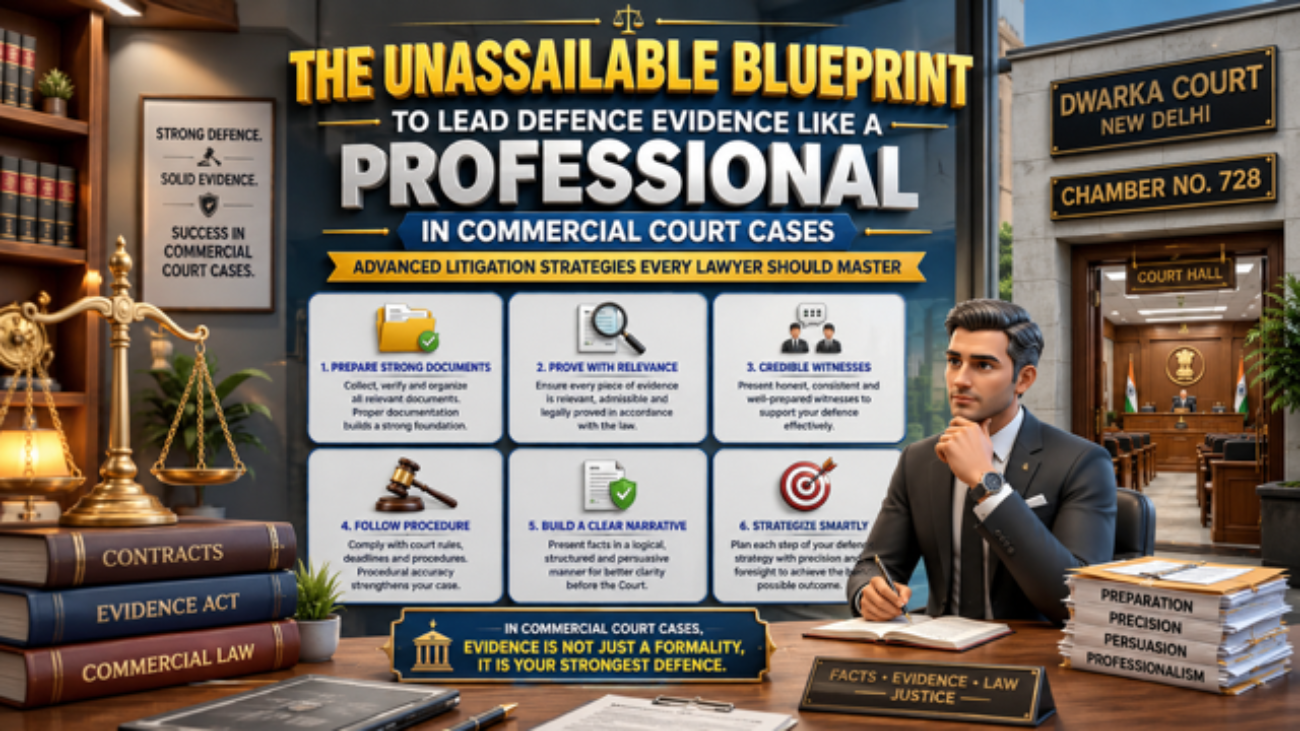
Introduction – Defence Evidence in Commercial Court Cases
A defendant may have a genuine defence in a business dispute, but a Commercial Court does not decide a case merely on what a party says happened.
The Court considers the pleadings, admitted facts, properly disclosed documents, legally admissible evidence, testimony of witnesses and the applicable law.
This makes Defence Evidence in Commercial Court Cases one of the most important stages of commercial litigation.
A written statement tells the Court what your defence is. Evidence is used to establish the facts on which that defence rests.
For example, a defendant may plead that the alleged outstanding amount has already been paid. That assertion becomes considerably more meaningful when it is supported by bank statements, payment acknowledgements, emails, ledger entries or other admissible material.
Similarly, where the dispute concerns defective goods, delayed supply, incomplete services, breach of contractual obligations or reconciliation of accounts, the defence may depend heavily upon contemporaneous business records.
Commercial litigation is therefore not merely about drafting a convincing reply. It requires an evidence strategy from the very beginning.
What Is a Commercial Dispute?
The Commercial Courts Act, 2015 covers specified categories of commercial disputes arising from transactions such as ordinary business dealings, agreements relating to goods and services, mercantile documents, partnership arrangements, shareholders’ agreements, intellectual-property matters and several other recognised commercial relationships.
Whether a particular matter falls within the jurisdiction of a Commercial Court depends not merely upon the parties being businesses. The nature of the transaction, the statutory definition of a commercial dispute, the specified value, territorial jurisdiction and pecuniary jurisdiction must all be examined.
The Commercial Courts Act presently defines “Specified Value” with a statutory floor of ₹3 lakh, subject to the applicable statutory and notified jurisdictional framework. Therefore, jurisdiction should be examined on the facts of the particular case rather than assumed merely from the amount involved. (Indian Kanoon).
What Does “Defence Evidence” Mean?
Defence evidence consists of the material through which a defendant seeks to establish the factual foundation of the defence taken in the written statement.
Depending upon the dispute, this may include contracts, purchase orders, invoices, credit notes, debit notes, delivery challans, e-way bills, bank statements, ledger accounts, GST records, emails, WhatsApp conversations, correspondence, photographs, audio or video material, certificates, reports and oral testimony.
But possession of a document does not automatically mean that the document will prove the case.
The important questions are:
| Question | Why It Matters |
| Is the document relevant? | Evidence should relate to an issue actually arising in the suit. |
| Was it disclosed at the appropriate stage? | Commercial suits have a stricter disclosure regime. |
| Can its execution or origin be established? | A document may need to be proved through the appropriate person or record. |
| Has the opposite party admitted it? | Admitted documents may reduce the extent of formal proof required. |
| Is it an electronic record? | Electronic evidence may require compliance with the Bharatiya Sakshya Adhiniyam, 2023. |
| Does it contradict the written statement? | Evidence normally cannot be used to create an entirely different factual case from the pleadings. |
| Who will prove it? | The correct witness may be essential to establish a disputed document. |
That is why Defence Evidence in Commercial Court Cases should ideally be planned while the written statement itself is being prepared.
Written Statement and Evidence Are Not the Same Thing
One of the most common misunderstandings in commercial litigation is:
“We have already stated everything in the written statement. Why do we need evidence?”
Because pleadings and proof perform different functions.
Suppose the plaintiff claims that ₹25 lakh remains unpaid under a supply agreement.
The defendant pleads:
“The entire amount has already been paid.”
That is the defence.
Bank transfers, receipts, reconciliation statements and correspondence acknowledging payment may constitute evidence supporting that defence.
Similarly, if the defence is that the plaintiff supplied defective goods, the relevant evidence may include inspection reports, rejection emails, photographs, replacement requests, debit notes and correspondence generated at the time of the dispute.
A carefully drafted written statement therefore needs to be supported by an equally careful documentary record.
The 120-Day Written Statement Rule Is Critical
Commercial litigation contains strict timelines.
Ordinarily, a defendant is required to file the written statement within 30 days from service of summons. The Commercial Courts framework permits the Court, for recorded reasons and ordinarily upon costs, to allow filing beyond 30 days—but not beyond 120 days from the date of service of summons. On expiry of the 120-day period, the statutory provision states that the defendant forfeits the right to file the written statement and the Court shall not take it on record. (IndiaCode by eCourtsIndia)
The Supreme Court has treated this deadline in commercial suits as mandatory. (Indian Kanoon)
This is important for evidence because the defendant’s document disclosure is closely connected with preparation of the written statement.
Waiting until the last moment to collect business records can therefore create serious procedural problems.
Order XI CPC: The Most Important Provision for Documents
For defendants, Order XI of the CPC as applicable to commercial disputes deserves particular attention.
The defendant is required to file a list and copies of documents within its power, possession, control or custody pertaining to the suit along with the written statement or counterclaim.
Importantly, this disclosure is not restricted only to favourable documents.
Order XI includes documents relevant to matters in question even where they may be adverse to the defendant’s defence. The written statement or counterclaim also carries a declaration regarding disclosure of documents. The duty to disclose continues during the suit. (IndiaCode by eCourtsIndia)
This creates an important practical rule:
Do not prepare the written statement first and start searching for evidence afterwards.
The better approach is to collect, organise and review the documents before finalising the defence.
Can a Defendant File Additional Documents Later?
Sometimes a document is discovered after the written statement has been filed.
However, a defendant should not assume that it can simply produce the document whenever the evidence stage begins.
Under Order XI, where a document was within the defendant’s power, possession, control or custody but was not disclosed with the written statement or counterclaim, later reliance generally requires leave of the Court and the defendant must establish reasonable cause for the earlier non-disclosure. (IndiaCode by eCourtsIndia)
Accordingly, saying:
“We forgot to file it.”
may not necessarily solve the problem.
Document collection should therefore begin immediately after summons or even earlier when the business first becomes aware that litigation is likely.
Create a Commercial Litigation Evidence Folder
A business facing litigation should ideally create a separate litigation record rather than relying upon scattered emails and WhatsApp messages.
The file may contain the contract, amendments, quotations, purchase orders, invoices, delivery records, bank transactions, tax documents, correspondence, legal notices, replies, internal approvals, meeting records and electronic evidence relevant to the dispute.
A chronology is also extremely useful.
For example:
15 January — Purchase order issued.
20 January — Advance payment received.
5 February — Goods supplied.
7 February — Plaintiff complained about quantity.
8 February — Defendant disputed the complaint.
12 February — Joint reconciliation meeting.
20 February — Part payment received.
10 March — Legal notice issued.
A chronology often exposes inconsistencies that cannot easily be identified when hundreds of documents are reviewed individually.
Admission and Denial of Documents Is Not a Formality
Commercial litigation also gives considerable importance to admission and denial of documents.
After disclosure and inspection, parties are required to state whether they admit or deny matters such as the correctness of contents, existence, execution, issuance or receipt, and custody of documents.
Importantly, Order XI requires reasons for denial. Bare and unsupported denials may not amount to an effective denial, subject to the statutory provisions concerning third-party documents. (IndiaCode by eCourtsIndia)
This stage should therefore not be treated as routine clerical work.
Before admitting or denying a document, the advocate and client should examine questions such as:
Was the agreement actually executed?
Was this email received?
Was the invoice generated by our company?
Is the signature admitted?
Does the document contain alterations?
Is only part of the document being relied upon?
Is the purported WhatsApp conversation complete?
Does the ledger correspond with the company’s actual books?
An incorrect admission may damage the defence. An unreasonable denial may also have procedural consequences.
Emails, WhatsApp Chats and Electronic Evidence
Modern commercial disputes are increasingly decided through electronic records.
Important negotiations may exist only through email.
Purchase confirmations may be sent through WhatsApp.
Payments may be acknowledged electronically.
Meetings may occur through online platforms.
Invoices and accounting data may originate from enterprise software or cloud systems.
Electronic records cannot simply be treated as ordinary paper documents without examining the applicable evidentiary requirements.
The Bharatiya Sakshya Adhiniyam, 2023 recognises electronic and digital records and provides that their contents may be proved in accordance with its provisions. Sections 61 to 63 are particularly relevant to electronic records. Section 63 contains requirements concerning computer output and certification where applicable. (India Code)
Therefore, parties should preserve original devices, complete email chains, attachments, metadata wherever relevant, source files and appropriate electronic-record information instead of merely keeping cropped screenshots.
A screenshot may show what appeared on a screen. It does not automatically answer every question concerning authenticity, completeness, source and admissibility.
Never Delete Electronic Records Once a Dispute Begins
This is a simple but extremely important rule.
Once a commercial dispute is anticipated, businesses should avoid deleting relevant emails, chats, invoices, server records, accounting entries or other electronic material.
The objective should be preservation—not reconstruction.
Where possible, relevant company personnel should be informed that records relating to the dispute must not be routinely deleted.
This is particularly important where email servers, accounting software or cloud storage automatically delete or archive old data.
Accounting Records Can Be Powerful—but Must Be Explained
Many recovery suits depend upon invoices and ledger accounts.
However, simply filing a lengthy ledger may not communicate the defence effectively.
The Court may need to understand:
What amount was originally invoiced?
What payments were received?
What credit notes were issued?
Were goods returned?
Was any amount adjusted?
Was tax deducted?
Was there a running account?
What amount does the defendant actually admit, if any?
Where does the defendant dispute the plaintiff’s calculation?
A proper reconciliation statement can therefore be more useful than hundreds of pages of unexplained entries.
Where necessary, the person familiar with the accounts may also become an important witness.
Who Should Become the Defence Witness?
Choosing the correct witness is an important part of Defence Evidence in Commercial Court Cases.
The witness should ordinarily have genuine knowledge of the relevant transaction and should be capable of explaining the documents relied upon.
For example, depending upon the dispute, the appropriate witness may be a director involved in negotiations, an authorised representative who handled the transaction, an accounts officer familiar with payments, a project manager responsible for execution, or another person with direct knowledge of the relevant facts.
Merely choosing the most senior person in the organisation does not necessarily make that person the best witness.
A witness who repeatedly answers:
“I do not know.”
“I was not handling the transaction.”
“I cannot identify this email.”
“I cannot explain this ledger.”
may weaken otherwise useful documentary evidence.
Affidavit of Evidence Should Match the Pleadings
The affidavit by way of evidence should be prepared with reference to the issues framed by the Court, the written statement and the documents disclosed.
It should not become an attempt to rewrite the defence.
A common mistake is to introduce new factual allegations during evidence that were never pleaded in the written statement.
The safer approach is to create a clear connection:
Pleading → Issue → Document → Witness → Proof
For example:
Defence: Payment already made.
Issue: Whether the defendant discharged the outstanding liability.
Evidence: Bank statement and payment acknowledgement.
Witness: Accounts representative familiar with the payment.
Cross-examination preparation: Date, amount, bank account, reference number and reconciliation.
That is an evidence strategy.
Prepare the Witness—Do Not Coach the Witness
Witness preparation is legitimate and necessary.
Coaching a witness to give an artificial version is not.
A properly prepared witness should understand the chronology, review his or her affidavit, know which documents are being relied upon, distinguish personal knowledge from information received from company records and be prepared to answer questions truthfully.
Witnesses should be specifically warned against guessing.
If a witness does not know an answer, the witness should not invent one merely because the question appears important.
Cross-Examination Begins Before Defence Evidence
A good defence evidence strategy does not begin on the day the defendant enters the witness box.
It may start during cross-examination of the plaintiff’s witnesses.
For example, the defendant may seek admissions regarding payments, delivery, correspondence, contractual obligations, defects, delays, reconciliation of accounts or other matters relevant to the defence.
Those admissions may later support the defendant’s documentary case.
Therefore, plaintiff evidence and defence evidence should not be treated as disconnected stages.
Case Management Hearing and Evidence Timelines
Commercial Courts employ a structured case-management mechanism under Order XV-A CPC.
After completion of the relevant pleading and admission/denial stages, the Court may establish a timetable dealing with issues, witnesses, affidavits of evidence, recording of evidence, written arguments and oral submissions.
The objective is to prevent commercial suits from proceeding through indefinite adjournments. (Indian Kanoon)
This means that parties should prepare their evidence much earlier than they might expect in an ordinary civil dispute.
What If the Plaintiff’s Case Has No Real Prospect of Succeeding?
Not every commercial suit necessarily requires a full trial.
Order XIII-A CPC provides a mechanism for summary judgment in appropriate commercial disputes where the statutory requirements are satisfied.
Therefore, while preparing defence evidence, the legal team should also consider whether the dispute genuinely requires a complete evidence trial or whether another procedural remedy may be available.
The answer depends entirely upon the pleadings, documents and particular facts of the case.
Counterclaim and Set-Off Must Be Considered Early
Sometimes a defendant is not merely resisting payment.
The defendant may itself have a monetary or contractual claim against the plaintiff.
For example, the plaintiff demands ₹30 lakh for supplies, while the defendant claims ₹12 lakh for defective goods, delay or contractual losses.
The possibility of a legally maintainable set-off or counterclaim should therefore be considered while preparing the written statement rather than after the case reaches the evidence stage.
Jurisdiction, limitation, court fees and the factual basis of the proposed claim must be examined separately.
Section 12A Pre-Institution Mediation Can Affect Strategy
Where a commercial plaintiff proposes to institute a suit that does not contemplate urgent interim relief, Section 12A of the Commercial Courts Act provides for pre-institution mediation. The Supreme Court in Patil Automation Pvt. Ltd. v. Rakheja Engineers Pvt. Ltd. treated the statutory requirement as mandatory in the circumstances governed by Section 12A. (Indian Kanoon)
For a prospective defendant, receipt of a pre-institution mediation notice should not be treated casually.
It may be the first indication that commercial litigation is imminent.
That is an appropriate stage to preserve documents, prepare the chronology, review contractual rights, calculate financial exposure and obtain legal advice regarding possible settlement or defence strategy.
Ten Practical Mistakes That Can Damage a Commercial Defence
The most damaging errors usually occur before the evidence stage formally begins.
These include waiting until the evidence stage to search for documents; filing a written statement without reviewing the complete business record; failing to disclose relevant documents under Order XI; relying only upon oral explanations when written records exist; giving blanket admissions or denials without analysing documents; preserving only screenshots instead of complete electronic records; producing a witness who lacks personal knowledge; allowing the affidavit of evidence to contradict the written statement; attempting to introduce important documents very late; and failing to reconcile invoices, payments, credit notes and ledger entries before the witness enters the box.
Most of these problems are preventable through early preparation.
Practical Defence Evidence Checklist
Before finalising the evidence strategy, examine the contract and amendments, purchase orders, invoices, delivery documents, payment records, bank statements, ledger accounts, GST or tax records where relevant, emails and attachments, WhatsApp or other electronic communications, legal notices and replies, internal correspondence relevant to the issues, credit/debit notes, photographs and videos, original documents, electronic-evidence requirements, witness availability, chronology of events, admission/denial statements, disputed signatures or execution, additional documents requiring leave of Court, and the precise issues the defendant actually needs to prove.
The objective is not to produce the largest possible volume of papers.
The objective is to identify the evidence that proves the defence.
Defence Evidence: Strong Preparation vs Weak Preparation
| Stage | Proper Preparation | Weak Preparation |
| Written Statement | Defence supported by identified records | Drafted before documents are reviewed |
| Disclosure | Relevant documents organised and disclosed | Documents discovered piecemeal later |
| Electronic Records | Source and evidentiary requirements examined | Cropped screenshots only |
| Admission/Denial | Each important document reviewed | Blanket denial |
| Accounts | Reconciliation prepared | Hundreds of unexplained ledger entries |
| Witness Selection | Person with genuine knowledge | Senior person with no transaction knowledge |
| Affidavit | Consistent with pleadings and issues | New facts introduced during evidence |
| Cross-Examination | Based on documents and chronology | Improvised questions |
| Timeline | Evidence prepared before deadlines | Preparation begins immediately before hearing |
| Final Arguments | Evidence connected with each issue | Documents referred to without explaining relevance |
Good evidence preparation is therefore not about presentation alone. It is about procedural compliance, relevance and proof.
Why Local Commercial Litigation Experience Can Be Useful in Dwarka Court
Commercial litigation combines substantive law with strict procedure.
For parties whose matters fall within the territorial and pecuniary jurisdiction of courts at Dwarka, regular familiarity with the filing system, court directions, case-management stages and day-to-day procedure can make coordination easier.
Our litigation practice is based at Dwarka Courts, Sector-10, New Delhi, and we assist individuals, proprietorship concerns, partnership firms, professionals, companies and other businesses in commercial and civil disputes.
Our work may include reviewing the dispute before litigation, preparing or responding to legal notices, examining contracts and evidence, drafting commercial pleadings, preparing written statements and counterclaims, document disclosure, admission and denial, applications arising during the suit, witness preparation, cross-examination, written submissions and final arguments.
Each matter, however, requires an independent assessment according to its own facts and applicable law.
Important & Related blogs
| Important Topics | Text |
| Commercial Court practice page | Commercial Court Lawyer in Dwarka Court |
| Commercial Court Recovery Suit: | When Does the Limitation Period Start? |
| Commercial Lease Dispute Dwarka | Powerful Ground Every Client Should Know |
| Written Statement 120 Days in Commercial Court Recovery Suit | Important Law |
| Commercial Money Recovery Suit in Delhi | A Complete Guide for International Clients & Foreign Companies |
| The Unassailable Blueprint to Lead Defence Evidence Like a Professional in Commercial Court Cases | Advanced Litigation Strategies Every Lawyer Should Master |
| Commercial Court Is Fast | But Only If Your Lawyer Does This in Delhi Court |
| Why Businesses Lose Strong Commercial Cases Despite Having Agreements? | Experienced Commercial Court Advocate Dwarka Delhi |
| Powerful Commercial Court Recovery Case | Acquittal Strategies for Fearless Defence |
| What Happens After Receiving a Legal Notice | in a Commercial Matter? |
Frequently Asked Questions
FAQ 1 — Is filing a written statement enough to defend a Commercial Court case?
No. A written statement contains the defendant’s pleaded case. The relevant factual assertions may still have to be established through admissible documents and witness evidence, subject to admissions and applicable evidentiary rules.
FAQ 2 — When should a defendant start collecting evidence?
Ideally, immediately after becoming aware of the dispute. Once summons have been received, collection should not be delayed because both the written-statement timeline and Commercial Court disclosure requirements can become critical.
FAQ 3 — Do defendants have to disclose documents that are against their own case?
Order XI applicable to commercial disputes contains an extensive disclosure obligation covering documents relating to matters in question that are within the defendant’s power, possession, control or custody, including documents adverse to the defence, subject to the statutory exceptions. (IndiaCode by eCourtsIndia)
FAQ 4 — Can WhatsApp messages be used in a Commercial Court?
Electronic communications may become relevant evidence depending upon their contents and the issues in the suit. Their admissibility and proof must be examined under the Bharatiya Sakshya Adhiniyam, 2023, including the provisions governing electronic records. (India Code)
FAQ 5 — Can additional documents be filed during evidence?
Possibly, but it should never be assumed. Where documents within the defendant’s power, possession, control or custody were not disclosed with the written statement, leave of Court and a satisfactory explanation consistent with Order XI may be required. (IndiaCode by eCourtsIndia)
FAQ 6 — Should the company director always become the witness?
Not necessarily. The appropriate witness depends on who has knowledge of the transaction and who can properly explain the documents and facts relied upon.
FAQ 7 — What documents are commonly important in commercial recovery cases?
Depending upon the facts, agreements, purchase orders, invoices, delivery challans, bank statements, ledger accounts, credit notes, GST records, emails, acknowledgements and electronic communications may all become relevant.
FAQ 8 — What happens if the written statement is filed after 120 days?
In a commercial suit governed by the relevant Commercial Court provisions, the defendant ordinarily forfeits the right to file the written statement after expiry of 120 days from service of summons, and the statutory framework prevents the Court from taking it on record. (IndiaCode by eCourtsIndia)
FAQ 9 — Is every business dispute a Commercial Court case?
No. The transaction must fall within the statutory framework governing commercial disputes and the requirements relating to specified value and jurisdiction must also be satisfied.
FAQ 10 — Can Commercial Court cases be settled?
Yes. Depending upon the stage and circumstances, negotiation, mediation or a structured settlement may be considered. Settlement should be evaluated commercially and legally rather than treated as an admission of weakness.
Conclusion
Defence Evidence in Commercial Court Cases should never be treated as an exercise that begins only after the plaintiff closes its evidence.
A strong commercial defence is usually constructed much earlier.
The process begins by understanding the plaint, identifying the real issues, collecting the entire documentary record, preparing the written statement carefully, complying with Order XI disclosure, preserving electronic records, handling admission and denial correctly, selecting the appropriate witnesses and preparing cross-examination around the documentary record.
One principle is particularly important:
Do not ask only, “What is our defence?”
Also ask:
“How will we prove each important part of that defence?”
That question can fundamentally change the quality of Commercial Court preparation.
Professional Consultation for Commercial Court Matters in Dwarka, Delhi
If you are a defendant in a commercial recovery suit, contractual dispute or other commercial litigation, obtaining legal advice before important procedural deadlines expire may help prevent avoidable difficulties.
Ankit Gaurav Kainth & Associates
Advocates – Civil & Commercial Litigation
Chamber No. 728, 7th Floor
Dwarka Court, Sector-10, New Delhi
Mobile: 98990 85554 | 98118 85554
Consultations may involve review of pleadings, contracts, invoices, emails, accounts, electronic records and other relevant documents before a litigation strategy is advised.
Disclaimer: This article is intended for general legal awareness and informational purposes only. It is not a substitute for legal advice and does not create an advocate-client relationship. Commercial Court jurisdiction, limitation, admissibility of evidence, procedural requirements and available remedies depend upon the facts of each case and the law applicable at the relevant time. No particular result or outcome is guaranteed.
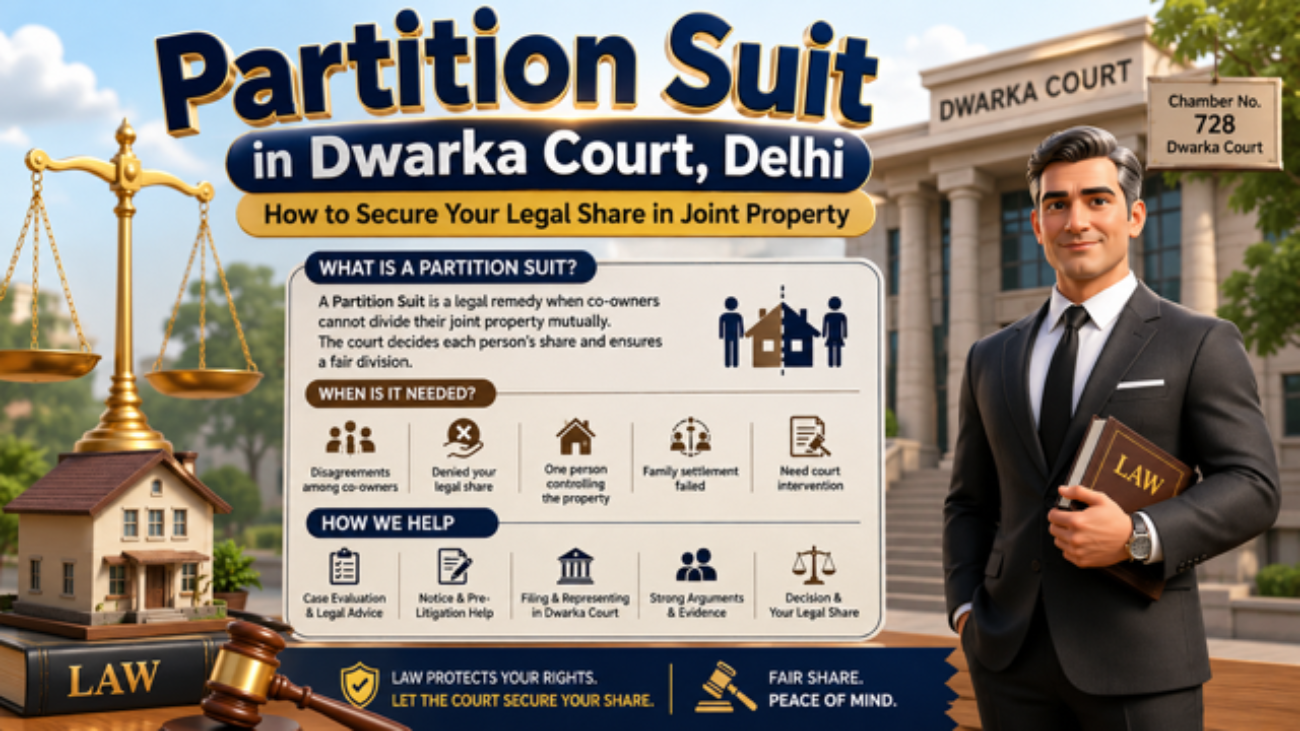
Introduction – Partition Suit in Dwarka
Property disputes are among the most common legal issues faced by families in Delhi. Many people invest their lifetime earnings into purchasing property. However, disputes often arise when family members, legal heirs, or co-owners disagree about ownership and division.
In such situations, filing a Partition Suit in Dwarka can help protect your legal rights and ensure that you receive your rightful share.
Whether the dispute involves ancestral property, jointly owned property, inherited assets, or family-owned real estate, understanding the legal process is essential. Therefore, this guide explains everything in simple language.
With over 18 years of experience in Dwarka Court, our legal team assists clients from Dwarka Sector 6, Dwarka Sector 10, Dwarka Sector 12, Dwarka Sector 23, Uttam Nagar, Janakpuri, Najafgarh, Palam Village, Dabri, Chhawla, Samalka, Kapashera, Mohan Garden, Bindapur, Baba Haridas Nagar, Delhi Cantonment, Vikaspuri, Jaffarpur Kalan and nearby areas.
⚖️ What is a Partition Suit?
A Partition Suit in Dwarka is a civil case filed before the court when co-owners of a property cannot mutually divide their shares.
The court determines:
✅ Who owns what share
✅ Rights of each co-owner
✅ Whether physical division is possible
✅ Whether the property should be sold and proceeds distributed
Simply put, a partition suit legally separates ownership rights among family members or co-owners.
🏠 When is a Partition Suit Required?
You may need a Partition Suit in Dwarka if:
Therefore, court intervention becomes necessary when peaceful settlement is not possible.
📋 Common Properties Involved in Partition Cases
| Property Type | Can Partition Suit Be Filed? |
| Ancestral Property | ✅ Yes |
| Inherited Property | ✅ Yes |
| Joint Family Property | ✅ Yes |
| Co-Owned Flat | ✅ Yes |
| Commercial Property | ✅ Yes |
| Agricultural Land | ✅ Yes |
| Self-Acquired Property | ⚠️ Depends on ownership |
⚖️ Who Can File a Partition Suit?
A Partition Suit in Dwarka can be filed by:
Moreover, daughters now enjoy equal rights in ancestral property under Indian law.
📑 Important Documents Required
Generally, the following documents are needed:
However, additional documents may be required depending on the facts of the case.
🔍 Stages of a Partition Suit in Dwarka
Stage 1: Legal Consultation
Initially, an advocate examines ownership records and legal rights.
Stage 2: Pre-Litigation Notice
Thereafter, a legal notice may be sent to other co-owners seeking an amicable settlement.
Stage 3: Filing of Suit
If settlement fails, the Partition Suit in Dwarka is filed before the competent court.
Stage 4: Court Proceedings
The court records pleadings, evidence, and arguments.
Stage 5: Preliminary Decree
The court determines ownership shares.
Stage 6: Final Decree
Finally, the property is divided or sold according to the decree.
🤝 Why Pre-Litigation Assistance Matters
Many property disputes can be resolved before court proceedings begin.
Therefore, our legal team focuses extensively on pre-litigation support.
We Assist By:
✅ Reviewing ownership documents
✅ Conducting legal analysis
✅ Sending legal notices
✅ Negotiating settlements
✅ Drafting family settlements
✅ Protecting client rights before litigation
As a result, clients often save substantial time, money, and emotional stress.
⚖️ Our Litigation Support in Dwarka Court
When litigation becomes unavoidable, professional representation becomes crucial.
Our team handles:
✅ Filing of Partition Suit in Dwarka
✅ Drafting plaints
✅ Court appearances
✅ Evidence preparation
✅ Cross-examination
✅ Interim applications
✅ Execution proceedings
✅ Appeals and related proceedings
Consequently, clients receive complete legal assistance throughout the litigation process.
📍 Advantage of Hiring Local Advocates in Dwarka Court
Choosing a local advocate can make a significant difference.
Since we regularly practice in Dwarka Court, we understand:
As a result, cases can be filed and managed more efficiently.
This local experience benefits clients from Janakpuri, Vikaspuri, Dwarka North, Dwarka South, Uttam Nagar, Najafgarh, Palam Village, Chhawla, Kapashera, Samalka, Bindapur, Mohan Garden and areas near Dwarka Court.
🌟 Why Clients Trust Our Law Firm
Trust is the foundation of every lawyer-client relationship.
Therefore, we maintain the highest professional standards.
Our Client Commitment
✅ Honest legal advice
✅ Transparent fee structure
✅ Proper Lawyer-Client Fee Agreements
✅ Written fee receipts
✅ Acknowledgements for payments
✅ Regular case updates
✅ Dedicated WhatsApp support
✅ Availability on call
✅ Quick responsiveness
✅ Ethical and fair dealings
Therefore, clients remain informed at every stage of their case.
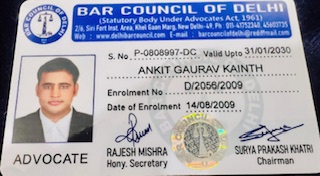
📊 Why Professional Legal Guidance Matters
| Without Legal Guidance | With Professional Guidance |
| Incomplete documents | Proper documentation |
| Delay in filing | Timely filing |
| Weak legal strategy | Strong legal planning |
| Procedural errors | Compliance with court rules |
| Higher litigation risk | Better case management |
| Stress and confusion | Clarity and confidence |
🔑 Choosing the Right Advocate
When selecting a lawyer for a Partition Suit in Dwarka, consider:
Many clients searching for a Criminal & Civil Advocate Dwarka, Best Partition Lawyer in Dwarka Court, Best Criminal Disputes Advocate Dwarka Court, Top and Best Advocate in Dwarka Court, or Top Regular Bail & Anticipatory Bail Lawyer Dwarka prefer experienced local representation because it provides practical advantages and efficient case management.
Conclusion
A property dispute should never deprive you of your lawful ownership rights. Fortunately, the law provides effective remedies through a Partition Suit in Dwarka.
Whether the dispute involves ancestral property, inherited assets, joint family property, or co-owned real estate, timely legal action can protect your interests.
Furthermore, professional legal guidance helps avoid procedural mistakes and ensures that your case progresses effectively. Therefore, consulting an experienced advocate at the earliest stage can significantly strengthen your position and improve the chances of a favourable outcome.
Frequently Asked Questions (FAQs)
1. What is a Partition Suit in Dwarka?
A legal proceeding filed to divide jointly owned or inherited property among co-owners.
2. How long does a partition suit take?
The duration depends upon facts, evidence, court workload, and cooperation between parties.
3. Can daughters file a partition suit?
Yes. Daughters have equal rights in ancestral property under Indian law.
4. Is a legal notice necessary before filing a partition suit?
Although not mandatory in every case, it is often advisable and may help achieve settlement.
5. Can the court order sale of property?
Yes. If physical division is impractical, the court may order sale and distribution of proceeds.
📞 Contact Us Today
If you need assistance regarding a Partition Suit in Dwarka, property dispute, family settlement, civil litigation, or related legal matter, contact our office today.
⚖️ Ankit Gaurav Kainth & Associates
📞 Mobile: 9899085554
📞 Mobile: 9811885554
📍 Near Dwarka Court, Delhi
✅ 18+ Years of Court Experience
✅ Dedicated WhatsApp Support
✅ Transparent Fee Structure
✅ Professional & Ethical Representation
Book your consultation today and secure your legal share with confidence.