
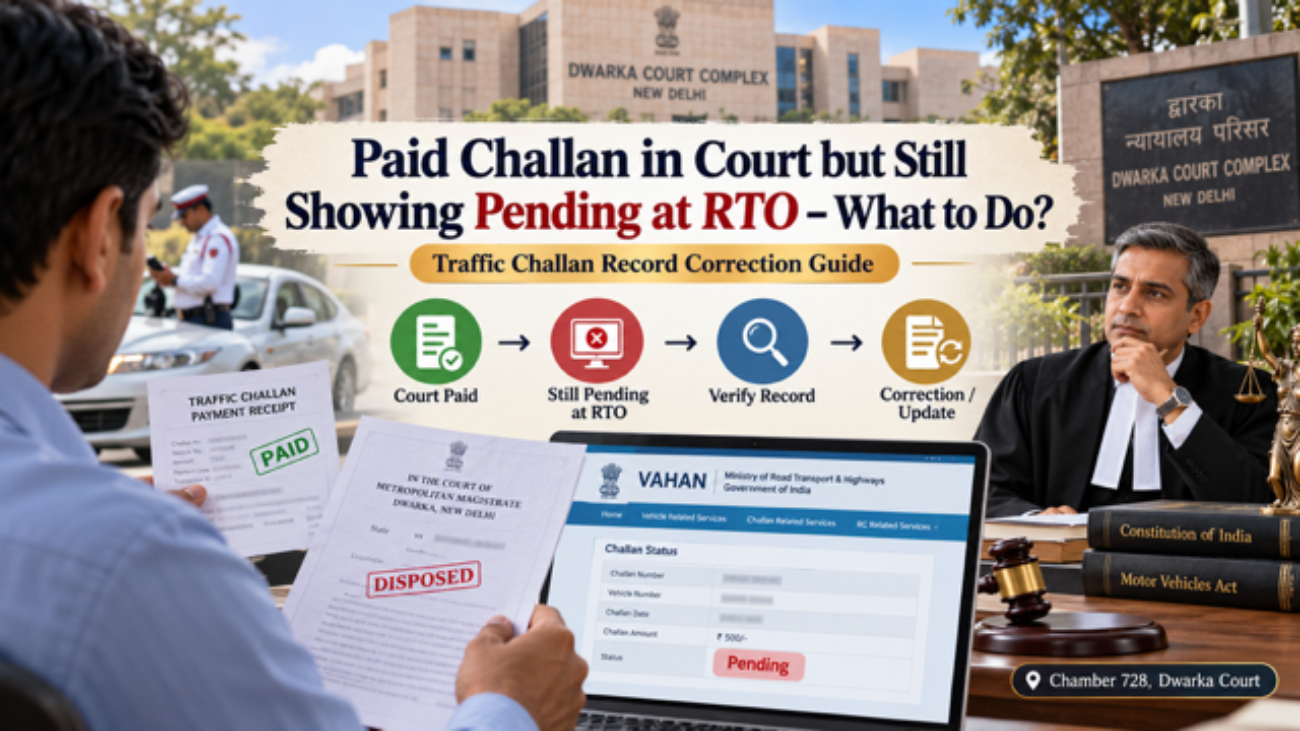
Introduction – Paid Challan in Court but Still Showing Pending at RTO
Traffic Challan Paid but Not Updated in RTO, VAHAN or eChallan Records? A Practical Delhi Guide
You appeared before the Court. The traffic challan was disposed of. The fine was paid. You have the court order or payment receipt.
But days or weeks later, the same challan is still showing as pending against your vehicle or driving licence.
The problem may become more noticeable when you try to:
- transfer ownership of a vehicle;
- obtain or renew a traffic NOC;
- complete an RTO/Transport Department service;
- sell the vehicle;
- check pending challans online;
- deal with another vehicle-related application; or
- verify whether the court matter has actually been closed.
This situation does not necessarily mean that the challan has to be paid again.
The first task is to identify where the challan has been disposed of, where the payment is reflected and which database is still showing it as pending.
A court record, Delhi Traffic Police record, Virtual Court record, eChallan record and VAHAN-related record may not always display exactly the same information at the same time.
The problem should therefore be approached systematically.
Quick Answer: What Should You Do?
If a traffic challan has already been paid or disposed of by a Court but still appears as pending:
- Do not immediately pay the same challan again.
- Obtain the court order/disposal order and payment receipt.
- Verify the challan number, vehicle number and payment details.
- Check the challan on the official Traffic Police/eChallan portal.
- Check whether the matter was transferred to or disposed of through Virtual Court.
- Verify whether the payment transaction itself shows successful.
- If the court record shows disposal but the online traffic database remains pending, raise a grievance with the concerned authority.
- If the traffic record is corrected but an RTO/VAHAN service remains blocked, submit the disposal record before the concerned Transport/RTO authority.
- Preserve screenshots and acknowledgement numbers of every complaint or representation.
The correct route depends upon where the mismatch is occurring.
Why Can a Paid Challan in Court but Still Showing Pending at RTO Still Show as Pending?
Several different situations can produce the same apparent problem.
1. Court Has Disposed of the Challan but Online Record Has Not Updated
A challan may have been disposed of before a Traffic Court, Evening Court, Lok Adalat or other competent court, but the updated disposal information may not yet be reflected in the electronic system being checked by the vehicle owner.
The first question should therefore be:
What does the actual court record say?
If the order records payment/disposal, preserve a copy carefully.
2. Payment Was Made but Transaction Status Is Still Unclear
Sometimes the problem is not the judicial order but the payment record.
Verify:
- challan number;
- transaction/reference number;
- amount paid;
- date of payment;
- vehicle registration number;
- status of payment; and
- whether a receipt was generated.
A bank debit alone should not be treated as the only proof of disposal.
Keep the official payment acknowledgement wherever available.
3. Challan Was Transferred to Virtual Court
Traffic challans can be transmitted to the Virtual Court system.
If that has happened, checking only one portal may create confusion.
The vehicle owner should determine:
- whether the challan was transferred to Virtual Court;
- whether it was subsequently paid there;
- whether an order was passed;
- whether it was contested instead;
- and whether the final disposal is reflected against the correct challan number.
Important
If a particular challan has already been paid through the proper court/Virtual Court channel, do not knowingly make a second payment merely because another screen continues to display “pending.”
First verify the records.
4. There May Be More Than One Challan
Another common source of confusion is multiple challans against the same registration number.
For example:
- Challan A may already be disposed of;
- Challan B may still be pending.
A person checking only the vehicle number may believe that the earlier payment has not been updated.
Always compare the individual challan number, not merely the vehicle registration number.
5. Vehicle Number or Challan Details May Not Match Correctly
Before filing any grievance, compare the details appearing on:
- original challan;
- RC;
- court order;
- payment receipt;
- Virtual Court record;
- eChallan record; and
- current online status.
Even a mismatch in the challan being referred to can result in unnecessary correspondence.
6. Court Disposal and RTO/VAHAN Status Are Two Different Issues
This distinction is extremely important.
A traffic challan is one matter.
The status of a vehicle-related service before the Transport Department or VAHAN system is another.
Therefore, where the challan itself has been correctly shown as disposed of but an RTO/VAHAN transaction remains blocked, the issue may require a separate correction or representation before the concerned transport authority.
Do not assume that obtaining the court receipt alone automatically resolves every linked administrative process.
Step-by-Step: What to Do When a Paid Challan Still Shows Pending
Step 1 – Identify the Exact Challan
Record the:
- challan number;
- vehicle number;
- date of violation;
- alleged offence;
- amount;
- court, if any;
- case/challan reference; and
- date of disposal/payment.
Take a screenshot of the screen currently showing the challan as pending.
This creates a clear before-correction record.
Step 2 – Obtain Proof of Court Disposal
Preserve whichever documents are applicable:
- court order;
- disposal order;
- receipt of fine;
- Virtual Court receipt;
- Lok Adalat order;
- Evening Court order;
- payment acknowledgement;
- case status printout; or
- certified copy where required.
The most important document is normally one which connects the specific challan number/vehicle/case with the final disposal or payment.
Step 3 – Verify the Challan on Official Portals
Do not depend upon screenshots received through WhatsApp, third-party applications or random payment websites.
Check the status on the applicable official platform.
Depending upon the challan, this may include:
- Delhi Traffic Police;
- MoRTH eChallan;
- Virtual Courts; and
- the relevant VAHAN/Transport Department service.
Compare the status appearing on each relevant official system.
Step 4 – Verify the Payment Transaction Separately
Where payment was made digitally, confirm whether the transaction itself is shown as successful.
Keep:
- transaction ID;
- bank reference;
- GRN/reference number where applicable;
- challan number;
- payment date; and
- official receipt.
If the transaction failed but the bank account was debited, that is different from a case where the transaction succeeded but the challan continues to show as pending.
The grievance should describe the correct problem.
Step 5 – Check Virtual Court Status
If the challan was transferred to Virtual Court, search using the available particulars such as:
- challan number;
- vehicle number;
- case/CNR information where available; or
- other permitted search particulars.
Download or preserve the final status wherever possible.
If the Virtual Court record itself shows successful disposal but another portal shows the challan as pending, attach that record to your representation.
Step 6 – Raise an Online Grievance
Where an incorrect pending status continues, submit a grievance through the appropriate official channel.
The complaint should be precise.
Avoid simply writing:
“Challan paid but still showing pending. Please clear.”
Instead mention:
Challan No. ______ relating to Vehicle No. ______ was disposed of/paid on ______ before/through ______. The payment/disposal record is enclosed. The challan continues to appear as pending on ______. Kindly verify the disposal and update/correct the electronic record.
Attach the relevant proof.
Keep the grievance number and screenshot after submission.
Step 7 – If Necessary, Contact the Relevant Virtual Court/Court Authority
If the mismatch appears to originate from the court or Virtual Court record itself, the matter may require clarification from the concerned judicial/Virtual Court support mechanism.
The representation should identify:
- State/department;
- challan number;
- vehicle number;
- date of payment;
- transaction number;
- court details;
- nature of discrepancy; and
- supporting record.
Do not send incomplete complaints from different email addresses without maintaining a record.
Step 8 – If the Challan Is Cleared but RTO Work Remains Blocked
This is the situation many vehicle owners find especially confusing.
Suppose:
Court status: Disposed
Traffic challan status: Paid/Disposed
RTO/VAHAN service: Still blocked
At this stage, repeatedly approaching the Traffic Court may not solve the issue if the remaining problem is in the transport database or a pending transaction.
The vehicle owner should identify the particular RTO/VAHAN service affected.
For example:
- transfer of ownership;
- NOC;
- permit-related service;
- fitness-related service;
- registration-related transaction;
- other citizen service.
A written representation may then be submitted to the concerned Transport/RTO authority enclosing the disposal proof.
Documents You Should Keep Ready
Before seeking correction, prepare one PDF/file containing:
1. Registration Certificate
Clear copy of RC.
2. Driving Licence
Where the challan is connected with the licence.
3. Original Challan
The original or downloaded challan.
4. Court Order
Order recording disposal/payment where available.
5. Payment Receipt
Court/Virtual Court/eChallan receipt.
6. Transaction Details
Transaction ID or bank reference.
7. Current Pending-Status Screenshot
Preferably displaying the date.
8. Previous Grievance
If already submitted.
9. Grievance Acknowledgement
Ticket/complaint number.
10. RTO/VAHAN Error Screenshot
If a vehicle-related service is being prevented.
Keeping these records together considerably simplifies verification.
Paid in Court but No Receipt Available – What Then?
Do not rely only on memory that the fine was paid.
Try to identify:
- date of hearing;
- name/location of court;
- case/challan number;
- vehicle number;
- amount paid; and
- person who appeared.
The judicial record or online case record may need to be checked.
Where an order is available but the receipt has been misplaced, the order itself may help establish what happened, depending upon its contents.
Challan Disposed of in Lok Adalat but Still Showing Pending
Preserve the Lok Adalat settlement/order.
Then check whether the exact challan referred to in that order is the challan that continues to show pending.
If yes, submit the order along with the grievance.
Do not confuse another outstanding challan with the challan that was settled in Lok Adalat.
Challan Paid in Evening Court but Still Pending
The same basic process applies:
Evening Court disposal record → payment proof → challan-number verification → online status → grievance/correction.
Where a large number of challans were dealt with together, prepare a separate table containing each challan number and its corresponding disposal status.
This prevents one unresolved challan from being confused with several already disposed matters.
I Sold the Vehicle but an Old Challan Is Still Showing – What Should I Check?
First verify the date of:
- alleged violation;
- sale/transfer;
- delivery of possession;
- transfer application; and
- registration change.
Do not simply assume liability based upon the present possession of the vehicle.
Ownership, registration records, the identity of the driver and the nature/date of the alleged violation may all be relevant depending upon the circumstances.
Separate legal advice may be required where ownership itself is disputed.
Can a Pending Challan Affect an NOC?
Pending traffic challans can become relevant when an NOC or related transport service requires clearance of outstanding challans.
This is why an incorrectly continuing “pending” entry should not be ignored merely because the fine has already been paid.
If the record is incorrect, seek correction with documentary proof rather than paying the same liability twice merely to complete another transaction.
Should You Pay the Challan Again to Save Time?
Generally, do not make a duplicate payment without first verifying why the challan remains pending.
If payment has already been made against the same challan, preserve the first receipt and seek correction.
A second payment may create an additional refund/reconciliation problem instead of solving the underlying database issue.
What If the Challan Itself Is Wrong?
That is a different situation.
If the allegation, vehicle number, location, photograph, identity of the vehicle or other material particulars are incorrect, the question is not merely about updating a paid challan.
The challan may need to be challenged or disputed.
That should be examined before making payment because voluntary payment/disposal can affect the practical options available thereafter.
Read our related guide:
How to Challenge a Traffic Challan in Dwarka Court
When Should You Consider Legal Assistance?
Many straightforward database corrections can be pursued directly by the vehicle owner.
Legal assistance may become useful where:
- the Court shows disposal but the department refuses correction;
- no clear disposal record is available;
- multiple challans are involved;
- an RTO transaction is repeatedly blocked;
- the vehicle has already been sold;
- ownership is disputed;
- a licence has been affected;
- the challan concerns a serious alleged traffic offence;
- the person is being asked to appear before Court;
- the record incorrectly shows a continuing court matter;
- previous grievances have not resolved the discrepancy; or
- a formal representation/application is required.
The objective should first be to identify whether the problem is judicial, payment-related, traffic-database-related or RTO/VAHAN-related.
How We Assist in Traffic Challan Record Problems at Dwarka Court
At Ankit Gaurav Kainth & Associates, we assist clients with traffic challan matters connected with Dwarka Courts and Delhi.
Depending upon the circumstances, assistance may include:
- verification of challan and court status;
- examination of court orders;
- checking whether the correct challan was disposed of;
- preparation of representations;
- guidance regarding Virtual Court records;
- Traffic Court appearance where required;
- Evening Court matters;
- Lok Adalat-related challan matters;
- disputed or incorrect challans;
- multiple pending challans;
- record-correction issues; and
- related criminal proceedings arising from serious traffic incidents.
Not every paid-challan status problem requires litigation.
The first step should usually be document verification and identification of the authority whose record requires correction.
| S. No. | Related Page / Blog | Recommended Anchor Text | Why It Supports This Page | Best Placement | Internal Link |
|---|---|---|---|---|---|
| 1 | Traffic Challan Cases in Dwarka Court | Traffic Challan Cases in Dwarka Court | Main traffic-challan service page and parent page for this supporting article. | Introduction and conclusion | Read Guide |
| 2 | How to Challenge Traffic Challan in Dwarka Court | Challenge an Incorrect Traffic Challan | Useful where the problem is not merely an RTO update but the challan itself is disputed. | Section: What If the Challan Itself Is Wrong? | Read Guide |
| 3 | Evening Court vs Lok Adalat for Traffic Challan | Evening Court vs Lok Adalat for Traffic Challans | Explains two routes through which traffic challans may be disposed of. | Lok Adalat / Evening Court sections | Read Guide |
| 4 | Advocate Near Dwarka Court | Advocate Near Dwarka Court | Provides the local-service connection for users whose traffic matter requires court verification or appearance. | Legal assistance section | View Page |
| 5 | Criminal Defence Lawyer in Dwarka | Criminal Defence Lawyer in Dwarka | Relevant where the traffic incident develops beyond a routine challan into criminal proceedings. | Serious traffic-offence section | View Page |
| 6 | Death Caused by Negligent Driving in Dwarka Court | Criminal Case After a Serious Road Accident | Separates ordinary challan matters from serious road-accident cases involving criminal proceedings. | When Legal Assistance May Be Required | Read Guide |
Frequently Asked Questions
1. I paid my challan in Court. Why does it still show pending?
The exact reason has to be identified. The court may have disposed of the matter while another electronic record has not yet reflected the disposal, or a different challan may still be pending.
2. Should I pay the challan again?
Not merely because one screen continues to show “pending”. First verify whether the same challan has already been paid and obtain the payment/disposal record.
3. How do I prove that my challan was paid?
Useful documents can include the court order, payment receipt, Virtual Court receipt, transaction number and official challan status.
4. Can I check a traffic challan through Virtual Court?
Where the challan has been transferred to Virtual Court, its status can be searched through the Virtual Courts system using the permitted search particulars.
5. What if the bank account was debited but the payment status is pending?
Check the official transaction/payment-verification facility and preserve the bank reference and transaction details. A bank debit does not by itself establish that the challan was successfully disposed of.
6. Can a pending challan create difficulty during vehicle transfer?
An unresolved challan or an incorrectly pending record can become relevant during certain vehicle/RTO processes. The exact effect depends upon the service being requested and the record appearing against the vehicle.
7. Can a pending challan affect an NOC?
Clearance of pending traffic challans can be relevant to traffic NOC-related processes. If a paid challan is incorrectly shown as outstanding, seek correction with proof of disposal.
8. What if I have five challans and paid only four?
The fifth challan may continue to cause the vehicle number to appear as having pending challans. Verify every challan separately by challan number.
9. Can an advocate appear for a traffic challan matter?
Depending upon the nature of the proceeding and applicable court requirements, legal representation may be possible. Some matters may still require personal participation or compliance by the concerned person.
10. Can a wrong traffic challan be challenged instead of paid?
Potentially, yes. An incorrect challan should be examined before payment. The appropriate procedure depends upon the allegations, evidence and stage of the challan.
11. What if my court order says disposed but VAHAN is still not allowing my transaction?
First verify that the challan record itself has been updated. If it has, identify the exact VAHAN/RTO transaction that remains blocked and submit the disposal proof to the appropriate transport authority or use the applicable grievance mechanism.
12. How long does correction take?
There is no single period that can safely be promised for every case. It depends upon the authority, nature of discrepancy and whether the relevant disposal/payment record is already available electronically.
Practical Checklist
Before approaching any authority, confirm:
✓ Correct challan number
✓ Correct vehicle registration number
✓ Court disposal order available
✓ Fine/payment receipt available
✓ Transaction reference available
✓ Current status screenshot saved
✓ Virtual Court status checked, if applicable
✓ Traffic/eChallan status checked
✓ RTO/VAHAN issue identified separately
✓ Grievance acknowledgement preserved
This simple checklist can prevent repeated visits and unnecessary duplicate payments.
Conclusion
A traffic challan that has already been paid or disposed of by a Court should not be treated as a fresh liability merely because another online record still displays “pending”.
The important task is to establish the chain:
Challan → Court/Virtual Court → Disposal → Payment → Traffic Database → RTO/VAHAN Record
Find the point at which the information stops matching.
Then approach the authority responsible for that particular record with the challan number, disposal order, payment receipt and supporting documents.
For matters connected with Traffic Challan Cases in Dwarka Court, disputed challans, court appearances or unresolved disposal records, proper document verification at the beginning can avoid unnecessary repeat payments and procedural confusion.
Author: Advocate Ankit Gaurav Kainth
Practice: Civil & Criminal Litigation
Chamber: Chamber No. 728, Dwarka Court, Sector 10, New Delhi
Disclaimer
This article provides general legal and procedural information. Traffic challan, court, Virtual Court and Transport Department procedures can depend upon the nature of the violation, status of proceedings and applicable administrative system. The article should not be treated as legal advice for a particular matter.