
Practising Advocate in Dwarka Court Delhi

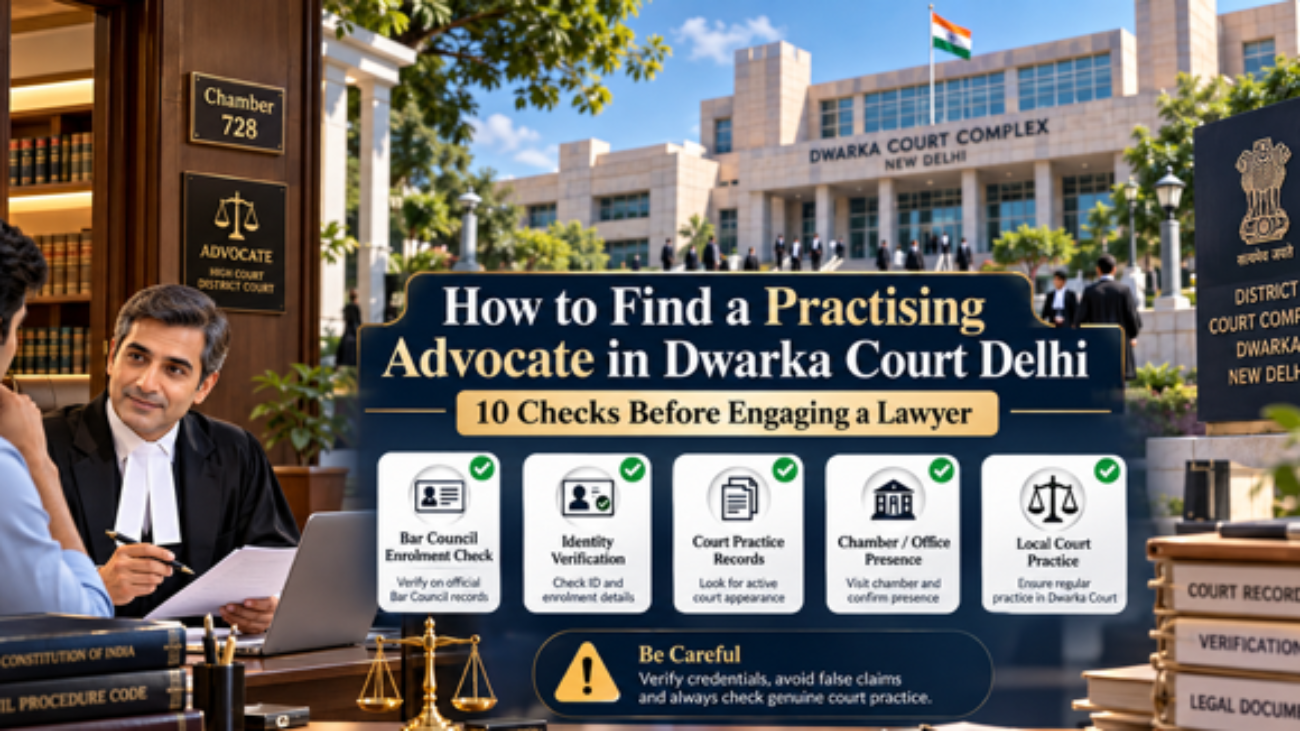
How to Find a Practising Advocate in Dwarka Court Delhi – 10 Checks Before Engaging a Lawyer

Introduction – Practising Advocate in Dwarka Court Delhi

Searching online for an advocate in Dwarka Court is easy.

Verifying whether the person you find actually practises law and has a genuine professional connection with Dwarka Courts requires a little more care.

A search for terms such as “Advocate in Dwarka Court”, “Lawyer Near Dwarka Court” or even “Best Advocate in Dwarka Court Delhi” can produce websites, advertisements, directory listings, social-media profiles and business listings.

However, appearing prominently on Google is not the same thing as having an established litigation practice before Dwarka Courts.

A prospective client should therefore look beyond rankings, photographs, reviews and promotional claims.

The more useful questions are:

Is the person enrolled as an advocate?

Can the enrolment details be independently verified?

Does the advocate actually practise before Dwarka Courts?

Is there evidence of an established professional presence in the court?

Can the advocate explain the court, jurisdiction and procedure relevant to my case?


This practical guide explains 10 checks a client can make before engaging an advocate in Dwarka Court, Delhi.

1. Start With the Most Important Check – Bar Council Enrolment

The first question should not be:

“How many Google reviews does the advocate have?”

It should be:

“What is the advocate’s Bar Council enrolment number?”

An advocate enrolled with the Bar Council of Delhi ordinarily has an enrolment number that can be checked through the Bar Council’s official records.

The Bar Council of Delhi presently provides an online Enrolment Status facility through which enrolment details can be searched using the enrolment number and year.

This is substantially more meaningful than relying only on:

  • a Google Business Profile;
  • an Instagram account;
  • a legal-directory listing;
  • a website;
  • photographs in a lawyer’s gown; or
  • claims such as “top lawyer” or “best advocate”.

These things may form part of an advocate’s online presence, but they are not substitutes for professional enrolment.

Practical client question

Before paying substantial professional fees, ask:

“May I have your Bar Council enrolment number for my records?”

A client can then independently verify the information through the appropriate official source.


2. Understand the Difference Between Bar Council Enrolment and Bar Association Membership

This distinction is extremely important.

The Bar Council of Delhi and the Dwarka Court Bar Association do not perform the same function.

Bar Council enrolment concerns the advocate’s professional enrolment.

The Dwarka Court Bar Association is a local association connected with advocates practising at the Dwarka Courts Complex.

Therefore, a person should not be described as an unauthorised advocate merely because he or she is not a member of a particular local Bar Association.

At the same time, where somebody represents that they have an established and regular Dwarka Court practice, membership or registration with the local Bar Association can be a useful additional indicator of their professional connection with that court.

Official Dwarka Court material itself distinguishes between a BCD enrolment number and a DCBA registration number.

Clients should therefore understand the difference:

Bar Council enrolment → professional enrolment

Local Bar Association membership → evidence of association with a particular court Bar

The second should not be mistaken for the first.


3. Ask Whether AIBE / Certificate of Practice Requirements Apply

Clients sometimes hear expressions such as:

“Certificate of Practice”

“AIBE certificate”

“Bar Council licence”

and assume that they all mean exactly the same thing.

They do not.

The All India Bar Examination framework and Certificate of Practice requirements apply according to the applicable Bar Council of India rules and the advocate’s enrolment circumstances.

The Bar Council of Delhi presently also provides an online AIBE-data search showing whether its records reflect the relevant AIBE status.

Therefore, where applicable, a client may ask the advocate about:

Bar Council enrolment + AIBE status + Certificate of Practice requirements.

At the same time, a client should not assume that a particular AIBE entry is required in exactly the same manner for every advocate irrespective of when and under what regime the advocate was enrolled.

Verification should be based on the rules applicable to that advocate.


4. Does the Advocate Actually Practise in Dwarka Court?

This is a different question from enrolment.

An advocate may be legally enrolled but primarily practise somewhere else.

There is nothing improper about an advocate appearing in different courts.

However, if a professional profile specifically represents the person as an established Dwarka Court advocate, a client may reasonably ask about the advocate’s regular practice there.

Useful questions include:

Which types of matters do you regularly handle in Dwarka Courts?

Where is your chamber or regular meeting place?

Do you regularly appear before the Civil, Criminal, Family, Commercial or NI Act Courts here?

Can you explain where my type of case is ordinarily dealt with?

Someone who regularly litigates before a particular court will generally understand its working environment, filing process, court structure and procedural requirements.


5. Check for a Genuine Professional Presence at Dwarka Court

Dwarka Courts Complex is situated at Sector 10, Dwarka, New Delhi and serves, among other matters, cases connected with the South-West District and IGI Airport jurisdiction.

A litigant searching specifically for a lawyer established at Dwarka Court can ask where the advocate normally works from.

Evidence of an established local professional presence may include:

  • an allotted or shared chamber;
  • an office regularly used for the practice;
  • local Bar Association membership;
  • regular court appearances;
  • professional staff or associates;
  • case files and litigation infrastructure; and
  • an established history of conducting matters in that court.

However, one important qualification is necessary:

Having a chamber is not compulsory proof of being a genuine advocate.

Not every practising advocate has an allotted court chamber.

Therefore:

No chamber ≠ fake advocate.

But where someone specifically represents that they have a long-established practice inside Dwarka Court, asking for the location of that professional establishment is perfectly reasonable.

6. Ask for the DCBA Registration Details Where Local Membership Is Claimed

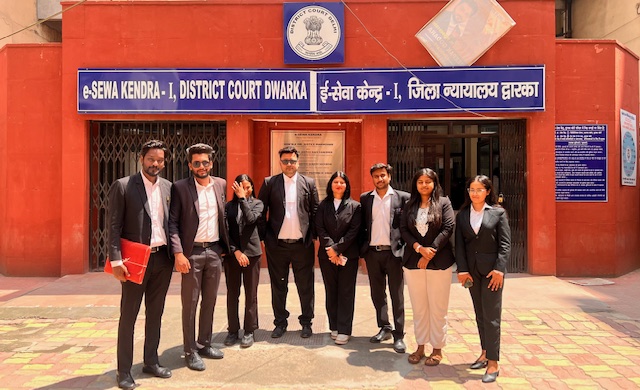
Dwarka Court has its own recognised Bar Association.

Official court material records the Dwarka Court Bar Association, and its office is situated in the Lawyers Chamber Block at the court complex.

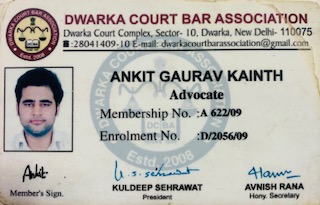
Where an advocate claims to be a member of the Dwarka Court Bar Association, the prospective client can ask for the relevant membership or registration details.

This is especially useful where a website or profile repeatedly represents the person as:

“Dwarka Court Advocate”

“Practising in Dwarka Court”

or

“Based at Dwarka Courts.”

Again, this requires an important distinction:

DCBA membership should be treated as supporting evidence of local professional association—not as the sole legal test of whether a person is entitled to practise law.


7. Look for Evidence of Actual Court Work—Not Merely Online Marketing

An attractive website can be created quickly.

An Instagram page can be created in minutes.

Hundreds of articles can now be produced with digital tools.

Actual litigation practice leaves a different professional footprint.

Depending upon the case and availability of public records, a client may find an advocate’s name appearing in:

  • judicial orders;
  • case records;
  • cause lists;
  • court proceedings;
  • reported matters;
  • mediation proceedings;
  • professional court documentation; or
  • other legitimate public legal records.

Delhi District Courts and the eCourts system provide considerable public case information.

No single order proves the scale or quality of someone’s practice.

Likewise, absence from a simple internet search does not prove that an advocate is not practising.

But a consistent court record can provide stronger evidence of actual litigation activity than marketing claims alone.


8. Ask the Advocate to Explain Your Case Before Discussing Promises

A useful test of professional experience is surprisingly simple:

Ask the advocate to explain the legal process.

For example, if the dispute concerns property, ask:

Which court has jurisdiction?

Do I require injunction, possession, declaration, partition or another remedy?

For a criminal matter:

Is anticipatory bail, regular bail, quashing, discharge or trial defence presently relevant?

For a cheque-bounce case:

Are we at notice, summoning, appearance, Section 145(2), evidence, arguments or appeal stage?

For a commercial recovery dispute:

Does the Commercial Courts Act apply? Is pre-institution mediation relevant? What documents need disclosure?

A genuine practising lawyer should be able to explain:

facts → jurisdiction → legal remedy → documents → procedure → possible risks → next step.

That is considerably more valuable than hearing:

“Don’t worry, I will win the case.”

No responsible advocate can guarantee what a court will ultimately decide.


9. Treat “Best Advocate” Rankings, Reviews and Social Media as Secondary Information

Online information is useful.

Clients routinely use:

  • Google;
  • legal directories;
  • LinkedIn;
  • YouTube;
  • Instagram;
  • Facebook;
  • websites; and
  • client reviews

to discover advocates.

There is nothing inherently wrong with that.

The problem arises when online visibility is treated as professional verification.

A high-ranking website does not establish Bar Council enrolment.

A five-star review does not prove regular appearances before a particular court.

A photograph outside a court building does not establish an office or chamber there.

A social-media following does not establish litigation experience.

Therefore, use online information as the starting point—not the final verification test.

A sensible verification sequence is:

Online Search
↓
Advocate’s Full Name
↓
Bar Council Enrolment
↓
Applicable AIBE/COP Status
↓
Actual Area of Practice
↓
Dwarka Court Connection
↓
Court Record / Local Presence
↓
Consultation
↓
Fee & Scope of Engagement


10. Insist on Professional Transparency About Fees and Case Handling

Before formally engaging an advocate, clients should understand who will handle the matter and how professional fees will operate.

Ask:

Who will primarily handle my case?

Who will appear on the next date?

What work is included in the professional fee?

Are drafting, filing and hearings charged separately?

Will additional applications involve additional fees?

How will I receive court orders and information about the next date?

Where appropriate, obtain the fee understanding in writing and retain receipts or payment records.

Clients should also maintain their own copies of:

  • petitions;
  • replies;
  • applications;
  • affidavits;
  • evidence;
  • court orders;
  • receipts; and
  • important correspondence.

Professional transparency is often a much better indicator than advertising language.


Red Flags Clients Should Not Ignore

No single factor automatically establishes misconduct or lack of professional status.

However, additional verification may be sensible where somebody:

refuses to disclose an enrolment number;

provides professional details that cannot be independently matched;

claims to have a chamber but refuses to identify it;

claims long-established Dwarka Court practice but cannot clearly explain the relevant court procedure;

uses different professional names across different platforms without explanation;

pressures the client to immediately transfer substantial money without explaining the scope of work;

makes guaranteed-result claims;

claims special personal influence over judges, police officers or court staff;

or discourages the client from independently checking court and professional records.

The correct response to doubt is not accusation.

It is independent verification.


Is Delhi Bar Association Membership Necessary for a Dwarka Court Advocate?

This is another common source of confusion.

Delhi has different Bar Associations connected with different court complexes.

For example, the Delhi Bar Association is associated with Tis Hazari Courts, while Dwarka has the Dwarka Court Bar Association.

Accordingly, a client should not ask:

“Are you a member of Delhi Bar Association?”

as though this were a universal licensing requirement for every practising advocate in Delhi.

A more accurate question is:

“Where are you enrolled, and which local Bar Association or court do you ordinarily practise with?”

The regulator and the local professional association should not be confused.

Can You Verify an Advocate Through Google Reviews?

Reviews can help a client understand other people’s reported experiences.

They may provide information about:

communication;

accessibility;

professional manner;

responsiveness; or

the kind of cases a lawyer handles.

But reviews cannot independently prove professional enrolment or regular court practice.

Therefore:

Reviews should supplement verification—not replace it.


Does a Dwarka Court Chamber Prove Someone Is a Practising Advocate?

An established chamber inside the court complex is useful evidence of professional presence, particularly when combined with Bar Council enrolment and local court practice.

However, chamber allotment is not the statutory test of whether someone is an advocate.

A genuine advocate may practise without an allotted chamber.

The better approach is to consider several pieces of information together:

Enrolment + professional identity + local practice + court activity + office/chamber + consultation quality + transparent engagement.


Why Local Court Practice Can Matter

Different courts operate under the same substantive and procedural laws, but regular litigation before a particular court gives an advocate familiarity with practical matters such as:

filing;

scrutiny;

listing;

court locations;

certified copies;

administrative branches;

video-conferencing arrangements;

record inspection;

mediation;

process service; and

day-to-day procedural requirements.

Local familiarity should never be portrayed as special access or influence.

Its legitimate value is procedural familiarity and accessibility.

That distinction is important.

10-Point Checklist Before Engaging an Advocate in Dwarka Court

Before finalising your advocate, check:

1. Full professional name

2. Bar Council enrolment number

3. Enrolment status through an official source

4. AIBE / Certificate of Practice position where applicable

5. Actual areas of litigation practice

6. Regular connection with Dwarka Courts

7. DCBA membership details if local membership is claimed

8. Chamber, office or other professional establishment

9. Evidence of genuine court practice where reasonably available

10. Clear consultation, fee structure and case-handling process

None of these factors should be considered in isolation.

Together, however, they can help a litigant make a substantially better-informed decision.


Frequently Asked Questions

How can I check whether somebody is enrolled as an advocate in Delhi?

The Bar Council of Delhi provides an online facility for searching enrolment information using the advocate’s enrolment number and year.

Is Dwarka Court Bar Association registration compulsory to appear in Dwarka Court?

Local Bar Association membership and professional Bar Council enrolment are different matters. DCBA membership can provide useful evidence of association with the local Bar, but it should not be represented as the sole statutory requirement for appearing before Dwarka Courts.

Should I ask an advocate for his or her enrolment number?

Yes. There is nothing unreasonable about a client asking for professional identification before establishing a professional relationship.

Is having a chamber in Dwarka Court compulsory?

No. A chamber can demonstrate an established professional presence, but not every genuine practising advocate has an allotted chamber.

Can I check whether a lawyer regularly appears in court?

Depending upon the matter and availability of public information, judicial orders, eCourts records and other court documents may provide useful information about appearances.

Should I choose a lawyer merely because Google shows the lawyer first?

No. Search position can help you discover a professional, but it should not replace verification of enrolment, experience, relevant practice and professional identity.

Is the lawyer with the highest number of reviews necessarily the most appropriate lawyer for my matter?

Not necessarily.

A client’s requirements depend upon the nature of the case.

A lawyer handling criminal bail every day may not be the appropriate choice for a complicated commercial dispute, just as a matrimonial lawyer may not necessarily conduct cheque-bounce appeals regularly.

Look for relevant practice, not merely visibility.

Final Takeaway

Finding an advocate online has become easier.

Verifying the advocate remains the client’s responsibility.

Do not select an advocate merely because a profile repeatedly uses expressions such as:

“Best Advocate in Dwarka Court”

“Top Lawyer in Delhi”

or

“No. 1 Advocate.”

Instead, verify what can actually be verified.

Start with:

Bar Council enrolment.

Then examine:

applicable AIBE/COP position → relevant practice → Dwarka Court connection → Bar Association association → professional establishment → court work → consultation quality → fee transparency.

A professional legal practice should be capable of standing on verifiable credentials, actual litigation work and transparent client communication—not merely advertising claims.
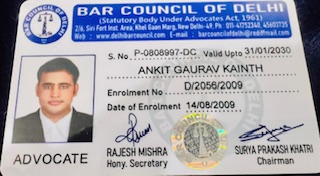

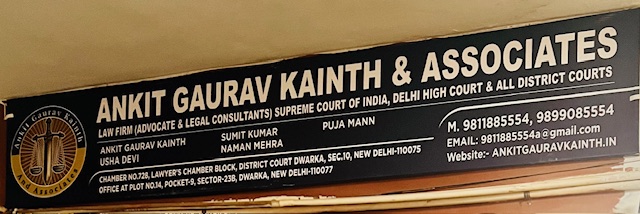
About the Practice

Ankit Gaurav Kainth & Associates is a litigation practice based at Dwarka Courts, Sector-10, New Delhi.

The practice handles civil, criminal, matrimonial, property, cheque-bounce, commercial and connected litigation before Dwarka Courts and other courts in Delhi.

Clients seeking representation may independently verify professional credentials and discuss the nature, jurisdiction and procedural requirements of their matter during consultation.

Professional verification should always come before professional engagement.

Disclaimer

This article is intended for general legal awareness and client education. It does not allege that any particular advocate, website, profile or legal-service provider is unauthorised or engaged in misconduct. Bar Council enrolment, AIBE/Certificate of Practice requirements and Bar Association membership are distinct matters and should be verified through the relevant official authority. Local Bar Association membership or possession of a chamber should not, by itself, be treated as the legal test of entitlement to practise. The article does not constitute legal advice or guarantee any legal outcome.
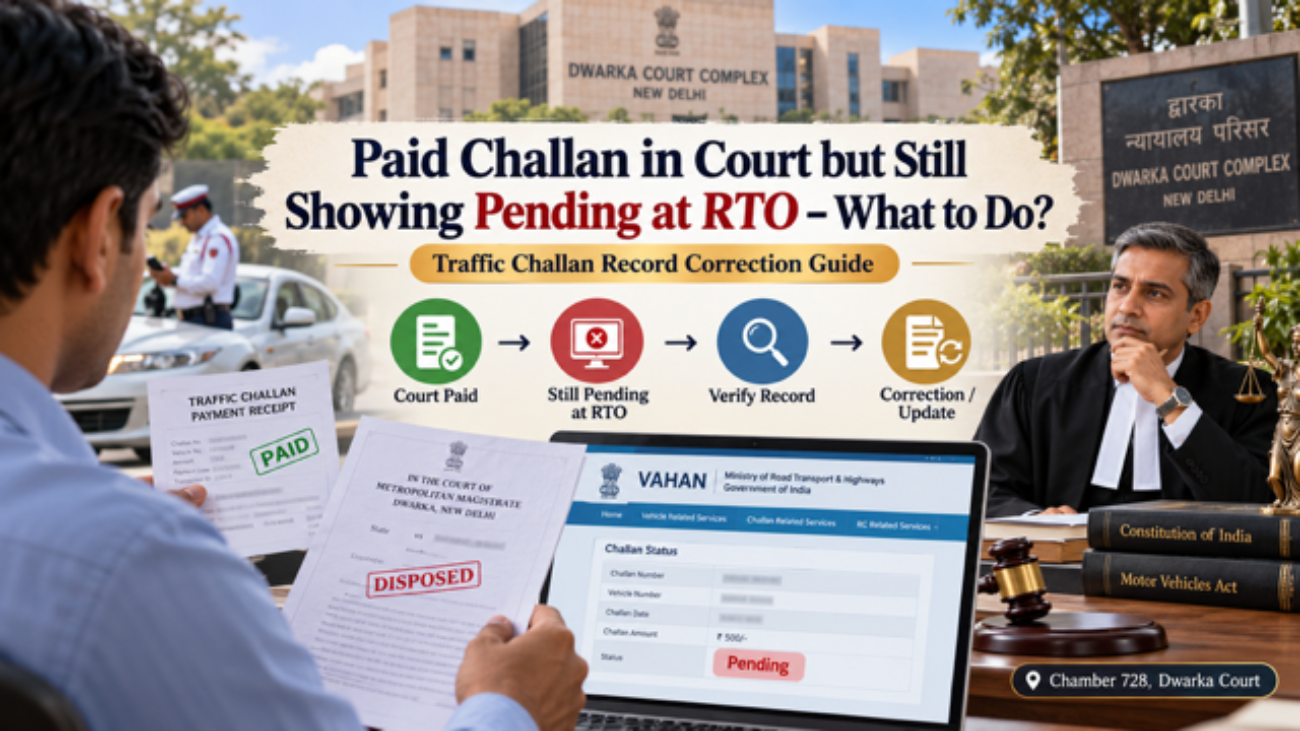
Paid Challan in Court but Still Showing Pending at RTO Dwarka Delhi

Paid Challan in Court but Still Showing Pending at RTO – What to Do?

Introduction – Paid Challan in Court but Still Showing Pending at RTO

Traffic Challan Paid but Not Updated in RTO, VAHAN or eChallan Records? A Practical Delhi Guide

You appeared before the Court. The traffic challan was disposed of. The fine was paid. You have the court order or payment receipt.

But days or weeks later, the same challan is still showing as pending against your vehicle or driving licence.

The problem may become more noticeable when you try to:

  • transfer ownership of a vehicle;
  • obtain or renew a traffic NOC;
  • complete an RTO/Transport Department service;
  • sell the vehicle;
  • check pending challans online;
  • deal with another vehicle-related application; or
  • verify whether the court matter has actually been closed.

This situation does not necessarily mean that the challan has to be paid again.

The first task is to identify where the challan has been disposed of, where the payment is reflected and which database is still showing it as pending.

A court record, Delhi Traffic Police record, Virtual Court record, eChallan record and VAHAN-related record may not always display exactly the same information at the same time.

The problem should therefore be approached systematically.


Quick Answer: What Should You Do?

If a traffic challan has already been paid or disposed of by a Court but still appears as pending:

  1. Do not immediately pay the same challan again.
  2. Obtain the court order/disposal order and payment receipt.
  3. Verify the challan number, vehicle number and payment details.
  4. Check the challan on the official Traffic Police/eChallan portal.
  5. Check whether the matter was transferred to or disposed of through Virtual Court.
  6. Verify whether the payment transaction itself shows successful.
  7. If the court record shows disposal but the online traffic database remains pending, raise a grievance with the concerned authority.
  8. If the traffic record is corrected but an RTO/VAHAN service remains blocked, submit the disposal record before the concerned Transport/RTO authority.
  9. Preserve screenshots and acknowledgement numbers of every complaint or representation.

The correct route depends upon where the mismatch is occurring.


Why Can a Paid Challan in Court but Still Showing Pending at RTO Still Show as Pending?

Several different situations can produce the same apparent problem.

1. Court Has Disposed of the Challan but Online Record Has Not Updated

A challan may have been disposed of before a Traffic Court, Evening Court, Lok Adalat or other competent court, but the updated disposal information may not yet be reflected in the electronic system being checked by the vehicle owner.

The first question should therefore be:

What does the actual court record say?

If the order records payment/disposal, preserve a copy carefully.

2. Payment Was Made but Transaction Status Is Still Unclear

Sometimes the problem is not the judicial order but the payment record.

Verify:

  • challan number;
  • transaction/reference number;
  • amount paid;
  • date of payment;
  • vehicle registration number;
  • status of payment; and
  • whether a receipt was generated.

A bank debit alone should not be treated as the only proof of disposal.

Keep the official payment acknowledgement wherever available.

3. Challan Was Transferred to Virtual Court

Traffic challans can be transmitted to the Virtual Court system.

If that has happened, checking only one portal may create confusion.

The vehicle owner should determine:

  • whether the challan was transferred to Virtual Court;
  • whether it was subsequently paid there;
  • whether an order was passed;
  • whether it was contested instead;
  • and whether the final disposal is reflected against the correct challan number.

Important

If a particular challan has already been paid through the proper court/Virtual Court channel, do not knowingly make a second payment merely because another screen continues to display “pending.”

First verify the records.

4. There May Be More Than One Challan

Another common source of confusion is multiple challans against the same registration number.

For example:

  • Challan A may already be disposed of;
  • Challan B may still be pending.

A person checking only the vehicle number may believe that the earlier payment has not been updated.

Always compare the individual challan number, not merely the vehicle registration number.

5. Vehicle Number or Challan Details May Not Match Correctly

Before filing any grievance, compare the details appearing on:

  • original challan;
  • RC;
  • court order;
  • payment receipt;
  • Virtual Court record;
  • eChallan record; and
  • current online status.

Even a mismatch in the challan being referred to can result in unnecessary correspondence.

6. Court Disposal and RTO/VAHAN Status Are Two Different Issues

This distinction is extremely important.

A traffic challan is one matter.

The status of a vehicle-related service before the Transport Department or VAHAN system is another.

Therefore, where the challan itself has been correctly shown as disposed of but an RTO/VAHAN transaction remains blocked, the issue may require a separate correction or representation before the concerned transport authority.

Do not assume that obtaining the court receipt alone automatically resolves every linked administrative process.


Step-by-Step: What to Do When a Paid Challan Still Shows Pending

Step 1 – Identify the Exact Challan

Record the:

  • challan number;
  • vehicle number;
  • date of violation;
  • alleged offence;
  • amount;
  • court, if any;
  • case/challan reference; and
  • date of disposal/payment.

Take a screenshot of the screen currently showing the challan as pending.

This creates a clear before-correction record.

Step 2 – Obtain Proof of Court Disposal

Preserve whichever documents are applicable:

  • court order;
  • disposal order;
  • receipt of fine;
  • Virtual Court receipt;
  • Lok Adalat order;
  • Evening Court order;
  • payment acknowledgement;
  • case status printout; or
  • certified copy where required.

The most important document is normally one which connects the specific challan number/vehicle/case with the final disposal or payment.

Step 3 – Verify the Challan on Official Portals

Do not depend upon screenshots received through WhatsApp, third-party applications or random payment websites.

Check the status on the applicable official platform.

Depending upon the challan, this may include:

  • Delhi Traffic Police;
  • MoRTH eChallan;
  • Virtual Courts; and
  • the relevant VAHAN/Transport Department service.

Compare the status appearing on each relevant official system.

Step 4 – Verify the Payment Transaction Separately

Where payment was made digitally, confirm whether the transaction itself is shown as successful.

Keep:

  • transaction ID;
  • bank reference;
  • GRN/reference number where applicable;
  • challan number;
  • payment date; and
  • official receipt.

If the transaction failed but the bank account was debited, that is different from a case where the transaction succeeded but the challan continues to show as pending.

The grievance should describe the correct problem.

Step 5 – Check Virtual Court Status

If the challan was transferred to Virtual Court, search using the available particulars such as:

  • challan number;
  • vehicle number;
  • case/CNR information where available; or
  • other permitted search particulars.

Download or preserve the final status wherever possible.

If the Virtual Court record itself shows successful disposal but another portal shows the challan as pending, attach that record to your representation.

Step 6 – Raise an Online Grievance

Where an incorrect pending status continues, submit a grievance through the appropriate official channel.

The complaint should be precise.

Avoid simply writing:

“Challan paid but still showing pending. Please clear.”

Instead mention:

Challan No. ______ relating to Vehicle No. ______ was disposed of/paid on ______ before/through ______. The payment/disposal record is enclosed. The challan continues to appear as pending on ______. Kindly verify the disposal and update/correct the electronic record.

Attach the relevant proof.

Keep the grievance number and screenshot after submission.

Step 7 – If Necessary, Contact the Relevant Virtual Court/Court Authority

If the mismatch appears to originate from the court or Virtual Court record itself, the matter may require clarification from the concerned judicial/Virtual Court support mechanism.

The representation should identify:

  • State/department;
  • challan number;
  • vehicle number;
  • date of payment;
  • transaction number;
  • court details;
  • nature of discrepancy; and
  • supporting record.

Do not send incomplete complaints from different email addresses without maintaining a record.

Step 8 – If the Challan Is Cleared but RTO Work Remains Blocked

This is the situation many vehicle owners find especially confusing.

Suppose:

Court status: Disposed
Traffic challan status: Paid/Disposed
RTO/VAHAN service: Still blocked

At this stage, repeatedly approaching the Traffic Court may not solve the issue if the remaining problem is in the transport database or a pending transaction.

The vehicle owner should identify the particular RTO/VAHAN service affected.

For example:

  • transfer of ownership;
  • NOC;
  • permit-related service;
  • fitness-related service;
  • registration-related transaction;
  • other citizen service.

A written representation may then be submitted to the concerned Transport/RTO authority enclosing the disposal proof.


Documents You Should Keep Ready

Before seeking correction, prepare one PDF/file containing:

1. Registration Certificate

Clear copy of RC.

2. Driving Licence

Where the challan is connected with the licence.

3. Original Challan

The original or downloaded challan.

4. Court Order

Order recording disposal/payment where available.

5. Payment Receipt

Court/Virtual Court/eChallan receipt.

6. Transaction Details

Transaction ID or bank reference.

7. Current Pending-Status Screenshot

Preferably displaying the date.

8. Previous Grievance

If already submitted.

9. Grievance Acknowledgement

Ticket/complaint number.

10. RTO/VAHAN Error Screenshot

If a vehicle-related service is being prevented.

Keeping these records together considerably simplifies verification.


Paid in Court but No Receipt Available – What Then?

Do not rely only on memory that the fine was paid.

Try to identify:

  • date of hearing;
  • name/location of court;
  • case/challan number;
  • vehicle number;
  • amount paid; and
  • person who appeared.

The judicial record or online case record may need to be checked.

Where an order is available but the receipt has been misplaced, the order itself may help establish what happened, depending upon its contents.


Challan Disposed of in Lok Adalat but Still Showing Pending

Preserve the Lok Adalat settlement/order.

Then check whether the exact challan referred to in that order is the challan that continues to show pending.

If yes, submit the order along with the grievance.

Do not confuse another outstanding challan with the challan that was settled in Lok Adalat.


Challan Paid in Evening Court but Still Pending

The same basic process applies:

Evening Court disposal record → payment proof → challan-number verification → online status → grievance/correction.

Where a large number of challans were dealt with together, prepare a separate table containing each challan number and its corresponding disposal status.

This prevents one unresolved challan from being confused with several already disposed matters.


I Sold the Vehicle but an Old Challan Is Still Showing – What Should I Check?

First verify the date of:

  • alleged violation;
  • sale/transfer;
  • delivery of possession;
  • transfer application; and
  • registration change.

Do not simply assume liability based upon the present possession of the vehicle.

Ownership, registration records, the identity of the driver and the nature/date of the alleged violation may all be relevant depending upon the circumstances.

Separate legal advice may be required where ownership itself is disputed.


Can a Pending Challan Affect an NOC?

Pending traffic challans can become relevant when an NOC or related transport service requires clearance of outstanding challans.

This is why an incorrectly continuing “pending” entry should not be ignored merely because the fine has already been paid.

If the record is incorrect, seek correction with documentary proof rather than paying the same liability twice merely to complete another transaction.


Should You Pay the Challan Again to Save Time?

Generally, do not make a duplicate payment without first verifying why the challan remains pending.

If payment has already been made against the same challan, preserve the first receipt and seek correction.

A second payment may create an additional refund/reconciliation problem instead of solving the underlying database issue.


What If the Challan Itself Is Wrong?

That is a different situation.

If the allegation, vehicle number, location, photograph, identity of the vehicle or other material particulars are incorrect, the question is not merely about updating a paid challan.

The challan may need to be challenged or disputed.

That should be examined before making payment because voluntary payment/disposal can affect the practical options available thereafter.


Read our related guide:

How to Challenge a Traffic Challan in Dwarka Court

When Should You Consider Legal Assistance?

Many straightforward database corrections can be pursued directly by the vehicle owner.

Legal assistance may become useful where:

  • the Court shows disposal but the department refuses correction;
  • no clear disposal record is available;
  • multiple challans are involved;
  • an RTO transaction is repeatedly blocked;
  • the vehicle has already been sold;
  • ownership is disputed;
  • a licence has been affected;
  • the challan concerns a serious alleged traffic offence;
  • the person is being asked to appear before Court;
  • the record incorrectly shows a continuing court matter;
  • previous grievances have not resolved the discrepancy; or
  • a formal representation/application is required.

The objective should first be to identify whether the problem is judicial, payment-related, traffic-database-related or RTO/VAHAN-related.

How We Assist in Traffic Challan Record Problems at Dwarka Court

At Ankit Gaurav Kainth & Associates, we assist clients with traffic challan matters connected with Dwarka Courts and Delhi.

Depending upon the circumstances, assistance may include:

  • verification of challan and court status;
  • examination of court orders;
  • checking whether the correct challan was disposed of;
  • preparation of representations;
  • guidance regarding Virtual Court records;
  • Traffic Court appearance where required;
  • Evening Court matters;
  • Lok Adalat-related challan matters;
  • disputed or incorrect challans;
  • multiple pending challans;
  • record-correction issues; and
  • related criminal proceedings arising from serious traffic incidents.

Not every paid-challan status problem requires litigation.

The first step should usually be document verification and identification of the authority whose record requires correction.


S. No. Related Page / Blog Recommended Anchor Text Why It Supports This Page Best Placement Internal Link
1 Traffic Challan Cases in Dwarka Court Traffic Challan Cases in Dwarka Court Main traffic-challan service page and parent page for this supporting article. Introduction and conclusion Read Guide
2 How to Challenge Traffic Challan in Dwarka Court Challenge an Incorrect Traffic Challan Useful where the problem is not merely an RTO update but the challan itself is disputed. Section: What If the Challan Itself Is Wrong? Read Guide
3 Evening Court vs Lok Adalat for Traffic Challan Evening Court vs Lok Adalat for Traffic Challans Explains two routes through which traffic challans may be disposed of. Lok Adalat / Evening Court sections Read Guide
4 Advocate Near Dwarka Court Advocate Near Dwarka Court Provides the local-service connection for users whose traffic matter requires court verification or appearance. Legal assistance section View Page
5 Criminal Defence Lawyer in Dwarka Criminal Defence Lawyer in Dwarka Relevant where the traffic incident develops beyond a routine challan into criminal proceedings. Serious traffic-offence section View Page
6 Death Caused by Negligent Driving in Dwarka Court Criminal Case After a Serious Road Accident Separates ordinary challan matters from serious road-accident cases involving criminal proceedings. When Legal Assistance May Be Required Read Guide

Frequently Asked Questions

1. I paid my challan in Court. Why does it still show pending?

The exact reason has to be identified. The court may have disposed of the matter while another electronic record has not yet reflected the disposal, or a different challan may still be pending.

2. Should I pay the challan again?

Not merely because one screen continues to show “pending”. First verify whether the same challan has already been paid and obtain the payment/disposal record.

3. How do I prove that my challan was paid?

Useful documents can include the court order, payment receipt, Virtual Court receipt, transaction number and official challan status.

4. Can I check a traffic challan through Virtual Court?

Where the challan has been transferred to Virtual Court, its status can be searched through the Virtual Courts system using the permitted search particulars.

5. What if the bank account was debited but the payment status is pending?

Check the official transaction/payment-verification facility and preserve the bank reference and transaction details. A bank debit does not by itself establish that the challan was successfully disposed of.

6. Can a pending challan create difficulty during vehicle transfer?

An unresolved challan or an incorrectly pending record can become relevant during certain vehicle/RTO processes. The exact effect depends upon the service being requested and the record appearing against the vehicle.

7. Can a pending challan affect an NOC?

Clearance of pending traffic challans can be relevant to traffic NOC-related processes. If a paid challan is incorrectly shown as outstanding, seek correction with proof of disposal.

8. What if I have five challans and paid only four?

The fifth challan may continue to cause the vehicle number to appear as having pending challans. Verify every challan separately by challan number.

9. Can an advocate appear for a traffic challan matter?

Depending upon the nature of the proceeding and applicable court requirements, legal representation may be possible. Some matters may still require personal participation or compliance by the concerned person.

10. Can a wrong traffic challan be challenged instead of paid?

Potentially, yes. An incorrect challan should be examined before payment. The appropriate procedure depends upon the allegations, evidence and stage of the challan.

11. What if my court order says disposed but VAHAN is still not allowing my transaction?

First verify that the challan record itself has been updated. If it has, identify the exact VAHAN/RTO transaction that remains blocked and submit the disposal proof to the appropriate transport authority or use the applicable grievance mechanism.

12. How long does correction take?

There is no single period that can safely be promised for every case. It depends upon the authority, nature of discrepancy and whether the relevant disposal/payment record is already available electronically.


Practical Checklist

Before approaching any authority, confirm:

✓ Correct challan number
✓ Correct vehicle registration number
✓ Court disposal order available
✓ Fine/payment receipt available
✓ Transaction reference available
✓ Current status screenshot saved
✓ Virtual Court status checked, if applicable
✓ Traffic/eChallan status checked
✓ RTO/VAHAN issue identified separately
✓ Grievance acknowledgement preserved

This simple checklist can prevent repeated visits and unnecessary duplicate payments.


Conclusion

A traffic challan that has already been paid or disposed of by a Court should not be treated as a fresh liability merely because another online record still displays “pending”.

The important task is to establish the chain:

Challan → Court/Virtual Court → Disposal → Payment → Traffic Database → RTO/VAHAN Record

Find the point at which the information stops matching.

Then approach the authority responsible for that particular record with the challan number, disposal order, payment receipt and supporting documents.

For matters connected with Traffic Challan Cases in Dwarka Court, disputed challans, court appearances or unresolved disposal records, proper document verification at the beginning can avoid unnecessary repeat payments and procedural confusion.

Author: Advocate Ankit Gaurav Kainth
Practice: Civil & Criminal Litigation
Chamber: Chamber No. 728, Dwarka Court, Sector 10, New Delhi


Disclaimer

This article provides general legal and procedural information. Traffic challan, court, Virtual Court and Transport Department procedures can depend upon the nature of the violation, status of proceedings and applicable administrative system. The article should not be treated as legal advice for a particular matter.


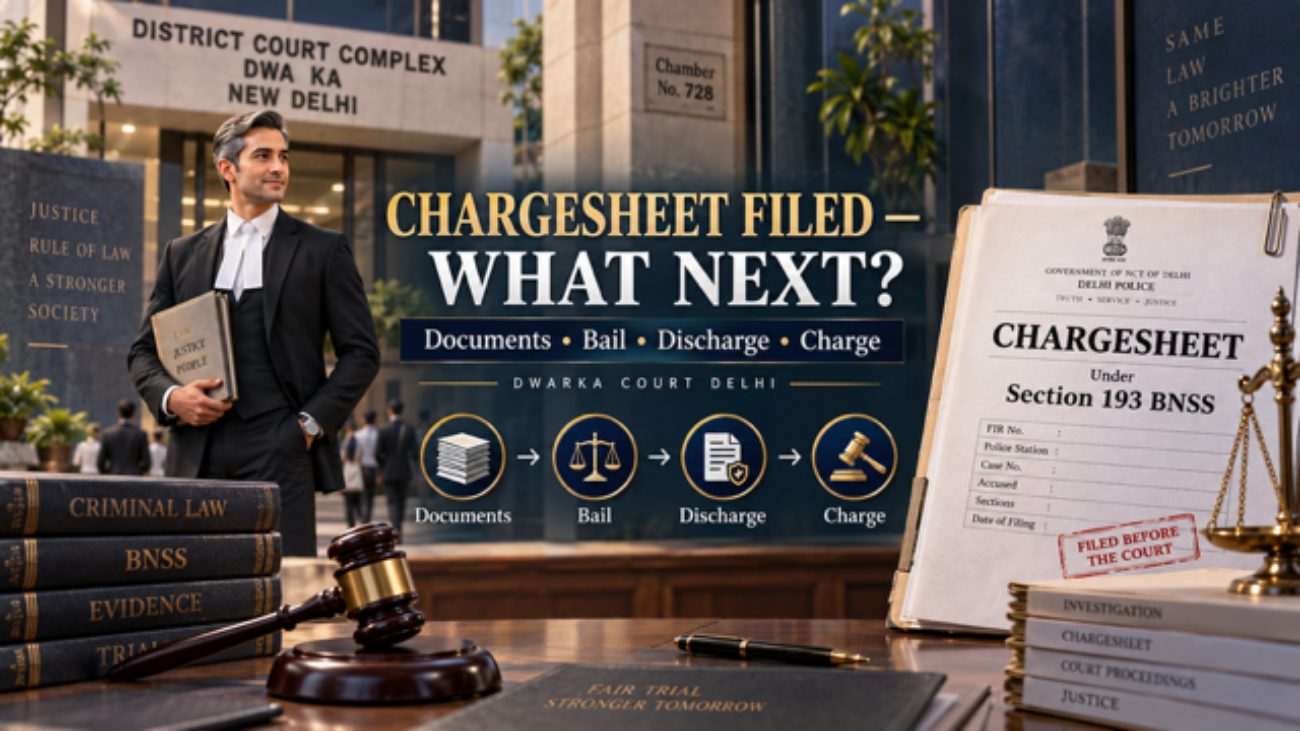
Chargesheet Filed What Next

Chargesheet Filed What Next | 10 Critical Defence Steps Before Charges Are Framed in Dwarka Court?

Introduction – Chargesheet filed what Next

Police have filed the chargesheet—but does that mean the criminal case against you is proved?

Understand what happens after a chargesheet is filed / Chargesheet Filed What Next, Section 193 BNSS, court cognizance, summons, bail, supply of documents, discharge, supplementary chargesheet, framing of charges and possible remedies before the Delhi High Court.

A common question after completion of a police investigation is:

“The police have filed the chargesheet against me. What happens now?”

For an accused person, receiving this information can be disturbing. However, one important distinction should be understood immediately:

A chargesheet is not a conviction.

The filing of a chargesheet means that after investigation, the investigating agency has submitted its police report before the competent Court and has taken a particular view regarding the material collected during investigation.

The Court must thereafter deal with the case according to law.

Depending upon the nature of the offence and the stage of proceedings, questions concerning cognizance, summons, appearance, bail, supply of documents, discharge and framing of charges may arise before evidence at trial begins.

Under the Bharatiya Nagarik Suraksha Sanhita, 2023, the police report on completion of investigation is governed principally by Section 193 BNSS. Section 193 also recognises further investigation and filing of further reports where additional evidence is subsequently obtained.

For a person facing criminal proceedings in Dwarka Court, this period between filing of the chargesheet and framing of charges can therefore be strategically important.


Chargesheet Under Section 193 BNSS — What Does It Contain?

Section 193 BNSS deals with the report submitted by the police after completion of investigation.

The report ordinarily contains information relating to the parties, nature of the information received, persons acquainted with the circumstances of the case, whether an offence appears to have been committed and by whom, and other prescribed particulars.

Documents and witness statements relied upon by the prosecution are also forwarded in accordance with the statutory framework.

The chargesheet may therefore contain material such as witness statements, documentary records, medical evidence, seizure documents, electronic evidence, forensic reports and other material collected during investigation.

But the defence should not examine the chargesheet merely by counting the number of documents or witnesses.

The real questions are:

What does each document actually prove? Is there admissible material connecting the accused with every ingredient of the alleged offence? Are there contradictions, gaps, missing links or assumptions in the prosecution case?

That is where meaningful chargesheet analysis begins.

1. First Obtain the Complete Chargesheet and Relied-Upon Documents

A defence strategy should normally begin with the complete record rather than with the allegations in the FIR alone.

Section 230 BNSS provides for supply to the accused, free of cost, of the police report and specified accompanying material in a case instituted on a police report. It provides that this should be done without delay and, in any event, within fourteen days from production or appearance of the accused. Electronic supply can also amount to due furnishing under the provision.

The FIR is only the beginning of the prosecution story.

The chargesheet shows what the investigation ultimately produced.

A lawyer reviewing the matter should therefore compare the FIR, complainant’s version, witness statements, documentary evidence, electronic evidence, recovery or seizure material, medical/forensic material and the final conclusions of the investigating officer.


2. Check Whether the Court Has Taken Cognizance and Issued Summons

Filing of the chargesheet and appearance of the accused are not always simultaneous events.

After receiving the police report, the competent Court deals with the matter according to the applicable procedural law. Process may thereafter be issued requiring an accused to appear.

Ignoring court summons can create a problem that did not previously exist.

An accused who has cooperated throughout the investigation should therefore not assume that because the police never arrested him, appearance before Court can also be ignored.

The procedural history needs to be checked carefully: whether cognizance has been taken, whether summons have been issued, whether they were served, the next date of hearing and whether any coercive process has subsequently been ordered.


3. Do Not Assume That Filing of the Chargesheet Automatically Requires Arrest

This issue is particularly important where the accused was never arrested during investigation and had cooperated with the investigating agency.

In Satender Kumar Antil v. CBI, the Supreme Court developed important principles concerning summons and bail for persons who had not been arrested during investigation and had cooperated.

The Supreme Court has continued to reinforce safeguards against unnecessary arrest. In its decision dated 15 January 2026, Satender Kumar Antil v. CBI, 2026 INSC 115, the Court held in the context of offences punishable with imprisonment up to seven years that notice under Section 35(3) BNSS is the rule and arrest is an exception; the statutory conditions governing arrest must still be satisfied.

This does not mean that bail is automatic in every chargesheet case. Serious offences, special statutes, previous conduct, non-cooperation, risks relating to witnesses or evidence and other circumstances can materially affect the position.

The correct bail strategy must therefore be determined from the actual sections invoked and procedural history of the case.


4. Read the Chargesheet Offence-by-Offence, Not Page-by-Page

A large chargesheet can create the impression that the prosecution case must be strong.

That is not necessarily the correct legal approach.

For every offence alleged against an accused, the prosecution must have material capable of satisfying the ingredients of that particular offence.

A proper defence review should therefore create a simple matrix:

Issue to ExamineDefence Question
Alleged offenceWhat are its essential legal ingredients?
Role of accusedWhat specific act is actually attributed?
WitnessesIs the allegation direct, hearsay or contradictory?
DocumentsDo they genuinely connect the accused?
Electronic evidenceIs source, integrity and legal admissibility addressed?
Recovery/seizureIs there a legally relevant recovery and proper documentation?
Common intention/conspiracyWhat material connects the accused with the alleged common design?
TimelineDo dates and events support or contradict the prosecution theory?

This exercise often reveals the difference between an allegation and evidence capable of supporting that allegation.


5. Compare the FIR With the Final Investigation

One of the most useful exercises after receiving the chargesheet is to prepare a chronology.

Compare what was originally alleged with what investigation subsequently revealed.

Has the complainant’s version changed?

Were important allegations omitted from the earliest complaint but introduced later?

Did independent witnesses support the allegations?

Do bank records, call records, CCTV footage, messages, location data or other objective evidence support or contradict the prosecution version?

Were important persons investigated?

Was potentially exculpatory material ignored?

A defence should identify these issues before the matter reaches the charge stage rather than waiting until cross-examination begins.


6. Examine Whether a Discharge Application Is Available

The filing of a chargesheet does not necessarily mean that every accused must face a complete criminal trial.

Depending upon the nature of the case and the Court before which it is pending, the accused may have a statutory remedy of seeking discharge.

For a warrant case instituted on a police report before a Magistrate, Section 262 BNSS permits an accused to prefer a discharge application within sixty days from supply of copies under Section 230. If, after considering the police report and documents and hearing the parties, the Magistrate considers the charge against the accused to be groundless, the accused is to be discharged.

For a case triable by the Court of Session, Section 250 BNSS provides that an accused may prefer a discharge application within sixty days from the date of commitment under Section 232. If there is not sufficient ground for proceeding, the Judge may discharge the accused for recorded reasons.

Not every criminal proceeding follows identical discharge provisions. The type of case, offence, applicable statute and procedural regime should therefore be identified before choosing the remedy.


7. Understand the Difference Between Chargesheet and Framing of Charge

This distinction is frequently misunderstood.

Chargesheet: the investigating agency’s report after investigation.

Framing of charge: the judicial stage at which the Court determines whether sufficient grounds exist to put the accused on trial for particular offence or offences.

They are not the same thing.

In warrant cases instituted on a police report, Section 263 BNSS deals with framing of charge where the Magistrate finds ground for presuming commission of an offence triable under that chapter. The provision states that the charge is to be framed within sixty days from the first hearing on charge.

Accordingly, the period before charges are framed should not be treated as a procedural formality.

It may be the stage for identifying whether the prosecution material, taken according to the applicable legal standard, actually justifies putting the accused to trial.


8. Check for FSL Reports, Electronic Evidence and Other Pending Material

Modern chargesheets increasingly depend upon electronic and forensic evidence.

Cybercrime cases may involve bank trails, IP information, device analysis, WhatsApp or Telegram communications, cryptocurrency transactions, email records or digital forensic reports.

Other criminal cases may depend upon CCTV footage, call records, location information, medical evidence, DNA reports, handwriting examination or forensic reports.

A chargesheet should therefore be reviewed for what is present as well as what is absent.

If an important forensic report is still awaited, or the police propose further investigation regarding a particular aspect, that may affect how the defence approaches discharge, charge, bail or trial preparation.


9. A Supplementary Chargesheet Can Still Be Filed

Filing of the first police report does not necessarily end every aspect of investigation.

Section 193(9) BNSS expressly preserves further investigation after a report has been forwarded to the Magistrate. If additional oral or documentary evidence is obtained, a further report may be forwarded.

The proviso specifically provides that further investigation during trial may be conducted with permission of the Court and is ordinarily to be completed within ninety days, subject to extension with Court permission.

The Delhi High Court in Yash Mishra v. State of NCT of Delhi discussed Section 193(9) and recognised that further investigation may continue after the police report, subject to the statutory safeguards applicable at the trial stage.

Therefore, a defence should keep track not only of the original chargesheet but also of later supplementary reports, additional witnesses, forensic results and newly produced documents.


10. Consider Whether a Higher-Court Remedy Is Legally Available

Some cases raise issues extending beyond an ordinary discharge application.

Depending upon the facts and applicable law, questions may arise concerning jurisdiction, abuse of criminal process, absence of essential ingredients of an offence, legal bars to prosecution, settlement in legally permissible categories of cases, or other grounds capable of being examined by the High Court.

However, quashing is an exceptional remedy and should not be treated as a substitute for conducting a criminal trial merely because the accused disputes the prosecution evidence.

The correct remedy—discharge, bail, revision, quashing or defending the trial—depends upon the nature of the defect and the stage of the proceedings.


CrPC or BNSS — Which Law Applies to Your Chargesheet?

This question should now be checked carefully in every criminal case.

The BNSS came into force on 1 July 2024, but Section 531 contains a repeal-and-savings provision relating to proceedings already pending under the CrPC.

In Parvinder Singh v. Directorate of Enforcement, decided on 19 May 2026, the Supreme Court examined Section 531 and explained that its object is to avoid piecemeal application of CrPC and BNSS to proceedings saved by the provision.

Accordingly, one should not mechanically replace every old CrPC section number with a BNSS provision merely because the hearing is taking place in 2026.

The FIR date, stage of proceedings on 1 July 2024, nature of the proceeding and subsequent procedural developments may all require examination.


What Happens After Charges Are Framed?

If the accused is not discharged and the Court frames charges, the criminal case ordinarily proceeds toward trial according to the applicable procedure.

The prosecution then has to prove its case through legally admissible evidence.

Witnesses may be examined and cross-examined, documentary and electronic evidence may be proved, the accused receives the procedural protections available under law, and defence evidence may be led where appropriate.

The chargesheet is therefore important—but it is not the final determination of guilt.


Practical Defence Strategy After Chargesheet in Dwarka Court

For an accused facing a chargesheet before Dwarka Courts, Delhi, the immediate objective should be to understand the case before making the next procedural move.

The defence should know exactly what the police allege, what material supports each allegation, which documents are missing, what the witnesses actually state, whether bail issues remain, whether discharge is legally available and what happens at the next court hearing.

Preparation at this stage can shape the entire trial strategy that follows.

A chargesheet is not a conviction. This practical guide explains what an accused should examine after police file a chargesheet, including bail, summons, Section 230 documents, discharge, supplementary investigation and framing of charges under BNSS.


Frequently Asked Questions

1. Does filing of a chargesheet mean that I have been found guilty?
No. A chargesheet represents the investigating agency’s report and conclusions after investigation. Guilt can be determined only through the judicial process according to law.

2. Can I get bail after the chargesheet is filed?
Bail remains available according to the nature of the offence, applicable bail provision, conduct of the accused, previous custody or non-arrest, special statutory restrictions and other facts of the case. Filing of a chargesheet alone does not provide one universal answer.

3. Can I seek discharge after a chargesheet?
In appropriate cases, yes. The applicable discharge provision depends upon the nature of the case and Court. Sections 250 and 262 BNSS contain specific discharge provisions for Sessions cases and warrant cases on police reports respectively.

4. What is the difference between a chargesheet and framing of charges?
The chargesheet is submitted by the police after investigation. Framing of charge is a judicial determination concerning the offence or offences for which the accused should face trial.

5. Can police investigate further after filing the chargesheet?
Yes. Section 193(9) BNSS recognises further investigation and submission of further reports. Further investigation during trial is subject to the statutory requirements concerning Court permission and time.

6. Can a supplementary chargesheet add new evidence or accused persons?
Further investigation can produce additional oral or documentary evidence and may result in a further report. Its legal effect depends upon the facts, evidence and orders of the Court.

7. How quickly should the chargesheet documents be supplied to the accused?
Section 230 BNSS provides that specified copies should be supplied without delay and in no case beyond fourteen days from production or appearance of the accused, subject to the provision’s terms concerning electronic supply and voluminous documents.

8. Can a chargesheet be challenged before the Delhi High Court?
In appropriate cases, High Court remedies may be available, but the grounds and procedure depend upon the facts and stage of the case. Quashing is not an automatic remedy merely because the accused disputes the allegations.


Criminal proceedings in Delhi may involve police investigation, bail, trial proceedings, revision or appellate remedies depending upon the stage of the case. For a broader overview of our criminal, civil, commercial and appellate litigation practice, see our Advocate in Delhi practice page.


Conclusion — The Chargesheet Is a Critical Stage, Not the End of the Case

When a chargesheet is filed, the investigation has reached an important milestone—but the judicial process is still ahead.

For an accused, the next questions should be precise:

What evidence has actually been collected?
Do the alleged offences stand supported by the material?
Is bail required?
Is discharge available?
Are documents or forensic reports missing?
Can further investigation occur?
What should be argued before charges are framed?

A careful review of the chargesheet at this stage can prevent the defence from entering trial without understanding the prosecution case.

For matters pending before Dwarka Courts, Delhi, legal strategy should be based upon the actual FIR, chargesheet, relied-upon documents, applicable procedural law and orders already passed by the Court.

Author

Advocate Ankit Gaurav Kainth
Ankit Gaurav Kainth & Associates
Litigation practice based at Dwarka Courts, Delhi

Practice areas include criminal defence, bail, civil litigation, commercial disputes, matrimonial matters, cheque bounce litigation and related court proceedings.


Disclaimer

This article is intended for general legal information and awareness. It does not constitute legal advice and does not create an advocate-client relationship. Criminal procedure, bail, discharge, quashing and trial strategy depend upon the facts of each case, the offences involved, applicable special laws, the stage of proceedings and judicial orders. Readers should obtain case-specific legal advice before taking or refraining from any legal step.


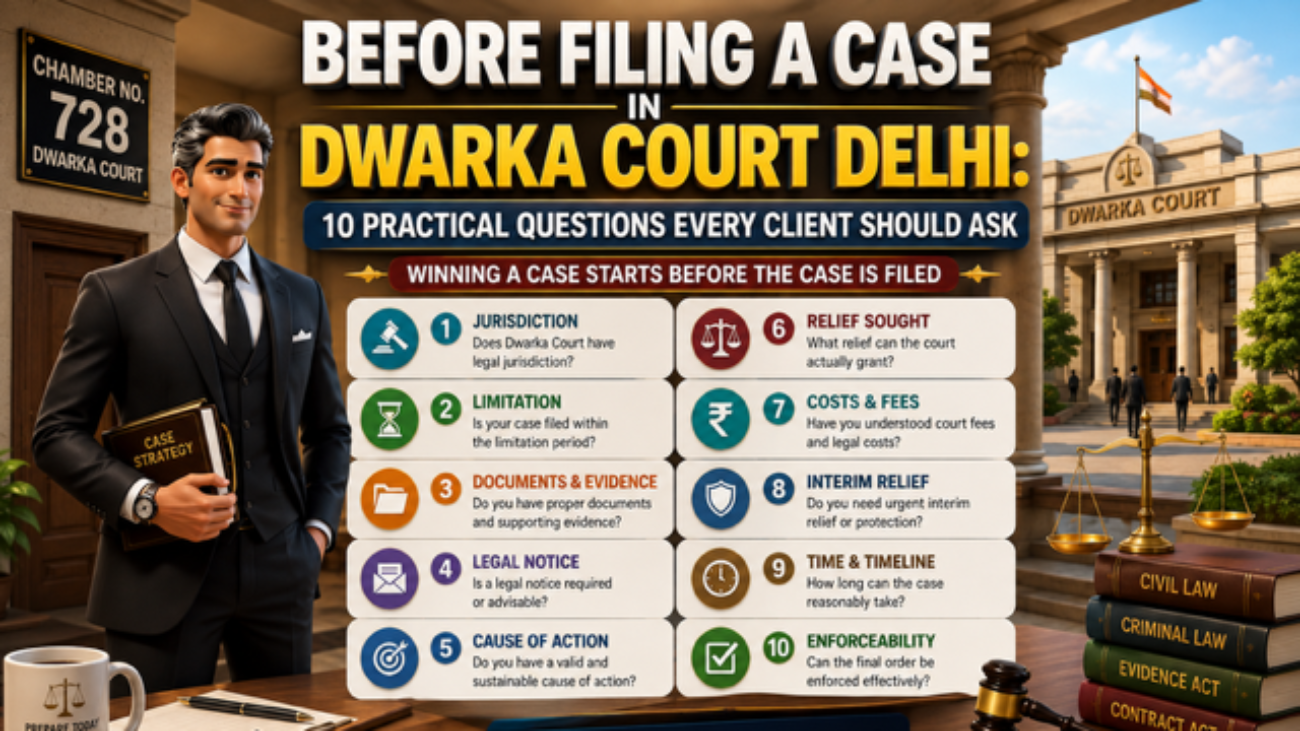
Before Filing a Case in Dwarka Court Delhi – practical legal checklist for clients

Before Filing a Case in Dwarka Court Delhi: 10 Crucial Questions for a Fearless, Meticulous & Powerful Legal Strategy

Introduction – Before Filing a Case in Dwarka Court Delhi – Ankit Gaurav Kainth 18+ Years Experience in Litigation Civil & Criminal Case

Going to court should not be the first reaction to every dispute. It should be a considered legal decision.

Before Filing a Case in Dwarka Court Delhi, a client should first understand the jurisdiction, limitation period, evidence, legal remedy, likely costs and practical purpose of litigation.

A strong case is often built before the first document reaches the filing counter.

At Ankit Gaurav Kainth & Associates, our approach is simple: first understand the dispute, then examine the documents, identify the correct remedy and only thereafter decide the legal strategy.

With 18+ years of litigation experience in Dwarka Court, we have seen an important reality:

Winning a case starts before the case is filed.


Here are 10 practical questions every client should consider – Before Filing a Case in Dwarka Court Delhi

⚖️ Quick Checklist Before Filing Your Case

QuestionWhy It Matters
1. Does Dwarka Court have jurisdiction?A case must be filed before the correct court
2. Is the case within limitation?Delay may affect the legal remedy
3. Do I have proper documents?Evidence supports your allegations
4. Is a legal notice required?Some matters require or benefit from pre-litigation steps
5. What is my cause of action?The case must disclose a sustainable legal grievance
6. What relief can the court actually grant?Expectations must match the law
7. What will litigation cost?Court fees and professional fees should be understood
8. Do I need urgent interim relief?Delay may defeat the immediate purpose
9. How long can the matter take?Litigation requires realistic expectations
10. Can the final order be enforced?A judgment is useful only if it provides practical relief

1. Does Dwarka Court Have Jurisdiction?

Before Filing a Case in Dwarka Court Delhi, the first question should be: Can this case legally be filed here?

Jurisdiction may depend on several factors. These include the nature of the dispute, location of property, place where the cause of action arose, residence or business of parties, value of the claim and applicable statute.

A convenient court is not automatically the correct court.

Therefore, jurisdiction should be examined before drafting begins. Filing before the wrong forum may lead to delay, additional expense or return of proceedings.

Being local Advocates in Dwarka Court helps us understand the practical filing system and court procedures. However, jurisdiction must still come from law and facts.

2. Is Your Case Within Limitation?

A good claim can face serious difficulty if it is filed too late.

Different proceedings have different limitation rules. Moreover, the starting point for limitation can itself become disputed.

For example, a recovery dispute, contractual claim, property dispute or appellate proceeding may involve different limitation considerations.

Therefore, Before Filing a Case in Dwarka Court Delhi, identify:

When did the right to sue arise?

Do not wait until the last few days.

Old emails, acknowledgements, payments, notices, agreements and other events may also require legal examination while determining limitation.

3. What Documents and Evidence Do You Actually Have?

Clients often tell an advocate:

“Sir, everything happened exactly as I am telling you.”

That is important. However, a court decides disputes on pleadings, admissible material, evidence and applicable law.

So ask:

✅ Is there a written agreement?
✅ Are payments reflected in bank records?
✅ Do you have WhatsApp messages or emails?
✅ Are invoices available?
✅ Are there photographs or videos?
✅ Are original documents available?
✅ Are there witnesses?
✅ What documents does the opposite party possess?

Whether you consult a Civil Litigation Lawyer in Delhi, Property Dispute Advocate, Recovery Suit Counsel, Commercial Litigation Lawyer Dwarka or Cheque Bounce Lawyer in Dwarka Court, documents can fundamentally change case strategy.

4. Should a Legal Notice Be Sent First?

Not every dispute requires the same pre-litigation step.

In some cases, a statutory notice may be necessary. In others, a carefully drafted legal notice can clarify the dispute, formally demand compliance, preserve a record or create an opportunity for settlement.

However, sending an aggressive notice without understanding the case may also disclose your strategy prematurely.

Therefore, the question is not simply:

“Should I send a notice?”

The better question is:

“What legal purpose will this notice serve?”

That is why pre-litigation consultation matters.

5. What Is Your Actual Cause of Action?

Before Filing a Case in Dwarka Court Delhi, a client must distinguish between feeling wronged and having a legally sustainable cause of action.

Courts provide legal remedies. They do not resolve every personal disagreement.

For example, a property dispute may require injunction, possession, declaration, partition or specific performance depending upon the facts.

Likewise, a commercial dispute may involve recovery, contractual enforcement or another statutory remedy.

In criminal matters, the factual allegations must disclose the ingredients of the alleged offence.

Therefore, the correct remedy starts with identifying the correct legal wrong.

6. What Relief Can the Court Realistically Grant?

This is one of the most important questions.

Clients sometimes focus entirely on proving that the opposite party acted wrongly. However, litigation should also have a clear objective.

Ask:

What exactly do I want the court to order?

Money recovery?

Possession?

Injunction?

Declaration?

Bail?

Setting aside an order?

Compensation?

Enforcement of a contractual right?

Before Filing a Case in Dwarka Court Delhi, your desired outcome should be compared with the relief that the law and chosen forum can actually provide.

A responsible advocate should explain both the strengths and limitations of the proposed proceeding.

7. Have You Understood Court Fees and Advocate Fees?

Litigation has financial implications.

Depending upon the proceeding, court fees may be linked to the nature of relief or valuation. Other procedural expenses can also arise.

Professional fees should likewise be discussed transparently.

At our office, we believe professional relationships work better when expectations are clear. Therefore, we follow a system that may include:

✅ Proper Lawyer-Client Fee Agreements
✅ Clear professional fee discussions
✅ Fee receipts and acknowledgements
✅ Transparent communication
✅ Honest and fair professional dealings

The purpose is simple: the client should understand the professional arrangement before substantial legal work begins.

8. Do You Need Immediate Interim Relief?

Sometimes the final case is not the client’s most urgent concern.

The immediate problem may be:

“The property may be sold.”

“I may be dispossessed.”

“An adverse action is imminent.”

“I need bail.”

“Important evidence may disappear.”

In such cases, the possibility of interim relief should be examined at the beginning.

For civil litigation, this could involve an interim injunction or another protective order. In criminal proceedings, clients may require advice from a Regular Bail & Anticipatory Bail Lawyer Dwarka depending upon the circumstances.

Urgency should be genuine, supported by facts and properly presented.

9. How Long Can the Case Take?

No responsible advocate should casually promise an exact date for final disposal.

The timeline can depend upon the type of proceeding, service of parties, number of witnesses, interim applications, court workload, evidence, adjournments and appeals.

Therefore, Before Filing a Case in Dwarka Court Delhi, clients should prepare for litigation as a process rather than a single hearing.

Our team assists clients during ongoing litigation through court appearances, drafting, filing, document preparation and case updates.

Moreover, we maintain communication through telephone and dedicated WhatsApp support so that clients can remain informed about their matters.

10. Can You Enforce the Final Order?

This question is often forgotten.

Suppose you obtain a money decree. Does the opposite party have identifiable assets?

Suppose you obtain an injunction. Is the order practically enforceable?

Suppose settlement is possible today. Could it provide a faster and more certain commercial solution than several years of contested litigation?

The objective should not merely be:

“I want to win.”

Instead, ask:

“What practical result will this litigation achieve?”

A legally favourable order has greater value when it can actually protect or enforce the client’s rights.


🤝 Should Settlement Be Considered Before Litigation?

Settlement is not necessarily weakness.

In suitable matters, a well-structured settlement can save time, cost and uncertainty. However, settlement should be evaluated from a position of legal understanding.

Before Filing a Case in Dwarka Court Delhi, we may examine whether negotiation, mediation, legal notice or another pre-litigation process is commercially and legally sensible.

If settlement is unsuitable or unsuccessful, litigation can then proceed with a clearer understanding of the dispute.


Pre-Litigation Assistance: Why Preparation Matters

Our work can begin before the case reaches court.

At the pre-litigation stage, we may:

✅ Understand the complete factual history
✅ Review documents and electronic records
✅ Examine jurisdiction and limitation
✅ Identify the appropriate legal remedy
✅ Consider notices and pre-litigation requirements
✅ Assess the need for urgent relief
✅ Discuss settlement possibilities
✅ Explain likely procedural steps

This process can reveal weaknesses before they become problems inside the courtroom.

Therefore, pre-litigation consultation is not merely about asking, “Can I file a case?”

It is about asking:

“What is the most appropriate legal strategy?”

Litigation Assistance After the Case Is Filed

Once litigation begins, strategy must continue.

Our work may include drafting pleadings and applications, filing proceedings, court appearances, evidence preparation, cross-examination strategy, interim applications, final arguments and regular case updates.

Clients looking for a Criminal Advocate Dwarka, Criminal Disputes Advocate Dwarka Court, Commercial Litigation Lawyer Dwarka, Lawyer in South West Delhi or Advocate in Dwarka Court should choose counsel according to the nature and complexity of their dispute.

Local court familiarity can help with coordination and procedural efficiency. Nevertheless, every case must ultimately stand on its own facts, evidence and law.


📍 Local Litigation Practice Near Dwarka Court

Our practice at Dwarka Court serves clients from Dwarka Sector 6, Sector 10, Sector 12, Sector 23, Dwarka North and Dwarka South.

Clients also approach Dwarka Court from Janakpuri, Vikaspuri, Uttam Nagar, Najafgarh, Delhi Cantonment, Chhawla, Bindapur, Baba Haridas Nagar, Mohan Garden, Palam Village, Samalka, Dabri, Jaffarpur Kalan and Kapashera.

For people searching for an advocate near Dwarka Court, local accessibility can make consultation, document review and case coordination easier.


Frequently Asked Questions – Before Filing a Case in Dwarka Court Delhi

1. What should I do before filing a case in Dwarka Court?

First, collect your documents and prepare a clear chronology. Then examine jurisdiction, limitation, evidence, cause of action, available relief and litigation costs with an advocate.

2. Do I always need to send a legal notice before filing?

No. The requirement depends upon the nature of the case and applicable law. In some disputes a notice is mandatory, while in others it may simply be strategically useful.

3. How do I know whether Dwarka Court has jurisdiction?

Jurisdiction depends on factors such as the nature of the dispute, territorial connection, property location, cause of action, valuation and applicable law. It should be examined case by case.

4. Should I settle or file a court case?

There is no universal answer. Consider the strength of evidence, urgency, value of the dispute, enforceability, cost, time and terms being offered. A legally sound settlement can sometimes be more practical than prolonged litigation.

5. Can an advocate tell me whether I will win before filing?

An advocate can assess strengths, weaknesses and available remedies. However, litigation outcomes depend upon evidence, law, the opposite party’s case and judicial determination. No outcome should be guaranteed.


Conclusion: Prepare First, Litigate Second

Before Filing a Case in Dwarka Court Delhi, ask yourself one final question:

“Have I prepared my case before deciding to fight it?”

Good litigation starts with documents, jurisdiction, limitation, evidence and a clear objective.

It also requires realistic expectations about time, cost, interim relief, settlement and enforcement.

Therefore, do not treat filing as the first step.

Preparation is the first step.

After 18+ years of litigation practice in Dwarka Court, our approach remains centred on careful preparation, professional communication and transparent dealings.


⚖️ Winning a case starts before the case is filed.

📞 Pre-Litigation Consultation – Dwarka Court Delhi

If you are considering civil, criminal, property, recovery, cheque bounce, commercial or other litigation in Dwarka Court, you may arrange a professional consultation to understand the appropriate legal remedy before taking action.

Ankit Gaurav Kainth & Associates
Advocates – Dwarka Court, Delhi

📞 9899085554
📞 9811885554

Please keep your important documents, notices, agreements, court papers and a brief chronology of events ready for consultation.

Disclaimer: This article contains general legal information and is not a substitute for advice based on the facts of a particular case. Jurisdiction, limitation, remedies, court fees, procedure and outcomes depend upon the applicable law and individual circumstances. No outcome is guaranteed.

Important TopicsText
Commercial Court practice pageCommercial Court Lawyer in Dwarka Court
Commercial Court Recovery Suit: When Does the Limitation Period Start?
Commercial Lease Dispute DwarkaPowerful Ground Every Client Should Know
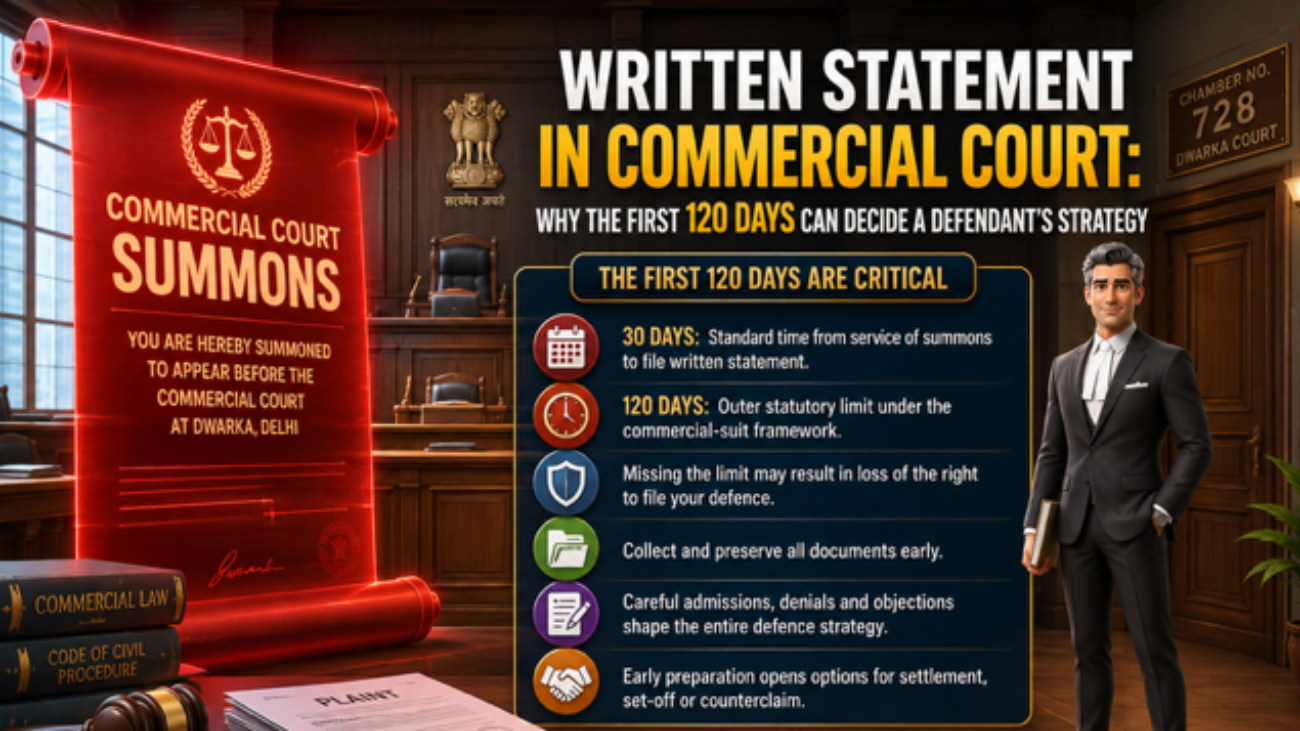
Written Statement 120 Days in Commercial Court Recovery SuitImportant Law
Commercial Money Recovery Suit in DelhiA Complete Guide for International Clients & Foreign Companies
The Unassailable Blueprint to Lead Defence Evidence Like a Professional in Commercial Court CasesAdvanced Litigation Strategies Every Lawyer Should Master
Commercial Court Is FastBut Only If Your Lawyer Does This in Delhi Court
Why Businesses Lose Strong Commercial Cases Despite Having Agreements?Experienced Commercial Court Advocate Dwarka Delhi
Powerful Commercial Court Recovery CaseAcquittal Strategies for Fearless Defence
What Happens After Receiving a Legal Noticein a Commercial Matter?
Written Statement in Commercial Court – 30-day and 120-day timeline for defendants in Dwarka Court

Written Statement in Commercial Court: Why the First 120 Days Can Decide a Defendant’s Strategy

Introduction – Written Statement in Commercial Court

A company receives summons from the Commercial Court at Dwarka in a recovery suit claiming ₹38 lakh towards unpaid invoices.

The next hearing is several weeks away.

The director thinks:

“There is still plenty of time. We will prepare the reply later.”

That approach can be risky.

In commercial litigation, the Written Statement in Commercial Court is not merely a reply to allegations. It may become the foundation of the defendant’s documentary, procedural and trial strategy.

The first exercise should therefore be:

SUMMONS → DATE OF SERVICE → DEADLINE → DOCUMENTS → DEFENCE → DISCLOSURE → ADMISSION/DENIAL → WRITTEN STATEMENT → STRATEGY

Most importantly, the statutory 120-day period should be understood as an outer limit under the commercial-suit framework—not as a target date for beginning preparation.


⚖️ Written Statement in Commercial Court: What Should a Defendant Do During the First 120 Days?

StageWhat the Defendant Should DoWhy It MattersMistake to Avoid
1Record date and mode of serviceDeadline may run from serviceGuessing the date later
2Obtain complete plaintDefence needs complete allegationsReading summons only
3Calculate applicable deadlineCommercial timelines are strictTreating Day 120 as target
4Identify preliminary objectionsJurisdiction and maintainability may matterUsing boilerplate objections
5Collect business recordsDefence is often document-drivenWaiting until drafting starts
6Reconcile monetary claimClaimed amount may be disputedAccepting plaintiff’s ledger
7Prepare admissions/denialsVague denials may be inadequateDenying everything mechanically
8Organise disclosureCommercial suits require structured disclosureHiding adverse documents
9Examine set-off/counterclaimDefendant may have independent claimsDiscovering them too late
10Finalise and filePleading, documents and verification must alignLast-day filing strategy

This is a workflow. It is not an invitation to wait for Day 120.


What Is a Written Statement in a Commercial Suit?

A written statement is commonly described as the defendant’s reply to the plaint.

That description is incomplete.

A properly prepared commercial written statement may explain:

  • what the defendant admits;
  • what the defendant denies;
  • why a particular allegation is denied;
  • the defendant’s own version of the transaction;
  • jurisdictional objections;
  • contractual defences;
  • payments and adjustments;
  • limitation issues where relevant;
  • documentary defences;
  • set-off or counterclaim where legally available; and
  • the factual basis upon which the suit will be contested.

Therefore, careless admissions can create difficulty later.

Likewise, a vague sentence such as “contents are wrong and denied” may not be a substitute for a carefully prepared paragraph-wise defence.


⚠️ Written Statement in Commercial Court: The 30-Day and 120-Day Framework

The Commercial Courts Act modifies the CPC for commercial disputes.

Under Order VIII Rule 1, read with the commercial amendments, a defendant is expected to present the written statement within 30 days from service of summons.

If that does not happen, the Court may permit filing later, subject to the statutory framework, recorded reasons and costs. However, for commercial suits governed by this regime, the amended provisions impose an outer limit of 120 days from service of summons. On expiry of that period, the statutory language provides for forfeiture of the right to file the written statement. (India Code)

The Supreme Court in SCG Contracts India Pvt. Ltd. v. K.S. Chamankar Infrastructure Pvt. Ltd. emphasised the mandatory nature of these commercial-suit amendments and held that inherent powers cannot ordinarily be used to bypass the statutory 120-day bar. (Sci API)

More recently, the Supreme Court in 2025 again described the commercial-dispute provisions as imposing an absolute embargo after expiry of the statutory 120-day period in the case before it. (Sci API)

A Delhi High Court Division Bench in August 2025 likewise upheld the consequence where no written statement had been filed within the 120-day period in a district-level commercial matter. (Delhi High Court)

The practical lesson

Do not think:

“I have 120 days.”

Think:

“My defence preparation starts on the date summons is served.”

The actual computation must still be checked from the service record and procedural history.

When Does the Written Statement Clock Start?

The date of service can become critical.

A defendant should preserve:

✅ Physical envelope
✅ Email through which papers were received
✅ Electronic service record
✅ WhatsApp/service communication where applicable
✅ Court order recording service
✅ Complete summons and plaint set

Questions may arise regarding whether summons were properly served, whether complete papers accompanied service and what the court record shows.

Therefore, do not casually state a service date from memory.

Your advocate should examine the actual record.

For district Commercial Courts such as Dwarka, one should also avoid relying on procedural rules designed specifically for original-side proceedings before the Delhi High Court unless they legally apply to the particular case.


📂 Your Documents Build Your Written Statement – Written Statement in Commercial Court

A Written Statement in Commercial Court should rarely be drafted in isolation from the underlying business records.

Suppose the plaintiff claims ₹38 lakh.

Before drafting, the defendant should collect:

  • contracts;
  • purchase orders;
  • work orders;
  • invoices;
  • delivery challans;
  • ledger accounts;
  • bank statements;
  • payment records;
  • emails;
  • WhatsApp conversations;
  • GST-related records where relevant;
  • debit notes;
  • credit notes;
  • returned-goods records;
  • quality complaints;
  • termination correspondence;
  • settlement communications;
  • legal notices and replies; and
  • relevant internal business records.

Importantly, preserve helpful documents as well as documents that may appear adverse.

Commercial litigation is not the place to delete inconvenient emails or accounting records.


Disclosure: Why Commercial Court Defendants Must Organise Documents Early

Commercial litigation has a more structured disclosure regime.

Order XI, as substituted for commercial disputes, places significant emphasis on disclosure of documents within a party’s power, possession, control or custody.

Accordingly, document preparation should begin alongside the written statement—not several months later.

The statutory framework also requires commercial pleadings to be verified through a Statement of Truth in the prescribed manner. The law expressly provides consequences where a pleading is not properly verified. (India Code)

This is one reason why the defendant must provide complete and accurate instructions.


Do Not Deny Every Document Mechanically – Written Statement in Commercial Court

Admission and denial of documents can significantly narrow the dispute.

A defendant should distinguish between different questions:

Did I receive this document?
Did I execute it?
Are its contents correct?
Is the amount correct?
Do I dispute its authenticity?
Do I accept the document but dispute its legal effect?

These are not always the same thing.

For example, a defendant may admit receiving an invoice while disputing that the goods were accepted without objection.

Therefore, the written statement, documents and admission/denial strategy should remain consistent.-


💰 Does the Defendant Actually Owe the Amount Claimed? – Written Statement in Commercial Court

Consider this example:

Plaintiff’s claim: ₹38 lakh

However, the defendant’s records indicate:

  • ₹5 lakh already paid;
  • ₹3 lakh credit note;
  • ₹4 lakh worth of goods returned;
  • disputed contractual interest;
  • quality complaints; and
  • incomplete supply.

The correct approach is to reconcile:

PLAINT → INVOICES → LEDGER → BANK → PAYMENTS → CREDIT NOTES → CORRESPONDENCE

Potential issues may include:

✅ Payments ignored
✅ Partial payments omitted
✅ Incorrect interest
✅ Inflated invoices
✅ Defective goods
✅ Returned material
✅ Wrong ledger entries
✅ Contractual adjustments
✅ Incomplete performance
✅ Settlement communications

The existence of an invoice does not automatically resolve all these factual or legal questions.


Preliminary Objections Should Be Identified Early

Preparing the written statement also requires examining threshold issues.

These may include:

  • territorial jurisdiction;
  • pecuniary jurisdiction where relevant;
  • limitation;
  • contractual jurisdiction clauses;
  • arbitration clause;
  • maintainability;
  • cause of action;
  • Section 12A issues where relevant;
  • contractual terms; and
  • status or capacity of the parties.

However, objections should not be inserted merely because they appear in a standard drafting format.

A meaningful preliminary objection needs a factual and legal foundation.


Does the Defendant Have a Claim Against the Plaintiff?

Sometimes the defendant is not merely defending money.

The defendant may itself claim that the plaintiff caused loss through:

  • defective supply;
  • delayed delivery;
  • breach of contract;
  • incomplete performance;
  • excess billing; or
  • other contractual defaults.

Depending upon the facts and CPC requirements, set-off or counterclaim may need consideration.

These issues should be identified while preparing the initial litigation strategy rather than after the defence is substantially complete.


Statement of Truth: Do Not Sign the Pleading Casually

Commercial pleadings are subject to enhanced verification requirements.

Order VI Rule 15A requires verification by an affidavit in the prescribed form—the Statement of Truth. The statutory form requires the deponent to distinguish statements based on knowledge, information and legal advice and to affirm disclosure of relevant records. (India Code)

Therefore, a director, proprietor or authorised representative should carefully check:

✅ Dates
✅ Payments
✅ Documents
✅ Amounts
✅ Admissions
✅ Denials
✅ Source of factual information

The client should understand the pleading before signing it.


Why Waiting Can Damage a Commercial Defence

Even before the statutory bar becomes an issue, delay can weaken preparation.

Waiting may cause:

  • rushed drafting;
  • incomplete document collection;
  • overlooked payments;
  • missed credit notes;
  • inconsistent instructions;
  • poor admission/denial preparation;
  • inadequate disclosure;
  • unexamined jurisdiction objections;
  • missed counterclaim possibilities; and
  • less time for settlement analysis.

Therefore, the real danger is not merely Day 121.

It is losing the preparation time available before it.


Interim Applications Cannot Always Wait

The plaintiff may also seek:

  • injunction;
  • attachment;
  • security;
  • restraint against assets;
  • deposit; or
  • another interim order.

Such an application may require immediate attention even while the written statement is being prepared.

Accordingly, the advocate should review the entire case file, not only the plaint.


Summary Judgment Makes Early Defence Preparation Even More Important

Order XIII-A provides a summary-judgment mechanism for qualifying commercial claims.

Under that framework, a Court may decide a commercial claim without recording oral evidence where the prescribed test is satisfied, including the absence of a real prospect of succeeding or defending and the absence of another compelling reason for trial. (India Code)

This does not mean that every weak written statement results in summary judgment.

However, it does reinforce an important point:

Commercial litigation rewards early clarity in pleadings and documents.


🤝 Written Statement Preparation Is Also a Settlement Reality Check

Document review may reveal:

  • a strong defence;
  • partial liability;
  • an accounting dispute;
  • interest-only disagreement;
  • weak plaintiff records;
  • weak defendant records;
  • a genuine counterclaim; or
  • a sensible settlement possibility.

Therefore, a business should assess:

Claim Amount + Documents + Defence + Cost + Time + Business Relationship + Enforceability + Settlement Opportunity

Settlement is not automatically a sign of weakness.

Equally, receiving summons does not mean a defendant should settle a claim merely because a large amount appears on the first page.


⚖️ Pre-Litigation and Litigation Assistance – Written Statement in Commercial Court

Before commercial litigation, Ankit Gaurav Kainth & Associates assists clients with areas such as contract review, invoice disputes, legal notices, replies, document analysis, settlement negotiations, commercial mediation, risk assessment and evidence preservation.

Once Commercial Court summons have been received, the focus may shift to:

✅ Examining the summons and service record
✅ Reading the plaint and applications
✅ Calculating procedural timelines
✅ Preparing the written statement
✅ Preliminary objections
✅ Disclosure
✅ Admission and denial
✅ Statement of Truth
✅ Set-off/counterclaim where legally available
✅ Interim applications
✅ Evidence and cross-examination
✅ Final arguments
✅ Settlement or mediation

With 18+ years of litigation experience, our approach is to understand the transaction and documents before finalising the defence.

📍 Written Statement and Commercial Court Matters in Dwarka

Our practice is based at Dwarka Courts, Delhi.

Local presence assists with consultation, document coordination, filing, appearances and procedural follow-up. It does not provide any special influence or preferential treatment.

Clients may approach from Dwarka Sector 6, Sector 10, Sector 12, Sector 23, Dwarka North, Dwarka South, Janakpuri, Vikaspuri, Uttam Nagar, Najafgarh, Delhi Cantonment, Chhawla, Bindapur, Baba Haridas Nagar, Mohan Garden, Palam Village, Samalka, Dabri, Jaffarpur Kalan, Kapashera and other parts of South West Delhi near Dwarka Court.

🌍 Defendant Outside Delhi or India?

A defendant in Delhi commercial litigation may be based elsewhere in India or abroad.

Businesses or directors may be located in the United States, United Kingdom, UAE, Singapore, Australia, Canada, Germany, France, Saudi Arabia or Qatar.

However, residence abroad neither creates nor eliminates Dwarka Court jurisdiction by itself.

Jurisdiction depends upon applicable law, the transaction, contractual terms, cause of action and territorial connection.

Where suitable, digital document sharing and video consultations can assist clients who are outside Delhi.


❓ Frequently Asked Questions – Written Statement in Commercial Court

1. How much time do I have to file a written statement in Commercial Court?

The commercial-suit framework ordinarily requires filing within 30 days from service of summons. Filing beyond that period may be permitted subject to statutory conditions, but the amended CPC provides a 120-day outer limit for commercial suits governed by the provision. The actual computation should be checked from the service record. (India Code)

2. What happens if a written statement is not filed within 120 days?

Under the commercial-suit amendments, the defendant forfeits the right to file the written statement after the statutory 120-day period where that regime applies, and the Court is not to take it on record. Supreme Court authority has repeatedly treated this rule strictly. (Sci API)

3. From which date is the 120-day period calculated?

The statutory language refers to the date of service of summons. However, disputes about valid service and procedural history can be fact-specific, so the court record should be examined carefully. (India Code)

4. What documents should I give my advocate?

Provide the complete summons and plaint along with contracts, invoices, purchase orders, delivery records, ledger, bank statements, emails, WhatsApp records, payment details, credit/debit notes, legal notices and settlement communications.

5. Can a defendant file a counterclaim with the written statement?

A counterclaim may be available depending upon its cause of action, maintainability and applicable CPC provisions. It should be examined early because it may affect the structure of the defence.


🏁 Conclusion

A Written Statement in Commercial Court is not merely a reply to allegations.

It is the foundation upon which the defendant’s documentary, procedural and trial strategy may be built.

The correct approach is not:

“How close can I get to Day 120?”

It is:

“What do we need to prepare from Day 1?”

Early preparation creates time to examine jurisdiction, limitation, invoices, payments, contracts, disclosure, admission/denial, counterclaims, interim applications and settlement possibilities.

Do not treat Day 120 as your filing plan. Treat the date of service as the day defence preparation begins.

📞 Written Statement / Commercial Suit Consultation – Dwarka Court

Ankit Gaurav Kainth & Associates
Advocates – Dwarka Court, Delhi

📞 9899085554
📞 9811885554

For consultation, keep ready:

✅ Summons and complete plaint
✅ Applications
✅ Evidence of date/mode of service
✅ Contracts
✅ Purchase/work orders
✅ Invoices and delivery challans
✅ Ledger accounts
✅ Bank statements
✅ Emails and WhatsApp communications
✅ Payment records
✅ Debit/credit notes
✅ Previous notices
✅ Settlement communications

Disclaimer: This article provides general legal information only. Written-statement timelines, service, jurisdiction, disclosure requirements and available defences depend upon the applicable law, court, facts and procedural record. No particular outcome is guaranteed.


Written Statement in Commercial Court with important links

Important Topics Text
Commercial Court practice pageCommercial Court Lawyer in Dwarka Court
Commercial Court Recovery Suit: When Does the Limitation Period Start?
Commercial Lease Dispute DwarkaPowerful Ground Every Client Should Know
Written Statement 120 Days in Commercial Court Recovery SuitImportant Law
Commercial Money Recovery Suit in DelhiA Complete Guide for International Clients & Foreign Companies
The Unassailable Blueprint to Lead Defence Evidence Like a Professional in Commercial Court CasesAdvanced Litigation Strategies Every Lawyer Should Master
Commercial Court Is FastBut Only If Your Lawyer Does This in Delhi Court
Why Businesses Lose Strong Commercial Cases Despite Having Agreements?Experienced Commercial Court Advocate Dwarka Delhi
Powerful Commercial Court Recovery CaseAcquittal Strategies for Fearless Defence
What Happens After Receiving a Legal Noticein a Commercial Matter?
Traffic Challan Settlement via WhatsApp scam warning in Delhi

⚠️ Traffic Challan Settlement via WhatsApp: Avoid This Perilous Trap Before It Costs You Dearly

Introduction – Traffic Challan Settlement

Receiving a WhatsApp message saying “Your traffic challan can be settled immediately” may look convenient. However, it can also be a warning sign.

A message may contain a challan number, vehicle details, a QR code, a payment link, or even the name and photograph of a person claiming to be connected with the police or court. Therefore, never assume that a WhatsApp message is genuine merely because it contains correct vehicle information.

The official eChallan portal itself warns users about fraudulent websites and mobile applications impersonating eChallan services. It also states that users should access the official portal and that it does not request passwords, OTPs, payment details or sensitive information through calls, emails, messages or links. 

This article explains Traffic Challan Settlement, the major warning signs of a WhatsApp scam, and what a vehicle owner should do when a challan is pending or has been sent to court.


⚖️ What Does Traffic Challan Settlement Actually Mean?

In simple terms, Traffic Challan Settlement means dealing with a traffic offence through the lawful process applicable to that challan.

Depending on the status and nature of the challan, a person may be able to:

  • Pay the applicable fine through an authorised online system.
  • Check the challan status.
  • Use the Virtual Courts system where the challan is available there.
  • Request to contest the matter.
  • Appear before the court to contest the allegation.
  • Engage an advocate where legal representation is appropriate.

The official Virtual Courts platform allows users to search by challan number, vehicle number, CNR, party name or mobile number. It also provides options to pay the fine or request to contest the case. 

Therefore, a genuine Traffic Challan Settlement should be connected with an identifiable official process. It should not depend upon secretly transferring money to an unknown individual.


🚨 Why Are WhatsApp Challan Messages Dangerous?

Scammers often use urgency and fear.

A message may say:

“Pay immediately or your driving licence will be cancelled.”

Another may state:

“Your challan has gone to court. Pay now to avoid arrest.”

Some messages may ask you to:

  • Scan a QR code.
  • Click a payment link.
  • Download an APK.
  • Share an OTP.
  • Share your driving licence details.
  • Send money to a personal UPI account.
  • Contact an unknown “court representative”.
  • Pay a person for “Traffic Challan Settlement”.

The purpose is often to make you act before you verify the information.

The safest rule is simple:

STOP → VERIFY → THEN ACT


🔟 10 Red Flags of a Traffic Challan WhatsApp Scam

Red FlagWhat It May IndicateWhat You Should Do
1. Unknown WhatsApp NumberIdentity is not establishedDo not trust the message
2. Immediate Payment DemandPressure tacticVerify first
3. Personal UPI AccountPayment may not be officialDo not transfer money
4. Unknown QR CodeCould redirect paymentDo not scan without verification
5. APK/App DownloadMalware riskNever install an unknown app
6. OTP RequestAttempt to access an account/transactionNever disclose OTP
7. Threat of ArrestFear-based pressureVerify the actual case status
8. “Guaranteed SettlementSuspicious promiseAsk for official case details
9. Fake Court IdentityPossible impersonationVerify court information independently
10. Fake Payment LinkCould imitate an official portalUse the official website yourself

The official eChallan system specifically warns about fraudulent websites and mobile applications and tells users not to provide sensitive information through suspicious communications. 

⚠️ Red Flag No. 1: “Pay Me Personally”

One of the biggest warning signs is a person saying:

“Send the amount to my UPI. I will settle your challan.”

A genuine legal process should have a traceable and verifiable basis.

A private person claiming that he can personally “clear” a challan should not be trusted merely because he uses words such as:

Police • Court • Advocate • Traffic Department • Lok Adalat • Settlement Officer

Verify the claim independently.


📱 Red Flag No. 2: “Click This Link”

A WhatsApp message may contain a link that looks official.

However, the safest approach is not to use the link provided by an unknown sender.

Instead, manually open the official eChallan service and check your challan using the available search options. The official portal allows challan status to be checked using information such as the challan number, vehicle number or driving licence number. 

Official eChallan Status Portal⁠


🚨 Red Flag No. 3: “Download This App”

This is particularly dangerous.

A scammer may send an APK or ask you to install an application to “complete Traffic Challan Settlement”.

❌ Do not install an unknown APK.

It may expose your:

  • Banking information
  • OTPs
  • Personal data
  • Contacts
  • Messages
  • Device information

The official eChallan website has itself issued warnings about fraudulent websites and mobile applications impersonating its services. 


🔐 Red Flag No. 4: OTP or Banking Details

Never share:

OTP + UPI PIN + Card PIN + Net Banking Password

with someone claiming to be arranging your Traffic Challan Settlement.

An OTP is not proof that the person contacting you is from the police or court.

It is an authentication mechanism.

Therefore, keep your OTP private.


⚖️ What Is the Correct Way to Check a Challan?

Start with verification.

Step 1 — Check the Challan

Use the official eChallan system.

Step 2 — Check the Status

See whether the challan is:

  • Pending
  • Paid
  • Sent to court
  • Available through Virtual Courts
  • Otherwise requiring further action

Step 3 — Check the Court Status

If the challan has been forwarded to a court or Virtual Court, verify the relevant details through the official system.

The eChallan system can display court-related information for challans that have been forwarded to court. 

Step 4 — Decide Whether to Pay or Contest

If the person accepts the offence and the official system provides a lawful payment route, payment may be appropriate.

If the person wishes to contest the allegation, the Virtual Courts system provides a “Request to Contest” route where applicable. The official Virtual Courts guidance states that, after choosing to contest, the user is informed of the physical court and date. 


🏛️ A Genuine Advocate Does Not “Secretly Settle” a Challan Through WhatsApp

This point is important.

A genuine advocate may communicate with a client through WhatsApp for convenience. However, WhatsApp itself is not the legal forum for disposing of a traffic case.

Where a matter requires court intervention, the advocate represents the client through the relevant court or authorised legal process.

In other words:

❌ WhatsApp message ≠ Court proceeding

❌ WhatsApp payment request ≠ Court settlement

❌ Unknown person ≠ Authorised representative

✅ Official challan record + authorised process + proper legal representation = safer approach

Virtual Courts is itself an official judicial service. It allows certain challan matters to be searched online and provides a route to pay or contest, depending on the case. 

Therefore, the better statement is not that every traffic challan must physically go before a regular court. Some matters can be dealt with through authorised online or Virtual Court mechanisms. But where court representation is required, a genuine Advocate represents the client through the respective court and lawful procedure—not through an unofficial WhatsApp “settlement”.


👨‍⚖️ How We Assist Clients With Traffic Challan Matters

At Ankit Gaurav Kainth & Associates, we assist clients at both the pre-litigation stage and litigation stage, depending on the status and nature of the challan.

🔹 Before Court / Pre-Litigation Stage

We may assist with:

  • Understanding the challan.
  • Checking the available case status.
  • Reviewing the alleged traffic violation.
  • Understanding whether payment or contest is appropriate.
  • Explaining the applicable procedure.
  • Checking whether the matter is available through an authorised online process.
  • Advising the client before taking further action.

This stage is important because many people pay money to unknown persons simply because they do not understand the actual status of their challan.


⚖️ Litigation Stage

Where the matter requires court proceedings, we can assist with:

  • Court appearance.
  • Representation before the appropriate court.
  • Challan-related applications.
  • Contesting the allegation where legally appropriate.
  • Explaining court orders.
  • Monitoring dates.
  • Advising on the next procedural step.

Our objective is to ensure that the client understands where the case is pending, what the next date means and what action is required.


📊 WhatsApp Scam vs Genuine Legal Process

WhatsApp SettlementGenuine Process
Unknown individualIdentifiable official system/lawyer
Personal UPI paymentAuthorised payment mechanism
Threats and urgencyVerifiable case information
Unknown linkOfficial portal accessed independently
APK installationNo suspicious application
OTP demanded by strangerAuthentication only through authorised process
Guaranteed settlementLawful procedure
No proper case detailsChallan/CNR/court details can be verified
No receipt or unreliable receiptOfficial acknowledgement/receipt
Pay me and case is closedStatus verified after lawful disposal/payment

📍 Traffic Challan Lawyer Near Dwarka Court

Clients from Dwarka Sector 6, Sector 10, Sector 12, Dwarka North, Dwarka South and Dwarka Sector-23 may have traffic-related legal concerns connected with different courts and authorities.

We also receive enquiries from areas such as:

Janakpuri, Vikaspuri, Uttam Nagar, Najafgarh, Bindapur, Baba Haridas Nagar, Mohan Garden, Palam Village, Chhawla, Delhi Cantonment, Samalka, Dabri, Jaffarpur Kalan and Kapashera.

Our office is located at:

Chamber No. 728, District Court Dwarka, Sector-10, New Delhi

Being a local Advocate in Dwarka Court gives us practical familiarity with court procedures, filing systems, listing processes and day-to-day court functioning.

However, location alone should never be the only reason for selecting an advocate. Clients should also consider experience, professional conduct, communication, case preparation and transparency.

⭐ 18+ Years of Court Practice

With 18+ years of litigation experience in Dwarka Court, New Delhi, our practice includes criminal and civil litigation along with traffic challan-related legal assistance.

Our wider legal practice also includes matters handled by a Criminal Advocate in Dwarka, Criminal Disputes Advocate Dwarka Court, Regular Bail & Anticipatory Bail Lawyer Dwarka, Cheque Bounce Lawyer in Dwarka Court, Civil Litigation Lawyer in Delhi, Property Dispute Advocate, Recovery Suit Counsel and Commercial Litigation Lawyer.

However, every matter is assessed according to its own facts.


🤝 Why Client Trust Matters

Legal representation should be based on clarity and professional responsibility.

Our client-handling approach focuses on:

⚖️ Professional Standards

We aim to maintain proper professional conduct in every engagement.

📞 Quick Responsiveness

Clients can communicate regarding important developments and procedural requirements.

💬 Dedicated WhatsApp Support

WhatsApp may be used for client communication and sharing documents or updates. It should not be confused with an official court process.

📄 Lawyer-Client Fee Agreement

Professional terms and fees should be clearly understood before engagement.

🧾 Fee Receipts & Acknowledgements

Clients should receive appropriate documentation regarding professional payments.

💰 Transparent Fee Structure

Fees should be discussed clearly instead of being presented as an unexplained “settlement amount”.

🤝 Honest & Fair Dealings

No responsible lawyer should promise a guaranteed result in a contested legal matter.

🚗 What Should You Do If You Already Paid a WhatsApp Scammer?

If you have already transferred money, do not delete the conversation.

Preserve:

  • WhatsApp screenshots.
  • Phone number.
  • Payment details.
  • UPI ID.
  • Bank transaction reference.
  • QR code.
  • Website address.
  • APK/application information.
  • Voice messages.
  • Documents sent by the person.
  • Challan number.

Then contact your bank/payment provider and use the appropriate cyber-fraud reporting mechanism without delay.

Also verify the actual challan independently.

Most importantly, do not send additional money merely because the same person threatens you again.


🛡️ 7 Golden Rules to Remember

1️⃣ Never panic.

Fear is often what makes people act without checking.

2️⃣ Never trust an unknown WhatsApp link.

Open the official portal independently.

3️⃣ Never share an OTP or UPI PIN.

4️⃣ Never install an unknown APK.

5️⃣ Never pay a stranger for “guaranteed settlement”.

6️⃣ Verify whether the challan is actually pending.

7️⃣ If the matter is in court, take advice from a genuine Advocate.


❓ Frequently Asked Questions

1. Can a traffic challan be settled through WhatsApp?

WhatsApp itself is not the legal forum for disposing of a traffic case. Depending on the challan, authorised online payment or Virtual Courts processes may be available. Always verify the case through official systems. 

2. Is every WhatsApp challan message fake?

Not necessarily. However, an unsolicited message should not be trusted merely because it contains your vehicle or challan details. Verify the information independently through the official eChallan or Virtual Courts system.

3. Can I contest a traffic challan?

Where the applicable system provides a contest option, a person may request to contest the matter. Virtual Courts states that a user can select “Request to Contest” and receive information about the assigned court and date. 

4. Should I give my OTP to a person claiming to be a lawyer?

No. Do not share OTPs, UPI PINs or banking credentials with an unknown person merely because they claim to be an advocate, police officer or court representative.

5. Can an Advocate handle a traffic challan case?

Where legal representation is permitted or required, an Advocate can assist the client through the applicable court process. The actual procedure depends upon the challan, offence, court and status of the case.


Written by Advocate Ankit Gaurav Kainth, Dwarka Court | 18+ Years of Legal Experience


Cross-Examination Expert Advocate in Dwarka Court Delhi

Cross-Examination Expert Advocate in Dwarka Court Delhi – Masterful, Fearless & Uncompromising Courtroom Strategy

Introduction – Cross-Examination Expert Advocate in Dwarka Court Delhi

⚖️ Understanding the Power of Cross-Examination

Cross-examination is one of the most important stages of a court case. It is not simply a process of asking questions. Instead, it requires preparation, legal knowledge, careful listening, timing, and courtroom strategy.

A Cross-Examination Expert Advocate in Dwarka Court Delhi prepares questions after studying the pleadings, documents, evidence, previous statements, and the testimony given by the witness.

In both civil and criminal cases, a well-planned cross-examination can help the Court understand contradictions, omissions, inconsistencies, admissions, and weaknesses in evidence. However, every case is different. Therefore, the questions must be based on the facts and evidence of that particular case.

With 18+ years of experience in Dwarka Court, our approach focuses on preparation, legal research, factual analysis, and effective courtroom representation.


What Is Cross-Examination?

Cross-examination is the questioning of a witness by the opposite party after the witness has given evidence.

The purpose may include:

  • Testing the truth and accuracy of testimony.
  • Bringing relevant facts on record.
  • Highlighting contradictions.
  • Testing the witness’s memory and knowledge.
  • Questioning disputed facts.
  • Establishing admissions where legally appropriate.
  • Testing documentary evidence.
  • Exposing inconsistencies between pleadings, statements, and testimony.
  • Challenging the reliability of evidence.

A Cross-Examination Expert Advocate in Dwarka Court Delhi does not rely only on aggressive questioning. Good cross-examination is usually precise, focused, and evidence-based.


Role of Cross-Examination in Civil & Criminal Cases

AspectCivil CasesCriminal Cases
Main purposeTest the evidence supporting the civil claim or defenceTest prosecution or defence evidence
Witness focusPlaintiff, defendant, expert, official or other witnessesComplainant, police officers, eyewitnesses, experts and other witnesses
DocumentsAgreements, invoices, property records, notices, bank records and correspondenceFIR, statements, medical records, forensic reports, seizure documents and other records
Key areasLiability, ownership, possession, contract, payment and damagesIdentity, occurrence, investigation, credibility, recovery and legal ingredients
ContradictionsPleadings, affidavits, documents and oral testimonyFIR, previous statements, investigation records and deposition
AdmissionsMay clarify liability, transactions or disputed factsMay affect credibility or particular factual issues, subject to law
StrategyFocused on issues framed by the CourtFocused on the prosecution/defence case and applicable criminal law
PreparationPleadings + documents + evidence + issuesFIR/complaint + investigation material + statements + evidence
Advocate’s roleTest the opposing evidence and protect the client’s caseTest prosecution evidence or defend the accused through lawful means

Therefore, cross-examination should always be connected with the issues and evidence before the Court.


Cross-Examination in Civil Litigation

In civil litigation, evidence often involves documents, contracts, property records, financial transactions, correspondence, notices, and oral testimony.

A Civil Litigation Lawyer in Delhi must therefore understand both the factual and documentary side of the dispute.

For example, in a property dispute, questions may relate to ownership, possession, title documents, previous transactions, notices, boundaries, or knowledge of the witness.

Similarly, in a recovery suit, the cross-examination may examine invoices, payments, acknowledgements, agreements, bank transactions, correspondence, and the basis of the alleged liability.

A Property Dispute Advocate must carefully connect the witness’s answers with the documents already placed before the Court.

In commercial matters, the approach may be different. A Commercial Litigation Lawyer may need to examine contractual obligations, invoices, business records, correspondence, accounts, delivery records, or alleged breaches of contract.


Cross-Examination in Criminal Cases

Criminal trials require careful preparation because the evidence may directly affect the liberty and legal rights of the accused.

A Criminal Advocate Dwarka may cross-examine witnesses on matters such as identification, sequence of events, presence at the location, previous statements, contradictions, investigation, recovery, medical evidence, documentary material, or other relevant facts.

The purpose is not to intimidate a witness. Rather, the purpose is to test the evidence according to law.

A Criminal Disputes Advocate Dwarka Court must therefore study the complete case record before deciding the questions to be asked.

In bail matters, the legal approach is different because bail proceedings are not the same as a full trial. Likewise, a Regular Bail & Anticipatory Bail Lawyer Dwarka must assess the allegations, applicable provisions, procedural history, and circumstances of the accused before advising on the appropriate legal remedy.


Cross-Examination in Cheque Bounce Cases

Section 138 of the Negotiable Instruments Act involves important factual and documentary issues.

A Cheque Bounce Lawyer in Dwarka Court may need to examine the complainant regarding the alleged transaction, legally enforceable liability, issuance of cheque, notice, payment, accounts, documents, and other relevant circumstances.

However, there is no universal cross-examination formula. The questions must depend upon the pleadings, documents, defence, and evidence available in the particular case.

That is why preparation matters.

A Cross-Examination Expert Advocate in Dwarka Court Delhi studies the record before framing the examination strategy.


How We Prepare for Cross-Examination – Cross-Examination Expert Advocate in Dwarka Court Delhi

Effective cross-examination starts well before the witness enters the witness box.

1. Complete Case Review

We first examine the pleadings, documents, previous orders, evidence, notices, statements, and relevant case history.

2. Identify Contradictions

Next, we compare different versions of the case. This may include pleadings, affidavits, notices, statements, documents, and deposition.

3. Identify Admissions

Where appropriate, we identify facts that may be relevant to the client’s case and prepare questions around them.

4. Prepare a Questioning Strategy

The questions are then arranged around the relevant issues. This helps maintain focus during the hearing.

5. Review Documents

Documents are carefully examined so that relevant questions can be put to the witness in the proper context.

6. Adapt During Evidence

Cross-examination is not always a fixed script. A witness’s answer may create a new relevant line of questioning. Therefore, an experienced Advocate in Dwarka Court Delhi must listen carefully and respond appropriately.


Pre-Litigation Legal Assistance

Our assistance does not begin only after a case is filed.

At the pre-litigation stage, we help clients understand their legal position before they decide whether litigation is necessary.

This may include:

  • Reviewing agreements and documents.
  • Examining potential claims and defences.
  • Assessing available evidence.
  • Reviewing legal notices.
  • Advising on possible civil or criminal remedies.
  • Identifying documentation gaps.
  • Discussing settlement or negotiation options.
  • Preparing for possible litigation.

This early assessment can help a client make a more informed legal decision.


Assistance During Ongoing Litigation

Once litigation begins, preparation continues.

As a Cross-Examination Expert Advocate in Dwarka Court Delhi, our assistance may include reviewing the evidence, preparing for witness examination, studying previous orders, examining documents, preparing legal submissions, and representing the client during court proceedings.

The same approach applies across suitable civil and criminal matters.

For example, a Recovery Suit Counsel may focus on documentary and financial evidence, while a Property Dispute Advocate may concentrate on title, possession, transactions, and supporting documents.


Why Choose a Local Advocate in Dwarka Court?

Local court experience can make a practical difference.

We are local advocates practising at Dwarka Court, Delhi. Our familiarity with the Court’s filing procedures, case-management processes, courtroom practices, listing system, and day-to-day working environment helps us handle matters efficiently.

For clients who need an Advocate in Dwarka Court Delhi, local accessibility can also make communication and coordination easier.

Our practice covers matters arising from and around:

Dwarka Sector 6, Sector 10, Sector 12, Dwarka Sector-23, Dwarka North, Dwarka South, Janakpuri, Vikaspuri, Uttam Nagar, Najafgarh, Delhi Cantonment, Chhawla, Bindapur, Baba Haridas Nagar, Mohan Garden, Palam Village, Samalka, Dabri, Jaffarpur Kalan, Kapashera and other nearby areas.

For people searching for a lawyer near Dwarka Court, local professional presence can be especially useful when urgent filing, documentation, consultation, or representation is required.


Building Client Trust Through Professional Standards

Legal representation is based on trust.

Our approach therefore focuses not only on courtroom advocacy but also on professional client service.

✅ Quick Responsiveness

Clients can communicate through available channels for case-related updates and coordination.

📞 Call & Dedicated WhatsApp Support

Where appropriate, dedicated WhatsApp communication helps clients share documents and receive updates without unnecessary delay.

💰 Reasonable & Transparent Fees

Fees are discussed clearly so that clients understand the professional charges applicable to their matter.

📄 Lawyer-Client Fee Agreement

Where applicable, professional engagements are documented through a proper Lawyer-Client Fee Agreement.

🧾 Fee Receipts & Acknowledgements

Fee payments and relevant transactions are acknowledged appropriately, supporting transparency between the advocate and client.

🤝 Honest & Fair Dealings

We believe legal advice should be based on the facts, applicable law, and professional ethics. Clients should receive a realistic assessment rather than unrealistic assurances.


What Makes Cross-Examination Effective?

A Cross-Examination Expert Advocate in Dwarka Court Delhi should combine several skills:

  • Strong preparation.
  • Knowledge of evidence and procedure.
  • Careful document review.
  • Active listening.
  • Precise questioning.
  • Understanding of the pleadings.
  • Ability to identify contradictions.
  • Proper courtroom conduct.
  • Strategic thinking.
  • Patience and discipline.

Moreover, cross-examination is not about asking the maximum number of questions. The quality and relevance of questions matter more than their quantity.


Cross-Examination Requires Preparation, Not Improvisation

A common mistake is to treat cross-examination as spontaneous questioning.

However, effective preparation begins much earlier.

The advocate should understand the client’s case, the opponent’s case, the documents, the witness, the legal issues, and the evidence already on record.

Therefore, a Cross-Examination Expert Advocate in Dwarka Court Delhi approaches every important witness with a structured strategy while remaining flexible enough to respond to unexpected answers.


🌟 Experienced Representation at Dwarka Court

With 18+ years of experience in Dwarka Court, our practice involves assisting clients in civil, criminal, property, recovery, commercial, cheque bounce, and other litigation-related matters.

Depending on the facts, our professional assistance may involve a Criminal Advocate Dwarka, Civil Litigation Lawyer in Delhi, Cheque Bounce Lawyer in Dwarka Court, Property Dispute Advocate, Recovery Suit Counsel, Commercial Litigation Lawyer, or Criminal Disputes Advocate Dwarka Court.

The appropriate legal strategy always depends upon the facts, documents, evidence, and applicable law.


Frequently Asked Questions – Cross-Examination Expert Advocate in Dwarka Court Delhi

1. What is cross-examination in a court case?

Cross-examination is the questioning of a witness by the opposite party after the witness has given evidence. It is used to test the witness’s testimony and relevant evidence.

2. Why is cross-examination important in criminal cases?

It may help test the reliability, consistency, and factual basis of testimony. The exact approach depends on the allegations, evidence, and issues involved.

3. Is cross-examination important in civil cases?

Yes. It can be important where factual disputes depend upon witness testimony, documents, transactions, ownership, possession, liability, or other contested matters.

4. Can an advocate prepare questions before cross-examination?

Yes. An advocate can study the pleadings, documents, previous statements, evidence, and legal issues and prepare a structured questioning strategy.

5. Can I consult an Advocate in Dwarka Court Delhi before filing a case?

Yes. Legal consultation at the pre-litigation stage can help you understand possible remedies, evidence, documentation, risks, and the appropriate legal course before commencing litigation.


🏁 Conclusion

Cross-examination is a skilled part of litigation. It requires preparation, legal understanding, patience, and disciplined questioning.

Whether the matter involves a civil dispute, property litigation, recovery claim, commercial dispute, cheque bounce complaint, or criminal proceeding, the evidence must be examined carefully.

A Cross-Examination Expert Advocate in Dwarka Court Delhi can assist in analysing the record, preparing the questioning strategy, and representing the client’s interests within the framework of law and professional ethics.

If you are looking for an Advocate in Dwarka Court Delhi, especially for litigation involving witness examination or contested evidence, early legal consultation can help you understand the available legal options.

📞 Legal Consultation & Representation

Ankit Gaurav Kainth & Associates
Advocate in Dwarka Court Delhi
Chamber No. 728, Lawyers Chambers Block, District Court Dwarka, Sector-10, New Delhi

📞 9899085554
📞 9811885554

Consultation and representation are subject to the facts and circumstances of each matter. No outcome or result is guaranteed. This article is intended for general legal information and should not be treated as a substitute for case-specific legal advice.


Written by Advocate Ankit Gaurav Kainth, Dwarka Court | 18+ Years of Legal Experience

Cross-Examination & Evidence Guides for Court Cases

Cross-examination and evidence are closely connected with the outcome of contested litigation. The following guides explain witness examination, documentary evidence, electronic records, defence evidence, contradictions, commercial documents and evidence strategy in civil, criminal, commercial and cheque bounce cases.

Area Legal Guide What It Covers
Cross-Examination Guides
Cross-Examination Cross-Examination in Dwarka Court – Complete Guide Preparation, contradictions, admissions, documents, witnesses and cross-examination strategy in civil and criminal cases.
Courtroom Strategy The Art of Cross-Examination in Court Practical courtroom preparation, questioning technique and examination of witnesses.
Suggestions in Cross Can Absence of Suggestions in Cross-Examination Weaken a Case? Importance of putting the defence case to a witness and the effect of omissions during cross-examination.
Cheque Bounce Cross-Examination & Defence Evidence
Section 138 Trial Cheque Bounce Lawyer in Dwarka Court – Section 138 Trial Guide Section 145(2), complainant evidence, cross-examination, statutory presumptions, defence evidence and final arguments.
Defence Evidence How to Lead Defence Evidence in a Cheque Bounce Case Preparing defence witnesses, documents, consistency of defence and evidence-stage strategy.
Defence Evidence Art of Defence Evidence in Cheque Bounce Cases Practical preparation of an accused’s evidence and defence at the trial stage.
Section 145(2) Section 138 NI Act Defence – 15 Mistakes Accused Persons Make Section 145(2), cross-examination, documents, contradictions, defence evidence and trial preparation.
Burden of Proof Preponderance of Probability in NI Act Cases How an accused may rebut statutory presumptions through probabilities, documents and the complainant’s own evidence.
Case Law Supreme Court Judgments on Cheque Bounce Acquittal Presumptions, financial capacity, contradictions, cross-examination and defence evidence in Section 138 cases.
Criminal & Electronic Evidence
Electronic Evidence How to Use Mobile Screenshots as Evidence in Court Screenshots, WhatsApp communications, electronic records, preservation and evidentiary use of digital material.
Criminal Evidence Chargesheet Filed – What Should the Accused Examine Next? Witness statements, documents, electronic material, recovery evidence, contradictions, discharge and framing of charges.
Commercial Court Evidence
Commercial Evidence How to Lead Defence Evidence in Commercial Court Cases Commercial documents, defence witnesses, admissible records and preparation for evidence.
Documents & Disclosure Written Statement in Commercial Court – Documents & Evidence Strategy Order XI disclosure, admissions and denials, invoices, ledgers, bank records and consistency between pleadings and evidence.
Trial Management Commercial Court Case Management Hearing Witnesses, evidence timetable, issues, affidavits and preparation of the commercial suit for trial.
Civil Litigation & Evidence Preparation
Pre-Litigation Evidence Before Filing a Case in Dwarka Court – Documents & Evidence Checklist Agreements, bank records, WhatsApp messages, emails, photographs, videos, originals and witnesses before litigation begins.
Civil Trial Strategy Civil Litigation Strategy – Pleadings, Evidence & Cross-Examination Preparation of pleadings, documents, witnesses, evidence and trial strategy in civil litigation.

Related: Effective litigation requires consistency between pleadings, documents, witness testimony, cross-examination and final arguments. Each case should therefore be prepared from the evidence available in that particular dispute rather than through a standard set of questions.

Professional Advocate in Dwarka Court explaining how to choose the right lawyer for criminal, civil, cheque bounce, bail, and property disputes in Delhi.

How to Choose the Right Advocate in Dwarka Court and Avoid Costly Mistakes

Introduction – Right Advocate in Dwarka Court

Finding the Right Advocate in Dwarka Court is one of the most important decisions you will make when facing a legal dispute. Whether your matter relates to a civil case, criminal prosecution, property dispute, cheque bounce complaint, commercial litigation, family dispute, or bail application, the advocate you choose can influence how efficiently your case is presented and managed.

Many people make the mistake of selecting an advocate solely because of a recommendation, social media presence, or the lowest fee quotation. However, legal representation is much more than cost alone. Experience, courtroom knowledge, strategy, communication, and transparency are equally important.

Therefore, before engaging any Advocate in Dwarka Court, take time to understand the advocate’s practice, experience, communication style, and professional approach. Making an informed decision at the beginning often saves valuable time, unnecessary expenses, and avoidable procedural complications later.

If you are searching for the Right Advocate in Dwarka Court, this guide explains the practical factors you should consider before making your choice.


⚖️ Why Choosing the Right Advocate in Dwarka Court Matters

Every legal case is unique. A carefully prepared case supported by proper legal strategy can proceed more efficiently than one requiring repeated corrections.

Moreover, Dwarka Court handles a wide range of matters every day, including:

  • Criminal Cases
  • Civil Suits
  • Property Disputes
  • Cheque Bounce Cases under the Negotiable Instruments Act
  • Bail Matters
  • Anticipatory Bail Applications
  • Commercial Litigation
  • Recovery Suits
  • Matrimonial Disputes
  • Domestic Violence Cases
  • Injunction Matters
  • Execution Proceedings

Each category follows different procedures. Consequently, selecting the Right Advocate in Dwarka Court who regularly practices before the court can help ensure that filings, documentation, and procedural requirements are handled efficiently.


📍 Why Local Experience in Dwarka Court Makes a Difference

Every court has its own working practices, filing procedures, registry requirements, and administrative systems.

As local advocates regularly practicing before Dwarka Court, Delhi, we understand its day-to-day functioning, procedural requirements, filing norms, listing process, and courtroom practices. This familiarity enables us to coordinate matters more efficiently and respond promptly to procedural requirements.

Our office regularly assists clients appearing before courts having jurisdiction over areas including:

📍 Dwarka Sector 6

📍 Dwarka Sector 10

📍 Dwarka Sector 12

📍 Dwarka Sector 23

📍 Dwarka North

📍 Dwarka South

📍 Janakpuri

📍 Vikaspuri

📍 Uttam Nagar

📍 Najafgarh

📍 Palam Village

📍 Dabri

📍 Bindapur

📍 Mohan Garden

📍 Delhi Cantonment

📍 Samalka

📍 Chhawla

📍 Kapashera

📍 Baba Haridas Nagar

📍 Jaffarpur Kalan

and other nearby areas falling within the jurisdiction of Dwarka Court.


📊 The Cost of Choosing Without Proper Due Diligence

Many people focus only on the initial legal fee. However, the overall cost of litigation may become significantly higher if the case requires substantial corrections or additional work later.

The following table illustrates why careful selection at the beginning is important.

StageDecision MadePossible Repercussion
Initial StageEngage an advocate without verifying relevant experience, communication, or strategyImportant procedural steps or documentation may require revision later.
During LitigationCase progresses with avoidable procedural issues or incomplete preparationAdditional hearings, delay, and extra legal work may become necessary.
Corrective StageA second advocate is engaged to review, redraft, or rectify earlier workFresh drafting, detailed case review, and further appearances may involve additional professional fees, increasing the overall cost of litigation.
Final ImpactTime and resources have already been spentThe total financial and procedural burden may become significantly higher than if appropriate legal guidance had been obtained at the outset.

Therefore, selecting the Right Advocate in Dwarka Court should be viewed as an informed professional decision rather than one based solely on the lowest quoted fee.


✅ What Should You Verify Before Hiring an Advocate?

Before engaging an advocate, consider asking the following practical questions:

✔ Does the advocate regularly practice before Dwarka Court?

✔ Does the advocate explain the legal process clearly?

✔ Will you receive realistic advice rather than unrealistic assurances?

✔ Is there transparency regarding professional fees?

✔ Will a proper Lawyer–Client Fee Agreement be executed?

✔ Are fee receipts or acknowledgements issued?

✔ Will you receive regular updates about your case?

✔ Is the legal strategy discussed before filing?

✔ Can you communicate easily through phone or WhatsApp when required?

✔ Does the advocate maintain professional standards throughout the matter?

These questions help clients make informed decisions and establish clear expectations from the beginning.


📝 Why Pre-Litigation Advice Is Equally Important

Many legal disputes can be addressed effectively before a case is filed.

Seeking timely legal advice allows clients to understand their rights, evaluate available remedies, and consider whether the dispute can be resolved without immediate litigation.

At Ankit Gaurav Kainth & Associates, we assist clients during the pre-litigation stage by providing structured legal guidance based on the facts and applicable law.

Our pre-litigation assistance includes:

⚖️ Legal consultation

📑 Case evaluation

📄 Document verification

✉️ Drafting legal notices

📬 Replying to legal notices

🤝 Settlement discussions where appropriate

📚 Legal opinion on available remedies

📋 Strategy before filing proceedings

Early legal guidance often helps clients make informed decisions, preserve relevant documents, and avoid unnecessary procedural complications.


⚖️ Practice Areas We Commonly Handle

Our team regularly assists clients before Dwarka Court in matters relating to:

✅ Criminal Cases

✅ Civil Litigation

✅ Property Disputes

✅ Cheque Bounce Matters

✅ Recovery Suits

✅ Commercial Litigation

✅ Matrimonial Cases

✅ Domestic Violence Proceedings

✅ Regular Bail

✅ Anticipatory Bail

✅ Injunction Matters

Accordingly, individuals searching for a Criminal Advocate Dwarka, Cheque Bounce Lawyer in Dwarka Court, Regular Bail & Anticipatory Bail Lawyer Dwarka, Civil Cases Advocate Dwarka Court, Property Dispute Advocate, Recovery Suit Counsel, Commercial Litigation Lawyer, or Lawyer in South West Delhi can benefit from obtaining legal advice tailored to the specific nature of their case.


⚖️ How We Assist During the Litigation Stage

Once a case is filed, every hearing becomes important. Proper preparation, timely filing of documents, and effective representation are essential throughout the proceedings. Therefore, clients should engage an advocate who remains actively involved at every stage of the case.

At Ankit Gaurav Kainth & Associates, we continue assisting clients throughout the litigation process before Dwarka Court. Our objective is to ensure that every procedural requirement is addressed carefully while keeping clients informed about the progress of their matter.

Our litigation support includes:

✅ Drafting and filing pleadings

✅ Preparing written statements and replies

✅ Filing applications and supporting documents

✅ Court appearances and effective representation

✅ Legal research and case strategy

✅ Evidence planning and document management

✅ Cross-examination preparation

✅ Final arguments

✅ Assistance in execution proceedings and post-judgment remedies where applicable

Every matter requires a different legal strategy. Accordingly, we analyse the facts, applicable law, and available evidence before advising the most suitable course of action.


🏛️ Why Local Advocates in Dwarka Court Offer Practical Advantages

Court procedures are governed by law. However, every court also has its own administrative practices and working systems. An advocate who regularly appears before Dwarka Court is familiar with these day-to-day procedures.

As advocates practising regularly before Dwarka Court, Delhi, we understand:

⚖️ Court filing procedures

📑 Registry requirements

📅 Listing practices

📋 Scrutiny of documents

🗂️ Case management systems

📄 Procedural compliance

This familiarity enables us to coordinate filings efficiently, address procedural requirements promptly, and minimise avoidable delays.

For clients searching for the Right Advocate in Dwarka Court, choosing a lawyer with regular local practice can offer practical advantages in managing litigation efficiently.

👨‍⚖️ More Than 18 Years of Litigation Experience

Experience cannot replace preparation, but it often helps in identifying practical issues before they become larger procedural problems.

With 18+ years of litigation experience before Dwarka Court, our legal team has represented clients in a wide variety of matters, including:

⚖️ Criminal Litigation

⚖️ Civil Litigation

⚖️ Property Disputes

⚖️ Cheque Bounce Cases

⚖️ Commercial Litigation

⚖️ Recovery Suits

⚖️ Matrimonial Matters

⚖️ Domestic Violence Cases

⚖️ Bail Applications

⚖️ Injunction Proceedings

Each matter receives individual attention because no two cases are exactly alike. Therefore, our approach focuses on understanding the facts first and then developing a legal strategy appropriate to the client’s objectives.


🤝 Why Clients Trust Our Professional Approach

Trust is earned through professionalism, transparency, and consistent communication. Legal representation involves more than appearing in court; it also requires keeping clients informed and maintaining clear professional standards.

Our practice is built on principles that help clients understand every stage of their matter.

We strive to provide:

📞 Prompt responses to calls whenever possible

💬 Dedicated WhatsApp support for updates and communication

📑 Proper Lawyer–Client Fee Agreements

🧾 Fee receipts and written acknowledgements

💼 Transparent and reasonable professional fee structure

⚖️ Honest legal opinions based on facts and law

🤝 Fair and transparent dealings

📋 Regular updates regarding important developments

These practices help clients make informed decisions while maintaining confidence throughout the legal process.


📌 Choosing the Right Advocate Is About Value, Not Just Cost

Professional fees should always be considered alongside experience, preparation, communication, and the quality of legal services.

Choosing the Right Advocate in Dwarka Court simply because the fee appears lower may not always serve the client’s long-term interests. Equally, paying a higher fee does not automatically indicate better representation.

Instead, consider whether the advocate:

✔ Explains the strengths and weaknesses of your case.

✔ Provides realistic legal advice.

✔ Discusses possible legal remedies.

✔ Maintains transparency regarding fees.

✔ Responds to client queries professionally.

✔ Keeps proper records and documentation.

✔ Follows ethical and professional standards.

When these factors are present, clients are often better equipped to make informed decisions regarding their legal representation.


⚖️ Practice Areas We Regularly Handle

Our office regularly represents clients in matters involving:

✅ Criminal Litigation

✅ Civil Litigation

✅ Property Disputes

✅ Recovery Suits

✅ Commercial Litigation

✅ Cheque Bounce Matters

✅ Regular Bail Applications

✅ Anticipatory Bail Applications

✅ Matrimonial Cases

✅ Domestic Violence Proceedings

✅ Injunction Matters

Accordingly, individuals searching for a Criminal Advocate Dwarka, Cheque Bounce Lawyer in Dwarka Court, Regular Bail & Anticipatory Bail Lawyer Dwarka, Civil Cases Advocate Dwarka Court, Civil Litigation Lawyer in Delhi, Property Dispute Advocate, Recovery Suit Counsel, Commercial Litigation Lawyer, Lawyer in South West Delhi, or an Advocate in Dwarka Court can seek legal guidance suited to their specific legal issue.


📍 Serving Clients Across South-West Delhi

Our office regularly assists clients from areas falling within the jurisdiction of Dwarka Court, including:

📍 Janakpuri

📍 Vikaspuri

📍 Dwarka Sector 6

📍 Dwarka Sector 10

📍 Dwarka Sector 12

📍 Dwarka Sector 23

📍 Dwarka North

📍 Dwarka South

📍 Uttam Nagar

📍 Najafgarh

📍 Palam Village

📍 Bindapur

📍 Mohan Garden

📍 Dabri

📍 Samalka

📍 Delhi Cantonment

📍 Chhawla

📍 Kapashera

📍 Baba Haridas Nagar

📍 Jaffarpur Kalan

and other nearby areas around Dwarka Court.

This local presence enables us to assist clients efficiently while remaining familiar with the court’s day-to-day functioning and jurisdiction.


⚠️ A Practical Reminder Before You Engage Any Advocate

Before signing any engagement, take a few minutes to verify the advocate’s experience, discuss your legal objectives, understand the proposed strategy, and seek clarity regarding professional fees and documentation.

A well-informed decision at the beginning of a case often reduces uncertainty later and helps establish a productive professional relationship between the advocate and the client.


Conclusion

Choosing the Right Advocate in Dwarka Court is one of the most important decisions in any legal dispute. While professional fees are a relevant consideration, they should not be the only deciding factor. Experience, preparation, communication, ethical practice, and transparency all contribute to effective legal representation.

Moreover, seeking legal advice at the earliest stage—whether before filing a case or during ongoing litigation—allows you to understand your legal position, evaluate available remedies, and make informed decisions. Similarly, engaging an advocate who regularly practices before Dwarka Court can help ensure that procedural requirements are handled efficiently and that your matter progresses in an organized manner.

At Ankit Gaurav Kainth & Associates, we combine more than 18 years of litigation experience before Dwarka Court with a client-focused approach built on professionalism, responsiveness, and transparent communication. We believe every client deserves clear legal advice, proper documentation, and dedicated representation throughout the legal process.

Whether you require assistance in a criminal matter, civil dispute, cheque bounce case, property litigation, commercial dispute, recovery suit, or bail proceedings, selecting the Right Advocate in Dwarka Court after careful evaluation is an investment in the effective management of your case.


📞 Contact Ankit Gaurav Kainth & Associates

If you are looking for the Right Advocate in Dwarka Court, our office is available to provide legal consultation and representation across a wide range of civil and criminal matters.

We regularly assist clients in:

⚖️ Criminal Litigation

⚖️ Civil Litigation

⚖️ Property Disputes

⚖️ Cheque Bounce Cases

⚖️ Recovery Suits

⚖️ Commercial Litigation

⚖️ Regular Bail & Anticipatory Bail

⚖️ Matrimonial & Family Matters

📍 Chamber No. 728, 7th Floor, Dwarka District Court, Sector-10, New Delhi

📞 Mobile: 9899085554

📞 Mobile: 9811885554

Prior appointments are recommended for detailed consultations.


Frequently Asked Questions (FAQs)

1. How do I choose the Right Advocate in Dwarka Court?

Choose an advocate based on relevant experience, regular practice before Dwarka Court, transparent professional fees, communication, ethical standards, and a clear legal strategy rather than only on the quoted fee.

2. Why is local experience in Dwarka Court important?

An advocate who regularly practices before Dwarka Court is familiar with its filing procedures, registry requirements, court functioning, and day-to-day processes, which can help in managing the case efficiently.

3. Do you assist clients before filing a case?

Yes. We provide comprehensive pre-litigation services, including legal consultation, document verification, legal notices, replies to notices, settlement discussions, and legal strategy before initiating proceedings.

4. What types of matters do you handle?

We regularly handle criminal litigation, civil suits, cheque bounce matters, property disputes, commercial litigation, recovery suits, matrimonial matters, domestic violence cases, regular bail, anticipatory bail, injunctions, and other proceedings before Dwarka Court.

5. Do you provide written fee agreements and receipts?

Yes. We believe in complete transparency. Our practice includes proper Lawyer–Client Fee Agreements, professional fee receipts, acknowledgements, and clear communication regarding legal fees and scope of work.

Advocate explaining legal remedies available when a false FIR is filed against a person in Dwarka Court Delhi.

What Should You Do If Someone Files a False FIR Against You? | Complete Legal Guide by an Advocate in Dwarka Court

Introduction – False FIR Against You

A False FIR Against You can be one of the most stressful situations a person may face. It may affect your reputation, employment, business, family life, and mental peace. However, receiving information about a False FIR Against You does not automatically mean that you are guilty.

The law provides several legal remedies to protect innocent persons from malicious or fabricated criminal allegations. Therefore, understanding your legal rights and taking timely legal advice is extremely important.

If you are facing a False FIR Against You in Delhi, especially within the jurisdiction of Dwarka Court, this guide explains the legal process, available remedies, and practical steps that should be taken immediately.


📌 What is a False FIR?

A False FIR Against You generally refers to a First Information Report containing allegations that are incorrect, exaggerated, fabricated, or motivated by personal disputes, family conflicts, business rivalry, property disputes, financial disagreements, or matrimonial litigation.

However, every allegation must be examined according to its own facts and evidence. Therefore, every FIR cannot automatically be described as false merely because the accused denies the allegations.


🚨 Immediate Steps to Take If There is a False FIR Against You

Instead of reacting emotionally, take legally informed steps.

SituationWhat You Should DoWhy It Matters
Learn about the FIRObtain complete details through lawful meansUnderstand the allegations accurately
Consult a lawyer immediatelyTake legal advice before making any statementAvoid legal mistakes
Preserve evidenceSave messages, emails, CCTV, bank records, documents and call records where legally availableSupports your defence
Avoid contacting the complainant unnecessarilyCommunicate only through lawful channels when advisedPrevents unnecessary complications
Cooperate through legal adviceFollow lawful investigation proceduresDemonstrates responsible conduct
Apply for appropriate bail if requiredConsider anticipatory or regular bail depending upon circumstancesProtects personal liberty where legally available
Maintain confidentialityAvoid discussing the case publicly or on social mediaPrevents misuse of statements

⚖️ Can You Get Bail in a False FIR?

Yes. Depending upon the nature of allegations, the applicable law and the facts of the case, you may seek:

✅ Anticipatory Bail

✅ Regular Bail

An experienced Regular Bail & Anticipatory Bail Lawyer Dwarka can examine whether immediate protection should be sought before arrest or whether regular bail becomes necessary after arrest.

Every case is different. Therefore, legal advice should always be based upon the specific facts.


📖 Can a False FIR Be Quashed?

In appropriate cases, legal remedies may include approaching the competent High Court for quashing of criminal proceedings where the law permits.

Courts generally examine factors such as:

  • Whether the allegations disclose a cognizable offence.
  • Whether the complaint appears malicious.
  • Whether continuation of proceedings would amount to abuse of legal process.
  • Whether documentary evidence clearly contradicts the allegations.

The availability of this remedy depends entirely upon the facts of each case.


🛡️ Common Reasons Behind a False FIR Against You

A False FIR Against You may sometimes arise because of:

  • Matrimonial disputes
  • Property disputes
  • Family disagreements
  • Business rivalry
  • Financial transactions
  • Employment conflicts
  • Neighbourhood disputes
  • Personal vengeance

Nevertheless, every complaint deserves careful legal evaluation before any conclusion is drawn.


⚖️ Our Role Before Litigation (Pre-Litigation Assistance)

Many disputes can be better managed before formal court proceedings begin.

Our legal assistance includes:

✅ Legal consultation

✅ Case evaluation

✅ Examination of documents

✅ Drafting replies to legal notices

✅ Complaint strategy

✅ Evidence preservation guidance

✅ Representation before police authorities wherever legally permissible

✅ Negotiation and lawful settlement discussions where appropriate

Early legal advice often helps clients understand their rights and available legal options before litigation progresses.


🏛️ Our Role During Litigation

Once court proceedings begin, proper legal representation becomes even more important.

Our litigation services include:

⚖️ Bail applications

⚖️ Court appearances

⚖️ Criminal defence

⚖️ Filing replies

⚖️ Cross-examination strategy

⚖️ Legal research

⚖️ Drafting petitions

⚖️ Criminal revisions

⚖️ Appeals

⚖️ Quashing petitions where legally maintainable

Every matter is handled after evaluating the applicable law and the available evidence.


📍 Why Choose an Advocate in Dwarka Court?

Choosing a local Advocate in Dwarka Court offers practical advantages.

For more than 18+ years, our office has been regularly appearing before courts functioning in the Dwarka Court Complex.

Our familiarity with local procedures, filing systems, court practice and administrative processes helps us represent clients efficiently while ensuring procedural compliance.

We regularly assist clients from:

📍 Dwarka Sector 6

📍 Dwarka Sector 10

📍 Dwarka Sector 12

📍 Dwarka Sector 23

📍 Dwarka North

📍 Dwarka South

📍 Janakpuri

📍 Vikaspuri

📍 Uttam Nagar

📍 Najafgarh

📍 Mohan Garden

📍 Palam Village

📍 Dabri

📍 Bindapur

📍 Chhawla

📍 Delhi Cantonment

📍 Baba Haridas Nagar

📍 Samalka

📍 Kapashera

📍 Jaffarpur Kalan

and other nearby areas falling within or near Dwarka Court jurisdiction.


🤝 Why Clients Trust Us

Professional relationships are built on transparency.

Our office focuses on:

✅ High professional standards

✅ Honest legal advice

✅ Prompt response to client queries

✅ Availability through phone consultation

✅ Dedicated WhatsApp support

✅ Proper Lawyer–Client Fee Agreements

✅ Transparent fee structure

✅ Fee receipts and acknowledgements

✅ Ethical and fair professional dealings

Every client receives clear communication regarding the legal process, documentation and professional fees.


⚖️ Practice Areas

Apart from defending matters involving a False FIR Against You, we also provide legal assistance as:


📚 Frequently Asked Questions

1. What should I do immediately after a False FIR Against You is registered?

Consult an experienced lawyer immediately, preserve all relevant evidence, avoid making unnecessary statements, and understand the allegations before taking further legal steps.

2. Can I get anticipatory bail in a false FIR?

Depending on the offence, applicable law and case facts, anticipatory bail may be available through the competent court.

3. Can a false FIR be cancelled?

Certain legal remedies, including quashing proceedings before the competent High Court, may be available in appropriate cases. The remedy depends on the facts and applicable law.

4. Should I contact the complainant directly?

Generally, it is advisable to seek legal guidance before communicating with the complainant, particularly during an ongoing investigation.

5. Why should I engage a local Advocate in Dwarka Court?

A local advocate familiar with Dwarka Court procedures, filing systems and day-to-day practice can assist in handling procedural requirements efficiently while providing regular case updates.


📝 Conclusion

A False FIR Against You should never be ignored. At the same time, it should not lead to panic. Timely legal advice, careful preservation of evidence and an informed legal strategy can help you understand your rights and respond appropriately under the law.

Every criminal case depends upon its unique facts, available evidence and applicable legal provisions. Therefore, obtaining professional legal guidance at the earliest stage is often beneficial.


📞 Contact for Legal Consultation

If you require legal guidance regarding a False FIR Against You, bail matters, criminal defence, cheque bounce cases, property disputes or civil litigation, you may contact our office.

📱 Mobile: 9899085554, 9811885554

Office: Near Dwarka Court, Sector-10, New Delhi

Our office provides legal consultation and representation in accordance with applicable law and professional ethics.


⚠️ Disclaimer

This article is intended solely for general legal awareness and informational purposes. It does not constitute legal advice, create an advocate–client relationship, or guarantee any legal outcome. Every case depends on its own facts, evidence and applicable law. Readers should obtain professional legal advice specific to their circumstances before taking any legal action.
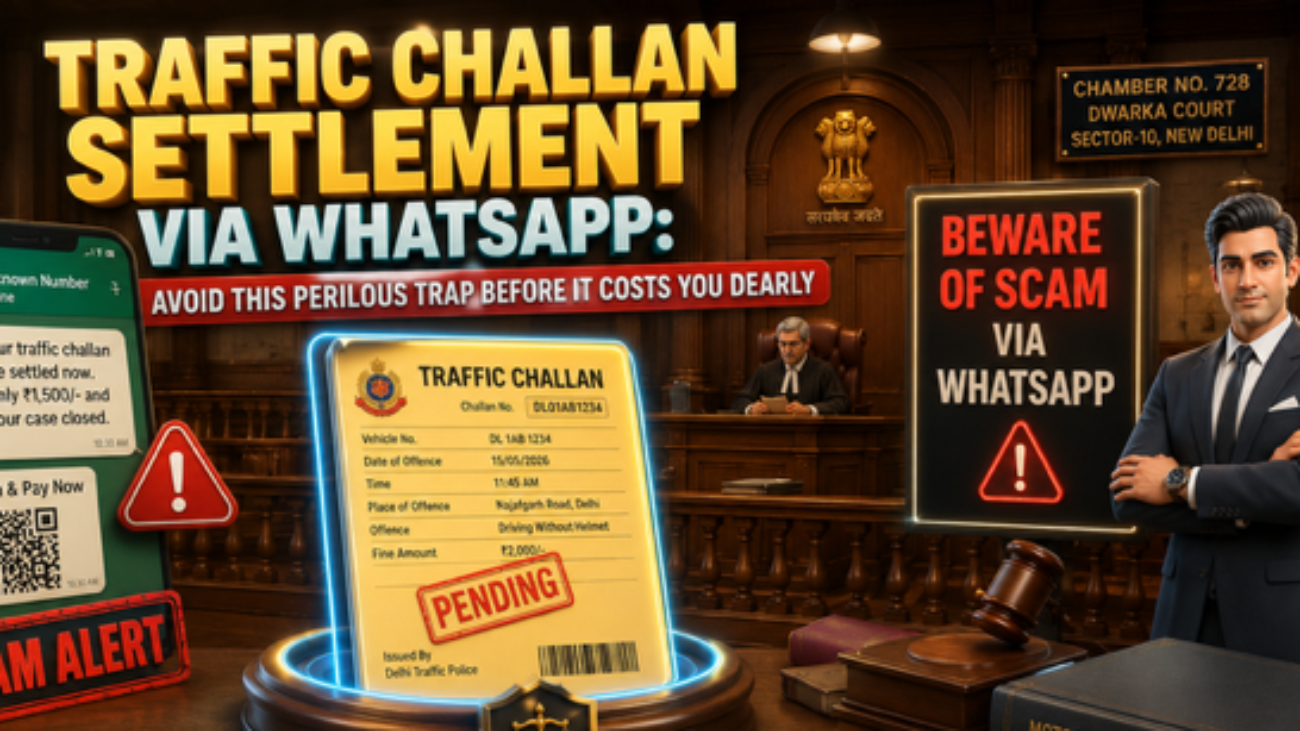
Advocate assisting clients in Cyber Cell Dwarka bail matters before Dwarka Court New Delhi.

Cyber Cell Dwarka: The Ultimate Blueprint to Get Bail at the Earliest Stage ⭐

Introduction – Cyber Cell Dwarka

Cyber crime investigations have increased significantly in recent years. Consequently, more individuals receive notices, summons, or even face arrest in cyber-related matters. If you or your family member has received communication from Cyber Cell Dwarka, understanding your legal rights and taking timely legal advice can make a substantial difference.

Whether the allegation relates to online fraud, financial scams, identity theft, social media offences, cryptocurrency transactions, phishing, cyber extortion, or digital evidence, obtaining proper legal guidance at the earliest stage is essential.

At Ankit Gaurav Kainth & Associates, we have 18+ years of litigation experience before Dwarka Court, New Delhi. We regularly assist clients at both the pre-litigation stage and throughout the litigation process. Our familiarity with the procedures of Cyber Cell Dwarka, the local investigation process, and the functioning of Dwarka Courtenables us to provide timely legal assistance while safeguarding our clients’ legal rights.


⚖️ Understanding Cyber Cell Dwarka

Cyber Cell Dwarka investigates offences involving computers, mobile phones, internet platforms, banking fraud, UPI fraud, fake websites, phishing, identity theft, cryptocurrency scams, hacking, cyber stalking, online cheating, and various offences under the Information Technology Act and the Bharatiya Nyaya Sanhita (where applicable).

An investigation by Cyber Cell Dwarka does not automatically establish guilt. Every person has constitutional and statutory rights, including the right to legal representation and, where applicable, the right to seek regular or anticipatory bail.


📋 Common Matters Investigated by Cyber Cell Dwarka

Type of MatterExamples
Online Financial FraudUPI Fraud, Net Banking Fraud, Credit Card Fraud
Cryptocurrency IssuesCrypto Transactions, Wallet Investigations
Social Media CasesFake Profiles, Cyber Bullying, Defamation
Business DisputesEmail Fraud, Data Theft
Identity TheftFake KYC, Aadhaar Misuse
Online CheatingE-commerce Fraud, Investment Scams
Cyber ExtortionBlackmail, Sextortion
Digital EvidenceMobile Phones, Laptops, Cloud Data

✅ Pre-Litigation Assistance – Why Early Legal Advice Matters

Many people wait until an FIR is registered. However, legal assistance should begin much earlier.

Our firm assists clients before litigation by:

  • ⚖️ Analysing notices received from Cyber Cell Dwarka
  • ⚖️ Preparing appropriate legal responses
  • ⚖️ Advising clients before appearing before the Investigating Officer
  • ⚖️ Protecting constitutional and procedural rights
  • ⚖️ Reviewing documents and electronic records
  • ⚖️ Guiding clients regarding digital evidence preservation
  • ⚖️ Assisting during questioning in accordance with law
  • ⚖️ Evaluating whether anticipatory bail may be appropriate depending upon the facts of the case

Early legal advice often helps clients understand the investigation process and avoid procedural mistakes.


⚖️ Litigation Support During Court Proceedings

If proceedings reach the Court, our representation continues at every stage.

We regularly assist clients with:

  • ✅ Regular Bail Applications
  • ✅ Anticipatory Bail Applications
  • ✅ Interim Protection Applications
  • ✅ Reply to Charge Sheets
  • ✅ Bail Conditions Compliance
  • ✅ Criminal Trial Representation
  • ✅ Revision Petitions
  • ✅ Sessions Court Proceedings
  • ✅ High Court Matters through appropriate legal process

Every case requires an independent assessment based upon its own facts, documents and applicable law.


📍 Why Local Representation Before Dwarka Court Matters

Choosing a local Advocate in Dwarka Court offers several practical advantages.

Our office is located near Dwarka Court, enabling prompt filing, efficient coordination, and familiarity with local procedures.

Our experience includes matters arising from:

  • Cyber Cell Dwarka Sector-16
  • Dwarka Sector 6
  • Dwarka Sector 10
  • Dwarka Sector 12
  • Dwarka Sector-23
  • Dwarka North
  • Dwarka South
  • Janakpuri
  • Vikaspuri
  • Uttam Nagar
  • Najafgarh
  • Bindapur
  • Palam Village
  • Dabri
  • Chhawla
  • Delhi Cantonment
  • Kapashera
  • Samalka
  • Mohan Garden
  • Baba Haridas Nagar
  • Jaffarpur Kalan
  • Nearby areas under the jurisdiction of Dwarka Court

Because we regularly appear before Dwarka Court, we understand filing procedures, documentation requirements, listing practices, and day-to-day court functioning. This familiarity assists us in providing efficient legal representation while maintaining professional standards.


📊 Pre-Litigation vs Litigation Assistance

Pre-Litigation StageLitigation Stage
Legal ConsultationCourt Representation
Notice ReviewBail Applications
Strategy PlanningCriminal Trial
Response DraftingCourt Hearings
Evidence ReviewFiling Applications
Rights ProtectionLegal Arguments
Interaction GuidanceCompliance with Court Directions

🤝 Why Clients Choose Our Law Firm

Professional legal representation is built upon trust.

Our firm focuses on:

✅ 18+ Years of Experience before Dwarka Court

✅ High Professional Standards

✅ Honest Legal Advice

✅ Transparent Fee Structure

✅ Proper Lawyer-Client Fee Agreements

✅ Fee Receipts and Written Acknowledgements

✅ Dedicated WhatsApp Support

✅ Quick Response to Client Queries

✅ Availability on Call

✅ Ethical and Transparent Dealings

Our objective is to keep every client informed throughout the legal process while maintaining confidentiality and professionalism.


⚖️ Practice Areas

Besides matters relating to Cyber Cell Dwarka, our firm also handles:

  • Criminal Advocate Dwarka
  • Advocate in Dwarka Court
  • Regular Bail & Anticipatory Bail Lawyer Dwarka
  • Civil Litigation Lawyer in Delhi
  • Property Dispute Advocate
  • Recovery Suit Counsel
  • Commercial Litigation Lawyer
  • Lawyer in South West Delhi
  • Cheque Bounce Lawyer in Dwarka Court
  • Matrimonial Litigation
  • Property Litigation
  • Civil Recovery Matters

Important Legal Tips

📌 Do not ignore notices issued by investigating agencies.

📌 Avoid deleting digital evidence.

📌 Do not submit statements without understanding their legal implications.

📌 Preserve mobile phones, emails and transaction records.

📌 Consult an experienced advocate at the earliest opportunity.

📌 Every cyber investigation follows its own facts and evidence.


Conclusion

Legal issues involving Cyber Cell Dwarka require timely advice, careful preparation and a clear understanding of legal procedure. Whether the matter is at the investigation stage or before the Court, every decision should be taken after obtaining professional legal advice suited to the specific facts of the case.

An experienced Advocate in Dwarka Court can assist in explaining the legal process, protecting procedural rights, preparing appropriate applications and representing clients throughout the proceedings. Early legal guidance often helps individuals understand their options and navigate the legal process more effectively.

📞 Contact Us

Ankit Gaurav Kainth & Associates

⚖️ Advocate in Dwarka Court, New Delhi

📱 Mobile: 9899085554

📱 Mobile: 9811885554

If you require legal assistance regarding Cyber Cell Dwarka, criminal litigation, regular bail, anticipatory bail, cheque bounce matters, civil disputes, commercial litigation, or property disputes, you may seek professional legal advice based on the specific facts of your case.


Frequently Asked Questions (FAQs)

1. Can I obtain anticipatory bail before joining an investigation by Cyber Cell Dwarka?

Depending on the facts, allegations, and applicable law, anticipatory bail may be available. Legal advice should be obtained before taking any step.

2. Does receiving a notice from Cyber Cell Dwarka mean I will be arrested?

Not necessarily. A notice is part of the investigation process. Every case depends on its own facts and legal requirements.

3. Why should I engage a local Advocate in Dwarka Court?

A local advocate is familiar with court procedures, filing requirements, and the functioning of Dwarka Court, which can facilitate efficient legal representation.

4. Can electronic records be used as evidence?

Yes. Subject to applicable legal provisions, electronic records may form part of the evidence in cyber crime investigations and court proceedings.

5. Does your firm assist before an FIR is registered?

Yes. We provide legal consultation, notice review, strategy advice, and assistance during the pre-litigation stage as well as representation during court proceedings.


Cyber Cell Dwarka:The Ultimate Blueprint to Get Bail at the Earliest Stage ⭐
🚨 Received a Notice Under Section 35(3) BNSS from Cyber Cell Dwarka?The Ultimate Playbook to Protect Your Rights
Expedited Relief: How to Secure Anticipatory Bail Swiftly in Cyber Fraud Cases at Dwarka Court
Cyber Crime InvestigationCan Police Freeze Your Bank Account in Cyber Crime Investigation?
🚨 Is your bank account frozen by Cyber Police?How to Release the Amount Freeze by Cyber Police from Dwarka Court?💰👮🚨
Criminal Defense LawyerCriminal Defense Lawyer in Dwarka, Delhi
Consult TodayCriminal Case Advocate Dwarka Court
Bail Lawyer in Dwarka CourtProfessional Bail Lawyer in Dwarka Court
Bail in 420 IPC / Fraud CasesLocal Criminal Case Bail Advocate Dwarka Court