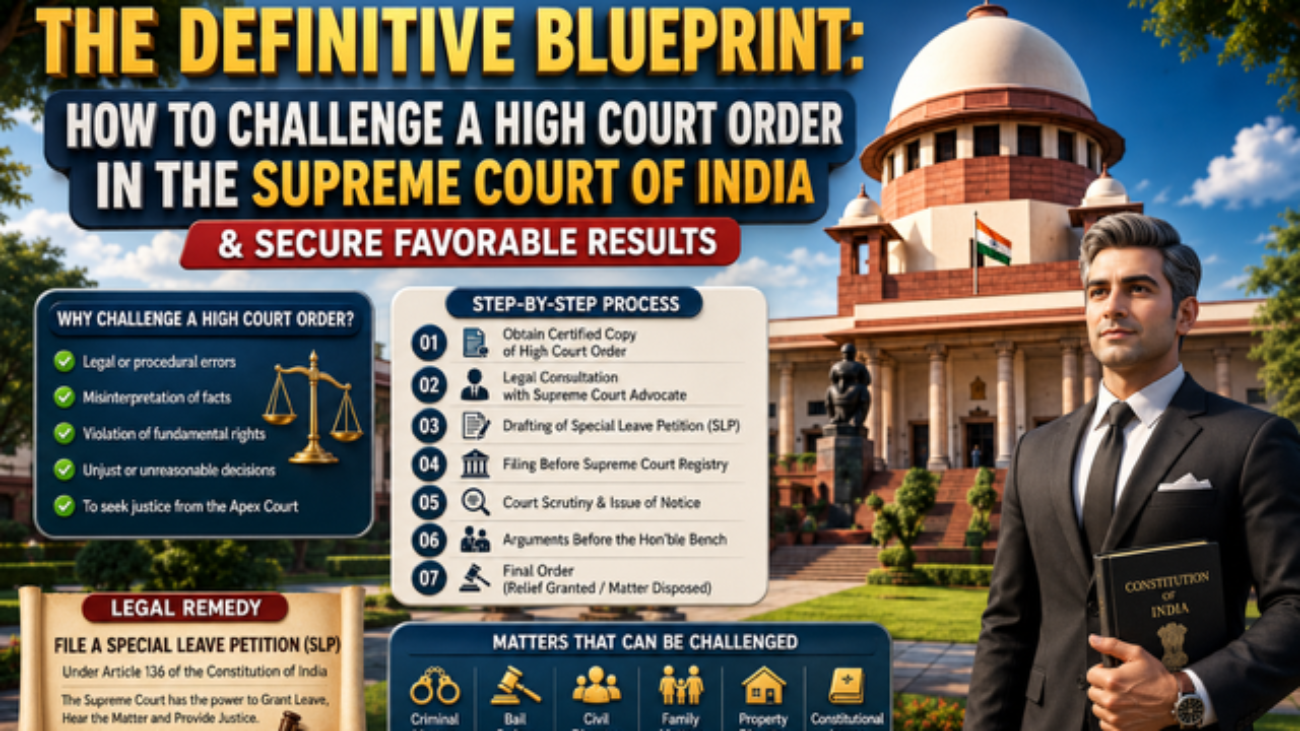
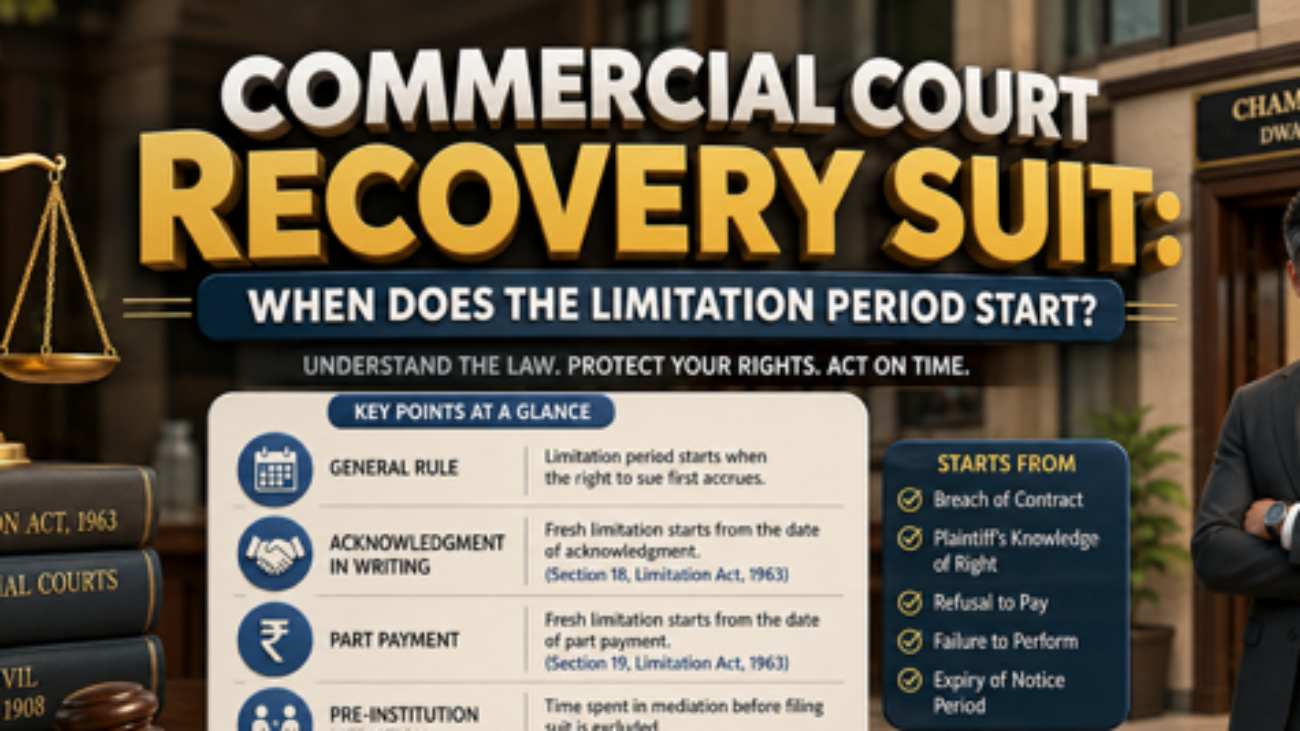

Commercial Court Recovery Suit limitation period explained by Advocate in Dwarka Court Delhi

Commercial Court Recovery Suit: When Does the Limitation Period Start?

Introduction: Commercial Court Recovery Suit – Why Limitation Matters in Money Recovery ⚖️

If a business, company, firm or individual has to recover money under a commercial transaction, one of the first legal questions is simple: when does the limitation period start? A Commercial Court Recovery Suit is not only about proving that money is due. It is also about filing the claim within the period allowed by law.

In many ordinary money recovery claims, the limitation period is three years, but the exact starting point depends on the nature of the transaction, the agreed payment date, the cause of action, and the documents available. Therefore, a person should not assume that every money claim automatically gets three years from the date of the invoice or agreement.

The Limitation Act, 1963 contains different limitation rules for different causes of action. In addition, a written acknowledgment of liability made before expiry of limitation can result in a fresh period of limitation under Section 18. A qualifying part-payment can also have an effect under Section 19.

This article explains the issue in a practical way for businesses and clients considering a Commercial Court Recovery Suit in Delhi and other parts of India.


What Is the Limitation Period for a Commercial Recovery Suit?

For many suits seeking recovery of money based on contracts, accounts or similar obligations, the applicable limitation is commonly three years. However, the date from which those three years are counted is critical.

The starting date may depend on when the money became legally due, when payment was refused, when a stipulated period expired, or another event specified by the applicable Article of the Limitation Act. Therefore, limitation must be examined from the documents and facts of each case.

A Commercial Court Recovery Suit filed after limitation may face a serious legal objection. Thus, early legal review is important even when the client believes that the debt is clear.


When Does the Limitation Period Start? 🔎Commercial Court Recovery Suit

The key principle is that limitation normally runs from the date prescribed by the relevant provision of the Limitation Act. In a contractual money claim, this often means the date on which the amount became due and payable.

For example, if a written contract says that payment must be made within 30 days of delivery, the limitation analysis may begin with the date on which the contractual right to demand payment arose. If the contract contains several invoices or instalments, each amount may require separate examination.

Moreover, a demand notice does not automatically create a new limitation period. The legal effect of a notice depends on the underlying cause of action and the applicable law.

Quick Table: Understanding Limitation in Money Recovery

SituationWhat to examinePossible limitation effect
Fixed payment date in contractDate the amount became dueUsually counted from the legally relevant due date
Invoice-based transactionInvoice terms, delivery and agreed credit periodExamine when payment became due
Written acknowledgment of liabilityDate and contents of signed acknowledgmentSection 18 can provide a fresh period if its requirements are met
Part-payment of debtDate and proof of qualifying paymentSection 19 can provide a fresh period if statutory requirements are met
Multiple instalmentsDue date of each instalment and contract termsLimitation may need separate analysis for each instalment
Demand made after defaultOriginal cause of action and contractual termsDemand letter alone does not necessarily restart limitation
Commercial pre-institution mediationDate of application and mediation periodThe statutory mediation period is not counted for limitation under Section 12A, subject to the Act
Fraud or concealed factsDate of discovery and Section 17 requirementsLimitation may be affected where statutory conditions are satisfied

Section 18 of the Limitation Act states that, where a qualifying acknowledgment is made in writing and signed before expiry of the prescribed period, a fresh period is computed from the time of signing. Section 19 addresses qualifying payments made before expiry of the prescribed period.

Example 1: Fixed Due Date Under a Business Contract

Suppose Company A supplies goods to Company B under a written contract. The contract states that the invoice amount must be paid within 30 days of delivery. The goods are delivered on 1 January 2026, and payment becomes due on 31 January 2026.

If Company B does not pay, the limitation analysis would ordinarily focus on when the debt became legally due under the contract and the applicable provision of the Limitation Act. Company A should therefore obtain legal advice promptly rather than waiting until the end of the three-year period.

If Company B later signs a written acknowledgment of the outstanding liability before limitation expires, Section 18 may become relevant and a fresh limitation period may run from the date of that acknowledgment, provided the statutory requirements are satisfied.

Example 2: Part-Payment and Written Acknowledgment

Assume a business is owed ₹15 lakh under a commercial transaction. The debtor pays ₹2 lakh before the original limitation period expires and the payment is properly documented. Later, the debtor also signs a written statement acknowledging the outstanding balance.

The legal effect of the payment and acknowledgment must be examined separately under Sections 18 and 19 of the Limitation Act. They may affect the calculation of limitation if the statutory conditions are satisfied. Therefore, bank statements, receipts, emails, letters and signed balance confirmations can become important evidence.

The lesson is clear: do not calculate limitation from memory alone. Check the complete documentary history.


Does a Legal Notice Restart Limitation?

This is a common question in a Commercial Court Recovery Suit. A legal notice can be valuable because it records the demand, sets out the claim and may support later proceedings. However, sending a notice does not, by itself, automatically extend or restart the limitation period.

Therefore, a client should not wait for the notice period to expire without checking the limitation position. The legal notice should form part of a wider litigation strategy, not be treated as a substitute for timely filing.


What About Pre-Institution Mediation in Commercial Cases?

Section 12A of the Commercial Courts Act, 2015 provides for pre-institution mediation for commercial suits that do not contemplate urgent interim relief. The statutory framework also provides that the period during which the parties remain occupied with pre-institution mediation is not computed for limitation, subject to the requirements of the Act.

This is important because mediation should not be treated as a reason to ignore limitation. Instead, the limitation position should be calculated before commencing the process, with the statutory exclusion properly considered.


Why Pre-Litigation Legal Assistance Matters 📝

Before filing a Commercial Court Recovery Suit, we assist clients at the pre-litigation stage. This stage can make a major difference to the quality and clarity of the eventual case.

Our work may include reviewing contracts, invoices, purchase orders, account statements, emails, delivery records, acknowledgments, payment records and correspondence. We also examine the cause of action, limitation, jurisdiction, specified value and available remedies.

Where appropriate, we help clients assess whether a legal notice, settlement discussion or pre-institution mediation should be pursued. The objective is to identify the legal position early and avoid preventable procedural problems.

For overseas businesses and clients located outside Delhi, this preliminary review can be especially useful. Documents can be examined remotely, while the litigation strategy can be planned for proceedings in Delhi where jurisdiction is legally available.


Assistance During the Litigation Stage ⚖️

Once proceedings begin, a Commercial Court Recovery Suit requires careful handling at every stage. We assist with pleadings, filing, documents, interim applications, written statements, evidence, cross-examination, arguments and other procedural requirements, depending on the nature of the case.

As a Commercial Court Advocate Delhi, our focus is not limited to filing the plaint. We also examine the defendant’s defence, documentary evidence and procedural objections, including limitation, jurisdiction and maintainability.

Our experience also covers connected civil and commercial matters. Depending on the dispute, clients may require a Civil Litigation Lawyer in Delhi, Property Dispute Advocate, Commercial Litigation Lawyer, or Commercial Disputes Advocate Dwarka Court.


Why a Local Advocate in Dwarka Court Can Help 🚀

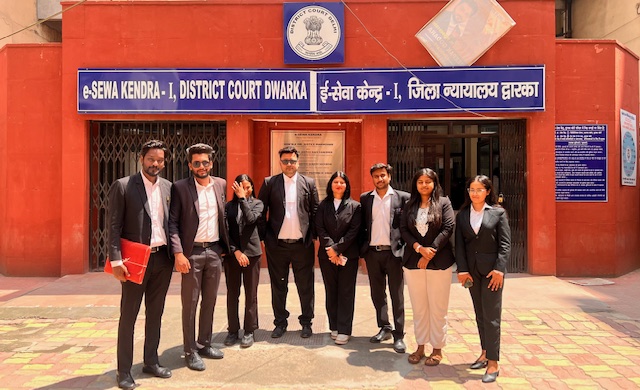
We are local advocates practising at Dwarka Court, New Delhi, including the Lawyers’ Chambers area. With more than 18 years of experience in litigation in Delhi, we have practical familiarity with filing processes, court procedures, listing systems and the working environment of the local court.

This local presence can help us coordinate filing and representation efficiently. For clients who need a Commercial Court Lawyer in Dwarka Court, local court familiarity can also make communication with the office, filing teams and court processes more practical.

Our practice is relevant to clients from Dwarka Sector 6, Sector 10, Sector 12 and Sector 23, as well as people and businesses from Janakpuri, Vikaspuri, Dwarka North, Dwarka South, Delhi Cantonment, Chhawla, Bindapur, Baba Haridas Nagar, Mohan Garden, Palam Village, Najafgarh, Uttam Nagar, Samalka, Dabri, Jaffarpur Kalan and Kapashera, and other areas near Dwarka Court.

Serving Clients Across India and Internationally 🌍

A commercial dispute may involve parties located in different cities or countries. A client may have a business in Delhi while its directors, shareholders or commercial partners live abroad.

We assist clients who need to pursue or defend commercial litigation in Delhi, subject to jurisdiction and applicable law. International clients may include individuals and businesses connected with the United States, United Kingdom, Canada, Australia, United Arab Emirates, Singapore, Germany, France and New Zealand.

For such matters, a Recover of Money Commercial Court Lawyer Dwarka can help coordinate the Indian litigation side, document review and communication with the client. Where foreign law, evidence or enforcement issues arise, appropriate specialist advice may also be required.


Client Trust: Professional, Transparent and Responsive Service ✅

Legal representation involves trust. Therefore, we follow a professional and transparent approach in client dealings.

Our client-service approach includes:

  • ⚖️ High professional standards in legal drafting, preparation and representation.
  • 📞 Quick responsiveness for important case-related communication.
  • 📱 Availability on call for practical updates and coordination.
  • 💬 Dedicated WhatsApp support for client communication and case updates.
  • 💰 Reasonable and transparent fee structure explained in advance.
  • 📝 Proper Lawyer-Client Fee Agreements recording the agreed professional terms.
  • 🧾 Fee receipts and acknowledgements for transparent financial records.
  • 🤝 Honest, fair and transparent dealings throughout the professional relationship.

These practices are intended to make the legal process easier to understand and more organised for clients.

What Documents Should You Keep Ready?

Before consulting a Recovery Suit Commercial Court Counsel, keep the key documents together. These may include:

  1. Agreement, contract or purchase order.
  2. Invoices and tax documents.
  3. Delivery challans or proof of performance.
  4. Bank statements and payment records.
  5. Ledger or statement of account.
  6. Emails, WhatsApp messages and business correspondence.
  7. Written acknowledgments of liability.
  8. Records of part-payments.
  9. Legal notices and replies.
  10. Documents showing jurisdiction and the commercial relationship.

Most importantly, arrange these documents by date. A clear chronology often makes the limitation analysis much easier.


Common Mistakes That Can Affect a Recovery Claim ⚠️

1. Waiting too long

A client may spend months negotiating without checking limitation. Negotiations do not automatically stop the clock.

2. Assuming every claim has the same limitation period

Different legal claims can have different limitation rules. The exact Article must be identified from the facts.

3. Treating a demand notice as an extension

A legal notice can support the case, but it does not automatically create a fresh limitation period.

4. Ignoring acknowledgments and payments

Signed acknowledgments and qualifying payments may materially affect limitation. Therefore, preserve all such records.

5. Filing without checking commercial procedure

A commercial dispute may involve specified-value requirements, pre-institution mediation and other procedural rules. The Commercial Courts Act contains a dedicated framework for commercial disputes and pre-institution mediation.


Why Early Legal Review Is Important

The limitation question should ideally be examined before filing a Commercial Court Recovery Suit. Early review allows the lawyer to identify the correct cause of action, calculate the relevant dates, check contractual terms, preserve evidence and consider pre-litigation options.

It also helps clients avoid a common problem: discovering a limitation issue only after substantial time and money have already been spent.


Frequently Asked Questions

1. What is the usual limitation period for a Commercial Court Recovery Suit?

For many money recovery claims, the limitation period is three years. However, the exact period and starting point depend on the nature of the claim and the applicable provision of the Limitation Act.

2. When does limitation start in a money recovery case?

It generally starts from the date prescribed by the applicable limitation provision. In contractual claims, the relevant date is often connected with when the amount became due. The agreement and transaction documents must be examined carefully.

3. Can a written acknowledgment extend limitation?

Yes, a qualifying written acknowledgment made and signed before expiry of the prescribed period can lead to a fresh period under Section 18 of the Limitation Act.

4. Does pre-institution mediation affect limitation?

For applicable commercial suits under Section 12A, the statutory period during which the parties remain occupied with pre-institution mediation is not counted for limitation, subject to the Act.

5. Can I file a commercial recovery case from outside Delhi?

Potentially, yes, where Delhi has legally valid territorial and subject-matter jurisdiction. A jurisdiction analysis should be completed before filing. Clients located elsewhere in India or abroad can obtain legal assistance remotely, subject to the facts and applicable law.


Conclusion

Limitation is one of the most important issues in a Commercial Court Recovery Suit. The key is not simply to remember the phrase “three years.” Instead, the correct starting date, applicable limitation provision, contractual terms, acknowledgments, payments and statutory exclusions must be examined together.

Therefore, if money remains unpaid under a commercial transaction, obtain legal advice at the earliest stage. A timely review can help identify the cause of action, preserve evidence and plan the appropriate pre-litigation or litigation strategy.

If you are looking for a Commercial Court Advocate Delhi, Commercial Court Lawyer in Dwarka Court, Commercial Disputes Advocate Dwarka Court, or Advocate in Dwarka Court, professional advice should be based on the documents and facts of your particular dispute.


📞 Legal Consultation & Assistance – Commercial Court Recovery Suit

If you are considering a Commercial Court Recovery Suit for recovery of money from a company, firm, business partner, customer or other commercial party, you may contact us for a preliminary discussion regarding your legal position, documents, limitation and available procedural options.

Mobile: 9899085554 | 9811885554

Ankit Gaurav Kainth & Associates
Advocate in Dwarka Court, New Delhi
Chamber No. 728, Lawyers’ Chambers Block, District Court Dwarka, Sector-10, New Delhi


⚠️ Legal Disclaimer

This article is intended for general legal information and educational purposes. Limitation depends on the facts, documents, cause of action and applicable statutory provisions. It should not be treated as a substitute for case-specific legal advice. The information stated above should be verified against the law applicable to the particular dispute before taking legal action.

✍️ Author – Commercial Court Recovery Suit

This article is written by Ankit Gaurav Kainth, Advocate, based on 18+ years of litigation experience in Delhi, including practice at Dwarka Court.

Important TopicsText
Commercial Court practice pageCommercial Court Lawyer in Dwarka Court
Commercial Court Recovery Suit:When Does the Limitation Period Start?
Commercial Lease Dispute DwarkaPowerful Ground Every Client Should Know
Written Statement 120 Days in Commercial Court Recovery SuitImportant Law
Commercial Money Recovery Suit in DelhiA Complete Guide for International Clients & Foreign Companies
The Unassailable Blueprint to Lead Defence Evidence Like a Professional in Commercial Court CasesAdvanced Litigation Strategies Every Lawyer Should Master
Commercial Court Is FastBut Only If Your Lawyer Does This in Delhi Court
Why Businesses Lose Strong Commercial Cases Despite Having Agreements?Experienced Commercial Court Advocate Dwarka Delhi
Powerful Commercial Court Recovery CaseAcquittal Strategies for Fearless Defence
What Happens After Receiving a Legal Noticein a Commercial Matter?
How to Read an FIR with a professional advocate in Dwarka Court Delhi

How to Read an FIR Like a Professional Advocate: A Powerful & Fearless Guide to Uncovering Hidden Clues in Dwarka Court, Delhi

⚖️ Introduction: How to Read an FIR/ Why Reading an FIR Correctly Matters

An FIR is often the first major document in a criminal case. It records the information given to the police about an alleged offence. However, an FIR is not the final proof of guilt. It is a starting point for investigation and legal action.

Therefore, how to read an FIR is an important legal skill. A professional advocate does not read it only once. Instead, the advocate studies its facts, dates, allegations, sections, witnesses, documents and omissions.

A careful reading can reveal:

  • Important factual inconsistencies.
  • Delay in reporting the incident.
  • Unclear or general allegations.
  • Missing facts about the alleged offence.
  • Contradictions between different parts of the FIR.
  • Questions about the ingredients of the alleged offences.
  • Issues relevant to bail, investigation or further legal remedies.

For a person facing criminal proceedings, this analysis can be extremely important.


🔍 How to Read an FIR Like a Professional Advocate

The first principle is simple: do not read an FIR emotionally. Read it legally.

A complainant may use strong words. The FIR may contain serious allegations. However, the advocate must separate allegations from legally relevant facts.

When considering how to read an FIR, a professional advocate normally asks:

Who? What? When? Where? How? Why? What evidence? What offence?

These questions help convert a long narrative into a structured legal analysis.

1. Check the Basic Details

Start with the basic information:

  • FIR number.
  • Police Station.
  • Date of registration.
  • Date and time of occurrence.
  • Sections invoked.
  • Name of complainant.
  • Names of accused persons.
  • Place of alleged occurrence.
  • Investigating Officer, where available.

These details create the basic framework of the case.

For example, if the FIR mentions an incident on a particular date but registration took place after a significant delay, the reason for that delay may require examination.

However, delay alone does not automatically make an FIR false or legally invalid. The circumstances and explanation for the delay must be considered.

2. Identify the Exact Allegation Against Each Person

A professional advocate does not treat every accused person in the same manner.

Instead, ask:

What exactly has been alleged against each accused?

This is especially important where several family members, directors, partners, employees or associates have been named.

Look for specific acts attributed to each person.

An FIR may contain a general allegation against several persons. Therefore, the advocate should examine whether the FIR actually describes the individual role attributed to each accused.

This approach is useful while considering appropriate legal remedies, including bail or other proceedings, depending upon the facts and applicable law.

3. Match the Allegations With the Ingredients of the Offence/How to Read an FIR

This is one of the most important steps in understanding how to read an FIR.

Every criminal offence has legal ingredients. The allegations should therefore be compared with those ingredients.

For example, merely using the word “cheating” does not by itself establish the offence of cheating. The factual allegations must be examined against the legal requirements of the offence.

Similarly, in cases involving alleged criminal breach of trust, intimidation, assault, forgery, misappropriation or other offences, the advocate should identify the facts supporting each required ingredient.

A Simple FIR Reading Table

FIR PointWhat an Advocate ChecksWhy It Matters
Date of incidentExact date and timelineTests chronology
FIR registrationDate and timeHelps examine delay
AccusedIndividual rolePrevents assumptions
AllegationSpecific act attributedIdentifies actual case
Offence sectionsLegal ingredientsTests applicability
WitnessesNames and roleAssesses supporting material
DocumentsNature and relevanceIdentifies evidence
Place of occurrenceJurisdiction and factsChecks territorial issues
Medical evidenceInjury and timingCorrelates allegations
Prior disputeEarlier relationship or conflictProvides background
ContradictionsDifferences within recordHelps legal analysis
OmissionsImportant facts missingMay require explanation
Investigation statusStage of investigationGuides next legal step

4. Study the Timeline Carefully

A strong criminal defence often begins with chronology.

When learning how to read an FIR, prepare a simple timeline:

Alleged incident → communication → complaint → FIR → investigation → notice/arrest → recovery → chargesheet

Then compare every date.

For instance, examine whether the FIR was lodged immediately or after a substantial interval. Check whether the complainant refers to earlier complaints, calls, messages or meetings.

Moreover, compare the FIR with other available material.

A timeline does not prove a case by itself. However, it can expose questions that require further investigation or legal consideration.

5. Look for Omissions, Improvements and Contradictions/ How to Read an FIR

One of the most useful aspects of how to read an FIR is learning to distinguish between an omission and a contradiction.

An omission occurs when an important fact is absent from an earlier version but appears later.

A contradiction occurs when two versions contain materially different facts.

Therefore, the FIR should not be examined in isolation. Where legally permissible and available, an advocate may compare it with:

  • Complaint.
  • Statements.
  • Medical records.
  • Messages.
  • Emails.
  • Agreements.
  • Bank records.
  • CCTV footage.
  • Call records.
  • Other documentary material.

The significance of any inconsistency depends upon the facts, stage of proceedings and applicable law.

6. Examine the FIR From a Bail Perspective

For an accused person, FIR analysis can be particularly important before seeking legal relief.

A Regular Bail & Anticipatory Bail Lawyer Dwarka will generally examine factors such as:

  • Nature of allegations.
  • Punishment prescribed for the alleged offence.
  • Specific role attributed to the accused.
  • Need for custodial interrogation.
  • Possibility of tampering with evidence.
  • Possibility of influencing witnesses.
  • Previous criminal history, where relevant.
  • Cooperation with investigation.
  • Recovery requirements.
  • Stage of investigation.

The precise legal strategy depends on the facts and the applicable provisions.

Therefore, an FIR should never be assessed only by looking at the number of sections mentioned in it.

7. Do Not Assume That More Sections Mean a Stronger Case

Sometimes several penal sections appear in an FIR.

That can look alarming to an accused person. However, the number of sections does not, by itself, determine the strength of the prosecution case.

A Criminal Advocate Dwarka should examine whether the factual allegations actually correspond to the ingredients of each invoked offence.

This is why professional legal analysis is different from simply reading an FIR.

8. Examine the Background of the Dispute

The surrounding circumstances can be highly relevant.

For example, a criminal complaint may arise from:

  • Business disagreements.
  • Property disputes.
  • Matrimonial conflict.
  • Financial transactions.
  • Employment disputes.
  • Partnership disagreements.
  • Contractual disputes.
  • Family disagreements.

However, the existence of a civil or commercial dispute does not automatically make a criminal case invalid.

A professional advocate therefore studies the complete factual background instead of reaching a conclusion from the FIR alone.

This approach is also useful when advising clients who are dealing with overlapping civil and criminal proceedings.


FIR Analysis in Financial and Cheque Bounce Disputes

Not every financial dispute is identical.

A Cheque Bounce Lawyer in Dwarka Court may need to examine the underlying transaction, documents, payment history, notices, bank records and the nature of the allegations.

Likewise, where a financial disagreement develops into multiple proceedings, the advocate should map the entire dispute.

The same principle applies to property and commercial matters.

A Property Dispute Advocate, Recovery Suit Counsel or Commercial Litigation Lawyer may need to study the criminal allegations alongside agreements, receipts, correspondence and other documents.


Why Local Legal Experience in Dwarka Court Matters

Local court experience can make the legal process more efficient.

We are local Advocates in Dwarka Court, Delhi, with 18+ years of professional experience in Dwarka Court.

Our familiarity with local court procedures, filing practices, listing processes, documentation requirements and day-to-day working systems helps us respond promptly to litigation requirements.

This local experience is particularly useful when a matter requires urgent filing, appearance, procedural follow-up or coordination.

We assist clients at both stages:

🔹 Pre-Litigation Stage

Before litigation begins, we help clients understand their legal position and available options.

Depending on the matter, assistance may include:

  • Reviewing documents.
  • Examining notices and complaints.
  • Analysing potential criminal exposure.
  • Preparing legal replies.
  • Advising on evidence preservation.
  • Assessing settlement or negotiation options.
  • Planning appropriate legal proceedings.
  • Identifying procedural risks.

Early legal advice can help a client make an informed decision before a dispute becomes more complicated.

🔹 Litigation Stage

Once proceedings begin, legal assistance may include:

  • Bail proceedings.
  • Anticipatory bail matters.
  • Criminal complaints.
  • Trial proceedings.
  • Evidence and cross-examination.
  • Applications before the court.
  • Procedural objections.
  • Civil and commercial proceedings connected with the dispute.
  • Appeals, revisions or other appropriate remedies.

A Criminal Disputes Advocate Dwarka Court must therefore look beyond the FIR and understand the complete litigation strategy.


📍 Serving Clients Across Dwarka and South-West Delhi

Our practice is focused on clients appearing before or dealing with matters connected with Dwarka Court and nearby areas.

Clients may approach us from:

Dwarka Sector 6, Sector 10, Sector 12, Dwarka Sector-23, Dwarka North, Dwarka South, Janakpuri, Vikaspuri, Uttam Nagar, Najafgarh, Palam Village, Dabri, Bindapur, Mohan Garden, Delhi Cantonment, Chhawla, Baba Haridas Nagar, Samalka, Jaffarpur Kalan, Kapashera and other nearby areas.

If you are searching for a Lawyer in South West Delhi or an Advocate in Dwarka Court near Dwarka Court, local professional assistance can help you understand the procedure and practical steps involved.


🤝 Building Client Trust Through Professional Standards

Legal representation requires more than legal knowledge. It also requires trust, communication and professional discipline.

We focus on:

✅ High professional standards
✅ Quick responsiveness
✅ Availability on call, subject to professional commitments
✅ Dedicated WhatsApp support for case-related communication
✅ Reasonable and transparent fee structure
✅ Proper Lawyer-Client Fee Agreements
✅ Fee receipts and acknowledgements
✅ Honest and fair dealings
✅ Clear communication about the legal process

A written fee arrangement helps both sides understand the professional engagement, scope of work and applicable charges.

Likewise, fee receipts and acknowledgements promote transparency and proper record keeping.


📞 What Should You Do After Receiving an FIR?

If you or someone close to you has received information about an FIR, do not panic.

First, obtain a copy of the FIR and related documents where legally available.

Next, avoid making statements or taking legal steps without understanding the situation.

Then prepare all relevant documents and communicate the complete facts to your advocate.

Finally, obtain advice on the appropriate legal remedy based on the actual allegations and procedural stage.

The objective is not simply to find a “loophole.” The objective is to understand the case accurately and respond according to law.


Five Questions Every Accused Person Should Ask

Before taking the next legal step, ask:

  1. What exactly is alleged against me?
  2. Which legal ingredients are being relied upon?
  3. What evidence is presently available?
  4. What is the current stage of investigation or proceedings?
  5. What legal remedy is appropriate at this stage?

These questions make how to read an FIR much easier for a person who is unfamiliar with criminal law.


Frequently Asked Questions

1. How to Read an FIR for the first time?

Start with the basic details, then identify the allegations, accused persons, dates, witnesses, documents and invoked offences. Finally, compare the factual allegations with the legal ingredients of the offences.

2. Does an FIR prove that a person is guilty?

No. An FIR contains information regarding an alleged offence and sets the criminal process in motion. Guilt must be determined through the legally applicable process and evidence.

3. Can an advocate identify weaknesses in an FIR?

An advocate can identify factual inconsistencies, omissions, unclear allegations, procedural issues and questions concerning the ingredients of alleged offences. Their legal significance depends on the complete facts and stage of the case.

4. Can I seek bail after an FIR is registered?

Depending on the offence, circumstances and procedural stage, a person may have remedies such as regular bail or anticipatory bail. The appropriate remedy must be assessed on the specific facts.

5. Why choose a local Advocate in Dwarka Court?

A local advocate familiar with Dwarka Court can provide practical assistance based on knowledge of local filing procedures, court processes, listing practices and day-to-day litigation requirements.


📊 Quick Professional FIR Review Checklist

StageKey Question
1️⃣ Basic detailsIs the FIR number, police station and date correct?
2️⃣ TimelineWhat happened, and when?
3️⃣ RoleWhat specific act is attributed to each accused?
4️⃣ SectionsDo the allegations contain the ingredients of the offences?
5️⃣ EvidenceWhat documents or witnesses support the allegation?
6️⃣ ContradictionsAre there material inconsistencies?
7️⃣ DelayIs there a delay, and is there an explanation?
8️⃣ BackgroundWhat is the history of the dispute?
9️⃣ InvestigationWhat stage has the investigation reached?
🔟 RemedyWhat legal step is appropriate now?

Conclusion

Learning how to read an FIR is not merely about understanding legal language. It is about analysing facts, chronology, allegations, evidence and legal ingredients with a disciplined approach.

A professional advocate reads the FIR carefully, verifies the surrounding material and then develops advice based on the actual circumstances.

For persons facing criminal allegations in Dwarka Court, early legal guidance can be valuable. Whether the matter involves bail, a criminal dispute, a financial disagreement, a property issue or connected civil proceedings, the first step is to understand the case clearly.

With 18+ years of experience in Dwarka Court, we assist clients during both the pre-litigation and litigation stages with a focus on professional standards, transparent communication and proper documentation.

📞 Need Legal Assistance in a Criminal Matter?

If you have received an FIR, police notice or complaint connected with Dwarka Court, take timely legal advice and understand your legal position before taking the next step.

Ankit Gaurav Kainth & Associates
Advocates in Dwarka Court, Delhi
📍 Chamber No. 728, 7th Floor, Lawyers Chambers Block, District Court Dwarka, Sector-10, New Delhi

📞 9899085554 | 9811885554

Disclaimer: This article is intended solely for general legal information and educational purposes. It does not constitute legal advice, does not create an advocate-client relationship and should not be treated as a substitute for examination of the facts and documents of an individual case. Legal remedies and procedures may vary according to the facts, applicable law and stage of proceedings.


Advocate explaining Supreme Court Bail Procedure outside the Supreme Court of India

Supreme Court Bail Procedure: The Ultimate Compendium Every Litigant Should Read

INTRODUCTION – Supreme Court Bail Procedure

Getting bail is often the first and most urgent concern for an accused person and their family. However, many people believe that approaching the Supreme Court is the first step for obtaining bail. In reality, the Supreme Court Bail Procedure follows a structured legal process, and understanding that process can save valuable time, effort, and legal expense.

Whether you are seeking regular bail, anticipatory bail, or challenging the rejection of bail by lower courts, knowing the Supreme Court Bail Procedure is essential. This guide explains the process in simple language while highlighting the role of an experienced Advocate in Supreme Court, Criminal Advocate Supreme Court, and Crime Lawyer Supreme Court.


⚖️ What is the Supreme Court Bail Procedure?

The Supreme Court Bail Procedure refers to the legal process through which a person approaches the Supreme Court of India seeking bail or challenging an order refusing bail passed by a High Court or another competent court.

Generally, the Supreme Court entertains bail matters through a Special Leave Petition (SLP) under Article 136 of the Constitution or other appropriate proceedings, depending upon the facts of each case.

Therefore, every case requires careful legal evaluation before approaching the Supreme Court.

📌 When Can You Approach the Supreme Court for Bail?

A person may approach the Supreme Court in situations such as:

  • ✅ Bail rejected by the High Court.
  • ✅ Exceptional circumstances requiring urgent intervention.
  • ✅ Serious violation of constitutional or legal rights.
  • ✅ Matters involving significant questions of law.
  • ✅ Cases where immediate protection is necessary in the interest of justice.

However, every matter depends upon its own facts, applicable law, judicial precedents and the discretion exercised by the Court.


📋 Understanding the Supreme Court Bail Procedure

StageProcessImportant Point
Step 1Consultation with an Advocate in Supreme CourtCase evaluation and legal strategy
Step 2Collection of documentsFIR, charge sheet, impugned orders, evidence and other records
Step 3Drafting of PetitionAccurate drafting is crucial
Step 4Filing before the Supreme Court RegistryRegistry scrutiny takes place
Step 5Removal of defects, if anyProcedural compliance is essential
Step 6Listing before the CourtMatter is assigned before the appropriate Bench
Step 7Hearing by Senior Advocate/Advocate-on-RecordLegal arguments are presented
Step 8Final OrderBail may be granted, refused or directions may be issued

📖 Types of Bail That May Reach the Supreme Court

✅ Regular Bail

Regular bail is sought after arrest. The Supreme Court Bail Procedure may be invoked after exhausting appropriate remedies before subordinate courts and the High Court.

✅ Anticipatory Bail

In suitable circumstances, disputes relating to anticipatory bail may also reach the Supreme Court. An experienced Regular Bail & Anticipatory Bail Lawyer Supreme Court can advise the correct legal remedy.

✅ Interim Protection

The Supreme Court may grant interim relief depending upon the facts and urgency of the matter.


⚖️ Why Proper Legal Strategy Matters

Many bail petitions fail because of:

  • Poor drafting
  • Incomplete documentation
  • Weak legal grounds
  • Incorrect reliance upon precedents
  • Procedural defects

Therefore, preparing a strong legal strategy before filing is extremely important.


🤝 How We Assist Clients Before Litigation

Many legal problems can be managed effectively before court proceedings begin.

Our pre-litigation services include:

  • ✅ Detailed legal consultation
  • ✅ Case evaluation
  • ✅ Examination of FIR and evidence
  • ✅ Preparation of legal notices where appropriate
  • ✅ Documentation review
  • ✅ Legal risk assessment
  • ✅ Settlement and negotiation wherever legally possible
  • ✅ Strategic advice before approaching courts

Early legal guidance often improves the overall outcome.


🏛️ How We Assist During Litigation

Once litigation begins, timely legal action becomes essential.

Our litigation services include:

  • Representation before the Supreme Court
  • Drafting Special Leave Petitions
  • Bail petitions
  • Criminal writ petitions
  • Filing miscellaneous applications
  • Legal research
  • Court appearances
  • Continuous case monitoring
  • Client updates after every hearing

Our experience allows us to handle complex procedural requirements efficiently.


📍 Advantage of Engaging Local Advocates in Supreme Court Delhi

Being local Lawyers in Supreme Court Delhi offers practical advantages.

We regularly work with the Supreme Court filing system and understand:

  • Registry procedures
  • Filing requirements
  • Listing practices
  • Procedural compliances
  • Urgent mentioning procedures
  • Court functioning

This familiarity often enables faster filing, prompt compliance with procedural requirements and efficient representation.

In addition to Supreme Court matters, our team has 18+ years of litigation experience before Dwarka Courts, giving us valuable practical exposure across criminal, civil and commercial disputes.


⚖️ Our Practice Areas

Our legal services include:

  • Criminal Advocate Supreme Court
  • Crime Lawyer Supreme Court
  • Regular Bail & Anticipatory Bail Lawyer Supreme Court
  • Criminal Writ Petition Advocate in Supreme Court
  • Civil Litigation Lawyer in Supreme Court Delhi
  • Property Dispute Advocate for Supreme Court
  • Recovery Suit Counsel for Supreme Court
  • Commercial Litigation Lawyer
  • Lawyer in Supreme Court Delhi
  • Advocate in Supreme Court

Every matter is handled after careful legal analysis and professional preparation.

📍 Areas We Regularly Assist

We assist clients from:

  • New Delhi
  • Supreme Court of India
  • Central Delhi
  • South Delhi
  • Dwarka
  • Janakpuri
  • Vikaspuri
  • Uttam Nagar
  • Najafgarh
  • Rohini
  • Pitampura
  • Punjabi Bagh
  • Karol Bagh
  • Connaught Place
  • Greater Kailash
  • Defence Colony
  • Noida
  • Gurugram
  • Faridabad
  • Ghaziabad
  • Delhi NCR

⭐ Why Clients Trust Us

Professional relationships are built on transparency and integrity.

Our clients appreciate:

⚖️ Honest legal advice

✅ High professional standards

📞 Quick responsiveness

💬 Dedicated WhatsApp support

📲 Easy accessibility on calls

💼 Proper Lawyer-Client Fee Agreements

🧾 Fee receipts and acknowledgements

💰 Reasonable and transparent fee structure

🤝 Fair, ethical and transparent dealings

Every client deserves clear communication and professional representation.


⚠️ Important Points Before Filing a Bail Petition

Always remember:

  • Every case has different facts.
  • Bail is never automatic.
  • Courts consider gravity of allegations.
  • Conduct of the accused is relevant.
  • Previous criminal history may be considered.
  • Proper documentation strengthens the case.
  • Experienced legal representation is beneficial.

📚 Conclusion

The Supreme Court Bail Procedure requires careful preparation, complete documentation and a well-planned legal strategy. Although every case is different, timely legal advice can significantly improve procedural compliance and presentation before the Court.

Whether you require assistance regarding Supreme Court Bail Procedure, criminal litigation, civil disputes or constitutional remedies, choosing an experienced legal team helps you understand your legal rights and available remedies with confidence.


📞 Contact Us

If you require professional legal assistance regarding the Supreme Court Bail Procedure, regular bail, anticipatory bail, criminal writ petitions, civil litigation or commercial disputes before the Supreme Court, feel free to consult us.

Ankit Gaurav Kainth & Associates

📞 9899085554

📞 9811885554

⚖️ Professional Consultation | Transparent Fees | Dedicated WhatsApp Support | Experienced Litigation Team


Frequently Asked Questions

1. Can I directly approach the Supreme Court for bail?

Depending upon the facts and applicable law, the Supreme Court may be approached through appropriate legal proceedings. Professional legal advice should always be obtained.

2. How long does the Supreme Court Bail Procedure take?

The timeline varies depending on urgency, filing compliance, listing and judicial workload.

3. What documents are generally required?

Common documents include the FIR, bail orders, charge sheet (if filed), relevant pleadings and supporting documents. Requirements vary from case to case.

4. Can the Supreme Court grant interim protection?

In appropriate cases, the Court may consider interim relief depending upon the facts and circumstances.

5. Why should I engage an experienced Advocate in Supreme Court?

An experienced advocate understands court procedures, drafting requirements, registry practices and effective legal presentation before the Court.


Best Supreme Court Advocate in Dehradun – Complete Legal Guide

Supreme Court Advocate in Dehradun: A Complete Legal Guide

INTRODUCTION – Best Supreme Court Advocate in Dehradun

Finding the Supreme Court Advocate in Dehradun is one of the most important decisions when your legal matter is likely to reach the Supreme Court of India. Many people assume that hiring a local lawyer from Dehradun is enough. However, Supreme Court litigation works differently.

The Supreme Court of India is situated in New Delhi. Therefore, it is always advisable to engage an Advocate in Supreme Court who is professionally based in Delhi and regularly appears before the Supreme Court. A Delhi-based legal team understands the filing system, registry procedures, mentioning practice, listing process, defects, urgent hearings, and court etiquette far better than lawyers who do not practice there regularly.

At Ankit Gaurav Kainth & Associates, we are based in Delhi and regularly handle matters before the Supreme Court of India. For the convenience of our Uttarakhand clients, we also have an office in Rajpur, Dehradun, where meetings can be scheduled through prior telephonic appointments.

Whether you are looking for a Criminal Advocate Supreme Court, Crime Lawyer Supreme Court, Civil Litigation Lawyer in Supreme Court Delhi, Commercial Litigation Lawyer, Property Dispute Advocate for Supreme Court, Recovery Suit Counsel for Supreme Court, or a trusted Lawyer in Supreme Court Delhi, choosing an experienced Delhi-based legal team can save valuable time, effort, and unnecessary expenses.


⚖️ Why Should You Choose a Delhi-Based Supreme Court Advocate?

The Supreme Court Advocate in Dehradun is not necessarily someone who has an office only in Dehradun. Since the Supreme Court functions exclusively in Delhi, a lawyer practicing there daily understands its unique working system.

A Delhi-based Advocate in Supreme Court offers several practical advantages.

✅ Faster filing of petitions

✅ Better coordination with the Registry

✅ Regular appearances before different Benches

✅ Immediate handling of urgent matters

✅ Better understanding of procedural requirements

✅ Efficient case management

As a result, clients receive quicker legal assistance and better procedural guidance.

📍 We Serve Clients from Dehradun While Practising in Delhi

Our principal practice is based in Delhi, close to the Supreme Court of India.

Additionally, we maintain a consultation office in Rajpur, Dehradun for clients across Uttarakhand.

Meetings are available by prior appointment over phone.

We regularly assist clients from:

  • Rajpur
  • Mussoorie Road
  • Jakhan
  • Ballupur
  • Clement Town
  • Sahastradhara
  • Dharampur
  • Prem Nagar
  • Vasant Vihar
  • Patel Nagar
  • Race Course
  • Nehru Colony
  • Dalanwala
  • Raipur
  • Harrawala
  • Mohkampur
  • ISBT Dehradun
  • Rishikesh
  • Doiwala
  • Vikasnagar
  • Herbertpur
  • Haridwar
  • Roorkee
  • Kotdwar
  • Tehri
  • Pauri
  • Rudrapur
  • Haldwani
  • Nainital
  • Almora
  • Pithoragarh
  • Chamoli
  • Uttarkashi

Therefore, clients throughout Uttarakhand can easily access experienced Supreme Court representation.


📊 Why a Delhi-Based Supreme Court Lawyer Makes a Difference

FeatureLocal Dehradun LawyerDelhi-Based Supreme Court Advocate
Regular Supreme Court PracticeSometimes✅ Yes
Knowledge of Registry ProceduresLimited✅ Extensive
Daily Court PresenceNo✅ Yes
Urgent MentioningDifficult✅ Easier
Filing Defects HandlingSlower✅ Immediate
Coordination with Supreme Court RegistryLimited✅ Regular
Cost Effective in Long RunVaries✅ Often Better
Dedicated Supreme Court StrategyLimited✅ Comprehensive

📝 We Assist Before Litigation (Pre-Litigation Stage)

Many legal disputes can be resolved before reaching the courtroom.

Therefore, our team actively assists clients during the pre-litigation stage.

Our services include:

✅ Legal consultation

✅ Case evaluation

✅ Document verification

✅ Legal notices

✅ Replies to legal notices

✅ Settlement negotiations

✅ Mediation assistance

✅ Opinion regarding chances of success

✅ Strategy planning before filing

Early legal advice often prevents unnecessary litigation while protecting your legal rights.


⚖️ We Also Handle Litigation Before the Supreme Court

If litigation becomes necessary, we continue representing clients throughout the legal process.

Our litigation services include:

✅ Special Leave Petitions (SLP)

✅ Civil Appeals

✅ Criminal Appeals

✅ Criminal Writ Petitions

✅ Civil Writ Petitions

✅ Review Petitions

✅ Curative Petitions

✅ Transfer Petitions

✅ Interim Applications

✅ Stay Applications

We also represent clients in matters involving:

  • Criminal Advocate Supreme Court
  • Crime Lawyer Supreme Court
  • Regular Bail & Anticipatory Bail Lawyer Supreme Court
  • Criminal Writ Petition Advocate in Supreme Court
  • Civil Litigation Lawyer in Supreme Court Delhi
  • Property Dispute Advocate for Supreme Court
  • Recovery Suit Counsel for Supreme Court
  • Commercial Litigation Lawyer
  • Lawyer in Supreme Court Delhi
  • Advocate in Supreme Court

🏛️ Why Clients Trust Us

Legal representation is built on trust.

For this reason, we maintain high professional standards in every matter.

Our clients appreciate us because we offer:

⚖️ Honest legal advice

📞 Quick response to calls

💬 Dedicated WhatsApp support

📑 Proper Lawyer-Client Fee Agreements

🧾 Fee receipts and written acknowledgements

💼 Transparent professional fee structure

✅ No hidden charges

🤝 Fair and ethical dealings

⏱️ Timely updates regarding every stage of the case

These practices create long-term confidence between advocate and client.


👨‍⚖️ Experience That Matters

Our legal team brings 18+ years of litigation experience, particularly before Dwarka Courts, Delhi, where we have successfully handled numerous civil, criminal, matrimonial, banking, property and commercial matters.

Our extensive courtroom experience enables us to prepare stronger pleadings and provide practical legal strategies before matters reach the Supreme Court.


📌 When Should You Contact a Supreme Court Advocate?

You should seek legal advice immediately if your matter involves:

  • Supreme Court Appeals
  • SLP Filing
  • Criminal Appeals
  • Bail Matters
  • Anticipatory Bail
  • Civil Appeals
  • Property Disputes
  • Commercial Litigation
  • Recovery Matters
  • Constitutional Issues
  • Criminal Writ Petitions
  • Transfer Petitions

Early consultation allows proper planning and reduces procedural delays.


✅ Tips for Choosing the Supreme Court Advocate in Dehradun

Before hiring any lawyer, always verify:

✔ Regular Supreme Court practice

✔ Experience before the Supreme Court Registry

✔ Transparent fee structure

✔ Written fee agreement

✔ Availability for urgent communication

✔ Proper legal strategy

✔ Honest assessment of your case

✔ Professional conduct

These factors often make a significant difference in the outcome of your case.


📍 Why Choose Ankit Gaurav Kainth & Associates?

We are a Delhi-based legal practice with extensive litigation experience.

For clients in Uttarakhand, consultations are also available at our Rajpur, Dehradun office through prior appointments.

Our approach focuses on:

✅ Professional representation

✅ Timely communication

✅ Transparent documentation

✅ Ethical legal practice

✅ Practical legal solutions

Whether you require a Criminal Advocate Supreme Court, Lawyer in Supreme Court Delhi, Commercial Litigation Lawyer, Property Dispute Advocate for Supreme Court, or Recovery Suit Counsel for Supreme Court, our team strives to provide dependable legal representation with complete professionalism.


Conclusion

Choosing the Supreme Court Advocate in Dehradun means choosing a lawyer who regularly practices before the Supreme Court of India rather than one who only practices locally. Since every Supreme Court matter is governed by specialized procedures, engaging a Delhi-based Advocate in Supreme Court provides a clear procedural advantage.

Moreover, professional guidance at both the pre-litigation and litigation stages helps clients make informed decisions, avoid unnecessary delays, and pursue effective legal remedies. With transparent dealings, responsive communication, structured fee agreements, and more than 18 years of courtroom experience, our team remains committed to delivering reliable legal services to clients from Dehradun and across Uttarakhand.


📞 Contact Us Today

If you are searching for the Supreme Court Advocate in Dehradun, we are ready to assist you.

📍 Delhi Office – Regular Supreme Court Practice

📍 Consultation Office – Rajpur, Dehradun (By Prior Appointment)

📞 Mobile: 9899085554

📞 Mobile: 9811885554

Let our experienced legal team guide you through every stage of your Supreme Court matter with professionalism, transparency, and dedication.


Frequently Asked Questions – Supreme Court Advocate in Dehradun

1. Should I hire a Delhi-based lawyer for a Supreme Court case from Dehradun?

Yes. Since the Supreme Court is located in Delhi, a lawyer who regularly practices there understands the filing procedures, registry process, and courtroom practice better.

2. Do you provide consultations in Dehradun?

Yes. We have a consultation office in Rajpur, Dehradun. Meetings are arranged by prior telephonic appointment.

3. Do you handle criminal matters before the Supreme Court?

Yes. We handle criminal appeals, bail matters, anticipatory bail, criminal writ petitions, SLPs, and other Supreme Court criminal proceedings.

4. Do you assist before filing a Supreme Court case?

Yes. We provide complete pre-litigation services, including legal opinions, notices, document review, and settlement advice.

5. Do you provide written fee agreements?

Yes. We maintain transparent fee structures, execute proper Lawyer-Client Fee Agreements, and issue receipts and acknowledgements for all professional fees.


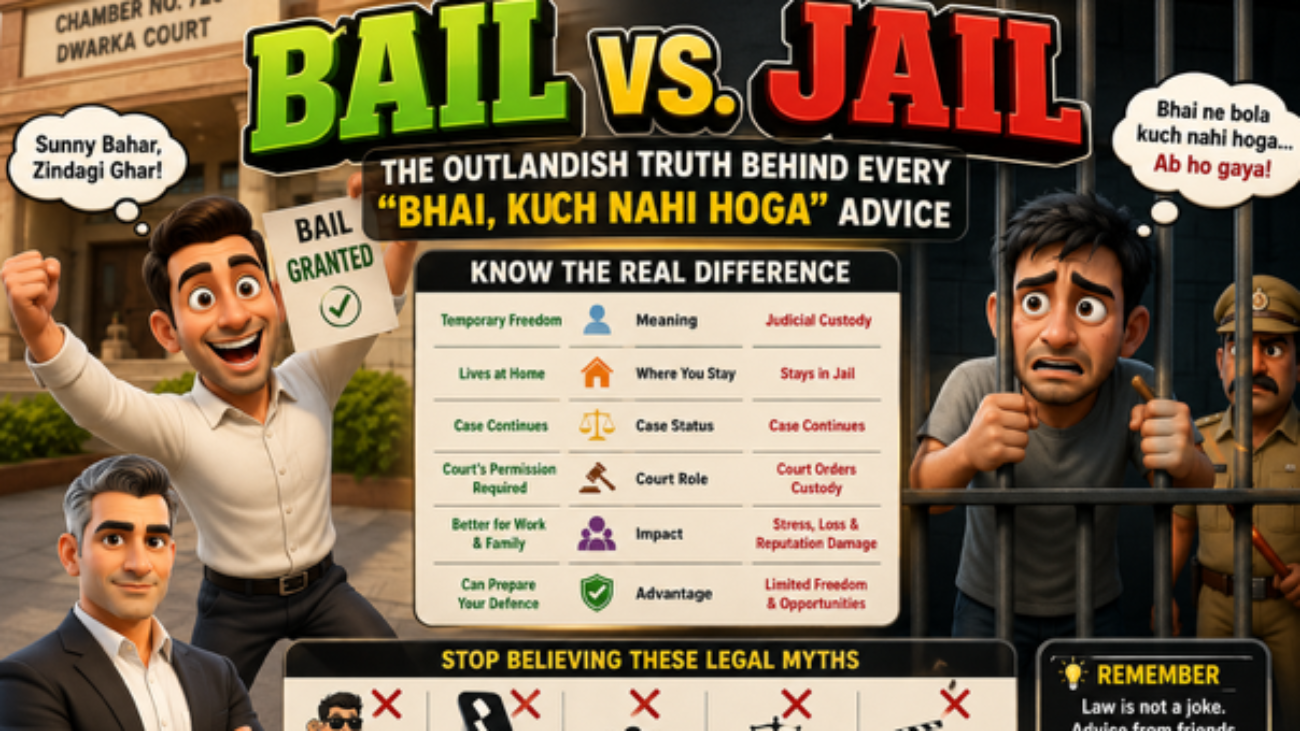
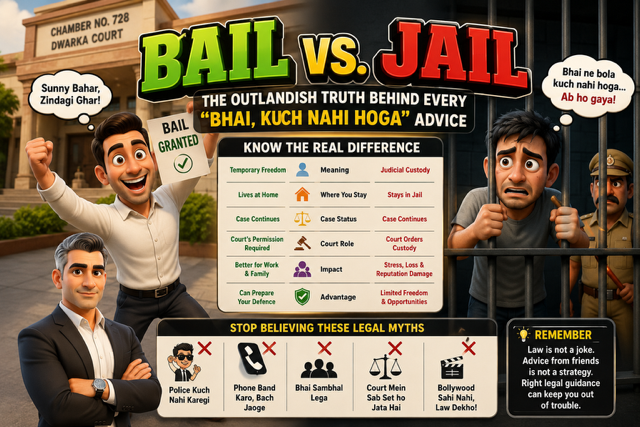
Criminal Advocate in Dwarka Court explaining the difference between Bail vs. Jail with humorous legal illustrations.

Bail vs. Jail: The Outlandish Truth Behind Every “Bhai, Kuch Nahi Hoga” Advice

Introduction – Bail vs. Jail

Arre Bhai, Police Kuch Nahi Karegi.”
“Bas ek phone kar denge, sab set ho jayega.”
“Jail toh sirf criminals jaate hain.”

Sounds familiar?

Unfortunately, this “WhatsApp University” legal advice has landed countless people in serious trouble. The difference between Bail vs. Jail is not a joke. However, believing jokes about criminal law can become one.

Therefore, before you trust your overconfident friend who has watched every Bollywood courtroom scene, understand the real meaning of Bail vs. Jail.

Let’s separate legal facts from hilarious myths.


⚖️ What Does Bail vs. Jail Really Mean?

Many people think bail means the case is over. Others believe jail automatically means guilt.

Both are wrong.

Simply put:

  • Bail means a person is released from custody while the criminal case continues.
  • Jail means a person remains in judicial custody because bail has not been granted or is legally unavailable at that stage.

Therefore, Bail vs. Jail is not about innocence or guilt. Instead, it is about liberty during the legal process.

😂 The Legendary “Bhai, Kuch Nahi Hoga” Advice

Here are some famous legal gems that deserve an award.

❌ “Police can’t arrest you.”

❌ “Ignore the notice.”

❌ “Court won’t do anything.”

❌ “Judge ko sab pata hota hai.”

❌ “Just switch off your phone.”

Reality?

⚠️ Your phone switches off.

⚠️ The legal process does not.

Eventually, the police may proceed according to law, notices may continue, warrants may be issued, and unnecessary complications can arise.

Moral of the story?

Never make legal decisions based on free tea-stall advice.


📋 Bail vs. Jail – Easy Comparison

ParticularBail ✅Jail 🚔
MeaningTemporary release from custodyJudicial custody
FreedomPerson goes homePerson remains confined
Criminal CaseContinuesContinues
Court PermissionRequiredCustody ordered by Court
Lawyer’s RolePrepare bail strategySeek release through legal remedies
Family ImpactLess stressfulOften emotionally difficult
EmploymentEasier to continueMay be affected
ReputationBetter protectedGreater social impact
Documents RequiredDepends on factsCourt directions apply

This table clearly explains the practical difference between Bail vs. Jail.


⚖️ Types of Bail

Understanding Bail vs. Jail also requires knowing different kinds of bail.

✅ Anticipatory Bail

Granted before arrest when there is a genuine apprehension of arrest.

✅ Regular Bail

Applied after arrest when a person is already in custody.

✅ Interim Bail

Temporary protection until the Court hears the complete matter.

Choosing the correct legal remedy depends entirely upon the facts of every case.


🚨 Why Bail Is Never Automatic

Many people wrongly assume that bail is guaranteed.

However, every Court considers several important factors.

These may include:

  • Nature of allegations
  • Gravity of offence
  • Criminal antecedents
  • Possibility of influencing witnesses
  • Chances of absconding
  • Stage of investigation
  • Evidence available

Therefore, understanding Bail vs. Jail requires professional legal guidance rather than assumptions.


👨‍⚖️ Why Early Legal Advice Can Change Everything

One of the biggest mistakes people make is contacting a lawyer after matters become complicated.

Instead, seek legal advice immediately.

✅ Pre-Litigation Assistance

Our office regularly assists clients even before court proceedings begin.

This includes:

  • Legal consultation
  • Police complaint guidance
  • Replying to legal notices
  • FIR-related advice
  • Complaint drafting
  • Evidence preservation
  • Negotiation wherever legally appropriate
  • Strategy planning before arrest or investigation

Proper planning often prevents unnecessary legal complications.


⚖️ Litigation Support During Court Proceedings

Once the case reaches Court, every hearing becomes important.

We assist clients through:

  • Regular Bail applications
  • Anticipatory Bail matters
  • Criminal trial representation
  • Sessions Court matters
  • Appeals and revisions
  • Criminal complaints
  • Documentation
  • Filing applications
  • Court appearances
  • Continuous legal guidance

Whether the issue relates to Bail vs. Jail, criminal defence, or procedural strategy, timely action matters.


📍 Why Choosing a Local Advocate in Dwarka Court Matters

Court procedure is not only about legal knowledge.

It also involves understanding the working system, filing process, documentation requirements, registry practice, listing procedure and day-to-day functioning.

As Advocates practicing in Dwarka Court for over 18 years, we understand these practical aspects thoroughly.

This enables us to:

✅ File matters promptly

✅ Handle urgent filings efficiently

✅ Coordinate with court procedures smoothly

✅ Guide clients realistically

Our experience before the Courts serving Janakpuri, Vikaspuri, Dwarka North, Dwarka South, Dwarka Sector-6, Dwarka Sector-10, Dwarka Sector-12, Dwarka Sector-23, Palam Village, Dabri, Bindapur, Mohan Garden, Uttam Nagar, Najafgarh, Chhawla, Delhi Cantonment, Samalka, Kapashera, Jaffarpur Kalan, Baba Haridas Nagar and nearby Dwarka Court jurisdictions helps clients receive efficient legal representation.

If you are searching for a Criminal Advocate Dwarka, Crime Lawyer Dwarka, Regular Bail & Anticipatory Bail Lawyer Dwarka, Criminal Disputes Advocate Dwarka Court, Advocate in Dwarka Court, Lawyer in South West Delhi, Civil Litigation Lawyer in Delhi, Property Dispute Advocate, Recovery Suit Counsel, or Commercial Litigation Lawyer, local courtroom familiarity can make the legal process more efficient.


🤝 Why Clients Trust Us

Legal representation begins with trust.

Therefore, we maintain:

📞 Quick response to client queries

📱 Dedicated WhatsApp support

⚖️ High professional standards

✅ Transparent legal advice

💰 Reasonable and transparent fee structure

📝 Proper Lawyer-Client Fee Agreements

🧾 Fee receipts and acknowledgements

🤝 Honest and fair dealings

📂 Regular updates regarding case progress

Our objective is simple.

Help clients understand Bail vs. Jail and every legal step with complete transparency.


😂 Bollywood vs. Reality

Bollywood Advice 🎬Court Reality ⚖️
Hero gets bail in 5 minutesCourts follow legal procedure
One emotional speech winsEvidence and law matter
Police always arrest wronglyEvery case depends on facts
Friend knows everythingYour lawyer should
“Bhai sambhal lega”Court orders matter

📚 Common Mistakes That Push People Towards Jail

❌ Ignoring notices

❌ Not consulting a lawyer

❌ Destroying evidence

❌ Believing rumours

❌ Posting about the case on social media

❌ Delaying legal action

Instead, understand Bail vs. Jail properly and take timely legal advice.


✅ Conclusion

The difference between Bail vs. Jail is much greater than most people imagine.

Never rely upon casual advice like “Bhai, Kuch Nahi Hoga.”

Every criminal case has unique facts. Consequently, every legal strategy must also be unique.

Early legal advice, proper documentation, timely filing and experienced courtroom representation can significantly improve the legal process.

Most importantly, consult a qualified advocate before making any legal decision.


📞 Need Legal Assistance?

If you require guidance regarding Bail vs. Jail, criminal cases, anticipatory bail, regular bail, FIR-related issues or any litigation before Dwarka Court, our office is ready to assist.

📍 Ankit Gaurav Kainth & Associates
⚖️ 18+ Years of Practice in Dwarka Court
📞 9899085554 | 9811885554

Book your consultation today and receive honest, transparent and practical legal advice tailored to your case.

Civil Advocate Dwarka explaining money recovery suit filing process in Dwarka Court Delhi

Guide to Filing a Civil Suit for Recovery of Money in Dwarka Court

Guide to Filing a Civil Suit for Recovery of Money in Dwarka Court

Money recovery disputes are among the most common civil disputes filed before the Dwarka Courts, Delhi. Whether the amount arises from an unpaid loan, business transaction, friendly borrowing, professional services, dishonoured commitments, or commercial dealings, the law provides an effective remedy through a civil suit for recovery of money.

This Guide to Filing a Civil Suit explains the complete process of filing a recovery suit in Dwarka Court. Moreover, it highlights the importance of obtaining legal assistance from experienced local advocates who understand the court procedures, documentation requirements, and litigation strategy required for successful recovery.

With over 18+ years of experience in Dwarka Court, our legal team has represented clients from Dwarka Sector 6, Dwarka Sector 10, Dwarka Sector 12, Dwarka North, Dwarka South, Dwarka Sector-23, Uttam Nagar, Janakpuri, Vikaspuri, Najafgarh, Palam Village, Dabri, Mohan Garden, Chhawla, Kapashera, Delhi Cantonment, Samalka, Bindapur, Baba Haridas Nagar, Jaffarpur Kalan, and nearby areas.


⚖️ What is a Civil Suit for Recovery of Money?

A civil suit for recovery of money is a legal proceeding filed before a competent civil court seeking recovery of an unpaid amount from a debtor.

A person may file such a suit when:

✅ A loan remains unpaid.

✅ Business dues are outstanding.

✅ Payments for services are withheld.

✅ Contractual obligations are breached.

✅ Friendly loans are not returned.

✅ Commercial transactions remain unsettled.

This Guide to Filing a Civil Suit is designed to help individuals and businesses understand their legal rights and available remedies.


Why Early Legal Advice Matters

Many clients approach lawyers only after disputes escalate. However, timely legal consultation can often prevent prolonged litigation.

Therefore, before filing a case, we assist clients during the pre-litigation stage by:

📌 Legal Assessment

We examine:

  • Agreements
  • Promissory notes
  • Invoices
  • Bank statements
  • WhatsApp chats
  • Emails
  • Payment records

Consequently, we assess the strength of the recovery claim.

📌 Drafting Legal Notices

A professionally drafted legal notice often encourages settlement.

Moreover, a proper notice demonstrates seriousness and creates valuable documentary evidence.

📌 Negotiation and Settlement

Whenever possible, we attempt amicable settlement before initiating court proceedings.

As a result, clients often save significant time and litigation expenses.

This proactive approach forms an important part of our Guide to Filing a Civil Suit.


Step-by-Step Guide to Filing a Civil Suit

Step 1: Collect Relevant Documents

The first requirement in any Guide to Filing a Civil Suit is documentation.

Important documents may include:

  • Agreements
  • Loan documents
  • Receipts
  • Invoices
  • Bank records
  • Ledger accounts
  • Emails
  • WhatsApp communications

Strong documentation significantly improves recovery prospects.

Step 2: Determine Jurisdiction

The next stage in the Guide to Filing a Civil Suit is determining jurisdiction.

Dwarka Courts generally handle disputes arising within areas such as:

  • Dwarka North
  • Dwarka South
  • Dwarka Sector-23
  • Uttam Nagar
  • Janakpuri
  • Vikaspuri
  • Najafgarh
  • Chhawla
  • Palam Village
  • Kapashera
  • Dabri
  • Mohan Garden
  • Samalka
  • Delhi Cantonment
  • Bindapur
  • Baba Haridas Nagar
  • Jaffarpur Kalan

An experienced Advocate in Dwarka Court can quickly identify the proper forum.

Step 3: Drafting the Plaint

The plaint forms the foundation of the recovery suit.

It includes:

  • Facts of the dispute
  • Cause of action
  • Outstanding amount
  • Interest claim
  • Relief sought

Therefore, careful drafting is essential.

This remains one of the most important aspects of any Guide to Filing a Civil Suit.

Step 4: Court Fees and Filing

After preparation of pleadings, the suit is filed before the competent court along with applicable court fees.

Subsequently, the matter is scrutinized by the filing department.

Step 5: Issuance of Summons

Once the case is accepted, summons are issued to the defendant.

Thereafter, the defendant is directed to appear and file a written statement.

Step 6: Evidence Stage

The parties produce documentary and oral evidence.

Consequently, the court evaluates:

  • Documentary records
  • Witness testimony
  • Financial transactions
  • Correspondence

This stage plays a critical role in the success of a recovery suit.

Step 7: Final Arguments and Judgment

Finally, the court hears arguments and delivers judgment.

If successful, the plaintiff may recover:

✅ Principal amount

✅ Interest

✅ Litigation costs

Thus, this completes the Guide to Filing a Civil Suit process.


Why Choose a Local Advocate in Dwarka Court?

One of the most overlooked aspects of litigation is local court experience.

As local advocates practicing regularly in Dwarka Court, Delhi, we possess deep familiarity with:

✅ Court Procedures

We understand filing requirements, registry processes, court practices, and procedural compliance.

✅ Faster Case Handling

Since we regularly appear before Dwarka Courts, documentation and filings can often be processed more efficiently.

✅ Local Court Knowledge

Our extensive exposure to court functioning enables us to guide clients effectively at every stage.

✅ Immediate Availability

Clients frequently require urgent updates and strategic advice.

Being based near Dwarka Court allows us to remain readily accessible.

Therefore, engaging a local Civil Advocate Dwarka often offers practical advantages.


Litigation Support During Ongoing Court Cases

Our role does not end after filing.

During litigation, we assist clients through:

⚖️ Drafting pleadings

⚖️ Filing applications

⚖️ Evidence preparation

⚖️ Witness examination

⚖️ Cross-examination strategy

⚖️ Interim relief applications

⚖️ Final arguments

This comprehensive support strengthens the overall litigation process.

Building Trust Through Professional Legal Services

Trust remains the cornerstone of every lawyer-client relationship.

Accordingly, we maintain:

📞 Quick Responsiveness

Clients receive prompt updates and practical guidance.

📱 Dedicated WhatsApp Support

We remain available through dedicated communication channels.

💼 Proper Lawyer-Client Fee Agreements

Every engagement is clearly documented.

🧾 Fee Receipts and Acknowledgements

We issue proper receipts and maintain transparent records.

💰 Reasonable and Transparent Fees

Clients understand the fee structure before engagement.

🤝 Honest and Fair Dealings

We provide realistic assessments rather than false assurances.

Consequently, many clients continue to trust us with complex civil and commercial disputes.

Additional Areas of Practice

Apart from recovery suits, our legal team regularly handles:

  • Civil Advocate Dwarka matters
  • Civil Lawyer Dwarka services
  • Civil Litigation Lawyer in Delhi assignments
  • Property Dispute Advocate cases
  • Commercial Litigation Lawyer matters
  • Recovery Suit Counsel representation
  • Criminal Disputes Advocate Dwarka Court cases
  • Regular Bail & Anticipatory Bail Lawyer Dwarka services
  • Lawyer in South West Delhi consultations
  • Advocate in Dwarka Court appearances

Common Mistakes to Avoid

When following a Guide to Filing a Civil Suit, avoid:

❌ Delaying legal action

❌ Ignoring limitation periods

❌ Incomplete documentation

❌ Informal settlements without records

❌ Filing in the wrong jurisdiction

❌ Proceeding without legal advice

Avoiding these mistakes can significantly improve recovery outcomes.


Conclusion

A properly planned recovery suit can be a powerful legal remedy for recovering unpaid dues. However, success depends upon documentation, strategy, procedural compliance, and effective representation.

This Guide to Filing a Civil Suit demonstrates that timely legal advice, proper preparation, and experienced court representation can make a substantial difference. Whether you are dealing with a personal loan dispute, commercial debt recovery, contractual claim, or business outstanding, professional legal guidance can help protect your rights and improve recovery prospects.

With over 18 years of experience near Dwarka Court, our team remains committed to providing practical, transparent, and result-oriented legal services for clients across South West Delhi.


FAQ Section

Q1. How long does a money recovery suit take in Dwarka Court?
The timeline depends on facts, evidence, court workload, and cooperation of parties. Each case proceeds according to its specific circumstances.

Q2. Is a legal notice mandatory before filing a recovery suit?
In many cases, a legal notice is advisable and beneficial. It may encourage settlement and create useful documentary evidence.

Q3. Can interest be claimed in a recovery suit?
Yes. Depending on the facts, contract terms, and applicable law, the plaintiff may claim interest along with the principal amount.

Q4. What documents are required for a recovery suit?
Common documents include agreements, invoices, receipts, bank records, emails, WhatsApp communications, and payment acknowledgements.

Q5. Why hire a local Advocate in Dwarka Court?
A local advocate understands court procedures, filing systems, jurisdictional requirements, and day-to-day court functioning, which can improve efficiency.


📞 Contact Us Today

Need assistance with a recovery suit or civil litigation matter?

⚖️ Advocate in Dwarka Court, Delhi

📱 Mobile: 9899085554

📱 Mobile: 9811885554

✅ Civil Recovery Suits

✅ Property Disputes

✅ Commercial Litigation

✅ Civil Litigation

✅ Bail Matters

✅ Legal Notices & Court Representation

Call today for professional legal assistance and case evaluation.

Advocate explaining quashing of FIR in domestic violence cases before Delhi High Court

The Ultimate Guide to Quashing of FIR in Domestic Violence Cases

⚖️ Introduction – Quashing of FIR in Domestic Violence

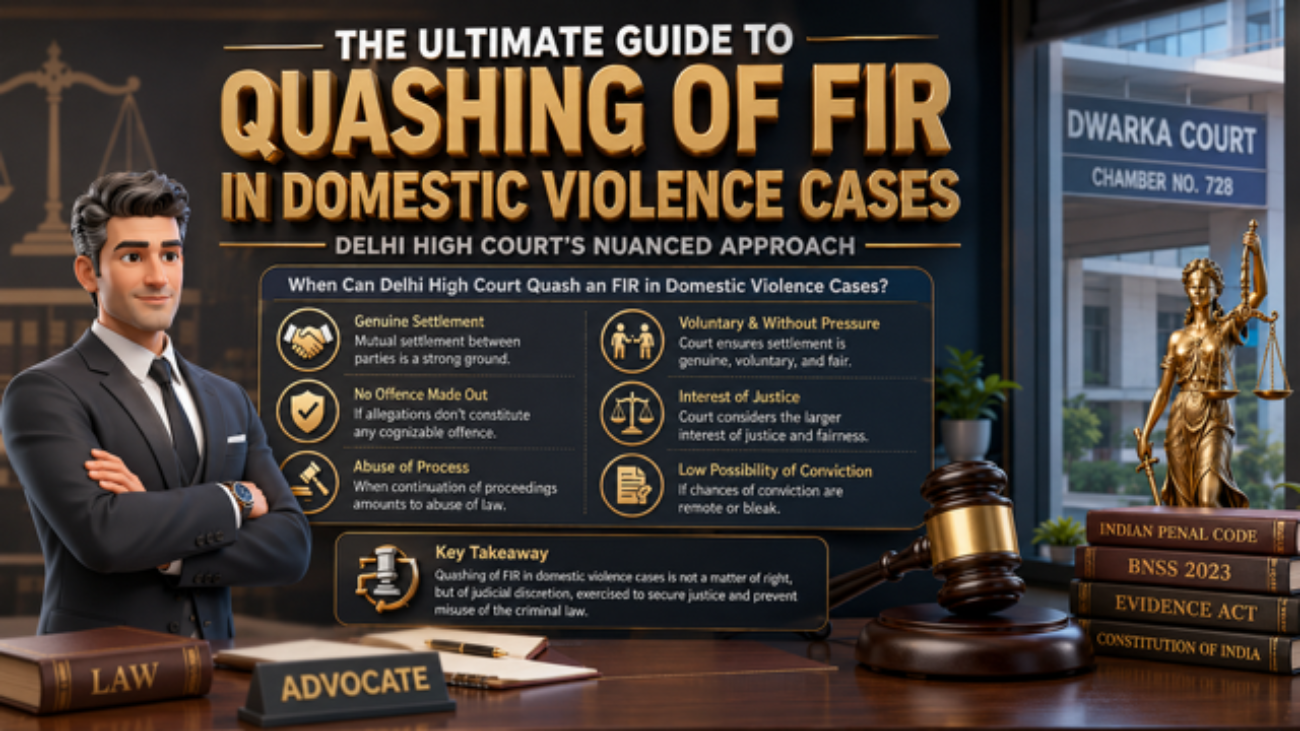
The process of Quashing of FIR in Domestic Violence matters has become one of the most important legal remedies available before the Delhi High Court. In many cases, matrimonial disputes escalate into criminal proceedings. However, after settlement, reconciliation, or discovery of legal infirmities, parties often seek Quashing of FIR in Domestic Violence cases to bring an end to prolonged litigation.

The Delhi High Court has consistently adopted a nuanced approach while dealing with petitions for Quashing of FIR in Domestic Violence matters. Every case is examined on its own facts, the nature of allegations, the settlement terms, and the larger interest of justice.

If you are facing criminal proceedings arising from matrimonial disputes in Dwarka, Janakpuri, Vikaspuri, Uttam Nagar, Najafgarh, Palam Village, Kapashera, Chhawla, Dabri, Samalka, Dwarka Sector-6, Dwarka Sector-10, Dwarka Sector-12, Dwarka Sector-23, Dwarka North, Dwarka South, Jaffarpur Kalan, Mohan Garden, Bindapur, Baba Haridas Nagar, Delhi Cantonment, or nearby Dwarka Court areas, understanding the law relating to Quashing of FIR in Domestic Violence is essential.


📖 What is Quashing of FIR in Domestic Violence?

Quashing of FIR in Domestic Violence refers to the power of the High Court under Section 528 BNSS (earlier Section 482 CrPC) to set aside criminal proceedings where continuation of the case would amount to abuse of the process of law.

The Delhi High Court may exercise this power when:

✅ Parties have entered into a genuine settlement.

✅ Matrimonial disputes have been resolved.

✅ The allegations do not disclose commission of an offence.

✅ Continuation of proceedings serves no useful purpose.

✅ The interests of justice require intervention.

Therefore, Quashing of FIR in Domestic Violence serves as a powerful remedy to prevent unnecessary criminal trials.


⚖️ Delhi High Court’s Nuanced Approach

The Delhi High Court does not mechanically allow every petition for Quashing of FIR in Domestic Violence.

Instead, the Court carefully considers:

1. Nature of Allegations

The Court evaluates whether allegations are primarily matrimonial in nature or involve serious criminal conduct.

2. Voluntary Settlement

Moreover, the Court verifies whether the settlement is genuine, voluntary, and free from coercion.

3. Conduct of Parties

The conduct of both parties before and after settlement plays an important role.

4. Future Possibility of Conviction

Furthermore, where chances of conviction become remote after settlement, Quashing of FIR in Domestic Violence may be permitted.

5. Larger Interest of Justice

Above all, the High Court ensures that justice is served while preventing misuse of criminal law.


📊 Quick Understanding Table

AspectDelhi High Court Consideration
Settlement Between PartiesStrong ground for quashing
Mutual Consent DivorceSupports quashing petition
Serious Physical ViolenceHigher scrutiny
False Implication AllegationsExamined carefully
Criminal AntecedentsRelevant factor
Voluntary StatementsMandatory
Future Conviction ProbabilityImportant consideration
Interest of JusticeFinal deciding factor

🏛️ Pre-Litigation Assistance: Why Early Legal Advice Matters

Many people approach lawyers only after receiving summons or notices. However, strategic intervention at the pre-litigation stage often prevents unnecessary complications.

Our office assists clients before litigation by:

✅ Legal consultations

✅ Drafting replies to notices

✅ Settlement negotiations

✅ Mediation assistance

✅ Documentation review

✅ Legal risk assessment

As experienced advocates near Dwarka Court, we help clients evaluate the possibility of Quashing of FIR in Domestic Violence even before criminal proceedings escalate.


⚖️ Litigation Stage Representation

Once litigation begins, immediate legal action becomes crucial.

We assist clients through:

Criminal Proceedings

  • Bail applications
  • Anticipatory bail
  • Regular bail
  • Trial representation
  • High Court petitions

High Court Matters

As a trusted Lawyer in High Court, we regularly assist clients seeking Quashing of FIR in Domestic Violence before the Delhi High Court.

Related Litigation

Our services also include:

  • Civil Litigation Lawyer in Delhi matters
  • Property disputes
  • Commercial litigation
  • Recovery suits
  • Matrimonial disputes
  • Criminal defence matters

📍 Why Local Presence Near Dwarka Court Matters

Choosing an Advocate in Dwarka Court offers practical advantages.

With more than 18 years of experience in Dwarka Court, we understand:

✅ Filing procedures

✅ Court registry practices

✅ Administrative requirements

✅ Listing processes

✅ Local court functioning

Because we regularly appear before courts in South West Delhi, we can act quickly and efficiently for our clients.

This local advantage benefits clients from Janakpuri, Vikaspuri, Uttam Nagar, Najafgarh, Palam Village, Kapashera, Chhawla, Dabri, Samalka, Mohan Garden, Bindapur, Baba Haridas Nagar and surrounding areas.


👨‍⚖️ Why Clients Trust Us

Trust is the foundation of every lawyer-client relationship.

Therefore, we maintain:

✅ High Professional Standards

Every matter receives careful legal analysis and strategic planning.

📞 Quick Responsiveness

Clients receive prompt updates and timely responses.

📱 Dedicated WhatsApp Support

We remain accessible through calls and WhatsApp support.

💰 Transparent Fee Structure

Our fee structure remains reasonable and transparent.

📝 Proper Fee Agreements

We execute Lawyer-Client Fee Agreements to maintain clarity.

📄 Fee Receipts & Acknowledgements

Receipts and acknowledgements are issued for professional transparency.

🤝 Honest Dealings

We believe in fair, ethical, and transparent legal practice.


⚖️ Criminal Defence and Bail Representation

Apart from Quashing of FIR in Domestic Violence, our office regularly handles:

  • Criminal Advocate Dwarka matters
  • Criminal Disputes Advocate Dwarka Court matters
  • Regular Bail matters
  • Anticipatory Bail matters
  • High Court criminal petitions

Individuals facing criminal allegations often require immediate legal protection. Therefore, engaging a knowledgeable Regular Bail & Anticipatory Bail Lawyer Dwarka becomes essential.

📍 Areas We Serve

We regularly assist clients from:

Dwarka Sector-6, Dwarka Sector-10, Dwarka Sector-12, Dwarka Sector-23, Dwarka North, Dwarka South, Janakpuri, Vikaspuri, Uttam Nagar, Najafgarh, Chhawla, Bindapur, Baba Haridas Nagar, Palam Village, Samalka, Kapashera, Mohan Garden, Jaffarpur Kalan, Dabri, Delhi Cantonment and nearby Dwarka Court jurisdictions.


✅ Conclusion

The remedy of Quashing of FIR in Domestic Violence continues to play a vital role in resolving matrimonial criminal disputes. Nevertheless, success depends upon proper legal strategy, accurate documentation, genuine settlements, and effective representation before the Delhi High Court.

Since every case presents unique facts, professional legal advice becomes indispensable. Early intervention often saves significant time, cost, and emotional stress. Therefore, parties should seek experienced legal assistance before taking any major legal step.


📞 Contact Us Today

If you require assistance regarding Quashing of FIR in Domestic Violence, criminal defence, bail matters, property disputes, commercial litigation, recovery suits, or High Court representation, contact us today.

📞 Mobile: 9899085554

📞 Mobile: 9811885554

🏛️ Chamber Near Dwarka Court, New Delhi

⚖️ 18+ Years of Courtroom Experience

📱 Dedicated WhatsApp Support

✅ Transparent Fees

✅ Professional Representation

✅ Prompt Legal Assistance

Quashing of FIR in Domestic Violence

FAQ Section

Q1. Can an FIR in a domestic violence-related criminal case be quashed?
Yes, the Delhi High Court may quash criminal proceedings if parties have settled the dispute and the interests of justice support such relief.

Q2. Which court can quash an FIR in Delhi?
Generally, the Delhi High Court exercises powers to quash FIRs under its inherent jurisdiction.

Q3. Is personal appearance necessary for quashing proceedings?
In many cases, parties are required to appear before the Court to confirm the settlement.

Q4. How long does a quashing petition take in Delhi High Court?
Timelines vary depending upon listing, documentation, and case complexity.

Q5. Can a settled matrimonial dispute still continue as a criminal case?
In appropriate cases, parties may seek quashing so that unnecessary criminal proceedings do not continue after settlement.


Criminal Advocate Dwarka assisting client with anticipatory bail in cyber fraud case before Dwarka Court

Expedited Relief: How to Secure Anticipatory Bail Swiftly in Cyber Fraud Cases at Dwarka Court

⚖️ Introduction – Anticipatory Bail Swiftly in Cyber Fraud

In recent years, cyber fraud complaints have increased significantly across Delhi. Consequently, many individuals receive notices from police stations, cyber cells, or investigating agencies. In such situations, the fear of arrest often creates immense stress and uncertainty. Therefore, obtaining Anticipatory Bail Swiftly in Cyber Fraud matters becomes crucial for protecting personal liberty and ensuring legal representation from the very beginning.

If you are facing allegations related to online fraud, UPI scams, phishing, investment fraud, cryptocurrency disputes, social media offences, or cybercrime investigations, understanding the anticipatory bail process can make a significant difference.

As local advocates practicing in Dwarka Court for more than 18 years, we regularly assist clients seeking Anticipatory Bail Swiftly in Cyber Fraud cases arising from Dwarka, Janakpuri, Uttam Nagar, Najafgarh, Vikaspuri, Palam, Dabri, Kapashera, Chhawla, and nearby areas.


📌 What is Anticipatory Bail?

Anticipatory Bail is a legal protection granted under Section 482 of the Bharatiya Nagarik Suraksha Sanhita (BNSS), enabling a person to seek bail before arrest.

Simply put, if a person reasonably believes that they may be arrested in connection with a criminal case, they can approach the court and seek protection through anticipatory bail.

Therefore, obtaining Anticipatory Bail Swiftly in Cyber Fraud cases helps individuals avoid unnecessary custody while cooperating with the investigation.


🚨 Why Cyber Fraud Cases Require Immediate Legal Action

Cybercrime investigations move quickly. Moreover, investigating agencies often freeze bank accounts, issue notices, and seek custodial interrogation.

Common allegations include:

✅ Online Banking Fraud

✅ UPI Fraud

✅ Investment Scam Cases

✅ Cryptocurrency Transactions

✅ Social Media Fraud

✅ E-Commerce Fraud

✅ Identity Theft

✅ Financial Cyber Offences

Consequently, delays in seeking legal assistance may adversely affect your defence strategy. Hence, obtaining Anticipatory Bail Swiftly in Cyber Fraud matters should be a priority.


🏛 Why Choose a Local Dwarka Court Advocate?

Many clients underestimate the importance of hiring a local lawyer. However, local experience often plays a vital role in urgent criminal matters.

As advocates regularly practicing before Dwarka Court, we possess extensive knowledge of:

  • Court filing procedures
  • Registry requirements
  • Bail application formats
  • Court schedules
  • Judicial processes
  • Documentation requirements
  • Local investigation procedures

Therefore, our familiarity with the system helps us pursue Anticipatory Bail Swiftly in Cyber Fraud cases efficiently and effectively.

Moreover, proximity to Dwarka Court allows us to respond quickly whenever urgent legal action becomes necessary.


📍 Areas We Regularly Serve

We represent clients from:

  • Dwarka Sector 6
  • Dwarka Sector 10
  • Dwarka Sector 12
  • Dwarka Sector 23
  • Dwarka North
  • Dwarka South
  • Uttam Nagar
  • Najafgarh
  • Janakpuri
  • Vikaspuri
  • Palam Village
  • Dabri
  • Mohan Garden
  • Samalka
  • Kapashera
  • Chhawla
  • Bindapur
  • Baba Haridas Nagar
  • Delhi Cantonment
  • Jaffarpur Kalan

Additionally, we assist clients from all locations near Dwarka Court and throughout South-West Delhi.


⚖️ Pre-Litigation Assistance: Protecting Clients Before Court Proceedings

Many legal problems can be managed effectively before formal court proceedings begin.

Therefore, we assist clients during the pre-litigation stage by:

✅ Legal Consultation

We assess allegations and identify potential risks.

✅ Notice Response

We draft and submit appropriate replies to police notices.

✅ Investigation Guidance

We advise clients regarding lawful cooperation with investigating agencies.

✅ Documentation Preparation

We help collect records, banking documents, electronic evidence, and supporting material.

✅ Bail Strategy Development

Most importantly, we formulate a strong strategy for securing Anticipatory Bail Swiftly in Cyber Fraudinvestigations.

As a result, clients remain legally protected from the earliest stage possible.


🏛 Litigation Support During Ongoing Court Cases

Once proceedings commence, professional representation becomes even more important.

Our litigation services include:

  • Anticipatory Bail Applications
  • Regular Bail Applications
  • Criminal Defence Representation
  • Court Appearances
  • Filing Criminal Petitions
  • Documentation and Compliance
  • Legal Research and Strategy

Accordingly, we continue working towards securing Anticipatory Bail Swiftly in Cyber Fraud matters while protecting our client’s legal rights.


📊 Anticipatory Bail Process in Cyber Fraud Cases

StageAction Taken
Initial ConsultationReview allegations and available evidence
Case AssessmentAnalyse arrest risk and legal options
Document CollectionGather notices, FIR, bank records, communications
Drafting ApplicationPrepare anticipatory bail petition
Filing Before CourtSubmit application before competent court
Hearing StagePresent legal arguments and supporting documents
Court OrderProtection from arrest subject to conditions
ComplianceContinued legal support during investigation

This structured approach helps achieve Anticipatory Bail Swiftly in Cyber Fraud cases whenever legally justified.


🤝 Why Clients Trust Our Legal Services

Trust is the foundation of every successful lawyer-client relationship.

⭐ High Professional Standards

We maintain ethical and professional conduct in every matter.

⭐ Quick Responsiveness

Urgent criminal cases require immediate attention. Therefore, we respond promptly.

⭐ Dedicated WhatsApp Support

Clients receive regular updates through WhatsApp communication.

⭐ Availability on Call

Legal emergencies cannot wait. Consequently, we remain accessible whenever required.

⭐ Transparent Fee Structure

We explain fees clearly before accepting assignments.

⭐ Proper Lawyer-Client Fee Agreements

Every engagement is documented properly.

⭐ Fee Receipts and Acknowledgements

Clients receive receipts and confirmations for payments.

⭐ Honest and Fair Dealings

We provide practical legal advice rather than unrealistic promises.

As a result, many clients searching for a Criminal Advocate Dwarka, Best Crime Lawyer Dwarka, Top Regular Bail & Anticipatory Bail Lawyer Dwarka, Best Criminal Disputes Advocate Dwarka Court, and Top and Best Advocate in Dwarka Court choose our services.


🔍 Factors Courts Consider While Granting Anticipatory Bail

While deciding applications, courts commonly examine:

  • Nature of allegations
  • Role of the accused
  • Previous criminal history
  • Requirement of custodial interrogation
  • Cooperation during investigation
  • Risk of absconding
  • Available documentary evidence

Therefore, professional legal preparation significantly improves the chances of securing Anticipatory Bail Swiftly in Cyber Fraud matters.


⚖️ Importance of Early Legal Representation

Many individuals approach lawyers only after receiving repeated notices.

However, early intervention often provides substantial benefits.

For example:

✅ Better preparation

✅ Stronger documentation

✅ Improved defence strategy

✅ Timely filing

✅ Reduced legal risks

Hence, seeking legal advice at the earliest opportunity remains the most effective approach when pursuing Anticipatory Bail Swiftly in Cyber Fraud cases.


📌 Conclusion

Cyber fraud allegations can have serious legal consequences. Nevertheless, timely legal action, proper documentation, and professional representation can significantly strengthen your position.

Whether you are facing an ongoing investigation or anticipate legal action, obtaining Anticipatory Bail Swiftly in Cyber Fraud matters should be addressed without delay. Furthermore, engaging experienced local advocates familiar with Dwarka Court procedures can streamline the entire process.

With more than 18 years of experience before Dwarka Court, we provide strategic guidance during both pre-litigation and litigation stages while maintaining transparency, professionalism, and client-focused service.


FAQ Section

Q1. How quickly can anticipatory bail be filed in a cyber fraud case?
Depending on the facts and documents available, an anticipatory bail application can often be prepared and filed promptly before the competent court.

Q2. Is anticipatory bail available in all cyber fraud cases?
Availability depends upon the allegations, evidence, and legal circumstances of each case.

Q3. Can anticipatory bail prevent arrest?
Yes. If granted, anticipatory bail provides protection against arrest subject to court-imposed conditions.

Q4. Why should I hire a local Dwarka Court advocate?
A local advocate is familiar with court procedures, filing systems, and judicial processes, helping ensure efficient representation.

Q5. What documents are generally required for anticipatory bail?
Typically, notices, FIR details (if available), identity documents, bank records, and relevant communications may be required.

Anticipatory Bail Swiftly in Cyber Fraud Cases at Dwarka Court
Definitive Roadmap for Filing a Petition in the Supreme Court

📞 Contact Us Today

Need urgent assistance regarding cyber fraud investigations, anticipatory bail, or criminal defence?

⚖️ Experienced Criminal Litigation Team

📍 Near Dwarka Court, New Delhi

📞 Mobile: 9899085554

📞 Mobile: 9811885554

✅ Anticipatory Bail

✅ Regular Bail

✅ Criminal Defence

✅ Cyber Fraud Cases

✅ Immediate Legal Consultation

Call now for prompt legal assistance and case evaluation.

Cyber Cell Dwarka:The Ultimate Blueprint to Get Bail at the Earliest Stage ⭐
🚨 Received a Notice Under Section 35(3) BNSS from Cyber Cell Dwarka?The Ultimate Playbook to Protect Your Rights
Expedited Relief: How to Secure Anticipatory Bail Swiftly in Cyber Fraud Cases at Dwarka Court
Cyber Crime InvestigationCan Police Freeze Your Bank Account in Cyber Crime Investigation?
🚨 Is your bank account frozen by Cyber Police?How to Release the Amount Freeze by Cyber Police from Dwarka Court?💰👮🚨
Criminal Defense LawyerCriminal Defense Lawyer in Dwarka, Delhi
Consult TodayCriminal Case Advocate Dwarka Court
Bail Lawyer in Dwarka CourtProfessional Bail Lawyer in Dwarka Court
Bail in 420 IPC / Fraud CasesLocal Criminal Case Bail Advocate Dwarka Court
How to Challenge a High Court Order in the Supreme Court of India Step by Step Legal Guide

The Definitive Blueprint: How to Challenge a High Court Order in the Supreme Court of India & Secure Favorable Results

Introduction – About How to Challenge a High Court Order in the Supreme Court

A High Court order can significantly impact your rights, liberty, property, business, or family matters. However, many people are unaware that an unfavorable judgment or order of a High Court can often be challenged before the Supreme Court of India through appropriate legal remedies.

Understanding How to Challenge a High Court Order in the Supreme Court of India is essential because even a small procedural mistake can affect the outcome of your case. Therefore, proper legal guidance becomes crucial from the very beginning.

Whether the matter relates to criminal law, bail, property disputes, matrimonial disputes, commercial litigation, constitutional issues, or service matters, the Supreme Court provides an opportunity to seek justice against erroneous High Court decisions.

With more than 18 years of legal experience, our team assists clients across India in understanding How to Challenge a High Court Order in the Supreme Court of India and pursuing effective legal remedies before the Apex Court.


⚖️ Why Do People Challenge High Court Orders Before the Supreme Court?

The Supreme Court of India is the highest judicial authority in the country. Therefore, if a person believes that a High Court has committed an error in law, procedure, or appreciation of facts, an appeal or Special Leave Petition (SLP) may be filed.

Common reasons include:

✅ Rejection of Regular Bail

✅ Rejection of Anticipatory Bail

✅ Criminal Convictions

✅ Quashing Petitions Dismissed

✅ Property Disputes

✅ Family Court Matters

✅ Service Matters

✅ Commercial Disputes

✅ Constitutional Issues

Consequently, knowing How to Challenge a High Court Order in the Supreme Court of India can help protect valuable legal rights.


📋 How to Challenge a High Court Order in the Supreme Court of India – Step-by-Step Process

The process may seem complicated. However, it becomes manageable when handled systematically.

Easy Explanation Table

StepProcessPurpose
1Obtain Certified Copy of High Court OrderRequired for filing
2Consult Supreme Court AdvocateEvaluate legal grounds
3Review Case RecordsIdentify errors in judgment
4Draft Special Leave Petition (SLP)Main challenge document
5Prepare Supporting DocumentsEvidence and records
6Filing Before Supreme Court RegistryOfficial institution of case
7Removal of Registry ObjectionsCompliance with procedural requirements
8Listing Before CourtMatter gets hearing date
9Arguments Before BenchLegal submissions made
10Final OrderRelief granted or matter disposed

Therefore, anyone seeking information about How to Challenge a High Court Order in the Supreme Court of India should carefully follow each stage.


What Is a Special Leave Petition (SLP)?

In most situations, a person challenges a High Court order through a Special Leave Petition under Article 136 of the Constitution of India.

An SLP allows the Supreme Court to examine whether substantial injustice has occurred.

Moreover, the Supreme Court may:

✔️ Issue notice

✔️ Grant stay

✔️ Grant bail

✔️ Set aside the High Court order

✔️ Remand the matter for reconsideration

Thus, understanding How to Challenge a High Court Order in the Supreme Court of India often begins with understanding the role of an SLP.


🔍 Important Factors That Increase Chances of Success

Many litigants believe filing alone guarantees relief. However, that is not correct.

The following factors significantly improve the prospects of success:

Strong Legal Grounds

The Supreme Court primarily examines legal errors rather than re-appreciating every factual issue.

Proper Documentation

Missing records often weaken cases.

Timely Filing

Delay can adversely affect maintainability.

Effective Advocacy

Persuasive arguments play a crucial role.

Strategic Case Preparation

A carefully planned litigation strategy often leads to better outcomes.

As a result, professional guidance becomes important when evaluating How to Challenge a High Court Order in the Supreme Court of India.


⚖️ Criminal Matters Before the Supreme Court

Our office regularly assists clients in criminal litigation matters including:

✅ Regular Bail Matters

✅ Anticipatory Bail Matters

✅ FIR Quashing Matters

✅ Criminal Appeals

✅ NDPS Cases

✅ Economic Offence Cases

✅ White Collar Crime Cases

✅ Cheating and Fraud Cases

✅ POCSO Matters

Clients searching for a Criminal Advocate for Supreme Court of India, Crime Lawyer for Supreme Court of India, Regular Bail & Anticipatory Bail Lawyer for Supreme Court of India, or Criminal Disputes Advocate Supreme Court of India often require immediate legal intervention due to strict timelines.


📞 Our Pre-Litigation Assistance

Successful litigation often begins before the actual filing of a case.

Therefore, we assist clients during the pre-litigation stage through:

Legal Consultation

Understanding legal strengths and weaknesses.

Document Review

Examining judgments, pleadings, and evidence.

Risk Assessment

Identifying possible legal consequences.

Strategic Planning

Preparing an effective litigation roadmap.

Settlement Evaluation

Exploring lawful settlement opportunities where appropriate.

Consequently, our clients gain clarity before initiating proceedings regarding How to Challenge a High Court Order in the Supreme Court of India.


⚖️ Our Litigation Support

Once litigation begins, continuous support becomes essential.

We provide:

✅ Drafting of SLPs

✅ Bail Applications

✅ Criminal Appeals

✅ Stay Applications

✅ Case Monitoring

✅ Filing Coordination

✅ Court Representation

✅ Legal Research

✅ Regular Updates

Thus, clients remain informed throughout every stage of How to Challenge a High Court Order in the Supreme Court of India.


🏛️ Why Our Presence in Dwarka Court Benefits Clients

We are local advocates practicing in Dwarka Court with over 18 years of experience.

This provides significant advantages:

✔️ Familiarity with Court Procedures

✔️ Understanding of Filing Processes

✔️ Faster Documentation Management

✔️ Efficient Coordination

✔️ Practical Litigation Experience

✔️ Immediate Client Accessibility

Moreover, our experience within the Dwarka Court system helps us manage litigation efficiently while coordinating Supreme Court matters across India.


🤝 Why Clients Trust Us

Trust is the foundation of every lawyer-client relationship.

Our clients appreciate:

✅ High Professional Standards

✅ Quick Response Time

✅ Availability on Call

✅ Dedicated WhatsApp Support

✅ Transparent Communication

✅ Reasonable Fee Structure

✅ Written Lawyer-Client Fee Agreements

✅ Fee Receipts and Acknowledgements

✅ Honest Legal Assessment

✅ Fair and Transparent Dealings

Therefore, many clients searching for a Top and Best Advocate in Supreme Court of India choose firms that prioritize transparency and accountability.

How to Challenge a High Court Order in the Supreme Court

🌎 We Assist Clients Across India

Our legal assistance extends to matters originating from:

Delhi, Haryana, Punjab, Rajasthan, Uttar Pradesh, Uttarakhand, Himachal Pradesh, Gujarat, Maharashtra, Goa, Madhya Pradesh, Chhattisgarh, Bihar, Jharkhand, West Bengal, Odisha, Assam, Arunachal Pradesh, Meghalaya, Manipur, Mizoram, Nagaland, Tripura, Sikkim, Telangana, Andhra Pradesh, Karnataka, Kerala, Tamil Nadu, Jammu & Kashmir, Ladakh and all Union Territories.

Therefore, regardless of location, individuals seeking guidance on How to Challenge a High Court Order in the Supreme Court of India can obtain professional assistance.


Conclusion

Understanding How to Challenge a High Court Order in the Supreme Court of India requires careful planning, timely action, proper documentation, and effective legal representation. While every case is unique, a well-prepared strategy significantly improves the likelihood of obtaining favorable relief.

Whether the matter concerns bail, criminal litigation, property disputes, constitutional issues, family matters, or commercial disputes, obtaining experienced legal guidance at the earliest stage can make a substantial difference.


FAQ Section

1. Can a High Court order be challenged in the Supreme Court of India?

Yes. Most High Court orders can be challenged through a Special Leave Petition (SLP) under Article 136 of the Constitution.

2. What is the time limit for filing an SLP?

Generally, an SLP should be filed within the prescribed limitation period, though delays may sometimes be condoned by the Court.

3. Can the Supreme Court grant bail after a High Court rejects bail?

Yes. The Supreme Court has the power to grant regular bail or anticipatory bail in appropriate cases.

4. Is a Supreme Court lawyer mandatory for filing an SLP?

Supreme Court filings generally require compliance with Supreme Court Rules and are usually handled through Advocates-on-Record and Supreme Court practitioners.

5. Can criminal, civil, family, and property matters be challenged before the Supreme Court?

Yes. Subject to maintainability and legal grounds, various categories of High Court orders may be challenged.


📞 Contact Us Today

If you need professional assistance regarding How to Challenge a High Court Order in the Supreme Court of India, our team is available to guide you through every stage of the process.

📱 Mobile: 9899085554

📱 Mobile: 9811885554

⚖️ Experienced Legal Representation

📞 Quick Response

📲 Dedicated WhatsApp Support

✅ Transparent Fee Structure

🏛️ Dwarka Court Based Advocates with 18+ Years of Experience

Contact us today for a detailed case evaluation and legal consultation.

Divorce in Dwarka Court, Delhi When Your Spouse Lives Abroad

⚖️ Beyond Borders: The Definitive Guide to Divorce in Dwarka Court, Delhi When Your Spouse Lives Abroad

Introduction-Divorce in Dwarka Court, Delhi When Your Spouse Lives Abroad

Global mobility has increased significantly over the last decade. As a result, many married couples now live in different countries. While this creates new opportunities, it also leads to legal challenges when a marriage breaks down.

One of the most common questions we receive is: Can I get a divorce in India if my spouse has moved abroad?

The answer is yes. In many situations, you can legally seek Divorce in Dwarka Court, Delhi When Your Spouse Lives Abroad through the appropriate legal process. However, jurisdiction, service of summons, documentation, and international communication require careful handling.

Therefore, understanding the legal framework becomes essential before initiating proceedings.

With over 18 years of experience in Dwarka Court, our legal team assists clients at every stage, from pre-litigation advice to complete court representation.


Why Divorce Cases Involving Overseas Spouses Require Special Attention

When one spouse resides outside India, the divorce process may involve additional legal procedures.

These may include:

✅ International service of court summons

✅ Verification of overseas addresses

✅ Video conferencing appearances

✅ Authentication of foreign documents

✅ Power of Attorney arrangements

✅ Enforcement of foreign judgments

Consequently, professional legal guidance becomes even more important.

If you are considering Divorce in Dwarka Court, Delhi When Your Spouse Lives Abroad, proper planning can save substantial time, cost, and stress.


Understanding Jurisdiction for Divorce in Dwarka Court

Before filing a case, it is necessary to determine whether Dwarka Court has jurisdiction.

Generally, a divorce petition may be filed where:

The Marriage Was Solemnised

If the marriage took place in Delhi, jurisdiction may arise.

The Couple Last Resided Together

If the husband and wife last lived together within the jurisdiction of Dwarka Court, the case may be maintainable.

The Wife Currently Resides

In several circumstances, the wife can file proceedings from the place where she currently resides.

Accordingly, many residents of:

  • Dwarka Sector 6
  • Dwarka Sector 10
  • Dwarka Sector 12
  • Dwarka North
  • Dwarka South
  • Dwarka Sector-23
  • Janakpuri
  • Vikaspuri
  • Uttam Nagar
  • Najafgarh
  • Palam Village
  • Dabri
  • Mohan Garden
  • Chhawla
  • Samalka
  • Kapashera
  • Bindapur
  • Delhi Cantonment
  • Jaffarpur Kalan
  • Baba Haridas Nagar

approach Dwarka Court for matrimonial disputes.


Ways to Obtain Divorce When Your Spouse Lives Abroad

1. Mutual Consent Divorce

This is usually the fastest and most cost-effective option.

If both spouses agree to separate, a Mutual Consent Divorce petition can be filed.

Even when one spouse lives overseas, participation may be possible through:

✅ Special Power of Attorney

✅ Video conferencing

✅ Embassy-attested documents

✅ Authorized legal representation

Therefore, mutual consent remains a preferred option for Divorce in Dwarka Court, Delhi When Your Spouse Lives Abroad.

2. Contested Divorce

If the spouse does not agree to divorce, a contested petition may be filed.

Common grounds include:

  • Cruelty
  • Desertion
  • Adultery
  • Mental cruelty
  • Irretrievable breakdown-related circumstances

In such situations, the court ensures proper service of summons to the overseas spouse before proceeding.

Consequently, legal representation becomes crucial.

3. Divorce Through Proper Service of Summons Abroad

Many people mistakenly believe that a spouse living abroad can simply avoid proceedings.

However, Indian courts have established procedures for serving summons internationally.

These may involve:

  • Email communication
  • International courier
  • Embassy channels
  • Hague Convention procedures (where applicable)

Once service is completed according to law, the matter can proceed.

4. Ex-Parte Divorce Proceedings

If the overseas spouse deliberately avoids appearing despite valid service, the court may proceed ex-parte.

Thereafter, evidence can be recorded and the court may pass a decree based on available material.

This is another route for obtaining Divorce in Dwarka Court, Delhi When Your Spouse Lives Abroad where the other party remains uncooperative.


Pre-Litigation Assistance: Why It Matters

Many disputes can be resolved before filing a court case.

Therefore, we strongly focus on pre-litigation solutions.

Our Pre-Litigation Services

⚖️ Legal consultation

⚖️ Jurisdiction assessment

⚖️ Documentation review

⚖️ Negotiation support

⚖️ Settlement discussions

⚖️ Drafting legal notices

⚖️ Mutual consent divorce planning

⚖️ International documentation guidance

As a result, clients often avoid unnecessary delays and litigation expenses.

Divorce in Dwarka Court, Delhi When Your Spouse Lives Abroad

Litigation Support During Court Proceedings

When court proceedings become necessary, strategic representation is essential.

Our litigation services include:

✅ Drafting and filing petitions

✅ Court appearances

✅ Evidence preparation

✅ Cross-examination strategy

✅ Interim applications

✅ Child custody matters

✅ Maintenance proceedings

✅ Settlement negotiations

✅ Final arguments

Thus, clients receive complete support throughout the process of Divorce in Dwarka Court, Delhi When Your Spouse Lives Abroad.

Divorce in Dwarka Court, Delhi When Your Spouse Lives Abroad

Advantages of Choosing Local Advocates Near Dwarka Court

One of the biggest advantages of engaging local counsel is familiarity with court procedures.

As local advocates practicing regularly near Dwarka Court, we understand:

  • Filing procedures
  • Court registry requirements
  • Documentation standards
  • Daily court functioning
  • Listing processes
  • Practical procedural requirements

Therefore, cases can often be filed and processed more efficiently.

This practical advantage benefits clients seeking Divorce in Dwarka Court, Delhi When Your Spouse Lives Abroad.


Why Clients Trust Our Legal Services

Trust is the foundation of every successful lawyer-client relationship.

Accordingly, we maintain:

High Professional Standards

Every case receives professional attention and ethical handling.

Quick Responsiveness

Clients receive timely updates and prompt communication.

Dedicated WhatsApp Support

Easy document sharing and regular case updates.

Availability on Call

We remain accessible for urgent legal concerns.

Transparent Fee Structure

No hidden costs. No surprises.

Proper Lawyer-Client Fee Agreements

Every engagement is clearly documented.

Fee Receipts and Acknowledgements

Complete financial transparency.

Honest Legal Advice

We provide realistic assessments rather than false assurances.

These values have helped us earn the confidence of clients across Dwarka and nearby areas.

Additional Family Law Services

Apart from Divorce in Dwarka Court, Delhi When Your Spouse Lives Abroad, we also handle:

⚖️ Child Custody Cases

⚖️ Maintenance Matters

⚖️ Domestic Violence Cases

⚖️ Restitution of Conjugal Rights

⚖️ Matrimonial Settlements

⚖️ NRI Family Disputes

Additionally, clients searching online for a Best Divorce Lawyer in Dwarka, Top and Best Advocate in Dwarka Court, Criminal Advocate Dwarka, Best Criminal Disputes Advocate Dwarka Court, or Top Regular Bail & Anticipatory Bail Lawyer Dwarka often consult our office for comprehensive legal assistance.


Conclusion

International distances do not prevent legal remedies. Whether your spouse has moved to the United States, Canada, Australia, the United Kingdom, the Middle East, or any other country, Indian law provides mechanisms to protect your rights.

Most importantly, proper legal planning, accurate documentation, and effective representation can significantly simplify the process.

If you are considering Divorce in Dwarka Court, Delhi When Your Spouse Lives Abroad, obtaining professional guidance at an early stage can help you avoid procedural complications and move forward with confidence.


Frequently Asked Questions (FAQs)

1. Can I file for divorce in India if my spouse lives abroad?

Yes. Subject to jurisdiction and legal requirements, Indian courts can entertain divorce petitions even when one spouse resides overseas.

2. Can an NRI spouse attend hearings through video conferencing?

In appropriate cases, courts may permit virtual appearances or representation through authorized arrangements.

3. How are summons served to a spouse living in another country?

Service may be completed through email, courier, embassy channels, or other legally recognized methods.

4. What happens if my spouse ignores court notices?

If valid service is established and the spouse still fails to appear, the court may proceed ex-parte.

5. How long does Divorce in Dwarka Court, Delhi When Your Spouse Lives Abroad take?

The timeline depends on whether the matter is mutual consent or contested, as well as the complexity of serviced evidence. 


📞 Contact Us Today

Need legal assistance for Divorce, Child Custody, Maintenance, or NRI Matrimonial Matters?

⚖️ Experienced Advocates with 18+ Years of Practice in Dwarka Court

📞 Mobile: 9899085554

📞 Mobile: 9811885554

📍 Near Dwarka Court, Delhi

Schedule a confidential consultation today and understand your legal options with clarity and confidence.

ALSO READ CONNECTED BLOG :-