

⚖️ Introduction: A Cheque Bounce Case Is Not Always Simple – Defence in Cheque Bounce
A cheque bounce case under Section 138 of the Negotiable Instruments Act, 1881 may look straightforward.
A cheque was issued.
The cheque was presented.
The bank returned it unpaid.
A legal notice followed.
However, the real legal dispute often begins after these events.
The important question is not only “Did the cheque bounce?” It is also:
“Was there a legally enforceable debt or liability, and can the complainant prove every essential requirement of the case?”
This is where a proper Defence in Cheque Bounce becomes important.
Many accused persons believe that once they receive a legal notice, conviction is almost certain. That assumption can be dangerous. A cheque case must be examined through its facts, documents, statutory requirements, presumptions, evidence and contradictions.
Therefore, the Defence in Cheque Bounce should begin much before the final arguments.
For persons facing proceedings in Dwarka Court, Delhi, early legal assessment can help identify weaknesses, preserve documents and prepare a consistent defence.
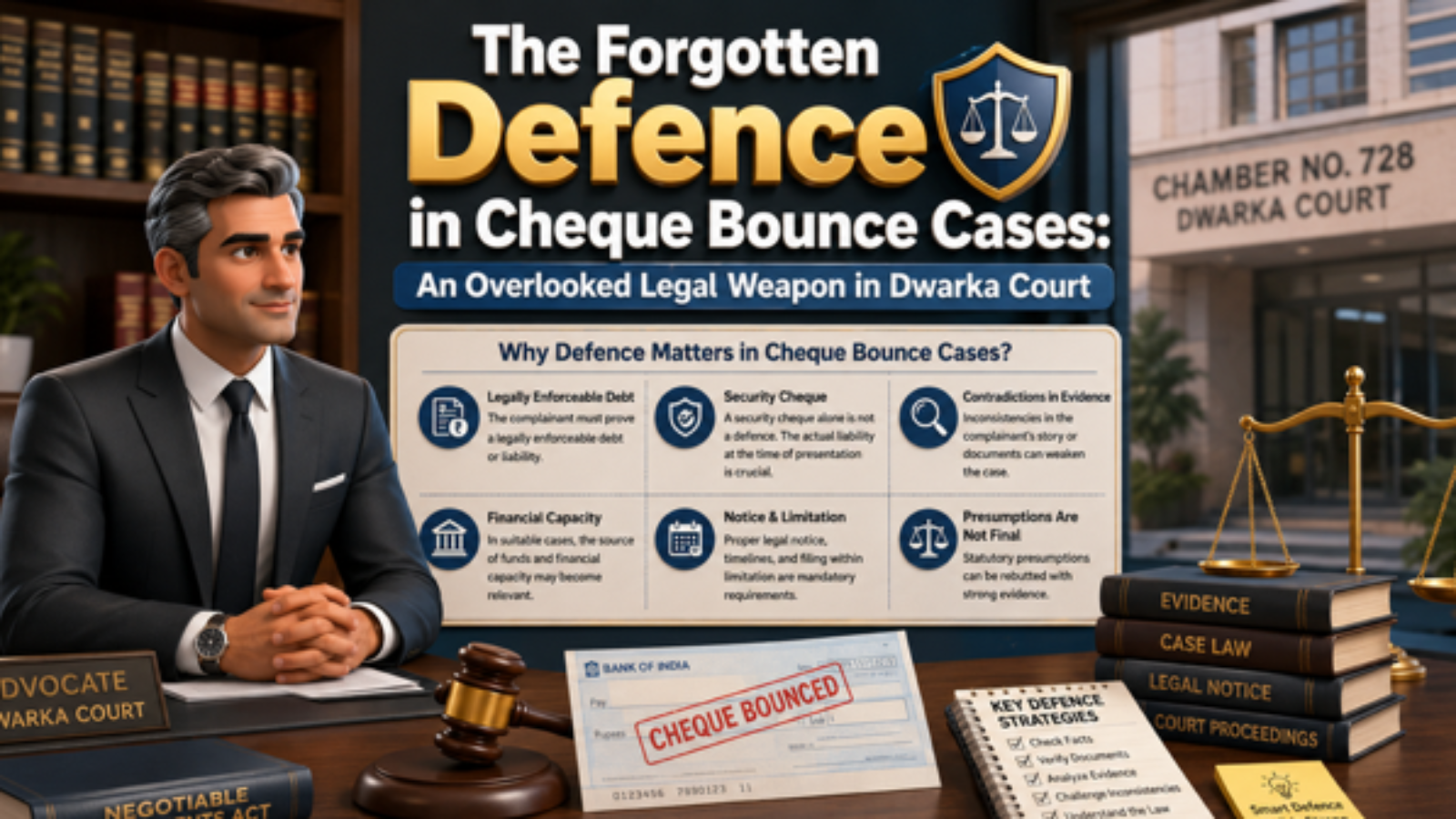
🔎 What Is the “Forgotten Defence” in a Cheque Bounce Case?
One of the most overlooked aspects of a cheque case is that the defence should not focus on the cheque alone.
The entire transaction must be examined.
For example:
- Was there actually a legally enforceable debt?
- What was the original transaction?
- Was the cheque issued for a specific liability?
- Was it a security cheque?
- Were payments already made?
- Does the complainant’s version match the documents?
- Is the amount claimed supported by records?
- Was the statutory notice properly issued?
- Was the complaint filed within the prescribed limitation?
- Are there contradictions in the complainant’s evidence?
- Does the financial capacity of the complainant become relevant on the facts of the case?
These questions can become central to the Defence in Cheque Bounce.
Importantly, a defence should be based on the actual facts and evidence of the case. A particular defence cannot be mechanically applied to every cheque matter.

🛡️ The Presumption Under the NI Act Is Important — But So Is the Defence
Section 118 and Section 139 of the Negotiable Instruments Act create important statutory presumptions in appropriate circumstances.
That is why simply saying “I did not take the money” may not always be enough.
The accused needs to understand how the presumptions operate and how they may be rebutted on the facts of the case.
The defence may rely on circumstances emerging from:
- Cross-examination
- Documents
- Bank records
- Agreements
- Invoices
- Account statements
- Emails and messages
- Prior correspondence
- Payment records
- Contradictions in testimony
- The complainant’s own documents
Therefore, a strong Defence in Cheque Bounce is usually built from the entire evidence rather than from one isolated argument.
📌 Some Often-Overlooked Defence Points
1. Legally Enforceable Debt or Liability
This is one of the most important areas.
The prosecution under Section 138 concerns a cheque issued for a legally enforceable debt or other liability.
Therefore, the nature of the underlying transaction matters.
If the defence can create a credible doubt or rebut the statutory presumption through legally admissible material, the underlying liability becomes a key issue.
2. Security Cheque — But With a Caution
The words “security cheque” do not automatically end a Section 138 case.
That is an important point.
A security cheque may still attract Section 138 if, when the cheque was presented, a legally enforceable liability had actually become due and the statutory requirements were satisfied.
Therefore, merely describing a cheque as a security cheque is not a complete defence.
The real question is:
What liability existed when the cheque was presented?
This distinction can be crucial while preparing the Defence in Cheque Bounce.
3. Contradictions in the Complainant’s Case
Sometimes the strongest defence is hidden inside the complainant’s own evidence.
Consider a case where:
- The complaint mentions one transaction date.
- The bank records indicate another timeline.
- The notice gives a different explanation.
- The affidavit contains another version.
- Cross-examination exposes an inconsistency.
Such contradictions may become relevant when the court evaluates the overall evidence.
Consequently, careful cross-examination can play a major role in the Defence in Cheque Bounce.
4. Financial Capacity and Source of Funds
In suitable cases, the complainant’s financial capacity and source of funds may become relevant.
However, this issue must be approached carefully.
It should not be raised as a routine formula in every matter. Its relevance depends on the pleadings, evidence, nature of transaction and circumstances of the case.
A good defence therefore asks:
What exactly does the complainant say happened, and what evidence supports that story?
5. Statutory Notice and Limitation
Section 138 contains specific statutory requirements concerning presentation of the cheque, dishonour, demand notice and subsequent complaint.
A careful lawyer checks the dates.
For example:
| Stage | What Should Be Examined? | Why It Matters |
| Cheque | Date, amount and validity | Establishes the basic transaction |
| Presentation | Bank records | Helps verify timely presentation |
| Dishonour | Return memo | Shows reason for dishonour |
| Notice | Date, contents and service | Statutory compliance may become relevant |
| Payment period | Statutory timeline | Determines the next legal step |
| Complaint | Filing date | Limitation must be examined |
| Evidence | Documents and testimony | Supports or challenges the case |
Thus, a Defence in Cheque Bounce should include a proper chronology.
⚖️ Why Early Legal Advice Matters Before Litigation
A common mistake is to contact a lawyer only after summons arrive.
That can make preparation harder.
At the pre-litigation stage, legal assistance may include:
✅ Examining the cheque and bank records
✅ Reviewing the underlying transaction
✅ Checking agreements and invoices
✅ Examining previous payments
✅ Reviewing the proposed legal notice
✅ Assessing the likely issues in dispute
✅ Preserving relevant documents and communications
✅ Considering whether a lawful settlement route is appropriate
Early review does not mean that litigation will always be avoided.
Instead, it helps the client understand the legal position before making an important decision.
For a person receiving a demand concerning a disputed cheque, early advice can therefore be valuable in building a sensible Defence in Cheque Bounce.
🏛️ Assistance During Ongoing Litigation
Once proceedings begin, the strategy changes.
At the litigation stage, assistance may involve:
- Reviewing the complaint
- Preparing the defence
- Appearing before the court
- Examining procedural developments
- Cross-examining witnesses
- Reviewing documents
- Addressing interim applications
- Preparing written submissions where appropriate
- Conducting final arguments
- Advising on settlement possibilities
- Considering further legal remedies when required
Every stage has its own importance.
Moreover, the defence should remain consistent from the first appearance through evidence and final arguments.
A sudden change in the defence can create avoidable difficulties.
📍 Why Local Representation in Dwarka Court Can Help
A Cheque Bounce Lawyer in Dwarka Court who regularly works in the local court environment can understand the practical workflow of proceedings.
This includes familiarity with:
- Filing procedures
- Court listings
- Procedural requirements
- Local court processes
- Filing counters and administrative systems
- Evidence stages
- Summons-related procedures
- Routine applications
- Courtroom practice
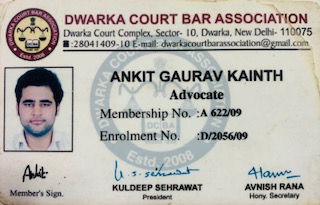
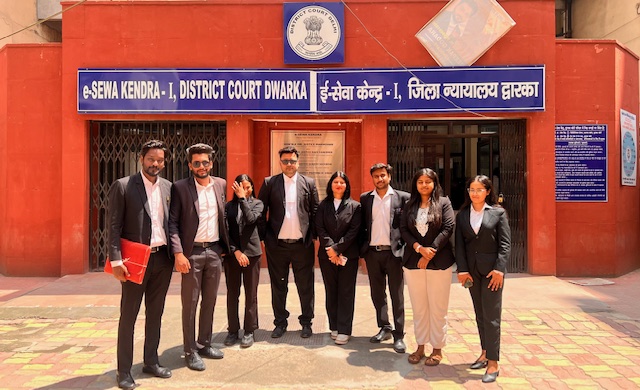
Our practice is based in Dwarka Court, Delhi, and we have 18+ years of experience in Dwarka Court.
This local familiarity can help in handling procedural work efficiently and in coordinating appearances and filings.
For clients from Dwarka Sector 6, Dwarka Sector 10, Dwarka Sector 12, Dwarka Sector 23, Janakpuri, Vikaspuri, Dwarka North, Dwarka South, Uttam Nagar, Najafgarh, Bindapur, Dabri, Palam Village, Samalka, Chhawla, Delhi Cantonment, Baba Haridas Nagar, Mohan Garden, Jaffarpur Kalan, Kapashera and nearby areas, representation near Dwarka Court may also make coordination easier.
The objective is not merely to file a case.
It is to understand the case and manage each legal stage carefully.
🧾 Building a Strong Defence: A Practical Checklist
A useful approach is to create a complete case file before deciding the final defence.
Step 1 — Prepare the Timeline
Write down:
Transaction → Cheque → Presentation → Dishonour → Notice → Payment period → Complaint → Summons → Evidence
A clear timeline can reveal inconsistencies that are difficult to notice when documents are examined separately.
Step 2 — Collect the Documents
Keep copies of:
- Cheque
- Return memo
- Legal notice
- Postal records
- Agreements
- Invoices
- Bank statements
- Receipts
- Emails
- Messages
- Account records
- Previous correspondence
Step 3 — Identify the Real Dispute
Ask one basic question:
Why did the cheque become disputed?
The answer may involve payment, accounting, consideration, goods, services, loan, security arrangement or another transaction.
Step 4 — Test the Evidence
Every major allegation should be compared with the available documentary evidence.
This is where a detailed Defence in Cheque Bounce becomes more meaningful than a generic denial.
📊 Pre-Litigation vs Litigation Assistance
| Pre-Litigation Stage | Litigation Stage |
| Examine cheque and transaction | Study complaint and evidence |
| Review legal notice | Prepare procedural response |
| Check statutory timelines | Appear before court |
| Preserve documents | Conduct cross-examination |
| Assess liability | Challenge inconsistencies |
| Explore lawful settlement | Prepare arguments |
| Identify possible defences | Continue case strategy |
| Plan documentation | Advise on further remedies |
The two stages are connected.
Therefore, information collected before litigation can later become important during evidence and arguments.
🤝 Why Client Trust Matters in Legal Practice
A legal case is not only about statutes and judgments.
It is also about communication.
Our approach focuses on:
⚖️ High Professional Standards
Each matter should receive structured legal attention and responsible professional handling.
📞 Quick Responsiveness
Clients often need timely updates. Therefore, communication should not become unnecessarily difficult.
📱 Call & Dedicated WhatsApp Support
Subject to professional and practical limits, clients can communicate through calls and dedicated WhatsApp support for case-related coordination and updates.
💰 Reasonable and Transparent Fees
Clients should understand the professional fee structure before proceeding.
📝 Proper Lawyer-Client Fee Agreements
Clear documentation helps both sides understand the agreed professional scope and fee arrangement.
🧾 Fee Receipts and Acknowledgements
Proper receipts and acknowledgements promote transparency and maintain organised records.
🤝 Honest and Fair Dealings
Legal advice should be based on the facts and applicable law, not on unrealistic promises.
These principles are especially important in criminal and financial disputes, where clients may already be under considerable stress.
👨⚖️ More Than a Cheque Case: Related Legal Disputes
A cheque dispute may sometimes arise from a wider commercial, property or recovery dispute.
Depending on the facts, legal issues may also involve:
- Civil recovery
- Commercial disputes
- Property transactions
- Business accounts
- Contractual disputes
- Loan transactions
- Partnership disputes
Accordingly, clients may require assistance from a Criminal Advocate Dwarka, Criminal Disputes Advocate Dwarka Court, Recovery Suit Counsel, Commercial Litigation Lawyer, Property Dispute Advocate, or Civil Litigation Lawyer in Delhi, depending on the nature of the dispute.
Similarly, where separate criminal proceedings arise, clients may need a Regular Bail & Anticipatory Bail Lawyer Dwarka.
The correct legal remedy depends on the facts.
🚨 Common Mistakes That Can Damage a Defence
Avoid these common mistakes:
1. Ignoring the legal notice
Do not assume that silence will automatically solve the matter.
2. Destroying or deleting messages
Relevant communications may later become important evidence.
3. Giving inconsistent explanations
The defence should be factual and consistent.
4. Relying only on oral statements
Documents can become extremely important.
5. Assuming that “security cheque” ends the case
It does not automatically do so.
6. Waiting until the final hearing
Good preparation should begin early.
7. Treating every cheque case alike
Each case has its own transaction, documents and evidence.
Therefore, a proper Defence in Cheque Bounce must be fact-specific.
The Real Legal Weapon: Preparation
The most overlooked defence is often not a single magic argument.
It is preparation.
A well-prepared defence identifies:
Facts + Documents + Timeline + Statutory Requirements + Evidence + Contradictions + Legal Position
When these elements are studied together, the court can be presented with a clear and structured defence.
That is why the Defence in Cheque Bounce should be planned from the first legal consultation rather than created at the last moment.
📍 Advocate in Dwarka Court for Cheque Bounce Matters
If you are searching for an Advocate in Dwarka Court, a Cheque Bounce Lawyer in Dwarka Court, or a Criminal Disputes Advocate Dwarka Court, the first step should be a proper review of your documents and facts.
Our office handles legal matters connected with Dwarka Court and surrounding areas of South West Delhi.
The focus remains on professional preparation, clear communication, proper documentation and lawful legal strategy.
Whether the matter originates from Janakpuri, Vikaspuri, Dwarka North, Dwarka South, Uttam Nagar, Najafgarh, Bindapur, Palam Village, Dabri, Samalka, Chhawla, Kapashera, Jaffarpur Kalan, Baba Haridas Nagar, Mohan Garden or Delhi Cantonment, the relevant question remains the same:
What does the evidence actually show?
That question should guide the defence.
🏁 Conclusion: Do Not Ignore the Forgotten Defence
A cheque bounce case is not merely a story about a dishonoured cheque.
It is a legal proceeding involving statutory requirements, presumptions, evidence, documents, timelines and the underlying transaction.
The Defence in Cheque Bounce becomes meaningful when these elements are examined together.
Therefore, do not wait until the final hearing to think about your defence.
Review the documents early.
Understand the transaction.
Check the timeline.
Study the evidence.
Identify contradictions.
Understand the statutory requirements.
Then choose a defence based on the actual facts.
In appropriate cases, what initially appears to be a straightforward cheque dispute may contain important legal questions that deserve careful examination.
📞 Legal Consultation
If you are facing a cheque bounce complaint or are involved in a related financial, commercial or criminal dispute near Dwarka Court, you may seek professional legal advice after sharing the relevant facts and documents.
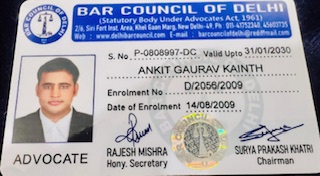
Ankit Gaurav Kainth & Associates
Advocate in Dwarka Court, Delhi
18+ Years of Practice in Dwarka Court
📞 9899085554
📞 9811885554
Professional advice should be based on the facts and documents of the individual matter. No particular result or outcome is guaranteed.
❓ Frequently Asked Questions
1. What is the most important Defence in Cheque Bounce cases?
There is no single defence that applies to every case. The defence may involve the underlying legally enforceable liability, evidence, statutory compliance, contradictions, documents, payment history and other facts of the individual matter.
2. Is a security cheque a complete defence to Section 138 NI Act?
No. Calling a cheque a “security cheque” does not automatically defeat a Section 138 case. The circumstances existing when the cheque was presented and the underlying liability must be examined.
3. Can the complainant’s financial capacity become relevant?
Yes, in appropriate factual circumstances. However, it is not a universal defence. Its relevance depends on the pleadings, evidence, transaction and circumstances of the particular case.
4. Why should I consult a lawyer before the case reaches final arguments?
Early advice can help preserve documents, understand the transaction, examine statutory timelines and develop a consistent legal strategy before evidence and arguments progress.
5. Can a local Advocate in Dwarka Court help with cheque bounce litigation?
Local court familiarity can assist with understanding filing procedures, listings, routine processes and courtroom practice. However, the strength of every case ultimately depends on its facts, evidence and applicable law.
⚠️ Legal Disclaimer
This article is intended solely for general legal information and educational purposes. It does not constitute legal advice or create an advocate-client relationship. Cheque bounce matters are fact-specific, and the applicable legal position may depend on the documents, pleadings, evidence and stage of proceedings. Readers should obtain independent professional legal advice before taking action in a specific matter. No outcome or result is guaranteed.
| Cheque Bounce Guide | What You Will Learn | Read Guide |
|---|---|---|
| Cheque Bounce Lawyer in Dwarka Court | Complete guidance on Section 138 NI Act cases, legal notices, complaints, defence, evidence, settlement and court proceedings in Dwarka Court. | Read Complete Guide → |
| Section 138 NI Act Defence | 15 important mistakes accused persons should avoid, including summons, Section 139 presumptions, Section 145(2), cross-examination, defence evidence and Section 143A. | Section 138 Defence → |
| Defence Evidence in Cheque Bounce Cases | Understand when an accused should lead defence evidence, which documents may matter and how defence evidence fits into a Section 138 trial. | Defence Evidence Guide → |
| Section 143A Interim Compensation | Understand interim compensation under Section 143A NI Act, the 20% provision and issues relevant to complainants and accused persons. | Section 143A Guide → |
| Complete Section 138 NI Act Guide | A practical overview of cheque dishonour, statutory notice, complaint filing, summons, evidence, hearings and Section 138 proceedings. | Section 138 Guide → |
| Digital Guide to Section 138 Cases | Practical defence issues involving disputed liability, blank cheques, statutory presumptions, documentary evidence and cross-examination. | Read Digital Guide → |
| Supreme Court Judgments on Cheque Bounce Acquittal | Important Supreme Court principles concerning statutory presumptions, legally enforceable debt, financial capacity and defence in cheque bounce cases. | Supreme Court Judgments → |
| Cheque Bounce Advocate in Dwarka Court | Information for complainants and accused persons seeking assistance in Section 138 NI Act proceedings before Dwarka Court, Delhi. | Cheque Bounce Advocate → |
[…] Section 138 NI Act Defence: Practical Guide for Complainants and Accused […]