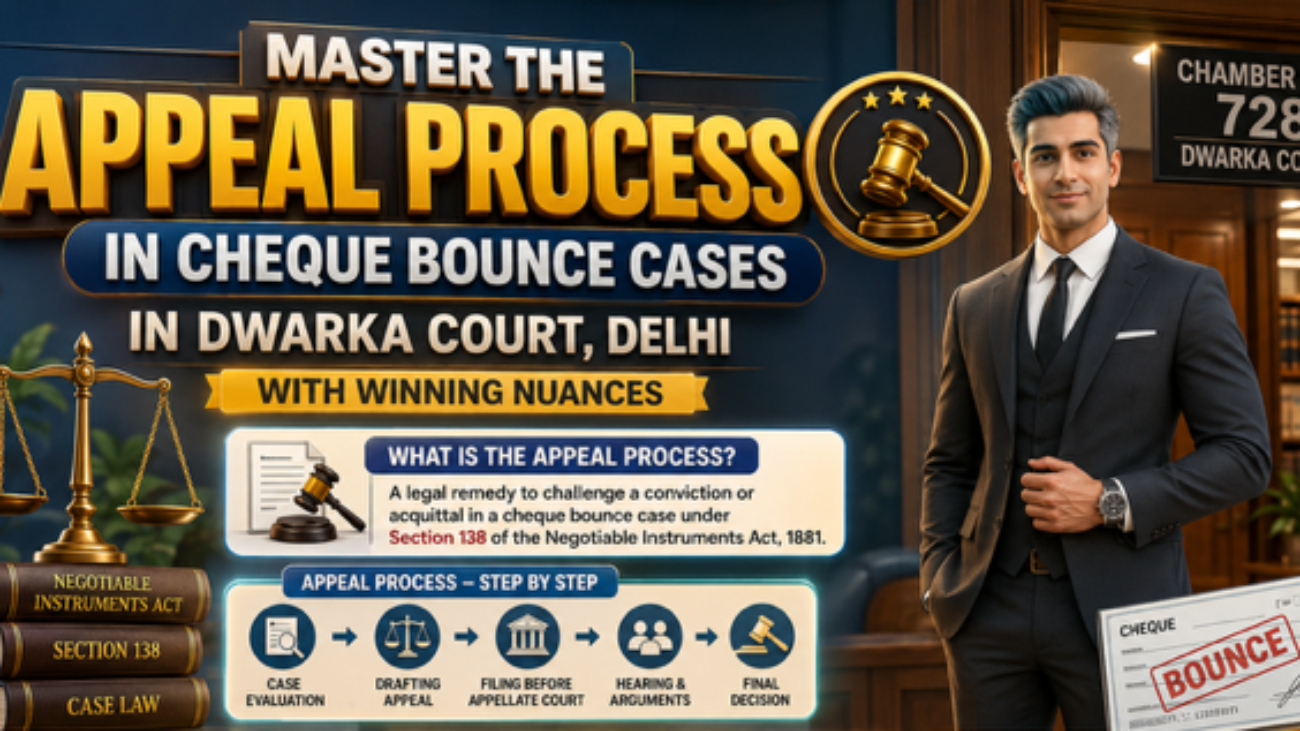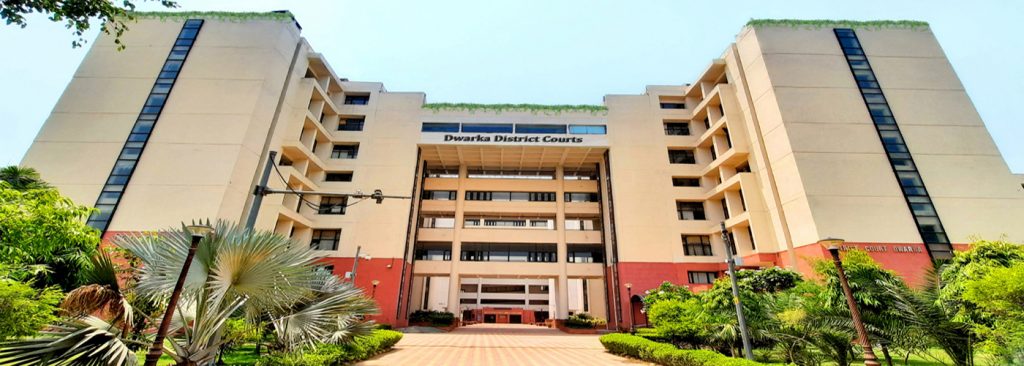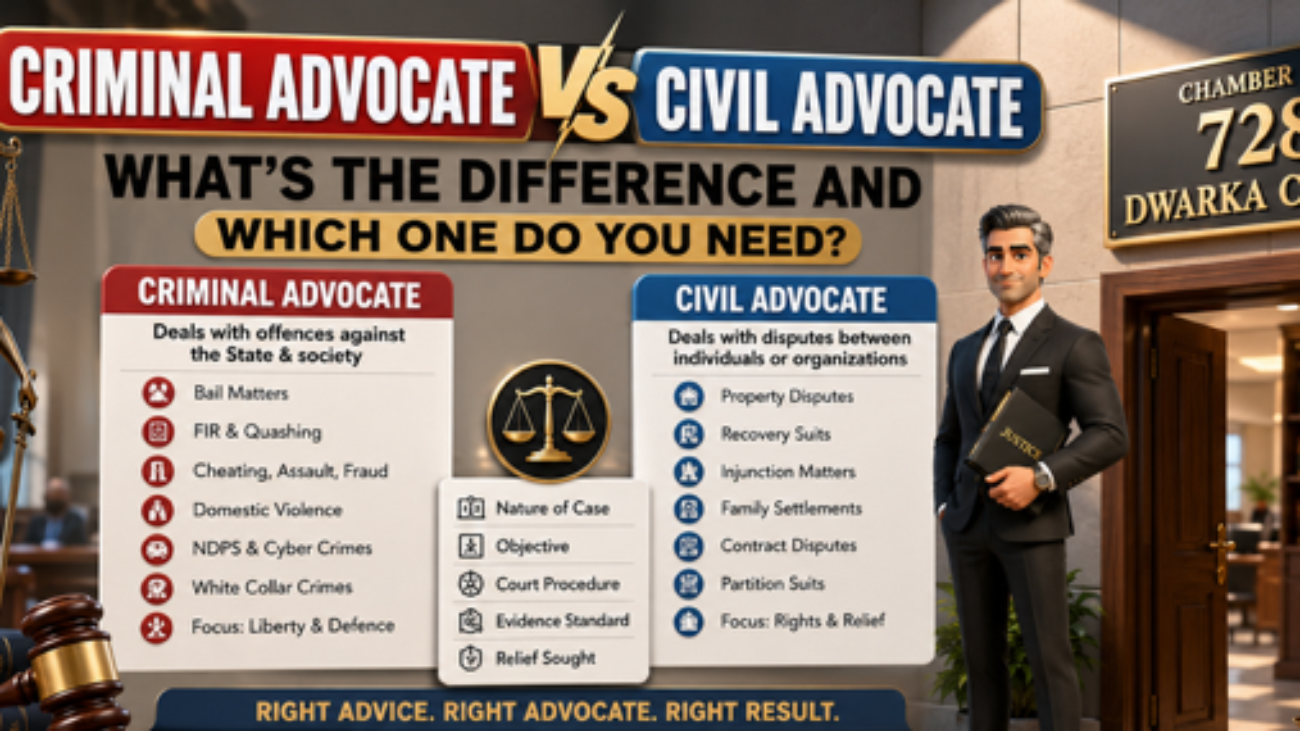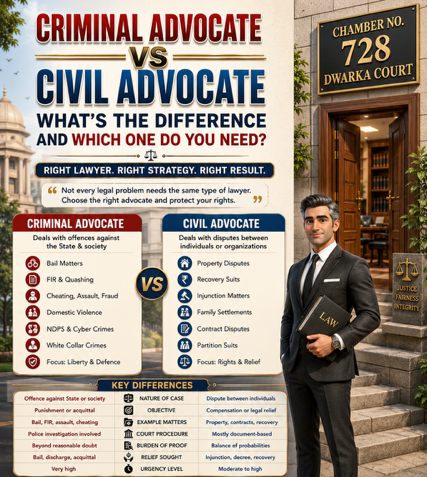


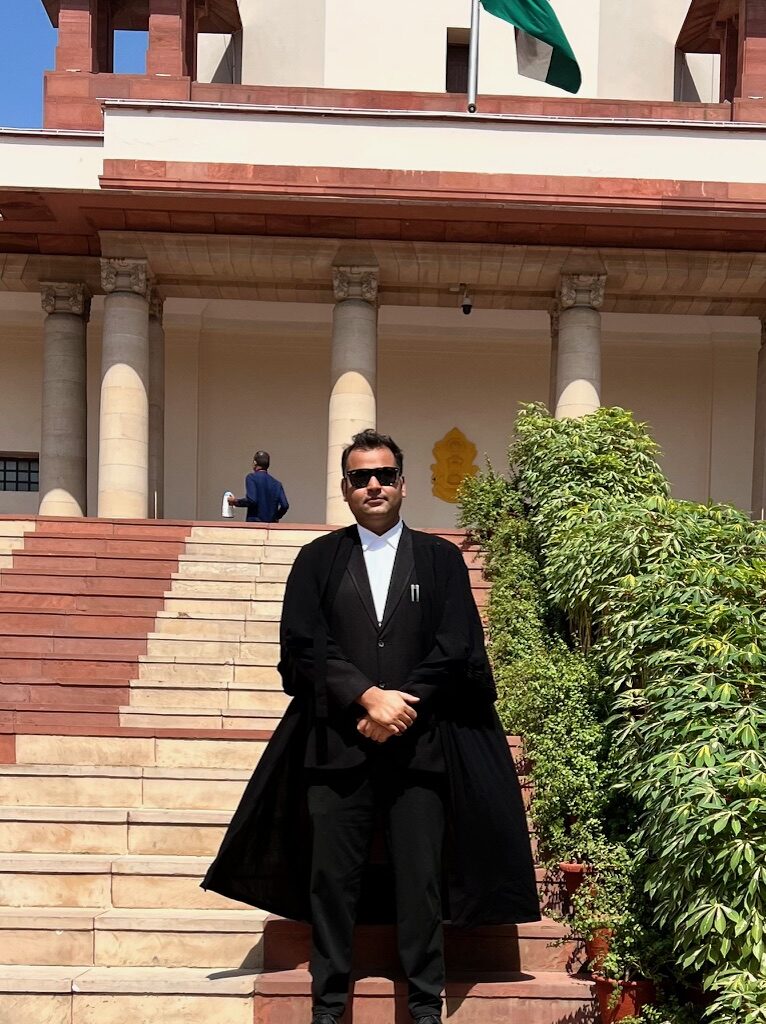
Cross-Examination Expert Advocate in Dwarka Court Delhi

Cross-Examination Expert Advocate in Dwarka Court Delhi – Masterful, Fearless & Uncompromising Courtroom Strategy

Introduction – Cross-Examination Expert Advocate in Dwarka Court Delhi

⚖️ Understanding the Power of Cross-Examination

Cross-examination is one of the most important stages of a court case. It is not simply a process of asking questions. Instead, it requires preparation, legal knowledge, careful listening, timing, and courtroom strategy.

Cross-Examination Expert Advocate in Dwarka Court Delhi prepares questions after studying the pleadings, documents, evidence, previous statements, and the testimony given by the witness.

In both civil and criminal cases, a well-planned cross-examination can help the Court understand contradictions, omissions, inconsistencies, admissions, and weaknesses in evidence. However, every case is different. Therefore, the questions must be based on the facts and evidence of that particular case.

With 18+ years of experience in Dwarka Court, our approach focuses on preparation, legal research, factual analysis, and effective courtroom representation.


🔎 What Is Cross-Examination?

Cross-examination is the questioning of a witness by the opposite party after the witness has given evidence.

The purpose may include:

  • Testing the truth and accuracy of testimony.
  • Bringing relevant facts on record.
  • Highlighting contradictions.
  • Testing the witness’s memory and knowledge.
  • Questioning disputed facts.
  • Establishing admissions where legally appropriate.
  • Testing documentary evidence.
  • Exposing inconsistencies between pleadings, statements, and testimony.
  • Challenging the reliability of evidence.

Cross-Examination Expert Advocate in Dwarka Court Delhi does not rely only on aggressive questioning. Good cross-examination is usually precise, focused, and evidence-based.


⚖️ Role of Cross-Examination in Civil & Criminal Cases

AspectCivil CasesCriminal Cases
Main purposeTest the evidence supporting the civil claim or defenceTest prosecution or defence evidence
Witness focusPlaintiff, defendant, expert, official or other witnessesComplainant, police officers, eyewitnesses, experts and other witnesses
DocumentsAgreements, invoices, property records, notices, bank records and correspondenceFIR, statements, medical records, forensic reports, seizure documents and other records
Key areasLiability, ownership, possession, contract, payment and damagesIdentity, occurrence, investigation, credibility, recovery and legal ingredients
ContradictionsPleadings, affidavits, documents and oral testimonyFIR, previous statements, investigation records and deposition
AdmissionsMay clarify liability, transactions or disputed factsMay affect credibility or particular factual issues, subject to law
StrategyFocused on issues framed by the CourtFocused on the prosecution/defence case and applicable criminal law
PreparationPleadings + documents + evidence + issuesFIR/complaint + investigation material + statements + evidence
Advocate’s roleTest the opposing evidence and protect the client’s caseTest prosecution evidence or defend the accused through lawful means

Therefore, cross-examination should always be connected with the issues and evidence before the Court.


🏛️ Cross-Examination in Civil Litigation

In civil litigation, evidence often involves documents, contracts, property records, financial transactions, correspondence, notices, and oral testimony.

Civil Litigation Lawyer in Delhi must therefore understand both the factual and documentary side of the dispute.

For example, in a property dispute, questions may relate to ownership, possession, title documents, previous transactions, notices, boundaries, or knowledge of the witness.

Similarly, in a recovery suit, the cross-examination may examine invoices, payments, acknowledgements, agreements, bank transactions, correspondence, and the basis of the alleged liability.

Property Dispute Advocate must carefully connect the witness’s answers with the documents already placed before the Court.

In commercial matters, the approach may be different. A Commercial Litigation Lawyer may need to examine contractual obligations, invoices, business records, correspondence, accounts, delivery records, or alleged breaches of contract.


⚔️ Cross-Examination in Criminal Cases

Criminal trials require careful preparation because the evidence may directly affect the liberty and legal rights of the accused.

Criminal Advocate Dwarka may cross-examine witnesses on matters such as identification, sequence of events, presence at the location, previous statements, contradictions, investigation, recovery, medical evidence, documentary material, or other relevant facts.

The purpose is not to intimidate a witness. Rather, the purpose is to test the evidence according to law.

Criminal Disputes Advocate Dwarka Court must therefore study the complete case record before deciding the questions to be asked.

In bail matters, the legal approach is different because bail proceedings are not the same as a full trial. Likewise, a Regular Bail & Anticipatory Bail Lawyer Dwarka must assess the allegations, applicable provisions, procedural history, and circumstances of the accused before advising on the appropriate legal remedy.


💼 Cross-Examination in Cheque Bounce Cases

Section 138 of the Negotiable Instruments Act involves important factual and documentary issues.

Cheque Bounce Lawyer in Dwarka Court may need to examine the complainant regarding the alleged transaction, legally enforceable liability, issuance of cheque, notice, payment, accounts, documents, and other relevant circumstances.

However, there is no universal cross-examination formula. The questions must depend upon the pleadings, documents, defence, and evidence available in the particular case.

That is why preparation matters.

Cross-Examination Expert Advocate in Dwarka Court Delhi studies the record before framing the examination strategy.


🧠 How We Prepare for Cross-Examination – Cross-Examination Expert Advocate in Dwarka Court Delhi

Effective cross-examination starts well before the witness enters the witness box.

1. Complete Case Review

We first examine the pleadings, documents, previous orders, evidence, notices, statements, and relevant case history.

2. Identify Contradictions

Next, we compare different versions of the case. This may include pleadings, affidavits, notices, statements, documents, and deposition.

3. Identify Admissions

Where appropriate, we identify facts that may be relevant to the client’s case and prepare questions around them.

4. Prepare a Questioning Strategy

The questions are then arranged around the relevant issues. This helps maintain focus during the hearing.

5. Review Documents

Documents are carefully examined so that relevant questions can be put to the witness in the proper context.

6. Adapt During Evidence

Cross-examination is not always a fixed script. A witness’s answer may create a new relevant line of questioning. Therefore, an experienced Advocate in Dwarka Court Delhi must listen carefully and respond appropriately.


🏛️ Pre-Litigation Legal Assistance

Our assistance does not begin only after a case is filed.

At the pre-litigation stage, we help clients understand their legal position before they decide whether litigation is necessary.

This may include:

  • Reviewing agreements and documents.
  • Examining potential claims and defences.
  • Assessing available evidence.
  • Reviewing legal notices.
  • Advising on possible civil or criminal remedies.
  • Identifying documentation gaps.
  • Discussing settlement or negotiation options.
  • Preparing for possible litigation.

This early assessment can help a client make a more informed legal decision.


⚖️ Assistance During Ongoing Litigation

Once litigation begins, preparation continues.

As a Cross-Examination Expert Advocate in Dwarka Court Delhi, our assistance may include reviewing the evidence, preparing for witness examination, studying previous orders, examining documents, preparing legal submissions, and representing the client during court proceedings.

The same approach applies across suitable civil and criminal matters.

For example, a Recovery Suit Counsel may focus on documentary and financial evidence, while a Property Dispute Advocate may concentrate on title, possession, transactions, and supporting documents.


📍 Why Choose a Local Advocate in Dwarka Court?

Local court experience can make a practical difference.

We are local advocates practising at Dwarka Court, Delhi. Our familiarity with the Court’s filing procedures, case-management processes, courtroom practices, listing system, and day-to-day working environment helps us handle matters efficiently.

For clients who need an Advocate in Dwarka Court Delhi, local accessibility can also make communication and coordination easier.

Our practice covers matters arising from and around:

Dwarka Sector 6, Sector 10, Sector 12, Dwarka Sector-23, Dwarka North, Dwarka South, Janakpuri, Vikaspuri, Uttam Nagar, Najafgarh, Delhi Cantonment, Chhawla, Bindapur, Baba Haridas Nagar, Mohan Garden, Palam Village, Samalka, Dabri, Jaffarpur Kalan, Kapashera and other nearby areas.

For people searching for a lawyer near Dwarka Court, local professional presence can be especially useful when urgent filing, documentation, consultation, or representation is required.


🤝 Building Client Trust Through Professional Standards

Legal representation is based on trust.

Our approach therefore focuses not only on courtroom advocacy but also on professional client service.

✅ Quick Responsiveness

Clients can communicate through available channels for case-related updates and coordination.

📞 Call & Dedicated WhatsApp Support

Where appropriate, dedicated WhatsApp communication helps clients share documents and receive updates without unnecessary delay.

💰 Reasonable & Transparent Fees

Fees are discussed clearly so that clients understand the professional charges applicable to their matter.

📄 Lawyer-Client Fee Agreement

Where applicable, professional engagements are documented through a proper Lawyer-Client Fee Agreement.

🧾 Fee Receipts & Acknowledgements

Fee payments and relevant transactions are acknowledged appropriately, supporting transparency between the advocate and client.

🤝 Honest & Fair Dealings

We believe legal advice should be based on the facts, applicable law, and professional ethics. Clients should receive a realistic assessment rather than unrealistic assurances.


🔥 What Makes Cross-Examination Effective?

Cross-Examination Expert Advocate in Dwarka Court Delhi should combine several skills:

  • Strong preparation.
  • Knowledge of evidence and procedure.
  • Careful document review.
  • Active listening.
  • Precise questioning.
  • Understanding of the pleadings.
  • Ability to identify contradictions.
  • Proper courtroom conduct.
  • Strategic thinking.
  • Patience and discipline.

Moreover, cross-examination is not about asking the maximum number of questions. The quality and relevance of questions matter more than their quantity.


📚 Cross-Examination Requires Preparation, Not Improvisation

A common mistake is to treat cross-examination as spontaneous questioning.

However, effective preparation begins much earlier.

The advocate should understand the client’s case, the opponent’s case, the documents, the witness, the legal issues, and the evidence already on record.

Therefore, a Cross-Examination Expert Advocate in Dwarka Court Delhi approaches every important witness with a structured strategy while remaining flexible enough to respond to unexpected answers.


🌟 Experienced Representation at Dwarka Court

With 18+ years of experience in Dwarka Court, our practice involves assisting clients in civil, criminal, property, recovery, commercial, cheque bounce, and other litigation-related matters.

Depending on the facts, our professional assistance may involve a Criminal Advocate DwarkaCivil Litigation Lawyer in DelhiCheque Bounce Lawyer in Dwarka CourtProperty Dispute AdvocateRecovery Suit CounselCommercial Litigation Lawyer, or Criminal Disputes Advocate Dwarka Court.

The appropriate legal strategy always depends upon the facts, documents, evidence, and applicable law.


❓ Frequently Asked Questions – Cross-Examination Expert Advocate in Dwarka Court Delhi

1. What is cross-examination in a court case?

Cross-examination is the questioning of a witness by the opposite party after the witness has given evidence. It is used to test the witness’s testimony and relevant evidence.

2. Why is cross-examination important in criminal cases?

It may help test the reliability, consistency, and factual basis of testimony. The exact approach depends on the allegations, evidence, and issues involved.

3. Is cross-examination important in civil cases?

Yes. It can be important where factual disputes depend upon witness testimony, documents, transactions, ownership, possession, liability, or other contested matters.

4. Can an advocate prepare questions before cross-examination?

Yes. An advocate can study the pleadings, documents, previous statements, evidence, and legal issues and prepare a structured questioning strategy.

5. Can I consult an Advocate in Dwarka Court Delhi before filing a case?

Yes. Legal consultation at the pre-litigation stage can help you understand possible remedies, evidence, documentation, risks, and the appropriate legal course before commencing litigation.


🏁 Conclusion

Cross-examination is a skilled part of litigation. It requires preparation, legal understanding, patience, and disciplined questioning.

Whether the matter involves a civil dispute, property litigation, recovery claim, commercial dispute, cheque bounce complaint, or criminal proceeding, the evidence must be examined carefully.

Cross-Examination Expert Advocate in Dwarka Court Delhi can assist in analysing the record, preparing the questioning strategy, and representing the client’s interests within the framework of law and professional ethics.

If you are looking for an Advocate in Dwarka Court Delhi, especially for litigation involving witness examination or contested evidence, early legal consultation can help you understand the available legal options.

📞 Legal Consultation & Representation

Ankit Gaurav Kainth & Associates
Advocate in Dwarka Court Delhi
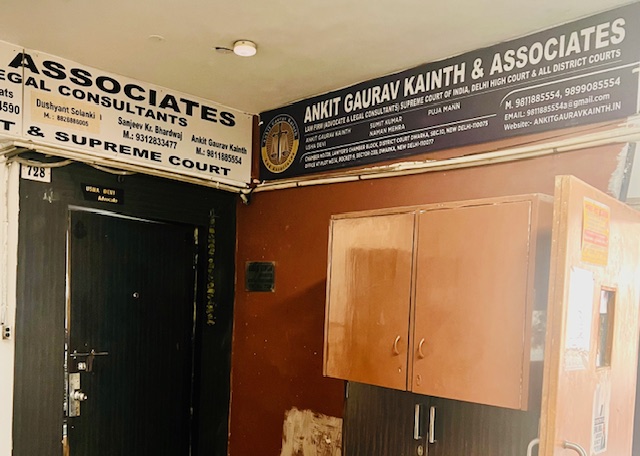
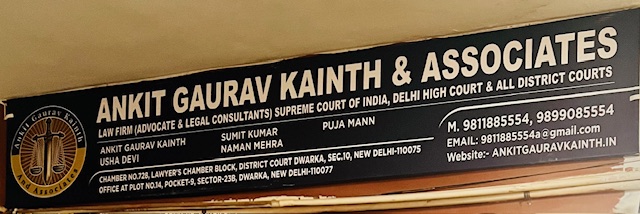
Chamber No. 728, Lawyers Chambers Block, District Court Dwarka, Sector-10, New Delhi

📞 9899085554
📞 9811885554

Consultation and representation are subject to the facts and circumstances of each matter. No outcome or result is guaranteed. This article is intended for general legal information and should not be treated as a substitute for case-specific legal advice.


Written by Advocate Ankit Gaurav Kainth, Dwarka Court | 18+ Years of Legal Experience

Section 138 NI Act Defence and cheque bounce lawyer in Dwarka Court

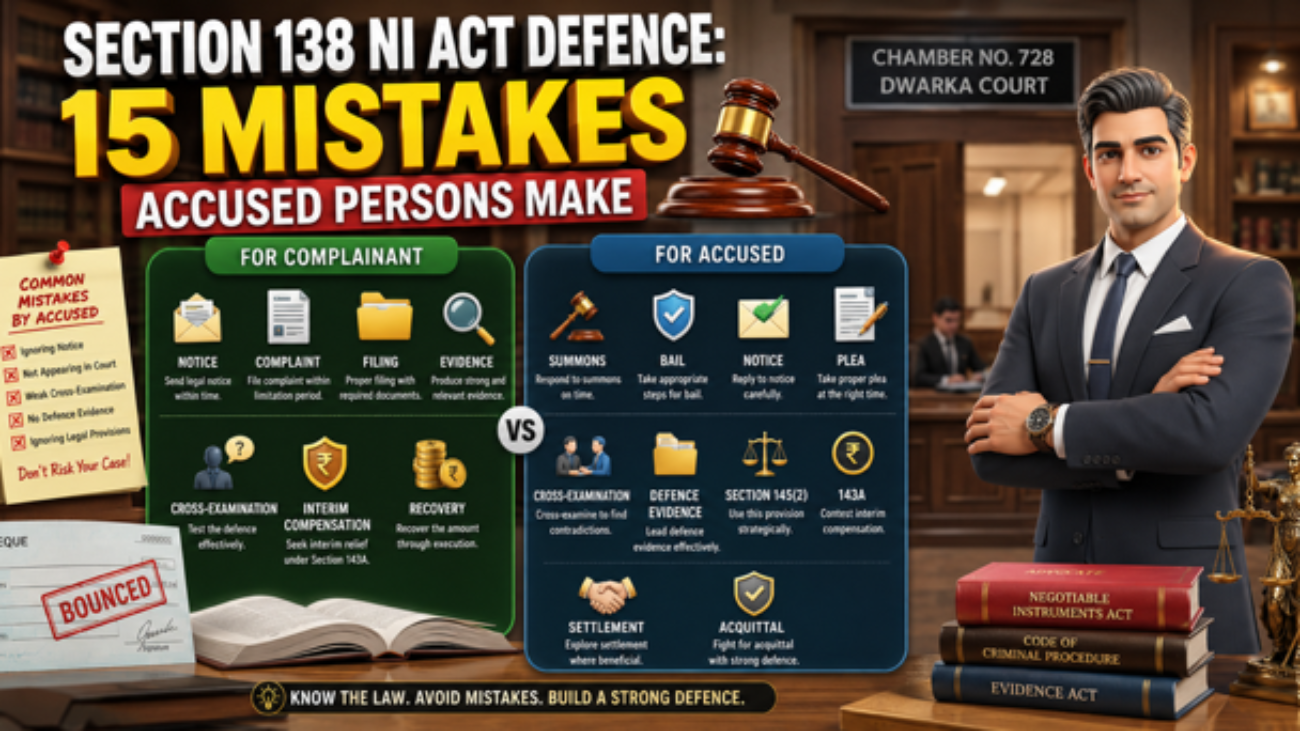
Section 138 NI Act Defence: 15 Mistakes Accused Persons Make

Section 138 NI Act Defence requires careful preparation, timely action and a proper understanding of evidence. A cheque may look like a simple piece of paper, but once it is dishonoured, the dispute can become legally and factually complex.

For a complainant, the case requires more than merely proving that a cheque bounced. For an accused person, receiving a legal notice or summons should never be treated casually. The notice, pleadings, documents, presumptions, cross-examination and defence evidence can all influence the final outcome.

At Ankit Gaurav Kainth & Associates, we assist clients in cheque dishonour matters before the District Court, Dwarka, Sector 10, New Delhi. With 18+ years of litigation experience, our work includes pre-litigation advice, statutory notices, filing, evidence, cross-examination, defence strategy, bail, settlement and final arguments in matters under Section 138 of the Negotiable Instruments Act, 1881.

⚖️ Chamber No. 728, 7th Floor, Lawyers Chambers Block, District Court Dwarka, Sector 10, New Delhi


What Is a Section 138 NI Act Case?

Section 138 of the Negotiable Instruments Act, 1881 deals with dishonour of a cheque for insufficiency of funds or where the amount exceeds the arrangement with the bank, subject to the statutory requirements.

The Supreme Court has reiterated that the basic statutory requirements include presentation of the cheque within its validity period, a demand for payment through the statutory notice and failure of the drawer to make payment within 15 days of receiving the demand. The complaint is ordinarily required to be filed within one month from the date the cause of action arises, subject to the statutory provision for condonation of delay. (SCI API)

Section 138 NI Act Defence therefore begins much earlier than the final arguments. It can begin when the cheque is issued, when the transaction is disputed, when the bank returns the cheque, or when a legal notice is received.

15 Mistakes Accused Persons Commonly Make

1. Ignoring the Legal Notice

One of the biggest mistakes is simply ignoring the statutory demand notice.

A notice under Section 138 is not the final court case. It is an important opportunity to examine the transaction, liability, cheque, bank return memo, documents and the complainant’s allegations.

Better approach

An accused should immediately preserve:

  • Copy of the cheque
  • Bank statements
  • Account statements
  • Agreements
  • Invoices
  • Receipts
  • WhatsApp messages
  • Emails
  • Payment records
  • Previous correspondence

A properly prepared response may become important later during the proceedings.

2. Assuming That a Bounced Cheque Automatically Means Conviction

A cheque dishonour does not mean that the accused should surrender all legal rights.

The prosecution must satisfy the statutory requirements. At the same time, Sections 118 and 139 create statutory presumptions in appropriate circumstances. Therefore, the accused should not rely upon a vague denial alone.

A strong Section 138 NI Act Defence examines both the complainant’s evidence and the surrounding transaction.

3. Failing to Understand the Presumption Under Section 139

Many accused persons say:

“The cheque was not issued for a debt, so the case is false.”

That statement alone may not be sufficient.

The Supreme Court has recognised the statutory presumption in favour of the holder and explained that the accused has to raise a legally sustainable defence to rebut the presumption. The nature and strength of that defence depend upon the facts and evidence of the case. (SCI API)

Therefore, the defence should be evidence-based.

4. Missing the Summons

Once a court summons is received, ignoring it can make the situation more difficult.

The accused should immediately consult a Section 138 NI Act Defence lawyer and understand:

  • Case number
  • Court
  • Date
  • Allegations
  • Amount involved
  • Stage of proceedings
  • Whether appearance is required
  • Bail/bond requirements
  • Available procedural remedies

A timely appearance and appropriate application can prevent avoidable complications.

5. Treating Bail as an Unimportant Formality

Although Section 138 proceedings have their own procedural characteristics, an accused should not assume that court appearance can simply be ignored.

The lawyer should examine the summons, stage of the proceedings and applicable procedure and take appropriate steps for appearance and bail/bond wherever required.

6. Giving an Emotional or Inaccurate Reply

A legal notice should not be answered with anger.

Statements made in correspondence may later become relevant to the dispute. Therefore, the reply should be factual, measured and legally considered.

For example, an accused should not make unnecessary admissions merely to end an argument over WhatsApp or email.

7. Not Using Section 145(2) Strategically

Section 145(2) of the NI Act can be important in appropriate cases because the accused may seek the court’s permission to summon and examine a person who has given evidence by affidavit.

This can become particularly significant where the complainant’s version needs detailed testing through cross-examination.

A good Section 138 NI Act Defence therefore identifies contradictions, missing documents, financial inconsistencies and weaknesses in the complainant’s evidence before cross-examination begins.

8. Treating Cross-Examination as a Routine Exercise

Cross-examination is often one of the most important stages of a cheque dispute.

Questions may concern:

  • Source of funds
  • Date and purpose of transaction
  • Existing liability
  • Accounts
  • Invoices
  • Agreements
  • Previous payments
  • Business records
  • Delivery of goods/services
  • Authority to issue documents
  • Cheque issuance
  • Security-cheque allegations
  • Contradictions between notice, complaint and affidavit

A lawyer handling cheque disputes must understand the documents before asking questions.

9. Failing to Prepare Defence Evidence

Some accused persons rely only upon cross-examination.

That can be risky.

Where appropriate, the defence may require documentary or oral evidence to establish the accused’s version.

Section 138 NI Act Defence should therefore be planned from the beginning rather than invented at the final-argument stage.

10. Ignoring Section 143A Interim Compensation

Section 143A permits the court, in specified circumstances, to order interim compensation to the complainant. The statutory provision states that such compensation shall not exceed 20% of the cheque amount and provides the applicable payment and repayment framework. (India Code)

Therefore, an accused should understand the implications of an application under Section 143A and contest it on legally available grounds where appropriate.

11. Assuming Every Defence Works in Every Case

Common arguments include:

  • “It was a security cheque.”
  • “The cheque was blank.”
  • “The cheque was misused.”
  • “I did not fill in the cheque.”
  • “There was no written agreement.”
  • “The debt was not legally recoverable.”

However, no single statement automatically results in acquittal.

The defence must be supported by the facts, documents and evidence.

12. Not Examining the Underlying Transaction

The cheque is only one part of the dispute.

The lawyer should examine the transaction that allegedly created the liability.

For example:

Loan → repayment → cheque

or

Goods/services → invoice → payment dispute → cheque

or

Business arrangement → settlement → cheque → dishonour

The underlying transaction may determine the most effective line of defence.

13. Waiting Until Final Arguments to Build the Defence

This is a serious mistake.

A defence cannot normally be reconstructed at the end of the trial.

The strategy should begin with:

Summons → Bail/Appearance → Notice → Plea → Section 145(2), where applicable → Cross-examination → Defence Evidence → Final Arguments

That is why choosing an experienced Section 138 NI Act Defence lawyer at an early stage can be important.

14. Rejecting Settlement Without Examining the Economics

Not every cheque dispute must necessarily end with a prolonged trial.

Depending upon the facts, parties may explore settlement or compounding.

Section 147 of the NI Act makes offences under the Act compoundable, subject to the applicable legal process and court considerations.

A sensible lawyer should explain the advantages and disadvantages of settlement rather than pressuring a client into one outcome.

15. Assuming That Every Case Will End in Conviction

A criminal complaint under Section 138 must be decided on the evidence and applicable law.

The accused is entitled to contest the allegations.

Where the prosecution fails to establish the case in accordance with law, an acquittal may follow.

Therefore, the objective of a Section 138 NI Act Defence is not to create artificial technical objections. It is to present a legally sustainable defence based upon the actual transaction, documents, statutory requirements and evidence.


⚖️ For the Complainant: How to Build a Strong Section 138 Case

A complainant should look at the same 15 mistakes from the opposite perspective.

1. Notice

Issue the statutory demand notice within the prescribed period after receiving information regarding dishonour.

The notice should accurately identify the cheque, dishonour, amount and demand for payment.

The drawer ordinarily gets 15 days from receipt of the demand to make payment before the cause of action arises. (SCI API)

2. Complaint

A Section 138 complaint must be in writing and filed by the payee or holder in due course in accordance with Section 142.

The complaint should be drafted carefully and supported by the necessary documents and averments. (India Code)

3. Filing

Limitation is critical.

The complaint is ordinarily to be filed within one month from the date on which the cause of action arises, although the statute permits the court to take cognizance of a delayed complaint where sufficient cause is shown. (India Code)

Jurisdiction must also be examined under Section 142(2).

4. Evidence

Keep the original cheque, return memo, notice, postal/courier records, transaction documents, bank statements and relevant correspondence properly organised.

5. Cross-Examination

The complainant should prepare for questions concerning the transaction, financial capacity where relevant, source of funds, documents, liability and circumstances surrounding issuance of the cheque.

6. Interim Compensation

Where legally applicable, the complainant may consider seeking relief under Section 143A. The statute permits interim compensation of up to 20% of the cheque amount in the circumstances specified by the provision. (India Code)

7. Recovery

A successful prosecution may involve fine/compensation consequences. The complainant should therefore take advice regarding the appropriate legal steps for recovery and execution of the monetary relief granted by the court.

🛡️ For the Accused: How to Avoid These Mistakes

If you have received a cheque-bounce notice or summons, do not panic.

Instead:

✅ Preserve every document.

✅ Obtain the complete case file.

✅ Check the cheque and bank return memo.

✅ Examine the underlying transaction.

✅ Review the statutory notice.

✅ Prepare the reply carefully.

✅ Appear before the court when required.

✅ Seek appropriate bail/bond relief where applicable.

✅ Consider Section 145(2) where the facts justify it.

✅ Prepare cross-examination questions from the documents.

✅ Identify contradictions.

✅ Prepare defence evidence where necessary.

✅ Understand Section 143A.

✅ Consider settlement only after understanding its legal and financial consequences.

✅ Prepare final arguments from the evidence already on record.

This is the practical foundation of a Section 138 NI Act Defence.


📅 What Happens at Each Stage of a Section 138 Case?

Actual Practical Timeline

Stage 1 — Cheque Issued

The drawer issues the cheque towards an alleged legally enforceable liability.

⬇️

Stage 2 — Cheque Presented

The payee presents the cheque within the applicable validity period.

In practice, bank rules generally mean that cheques are presented within the current three-month validity period.

⬇️

Stage 3 — Dishonour

The bank returns the cheque unpaid.

The complainant receives information regarding dishonour.

⬇️

Stage 4 — Statutory Notice

The payee issues the demand notice within the statutory period.

⬇️

Stage 5 — 15-Day Payment Window

The drawer gets 15 days from receipt of the demand notice to make payment.

If payment is made within the statutory period, the Section 138 offence does not arise on that dishonour in the ordinary course.

⬇️

Stage 6 — Cause of Action

If payment is not made within the 15-day period, the cause of action arises.

⬇️

Stage 7 — Complaint

The complainant files the written complaint within the statutory limitation period, ordinarily one month from the cause of action, subject to the statutory power to condone delay for sufficient cause. (India Code)

⬇️

Stage 8 — Court Proceedings

The court examines the complaint and proceeds according to the applicable procedure.

⬇️

Stage 9 — Summons

The accused is called before the court.

⬇️

Stage 10 — Appearance / Bail

The accused takes appropriate steps for appearance and bail/bond as advised.

⬇️

Stage 11 — Notice / Plea

The accused responds to the accusation in accordance with the procedure applicable to the case.

⬇️

Stage 12 — Evidence

The complainant’s evidence is considered.

⬇️

Stage 13 — Cross-Examination

The accused may challenge the complainant’s evidence through appropriate cross-examination, including through Section 145(2) procedure where applicable.

⬇️

Stage 14 — Defence Evidence

Where necessary, the accused presents defence evidence.

⬇️

Stage 15 — Final Arguments

Both sides present their legal and factual submissions.

⬇️

Stage 16 — Judgment

The court decides the matter based upon the pleadings, evidence, presumptions and applicable law.

The consequences of conviction under Section 138 can include imprisonment up to two years, fine up to twice the amount of the cheque, or both, subject to the statute and the facts of the case.


⚖️ Why Choose an Experienced Cheque Bounce Advocate in Dwarka Court?

Clients searching online for a Best Cheque Bounce Advocate in Dwarka Court often see multiple listings. That can create another important question:

“How do I choose the right advocate for my cheque-bounce case?”

The answer should not be based only on advertisements or rankings.

Look at:

  • Experience in Section 138 litigation
  • Understanding of evidence
  • Cross-examination skills
  • Knowledge of local court procedure
  • Ability to analyse documents
  • Communication with clients
  • Transparent fee structure
  • Professional conduct
  • Case-specific legal strategy

With 18+ years of litigation experience, Ankit Gaurav Kainth & Associates assists clients in cheque disputes before Dwarka Court.

Our work can cover the complete litigation cycle:

Legal Notice → Filing → Summons → Bail/Appearance → Plea → Evidence → Section 145(2) → Cross-Examination → Defence Evidence → Settlement → Final Arguments → Judgment

We assist both complainants and accused persons, depending upon the facts and professional engagement.


📍 Local Cheque Bounce Advocate in Dwarka Court

Our chamber is located at:

Chamber No. 728, 7th Floor, Lawyers Chambers Block, District Court Dwarka, Sector 10, New Delhi.

Being based at Dwarka Court provides practical familiarity with filing procedures, court processes and day-to-day working systems.

We assist clients from Dwarka Sector 6, Sector 10, Sector 12, Dwarka Sector 23, Dwarka North, Dwarka South, Janakpuri, Vikaspuri, Uttam Nagar, Najafgarh, Bindapur, Dabri, Palam Village, Mohan Garden, Chhawla, Baba Haridas Nagar, Delhi Cantonment, Samalka, Jaffarpur Kalan and Kapashera, as well as clients from other parts of New Delhi and India.

Clients who live outside Delhi can also discuss their matter remotely before making arrangements for necessary court appearances.

🤝 Client Trust, Communication & Transparency

Legal representation is not only about arguing a case.

It is also about communication and professional responsibility.

Our client-handling approach includes:

📞 Quick responsiveness

📱 Availability on call and dedicated WhatsApp communication

⚖️ Case-specific legal advice

📄 Proper Lawyer-Client Fee Agreements

🧾 Fee receipts and acknowledgements

💰 Reasonable and transparent fee structure

🤝 Honest and fair professional dealings

Clients should know what work is being undertaken, what the expected stages are and what professional fees are applicable.


🔍 Why Section 138 NI Act Defence Requires Experience

A cheque-bounce case can involve a combination of criminal procedure, documentary evidence, commercial transactions, statutory presumptions and financial records.

Therefore, the quality of preparation matters.

Top Cheque Bounce lawyer in Dwarka Court should be able to examine the entire transaction rather than looking only at the dishonoured cheque.

Similarly, someone searching for the Best 138 NI Act Lawyer in Dwarka should evaluate actual litigation experience, evidence handling and courtroom strategy.

Criminal Advocate for Cheque Bounce in Dwarka Court should also understand that Section 138 proceedings have their own statutory framework and cannot be approached like an ordinary criminal complaint.

For clients comparing a Best Cheque Bounce Disputes Advocate Dwarka Court, the most useful question is not simply “Who ranks first on Google?” It is:

“Who can understand my documents, identify the real legal issues and represent my case effectively?”

⚠️ Important Legal Note

Every Section 138 matter depends upon its own facts, documents, dates, bank records and procedural history.

The information in this article is intended for general legal education and should not be treated as case-specific legal advice. Limitation, jurisdiction, notice, service, evidence, bail, interim compensation and defence strategy should be assessed from the actual case record.

The law may also change through legislation and judicial interpretation. Therefore, obtain case-specific advice before taking legal action.


📞 Need Assistance in a Cheque Bounce Case?

If you are a complainant seeking assistance with:

Notice • Complaint • Filing • Evidence • Cross-Examination • Interim Compensation • Recovery

or an accused seeking assistance with:

Summons • Bail • Notice • Plea • Section 145(2) • Cross-Examination • Defence Evidence • Section 143A • Settlement • Acquittal

you may contact:

Ankit Gaurav Kainth & Associates

⚖️ Chamber No. 728, 7th Floor, Lawyers Chambers Block, District Court Dwarka, Sector 10, New Delhi

📞 9899085554
📞 9811885554

Section 138 NI Act Defence begins with understanding the case early, preserving the evidence and preparing the right strategy.


Frequently Asked Questions

1. What is Section 138 of the NI Act?

Section 138 deals with cheque dishonour for insufficiency of funds or where the cheque exceeds the arrangement with the bank, subject to the statutory requirements.

2. How much time does the drawer get after receiving the legal notice?

The drawer ordinarily gets 15 days from receipt of the demand notice to make payment. (SCI API)

3. When should a Section 138 complaint be filed?

The complaint is ordinarily required to be filed within one month from the date the cause of action arises, subject to statutory provisions concerning condonation of delay. (India Code)

4. Can an accused defend a cheque-bounce case?

Yes. The accused can contest the complaint and challenge the complainant’s case through legally available defences and evidence.

5. What is Section 145(2) NI Act?

Section 145(2) provides a mechanism through which the accused or prosecution may seek the court’s permission to summon and examine a person who has given evidence on affidavit, subject to the statutory framework.

6. What is Section 143A?

Section 143A permits the court, in specified circumstances, to direct the drawer to pay interim compensation of up to 20% of the cheque amount. (India Code)

7. Can a cheque-bounce case be settled?

Offences under the NI Act are compoundable under Section 147, subject to the applicable procedure and circumstances.

8. Is cross-examination important in a Section 138 case?

It can be extremely important because the complainant’s version, documents and underlying transaction may need to be tested through evidence.

9. Can a cheque-bounce case end in acquittal?

Yes. The court decides the case on the evidence and applicable law. Where the prosecution fails to establish the case in accordance with law, an acquittal may follow.

10. How do I choose a cheque-bounce advocate in Dwarka Court?

Consider litigation experience, knowledge of Section 138 procedure, evidence and cross-examination skills, communication, professional transparency and familiarity with the relevant court processes.


The 15 Mistakes — At a Glance

#Mistake by AccusedBetter Approach
1Ignoring legal noticeExamine it immediately
2Assuming dishonour means automatic convictionAnalyse statutory requirements
3Ignoring Section 139 presumptionBuild an evidence-based defence
4Ignoring summonsTake timely legal action
5Treating bail casuallyObtain appropriate procedural advice
6Sending an emotional replySend a carefully considered response
7Ignoring Section 145(2)Examine whether it is useful in the case
8Treating cross-examination casuallyPrepare questions from documents and pleadings
9Failing to prepare defence evidenceIdentify evidence early
10Ignoring Section 143AUnderstand and respond to interim-compensation proceedings
11Relying on one generic defenceBuild a fact-specific defence
12Ignoring underlying transactionAnalyse the complete transaction
13Waiting until final argumentsPrepare from the beginning
14Rejecting settlement automaticallyAssess legal and financial consequences
15Assuming conviction is inevitableContest the case through evidence and law

Written by Advocate Ankit Gaurav Kainth, Dwarka Court | 18+ Years of Legal Experience

Experienced Advocate in Dwarka Court providing legal guidance and representation

Why an Experienced Advocate Is Your Legal Shield—and Your Peace of Mind

INTRODUCTION – Experienced Advocate

Legal problems rarely begin inside a courtroom. They often begin with a notice, a police complaint, a payment dispute, a property disagreement, a matrimonial conflict, or a simple legal question. At that stage, the right advice can prevent a small issue from becoming a long legal battle.

That is why choosing an Experienced Advocate matters.

An Experienced Advocate does more than argue a case. The role includes understanding the facts, identifying legal risks, preparing the right strategy, explaining realistic options, and helping a client make an informed decision.

For clients dealing with courts in Delhi, having an Experienced Advocate who understands the local court system can also make communication and case management more efficient.


⚖️ What Does an Experienced Advocate Really Offer?

Experience is not only about the number of years spent in court. It is also about learning how different legal situations develop.

An Experienced Advocate knows that every case has its own facts. Therefore, a good legal strategy should never be based only on templates or assumptions.

Experience helps a lawyer to:

  • Identify important facts at an early stage.
  • Understand possible legal risks.
  • Select the appropriate legal remedy.
  • Prepare documents and pleadings carefully.
  • Assess whether litigation can be avoided.
  • Handle procedural requirements.
  • Prepare clients for hearings and evidence.
  • Respond to developments during a case.
  • Explain legal options in simple language.
  • Maintain proper communication throughout the matter.

With 18+ years of experience in Dwarka Court, our approach is based on professional preparation, clear communication and responsible legal advice.


🛡️ Why Legal Assistance Should Begin Before Litigation

Many clients approach a lawyer only after receiving a summons, notice or court order. However, legal assistance can often begin much earlier.

This stage is commonly called pre-litigation assistance.

An Experienced Advocate can review the situation before a case reaches court. This may include examining agreements, notices, documents, payment records, property papers, correspondence, police complaints or other relevant material.

Pre-litigation assistance may include:

  1. Understanding the dispute
    The first step is to understand what actually happened.
  2. Document review
    Important documents are examined for legal rights, obligations and possible weaknesses.
  3. Legal opinion
    The client is informed about possible remedies and risks.
  4. Legal notice
    Where appropriate, a properly drafted notice may help clarify the dispute and protect the client’s position.
  5. Negotiation and settlement
    Some disputes can be resolved without prolonged litigation.
  6. Litigation planning
    If court proceedings become necessary, the case can be prepared in advance.

Therefore, early advice may help a client avoid unnecessary mistakes.


🏛️ Assistance During Ongoing Court Cases

Once litigation begins, the role of an Experienced Advocate becomes even more important.

Court proceedings involve pleadings, filing requirements, hearings, evidence, arguments, applications, orders and procedural deadlines. A client may find these processes difficult to follow without professional assistance.

During litigation, legal assistance may include:

  • Drafting and filing pleadings.
  • Preparing applications.
  • Reviewing documents and evidence.
  • Appearing before the court.
  • Conducting cross-examination where required.
  • Presenting legal arguments.
  • Responding to applications filed by the opposite party.
  • Monitoring court orders and next dates.
  • Advising clients about developments.
  • Preparing the case for the next stage.

Moreover, litigation is rarely static. Facts may change. New documents may appear. The opposite party may take a different position. Therefore, the legal strategy may need to evolve as the case progresses.


📍 Why a Local Advocate in Dwarka Court Can Make a Difference

For people involved in cases before Dwarka Court, Delhi, local legal familiarity can be valuable.

An Experienced Advocate practising regularly at Dwarka Court understands the practical aspects of filing, mentioning, listing, documentation, court procedures and day-to-day case management.

Our practice is based at Dwarka Court, and we regularly deal with matters arising from areas such as:

Dwarka Sector 6, Sector 10, Sector 12, Dwarka Sector-23, Dwarka North, Dwarka South, Janakpuri, Vikaspuri, Uttam Nagar, Najafgarh, Bindapur, Dabri, Palam Village, Mohan Garden, Baba Haridas Nagar, Chhawla, Samalka, Jaffarpur Kalan, Kapashera and Delhi Cantonment.

Clients searching for an Advocate in Dwarka Court, a Lawyer in South West Delhi, or a lawyer near Dwarka Court often need someone who understands not just the law but also the practical court environment.

Local experience can help with:

  • Faster understanding of filing procedures.
  • Better familiarity with court processes.
  • Efficient coordination of documents.
  • Easier follow-up on procedural requirements.
  • Regular physical presence in the court.
  • Better understanding of local litigation practices.

However, local presence should complement legal skill. It should never replace proper preparation.


⚖️ Different Cases Need Different Legal Experience

An Experienced Advocate should understand the nature of the dispute before recommending a legal course.

For example, criminal proceedings may require a very different strategy from a property dispute or commercial recovery matter.

Criminal matters

Criminal Advocate Dwarka may assist with matters involving criminal complaints, FIRs, investigation, bail proceedings and trial-related issues.

For clients facing arrest concerns, a Regular Bail & Anticipatory Bail Lawyer Dwarka can explain the relevant procedure, legal grounds and documents required for the appropriate application.

Similarly, a Criminal Disputes Advocate Dwarka Court may assist in matters involving criminal complaints, trial proceedings and related applications.

Cheque bounce matters

Section 138 of the Negotiable Instruments Act involves specific procedural requirements. A Cheque Bounce Lawyer in Dwarka Court can help clients understand notices, limitation, complaints, evidence and trial strategy.

Civil and property disputes

Property disputes may involve title, possession, injunctions, partition, ownership documents or other civil remedies.

Property Dispute Advocate can examine the documents and identify the appropriate legal remedy.

Likewise, a Civil Litigation Lawyer in Delhi may assist with civil suits, injunction matters, recovery proceedings and other disputes.

Recovery and commercial disputes

Businesses and individuals may face unpaid dues, contractual disputes or commercial disagreements.

Recovery Suit Counsel can help assess the documents, limitation issues and appropriate proceedings.

For business-related disputes, a Commercial Litigation Lawyer can assist with litigation planning and representation.


💰 Why Do Experienced Advocates Charge a Justified Fee?

A common question clients ask is:

“Why does an Experienced Advocate charge more than someone with less experience?”

The answer is simple: legal fees are not only payment for the time spent inside a courtroom.

A significant part of legal work happens before the hearing.

What the Client ReceivesWhy It Matters
Legal consultationHelps understand rights and risks
Document reviewIdentifies important facts and weaknesses
Case strategyHelps determine the appropriate legal approach
DraftingProper drafting can affect the presentation of a case
Court preparationEnsures the lawyer is ready for the hearing
Court representationProfessional presentation before the court
Procedural knowledgeHelps manage filing and procedural requirements
Ongoing adviceAllows the strategy to respond to new developments
CommunicationKeeps the client informed about important events
Professional responsibilityEnsures the matter is handled with care

An Experienced Advocate has spent years developing legal knowledge, courtroom judgment and procedural understanding.

Therefore, a professional fee should be viewed in the context of the complete legal service rather than simply the number of minutes spent arguing before a judge.

At the same time, experience should not mean unreasonable or unexplained fees.

✅ Experience Should Come With Transparency

We believe that professional legal services should be based on trust.

Our approach therefore includes:

  • High professional standards
  • Quick responsiveness
  • Availability on call
  • Dedicated WhatsApp support
  • Reasonable and transparent fee structure
  • Proper Lawyer-Client Fee Agreements
  • Fee receipts and acknowledgements
  • Honest, fair and transparent dealings

An Experienced Advocate should make the client understand what legal work is being undertaken and what professional fees relate to that work.

The client should also receive clear communication about the scope of the engagement.


📞 Why Communication Is Part of Legal Service

Legal cases can create anxiety. Clients may worry about the next hearing, documents, court orders, police action or communication from the opposite party.

That is why communication matters.

An Experienced Advocate should not make the client feel lost after filing the case.

Regular communication can help clients understand:

  • What happened in court.
  • What the next step is.
  • Which documents are required.
  • Whether an application needs to be filed.
  • What the opposite party has done.
  • What the court has directed.
  • What action is required from the client.

Consequently, legal representation becomes more than courtroom appearance. It becomes a structured professional relationship.


🧭 The Difference Between Experience and Mere Representation

Anyone can say that a lawyer represents a client.

However, effective legal representation requires preparation.

An Experienced Advocate asks:

What is the real dispute?

What evidence supports the client’s position?

What evidence may create difficulty?

Which remedy is legally appropriate?

Can the dispute be resolved without unnecessary litigation?

What procedural step should come next?

This approach helps clients understand that litigation is not simply about speaking in court. It is about preparation, timing, evidence, procedure and legal reasoning.

🌿 Peace of Mind Comes From Preparation

No lawyer can ethically promise a particular result in litigation. Courts decide cases on the basis of law, facts, evidence and circumstances.

Nevertheless, proper preparation can provide something valuable: clarity.

An Experienced Advocate can help replace confusion with a structured legal plan.

The client knows what documents matter. The client understands the next procedural step. The client can ask questions and receive professional guidance.

That clarity can bring genuine peace of mind.


📍 Why Clients Choose Local Legal Assistance in Dwarka

Clients from Dwarka North, Dwarka South, Sector 6, Sector 10, Sector 12 and Sector-23 often prefer legal assistance that is easily accessible to Dwarka Court.

Similarly, people from Janakpuri, Vikaspuri, Uttam Nagar, Najafgarh, Bindapur, Dabri, Palam Village, Mohan Garden, Baba Haridas Nagar, Chhawla, Samalka, Jaffarpur Kalan, Kapashera and Delhi Cantonment may require representation before Dwarka Court.

For such clients, choosing an Experienced Advocate with regular practice at Dwarka Court can make coordination easier.

The objective is not simply to file a case.

The objective is to understand the client’s problem, prepare the matter properly and represent the client’s legal position responsibly.

🔍 Experience, Trust and Professional Responsibility

An Experienced Advocate should combine three important qualities:

1. Legal Knowledge

The lawyer must understand the applicable law and procedure.

2. Courtroom Experience

Practical experience helps the lawyer respond to developments during litigation.

3. Professional Integrity

Clients deserve honest advice, transparent fees and responsible communication.

When these qualities come together, legal representation becomes more meaningful.

Conclusion: Your Legal Shield Starts With the Right Advice

Legal problems can be stressful, expensive and time-consuming. However, the right legal guidance can make the process more organised and understandable.

An Experienced Advocate acts as a legal shield by helping clients understand their rights, identify risks, prepare documents, choose appropriate remedies and navigate court proceedings.

With 18+ years of experience in Dwarka Court, our approach focuses on professional standards, preparation, communication and transparent client relationships.

Whether you need a Criminal Advocate Dwarka, a Cheque Bounce Lawyer in Dwarka Court, a Regular Bail & Anticipatory Bail Lawyer Dwarka, a Property Dispute Advocate, or assistance from a Civil Litigation Lawyer in Delhi, informed legal advice should begin with understanding your specific circumstances.


📞 Need Professional Legal Guidance?

If you are facing a legal dispute or need advice before starting litigation, you may contact us for a professional consultation.

Ankit Gaurav Kainth & Associates
⚖️ Advocate in Dwarka Court, Delhi
📞 9899085554 | 9811885554

Disclaimer: This article is intended for general legal information and educational purposes only. It does not constitute legal advice or create an advocate-client relationship. Every case depends on its individual facts, applicable law and evidence. Readers should obtain professional advice before taking legal action.

Frequently Asked Questions

1. Why should I choose an Experienced Advocate?

An Experienced Advocate brings practical knowledge of law, court procedure, documentation, case preparation and litigation strategy. Experience can help identify legal issues and procedural requirements at an early stage.

2. Can an advocate help before a case is filed?

Yes. Pre-litigation assistance may include legal consultation, document review, drafting notices, negotiations, settlement discussions and planning for possible litigation.

3. Why do experienced advocates charge professional fees?

Legal fees cover more than courtroom appearances. They may include consultation, research, document review, drafting, preparation, court representation, procedural work and ongoing client communication.

4. Can I consult a lawyer for a matter near Dwarka Court?

Yes. Clients from Dwarka and nearby areas such as Janakpuri, Vikaspuri, Najafgarh, Uttam Nagar, Palam Village, Kapashera and other South West Delhi areas may seek professional legal assistance for matters falling within the relevant jurisdiction.

5. Can an advocate guarantee the result of my case?

No responsible lawyer should guarantee a particular court outcome. The result depends on the facts, evidence, applicable law and judicial determination. A lawyer’s role is to provide professional advice and representation.


Defence in Cheque Bounce cases before Dwarka Court Delhi

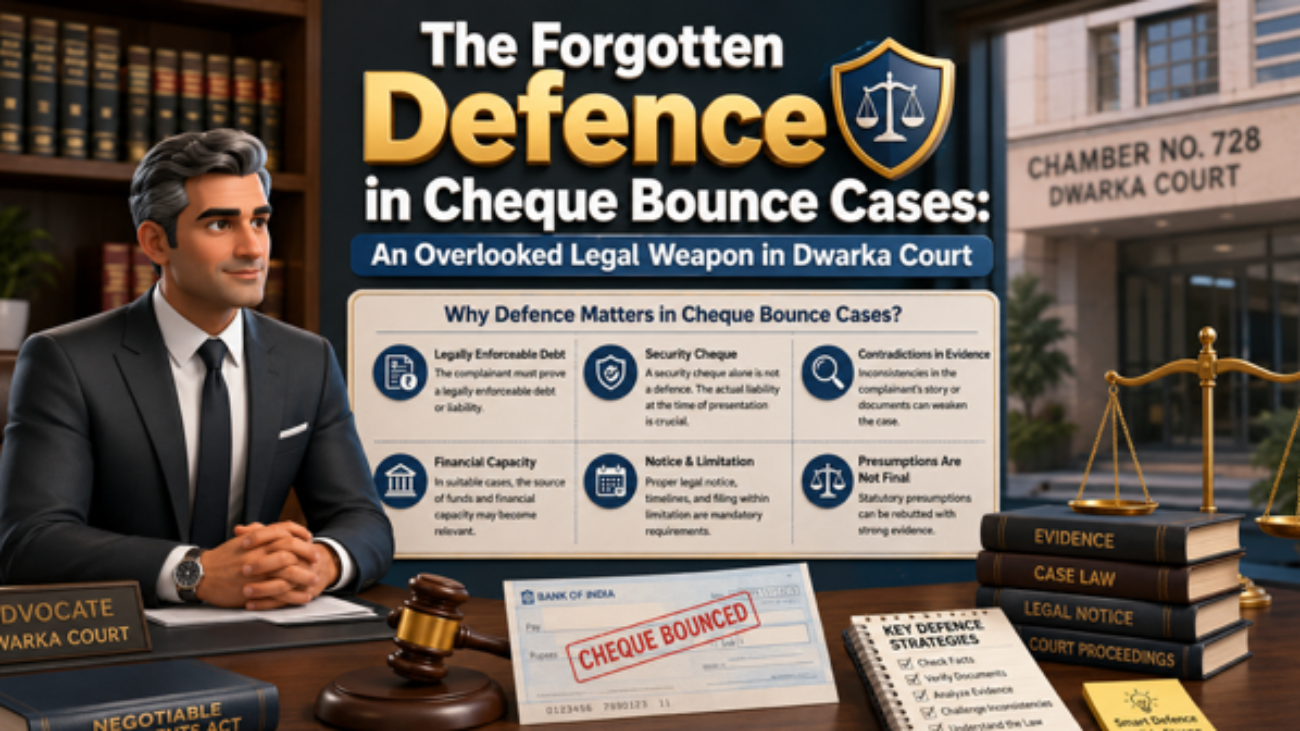
The Forgotten Defence in Cheque Bounce Cases: An Overlooked Legal Weapon in Dwarka Court

⚖️ Introduction: A Cheque Bounce Case Is Not Always Simple – Defence in Cheque Bounce

A cheque bounce case under Section 138 of the Negotiable Instruments Act, 1881 may look straightforward.

A cheque was issued.
The cheque was presented.
The bank returned it unpaid.
A legal notice followed.

However, the real legal dispute often begins after these events.

The important question is not only “Did the cheque bounce?” It is also:

“Was there a legally enforceable debt or liability, and can the complainant prove every essential requirement of the case?”

This is where a proper Defence in Cheque Bounce becomes important.

Many accused persons believe that once they receive a legal notice, conviction is almost certain. That assumption can be dangerous. A cheque case must be examined through its facts, documents, statutory requirements, presumptions, evidence and contradictions.

Therefore, the Defence in Cheque Bounce should begin much before the final arguments.

For persons facing proceedings in Dwarka Court, Delhi, early legal assessment can help identify weaknesses, preserve documents and prepare a consistent defence.


🔎 What Is the “Forgotten Defence” in a Cheque Bounce Case?

One of the most overlooked aspects of a cheque case is that the defence should not focus on the cheque alone.

The entire transaction must be examined.

For example:

  • Was there actually a legally enforceable debt?
  • What was the original transaction?
  • Was the cheque issued for a specific liability?
  • Was it a security cheque?
  • Were payments already made?
  • Does the complainant’s version match the documents?
  • Is the amount claimed supported by records?
  • Was the statutory notice properly issued?
  • Was the complaint filed within the prescribed limitation?
  • Are there contradictions in the complainant’s evidence?
  • Does the financial capacity of the complainant become relevant on the facts of the case?

These questions can become central to the Defence in Cheque Bounce.

Importantly, a defence should be based on the actual facts and evidence of the case. A particular defence cannot be mechanically applied to every cheque matter.


🛡️ The Presumption Under the NI Act Is Important — But So Is the Defence

Section 118 and Section 139 of the Negotiable Instruments Act create important statutory presumptions in appropriate circumstances.

That is why simply saying “I did not take the money” may not always be enough.

The accused needs to understand how the presumptions operate and how they may be rebutted on the facts of the case.

The defence may rely on circumstances emerging from:

  • Cross-examination
  • Documents
  • Bank records
  • Agreements
  • Invoices
  • Account statements
  • Emails and messages
  • Prior correspondence
  • Payment records
  • Contradictions in testimony
  • The complainant’s own documents

Therefore, a strong Defence in Cheque Bounce is usually built from the entire evidence rather than from one isolated argument.


📌 Some Often-Overlooked Defence Points

1. Legally Enforceable Debt or Liability

This is one of the most important areas.

The prosecution under Section 138 concerns a cheque issued for a legally enforceable debt or other liability.

Therefore, the nature of the underlying transaction matters.

If the defence can create a credible doubt or rebut the statutory presumption through legally admissible material, the underlying liability becomes a key issue.

2. Security Cheque — But With a Caution

The words “security cheque” do not automatically end a Section 138 case.

That is an important point.

A security cheque may still attract Section 138 if, when the cheque was presented, a legally enforceable liability had actually become due and the statutory requirements were satisfied.

Therefore, merely describing a cheque as a security cheque is not a complete defence.

The real question is:

What liability existed when the cheque was presented?

This distinction can be crucial while preparing the Defence in Cheque Bounce.

3. Contradictions in the Complainant’s Case

Sometimes the strongest defence is hidden inside the complainant’s own evidence.

Consider a case where:

  • The complaint mentions one transaction date.
  • The bank records indicate another timeline.
  • The notice gives a different explanation.
  • The affidavit contains another version.
  • Cross-examination exposes an inconsistency.

Such contradictions may become relevant when the court evaluates the overall evidence.

Consequently, careful cross-examination can play a major role in the Defence in Cheque Bounce.

4. Financial Capacity and Source of Funds

In suitable cases, the complainant’s financial capacity and source of funds may become relevant.

However, this issue must be approached carefully.

It should not be raised as a routine formula in every matter. Its relevance depends on the pleadings, evidence, nature of transaction and circumstances of the case.

A good defence therefore asks:

What exactly does the complainant say happened, and what evidence supports that story?

5. Statutory Notice and Limitation

Section 138 contains specific statutory requirements concerning presentation of the cheque, dishonour, demand notice and subsequent complaint.

A careful lawyer checks the dates.

For example:

StageWhat Should Be Examined?Why It Matters
ChequeDate, amount and validityEstablishes the basic transaction
PresentationBank recordsHelps verify timely presentation
DishonourReturn memoShows reason for dishonour
NoticeDate, contents and serviceStatutory compliance may become relevant
Payment periodStatutory timelineDetermines the next legal step
ComplaintFiling dateLimitation must be examined
EvidenceDocuments and testimonySupports or challenges the case

Thus, a Defence in Cheque Bounce should include a proper chronology.


⚖️ Why Early Legal Advice Matters Before Litigation

A common mistake is to contact a lawyer only after summons arrive.

That can make preparation harder.

At the pre-litigation stage, legal assistance may include:

✅ Examining the cheque and bank records
✅ Reviewing the underlying transaction
✅ Checking agreements and invoices
✅ Examining previous payments
✅ Reviewing the proposed legal notice
✅ Assessing the likely issues in dispute
✅ Preserving relevant documents and communications
✅ Considering whether a lawful settlement route is appropriate

Early review does not mean that litigation will always be avoided.

Instead, it helps the client understand the legal position before making an important decision.

For a person receiving a demand concerning a disputed cheque, early advice can therefore be valuable in building a sensible Defence in Cheque Bounce.


🏛️ Assistance During Ongoing Litigation

Once proceedings begin, the strategy changes.

At the litigation stage, assistance may involve:

  • Reviewing the complaint
  • Preparing the defence
  • Appearing before the court
  • Examining procedural developments
  • Cross-examining witnesses
  • Reviewing documents
  • Addressing interim applications
  • Preparing written submissions where appropriate
  • Conducting final arguments
  • Advising on settlement possibilities
  • Considering further legal remedies when required

Every stage has its own importance.

Moreover, the defence should remain consistent from the first appearance through evidence and final arguments.

A sudden change in the defence can create avoidable difficulties.


📍 Why Local Representation in Dwarka Court Can Help

Cheque Bounce Lawyer in Dwarka Court who regularly works in the local court environment can understand the practical workflow of proceedings.

This includes familiarity with:

  • Filing procedures
  • Court listings
  • Procedural requirements
  • Local court processes
  • Filing counters and administrative systems
  • Evidence stages
  • Summons-related procedures
  • Routine applications
  • Courtroom practice

Our practice is based in Dwarka Court, Delhi, and we have 18+ years of experience in Dwarka Court.

This local familiarity can help in handling procedural work efficiently and in coordinating appearances and filings.

For clients from Dwarka Sector 6, Dwarka Sector 10, Dwarka Sector 12, Dwarka Sector 23, Janakpuri, Vikaspuri, Dwarka North, Dwarka South, Uttam Nagar, Najafgarh, Bindapur, Dabri, Palam Village, Samalka, Chhawla, Delhi Cantonment, Baba Haridas Nagar, Mohan Garden, Jaffarpur Kalan, Kapashera and nearby areas, representation near Dwarka Court may also make coordination easier.

The objective is not merely to file a case.

It is to understand the case and manage each legal stage carefully.


🧾 Building a Strong Defence: A Practical Checklist

A useful approach is to create a complete case file before deciding the final defence.

Step 1 — Prepare the Timeline

Write down:

Transaction → Cheque → Presentation → Dishonour → Notice → Payment period → Complaint → Summons → Evidence

A clear timeline can reveal inconsistencies that are difficult to notice when documents are examined separately.

Step 2 — Collect the Documents

Keep copies of:

  • Cheque
  • Return memo
  • Legal notice
  • Postal records
  • Agreements
  • Invoices
  • Bank statements
  • Receipts
  • Emails
  • Messages
  • Account records
  • Previous correspondence

Step 3 — Identify the Real Dispute

Ask one basic question:

Why did the cheque become disputed?

The answer may involve payment, accounting, consideration, goods, services, loan, security arrangement or another transaction.

Step 4 — Test the Evidence

Every major allegation should be compared with the available documentary evidence.

This is where a detailed Defence in Cheque Bounce becomes more meaningful than a generic denial.


📊 Pre-Litigation vs Litigation Assistance

Pre-Litigation StageLitigation Stage
Examine cheque and transactionStudy complaint and evidence
Review legal noticePrepare procedural response
Check statutory timelinesAppear before court
Preserve documentsConduct cross-examination
Assess liabilityChallenge inconsistencies
Explore lawful settlementPrepare arguments
Identify possible defencesContinue case strategy
Plan documentationAdvise on further remedies

The two stages are connected.

Therefore, information collected before litigation can later become important during evidence and arguments.


🤝 Why Client Trust Matters in Legal Practice

A legal case is not only about statutes and judgments.

It is also about communication.

Our approach focuses on:

⚖️ High Professional Standards

Each matter should receive structured legal attention and responsible professional handling.

📞 Quick Responsiveness

Clients often need timely updates. Therefore, communication should not become unnecessarily difficult.

📱 Call & Dedicated WhatsApp Support

Subject to professional and practical limits, clients can communicate through calls and dedicated WhatsApp support for case-related coordination and updates.

💰 Reasonable and Transparent Fees

Clients should understand the professional fee structure before proceeding.

📝 Proper Lawyer-Client Fee Agreements

Clear documentation helps both sides understand the agreed professional scope and fee arrangement.

🧾 Fee Receipts and Acknowledgements

Proper receipts and acknowledgements promote transparency and maintain organised records.

🤝 Honest and Fair Dealings

Legal advice should be based on the facts and applicable law, not on unrealistic promises.

These principles are especially important in criminal and financial disputes, where clients may already be under considerable stress.

👨‍⚖️ More Than a Cheque Case: Related Legal Disputes

A cheque dispute may sometimes arise from a wider commercial, property or recovery dispute.

Depending on the facts, legal issues may also involve:

  • Civil recovery
  • Commercial disputes
  • Property transactions
  • Business accounts
  • Contractual disputes
  • Loan transactions
  • Partnership disputes

Accordingly, clients may require assistance from a Criminal Advocate DwarkaCriminal Disputes Advocate Dwarka CourtRecovery Suit CounselCommercial Litigation LawyerProperty Dispute Advocate, or Civil Litigation Lawyer in Delhi, depending on the nature of the dispute.

Similarly, where separate criminal proceedings arise, clients may need a Regular Bail & Anticipatory Bail Lawyer Dwarka.

The correct legal remedy depends on the facts.


🚨 Common Mistakes That Can Damage a Defence

Avoid these common mistakes:

1. Ignoring the legal notice

Do not assume that silence will automatically solve the matter.

2. Destroying or deleting messages

Relevant communications may later become important evidence.

3. Giving inconsistent explanations

The defence should be factual and consistent.

4. Relying only on oral statements

Documents can become extremely important.

5. Assuming that “security cheque” ends the case

It does not automatically do so.

6. Waiting until the final hearing

Good preparation should begin early.

7. Treating every cheque case alike

Each case has its own transaction, documents and evidence.

Therefore, a proper Defence in Cheque Bounce must be fact-specific.

🧠 The Real Legal Weapon: Preparation

The most overlooked defence is often not a single magic argument.

It is preparation.

A well-prepared defence identifies:

Facts + Documents + Timeline + Statutory Requirements + Evidence + Contradictions + Legal Position

When these elements are studied together, the court can be presented with a clear and structured defence.

That is why the Defence in Cheque Bounce should be planned from the first legal consultation rather than created at the last moment.

📍 Advocate in Dwarka Court for Cheque Bounce Matters

If you are searching for an Advocate in Dwarka Court, a Cheque Bounce Lawyer in Dwarka Court, or a Criminal Disputes Advocate Dwarka Court, the first step should be a proper review of your documents and facts.

Our office handles legal matters connected with Dwarka Court and surrounding areas of South West Delhi.

The focus remains on professional preparation, clear communication, proper documentation and lawful legal strategy.

Whether the matter originates from Janakpuri, Vikaspuri, Dwarka North, Dwarka South, Uttam Nagar, Najafgarh, Bindapur, Palam Village, Dabri, Samalka, Chhawla, Kapashera, Jaffarpur Kalan, Baba Haridas Nagar, Mohan Garden or Delhi Cantonment, the relevant question remains the same:

What does the evidence actually show?

That question should guide the defence.


🏁 Conclusion: Do Not Ignore the Forgotten Defence

A cheque bounce case is not merely a story about a dishonoured cheque.

It is a legal proceeding involving statutory requirements, presumptions, evidence, documents, timelines and the underlying transaction.

The Defence in Cheque Bounce becomes meaningful when these elements are examined together.

Therefore, do not wait until the final hearing to think about your defence.

Review the documents early.
Understand the transaction.
Check the timeline.
Study the evidence.
Identify contradictions.
Understand the statutory requirements.
Then choose a defence based on the actual facts.

In appropriate cases, what initially appears to be a straightforward cheque dispute may contain important legal questions that deserve careful examination.

📞 Legal Consultation

If you are facing a cheque bounce complaint or are involved in a related financial, commercial or criminal dispute near Dwarka Court, you may seek professional legal advice after sharing the relevant facts and documents.

Ankit Gaurav Kainth & Associates
Advocate in Dwarka Court, Delhi
18+ Years of Practice in Dwarka Court

📞 9899085554
📞 9811885554

Professional advice should be based on the facts and documents of the individual matter. No particular result or outcome is guaranteed.
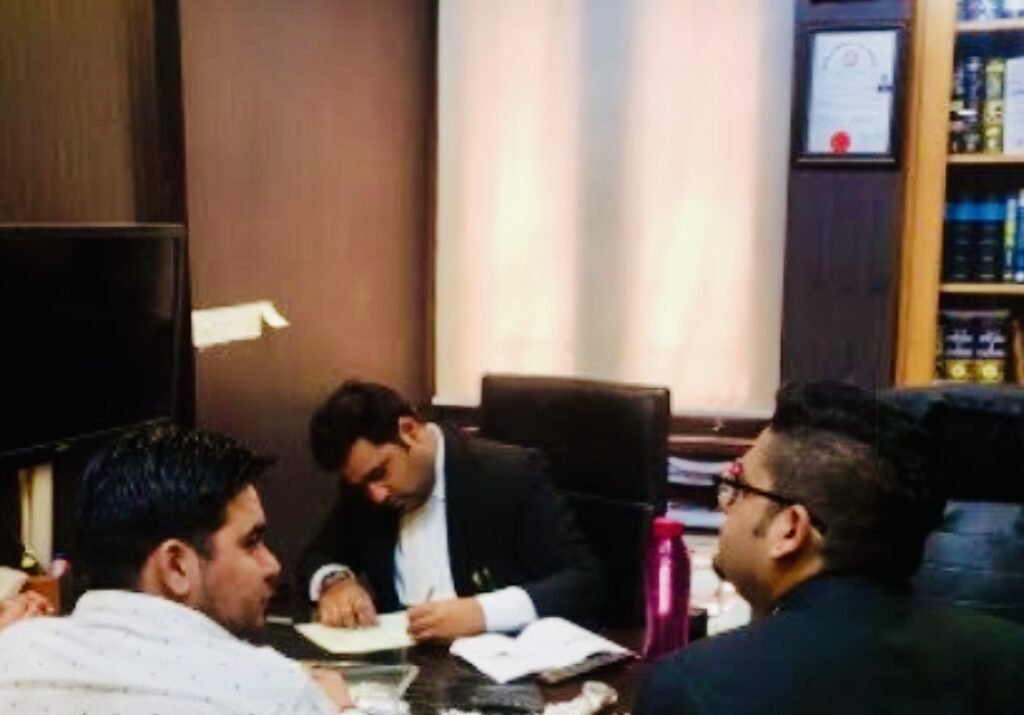

❓ Frequently Asked Questions

1. What is the most important Defence in Cheque Bounce cases?

There is no single defence that applies to every case. The defence may involve the underlying legally enforceable liability, evidence, statutory compliance, contradictions, documents, payment history and other facts of the individual matter.
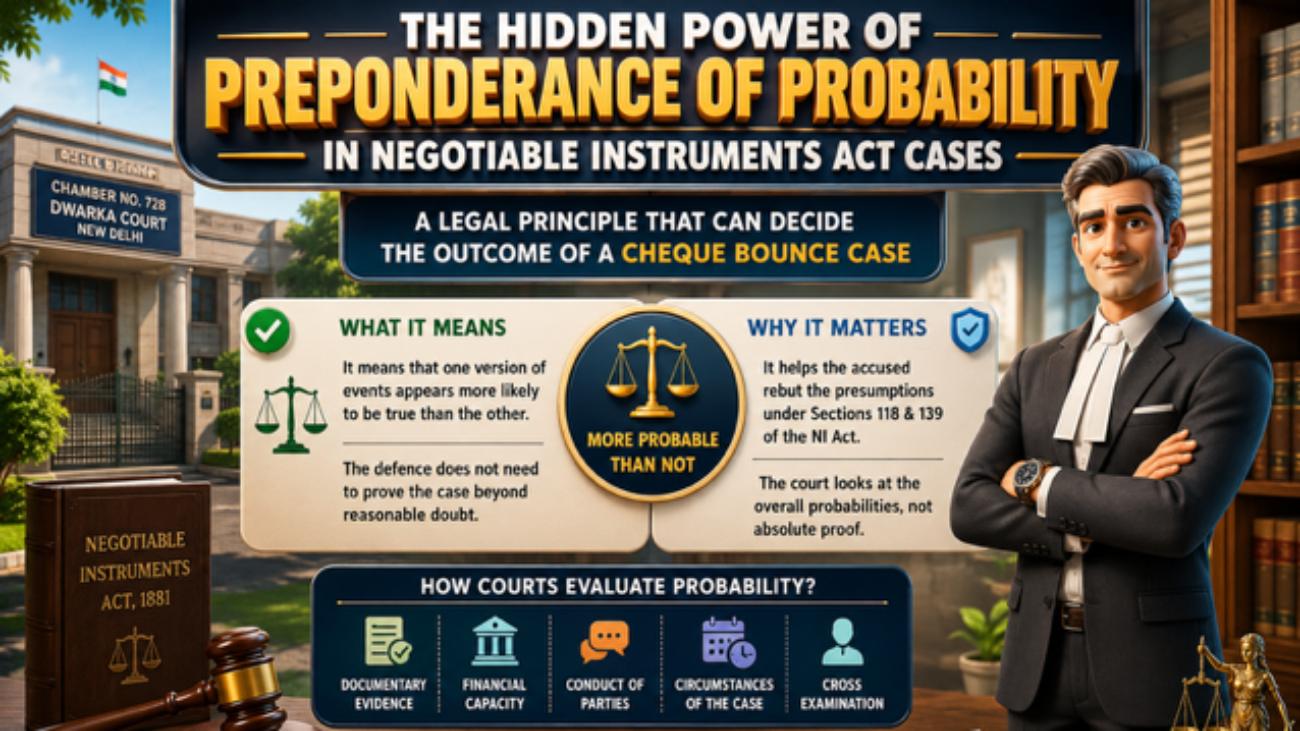
2. Is a security cheque a complete defence to Section 138 NI Act?

No. Calling a cheque a “security cheque” does not automatically defeat a Section 138 case. The circumstances existing when the cheque was presented and the underlying liability must be examined.

3. Can the complainant’s financial capacity become relevant?

Yes, in appropriate factual circumstances. However, it is not a universal defence. Its relevance depends on the pleadings, evidence, transaction and circumstances of the particular case.

4. Why should I consult a lawyer before the case reaches final arguments?

Early advice can help preserve documents, understand the transaction, examine statutory timelines and develop a consistent legal strategy before evidence and arguments progress.

5. Can a local Advocate in Dwarka Court help with cheque bounce litigation?

Local court familiarity can assist with understanding filing procedures, listings, routine processes and courtroom practice. However, the strength of every case ultimately depends on its facts, evidence and applicable law.


⚠️ Legal Disclaimer

This article is intended solely for general legal information and educational purposes. It does not constitute legal advice or create an advocate-client relationship. Cheque bounce matters are fact-specific, and the applicable legal position may depend on the documents, pleadings, evidence and stage of proceedings. Readers should obtain independent professional legal advice before taking action in a specific matter. No outcome or result is guaranteed.


Professional Advocate in Dwarka Court explaining how to choose the right lawyer for criminal, civil, cheque bounce, bail, and property disputes in Delhi.

How to Choose the Right Advocate in Dwarka Court and Avoid Costly Mistakes

Introduction – Right Advocate in Dwarka Court

Finding the Right Advocate in Dwarka Court is one of the most important decisions you will make when facing a legal dispute. Whether your matter relates to a civil case, criminal prosecution, property dispute, cheque bounce complaint, commercial litigation, family dispute, or bail application, the advocate you choose can influence how efficiently your case is presented and managed.

Many people make the mistake of selecting an advocate solely because of a recommendation, social media presence, or the lowest fee quotation. However, legal representation is much more than cost alone. Experience, courtroom knowledge, strategy, communication, and transparency are equally important.

Therefore, before engaging any Advocate in Dwarka Court, take time to understand the advocate’s practice, experience, communication style, and professional approach. Making an informed decision at the beginning often saves valuable time, unnecessary expenses, and avoidable procedural complications later.

If you are searching for the Right Advocate in Dwarka Court, this guide explains the practical factors you should consider before making your choice.


⚖️ Why Choosing the Right Advocate in Dwarka Court Matters

Every legal case is unique. A carefully prepared case supported by proper legal strategy can proceed more efficiently than one requiring repeated corrections.

Moreover, Dwarka Court handles a wide range of matters every day, including:

  • Criminal Cases
  • Civil Suits
  • Property Disputes
  • Cheque Bounce Cases under the Negotiable Instruments Act
  • Bail Matters
  • Anticipatory Bail Applications
  • Commercial Litigation
  • Recovery Suits
  • Matrimonial Disputes
  • Domestic Violence Cases
  • Injunction Matters
  • Execution Proceedings

Each category follows different procedures. Consequently, selecting the Right Advocate in Dwarka Court who regularly practices before the court can help ensure that filings, documentation, and procedural requirements are handled efficiently.


📍 Why Local Experience in Dwarka Court Makes a Difference

Every court has its own working practices, filing procedures, registry requirements, and administrative systems.

As local advocates regularly practicing before Dwarka Court, Delhi, we understand its day-to-day functioning, procedural requirements, filing norms, listing process, and courtroom practices. This familiarity enables us to coordinate matters more efficiently and respond promptly to procedural requirements.

Our office regularly assists clients appearing before courts having jurisdiction over areas including:

📍 Dwarka Sector 6

📍 Dwarka Sector 10

📍 Dwarka Sector 12

📍 Dwarka Sector 23

📍 Dwarka North

📍 Dwarka South

📍 Janakpuri

📍 Vikaspuri

📍 Uttam Nagar

📍 Najafgarh

📍 Palam Village

📍 Dabri

📍 Bindapur

📍 Mohan Garden

📍 Delhi Cantonment

📍 Samalka

📍 Chhawla

📍 Kapashera

📍 Baba Haridas Nagar

📍 Jaffarpur Kalan

and other nearby areas falling within the jurisdiction of Dwarka Court.


📊 The Cost of Choosing Without Proper Due Diligence

Many people focus only on the initial legal fee. However, the overall cost of litigation may become significantly higher if the case requires substantial corrections or additional work later.

The following table illustrates why careful selection at the beginning is important.

StageDecision MadePossible Repercussion
Initial StageEngage an advocate without verifying relevant experience, communication, or strategyImportant procedural steps or documentation may require revision later.
During LitigationCase progresses with avoidable procedural issues or incomplete preparationAdditional hearings, delay, and extra legal work may become necessary.
Corrective StageA second advocate is engaged to review, redraft, or rectify earlier workFresh drafting, detailed case review, and further appearances may involve additional professional fees, increasing the overall cost of litigation.
Final ImpactTime and resources have already been spentThe total financial and procedural burden may become significantly higher than if appropriate legal guidance had been obtained at the outset.

Therefore, selecting the Right Advocate in Dwarka Court should be viewed as an informed professional decision rather than one based solely on the lowest quoted fee.


✅ What Should You Verify Before Hiring an Advocate?

Before engaging an advocate, consider asking the following practical questions:

✔ Does the advocate regularly practice before Dwarka Court?

✔ Does the advocate explain the legal process clearly?

✔ Will you receive realistic advice rather than unrealistic assurances?

✔ Is there transparency regarding professional fees?

✔ Will a proper Lawyer–Client Fee Agreement be executed?

✔ Are fee receipts or acknowledgements issued?

✔ Will you receive regular updates about your case?

✔ Is the legal strategy discussed before filing?

✔ Can you communicate easily through phone or WhatsApp when required?

✔ Does the advocate maintain professional standards throughout the matter?

These questions help clients make informed decisions and establish clear expectations from the beginning.


📝 Why Pre-Litigation Advice Is Equally Important

Many legal disputes can be addressed effectively before a case is filed.

Seeking timely legal advice allows clients to understand their rights, evaluate available remedies, and consider whether the dispute can be resolved without immediate litigation.

At Ankit Gaurav Kainth & Associates, we assist clients during the pre-litigation stage by providing structured legal guidance based on the facts and applicable law.

Our pre-litigation assistance includes:

⚖️ Legal consultation

📑 Case evaluation

📄 Document verification

✉️ Drafting legal notices

📬 Replying to legal notices

🤝 Settlement discussions where appropriate

📚 Legal opinion on available remedies

📋 Strategy before filing proceedings

Early legal guidance often helps clients make informed decisions, preserve relevant documents, and avoid unnecessary procedural complications.


⚖️ Practice Areas We Commonly Handle

Our team regularly assists clients before Dwarka Court in matters relating to:

✅ Criminal Cases

✅ Civil Litigation

✅ Property Disputes

✅ Cheque Bounce Matters

✅ Recovery Suits

✅ Commercial Litigation

✅ Matrimonial Cases

✅ Domestic Violence Proceedings

✅ Regular Bail

✅ Anticipatory Bail

✅ Injunction Matters

Accordingly, individuals searching for a Criminal Advocate DwarkaCheque Bounce Lawyer in Dwarka CourtRegular Bail & Anticipatory Bail Lawyer DwarkaCivil Cases Advocate Dwarka CourtProperty Dispute AdvocateRecovery Suit CounselCommercial Litigation Lawyer, or Lawyer in South West Delhi can benefit from obtaining legal advice tailored to the specific nature of their case.


⚖️ How We Assist During the Litigation Stage

Once a case is filed, every hearing becomes important. Proper preparation, timely filing of documents, and effective representation are essential throughout the proceedings. Therefore, clients should engage an advocate who remains actively involved at every stage of the case.

At Ankit Gaurav Kainth & Associates, we continue assisting clients throughout the litigation process before Dwarka Court. Our objective is to ensure that every procedural requirement is addressed carefully while keeping clients informed about the progress of their matter.

Our litigation support includes:

✅ Drafting and filing pleadings

✅ Preparing written statements and replies

✅ Filing applications and supporting documents

✅ Court appearances and effective representation

✅ Legal research and case strategy

✅ Evidence planning and document management

✅ Cross-examination preparation

✅ Final arguments

✅ Assistance in execution proceedings and post-judgment remedies where applicable

Every matter requires a different legal strategy. Accordingly, we analyse the facts, applicable law, and available evidence before advising the most suitable course of action.


🏛️ Why Local Advocates in Dwarka Court Offer Practical Advantages

Court procedures are governed by law. However, every court also has its own administrative practices and working systems. An advocate who regularly appears before Dwarka Court is familiar with these day-to-day procedures.

As advocates practising regularly before Dwarka Court, Delhi, we understand:

⚖️ Court filing procedures

📑 Registry requirements

📅 Listing practices

📋 Scrutiny of documents

🗂️ Case management systems

📄 Procedural compliance

This familiarity enables us to coordinate filings efficiently, address procedural requirements promptly, and minimise avoidable delays.

For clients searching for the Right Advocate in Dwarka Court, choosing a lawyer with regular local practice can offer practical advantages in managing litigation efficiently.

👨‍⚖️ More Than 18 Years of Litigation Experience

Experience cannot replace preparation, but it often helps in identifying practical issues before they become larger procedural problems.

With 18+ years of litigation experience before Dwarka Court, our legal team has represented clients in a wide variety of matters, including:

⚖️ Criminal Litigation

⚖️ Civil Litigation

⚖️ Property Disputes

⚖️ Cheque Bounce Cases

⚖️ Commercial Litigation

⚖️ Recovery Suits

⚖️ Matrimonial Matters

⚖️ Domestic Violence Cases

⚖️ Bail Applications

⚖️ Injunction Proceedings

Each matter receives individual attention because no two cases are exactly alike. Therefore, our approach focuses on understanding the facts first and then developing a legal strategy appropriate to the client’s objectives.


🤝 Why Clients Trust Our Professional Approach

Trust is earned through professionalism, transparency, and consistent communication. Legal representation involves more than appearing in court; it also requires keeping clients informed and maintaining clear professional standards.

Our practice is built on principles that help clients understand every stage of their matter.

We strive to provide:

📞 Prompt responses to calls whenever possible

💬 Dedicated WhatsApp support for updates and communication

📑 Proper Lawyer–Client Fee Agreements

🧾 Fee receipts and written acknowledgements

💼 Transparent and reasonable professional fee structure

⚖️ Honest legal opinions based on facts and law

🤝 Fair and transparent dealings

📋 Regular updates regarding important developments

These practices help clients make informed decisions while maintaining confidence throughout the legal process.


📌 Choosing the Right Advocate Is About Value, Not Just Cost

Professional fees should always be considered alongside experience, preparation, communication, and the quality of legal services.

Choosing the Right Advocate in Dwarka Court simply because the fee appears lower may not always serve the client’s long-term interests. Equally, paying a higher fee does not automatically indicate better representation.

Instead, consider whether the advocate:

✔ Explains the strengths and weaknesses of your case.

✔ Provides realistic legal advice.

✔ Discusses possible legal remedies.

✔ Maintains transparency regarding fees.

✔ Responds to client queries professionally.

✔ Keeps proper records and documentation.

✔ Follows ethical and professional standards.

When these factors are present, clients are often better equipped to make informed decisions regarding their legal representation.


⚖️ Practice Areas We Regularly Handle

Our office regularly represents clients in matters involving:

✅ Criminal Litigation

✅ Civil Litigation

✅ Property Disputes

✅ Recovery Suits

✅ Commercial Litigation

✅ Cheque Bounce Matters

✅ Regular Bail Applications

✅ Anticipatory Bail Applications

✅ Matrimonial Cases

✅ Domestic Violence Proceedings

✅ Injunction Matters

Accordingly, individuals searching for a Criminal Advocate DwarkaCheque Bounce Lawyer in Dwarka CourtRegular Bail & Anticipatory Bail Lawyer DwarkaCivil Cases Advocate Dwarka CourtCivil Litigation Lawyer in DelhiProperty Dispute AdvocateRecovery Suit CounselCommercial Litigation LawyerLawyer in South West Delhi, or an Advocate in Dwarka Court can seek legal guidance suited to their specific legal issue.


📍 Serving Clients Across South-West Delhi

Our office regularly assists clients from areas falling within the jurisdiction of Dwarka Court, including:

📍 Janakpuri

📍 Vikaspuri

📍 Dwarka Sector 6

📍 Dwarka Sector 10

📍 Dwarka Sector 12

📍 Dwarka Sector 23

📍 Dwarka North

📍 Dwarka South

📍 Uttam Nagar

📍 Najafgarh

📍 Palam Village

📍 Bindapur

📍 Mohan Garden

📍 Dabri

📍 Samalka

📍 Delhi Cantonment

📍 Chhawla

📍 Kapashera

📍 Baba Haridas Nagar

📍 Jaffarpur Kalan

and other nearby areas around Dwarka Court.

This local presence enables us to assist clients efficiently while remaining familiar with the court’s day-to-day functioning and jurisdiction.


⚠️ A Practical Reminder Before You Engage Any Advocate

Before signing any engagement, take a few minutes to verify the advocate’s experience, discuss your legal objectives, understand the proposed strategy, and seek clarity regarding professional fees and documentation.

A well-informed decision at the beginning of a case often reduces uncertainty later and helps establish a productive professional relationship between the advocate and the client.

Conclusion

Choosing the Right Advocate in Dwarka Court is one of the most important decisions in any legal dispute. While professional fees are a relevant consideration, they should not be the only deciding factor. Experience, preparation, communication, ethical practice, and transparency all contribute to effective legal representation.

Moreover, seeking legal advice at the earliest stage—whether before filing a case or during ongoing litigation—allows you to understand your legal position, evaluate available remedies, and make informed decisions. Similarly, engaging an advocate who regularly practices before Dwarka Court can help ensure that procedural requirements are handled efficiently and that your matter progresses in an organized manner.

At Ankit Gaurav Kainth & Associates, we combine more than 18 years of litigation experience before Dwarka Court with a client-focused approach built on professionalism, responsiveness, and transparent communication. We believe every client deserves clear legal advice, proper documentation, and dedicated representation throughout the legal process.

Whether you require assistance in a criminal matter, civil dispute, cheque bounce case, property litigation, commercial dispute, recovery suit, or bail proceedings, selecting the Right Advocate in Dwarka Court after careful evaluation is an investment in the effective management of your case.


📞 Contact Ankit Gaurav Kainth & Associates

If you are looking for the Right Advocate in Dwarka Court, our office is available to provide legal consultation and representation across a wide range of civil and criminal matters.

We regularly assist clients in:

⚖️ Criminal Litigation

⚖️ Civil Litigation

⚖️ Property Disputes

⚖️ Cheque Bounce Cases

⚖️ Recovery Suits

⚖️ Commercial Litigation

⚖️ Regular Bail & Anticipatory Bail

⚖️ Matrimonial & Family Matters

📍 Chamber No. 728, 7th Floor, Dwarka District Court, Sector-10, New Delhi

📞 Mobile: 9899085554

📞 Mobile: 9811885554

Prior appointments are recommended for detailed consultations.


Frequently Asked Questions (FAQs)

1. How do I choose the Right Advocate in Dwarka Court?

Choose an advocate based on relevant experience, regular practice before Dwarka Court, transparent professional fees, communication, ethical standards, and a clear legal strategy rather than only on the quoted fee.

2. Why is local experience in Dwarka Court important?

An advocate who regularly practices before Dwarka Court is familiar with its filing procedures, registry requirements, court functioning, and day-to-day processes, which can help in managing the case efficiently.

3. Do you assist clients before filing a case?

Yes. We provide comprehensive pre-litigation services, including legal consultation, document verification, legal notices, replies to notices, settlement discussions, and legal strategy before initiating proceedings.

4. What types of matters do you handle?

We regularly handle criminal litigation, civil suits, cheque bounce matters, property disputes, commercial litigation, recovery suits, matrimonial matters, domestic violence cases, regular bail, anticipatory bail, injunctions, and other proceedings before Dwarka Court.

5. Do you provide written fee agreements and receipts?

Yes. We believe in complete transparency. Our practice includes proper Lawyer–Client Fee Agreements, professional fee receipts, acknowledgements, and clear communication regarding legal fees and scope of work.

Appeal Process in Cheque Bounce Cases in Dwarka Court explained by Advocate in Dwarka Court Delhi

Master the Appeal Process in Cheque Bounce Cases in Dwarka Court, Delhi with Winning Nuances

Master the Appeal Process in Cheque Bounce Cases in Dwarka Court with Winning Nuances ⚖️

A conviction or dismissal in a cheque bounce matter is not always the end of the legal journey. The Appeal Process in Cheque Bounce Cases in Dwarka Court gives an aggrieved party an opportunity to challenge an order before the appropriate appellate court. However, every appeal must be filed within the prescribed limitation period and should be supported by proper legal grounds.

Therefore, understanding the Appeal Process in Cheque Bounce Cases in Dwarka Court is essential for both complainants and accused persons. A carefully prepared appeal can help present legal errors, procedural irregularities, or appreciation of evidence before the appellate court.

At Ankit Gaurav Kainth & Associates, we have over 18+ years of experience in Dwarka Court and regularly assist clients from Dwarka Sector-6, Sector-10, Sector-12, Dwarka North, Dwarka South, Janakpuri, Vikaspuri, Uttam Nagar, Najafgarh, Palam Village, Dabri, Samalka, Kapashera, Bindapur, Mohan Garden, Chhawla, Baba Haridas Nagar, Delhi Cantonment, Jaffarpur Kalan, and nearby areas.


⚖️ What is the Appeal Process in Cheque Bounce Cases in Dwarka Court?

The Appeal Process in Cheque Bounce Cases in Dwarka Court is the legal remedy available when a party is dissatisfied with the judgment passed in a cheque bounce case under Section 138 of the Negotiable Instruments Act, 1881.

Depending upon the facts, an appeal may be preferred by:

  • ✅ A convicted accused
  • ✅ A complainant challenging acquittal (subject to applicable legal provisions)
  • ✅ A party challenging compensation or sentencing

However, every appeal must satisfy legal requirements. Consequently, timely filing and proper drafting become extremely important.


📋 When Can You File an Appeal?

Generally, an appeal may be considered when:

  • The judgment contains legal errors.
  • Important evidence was ignored.
  • Evidence was wrongly appreciated.
  • Law was incorrectly applied.
  • Compensation or sentence requires judicial reconsideration.
  • Procedural irregularities affected the decision.

Accordingly, every matter should first be evaluated on its own facts before deciding whether filing an appeal is appropriate.


📊 Understanding the Appeal Process in Cheque Bounce Cases in Dwarka Court

StageWhat Happens
Case EvaluationReview of judgment, evidence and legal grounds
Legal OpinionAssessment of appealability and limitation
Drafting AppealPreparation of detailed memorandum of appeal
FilingAppeal filed before the competent appellate court
AdmissionCourt examines maintainability
NoticeNotice issued to opposite party where required
ArgumentsLegal submissions by both parties
Final DecisionAppellate court passes appropriate order

Each stage requires careful preparation. Therefore, engaging an experienced Appeal Advocate in Cheque Bounce Cases in Dwarka Court can help ensure procedural compliance.


⚖️ Common Grounds Raised During the Appeal Process in Cheque Bounce Cases in Dwarka Court

Some common legal grounds include:

  • Incorrect appreciation of evidence
  • Improper reliance on documents
  • Failure to consider defence evidence
  • Misapplication of statutory presumptions
  • Procedural irregularities
  • Incorrect interpretation of law
  • Errors in sentencing or compensation
  • Violation of principles of natural justice

Nevertheless, every appeal depends entirely upon its own facts and applicable law.


🤝 How We Assist Clients Before Litigation

Many cheque bounce disputes can be better managed even before a case reaches court.

Our pre-litigation assistance includes:

✅ Legal consultation

✅ Review of financial documents

✅ Examination of cheque transactions

✅ Drafting and scrutiny of statutory legal notices

✅ Settlement discussions wherever appropriate

✅ Negotiation support

✅ Documentation review

✅ Strategic legal guidance

Early legal advice often helps clients understand their rights and obligations. Consequently, informed decisions become easier.


🏛️ How We Assist During Litigation

Once proceedings begin, timely legal action becomes essential.

Our litigation assistance includes:

  • Court representation
  • Drafting complaints and replies
  • Evidence preparation
  • Cross-examination strategy
  • Interim applications
  • Appeal drafting
  • Legal research
  • Final arguments
  • Compliance with court directions

The Appeal Process in Cheque Bounce Cases in Dwarka Court often begins immediately after pronouncement of judgment. Therefore, obtaining legal advice without unnecessary delay is advisable.


📍 Why Choosing a Local Advocate in Dwarka Court Matters

Being Advocates in Dwarka Court, we understand the practical working of the court system.

Our familiarity with local court procedures helps in:

  • Faster filing of cases
  • Better document preparation
  • Efficient procedural compliance
  • Smooth coordination
  • Timely case management

This local experience benefits clients from Dwarka Sector-23, Dwarka North, Dwarka South, Janakpuri, Vikaspuri, Uttam Nagar, Najafgarh, Palam Village, Dabri, Samalka, Kapashera, Delhi Cantonment, Bindapur, Mohan Garden, Baba Haridas Nagar, Chhawla, Jaffarpur Kalan and nearby areas.


⭐ Why Clients Trust Our Legal Services

Trust is earned through consistency.

Our practice focuses on:

⚖️ High professional standards

📞 Quick responsiveness

📱 Dedicated WhatsApp support

📋 Proper Lawyer–Client Fee Agreements

🧾 Fee receipts and acknowledgements

💼 Transparent and reasonable fee structure

🤝 Honest and fair professional dealings

📑 Regular case updates

These principles help build long-term professional relationships with clients.


⚖️ Our Broader Litigation Practice

Apart from the Appeal Process in Cheque Bounce Cases in Dwarka Court, our office also assists clients in matters relating to:

  • Criminal Advocate Dwarka
  • Cheque Bounce Appeal Lawyer in Dwarka Court
  • Appeal Advocate in Cheque Bounce Cases in Dwarka Court
  • Regular Bail & Anticipatory Bail Lawyer Dwarka
  • Civil Litigation Lawyer in Delhi
  • Commercial Litigation Lawyer
  • Property Dispute Advocate
  • Recovery Suit Counsel
  • Lawyer in South West Delhi
  • Advocate in Dwarka Court

Accordingly, clients receive comprehensive legal assistance under one roof.


📌 Practical Tips Before Filing an Appeal

Before initiating the Appeal Process in Cheque Bounce Cases in Dwarka Court, consider the following:

✅ Obtain a certified copy of the judgment.

✅ Check the limitation period carefully.

✅ Preserve all relevant documents.

✅ Organise evidence systematically.

✅ Consult an advocate promptly.

✅ Avoid unnecessary delay.

Proper preparation can significantly improve procedural efficiency.


⚖️ Important Points to Remember

The Appeal Process in Cheque Bounce Cases in Dwarka Court is governed by procedural law and judicial principles. Every appeal must be evaluated independently. Simply disagreeing with a judgment is not sufficient. Instead, there should be legally sustainable grounds supported by the record of the case.

Therefore, timely legal consultation is always advisable after receiving a judgment.

✅ Conclusion

The Appeal Process in Cheque Bounce Cases in Dwarka Court demands careful legal analysis, proper documentation, timely filing, and persuasive legal arguments. Every matter presents different factual and legal issues. Consequently, professional guidance at the earliest stage can help parties understand their legal options and procedural requirements.

Whether you require assistance before filing a cheque bounce case, during ongoing proceedings, or while considering an appeal, obtaining informed legal advice can make the process more organised and legally compliant.

📞 Contact Us

Ankit Gaurav Kainth & Associates

⚖️ Advocate in Dwarka Court, Delhi

📱 Mobile:
9899085554
9811885554

We assist clients in pre-litigation advice, litigation, appeals, civil disputes, commercial litigation, recovery matters, property disputes, bail matters, and cheque bounce cases across Dwarka Court and South West Delhi.


Frequently Asked Questions (FAQs)

1. What is the Appeal Process in Cheque Bounce Cases in Dwarka Court?

It is the legal process through which an eligible party challenges a judgment in a cheque bounce case before the competent appellate court, subject to the applicable law and limitation period.

2. Is there a time limit for filing an appeal?

Yes. The limitation period depends on the applicable legal provisions and the facts of the case. Legal advice should be obtained promptly after the judgment.

3. Can both the complainant and the accused file an appeal?

Depending on the circumstances and applicable legal provisions, either party may have legal remedies, including appeals, subject to maintainability.

4. Why should I engage a local Advocate in Dwarka Court?

A local advocate is familiar with court procedures, filing practices, and the functioning of Dwarka Court, which can improve procedural efficiency.

5. Do you assist clients before court proceedings begin?

Yes. We provide legal consultation, notice drafting, document review, settlement assistance, and strategic guidance before litigation as well as representation during court proceedings.


Disclaimer: This article is for general informational purposes only and does not constitute legal advice. Every case depends on its own facts, applicable law, and judicial discretion. Readers should seek professional legal advice before taking any legal action.

Cheque Bounce Case in Dwarka Court explained by an Advocate in Dwarka Court with legal process, documents, and important steps under the Negotiable Instruments Act.

Cheque Bounce Case in Dwarka Court? Here’s What You Should Do Immediately

IntroductionCheque Bounce Case in Dwarka Court

A cheque is one of the most commonly used instruments for business transactions, friendly loans, rent payments, and commercial dealings. However, when a cheque is returned unpaid by the bank, it can create financial stress as well as legal consequences for both the drawer and the payee.

If you are dealing with a Cheque Bounce Case in Dwarka Court, taking timely legal action is extremely important. Missing statutory timelines may affect your legal remedies under the Negotiable Instruments Act, 1881. Therefore, understanding the legal process at the earliest stage can help you make informed decisions.

Whether you are a business owner, landlord, professional, trader, or an individual, this guide explains the complete procedure for handling a Cheque Bounce Case in Dwarka Court, the importance of legal notice, filing of complaint, available legal remedies, and practical precautions.

At Ankit Gaurav Kainth & Associates, we have been representing clients in Dwarka Court for over 18 years, assisting individuals and businesses in cheque bounce litigation, civil disputes, criminal matters, recovery proceedings, commercial litigation, and related legal issues.


⚖️ What is a Cheque Bounce Case in Dwarka Court?

Cheque Bounce Case in Dwarka Court generally arises when a cheque issued towards a legally enforceable debt or liability is dishonoured by the bank due to reasons such as:

✅ Insufficient Funds

✅ Payment Stopped by Drawer

✅ Account Closed

✅ Exceeds Arrangement

✅ Signature Mismatch (depending upon facts)

After the cheque is dishonoured, the law provides a specific procedure that must be followed before initiating criminal proceedings under Section 138 of the Negotiable Instruments Act, 1881.

Every Cheque Bounce Case in Dwarka Court depends upon compliance with statutory timelines and documentary requirements. Therefore, prompt legal advice is always advisable.


📌 Common Situations Leading to Cheque Bounce Cases

Cheque Bounce Case in Dwarka Court may arise in several situations, including:

  • Business transactions
  • Friendly loans
  • Property transactions
  • Security cheques (depending on facts and law)
  • Partnership disputes
  • Supply of goods
  • Consultancy fees
  • Professional services
  • Rental disputes
  • Commercial agreements

Moreover, many disputes can be resolved at an early stage if legal guidance is sought immediately after dishonour.


⏳ What Should You Do Immediately?

The first few steps are extremely important.

Step 1 – Preserve the Cheque

Do not alter or damage the dishonoured cheque. Keep the original safely along with the bank return memo.

Step 2 – Collect the Bank Return Memo

The bank memo generally specifies the reason for dishonour. It becomes an important document in a Cheque Bounce Case in Dwarka Court.

Step 3 – Consult an Advocate

Legal timelines under the Negotiable Instruments Act are strict. Therefore, consulting an Advocate in Dwarka Courtat the earliest helps in understanding your legal options.

Step 4 – Issue a Statutory Legal Notice

A legal demand notice is generally required before initiating proceedings under Section 138 of the Negotiable Instruments Act. The notice must comply with the applicable legal requirements and timelines.

Step 5 – Preserve All Supporting Documents

Maintain records such as:

  • Original cheque
  • Bank return memo
  • Loan agreement (if any)
  • Invoices
  • WhatsApp chats
  • Emails
  • Payment records
  • Receipts
  • Account statements

Proper documentation strengthens your case.


📊 Understanding the Legal Process

StagePurposeWhy It Matters
Cheque IssuedPayment towards debt or liabilityCreates basis of transaction
Cheque DishonouredBank returns chequeCause of dispute arises
Bank Return MemoStates reason for dishonourEssential documentary evidence
Legal NoticeDemand for paymentMandatory statutory requirement in applicable cases
Waiting PeriodOpportunity to make paymentRequired under law before complaint
Filing ComplaintInitiates legal proceedingsStarts the court process
Court SummonsAppearance of accusedMatter proceeds before the Court
Evidence StageDocumentary and oral evidenceHelps establish facts
Final ArgumentsLegal submissionsCourt considers the case
JudgmentDecision by CourtMatter concludes subject to legal remedies

📄 Documents Commonly Required

Every Cheque Bounce Case in Dwarka Court is unique. However, the following documents are commonly required:

  • Original cheque
  • Bank return memo
  • Copy of legal notice
  • Postal receipts
  • Courier tracking report (where applicable)
  • Loan agreement or invoices
  • Ledger account
  • Payment acknowledgements
  • Identity proof
  • Address proof
  • Supporting correspondence

Preparing these documents in advance often helps avoid unnecessary delays.


⚖️ Important Legal Timelines

One of the biggest mistakes people make is delaying legal action.

The Negotiable Instruments Act prescribes specific timelines for issuing the statutory notice and filing the complaint. Since these timelines depend upon the facts of each matter and the applicable law, parties should seek legal advice immediately after receiving the bank return memo.

Delay may affect available legal remedies.


👨‍⚖️ Why Proper Legal Advice Matters

Although many people attempt to handle a Cheque Bounce Case in Dwarka Court on their own, procedural mistakes can create unnecessary complications.

Proper legal guidance helps in:

  • Examining the transaction.
  • Reviewing supporting documents.
  • Ensuring compliance with statutory timelines.
  • Preparing legally appropriate notices.
  • Drafting the complaint.
  • Presenting evidence effectively.
  • Responding to legal objections.

Accordingly, obtaining legal advice at an early stage often results in better preparation and procedural compliance.

Professional Legal Assistance in a Cheque Bounce Case in Dwarka Court


🤝 How We Assist Before Litigation (Pre-Litigation Stage)

Many Cheque Bounce Case in Dwarka Court matters can be better managed when legal advice is obtained immediately after the cheque is dishonoured. Early legal intervention helps parties understand their rights, preserve evidence, and comply with statutory timelines.

Before initiating court proceedings, our office assists clients with:

✅ Reviewing the underlying transaction and supporting documents.

✅ Examining the cheque, bank return memo, invoices, agreements, and payment records.

✅ Assessing the legal position based on the available facts.

✅ Drafting legally appropriate demand notices, where required under law.

✅ Advising on statutory timelines and procedural requirements.

✅ Exploring the possibility of an amicable settlement where appropriate.

✅ Identifying documentary gaps before filing a Cheque Bounce Case in Dwarka Court.

This structured approach allows clients to make informed decisions and reduces the risk of procedural errors.

Cheque Bounce Case in Dwarka Court

⚖️ Our Assistance During Litigation

Once litigation becomes necessary, careful preparation remains essential throughout the proceedings. Every Cheque Bounce Case in Dwarka Court has its own facts, documents, and legal issues. Therefore, a systematic approach is important at every stage.

Our litigation support generally includes:

📄 Drafting complaints under the applicable provisions of the Negotiable Instruments Act.

⚖️ Filing the Cheque Bounce Case in Dwarka Court before the competent court.

📑 Preparing affidavits and supporting documents.

📝 Filing replies, applications, and written submissions.

👨‍⚖️ Representation during hearings.

📚 Assistance during evidence and cross-examination.

📢 Final arguments.

📋 Guidance regarding post-judgment remedies, where applicable.

Moreover, clients receive regular updates regarding the progress of their matters.

Cheque Bounce Case in Dwarka Court

📍 Why Choosing a Local Advocate in Dwarka Court Matters

Choosing a local Advocate in Dwarka Court can offer practical advantages because of familiarity with the day-to-day functioning of the court.

Our office has been practicing in Dwarka Court, Delhi for over 18 years. During this period, we have represented clients across various civil, criminal, commercial, and cheque bounce matters.

Our familiarity with:

🏛️ Court filing procedures

📑 Registry requirements

📅 Cause list management

⚖️ Court practices

📂 Procedural compliance

📍 Local jurisdiction

helps ensure smoother handling of court procedures while maintaining professional standards.

Being available near Dwarka Court also enables us to respond promptly whenever urgent filing or court appearances are required.

Cheque Bounce Case in Dwarka Court

🌍 Serving Clients Across South West Delhi

Our office regularly assists clients from:

📍 Dwarka Sector-6

📍 Dwarka Sector-10

📍 Dwarka Sector-12

📍 Dwarka Sector-23

📍 Dwarka North

📍 Dwarka South

📍 Janakpuri

📍 Vikaspuri

📍 Uttam Nagar

📍 Najafgarh

📍 Palam Village

📍 Dabri

📍 Mohan Garden

📍 Bindapur

📍 Chhawla

📍 Baba Haridas Nagar

📍 Delhi Cantonment

📍 Samalka

📍 Kapashera

📍 Jaffarpur Kalan

and other nearby areas falling within or around the jurisdiction of Dwarka Court.


⭐ Why Clients Choose Our Office

Legal representation is built on trust, communication, and transparency. Accordingly, our office follows professional practices designed to provide clients with clarity throughout their legal matters.

Our clients appreciate:

⚖️ High professional standards.

📞 Quick responsiveness.

💬 Dedicated WhatsApp support for case updates.

📱 Availability on calls during working hours.

📄 Proper Lawyer–Client Fee Agreements.

🧾 Fee receipts and written acknowledgements.

✅ Transparent and ethical dealings.

💼 Clearly explained and reasonable professional fee structure.

Furthermore, we believe that every client should understand the legal process before making important decisions regarding a Cheque Bounce Case in Dwarka Court.


⚖️ Comprehensive Legal Services

Apart from handling a Cheque Bounce Case in Dwarka Court, our office also assists clients in various litigation matters, including:

✅ Cheque Bounce Lawyer in Dwarka Court

✅ Criminal Advocate Dwarka

✅ Criminal Disputes Advocate Dwarka Court

✅ Regular Bail & Anticipatory Bail Lawyer Dwarka

✅ Civil Litigation Lawyer in Delhi

✅ Property Dispute Advocate

✅ Recovery Suit Counsel

✅ Commercial Litigation Lawyer

✅ Lawyer in South West Delhi

✅ Advocate in Dwarka Court

This multidisciplinary approach allows clients to receive coordinated legal assistance for related disputes under one roof.


📌 Common Mistakes to Avoid

Many parties unintentionally weaken their legal position by making avoidable mistakes. Therefore, it is advisable to avoid the following:

❌ Ignoring the bank return memo.

❌ Delaying legal consultation.

❌ Missing statutory timelines.

❌ Losing the original cheque.

❌ Failing to preserve invoices or payment records.

❌ Sending informal communications without legal advice.

❌ Assuming every cheque bounce dispute is identical.

Instead, maintaining proper documentation and seeking timely legal guidance can help ensure procedural compliance and effective case preparation.

Cheque Bounce Case in Dwarka Court

Conclusion

Cheque Bounce Case in Dwarka Court involves more than simply presenting a dishonoured cheque before the Court. It requires compliance with statutory timelines, proper documentation, legally appropriate pleadings, and effective representation throughout the proceedings.

Whether you are the payee seeking recovery or the drawer requiring legal advice regarding your rights and obligations, obtaining professional guidance at an early stage can help you understand the legal process and available remedies under the law.

Every dispute depends upon its own facts, evidence, and applicable legal provisions. Therefore, legal advice should always be tailored to the specific circumstances of the case.

📞 Contact for Professional Legal Consultation

Ankit Gaurav Kainth & Associates
Advocates | Civil, Criminal & Commercial Litigation

📍 Chamber No. 728, 7th Floor, Dwarka Court, Sector-10, New Delhi

If you require legal guidance regarding a Cheque Bounce Case in Dwarka Court, recovery of cheque amounts, criminal complaints under the Negotiable Instruments Act, commercial disputes, civil litigation, property disputes, or bail matters, you may contact our office for a professional legal consultation.

📞 Mobile: 9899085554 | 9811885554

We strive to provide clients with clear legal advice, transparent professional practices, and timely communication throughout the legal process.


❓ Frequently Asked Questions (FAQs)

1. Which Court has jurisdiction for a Cheque Bounce Case in Dwarka Court?

Jurisdiction depends upon the applicable provisions of the Negotiable Instruments Act, the place where the cheque was presented, and other relevant legal factors. A legal consultation can help determine the appropriate court based on the facts of your case.

2. What documents are generally required for a Cheque Bounce Case in Dwarka Court?

Commonly required documents include:

  • Original cheque
  • Bank return memo
  • Copy of the statutory legal notice
  • Postal or courier proof
  • Loan agreement, invoice, ledger, or other documents evidencing the transaction
  • Identity and address proof
  • Any relevant correspondence between the parties

The exact documentation depends on the nature of the dispute.

3. Is sending a legal notice necessary before filing a cheque bounce complaint?

In matters under Section 138 of the Negotiable Instruments Act, 1881, a statutory demand notice is generally a mandatory requirement before initiating a complaint, subject to compliance with the applicable legal provisions and timelines.

4. Can a cheque bounce dispute be settled outside the Court?

Yes. Depending on the facts and willingness of the parties, many cheque bounce disputes may be resolved through negotiation, mediation, or a lawful settlement at different stages of the proceedings.

5. Why should I consult a local Advocate in Dwarka Court?

A local Advocate in Dwarka Court is familiar with the court’s filing procedures, registry requirements, and day-to-day practices. This practical experience can help ensure procedural compliance and efficient case management.


Advocate explaining the hidden power of Preponderance of Probability in Negotiable Instruments Act Cases before Dwarka Court, Delhi.

The Hidden Power of Preponderance of Probability in Negotiable Instruments Act Cases

Understanding Why This Legal Principle Can Decide the Outcome of a Cheque Bounce CasePreponderance of Probability in Negotiable Instruments Act Cases

A cheque is more than just a piece of paper. It is a promise to pay. Therefore, when a cheque is dishonoured, the law provides a remedy under the Negotiable Instruments Act, 1881. Most people believe that once a cheque is returned unpaid, the complainant automatically wins the case. However, that is not how the law works.

The Preponderance of Probability in Negotiable Instruments Act Cases is one of the most powerful legal principles available to the accused. It enables the court to determine whether the defence appears more probable than the complainant’s version, even without proving the defence beyond every reasonable doubt.

Understanding the Preponderance of Probability in Negotiable Instruments Act Cases is essential for complainants, accused persons, business owners, and legal professionals alike. Whether you are filing a complaint or defending one, this principle can significantly influence the final outcome.

At our chamber, we have been representing clients before Dwarka Court for more than 18 years. As a local Advocate in Dwarka Court, we understand the court procedures, filing requirements, judicial practices, and day-to-day functioning, enabling us to represent our clients efficiently and effectively.


What is Preponderance of Probability?

The phrase “Preponderance of Probability” means that one version of events appears more likely to be true than the other. Unlike criminal trials, where guilt must be established beyond reasonable doubt, the defence in cheque bounce cases only needs to present a probable explanation that creates reasonable doubt regarding the complainant’s claim.

Accordingly, the Preponderance of Probability in Negotiable Instruments Act Cases allows the accused to rebut the statutory presumptions under Sections 118 and 139 of the Negotiable Instruments Act.

In simple words, the accused is not required to conclusively prove innocence. Instead, the accused must only convince the court that the defence is more believable than the complainant’s version.


Why is this Principle Important in Cheque Bounce Cases?

Cheque bounce litigation is unique because the law initially presumes that:

✅ The cheque was issued voluntarily.

✅ The cheque was issued towards a legally enforceable debt.

✅ The holder received the cheque lawfully.

However, these presumptions are rebuttable.

Consequently, the accused may rely upon the Preponderance of Probability in Negotiable Instruments Act Cases to demonstrate that the cheque was not issued towards a legally enforceable liability or that other surrounding circumstances create doubt.

Burden of Proof under the Negotiable Instruments Act

Initially, the complainant enjoys statutory presumptions.

However, once the accused raises a probable defence, the burden gradually shifts back to the complainant.

Therefore, courts carefully examine:

  • Financial transactions
  • Documentary evidence
  • Conduct of parties
  • Bank records
  • Income Tax Returns
  • Loan agreements
  • WhatsApp chats
  • Emails
  • Witness testimony
  • Cross-examination

Each piece of evidence helps determine whether the defence satisfies the Preponderance of Probability in Negotiable Instruments Act Cases.


Difference Between Criminal Standard and Preponderance of Probability

ParticularsBeyond Reasonable DoubtPreponderance of Probability
Standard of ProofVery HighModerate
Used ByProsecutionDefence in NI Act cases
RequirementNear certaintyMore probable than not
ObjectiveProve guiltRebut statutory presumption
Evidence RequiredStrong and convincingProbable and believable
Benefit of DoubtGoes to accusedHelps accused rebut presumptions

The table clearly shows why the Preponderance of Probability in Negotiable Instruments Act Cases plays such a crucial role in cheque dishonour litigation.


How Courts Assess Preponderance of Probability

Courts do not merely examine whether a cheque bears the accused’s signature. Instead, they analyse the entire transaction.

The court may consider:

📌 Source of Funds

Did the complainant possess sufficient financial capacity to advance the alleged loan?

📌 Documentary Trail

Are there written agreements, receipts, account statements or acknowledgements supporting the transaction?

📌 Conduct of Parties

Did both parties behave consistently with the alleged transaction?

📌 Delay and Circumstances

Was there an unexplained delay in presenting the cheque or initiating legal proceedings?

📌 Cross-Examination

Can contradictions be brought out during the complainant’s testimony?

These factors often determine whether the defence successfully establishes the Preponderance of Probability in Negotiable Instruments Act Cases.


Common Defences Based on Preponderance of Probability

Several successful cheque bounce defences rely upon this principle.

For example:

  • The cheque was issued only as a security.
  • No legally enforceable debt existed.
  • The loan amount was never advanced.
  • The complainant lacked financial capacity.
  • The cheque was lost or misused.
  • The amount had already been repaid.
  • Material alterations were made.
  • The transaction itself was doubtful.

Each defence is evaluated on the basis of the Preponderance of Probability in Negotiable Instruments Act Cases rather than proof beyond every reasonable doubt.


How We Assist Clients Before Litigation ⚖️

Legal disputes can often be prevented through timely legal advice. Therefore, we assist clients before litigation to minimise legal risks and strengthen their legal position.

Our pre-litigation services include:

✅ Legal consultation and case assessment.

✅ Drafting and replying to legal notices.

✅ Cheque transaction documentation.

✅ Debt recovery strategy.

✅ Settlement negotiations.

✅ Evidence preservation.

✅ Documentation review.

✅ Legal opinion before filing or defending proceedings.

Early legal guidance frequently helps clients avoid unnecessary litigation while protecting their legal rights.


Why Early Legal Advice Matters

Many parties approach a lawyer only after receiving summons from the court. Unfortunately, valuable evidence may already be lost by then.

However, obtaining legal advice at the earliest stage enables proper documentation, strategic planning and timely action.

Whether you are a complainant seeking recovery or an accused preparing a defence, understanding the Preponderance of Probability in Negotiable Instruments Act Cases from the beginning can substantially improve your legal strategy.


How We Assist Clients During Ongoing Litigation ⚖️

Once litigation begins, every hearing becomes important. A well-planned legal strategy can make a significant difference in the outcome of a case. Therefore, our approach is not limited to filing documents. Instead, we guide clients through every stage of the proceedings.

Our litigation services include:

✅ Drafting and filing complaints under the Negotiable Instruments Act.

✅ Defending accused persons in cheque bounce cases.

✅ Preparing written submissions and legal applications.

✅ Conducting detailed cross-examinations.

✅ Presenting documentary and electronic evidence.

✅ Advising clients before every hearing.

✅ Exploring settlement opportunities wherever legally appropriate.

Throughout the proceedings, we continuously evaluate the Preponderance of Probability in Negotiable Instruments Act Cases to build a strong legal strategy. Every document, witness statement, bank record and admission is carefully examined to support our client’s case.


Why Choosing a Local Advocate in Dwarka Court Makes a Difference

Legal knowledge alone is not enough. Familiarity with the local court system also plays a vital role.

Having practised before Dwarka Court, Delhi for more than 18 years, we understand the court’s filing procedures, documentation requirements, listing practices and day-to-day functioning. Consequently, we are able to initiate proceedings promptly and represent our clients efficiently.

Whether it is filing a complaint, obtaining certified copies, responding to court objections or ensuring timely appearances, our local presence helps clients save valuable time.

Clients searching for an Advocate in Dwarka CourtCriminal Advocate DwarkaCheque Bounce Lawyer DwarkaCheque Disputes Advocate Dwarka CourtRegular Bail & Anticipatory Bail Lawyer DwarkaCivil Litigation Lawyer in DelhiProperty Dispute AdvocateRecovery Suit CounselCommercial Litigation Lawyeror a Lawyer in South West Delhi often prefer local representation because accessibility and familiarity with the court system matter.


Our Commitment to Professional Excellence 🤝

Every client deserves honesty, professionalism and complete transparency. We have built lasting relationships by maintaining high professional standards in every matter entrusted to us.

Our commitment includes:

📞 Quick Responsiveness

We understand that legal matters often require immediate attention. Therefore, we respond to client queries promptly and keep clients informed about important developments.

💬 Dedicated WhatsApp Support

Communication should be convenient. Clients receive dedicated WhatsApp support for sharing documents, receiving updates and seeking clarification whenever required.

📄 Transparent Fee Structure

We believe legal services should never involve uncertainty regarding fees.

Accordingly, our fee structure is:

  • Clearly explained in advance.
  • Reasonable and transparent.
  • Free from hidden charges.

✅ Proper Lawyer–Client Fee Agreement

Every engagement is supported by a written Lawyer–Client Fee Agreement. This ensures clarity regarding the scope of work, professional responsibilities and payment terms.

🧾 Fee Receipts and Acknowledgements

Transparency builds confidence. Therefore, every professional fee received is acknowledged through proper receipts and records.

⚖️ Honest and Fair Dealings

We provide practical legal advice based on the facts and applicable law. We do not make unrealistic promises or guarantee results. Instead, we explain both the strengths and possible challenges of every case so that clients can make informed decisions.


Practical Example of Preponderance of Probability

Consider the following example.

Mr. A alleges that he advanced a friendly loan of ₹15,00,000 to Mr. B. A cheque is later dishonoured, and proceedings are initiated under the Negotiable Instruments Act.

During the trial, Mr. B produces evidence showing:

  • No written loan agreement existed.
  • Mr. A’s Income Tax Returns do not reflect such a loan.
  • Bank statements do not show withdrawal of the alleged amount.
  • WhatsApp messages contradict the complainant’s version.

Although Mr. B does not conclusively prove that the loan never existed, the defence creates sufficient doubt. Consequently, the court may conclude that the defence satisfies the Preponderance of Probability in Negotiable Instruments Act Cases, thereby rebutting the statutory presumptions.

This example demonstrates why documentary evidence and consistent legal strategy are often more valuable than mere allegations.


Areas We Regularly Serve Near Dwarka Court 📍

Our office regularly represents clients from several areas within the jurisdiction of Dwarka Court and nearby regions.

These include:

  • Dwarka Sector 6
  • Dwarka Sector 10
  • Dwarka Sector 12
  • Dwarka North
  • Dwarka South
  • Dwarka Sector 23
  • Janakpuri
  • Vikaspuri
  • Uttam Nagar
  • Najafgarh
  • Palam Village
  • Dabri
  • Mohan Garden
  • Chhawla
  • Bindapur
  • Delhi Cantonment
  • Samalka
  • Kapashera
  • Baba Haridas Nagar
  • Jaffarpur Kalan

If you are searching for an experienced lawyer near Dwarka Court, timely legal assistance is readily available.


Key Takeaways

Before initiating or defending a cheque bounce case, always remember:

✔️ Every dishonoured cheque does not automatically result in conviction.

✔️ Documentary evidence often determines the outcome.

✔️ The Preponderance of Probability in Negotiable Instruments Act Cases provides an important legal defence.

✔️ Early legal advice can strengthen your position.

✔️ Proper documentation significantly improves the chances of presenting a convincing case before the court.


Frequently Asked Questions (FAQs)

1. What does “Preponderance of Probability” mean in a cheque bounce case?

The Preponderance of Probability in Negotiable Instruments Act Cases means that the accused only needs to establish a defence that appears more probable than the complainant’s version. Unlike the prosecution, the accused is not required to prove the defence beyond reasonable doubt.

2. Can an accused win a cheque bounce case without proving complete innocence?

Yes. Under the Negotiable Instruments Act, the accused can successfully rebut the statutory presumptions by presenting a probable defence supported by documents, circumstances, or cross-examination. Courts assess whether the defence satisfies the standard of preponderance of probability.

3. Why should I consult a lawyer before filing or defending a cheque bounce case?

Early legal advice helps preserve evidence, draft legally sound notices, evaluate documents, and prepare an effective litigation strategy. Proper preparation often strengthens the client’s position before court proceedings begin.

4. Why should I engage a local Advocate in Dwarka Court?

A local advocate is familiar with the filing procedures, documentation requirements, court practices, and day-to-day functioning of Dwarka Court. This practical experience can help ensure timely filings, efficient representation, and smoother case management.

5. Do you handle only cheque bounce matters?

No. We also represent clients in civil litigation, criminal matters, recovery suits, property disputes, commercial litigation, regular bail, anticipatory bail, and other legal proceedings before the appropriate courts.


Conclusion

The Preponderance of Probability in Negotiable Instruments Act Cases is far more than a technical legal principle. It is a practical tool that enables courts to assess the overall credibility of the parties and the surrounding circumstances. While the law presumes that a dishonoured cheque was issued for a legally enforceable debt, those presumptions are not absolute.

Therefore, careful preparation, proper documentation and strategic presentation of evidence are essential for both complainants and accused persons. Whether you are seeking to recover your money or defend yourself against an unfounded claim, timely legal guidance can make a substantial difference.

With over 18 years of experience before Dwarka Court, we remain committed to providing practical legal advice, transparent professional services and dedicated representation at every stage of the proceedings.


📞 Contact Us Today

If you require legal assistance regarding cheque bounce matters, recovery proceedings, criminal litigation or civil disputes, we are here to assist you.

⚖️ Chamber No. 728, Dwarka Court, New Delhi

📱 Mobile: 9899085554 | 9811885554

Whether you need advice before litigation or representation during ongoing court proceedings, our team is committed to protecting your legal rights with professionalism, transparency and dedication.

Advocate explaining the difference between free legal advice and paid legal consultation near Dwarka Court

🤔 Free Legal Advice vs Paid Consultation: The Most Expensive “Free” Decision You’ll Ever Make

Introduction: Free Legal Advice vs Paid Consultation

Welcome to India’s Largest Law Firm – The Tea Stall

Imagine this.

You have a legal problem.

Instead of consulting an advocate, you consult your neighbor, your cousin’s friend, your gym trainer, two WhatsApp groups, three YouTube videos, and one retired uncle who proudly declares:

“Beta, mujhe sab pata hai.”

Congratulations.

You have just entered the fascinating world of Free Legal Advice vs Paid Consultation.

Ironically, many people spend ₹500 on pizza without blinking. However, when it comes to legal advice that could save lakhs of rupees, suddenly everyone becomes a financial expert.

Therefore, today’s discussion is about Free Legal Advice vs Paid Consultation and why the word “free” often becomes surprisingly expensive.

Free Legal Advice vs Paid Consultation

⚖️ The Great Indian Legal Expert

In India, everyone knows law.

The shopkeeper knows law.

The property dealer knows law.

The cousin in Canada knows Indian law.

Even the person who has never entered a courtroom knows exactly how to win a case.

As a result, countless people rely on free opinions rather than professional consultation.

Unfortunately, courts do not accept “My uncle told me so” as legal authority.

Therefore, the debate of Free Legal Advice vs Paid Consultation becomes extremely important.


😂 Free Advice Is Never Really Free

Let’s be honest.

Most free advice comes with hidden costs.

For example:

✅ Missed limitation periods

✅ Incorrect legal notices

✅ Poor documentation

✅ Wrong court filings

✅ Delayed legal action

✅ Unnecessary litigation

Consequently, what appeared free initially may eventually cost substantial money, time, and peace of mind.

This is exactly why Free Legal Advice vs Paid Consultation is not merely about fees. It is about avoiding expensive mistakes.


📌 Why Professional Consultation Matters

When you consult an advocate, you are not paying for five minutes.

You are paying for years of education, court exposure, legal research, and practical experience.

Moreover, every legal matter is unique.

A strategy suitable for one case may be disastrous for another.

Therefore, professional legal consultation focuses on:

✅ Risk Assessment

Identifying potential problems before they become major disputes.

✅ Legal Strategy

Creating a practical roadmap.

✅ Document Review

Detecting mistakes before filing.

✅ Compliance

Ensuring legal procedures are correctly followed.

Hence, Free Legal Advice vs Paid Consultation often becomes the difference between prevention and damage control.

Free Legal Advice vs Paid Consultation

⚖️ Pre-Litigation: Where Good Advice Saves Money

Many disputes can be resolved before reaching court.

Surprisingly, this is where professional consultation creates the greatest value.

Before litigation, we assist clients through:

Legal Consultations

Understanding rights and obligations.

Legal Notices

Drafting strong and legally effective notices.

Settlement Discussions

Exploring practical solutions.

Document Verification

Reviewing agreements and property records.

As a result, many clients avoid years of litigation.

Therefore, in the discussion of Free Legal Advice vs Paid Consultation, pre-litigation guidance often proves invaluable.


🏛 Litigation Stage: When Court Becomes Necessary

Sometimes litigation cannot be avoided.

At this stage, proper representation becomes essential.

We regularly assist clients in:

Criminal Matters

As a trusted Criminal Advocate Dwarka, we represent clients in various criminal proceedings.

Bail Matters

Clients frequently seek assistance from a Top Regular Bail & Anticipatory Bail Lawyer Dwarka for urgent legal protection.

Criminal Disputes

Many individuals rely on experienced representation from a Best Criminal Disputes Advocate Dwarka Court.

Court Representation

Effective advocacy before courts and authorities.

Thus, Free Legal Advice vs Paid Consultation becomes even more significant when legal rights are at stake.


📍 Why Local Knowledge Matters Near Dwarka Court

Court procedure is not learned from WhatsApp forwards.

It is learned through daily practice.

With more than 18 years of experience near Dwarka Court, we understand:

✅ Filing procedures

✅ Registry requirements

✅ Court practices

✅ Documentation standards

✅ Bail filing processes

✅ Case management systems

Consequently, local knowledge often saves valuable time.

Clients from Dwarka North, Dwarka South, Dwarka Sector-23, Dwarka Sector 6, Dwarka Sector 10, Dwarka Sector 12, Janakpuri, Vikaspuri, Uttam Nagar, Najafgarh, Palam Village, Chhawla, Bindapur, Baba Haridas Nagar, Mohan Garden, Dabri, Samalka, Kapashera, Delhi Cantonment, and Jaffarpur Kalan frequently seek assistance near Dwarka Court because familiarity with local court systems matters.


🌟 Why Clients Trust Professional Consultation

Trust is earned through transparency.

Therefore, we focus on:

✅ High professional standards

✅ Quick responsiveness

✅ Dedicated WhatsApp support

✅ Availability on calls

✅ Proper Lawyer-Client Fee Agreements

✅ Fee receipts and acknowledgements

✅ Reasonable and transparent fee structure

✅ Honest and fair dealings

As a result, many clients searching for the Best Crime Lawyer Dwarka or the Top and Best Advocate in Dwarka Court value professionalism over guesswork.


😂 The Hospital Test

Imagine visiting a doctor and saying:

“Doctor Sahab, surgery later. First give me free diagnosis, free treatment plan, free prescription, and free follow-up.”

Sounds strange, right?

Yet many people expect exactly that from lawyers.

However, legal advice is professional expertise.

Just like medical advice, it has value.

Therefore, the next time someone says:

“Why pay for consultation? My friend already advised me.”

Ask one simple question:

“Will my friend also handle the consequences if the advice is wrong?”

Usually, the conversation ends there.


Conclusion

The debate of Free Legal Advice vs Paid Consultation is not about saving a consultation fee.

Instead, it is about protecting your rights, money, and future.

Free advice may feel comfortable.

Professional advice provides accountability.

Free opinions may sound confident.

Legal consultation delivers strategy.

Most importantly, free advice disappears when things go wrong. A professional advocate stands beside you when it matters most.

Therefore, before making a legal decision, remember this simple rule:

The cheapest legal advice is often the most expensive mistake.


📞 Contact Ankit Gaurav Kainth & Associates

Need professional legal guidance for criminal matters, bail applications, property disputes, or litigation near Dwarka Court?

⚖️ Ankit Gaurav Kainth & Associates

📞 9899085554

📞 9811885554

📍 Near Dwarka Court, Delhi

Professional legal advice today can prevent costly litigation tomorrow.


Frequently Asked Questions (FAQs)

1. Is free legal advice reliable?

General information may help. However, legal advice should be based on specific facts and documents.

2. Why do advocates charge consultation fees?

Consultation involves professional expertise, legal analysis, and strategic guidance developed through years of practice.

3. Can professional consultation prevent litigation?

Yes. Many disputes can be resolved through proper legal advice, notices, and negotiations before court proceedings begin.

4. Why is local court experience important?

Local advocates understand court procedures, filing requirements, and practical systems, helping matters move efficiently.

5. Is paid consultation worth the cost?

In most situations, professional legal advice helps avoid costly mistakes, delays, and unnecessary litigation.


Experienced Advocate in Dwarka Court presenting cross-examination during court proceedings

The Decisive Advantage: Why Only Experienced Advocate in Dwarka Court Excel at the Arcane Art of Cross-Examination

Introduction – Experienced Advocate in Dwarka Court

Cross-examination is often described as the soul of courtroom advocacy. A well-conducted cross-examination can expose falsehoods, reveal contradictions, and significantly influence the outcome of a case. However, this skill is not learned overnight. It develops through years of courtroom practice, strategic thinking, and deep understanding of human behavior.

This is precisely why an Experienced Advocate in Dwarka enjoys a decisive advantage in court proceedings. Whether it is a criminal trial, a civil dispute, a property matter, a recovery suit, or commercial litigation, effective cross-examination can make the difference between success and failure.

With more than 18 years of experience in Dwarka Court, our legal team has witnessed how proper preparation, local court knowledge, and courtroom advocacy help clients secure favorable outcomes. Therefore, choosing an Experienced Advocate in Dwarka becomes one of the most important decisions for any litigant.


⚖️ What Makes Cross-Examination an Arcane Art?

Cross-examination is not merely asking questions. Instead, it is the art of obtaining useful answers while preventing a witness from explaining away inconsistencies.

An Experienced Advocate in Dwarka understands:

✅ Witness psychology

✅ Courtroom strategy

✅ Timing and sequencing of questions

✅ Reading body language

✅ Identifying contradictions in testimony

✅ Effective use of documents and evidence

Moreover, experienced advocates know when to ask questions and, equally important, when not to ask them.

As a result, they can effectively challenge unreliable testimony while strengthening their client’s case.


Why Experience Matters in Cross-Examination

Years of Courtroom Exposure

Every case presents unique challenges. Consequently, advocates who have handled hundreds of matters gain insights that cannot be learned from books alone.

An Experienced Advocate in Dwarka has encountered:

  • Criminal trials
  • Civil litigation matters
  • Property disputes
  • Commercial litigation
  • Recovery suits
  • Family disputes
  • Bail proceedings

Therefore, such experience allows them to anticipate witness responses and prepare effective strategies.


Knowledge of Local Court Practices

Cross-examination does not occur in isolation. Instead, it takes place within the procedural framework of the court.

An Experienced Advocate in Dwarka understands:

  • Filing procedures
  • Courtroom protocols
  • Judicial expectations
  • Registry requirements
  • Case management systems

Consequently, matters proceed efficiently and without unnecessary delays.


📌 Pre-Litigation Assistance: Preventing Disputes Before They Reach Court

Many legal problems can be resolved before litigation begins.

Therefore, our role extends beyond courtroom representation.

As an Experienced Advocate in Dwarka, we assist clients during the pre-litigation stage by:

Legal Consultation

We carefully evaluate facts and advise clients regarding their legal rights and obligations.

Legal Notices

A professionally drafted legal notice often encourages settlement and reduces future complications.

Document Verification

Property documents, agreements, contracts, and financial records are reviewed thoroughly.

Negotiation and Settlement

Whenever appropriate, we attempt amicable settlements before initiating court proceedings.

Consequently, clients save valuable time, money, and emotional stress.


⚖️ Litigation Support During Ongoing Court Cases

When litigation becomes unavoidable, strong representation becomes essential.

An Experienced Advocate in Dwarka provides complete litigation support through:

Case Strategy Development

Every successful case requires a clear roadmap.

Therefore, we formulate strategies based on evidence, legal provisions, and judicial precedents.

Drafting and Filing

We prepare:

  • Plaints
  • Written Statements
  • Replies
  • Applications
  • Appeals
  • Affidavits
  • Legal Notices

Evidence Management

Proper presentation of evidence often determines case outcomes.

Therefore, documents and witness testimony are meticulously prepared.

Cross-Examination and Final Arguments

This is where experience becomes invaluable.

An Experienced Advocate in Dwarka uses years of courtroom exposure to challenge adverse witnesses effectively and present compelling arguments.


🏛 Why Local Advocates in Dwarka Court Offer a Significant Advantage

Many clients prefer engaging local counsel. There are practical reasons for this preference.

Being local advocates near Dwarka Court enables us to:

✅ File urgent matters quickly

✅ Attend hearings efficiently

✅ Respond promptly to court developments

✅ Coordinate with court staff effectively

✅ Manage procedural requirements smoothly

Moreover, our familiarity with the functioning of Dwarka Court helps avoid unnecessary procedural obstacles.

As a result, clients receive efficient and timely legal assistance.


Areas We Regularly Serve Near Dwarka Court

Our legal services extend throughout South West Delhi and surrounding jurisdictions.

We frequently represent clients from:

  • Dwarka Sector 6
  • Dwarka Sector 10
  • Dwarka Sector 12
  • Dwarka Sector 23
  • Dwarka North
  • Dwarka South
  • Janakpuri
  • Vikaspuri
  • Uttam Nagar
  • Najafgarh
  • Palam Village
  • Dabri
  • Mohan Garden
  • Samalka
  • Kapashera
  • Chhawla
  • Bindapur
  • Delhi Cantonment
  • Baba Haridas Nagar
  • Jaffarpur Kalan

Therefore, individuals searching for an Experienced Advocate in Dwarka or a Lawyer in South West Delhi can conveniently access professional legal representation near Dwarka Court.

Practice Areas We Handle

Criminal Advocate Dwarka

Criminal matters require immediate and strategic legal intervention.

We handle:

  • Criminal trials
  • FIR-related matters
  • Investigation-stage assistance
  • Complaint cases
  • Criminal appeals

Regular Bail & Anticipatory Bail Lawyer Dwarka

Securing bail at the earliest opportunity is often critical.

Therefore, we assist clients with:

  • Regular Bail
  • Anticipatory Bail
  • Interim Bail
  • Bail Cancellation Matters

Criminal Disputes Advocate Dwarka Court

We represent clients in a wide range of criminal disputes while ensuring procedural safeguards are respected.

Civil Lawyer Dwarka

Civil disputes often involve significant personal and financial interests.

We handle:

  • Injunction suits
  • Declaration suits
  • Recovery matters
  • Contract disputes

Property Dispute Advocate

Property disputes frequently involve complex legal and factual issues.

Therefore, professional representation becomes essential.

Recovery Suit Counsel

We assist individuals and businesses in recovering outstanding dues through legally enforceable remedies.

Commercial Litigation Lawyer

Commercial disputes require strategic legal planning and effective representation before courts.

Civil Litigation Lawyer in Delhi

From trial courts to appellate proceedings, we provide comprehensive civil litigation support.


🤝 Why Clients Trust Our Legal Services

Trust is earned through consistency, transparency, and professionalism.

Clients choose our services because we maintain:

High Professional Standards

Every matter receives detailed attention and strategic planning.

Quick Responsiveness

Legal emergencies cannot wait.

Therefore, prompt communication remains a priority.

Dedicated WhatsApp Support

Clients receive updates and assistance through dedicated communication channels.

Availability on Call

We remain accessible for urgent consultations and legal guidance.

Transparent Fee Structure

There are no hidden surprises.

Our fee structure remains clear and reasonable.

Proper Lawyer-Client Fee Agreements

Every professional engagement is supported by documented fee arrangements.

Fee Receipts and Acknowledgements

We issue proper receipts and acknowledgements for payments received.

Honest and Fair Dealings

Integrity remains central to our legal practice.

Consequently, clients enjoy clarity, confidence, and peace of mind throughout their legal journey.

Conclusion

Cross-examination remains one of the most powerful tools available in litigation. However, mastering this skill requires years of courtroom experience, strategic thinking, and practical exposure.

An Experienced Advocate in Dwarka brings these qualities together. From pre-litigation consultation and dispute resolution to courtroom representation and cross-examination, experience often becomes the decisive factor that shapes case outcomes.

Furthermore, local knowledge of Dwarka Court procedures, combined with professional ethics and transparent client service, creates a significant advantage for individuals and businesses seeking legal assistance.

Therefore, when your rights, property, liberty, or business interests are at stake, choosing an Experienced Advocate in Dwarka can be one of the most important decisions you make.


⚖️ Experienced Advocate in Dwarka vs Inexperienced Advocate in Cross-Examination

AspectExperienced Advocate in DwarkaInexperienced Advocate
Preparation of Cross-ExaminationThorough review of evidence, documents, and witness statementsOften limited preparation and case analysis
Understanding Witness PsychologyIdentifies hesitation, contradictions, and behavioral cuesMay overlook critical indicators
Questioning StrategyUses structured and goal-oriented questionsFrequently asks random or unnecessary questions
Courtroom ConfidenceComfortable handling pressure and unexpected developmentsMay become nervous during crucial stages
Knowledge of Evidence LawEffectively uses legal provisions and evidentiary rulesLimited practical application of evidence law
Handling ContradictionsQuickly identifies inconsistencies and admissionsOften misses important contradictions
Local Court ExperienceFamiliar with Dwarka Court procedures and practicesLimited understanding of local court functioning
Time ManagementConducts focused and efficient cross-examinationMay waste valuable court time
Protection of Clients InterestsMaintains strategic control throughout proceedingsMay unintentionally weaken the clients case
Impact on Final OutcomeSignificantly improves chances of a favorable resultReduced effectiveness in influencing case outcome

📊 Benefits of Hiring an Experienced Advocate in Dwarka

Legal ServiceBenefit to Client
Pre-Litigation ConsultationHelps avoid unnecessary litigation and legal expenses
Legal Notice DraftingCreates a strong legal foundation before court action
Criminal DefenceProtects legal rights from investigation to trial
Civil LitigationEffective representation in complex civil disputes
Property Dispute ResolutionStrategic handling of ownership and possession issues
Recovery Suit ProceedingsFaster and legally sound recovery efforts
Commercial LitigationProtection of business and contractual interests
Regular Bail ApplicationsTimely filing and effective representation
Anticipatory Bail MattersProtection against unnecessary arrest
Cross-Examination ServicesExposure of false claims and strengthening of evidence


Frequently Asked Questions (FAQs)

1. Why is cross-examination important in court cases?

Cross-examination helps test the credibility of witnesses and uncover inconsistencies.

2. Why should I hire an Experienced Advocate in Dwarka?

Experienced advocates possess courtroom knowledge, procedural understanding, and strategic litigation skills.

3. Do you handle criminal cases in Dwarka Court?

Yes, we regularly handle criminal litigation and bail matters.

4. Can you assist before filing a case?

Yes. We provide comprehensive pre-litigation consultation and dispute resolution services.

5. Do you provide legal notice drafting?

Yes. We draft and review legal notices for various disputes.

6. Do you handle property disputes?

Yes. We represent clients in property and ownership-related matters.

7. Do you offer bail services?

Yes. We handle regular bail and anticipatory bail applications.

8. Do you provide fee receipts?

Yes. Proper fee receipts and acknowledgements are issued.

9. Are you available on WhatsApp?

Yes. Dedicated WhatsApp support is available for clients.

10. Which areas near Dwarka Court do you serve?

We serve clients across Dwarka, Janakpuri, Vikaspuri, Uttam Nagar, Najafgarh, Palam, Dabri, Kapashera, Chhawla, Samalka, and nearby areas.


📞 Contact Us Today

Need professional legal assistance near Dwarka Court?

⚖️ Experienced Advocate in Dwarka

📱 Mobile: 9899085554

📱 Mobile: 9811885554

✅ Criminal Cases

✅ Civil Litigation

✅ Property Disputes

✅ Recovery Suits

✅ Regular Bail & Anticipatory Bail

✅ Commercial Litigation

Call today to schedule a consultation and discuss your legal concerns with confidence.