
Probate of Will and inheritance dispute advocate in Dwarka Court Delhi

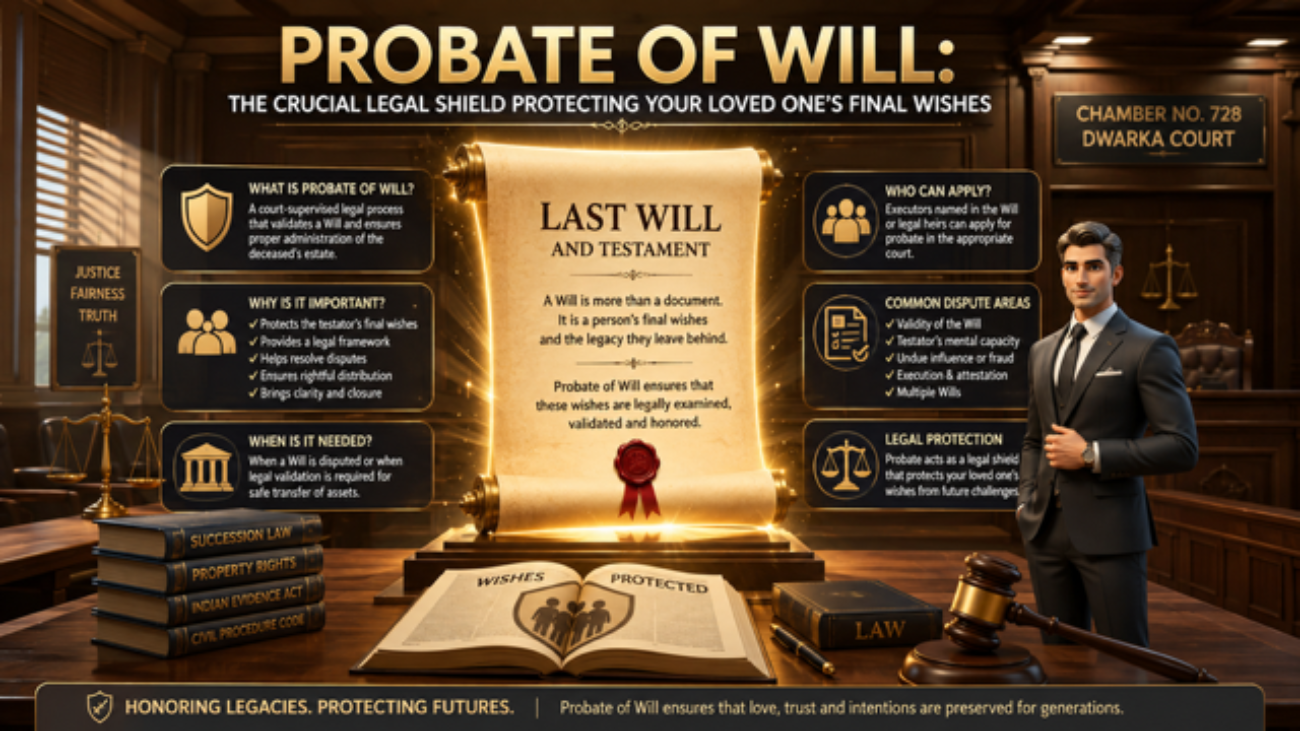
Probate of Will: The Crucial Legal Shield Protecting Your Loved One’s Final Wishes

Introduction – Probate of Will

Losing a loved one is never easy. When a Will is left behind, the family often expects the wishes of the deceased to be followed without difficulty. However, legal and family disputes can arise when questions are raised about the Will, its execution, its validity, or the rights of beneficiaries.

This is where Probate of Will becomes important.

Probate is a legal process through which a competent court examines and deals with a Will according to the applicable law. It can provide a formal legal framework for giving effect to the testamentary wishes of a deceased person.

For families dealing with property, inheritance, or succession issues, understanding Probate of Will can help avoid confusion and reduce the risk of prolonged disputes.

If you are looking for an Advocate in Dwarka Court for a Will, inheritance, property, or succession matter, it is important to understand both the legal process and the practical steps involved.


⚖️ What Is Probate of Will?

In simple words, Probate of Will refers to a court-supervised legal process concerning the Will of a deceased person.

The court examines the testamentary document and the circumstances relevant to it. Depending on the facts and applicable law, the process may involve notices, objections, evidence, hearings, and other procedural steps.

However, probate is not merely a formality.

A Will can affect valuable property, bank assets, investments, family businesses, and other interests. Therefore, proper legal handling is important, particularly where beneficiaries disagree.

The exact requirement for probate can depend on factors such as the nature of the Will, the property involved, the applicable personal law, the location of the assets, and the statutory framework applicable to the case.

Therefore, families should obtain case-specific legal advice rather than assuming that every Will follows the same procedure.

🔎 Why Is Probate of Will Important?

A Will represents the final testamentary wishes of a person. Consequently, disputes surrounding it can become emotionally and legally complicated.

Probate of Will can be important for several reasons.

1. It provides a formal legal process

A court process creates a structured method for dealing with the Will.

Instead of relying only on private claims, the parties can place their respective positions before the competent court.

2. It can help address objections

Sometimes, a beneficiary or legal heir may challenge the Will.

For example, allegations may relate to:

  • Lack of testamentary capacity
  • Undue influence
  • Fraud
  • Coercion
  • Suspicious circumstances
  • Improper execution
  • Questions regarding signatures
  • Questions concerning witnesses

Therefore, legal representation becomes particularly important when the Will is disputed.

3. It helps protect testamentary intentions

A person makes a Will to express how their assets should be dealt with after their death.

A properly handled Probate of Will matter can help place those wishes before the court in accordance with the applicable legal process.

4. It can reduce uncertainty

Inheritance disputes can remain unresolved for years if family members do not understand their respective legal positions.

Early legal assessment can therefore help identify the real issues before unnecessary litigation develops.


🏠 Probate and Property Disputes

Many Will disputes involve immovable property.

A property may be situated in Dwarka, Janakpuri, Vikaspuri, Najafgarh, Uttam Nagar, Palam Village, Samalka, Kapashera, or another part of Delhi.

In such matters, the Will may become one of several documents requiring examination.

Other relevant documents may include:

  • Sale deeds
  • Gift deeds
  • Previous Wills
  • Family settlement documents
  • Mutation records
  • Revenue documents
  • Bank records
  • Property tax records
  • Possession documents
  • Identity and relationship documents

Property Dispute Advocate can therefore examine the broader documentary picture instead of treating the Will in isolation.

📝 Common Questions About Probate of Will

Before starting proceedings, families commonly ask:

Is probate compulsory?

Not necessarily in every situation. The requirement depends upon the applicable law and the facts of the matter.

Can a Will be challenged?

Yes. A Will may be questioned on legally recognised grounds. However, the person raising an objection must establish the relevant grounds according to law and evidence.

Can beneficiaries disagree with the Will?

They may raise objections or pursue appropriate legal remedies where legally maintainable.

Does every Will require the same procedure?

No. The procedure and legal requirements can vary according to the circumstances.

Therefore, a proper legal review should be undertaken before filing proceedings.


⚖️ Probate of Will Disputes: What Can Lead to Litigation?

A disputed Probate of Will matter may become contentious when a legal heir or beneficiary challenges the document.

Common areas of dispute include:

Suspicious circumstances

Questions may arise regarding the circumstances in which the Will was prepared or executed.

Testamentary capacity

The mental capacity of the testator at the relevant time may become an issue.

Undue influence

A party may allege that the testator was influenced improperly while making the Will.

Execution and attestation

The manner in which the Will was executed and witnessed can become relevant.

Multiple Wills

Sometimes, more than one Will is produced.

In such cases, the parties may dispute which document represents the genuine and legally relevant testamentary intention.

Family and property disputes

A Will dispute may also overlap with possession, partition, injunction, declaration, or other property proceedings.

Therefore, the overall litigation strategy should be considered carefully.


👨‍⚖️ Pre-Litigation Assistance: Why Early Legal Advice Matters

Not every Will dispute needs to begin with immediate litigation.

In many situations, legal assistance at the pre-litigation stage can be extremely useful.

Before filing a case, we assist clients by understanding the complete background and reviewing the available documents.

This may include:

  • Examining the Will
  • Reviewing supporting documents
  • Understanding family relationships
  • Identifying potential beneficiaries
  • Examining property records
  • Assessing possible objections
  • Identifying jurisdictional issues
  • Explaining available legal remedies
  • Discussing the likely procedural steps

Moreover, early legal consultation can help identify missing documents before proceedings begin.

Where appropriate, parties may also explore lawful settlement or other pre-litigation options.

The objective is simple: understand the dispute before entering the courtroom.


🏛️ Assistance During Ongoing Litigation

When a Probate of Will matter reaches court, preparation becomes even more important.

Court proceedings may involve pleadings, notices, objections, evidence, affidavits, cross-examination, arguments, and procedural applications.

We assist clients throughout the litigation process by coordinating the legal and procedural aspects of the matter.

This can include:

  • Drafting and filing pleadings
  • Preparing replies and objections
  • Reviewing evidence
  • Preparing affidavits
  • Assisting with documentary evidence
  • Conducting cross-examination where required
  • Preparing legal submissions
  • Handling procedural applications
  • Appearing before the court
  • Keeping clients informed about important developments

However, every case is different.

The appropriate approach depends upon the Will, the evidence, the objections raised, the property involved, and the applicable law.


📍 Why Choose a Local Advocate in Dwarka Court?

Legal knowledge is important. Practical knowledge of the court system is equally valuable.

As local advocates practising at Dwarka Court, Delhi, we understand the working environment, filing procedures, court processes, and practical requirements involved in matters before the court.

This local presence can help with timely filing, procedural follow-up, court appearances, and coordination.

Our practice covers matters arising from areas such as:

  • Dwarka Sector 6
  • Dwarka Sector 10
  • Dwarka Sector 12
  • Dwarka Sector 23
  • Dwarka North
  • Dwarka South
  • Janakpuri
  • Vikaspuri
  • Uttam Nagar
  • Najafgarh
  • Bindapur
  • Mohan Garden
  • Chhawla
  • Baba Haridas Nagar
  • Palam Village
  • Samalka
  • Dabri
  • Jaffarpur Kalan
  • Kapashera
  • Delhi Cantonment

Therefore, if you are searching for an Advocate in Dwarka Court or a lawyer near Dwarka Court, local court familiarity can be practically useful.


🧑‍⚖️ Experience Across Related Legal Matters

Will and inheritance disputes may overlap with several areas of litigation.

For example, a single family dispute can involve succession, property possession, partition, recovery, injunctions, or commercial interests.

Our practice therefore also covers related areas including:

  • Civil Litigation Lawyer in Delhi
  • Property Dispute Advocate
  • Recovery Suit Counsel
  • Commercial Litigation Lawyer
  • Lawyer in South West Delhi
  • Criminal Advocate Dwarka
  • Cheque Bounce Lawyer in Dwarka Court
  • Regular Bail & Anticipatory Bail Lawyer Dwarka

These areas are legally distinct. However, understanding connected disputes can help in analysing the complete background of a client’s legal problem.

With 18+ years of experience in Dwarka Court, our approach focuses on careful preparation, professional conduct, clear communication, and proper legal procedure.


🤝 Building Client Trust Through Professional Standards

Legal representation is not only about filing a case.

It is also about communication, transparency, preparation, and trust.

We follow a professional approach based on:

✅ High professional standards

Every matter requires proper preparation and responsible handling.

📞 Quick responsiveness

Clients should receive timely updates about important developments.

📱 Call and WhatsApp support

Subject to professional and court commitments, clients can communicate through calls and dedicated WhatsApp support for coordination and updates.

💰 Reasonable and transparent fees

The fee structure should be discussed clearly so that clients understand the professional charges applicable to their matter.

📄 Proper Lawyer-Client Fee Agreements

Where applicable, the terms of professional engagement and fees are documented clearly.

🧾 Fee receipts and acknowledgements

Proper receipts and acknowledgements help maintain transparency in financial dealings.

🤝 Honest and fair dealings

A professional relationship should be based on honesty, fairness, confidentiality, and mutual respect.

These principles are particularly important in family and inheritance matters because legal disputes can already involve considerable emotional stress.


📊 Probate of Will: Pre-Litigation vs Litigation

StageWhat HappensHow Legal Assistance Helps
🔍 Initial ConsultationFacts and documents are discussedIdentifying the legal issues
📄 Document ReviewWill and supporting records are examinedFinding gaps, inconsistencies and relevant documents
🤝 Pre-LitigationPossible dispute is assessedExploring legally appropriate options
⚖️ FilingProceedings are initiated where appropriateDrafting, filing and procedural compliance
📬 Notice & ObjectionsInterested parties may respondPreparing replies and objections
🧾 EvidenceDocuments and testimony may be presentedEvidence preparation and legal strategy
👨‍⚖️ Court HearingsCourt hears the partiesRepresentation and procedural assistance
🔎 Cross-ExaminationWitnesses may be questionedPreparing and conducting cross-examination where required
🗣️ Final ArgumentsLegal and factual issues are presentedStructured legal submissions
📜 Court DecisionCourt determines the matter according to lawExplaining the order and considering available legal steps

🚨 Mistakes Families Should Avoid

Inheritance disputes can become more difficult when families delay legal advice.

Therefore, avoid these common mistakes:

1. Ignoring the original Will

Keep important original documents safely and maintain proper records.

2. Assuming every Will is automatically accepted

A Will may still require legal scrutiny depending upon the circumstances.

3. Destroying or altering documents

Do not modify, conceal, or discard documents connected with the estate.

4. Ignoring objections

If legal proceedings have already commenced, ignoring notices can create serious procedural complications.

5. Starting litigation without understanding jurisdiction

The correct forum and procedure matter.

6. Relying only on verbal family arrangements

Where property or inheritance is involved, proper legal documentation is important.

7. Waiting until the dispute becomes serious

Early legal advice can help identify potential problems before they become more complicated.


🔐 Probate of Will and the Protection of Family Interests

A Will is often prepared during a person’s lifetime to reduce uncertainty after death.

However, the existence of a Will does not always prevent disputes.

Family relationships can change. Properties can appreciate significantly. Beneficiaries may disagree. Documents may become difficult to locate.

Therefore, Probate of Will should be understood as part of a broader legal process concerning testamentary wishes and estate administration.

A careful approach involves examining the Will, understanding the legal position of the parties, identifying the assets involved, and selecting the appropriate legal procedure.


📍 Looking for an Advocate in Dwarka Court?

If you are searching for legal assistance regarding Probate of Will Disputes in Advocate Dwarka Court, property inheritance, succession, partition, or connected civil litigation, obtaining timely professional advice can help you understand your legal position.

For residents of Dwarka and nearby areas such as Janakpuri, Vikaspuri, Uttam Nagar, Najafgarh, Bindapur, Palam Village, Samalka, Dabri, Kapashera, Chhawla and Delhi Cantonment, Dwarka Court is an important local legal forum for many civil and family-related disputes.

As local advocates practising at Dwarka Court, we focus on proper preparation, procedural compliance, communication, and professional representation.

🧭 Conclusion

A Will carries a person’s final wishes regarding their estate. For that reason, disputes concerning a Will deserve careful legal attention.

Probate of Will can provide an important legal framework for addressing testamentary matters. At the same time, the need for probate and the appropriate legal procedure depend upon the facts and applicable law.

Whether you are considering action before litigation begins or already facing an ongoing court dispute, early legal assessment can make the process more structured.

With local court experience, proper documentation, transparent communication, and professional representation, clients can approach their legal matters with greater clarity.

If your matter concerns a Will, inheritance, property dispute, or related litigation, consult a qualified lawyer and understand the applicable legal process before taking the next step.


📞 Legal Consultation

If you require professional assistance regarding Probate of Will, Will disputes, inheritance, succession, property disputes, or related litigation before Dwarka Court, you may contact:

Ankit Gaurav Kainth & Associates
Advocate, Dwarka Court, Delhi
18+ Years of Experience in Dwarka Court

📞 9899085554
📞 9811885554

Legal matters are fact-specific. This article is intended for general informational purposes and should not be treated as legal advice or a guarantee of any particular result. Applicable legal requirements may vary depending upon the facts, documents, jurisdiction, and governing law.


Frequently Asked Questions

1. What is Probate of Will?

Probate of Will is a court-related legal process concerning the validity and administration of a deceased person’s Will, subject to the applicable law and facts of the case.

2. Is Probate of Will compulsory for every Will?

No. Whether probate is required depends upon the applicable law, the nature of the Will, the property involved, and other relevant circumstances.

3. Can a Will be challenged?

Yes. A Will can be challenged on legally recognised grounds, depending upon the facts and evidence available.

4. Can a property dispute involve a Will?

Yes. A Will may become relevant in disputes involving ownership, inheritance, partition, possession, declaration, injunction, or other property-related claims.

5. Why consult an Advocate in Dwarka Court for a Will dispute?

A local advocate may provide practical assistance with court procedures, filing requirements, hearings, documentation, and representation before Dwarka Court. However, the appropriate legal strategy depends upon the facts of each matter.
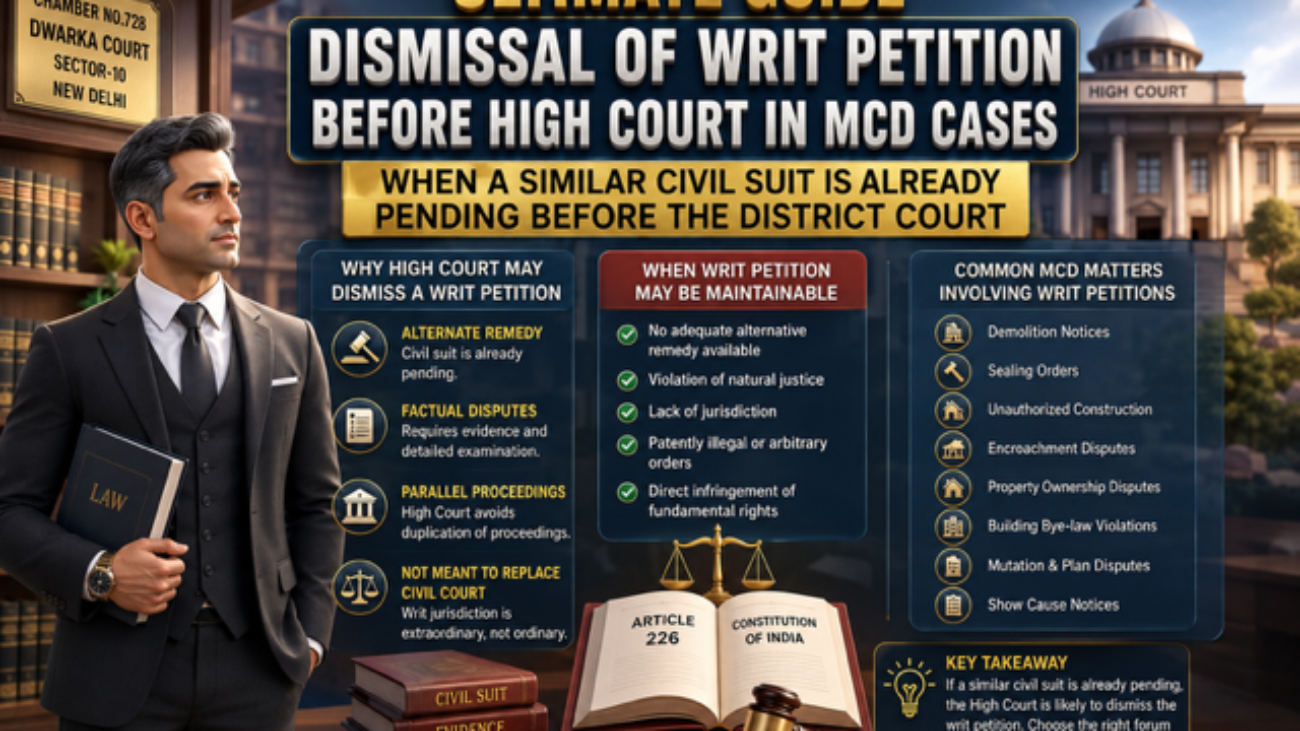
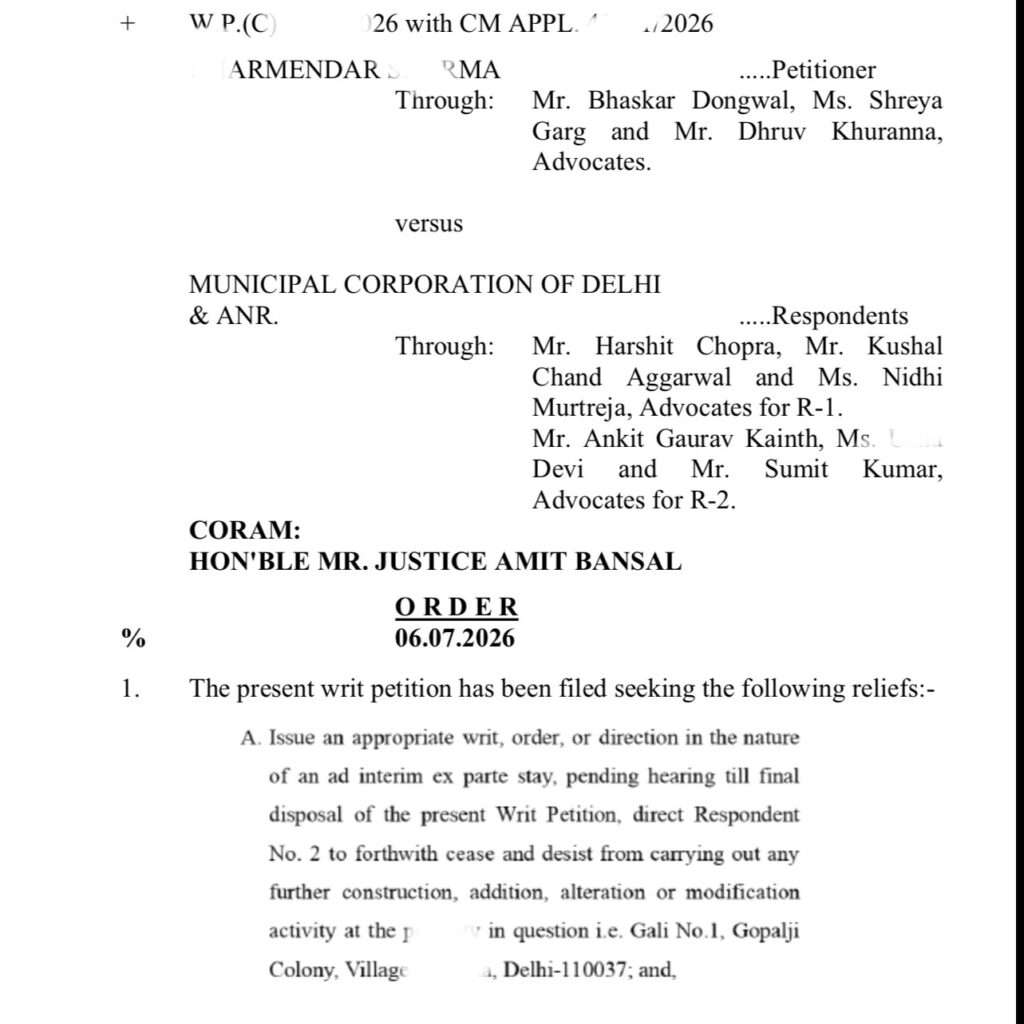
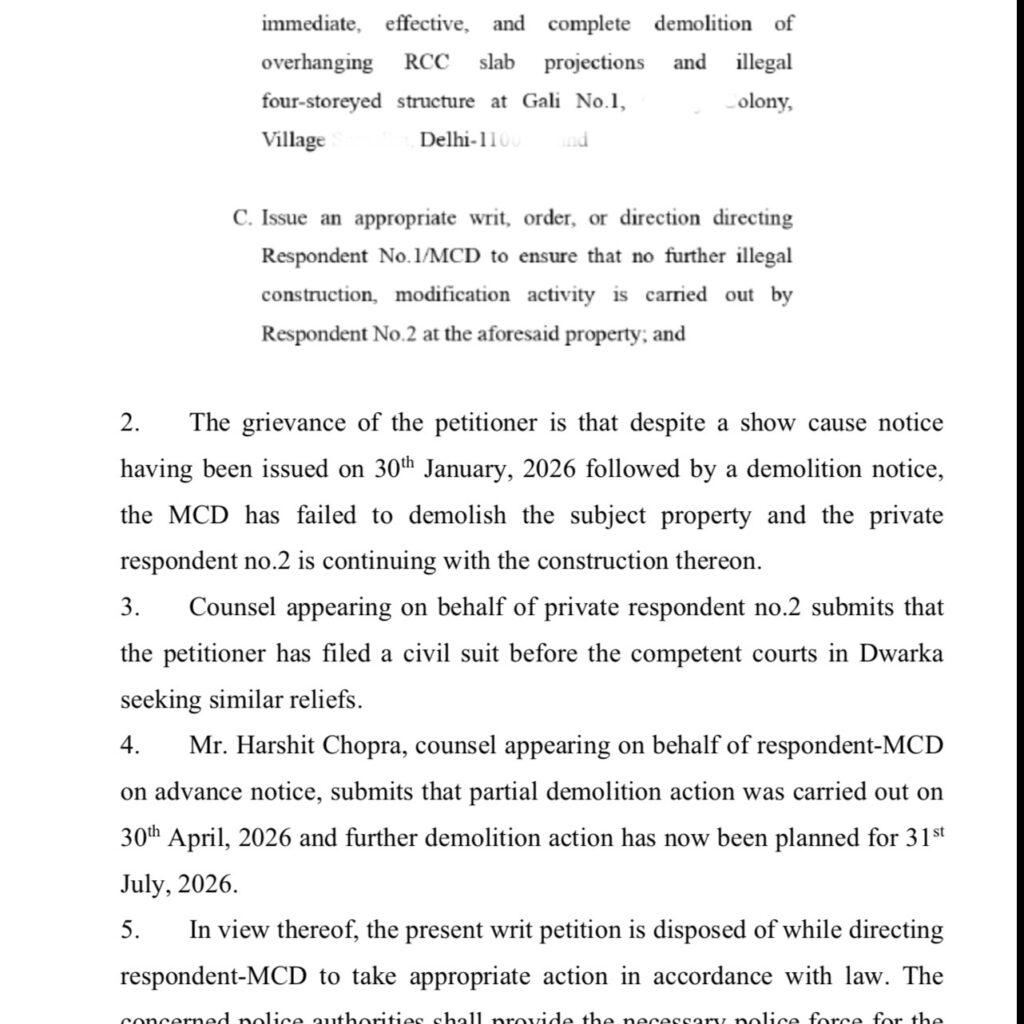
Advocate explaining dismissal of writ petition in MCD demolition case before High Court when civil suit is pending in District Court

⚖️ Ultimate Guide: Dismissal of Writ Petition Before High Court in MCD Cases When a Similar Civil Suit Is Already Pending Before the District Court

INTRODUCTION – Dismissal of Writ Petition

Municipal disputes involving the Municipal Corporation of Delhi (MCD) frequently result in demolition notices, sealing orders, unauthorized construction disputes, and property-related litigation. In many such matters, affected parties directly approach the High Court under Article 226 of the Constitution by filing a writ petition. However, the Dismissal of Writ Petition is a common outcome when a similar civil suit is already pending before the competent District Court.

Therefore, understanding when the High Court may refuse to exercise its extraordinary jurisdiction becomes essential. This article explains the legal principles governing the Dismissal of Writ Petition, the doctrine of alternative remedy, relevant judicial reasoning, and practical guidance for property owners, builders, residents, and businesses facing MCD actions.

If you are looking for a Writ Petition Advocate in Dwarka Delhi for MCD demolition cases, this guide will help you understand your legal rights and the appropriate legal strategy.

Dismissal of Writ Petition in MCD Cases – Advocate in Dwarka Court Delhi

⚖️ What Is a Dismissal of Writ Petition?

Dismissal of Writ Petition means that the High Court declines to entertain or continue the writ proceedings. The Court may dismiss the petition either on merits or because another equally effective legal remedy already exists.

Importantly, Article 226 provides extraordinary jurisdiction. It is not intended to replace ordinary civil remedies.

Consequently, where a civil suit involving identical issues is already pending before the District Court, the High Court often declines interference.


📚 Why Does the High Court Dismiss a Writ Petition?

The principle is simple.

When an effective statutory or civil remedy is available, the High Court generally expects litigants to pursue that remedy first.

Therefore, Dismissal of Writ Petition commonly occurs when:

  • A civil suit is already pending.
  • Interim relief has been sought before the Trial Court.
  • Evidence must be recorded.
  • Disputed questions of fact require examination.
  • Title or ownership disputes exist.
  • Complex property rights need adjudication.

Accordingly, the High Court avoids parallel proceedings before different forums.


🏛️ MCD Cases Where Dismissal of Writ Petition Is Common

The Dismissal of Writ Petition frequently arises in matters involving:

✅ Demolition Notices

✅ Sealing Proceedings

✅ Unauthorized Construction

✅ Encroachment Disputes

✅ Property Ownership Disputes

✅ Mutation Disputes

✅ Building Bye-law Violations

✅ Commercial Property Actions

✅ Show Cause Notices

✅ Reconstruction Permissions


📊 Understanding the Position Through a Simple Table

SituationHigh Court’s Likely View
Civil suit already pendingWrit may be dismissed
Temporary injunction application pendingHigh Court usually declines interference
Pure question of lawWrit may be maintainable
Violation of natural justiceHigh Court may entertain petition
No alternate remedyWrit usually maintainable
Property title disputedCivil Court is appropriate
Evidence requiredDistrict Court should decide
Fundamental rights directly violatedHigh Court may intervene

⚖️ Doctrine of Alternative Remedy

One of the strongest reasons for Dismissal of Writ Petition is the doctrine of alternative remedy.

Simply put, where the law provides another effective remedy, constitutional courts generally refrain from exercising writ jurisdiction.

However, this rule is not absolute.

The High Court may still entertain a writ petition where:

  • The authority acted without jurisdiction.
  • Natural justice was violated.
  • The order is patently illegal.
  • Fundamental rights are directly infringed.
  • Proceedings are completely arbitrary.

Otherwise, Dismissal of Writ Petition remains the normal approach.


🏠 Why MCD Property Cases Usually Belong Before Civil Courts

Many MCD disputes involve factual controversies.

For example:

  • Who owns the property?
  • Whether construction is authorized?
  • Whether sanctioned plans exist?
  • Whether demolition notice is valid?
  • Whether possession is lawful?

These issues require documentary evidence and witness examination.

Therefore, Civil Courts are generally considered the proper forum.

As a result, the possibility of Dismissal of Writ Petition increases significantly when similar issues are already pending before the District Court.


⚖️ How We Assist Clients Before Litigation

Every successful case begins with proper legal planning.

Therefore, our office assists clients even before litigation starts.

Our pre-litigation services include:

✅ Legal consultation

✅ Property document verification

✅ MCD notice analysis

✅ Reply drafting

✅ Legal notices

✅ Settlement discussions

✅ Negotiation with authorities

✅ Strategy planning

Early legal advice often prevents unnecessary litigation and protects valuable legal rights.


🏛️ How We Assist During Litigation

Once litigation becomes necessary, we represent clients at every stage.

Our litigation services include:

  • Drafting civil suits
  • Filing written statements
  • Injunction applications
  • Appeals
  • Writ petitions
  • MCD litigation
  • Evidence recording
  • Final arguments
  • Execution proceedings

Whether you require a Civil Litigation Lawyer in Delhi, a Property Dispute Advocate, a Recovery Suit Counsel, or a Commercial Litigation Lawyer, our office provides comprehensive representation.


📍 Why Clients Prefer Our Office Near Dwarka Court

We have more than 18 years of litigation experience before Dwarka Court.

Being a local Advocate in Dwarka Court, we understand:

  • Court procedures
  • Filing systems
  • Registry practice
  • Daily court functioning
  • Case management
  • Local administrative processes

This enables faster filing, better coordination, and efficient representation.

We regularly represent clients from:

📍 Dwarka Sector-6

📍 Dwarka Sector-10

📍 Dwarka Sector-12

📍 Dwarka Sector-23

📍 Dwarka North

📍 Dwarka South

📍 Janakpuri

📍 Vikaspuri

📍 Uttam Nagar

📍 Najafgarh

📍 Palam Village

📍 Dabri

📍 Samalka

📍 Kapashera

📍 Delhi Cantonment

📍 Chhawla

📍 Baba Haridas Nagar

📍 Bindapur

📍 Mohan Garden

📍 Jaffarpur Kalan

and other areas near Dwarka Court in South West Delhi.


🤝 Why Clients Trust Us

Trust is built through transparency.

Accordingly, we maintain:

✅ High professional standards

✅ Prompt legal advice

✅ Dedicated WhatsApp support

✅ Easy availability on calls

✅ Transparent fee structure

✅ Proper Lawyer-Client Fee Agreements

✅ Fee receipts and acknowledgements

✅ Honest legal opinions

✅ Ethical representation

Our objective is to build long-term client relationships based on integrity and professionalism.


⚖️ Related Practice Areas

Besides matters involving Dismissal of Writ Petition, we also handle:


📌 Key Takeaways

✔️ Dismissal of Writ Petition often occurs when a similar civil suit is pending.

✔️ Civil Courts remain the proper forum for disputed factual issues.

✔️ High Courts generally avoid parallel proceedings.

✔️ Proper legal strategy should be planned before filing any writ petition.

✔️ Early consultation can save significant litigation costs and time.


✅ Conclusion

The Dismissal of Writ Petition in MCD matters is largely based on the well-established principle that extraordinary writ jurisdiction should not replace ordinary civil remedies. When a similar civil suit is already pending before the District Court, the High Court generally expects parties to pursue that remedy unless exceptional circumstances exist, such as lack of jurisdiction, violation of natural justice, or infringement of fundamental rights.

Choosing the correct legal forum at the beginning is therefore crucial. A carefully planned litigation strategy can avoid procedural setbacks, reduce unnecessary costs, and improve the likelihood of obtaining effective relief. Seeking timely legal advice from an experienced advocate helps ensure that the most appropriate remedy is pursued from the outset.


📞 Contact Us

If you have received an MCD demolition notice, sealing notice, or are concerned about the Dismissal of Writ Petition, consult our office for a detailed legal evaluation.

Ankit Gaurav Kainth & Associates

⚖️ Advocate in Dwarka Court, Delhi

📞 9899085554

📞 9811885554

We provide practical legal advice, transparent professional services, and dedicated representation before the District Courts and the High Court.


❓Frequently Asked Questions (FAQs)

1. Can the High Court dismiss my writ petition if my civil suit is already pending?

Yes. The High Court may dismiss the writ petition if an effective civil remedy is already being pursued before the District Court.

2. What is the main reason for the dismissal of a writ petition?

The most common reason is the availability of an efficacious alternative remedy, especially where factual disputes require evidence.

3. Can I challenge an MCD demolition notice through a writ petition?

Yes, but maintainability depends on the facts. If no adequate alternative remedy exists or exceptional circumstances are present, the High Court may entertain the petition.

4. Do I need a lawyer experienced in MCD litigation?

Yes. MCD matters involve procedural and technical issues. An advocate familiar with municipal laws and court practice can help choose the correct legal remedy.

5. Do you represent clients before both Dwarka Court and the High Court?

Yes. We advise clients at the pre-litigation stage and represent them before the District Courts as well as the High Court, depending on the nature of the dispute.


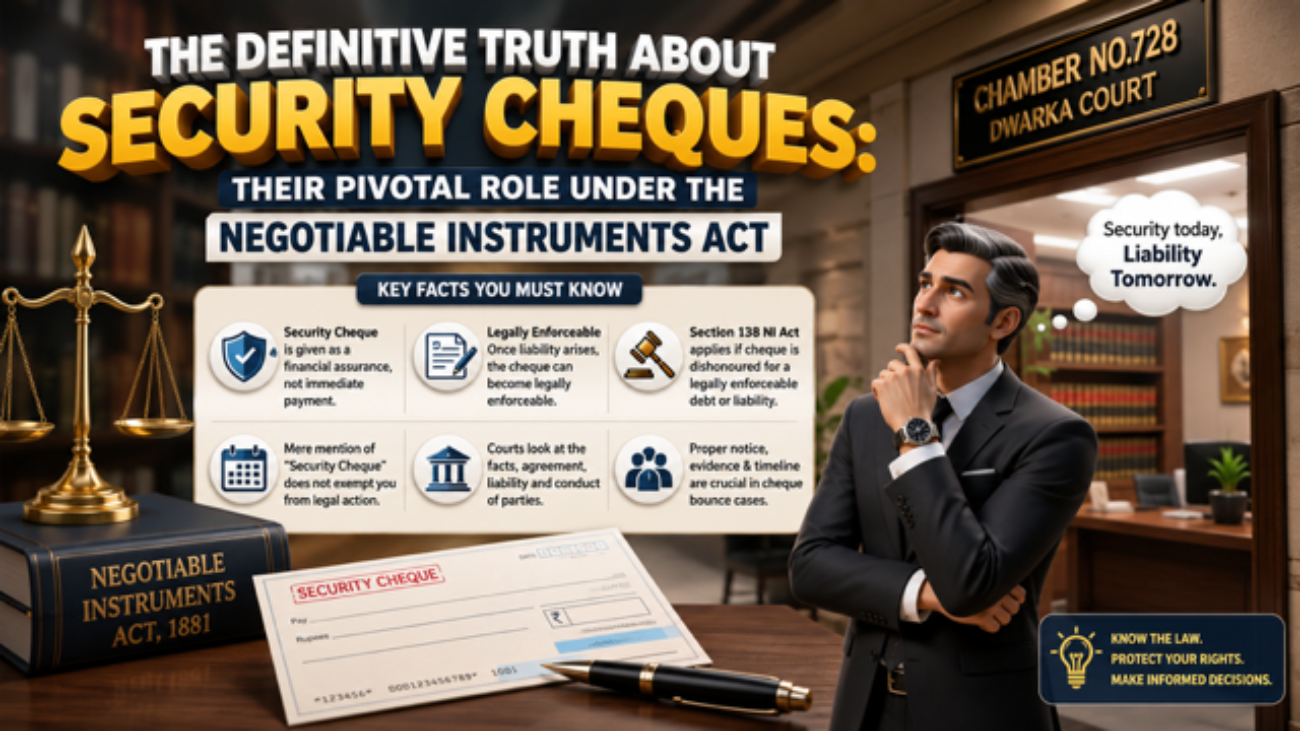
Advocate explaining the truth about security cheques and Section 138 NI Act near Dwarka Court Delhi

The Definitive Truth About Security Cheques: Their Pivotal Role Under the Negotiable Instruments Act

Truth About Security Cheques: Do They Really Have No Legal Value?

Many people believe that a security cheque cannot lead to legal action if it is dishonoured. However, this is one of the biggest misconceptions in commercial transactions. The Truth About Security Cheques is that merely writing the words “Security Cheque” on a cheque does not automatically protect the drawer from legal liability.

Therefore, understanding the Truth About Security Cheques is essential for every business owner, borrower, landlord, supplier, employer, and individual dealing with financial transactions.

At our office near Dwarka Court, we regularly advise clients at both the pre-litigation and litigation stages involving cheque dishonour matters. With 18+ years of experience before Dwarka Courts, we have successfully guided clients through legal disputes with professionalism, transparency, and prompt action.


⚖️ What is a Security Cheque?

security cheque is a cheque given as a form of financial assurance. It is generally handed over before the actual liability becomes due.

For example:

  • ✅ Loan transactions
  • ✅ Business agreements
  • ✅ Rent or lease arrangements
  • ✅ Supply contracts
  • ✅ Partnership transactions
  • ✅ Employment agreements

Initially, the cheque acts as security. However, once the agreed liability becomes payable, the security cheque may become legally enforceable.

This is the first and most important Truth About Security Cheques that every person should understand.


⚖️ Truth About Security Cheques Under the Negotiable Instruments Act

The Truth About Security Cheques is that the Negotiable Instruments Act, 1881 does not create any special exemption merely because a cheque is called a “security cheque.”

Instead, the law examines:

  • Whether a legally enforceable debt or liability existed.
  • Whether the cheque was presented according to the agreement.
  • Whether statutory requirements under Section 138 were fulfilled.

Accordingly, if these legal requirements are satisfied, even a security cheque may attract proceedings under Section 138 of the Negotiable Instruments Act.


📋 Simple Table to Understand Security Cheques

SituationCan Section 138 Apply?Explanation
Security cheque issued before liability❌ Usually NoNo existing liability at that stage.
Liability arises later and cheque is presented✅ YesCheque may become legally enforceable.
Cheque dishonoured after debt becomes due✅ YesLegal action may be maintainable.
No debt or liability ever existed❌ NoEssential ingredient of Section 138 is missing.
Liability already discharged before presentationDepends on factsCourt examines evidence carefully.

⚖️ Important Ingredients for a Section 138 Case

The Truth About Security Cheques becomes clearer when the following conditions are fulfilled:

✅ A legally enforceable debt exists.

✅ The cheque was issued towards that liability.

✅ The cheque is presented within its validity period.

✅ The cheque is dishonoured.

✅ A legal demand notice is issued within the prescribed limitation.

✅ Payment is not made within the statutory period.

Only after these requirements are fulfilled can criminal proceedings generally arise.


📖 Important Judicial View

The courts have repeatedly observed that merely calling a cheque a “security cheque” does not automatically defeat proceedings under Section 138.

Instead, the court examines:

  • Nature of transaction
  • Terms of agreement
  • Evidence produced
  • Timing of liability
  • Conduct of parties

Therefore, the Truth About Security Cheques always depends upon the complete facts and surrounding circumstances of each case.


⚖️ Common Myths vs Truth

MythTruth
Security cheques are never valid.Incorrect. They may become legally enforceable.
Writing “Security” on cheque avoids liability.Incorrect. Courts examine actual liability.
Every dishonoured security cheque leads to conviction.Incorrect. Facts and evidence matter.
No agreement is required.Documentary evidence always strengthens the case.
Security cheques have no legal importance.They may carry significant legal consequences.

🛡️ How We Help Before Litigation (Pre-Litigation Stage)

Proper legal advice before filing a case often saves valuable time, money, and unnecessary litigation.

We assist clients by:

✅ Examining agreements and documents.

✅ Verifying whether a legally enforceable liability exists.

✅ Drafting and reviewing legal notices.

✅ Advising on settlement opportunities.

✅ Negotiating commercial disputes.

✅ Evaluating strengths and weaknesses of the case.

✅ Protecting clients from avoidable legal risks.

Our objective is always to resolve disputes efficiently whenever possible.


⚖️ How We Assist During Litigation

If litigation becomes unavoidable, we provide complete representation before Dwarka Court and other competent courts.

Our services include:

  • Filing complaints under Section 138 NI Act.
  • Defence in cheque dishonour matters.
  • Criminal complaint proceedings.
  • Bail applications.
  • Recovery suits.
  • Civil litigation.
  • Commercial disputes.
  • Evidence preparation.
  • Cross-examination.
  • Final arguments.
  • Appeals and revisions.

Whether you require a Cheque Bounce Advocate DwarkaU/s 138 NI Act Lawyer DwarkaCriminal Disputes Advocate Dwarka CourtRegular Bail & Anticipatory Bail Lawyer DwarkaRecovery Suit CounselCommercial Litigation LawyerProperty Dispute AdvocateCivil Litigation Lawyer in Delhi, or an Advocate in Dwarka Court, we provide practical legal guidance based on the facts of each matter.
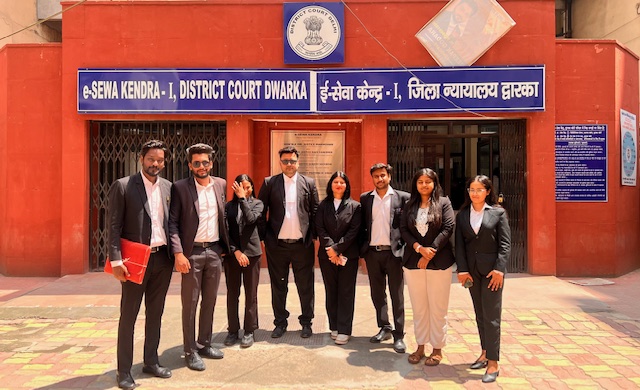

📍 Why Clients Prefer Our Office Near Dwarka Court

Our office is located near Dwarka Court, which enables us to respond quickly to urgent legal matters.

With 18+ years of experience before Dwarka Courts, we possess a practical understanding of:

  • Court filing procedures
  • Daily court working
  • Registry process
  • Case management
  • Documentation requirements
  • Local court practices

This allows us to act promptly while maintaining professional standards.

We regularly assist clients from Janakpuri, Vikaspuri, Dwarka North, Dwarka South, Dwarka Sector-6, Dwarka Sector-10, Dwarka Sector-12, Dwarka Sector-23, Uttam Nagar, Najafgarh, Delhi Cantonment, Palam Village, Dabri, Mohan Garden, Chhawla, Samalka, Bindapur, Baba Haridas Nagar, Jaffarpur Kalan, Kapashera, and nearby areas.


🤝 Why Clients Trust Us

We believe legal services should be transparent and client-focused.

Therefore, we provide:

✅ High professional standards

✅ Honest legal advice

✅ Quick responsiveness

✅ Easy availability on calls

✅ Dedicated WhatsApp support

✅ Reasonable and transparent fees

✅ Proper Lawyer–Client Fee Agreements

✅ Fee receipts and written acknowledgements

✅ Fair and ethical dealings

Our goal is to build long-term trust through professionalism and accountability.


✅ Conclusion

The Truth About Security Cheques is that there is no universal rule stating that every security cheque is legally enforceable or legally invalid. Instead, courts carefully examine whether a legally enforceable debt or liability existed when the cheque was presented.

Therefore, before initiating legal proceedings—or before assuming that a security cheque has no legal effect—it is advisable to obtain proper legal guidance. Early legal advice can help protect your rights, reduce unnecessary disputes, and improve the overall strategy of your case.


📞 Need Legal Assistance?

If you are facing a cheque bounce dispute, have received a legal notice, wish to file or defend a case under Section 138 of the Negotiable Instruments Act, or require assistance in civil or criminal litigation, our team is here to help.

⚖️ 18+ Years of Experience in Dwarka Court

📍 Office Near Dwarka Court, Delhi

📞 9899085554

📞 9811885554

We assist clients with professionalism, transparency, prompt communication, and practical legal solutions tailored to their specific needs.


Supreme Court Advocate in Delhi for Dehradun Clients

Invincible Roadmap: How to File a Case in the Supreme Court of India in Simple Steps

Introduction – Filing a Petition in the Supreme Court

The Supreme Court of India is the highest court in the country. It hears important constitutional matters, civil disputes, criminal appeals, Special Leave Petitions (SLPs), public interest litigations, and many other cases. However, many people are unsure about How to File a Case in the Supreme Court of India.

Fortunately, the process becomes easier when it is explained in simple language. This guide explains How to File a Case in the Supreme Court of India, the documents required, the filing process, and the importance of professional legal assistance.

Moreover, if you are looking for reliable legal support, our team assists clients from all States and Union Territories of India in Supreme Court matters while also providing strategic support from our Dwarka Court office.


What Types of Cases Can Be Filed in the Supreme Court of India?

Before understanding How to File a Case in the Supreme Court of India, it is important to know which matters can be filed before the Supreme Court.

The Supreme Court generally hears:

⚖️ Special Leave Petitions (SLP)

⚖️ Civil Appeals

⚖️ Criminal Appeals

⚖️ Writ Petitions

⚖️ Public Interest Litigations (PIL)

⚖️ Review Petitions

⚖️ Curative Petitions

⚖️ Transfer Petitions

⚖️ Constitutional Matters

Therefore, the nature of your dispute determines the procedure for How to File a Case in the Supreme Court of India.


Simple Table: How to File a Case in the Supreme Court of India

StepProcessPurpose
1Consult an AdvocateUnderstand legal options
2Review DocumentsVerify case strength
3Draft PetitionPrepare legal pleadings
4Prepare AnnexuresAttach supporting documents
5Filing in Supreme Court RegistrySubmit case officially
6Registry ScrutinyCheck technical compliance
7Removal of DefectsCorrect filing issues if any
8Listing Before CourtMatter gets listed
9Court HearingArguments are presented
10Final OrdersCourt passes directions

This table provides a simplified overview of How to File a Case in the Supreme Court of India.


Step 1: Consult an Experienced Advocate

The first step in How to File a Case in the Supreme Court of India is obtaining proper legal advice.

A detailed consultation helps determine:

✅ Whether the matter is maintainable

✅ Which remedy is available

✅ Whether an appeal or SLP should be filed

✅ Required documents

✅ Applicable limitation period

Consequently, proper guidance prevents costly mistakes.


Step 2: Collect Relevant Documents

Documentation is the foundation of every case.

Generally, the following documents may be required:

📄 Certified copies of judgments

📄 Orders passed by lower courts

📄 Pleadings

📄 Evidence documents

📄 Identity proofs

📄 Supporting correspondence

Without complete records, filing may become difficult. Therefore, document preparation is a crucial part of How to File a Case in the Supreme Court of India.


Step 3: Drafting the Petition

Once documents are reviewed, the petition is drafted.

The petition must clearly explain:

⚖️ Facts of the case

⚖️ Legal issues involved

⚖️ Grounds for challenge

⚖️ Relief sought

Furthermore, drafting must comply with Supreme Court Rules and procedural requirements.


Step 4: Filing Before the Supreme Court Registry

After drafting is completed, the matter is filed before the Supreme Court Registry.

The Registry examines:

✅ Formatting requirements

✅ Court fees

✅ Affidavits

✅ Annexures

✅ Procedural compliance

Accordingly, proper filing ensures smooth processing.


Step 5: Registry Scrutiny and Defect Removal

After filing, the Registry conducts scrutiny.

Sometimes defects may be identified.

For example:

📌 Missing documents

📌 Formatting errors

📌 Incomplete affidavits

📌 Technical deficiencies

Such defects must be removed within the prescribed time.

Therefore, careful compliance plays an important role in How to File a Case in the Supreme Court of India.


Step 6: Listing and Hearing

Once scrutiny is completed, the matter is listed before the Hon’ble Court.

Thereafter:

⚖️ Preliminary hearing takes place

⚖️ Notice may be issued

⚖️ Interim relief may be granted

⚖️ Final arguments may be heard

⚖️ Orders are passed

Hence, understanding the hearing process is equally important when learning How to File a Case in the Supreme Court of India.


Pre-Litigation Assistance We Provide

Many disputes can be resolved before court proceedings begin.

Therefore, we assist clients at the pre-litigation stage through:

✅ Legal consultations

✅ Case evaluation

✅ Documentation review

✅ Legal notices

✅ Settlement discussions

✅ Risk assessment

As a result, clients often save time, effort, and litigation expenses.


Litigation Support During Ongoing Cases

Once litigation starts, strategic representation becomes essential.

Our services include:-

⚖️ Drafting petitions

⚖️ Filing applications

⚖️ Appeal preparation

⚖️ Court representation

⚖️ Legal research

⚖️ Case management

⚖️ Compliance assistance

Consequently, clients receive end-to-end legal support throughout their matters.


Why Clients Choose Our Legal Services

High Professional Standards

Every case receives detailed legal attention.

Quick Responsiveness

Client queries are addressed promptly.

Dedicated WhatsApp Support

Easy communication helps clients stay informed.

Availability on Call

Timely legal guidance remains accessible.

Transparent Fee Structure

No hidden charges or surprises.

Proper Lawyer-Client Fee Agreements

Written agreements provide clarity.

Fee Receipts and Acknowledgements

Every payment is properly documented.

Honest and Transparent Advice

We provide practical and realistic legal opinions.


Advantage of Being Local Advocates in Dwarka Court

With over 18 years of experience in Dwarka Court, we understand court procedures, filing systems, documentation requirements, and litigation processes thoroughly.

This experience allows us to:

✅ Prepare matters efficiently

✅ Coordinate filings quickly

✅ Manage documentation effectively

✅ Provide strategic litigation support

Although Supreme Court matters are handled in New Delhi, our strong litigation background in Dwarka Court helps clients receive efficient and organised legal assistance.


Serving Clients Across India

We assist clients from:

📍 Delhi

📍 Haryana

📍 Punjab

📍 Rajasthan

📍 Uttar Pradesh

📍 Uttarakhand

📍 Himachal Pradesh

📍 Maharashtra

📍 Gujarat

📍 Karnataka

📍 Tamil Nadu

📍 Kerala

📍 Telangana

📍 Andhra Pradesh

📍 West Bengal

📍 Odisha

📍 Bihar

📍 Jharkhand

📍 Assam

📍 Jammu & Kashmir

📍 Ladakh

📍 All States and Union Territories of India

Therefore, individuals and businesses from across India can seek guidance regarding How to File a Case in the Supreme Court of India.


Conclusion

Understanding How to File a Case in the Supreme Court of India does not have to be complicated. With proper legal advice, complete documentation, strategic drafting, and timely filing, the process becomes significantly easier.

Whether your matter involves a civil dispute, criminal appeal, constitutional issue, Special Leave Petition, or writ petition, professional legal guidance can improve efficiency and reduce procedural errors.

Therefore, if you wish to understand How to File a Case in the Supreme Court of India, obtaining timely legal assistance is often the most important first step.


FAQs

1. Can I directly approach the Supreme Court of India?

In specific situations such as constitutional remedies and Special Leave Petitions, direct access may be available subject to legal requirements.

2. What documents are required for Filing a Petition in the Supreme Court?

Generally, certified copies, supporting documents, affidavits, vakalatnama, and relevant court orders are required.

3. How long does Filing a Petition in the Supreme Court take?

The timeline varies depending on documentation, procedural compliance, and court requirements.

4. Can bail matters be filed before the Supreme Court?

Yes. Appropriate cases involving Regular Bail and Anticipatory Bail can be considered subject to legal provisions.

5. Why should I consult a lawyer before filing?

Professional legal advice helps identify procedural issues, improve documentation, and develop an effective legal strategy.


📞 Contact Us Today

Need assistance regarding How to Filing a Case in the Supreme Court of India?

⚖️ Supreme Court Matters | Civil Matters | Criminal Matters

📞 Mobile: 9899085554

📞 Mobile: 9811885554

✅ Consultation Available

✅ Pre-Litigation Guidance

✅ Litigation Support

✅ Transparent Professional Services

Call today and discuss your legal options with confidence.