
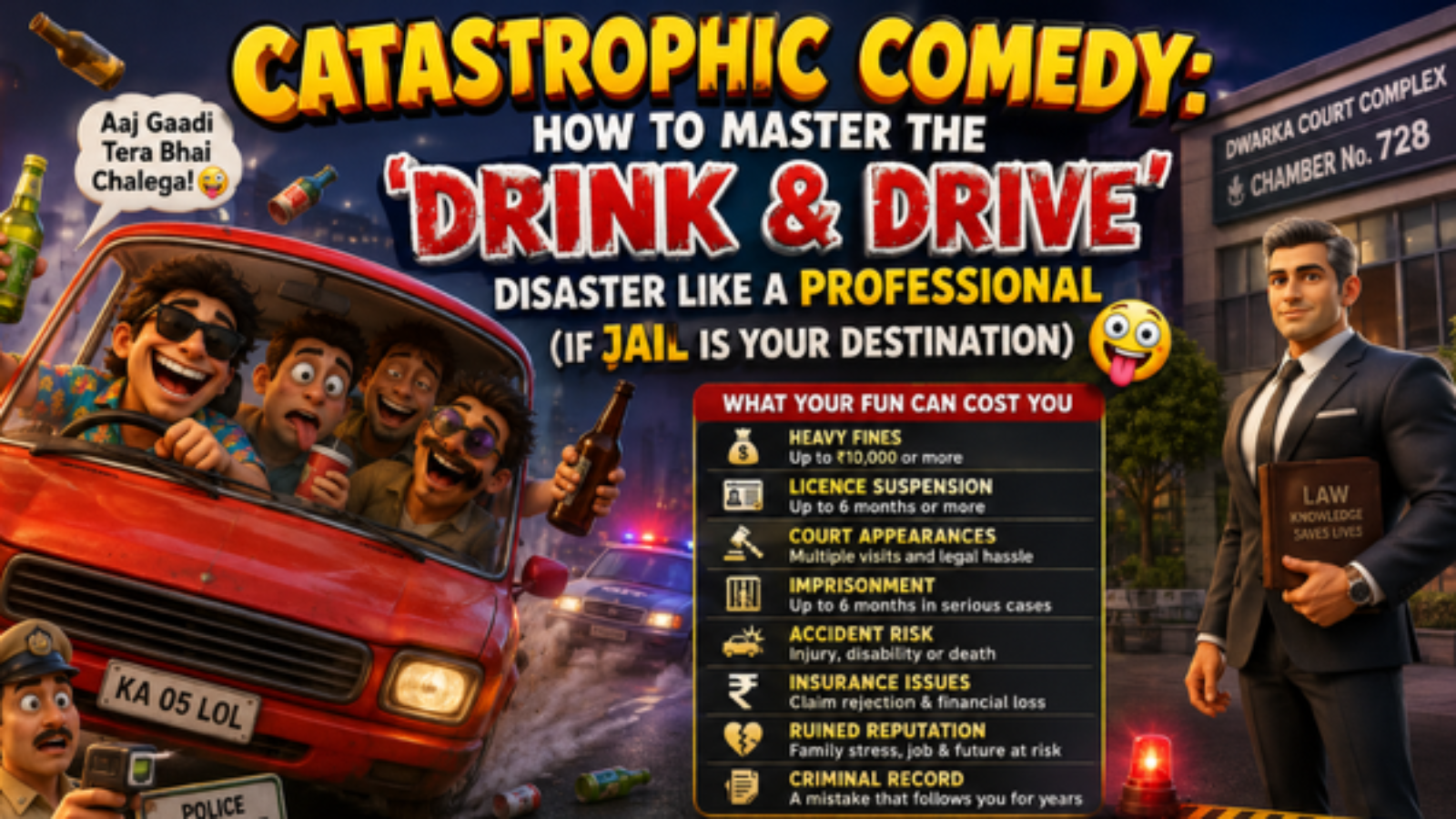
Drink & Drive – “Aaj Gaadi Tera Bhai Chalega!” 🍻🚗
Sounds familiar? It is one of those legendary lines uttered after “Bas do peg hi toh hue hain!”
Unfortunately, the police, the law, and the courts rarely appreciate this kind of confidence.
In fact, if your dream is to exchange your driver’s seat for a courtroom bench, receive a hefty Traffic Challan in Dwarka Court, spend money on lawyers instead of parties, and possibly face criminal prosecution, then congratulations—you are already enrolled in the unofficial “Drink & Drive Masterclass.”
However, if your goal is to reach home safely and keep your driving licence, reputation, and freedom intact, keep reading.
⚠️ Drink & Drive: The Fastest Shortcut to Trouble
Drink & Drive is not a symbol of confidence. It is a dangerous decision.
Alcohol slows down your brain before you even realize it. Your reaction time increases. Your judgment becomes poor. Moreover, your confidence becomes much higher than your actual driving ability.
As a result, you may fail to notice pedestrians, traffic signals, motorcycles, or sudden obstacles.
Therefore, one careless decision can permanently change multiple lives.
😂 The “Professional” Guide to Getting Arrested
Want to become an expert at landing in legal trouble?
Simply follow these “golden rules.”
❌ Drink heavily.
❌ Tell everyone, “Main bilkul theek hoon.”
❌ Reject every friend’s suggestion to book a cab.
❌ Turn the music louder than your common sense.
❌ Smile confidently at the police checkpoint.
Congratulations!
Your “Drink & Drive” journey has officially begun.
🚔 What Actually Happens During a Drink & Drive Check?
Most people imagine dramatic movie scenes.
Reality is much simpler.
Police officers stop your vehicle.
They ask you to cooperate.
A breath analyser test may be conducted.
If alcohol exceeds the permissible legal limit, proceedings may follow under the applicable provisions of the Motor Vehicles Act and other laws, depending on the facts of the case.
“Sir, bas do peg hi toh liye the.”
It is probably one of the most common explanations heard after a drink-and-drive challan.
The problem is that the law does not decide a drunken-driving case according to whether the driver felt capable of driving. What matters is the alcohol reading, the circumstances recorded by the traffic police, the documents prepared at the spot and, where applicable, what happened on the road.
A drink-and-drive matter in Delhi is also different from an ordinary traffic challan that can simply be paid online in the usual manner. Drunken driving under Section 185 of the Motor Vehicles Act, 1988 is treated as a court challan by Delhi Traffic Police.
Therefore, if you have been stopped for drunken driving in Dwarka, South West Delhi or another part of Delhi, the practical questions are usually:
What was the alcohol reading?
What documents did the police prepare?
Do you have to appear before the court?
What punishment does Section 185 provide?
What happens to your driving licence?
What if there was also an accident?
And what should you do before appearing in court?
This guide explains the process in practical terms.
What Is the Legal Alcohol Limit for Driving in India?
Section 185 of the Motor Vehicles Act applies where a person driving or attempting to drive a motor vehicle has alcohol exceeding 30 mg per 100 ml of blood, as detected through a breath analyser or another recognised test, including a laboratory test.
Delhi Traffic Police also identifies 30 mg per 100 ml of blood as the permissible threshold. (Indian Kanoon)
🍺 Expectation vs Reality
| 🍻 What You Think | 🚔 What Actually Happens |
| “Nobody will stop me.” | Police checkpoints appear exactly when confidence peaks. |
| “I drive better after drinking.” | Your reaction time becomes slower. |
| “Bas ghar hi toh jaana hai.” | Many accidents happen close to home. |
| “Police ko manage kar lenge.” | Legal procedures do not disappear because of confidence. |
| “Cab is expensive.” | Court cases are far more expensive. |
| “Friends will call me a legend.” | They may later visit you in court. |
| “Nothing will happen.” | Sometimes one mistake changes an entire life. |
The important word is “exceeding.”
Therefore, a drink-and-drive case should not be approached merely on the basis of statements such as:
“I had only one beer.”
“I had only two drinks.”
“I was completely normal.”
“I can handle alcohol.”
The legal issue is not how confident the driver felt. The recorded alcohol level and surrounding evidence are much more important.
Section 185 Motor Vehicles Act: Punishment for Drink & Drive
The punishment under Section 185 is considerably more serious than many drivers assume.
| Situation | Punishment Provided Under Section 185 |
| First offence | Imprisonment which may extend to 6 months, or fine of ₹10,000, or both |
| Second or subsequent offence | Imprisonment which may extend to 2 years, or fine of ₹15,000, or both |
| Alcohol threshold | Alcohol exceeding 30 mg per 100 ml of blood |
| Delhi procedure | Drunken driving is shown by Delhi Traffic Police as a court challan |
The current statutory penalties were introduced through the amendments to the Motor Vehicles Act. (Indian Kanoon)
This does not mean that every person caught for drunken driving will automatically be sent to jail. The result in an individual matter depends upon the applicable law, previous record, facts recorded in the challan and the orders passed by the competent court.
However, it is equally incorrect to treat a Section 185 challan as an insignificant ₹500 or ₹1,000 traffic ticket.
What Usually Happens When Police Stop You for Suspected Drunken Driving?
Suppose you are returning from a party and traffic police stop your vehicle at a checking point.
The officer may speak to you and, where there is reason to suspect alcohol consumption, require you to undergo a breath test.
Section 203 of the Motor Vehicles Act authorises an appropriate police officer or authorised Motor Vehicles Department officer, in the circumstances contemplated by that provision, to require a driver or person attempting to drive to provide a breath specimen. (India Code)
If the test indicates alcohol beyond the permissible limit, the police may initiate proceedings and prepare the relevant challan and documentation.
At this stage, arguing aggressively with the officer generally does not improve the legal position.
Neither does saying:
“Sir, ghar bas do kilometre hai.”
The distance remaining to your house does not change the alcohol reading.
First Practical Rule: Check the Breath Analyser Reading
When consulting an advocate regarding a Section 185 matter, one of the first facts that should be examined is the alcohol reading recorded against the driver.
There is a significant practical difference between simply admitting that alcohol was consumed and understanding what the actual recorded reading was.
Keep the challan and every document supplied by the traffic police. If a breath analyser slip or other testing record has been supplied, preserve that as well.
Do not throw these documents away after returning home.
They may become important when the case is examined.
Is a Drink & Drive Challan Payable Online Like an Ordinary Challan?
This is where many people become confused.
Delhi Traffic Police presently identifies Drunken Driving – Section 185 MVA as a court challan. (Delhi Traffic Police)
Therefore, you should not automatically assume that the matter will disappear merely because you have searched for the vehicle number on a payment portal.
Check the challan carefully.
Find out:
the offence mentioned;
the court or authority before which the matter has been sent;
the next date or procedural requirement;
the alcohol reading;
and whether any additional violations have also been recorded.
A Section 185 case should be understood on the basis of the actual challan rather than assumptions based on ordinary traffic violations.
What Documents Should You Keep Ready?
If you have received a drink-and-drive challan, keep one file—physical or digital—containing the challan, alcohol-test or breath-analyser record if supplied, driving licence details, registration certificate, valid insurance, PUC certificate, identity proof and any other document handed over by the traffic police.
If an accident also occurred, preserve photographs, videos, medical papers, insurance communications and other documents relating to the incident.
WhatsApp photographs of half the documents scattered across different chats are much less useful than maintaining one organised set.
Do Not Automatically Plead Guilty Without Understanding the Case
There is an understandable temptation to reach court and say:
“Whatever the fine is, I will pay it. I just want to finish the case.”
Sometimes an uncomplicated matter may indeed be capable of being dealt with expeditiously.
But before taking any position before the court, you should understand what offence has actually been alleged, what alcohol reading has been recorded, whether there are additional violations, whether it is a first or subsequent offence and whether an accident or injury is connected with the incident.
Once a statement or plea is made before the court, it has legal consequences.
The proper approach is therefore to understand the case first and decide the appropriate course thereafter.
What If It Is Your First Drink & Drive Case?
Whether the person has previously faced a similar offence can be legally relevant because Section 185 separately provides punishment for a first offence and for a second or subsequent offence.
For a first offence, the statutory punishment may extend to six months’ imprisonment, or a fine of ₹10,000, or both.
For a second or subsequent offence, the provision allows imprisonment extending to two years, or a fine of ₹15,000, or both. (Indian Kanoon)
Do not conceal an earlier conviction or challan from your advocate.
Previous proceedings can materially change the assessment of the case.
What Happens to the Driving Licence?
Drivers frequently assume that paying a fine automatically resolves every issue concerning their driving licence.
That should not be assumed.
A drunken-driving case may also have consequences concerning the driving licence depending upon the applicable statutory provisions, previous record and orders of the competent authorities or court.
Delhi Traffic Police itself warns that repeat offenders may face consequences relating to confiscation of their licence and enhanced penalties. (Delhi Traffic Police)
Accordingly, if your licence has been taken, retained, suspended or otherwise affected, examine the specific document or order instead of relying on information from friends or social media.
Drink & Drive With an Accident Is a Very Different Situation
A simple Section 185 challan and a case where drunken driving is accompanied by an accident should not be treated as identical situations.
If the vehicle has caused an accident involving injury, serious injury, death or substantial property damage, additional legal consequences may arise depending upon the circumstances.
The police investigation may then extend beyond the Motor Vehicles Act.
Questions concerning the manner of driving, accident evidence, medical examination, CCTV footage, witnesses, vehicle inspection and other criminal-law provisions may become relevant.
If an accident has occurred, obtain legal advice promptly.
Do not treat it as “only a traffic challan.”
Never Leave the Scene Merely Because You Are Afraid
An accident can create panic.
Driving away or attempting to avoid the authorities can make an already serious situation considerably worse.
Remain calm, comply with lawful directions and obtain appropriate legal advice.
If someone is injured, the immediate priority should be safety and medical assistance.
Trying to manufacture an explanation later is rarely a sensible legal strategy.
“But I Was Driving Perfectly Fine”
This argument is common.
A person may genuinely believe that alcohol has not affected his driving.
Section 185, however, specifies an objective alcohol threshold for alcohol-related cases: more than 30 mg per 100 ml of blood.
That means the prosecution is not necessarily required to accept the driver’s personal assessment that:
“I was completely under control.”
Confidence after alcohol and legal compliance are two different things.
“Can I Refuse the Breath Analyser Test?”
A driver should be extremely cautious about attempting to obstruct or refuse lawful traffic-police procedures.
The Motor Vehicles Act contains specific provisions relating to breath tests, including Section 203. (India Code)
Rather than arguing at the roadside about technical legal questions, comply with lawful directions and preserve the relevant records.
If there is a genuine procedural or evidentiary issue, it can be examined through the legal process.
The roadside is generally not the appropriate place to conduct a trial.
What Should You Do Immediately After Receiving a Drink & Drive Challan?
A practical approach is:
- Preserve the challan and testing documents. Take clear photographs or scans and keep the originals safely.
- Check the recorded alcohol reading. Do not rely merely on what you remember being told at the checkpoint.
- Read every offence mentioned in the challan. There may be more than one alleged violation.
- Check the court details and date. Do not ignore the matter because it does not appear like an ordinary online payable challan.
- Keep your vehicle documents ready. RC, driving licence, insurance and PUC may become relevant.
- Disclose previous drink-and-drive cases to your advocate.Whether the case is a first or subsequent offence matters.
- If an accident occurred, preserve evidence immediately.Photographs, videos, medical documents, insurance correspondence and witness details may become important.
- Do not fabricate a defence. A legal defence must arise from the evidence and applicable law—not from a story created after the event.
- Understand the case before taking a plea. Know what you are admitting and the legal consequences.
- Do not repeat the mistake. The second incident can place you in a materially worse legal position.
Drink & Drive Challan in Dwarka Court
Where a drunken-driving offence falls within the territorial jurisdiction connected with Dwarka Courts, the relevant traffic challan may be dealt with before the competent court having jurisdiction.
The exact court depends upon the place of the alleged offence, police/traffic jurisdiction and allocation of the matter.
Therefore, merely living in Dwarka does not necessarily mean that your challan will be dealt with at Dwarka Court.
The place where the alleged offence occurred is important.
For persons facing a Traffic Challan in Dwarka Court, it is advisable to first identify the court and challan particulars rather than reaching the court complex without knowing where the case has been assigned.
Can an Advocate Appear in a Drink & Drive Case?
Legal representation may be taken in a traffic prosecution.
An advocate can examine the challan and supporting documents, explain the provision invoked, advise you regarding the appropriate legal course and represent you in accordance with the applicable procedure.
However, whether the personal presence of the accused is required on a particular date is ultimately governed by the applicable procedure and orders of the court.
You should therefore not assume that appointing an advocate automatically means you will never need to attend court.
Practical Difference Between an Ordinary Traffic Challan and a Section 185 Case
| Ordinary Traffic Violation | Drink & Drive Under Section 185 |
| Many challans may be capable of online payment | Delhi Traffic Police lists drunken driving as a court challan |
| Usually concerns a specific traffic-rule violation | Involves an offence relating to driving under the influence |
| Court appearance may not arise in many routine cases | Court proceedings become directly relevant |
| Penalty may primarily involve a prescribed fine | Section 185 also provides for imprisonment |
| Usually limited to the traffic violation itself | Accident cases can create additional criminal-law issues |
The distinction is important.
A Section 185 case deserves to be treated as a legal proceeding, not merely an inconvenient traffic ticket.
Can the Court Send Someone to Jail for Drink & Drive?
Section 185 expressly provides imprisonment as one of the available punishments.
For the first offence, imprisonment may extend to six months.
For a second or subsequent offence, it may extend to two years. (Indian Kanoon)
This does not mean imprisonment follows automatically in every case.
The court deals with the matter according to the law and facts before it.
But anyone advising that “drink-and-drive mein sirf fine hota hai” is oversimplifying the statutory position.
Does Drink & Drive Affect Insurance?
It may.
Delhi Traffic Police itself cautions that insurance coverage may be affected where an accident occurs while the vehicle is being driven under the influence of alcohol. (Delhi Traffic Police)
The precise insurance consequences depend upon the policy terms and circumstances.
Therefore, where an accident has occurred, do not focus only on the criminal or traffic proceedings.
Insurance liability may need separate examination.
The ₹500 Cab vs the ₹10,000 Problem
There is one part of the original drink-and-drive joke that remains useful.
People sometimes refuse to spend ₹300, ₹500 or ₹700 on a cab because:
“Ghar paas hi hai.”
But Section 185 provides a ₹10,000 fine for a first offence, apart from the possibility of imprisonment and the inconvenience of court proceedings.
That calculation becomes even worse if an accident takes place.
The practical legal advice is therefore remarkably simple:
If you are drinking, arrange the journey home before the drinking begins.
A cab is cheaper than litigation.
Common Myths About Drink & Drive Cases
“I only had beer.”
The law is concerned with the alcohol level, not whether the drink was beer, whisky, wine or something else.
“It was my first time.”
That may be relevant to the applicable punishment structure, but it does not make the first offence lawful.
“My house was only five minutes away.”
Distance from home is not a defence to Section 185.
“I was driving normally.”
The alcohol threshold under Section 185 remains relevant irrespective of the driver’s personal confidence.
“I will simply pay the challan online.”
Delhi Traffic Police classifies drunken driving under Section 185 as a court challan.
“If I hire a lawyer, I will definitely not have to appear.”
Personal appearance depends upon the applicable procedure and directions of the court. No responsible advocate should guarantee otherwise.
When Should You Consult an Advocate?
Legal advice is particularly useful where the alcohol reading is disputed or unclear, multiple offences are mentioned in the challan, the person has a previous Section 185 case, the driving licence has been affected, an accident has occurred, another person has been injured, criminal proceedings have also been initiated, there is confusion regarding the appropriate court or there is uncertainty about the next procedural step.
Even in an uncomplicated matter, understanding the proceedings before appearing in court is preferable to relying on advice from friends who faced “the same case” several years ago.
Two traffic cases that sound similar may have very different records.
Legal Assistance for Traffic Challans Before Dwarka Court
Our litigation practice regularly deals with matters before Dwarka Courts, New Delhi, including traffic challans and connected criminal proceedings.
Where a client approaches us regarding a drink-and-drive matter, the first task is not to make promises about the result.
The first task is to examine the documents.
That normally means understanding the challan, alcohol reading, offences mentioned, previous record, court details and whether the incident involved any accident or additional criminal allegations.
Where legal representation is required, the matter can then be approached according to its actual facts.
Our practice also includes criminal defence, bail proceedings and related litigation before Dwarka Courts and other courts in Delhi.
Related reading:
Traffic Challan Cases in Dwarka Court
Criminal Defence Lawyer in Dwarka
Bail Lawyer in Dwarka Court
Advocate Near Dwarka Court
Frequently Asked Questions
What is the alcohol limit for driving in Delhi?
Under Section 185 of the Motor Vehicles Act, alcohol exceeding 30 mg per 100 ml of blood detected by the prescribed testing process can attract prosecution for drunken driving.
What is the fine for drink and drive in Delhi in 2026?
For a first offence under Section 185, the provision prescribes imprisonment extending to six months, or a fine of ₹10,000, or both.
For a second or subsequent offence, imprisonment may extend to two years, or the fine may be ₹15,000, or both.
Is drink and drive a court challan in Delhi?
Yes. Delhi Traffic Police presently lists drunken driving under Section 185 of the Motor Vehicles Act as a court challan.
Can I simply pay a drink-and-drive challan online?
Do not assume that you can dispose of it like an ordinary payable traffic challan. Check the actual challan, court allocation and instructions because Section 185 drunken driving is treated as a court challan in Delhi.
Is jail compulsory in every drink-and-drive case?
No. Section 185 provides imprisonment as a possible punishment, but that does not mean every person convicted of the offence automatically receives imprisonment. The matter is decided according to the applicable law and facts of the individual case.
Can my driving licence be affected?
Yes, consequences relating to the driving licence may arise depending upon the legal provisions, previous record and orders passed in the particular matter.
What if there was an accident while I was driving after drinking?
The legal position can become considerably more serious. Apart from the Section 185 proceedings, additional offences and investigation may arise depending upon injury, death, manner of driving and other facts. Obtain legal advice promptly.
Which court handles a drink-and-drive challan in Dwarka?
The competent court depends principally upon the place and jurisdiction of the alleged offence and allocation of the challan. Living in Dwarka does not by itself determine jurisdiction.
Should I take the breath-analyser slip to my lawyer?
Yes. Preserve the challan, breath-analyser/test record if supplied and all other documents given by the police.
Do I need a lawyer for a drink-and-drive case?
A person may take legal advice or representation to understand the allegation, applicable punishment, court procedure and possible consequences. Whether representation is necessary in a particular matter depends upon its facts and complexity.
Conclusion
The safest drink-and-drive case is the one that never reaches the court.
There is no legal strategy better than handing the keys to a sober driver.
If you have consumed alcohol:
Do not drive.
Book a cab.
Ask a sober friend to drive.
Leave the vehicle parked.
Collect it the next morning.
But if a Section 185 challan has already been issued, do not ignore it and do not rely exclusively on informal advice.
Check the alcohol reading.
Preserve the documents.
Understand the court proceedings.
And obtain legal advice where necessary.
“Bas do peg hi toh hue hain” may sound harmless at a party.
It is considerably less amusing when it becomes part of a traffic prosecution.
[…] article explains Traffic Challan Settlement, the major warning signs of a WhatsApp scam, and what a vehicle owner should do when a challan is […]