

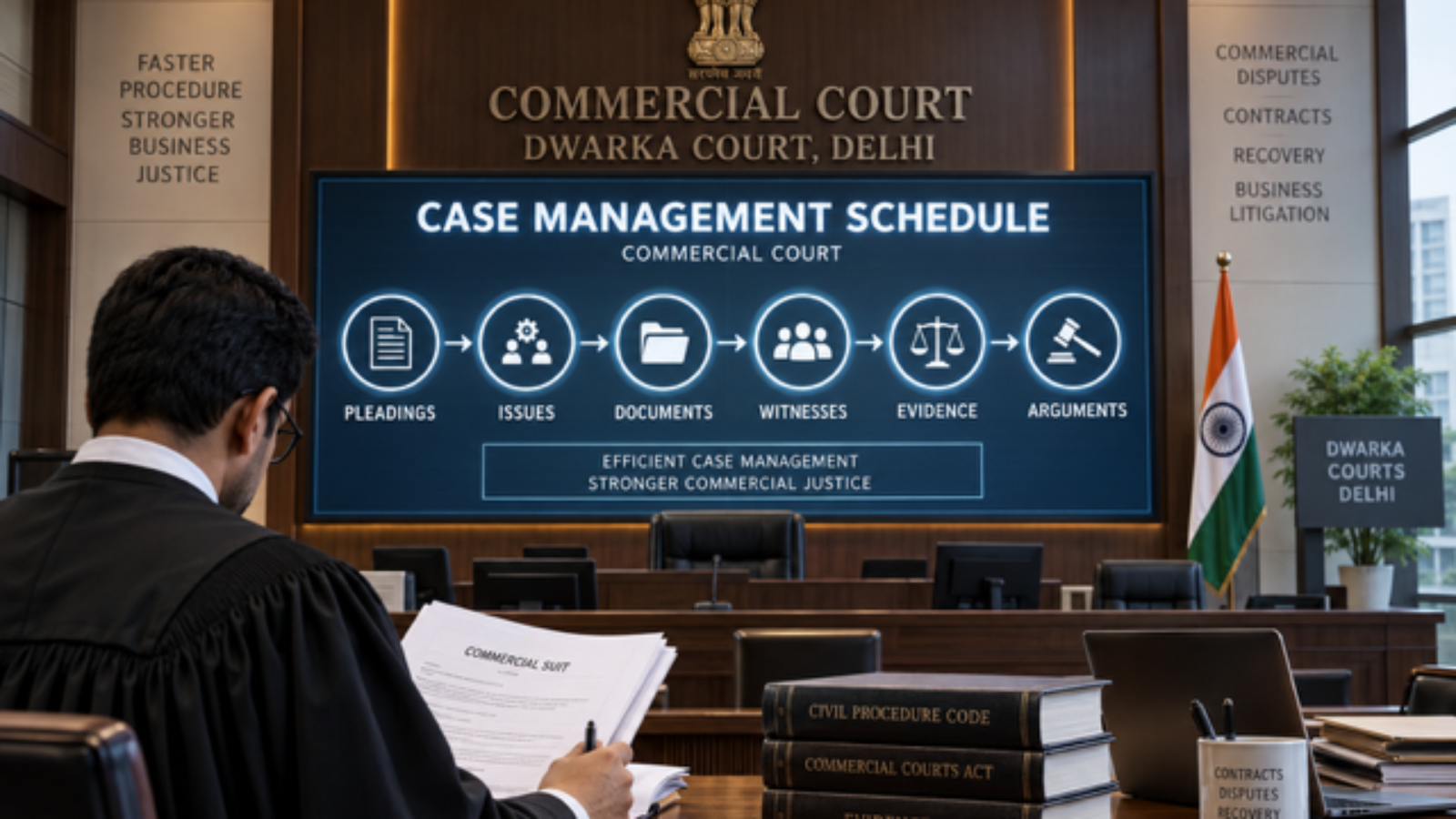

Introduction – Commercial Court Case Management Hearing Delhi
Why Order XV-A CPC Can Shape the Entire Commercial Suit Before Evidence Begins
A Commercial Court case is not supposed to proceed in the same manner as an ordinary civil dispute where dates may pass without a clear roadmap for completion of pleadings, evidence and arguments.
One of the most important procedural changes introduced for commercial litigation is the Case Management Hearing under Order XV-A of the Code of Civil Procedure, 1908, as amended for commercial disputes.
For a company, business owner, partnership firm, LLP, proprietor or individual involved in a commercial suit, the Case Management Hearing should not be treated as merely another date in Court.
It can potentially determine:
- What issues actually require trial
- Which witnesses need to be examined
- When evidence has to be filed
- When witnesses will be examined
- When written arguments must be filed
- When oral arguments will take place
- How much time parties may receive for final submissions
- Whether pending applications need to be decided first
- Whether the dispute can be narrowed or resolved without a lengthy trial
In practical terms, the Case Management Hearing can create the procedural roadmap for the remaining life of a commercial suit.
1. What Is a Case Management Hearing in a Commercial Court?
A Case Management Hearing, commonly referred to as a CMH, is a structured hearing through which the Commercial Court actively manages the progress of a commercial suit.
Order XV-A was introduced into the CPC through the Commercial Courts framework to facilitate quicker and more disciplined adjudication of commercial disputes.
The Supreme Court has also recognised that provisions such as Case Management Hearing reflect the proactive approach expected from courts dealing with commercial disputes. (SCI API)
Instead of leaving the progress of the case entirely dependent upon successive applications and adjournments, the Court can identify the matters that genuinely require adjudication and establish a schedule for moving the suit towards evidence and arguments.
For businesses involved in litigation, this is important because commercial litigation often involves substantial invoices, contracts, purchase orders, accounts, emails, banking transactions and business relationships.
Delay itself can carry a commercial cost.
2. When Should the First Case Management Hearing Take Place?
Order XV-A Rule 1 provides that the first Case Management Hearing is to be held not later than four weeks from the date on which affidavits of admission or denial of documents have been filed by all parties to the suit. (India Code)
This makes the stage of admission and denial of documents particularly important.
Before arriving at the Case Management Hearing, both parties should therefore have clarity regarding documents such as:
- Contracts and agreements
- Purchase orders
- Work orders
- Invoices
- Delivery challans
- Ledger accounts
- Bank statements
- Emails
- WhatsApp or electronic correspondence
- Legal notices
- Responses to notices
- GST-related records
- Acknowledgments of liability
- Settlement correspondence, where legally relevant
A party that approaches the Case Management Hearing without understanding its own documentary record may lose an important opportunity to properly frame the controversy.
3. What Orders Can the Commercial Court Pass at a Case Management Hearing?
Once the Court finds that questions of fact or law require trial, Order XV-A permits the Court to structure how that trial will proceed.
Among other things, the Court may:
- Frame the issues requiring adjudication.
- Identify the witnesses proposed to be examined.
- Fix deadlines for filing affidavits of evidence.
- Fix dates for recording evidence.
- Set deadlines for written arguments.
- Fix the date for oral arguments.
- Prescribe time limits for advocates and parties to address oral submissions. (Madhya Pradesh High Court)
This is why CMH preparation should begin before the hearing, not when counsel enters the courtroom.
A commercial litigant should already know what the real dispute is.
4. Why Is Case Management Different From an Ordinary Civil Suit?
The Commercial Courts Act was designed to introduce greater procedural discipline in commercial disputes.
| Ordinary Civil Litigation | Commercial Court Litigation |
| Progress may follow the conventional civil procedure | Greater emphasis on structured case management |
| Evidence dates may develop gradually | Court can establish an evidence schedule |
| Parties may attempt repeated procedural applications | Court can actively narrow the controversy |
| Witness planning may happen later | Witnesses may be identified during case management |
| Final arguments may arise after completion of evidence | Written and oral argument schedules can be fixed beforehand |
| Litigation is largely party-driven | Commercial Court is expected to take a more proactive managerial role |
The objective is not merely speed for the sake of speed.
The objective is to prevent unnecessary procedural delay while still preserving the parties’ opportunity to establish their respective claims and defences.
Delhi High Court has also issued a specific practice direction concerning Case Management Hearings/Pre-Trial Conferences in Commercial Courts, reinforcing their practical significance in Delhi commercial litigation. (Delhi High Court)
5. The Six-Month Framework Makes Preparation Important
One of the most striking provisions of Order XV-A is Rule 3.
While fixing dates under the case-management framework, the Court is required to ensure that arguments are closed not later than six months from the date of the first Case Management Hearing. (Indian Kanoon)
This statutory framework shows the seriousness with which commercial litigation timelines are intended to be treated.
That does not mean that every commercial suit in practice will automatically conclude within exactly six months of the first CMH regardless of circumstances.
Commercial disputes can involve complex evidence, interlocutory proceedings and other procedural developments.
However, the provision makes one point very clear:
Commercial litigation is not designed around unlimited procedural opportunities.
A plaintiff or defendant who postpones preparation can find the litigation moving faster than expected.
6. Why a Plaintiff Must Prepare Before the Case Management Hearing
Consider a company that has filed a commercial recovery suit for unpaid supplies.
The plaintiff may believe that producing invoices is sufficient.
But the defendant may allege:
- Goods were defective
- Quantity supplied was short
- Payments have already been made
- Purchase orders contained different terms
- Invoices were never accepted
- Goods were returned
- Credit notes were issued
- Liability belongs to another entity
- Accounts have not been reconciled
Before the Case Management Hearing, the plaintiff should therefore be able to answer:
What exactly requires evidence?
For example:
If delivery itself is admitted, is a witness required merely to prove delivery?
If invoices are admitted but payment is disputed, should the evidence focus primarily on accounts and bank transactions?
If emails contain acknowledgment of dues, have those emails been properly disclosed and relied upon?
If the defendant denies the ledger, who will prove the accounts?
Good commercial litigation involves identifying these questions early.
7. Why a Defendant Should Never Treat CMH as a Routine Date
The Case Management Hearing can be equally important—sometimes more important—for a defendant.
A defendant should know precisely:
- Which invoices are admitted
- Which invoices are disputed
- What amount, if any, is admitted
- What payments have already been made
- Whether goods or services were defective
- Whether written complaints exist
- Whether there were debit notes or credit notes
- Whether there is a set-off or counterclaim
- Which documents support the defence
- Which witnesses are actually necessary
A vague written statement followed by an equally vague trial strategy can create serious difficulty later.
Commercial litigation rewards a defence that is document-driven, specific and consistent.
For example, simply stating that “nothing is payable” may carry far less strategic value than showing:
Invoice No. 143 – admitted
Invoice No. 151 – goods returned
Invoice No. 168 – payment transferred on 12 March
Invoice No. 172 – disputed because material failed inspection
That is the type of clarity which helps define the real controversy.
8. Case Management Hearing and Summary Judgment Are Closely Connected
Commercial litigation also contains an important mechanism known as summary judgment under Order XIII-A CPC.
The two procedures should not be confused.
A simple way of understanding the difference is:
Summary Judgment:
Does this dispute—or a part of it—really require a trial?
Case Management Hearing:
If a trial is required, how should that trial be organised efficiently?
Order XV-A expressly gives the Court power, before framing issues, to hear and decide a pending application under Order XIII-A. (Indian Kanoon)
Therefore, a party preparing for CMH should also ask an important strategic question:
Do all issues genuinely require evidence, or can some part of the dispute be decided without a full trial?
That assessment should be made from the pleadings and documentary record rather than as a routine litigation tactic.
9. Witnesses Should Be Chosen for a Purpose
Commercial disputes frequently generate enormous records but may require relatively few witnesses.
For example, in a ₹30 lakh unpaid-invoice dispute, the real witnesses might only include:
- The authorised representative familiar with the transaction
- The person responsible for accounts
- The employee involved in supply/delivery
- A technical witness where quality or specification is genuinely disputed
Calling numerous witnesses who add nothing to the actual disputed issues can prolong proceedings unnecessarily.
Delhi High Court’s procedural guidance on commercial cases specifically contemplates examining witness lists and limiting witnesses to those genuinely necessary for adjudication. (Delhi High Court)
The correct question should therefore not be:
“How many witnesses can we call?”
It should be:
“Which witness proves which disputed fact?”
10. Evidence May Proceed on a Much Tighter Schedule
Order XV-A also contemplates, as far as possible, the recording of oral evidence on a day-to-day basis until cross-examination of the witnesses is complete. (Madhya Pradesh High Court)
This is another reason parties should prepare documents and witnesses beforehand.
A company should not discover on the morning of evidence that:
- Its authorised representative has changed employment
- Original records cannot be located
- The accounts witness has no knowledge of the transaction
- Electronic evidence has not been organised
- The witness was never briefed about the pleadings
- Relevant emails have not been identified
- Payment details do not reconcile with the ledger
Commercial litigation strategy must therefore extend beyond filing the plaint or written statement.

Trial preparation should start early.
A Practical Commercial Recovery Example
Consider the following situation:
ABC Components Pvt. Ltd. supplies machinery parts worth ₹32 lakh to XYZ Manufacturing Ltd.
ABC claims that ₹19 lakh remains unpaid.
XYZ does not completely deny the business relationship but argues that:
- Certain goods were defective
- Some invoices were already adjusted
- ₹4 lakh was subsequently paid
- Two consignments were allegedly returned
At the Case Management Hearing, the real controversy can potentially be narrowed to questions such as:
Issue 1
What amount is actually outstanding after admitted payments?
Issue 2
Were the allegedly defective goods formally rejected?
Issue 3
Were the returned goods received and acknowledged by ABC?
Issue 4
Are the claimed invoices supported by delivery records?
Issue 5
Is XYZ entitled to any adjustment, set-off or other defence claimed in its pleadings?
Once the dispute is properly defined, the Court and parties can identify the documents and witnesses genuinely necessary to resolve it.
That is the practical value of case management.
Plaintiff Checklist Before a Case Management Hearing
A plaintiff should ordinarily review:
- Plaint and prayer clause
- Written statement filed by the defendant
- Replication, if any
- Admission and denial of documents
- Agreements and purchase orders
- Invoices and delivery documents
- Ledger and banking evidence
- Electronic correspondence
- Defendant’s admissions
- Proposed issues
- Witness list
- Evidence required for each disputed fact
- Pending applications
- Possibility of summary judgment
- Settlement possibilities
Defendant Checklist Before a Case Management Hearing
A defendant should ordinarily review:
- Exact amount claimed
- Amount, if any, actually admitted
- Invoice-wise defence
- Payments already made
- Correspondence disputing liability
- Quality/short-supply complaints
- Debit notes and credit notes
- Contractual limitations or exclusions
- Set-off or counterclaim, where applicable
- Admission/denial of plaintiff’s documents
- Defendant’s own documentary evidence
- Proposed issues
- Necessary witnesses
- Pending applications
- Commercial feasibility of settlement
Can the Commercial Court Hold More Than One Case Management Hearing?
Yes.
Order XV-A permits the Court, where necessary, to conduct further Case Management Hearings during trial to ensure adherence to the schedule and facilitate speedy disposal. (svrkrn’s blog)
Therefore, case management is not merely a one-time procedural formality.
It can remain relevant throughout the trial.
What Happens if a Party Ignores the Case Management Schedule?
Directions passed during a Case Management Hearing should be taken seriously.
Order XV-A provides consequences for non-compliance with case-management directions. Depending on the circumstances, the Court has procedural powers including costs and, in cases of wilful and repeated non-compliance where costs are inadequate, potentially much more serious consequences concerning the claim or defence. (Indian Kanoon)
The appropriate consequence will depend upon the facts and the nature of the default.
The practical lesson is straightforward:
Do not assume that a deadline fixed in a Commercial Court can casually be ignored and repaired later.
Case Management Hearing in Commercial Court, Dwarka Delhi
Businesses operating in Dwarka, Janakpuri, Vikaspuri, Uttam Nagar, Najafgarh, Palam, Delhi Cantonment, Kapashera and other parts of South-West Delhi may find their commercial disputes coming before the competent Commercial Court depending upon territorial and pecuniary jurisdiction and the nature of the dispute.
Common commercial disputes may arise from:
- Unpaid invoices
- Supply agreements
- Service contracts
- Business-to-business transactions
- Construction contracts
- Commercial leases involving property used in trade or commerce
- Distribution agreements
- Consultancy arrangements
- Partnership or business transactions
- Recovery of contractual dues
The Commercial Courts Act defines a wide range of transactions capable of constituting a “commercial dispute,” but jurisdiction should be examined on the facts of each matter. (India Code)
A dispute does not become a commercial suit merely because one of the parties happens to be a company.
The nature of the transaction matters.
The Bigger Lesson: Commercial Litigation Should Be Prepared Backwards
A useful way to prepare a commercial case is to start with the final question:
What must ultimately be proved before the Court?
Then work backwards:
Final arguments
↑
Evidence
↑
Witnesses
↑
Issues
↑
Admission and denial
↑
Documents
↑
Pleadings
The Case Management Hearing sits at the centre of this process.
It connects what the parties have pleaded with what they will eventually need to prove.
For that reason, businesses should not view commercial litigation merely as filing a recovery suit or submitting a written statement.
The better question is:
What is our complete litigation strategy from pleadings to final arguments?
That is precisely where proper case management becomes valuable.

Frequently Asked Questions
1. What is a Case Management Hearing in a Commercial Court?
It is a structured hearing under Order XV-A CPC through which the Commercial Court can organise issues, witnesses, evidence, written arguments, oral submissions and the future timetable of the commercial suit.
2. When is the first Case Management Hearing held?
Order XV-A contemplates the first CMH being held not later than four weeks after all parties have filed their affidavits of admission or denial of documents.
3. What is Order XV-A CPC?
Order XV-A is the special case-management framework applicable to commercial disputes under the CPC as amended by the Commercial Courts regime.
4. Can the Court fix evidence dates during the CMH?
Yes. The Court can fix deadlines for evidence affidavits and dates for recording witness evidence.
5. Can the Court limit witnesses?
The Court can manage the witness schedule and commercial litigation procedure is intended to prevent unnecessary prolongation of trial.
6. Is the Case Management Hearing relevant only to plaintiffs?
No. It can be equally important for defendants because the defence, documentary disputes, witnesses and evidence strategy may be crystallised at this stage.
7. Can a summary judgment application be considered during case management?
Yes. Before framing issues, Order XV-A permits the Court to hear and decide a pending application under Order XIII-A.
8. Can there be another Case Management Hearing later?
Yes. The Court may hold further Case Management Hearings during trial where required to ensure adherence to the schedule and facilitate speedy disposal.
9. Can parties settle after a Case Management Hearing?
Yes. Settlement remains possible during commercial litigation. Delhi High Court’s procedural guidance also recognises exploration of settlement while managing commercial disputes. (Delhi High Court)
10. Why are documents so important in Commercial Court cases?
Commercial disputes are frequently decided around contracts, invoices, accounts, correspondence, banking records and admissions. Proper disclosure, admission/denial and organisation of these documents can substantially narrow what actually requires trial.
Conclusion
A Case Management Hearing in a Commercial Court is not merely another procedural date.
It can become the stage at which the Court transforms a large bundle of pleadings and documents into a defined litigation roadmap:
ISSUES → WITNESSES → EVIDENCE → ARGUMENTS → DECISION
For both plaintiffs and defendants, preparation before this hearing can help identify weaknesses, clarify documentary disputes, reduce unnecessary evidence and ensure that the litigation strategy is aligned with the accelerated procedural framework applicable to commercial cases.
Businesses involved in Commercial Court proceedings in Delhi should therefore approach the Case Management Hearing with the same seriousness they would attach to evidence or final arguments.
Advocate Ankit Gaurav Kainth & Associates assists businesses, companies, proprietors and individuals in commercial disputes before the Commercial Courts in Delhi, including commercial recovery suits, written statements, document strategy, interim applications, evidence and trial preparation.
This article is intended for general legal information and does not constitute legal advice. Commercial disputes should be evaluated on their individual facts, contractual documents, jurisdiction and applicable law.
Written Statement in Commercial Court with important links
| Important Topics | Text |
| Commercial Court practice page | Commercial Court Lawyer in Dwarka Court |
| Commercial Court Recovery Suit: | When Does the Limitation Period Start? |
| Commercial Lease Dispute Dwarka | Powerful Ground Every Client Should Know |
| Written Statement 120 Days in Commercial Court Recovery Suit | Important Law |
| Commercial Money Recovery Suit in Delhi | A Complete Guide for International Clients & Foreign Companies |
| The Unassailable Blueprint to Lead Defence Evidence Like a Professional in Commercial Court Cases | Advanced Litigation Strategies Every Lawyer Should Master |
| Commercial Court Is Fast | But Only If Your Lawyer Does This in Delhi Court |
| Why Businesses Lose Strong Commercial Cases Despite Having Agreements? | Experienced Commercial Court Advocate Dwarka Delhi |
| Powerful Commercial Court Recovery Case | Acquittal Strategies for Fearless Defence |
| What Happens After Receiving a Legal Notice | in a Commercial Matter? |
[…] Commercial Court Case Management Hearing […]
[…] Commercial Court Case Management Hearing […]