
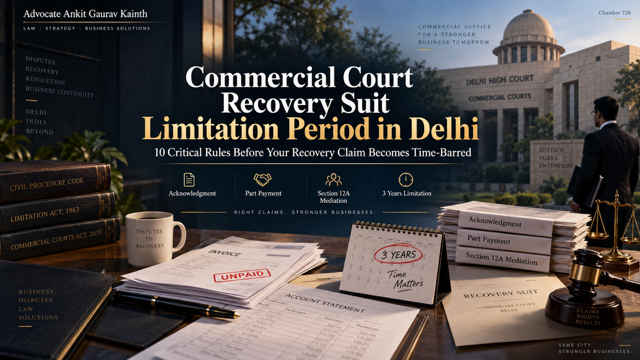
Introduction – Commercial Court Recovery Suit Limitation Period in Delhi
Unpaid invoices, outstanding business dues or an old running account? Understand when the three-year limitation period actually begins, whether a legal notice can extend limitation, how acknowledgment and part-payment affect the calculation, and what happens during Section 12A pre-institution mediation.
A business may have invoices, purchase orders, delivery records, emails and a ledger showing lakhs or even crores of rupees outstanding.
But there is another question which may become more important than the amount itself:
Is the recovery claim still within limitation?
In a Commercial Court recovery suit, having a genuine outstanding debt does not automatically mean that the claim can be filed at any time.
The Limitation Act, 1963 prescribes time limits for bringing different types of claims before Court. In many commercial recovery disputes, the relevant period is three years, but the real legal issue is:
Three years from which date?
That date may depend upon the invoice, delivery of goods, agreed credit period, completion of work, acknowledgment of liability, part-payment, structure of a running account and the contractual terms between the parties.
A particularly important recent development is the Delhi High Court decision in M/s Prism Johnson Limited v. M/s Master Nihal Singh Memorial Education Society, RFA(COMM) 383/2024, decided on 16 July 2026, which examined limitation in a commercial recovery dispute involving supplies, fixed credit terms, a running account, legal notice and pre-institution mediation.
1. Is the Limitation Period for a Commercial Recovery Suit Usually Three Years?
In many commercial money-recovery cases, yes.
However, simply writing:
“The limitation period is three years”
does not properly answer the legal question.
The starting point has to be identified.
For example, the limitation calculation may depend upon whether the claim concerns:
goods sold and delivered;
goods supplied with a fixed credit period;
professional or contractual services;
work completed for the defendant;
a running and current account;
a written acknowledgment of debt;
part-payment made by the debtor; or
a separate contractual event making the payment due.
The plaintiff should therefore prepare a limitation chronology before filing the commercial suit.
The chronology should ideally identify:
invoice date → delivery/work date → agreed credit period → due date → payments → acknowledgment → legal notice → Section 12A mediation → proposed filing date.
This exercise should happen before drafting the plaint—not after the defendant raises limitation as a defence.

2. Goods Sold Without a Fixed Credit Period – Article 14
Where the recovery relates to the price of goods sold and delivered and no fixed period of credit has been agreed, Article 14 of the Schedule to the Limitation Act may become relevant.
Article 14 provides a period of three years, ordinarily calculated from the date of delivery of the goods.
Therefore, if there are numerous invoices covering different deliveries, it can be dangerous to assume that limitation for every invoice automatically begins from the last business transaction.
Each invoice and delivery may need separate examination.
A supplier should maintain proper documentation including:
purchase orders;
tax invoices;
delivery challans;
e-way bills;
goods receipt records;
emails acknowledging delivery;
ledger accounts; and
bank statements showing payments.
These documents may become important not merely for proving liability but also for determining when the cause of action arose.
3. Fixed Credit Period – Article 15 Can Become Crucial
The position becomes particularly important where the contract, purchase order or invoice contains a fixed credit term such as:
“Payment within 30 days”
“45 days credit”
“60 days from invoice”
or another clearly identifiable payment period.
Article 15 of the Limitation Act deals with the price of goods sold and delivered where payment is to be made after expiry of a fixed period of credit.
The limitation period is three years from the date when that credit period expires.
This was central to the Delhi High Court’s July 2026 judgment in Prism Johnson.
The transaction contained a 60-day credit period. The Court held that the limitation trigger was connected with expiry of the contractual credit period. The fact that the plaintiff maintained a running account did not transform non-payment into an indefinitely continuing wrong.
This makes the payment clause in the purchase order extremely important.
Businesses should not examine only the invoice date. They should examine the contractual due date.
4. Does a Running Account Automatically Save Limitation?
No.
This is one of the most misunderstood areas of commercial recovery litigation.
Merely maintaining a ledger and describing it as a “running account” does not automatically extend limitation indefinitely.
There can, however, be an important distinction between:
invoice-specific transactions with separately ascertainable payment dates, and
a genuinely open, current and running account where payments are being made “on account” against the overall outstanding balance rather than individual invoices.
In Bharath Skins Corporation v. Taneja Skins Company Pvt. Ltd., the Delhi High Court considered an open and running but non-mutual buyer-seller account and applied the residuary Article 113.
More recently, in Johnson Engineers v. Indiatech, decided by the Delhi High Court on 29 May 2026, the Court examined an account in which payments were not being made invoice-to-invoice but were being made towards the running outstanding balance. The Court treated the nature of that account as relevant to the limitation analysis.
But Prism Johnson, decided on 16 July 2026, demonstrates the other side of the issue: where contractual supplies carried a fixed credit period, merely describing the account as running did not make non-payment a continuing cause of action.
Therefore:
“We had a running account” should never be treated as a complete answer to limitation.
The actual contractual arrangement, invoices, ledger entries, manner of payments and due dates must be examined.
5. What About Recovery for Services or Work Done?
Not every Commercial Court recovery suit relates to supply of goods.
Businesses may seek recovery for:
construction work;
consultancy;
professional services;
maintenance;
installation;
logistics;
contractual services;
technology services; or
other work performed for another business.
Article 18 of the Limitation Act provides a three-year period for the price of work done by the plaintiff at the defendant’s request where no time has been fixed for payment, with limitation running from when the work is done.
Where the agreement itself specifies milestones, certification requirements, final bills, payment dates or another contractual trigger, the precise contractual provisions have to be examined.
The applicable Article should therefore be identified from the nature of the transaction rather than mechanically treating every commercial recovery claim in the same manner. Article 18 has been recognised in decisions concerning claims for work performed where payment timing was not independently fixed.

6. Can Sending a Legal Notice Restart the Three-Year Limitation Period?
Ordinarily, no.
This is an extremely important point.
Suppose an invoice became payable several years ago and limitation has already expired.
A creditor cannot normally revive the claim simply by issuing a legal notice today and argue:
“The defendant failed to pay after my notice, therefore a new three-year period has started.”
The Delhi High Court specifically addressed this issue in Prism Johnson.
The Court held that a unilateral legal notice does not by itself set the limitation clock running afresh where the underlying claim had already matured. (Indian Kanoon)
Therefore, legal notices remain useful for demanding payment, recording the dispute and exploring settlement, but they should not be confused with a statutory extension of limitation.
A creditor should not wait until the final few days of limitation merely because repeated reminders or notices have been exchanged.
7. Can Written Acknowledgment of Liability Give a Fresh Limitation Period?
Potentially, yes.
Section 18 of the Limitation Act, 1963 is extremely important in commercial recovery disputes.
Where, before expiration of the existing limitation period, the debtor acknowledges the relevant liability in writing and the statutory requirements are satisfied, a fresh limitation period may be computed from the date of the acknowledgment.
Depending upon the facts, potentially relevant documents may include:
balance confirmations;
signed settlement communications;
letters acknowledging outstanding dues;
properly proved electronic communications;
signed account confirmations; or
other written acknowledgment of a subsisting liability.
But timing is critical.
An acknowledgment obtained after the claim is already time-barred does not ordinarily operate under Section 18 to resurrect the expired limitation.
The Delhi High Court reiterated this requirement in Prism Johnson: the acknowledgment contemplated by Section 18 must be made before expiration of the prescribed limitation period.
Therefore, businesses maintaining substantial receivables should periodically consider proper balance confirmations rather than allowing unpaid accounts to remain undocumented for years.
8. Can Part-Payment Extend Limitation?
Part-payment may also become legally significant.
Section 19 of the Limitation Act deals with payment on account of a debt or interest.
Where a qualifying payment is made before expiry of the prescribed limitation period and statutory requirements are satisfied, a fresh limitation period may be computed from the date of payment.
But every bank transfer should not automatically be assumed to extend every invoice.
Questions may arise regarding:
which debt the payment related to;
whether payment was invoice-specific;
whether it was an “on-account” payment;
whether the account was running;
whether the payment occurred before expiry of limitation; and
whether the statutory evidentiary requirements are satisfied.
The transaction documents and accounting treatment should therefore be analysed together.
9. Does Section 12A Pre-Institution Mediation Protect Limitation?
This is particularly relevant for Commercial Court litigation.
Section 12A of the Commercial Courts Act provides for pre-institution mediation where the commercial suit does not contemplate urgent interim relief.
Importantly, Section 12A(3) provides for exclusion of the period during which the parties remained occupied with the pre-institution mediation while computing limitation.
This can be important when a claim is approaching the limitation deadline.
However, it should not be treated as permission to delay the matter unnecessarily.
Before initiating mediation, the plaintiff should ideally calculate:
the original limitation date;
the date of the Section 12A application;
the period legitimately excludable;
the date of the non-starter/failure report; and
the revised outer filing date.
Commercial litigation requires precision. Limitation calculations should preferably form part of the pre-filing case assessment itself.
10. Can a Commercial Plaint Be Rejected Because It Is Time-Barred?
Yes, in an appropriate case.
Order VII Rule 11(d) CPC permits rejection of a plaint where, from the statements contained in the plaint, the suit appears to be barred by law.
Limitation can therefore become a threshold objection.
It is true that limitation frequently involves mixed questions of fact and law. But that does not mean that every limitation objection necessarily requires a full trial.
Where the dates stated in the plaintiff’s own pleadings and documents clearly show that the claim is barred, the Court may examine the issue at the threshold.
The Delhi High Court reiterated this principle in Prism Johnson, observing that where the relevant chronology emerges from the plaintiff’s own case and the limitation bar is apparent, the Court need not necessarily send the matter through an unnecessary trial.
This is why limitation should be addressed specifically in the commercial plaint instead of relying upon vague expressions such as:
“cause of action is continuing”
or
“the cause of action arose again when legal notice was issued.”
The plaint should disclose the actual factual and legal foundation showing why the claim is within limitation.
Practical Example
Assume a Delhi company supplies goods worth ₹25 lakh under a purchase order providing 60 days’ credit.
The final supply is delivered on 1 January 2024.
If payment for that supply becomes contractually due after 60 days, the limitation analysis ordinarily begins from expiry of that agreed credit period rather than from whichever future date the supplier chooses to send its legal notice.
Now suppose that, before limitation expires, the purchaser signs a balance confirmation acknowledging ₹25 lakh as outstanding.
Section 18 may become relevant and the effect of that acknowledgment should be examined.
Alternatively, if the purchaser makes a qualifying part-payment during the subsisting limitation period, Section 19 may require consideration.
If neither happens, repeatedly sending payment reminders does not ordinarily keep the debt alive forever.
That distinction can determine whether the Commercial Court examines a ₹25 lakh recovery claim on merits or first faces an objection that the claim itself is time-barred.
Documents to Check Before Filing a Commercial Recovery Suit
Before filing a commercial recovery suit in Delhi, the plaintiff should examine the complete transaction rather than relying merely upon the final ledger balance.
Important documents generally include the contract or purchase order, invoices, agreed payment terms, delivery documents, GST records where relevant, bank statements, ledger accounts, emails, WhatsApp/business communications, balance confirmations, acknowledgment letters, part-payment records, legal notices and replies, and Section 12A mediation documents.
A proper invoice-wise limitation chart can be particularly useful where multiple transactions have taken place over several financial years.
Commercial Court Recovery Suit Limitation Period in Delhi – Frequently Asked Questions
Is every commercial recovery claim subject to exactly three years from the invoice date?
No. Although three years is common, the commencement date depends on the applicable provision and transaction. Delivery date, expiry of an agreed credit period, completion of work, accrual of the right to sue, acknowledgment or qualifying part-payment may become relevant.
Does a legal notice extend limitation?
Issuing a legal notice does not by itself restart limitation for an already matured or time-barred debt.
Does an email admitting outstanding payment help?
Potentially. Whether an email amounts to a legally valid acknowledgment under Section 18 depends upon its language, authorship, timing and surrounding facts.
Does a balance confirmation extend limitation?
A valid written and signed acknowledgment made before expiry of limitation can attract Section 18, depending upon the facts and contents of the document.
Does part-payment restart limitation?
A qualifying payment made before expiration of limitation may attract Section 19, subject to the statutory requirements.
Is a running ledger enough to extend limitation?
Not necessarily. Courts examine whether there was actually an open/current running account, how payments were appropriated, whether individual invoices had fixed due dates and what the contractual arrangement provided.
Is Section 12A mediation time excluded?
Section 12A(3) of the Commercial Courts Act provides for exclusion of the period during which the parties remained occupied with pre-institution mediation for limitation purposes.
Conclusion
The most important question in a commercial recovery matter is not merely:
“How much money is outstanding?”
It is also:
“When did the right to recover that money arise, and when does limitation expire?”
The Commercial Court recovery suit limitation period in Delhi cannot safely be determined by looking only at the final ledger balance or the date of the latest legal notice.
The correct assessment may require examination of the contract, invoice dates, credit period, delivery dates, running-account structure, acknowledgment of liability, part-payments and Section 12A proceedings.
Recent Delhi High Court decisions also demonstrate that calling an account “running” does not automatically create an unlimited or continuously recurring right to sue.
For businesses facing substantial unpaid commercial dues, limitation should therefore be examined at the beginning of the recovery process—not when the three-year period is about to expire.
This article is intended for general legal information. The applicable limitation period depends upon the individual contract, transaction history, pleadings and documents of each matter.
| Commercial Recovery | Pre-Institution Mediation | Written Statement | Document Disclosure | Case Management | Counterclaim & Set-Off |
|---|---|---|---|---|---|
|
Commercial Court Recovery Suit Limitation Period in Delhi
Understand limitation for unpaid invoices, credit periods, acknowledgments, part-payments and business recovery claims. |
Section 12A Pre-Institution Mediation
Learn when pre-institution mediation is compulsory before filing a commercial suit and how it affects limitation. |
Written Statement in Commercial Court
Understand the strict timeline for filing a defence, admissions, denials and consequences of delay. |
Order XI CPC in Commercial Court
A practical guide to disclosure, discovery, production and inspection of commercial documents. |
Commercial Court Case Management Hearing
Understand Order XV-A CPC, timelines for evidence, witnesses, arguments and management of commercial suits. |
Counterclaim and Set-Off in Commercial Court
Understand how defendants can raise their own monetary claims instead of merely denying the plaintiff’s recovery suit. |

📞 Legal Consultation & Assistance
If you are considering a Commercial Court Recovery Suit for recovery of money from a company, firm, business partner, customer or other commercial party, you may contact us for a preliminary discussion regarding your legal position, documents, limitation and available procedural options.
Mobile: 9899085554 | 9811885554
Ankit Gaurav Kainth & Associates
Advocate in Dwarka Court, New Delhi
Chamber No. 728, Lawyers’ Chambers Block, District Court Dwarka, Sector-10, New Delhi
✍️ Author
This article is written by Ankit Gaurav Kainth, Advocate, major practice at Dwarka Court.