

How to Get Bail in Road Accident & 304A IPC Cases | Legal Rights, Process & Judgments
Road accidents are unfortunate—but when an accident results in injury or even loss of life, the situation becomes emotionally, legally, and socially overwhelming for the accused. Many clients walk into a lawyer’s chamber with fear:
“Sir, will I be arrested?”
“Can I get bail?”
“Is it treated like murder?”
Let us understand this calmly. Indian criminal law differentiates between intentional crime and negligence. A road accident, unless proved otherwise, is treated as rash or negligent act, NOT culpable homicide. This difference is the foundation of bail.
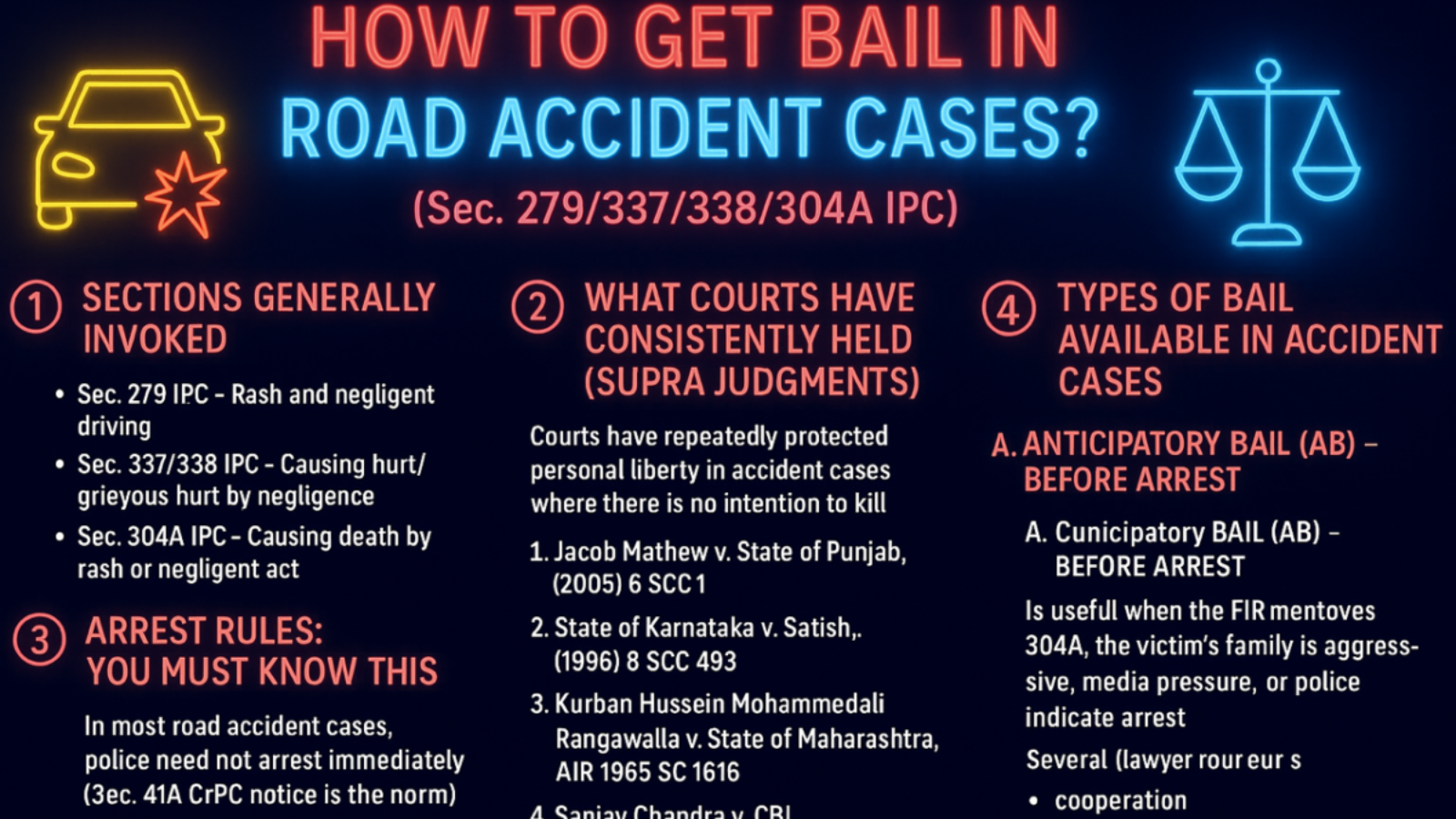
🚨 1. Sections Generally Invoked
Most road accident cases involve:
- Sec. 279 IPC – Rash and negligent driving
- Sec. 337/338 IPC – Causing hurt/grievous hurt by negligence
- Sec. 304A IPC – Causing death by rash or negligent act
👉 These are bailable or non-heinous offences, and the Courts treat them differently from murder (302 IPC) or culpable homicide (304 IPC).
⚖️ 2. What Courts Have Consistently Held (Supra Judgments)
Courts have repeatedly protected personal liberty in accident cases where there is no intention to kill.
📌 Landmark Judgments:
- Jacob Mathew v. State of Punjab, (2005) 6 SCC 1
- The Supreme Court held that criminal liability for negligence requires gross negligence, not mere accident.
- Important principle: Negligence ≠ Intention.
- State of Karnataka v. Satish, (1998) 8 SCC 493
- Speed alone is not proof of rashness.
- Bail was upheld because prosecution failed to show reckless disregard.
- Kurban Hussein Mohammedali Rangawalla v. State of Maharashtra, AIR 1965 SC 1616
- For culpable homicide (Sec. 304 IPC), intention or knowledge must be proved.
- This is why accident deaths fall under 304A.
- Sanjay Chandra v. CBI, (2012) 1 SCC 40
- Supreme Court reiterated that bail is the rule, jail is the exception — extremely helpful in 304A applications.
These judgments guide Magistrates and Sessions Courts while granting bail.
📝 3. Arrest Rules: You Must Know This
In most road accident cases:
✔ Police need not arrest immediately (Sec. 41A CrPC notice is the norm).
✔ Accused is usually called for inquiry.
✔ Arrest is justified only if:
- Accused is absconding
- Not cooperating
- Tampering of evidence
- Repeat offender
👉 This makes bail even smoother.
📄 4. Types of Bail Available in Accident Cases
A. Anticipatory Bail (AB) – Before Arrest
Useful when:
- FIR includes 304A
- Victim’s family is aggressive
- Media pressure
- Police indicate arrest
Your lawyer will argue:
- You are cooperating
- No criminal antecedents
- No intention to harm
- Fixed residence + job
- Based on supra judgments, offence is punishable up to 2 years only (304A)
Courts generally grant AB with conditions like joining investigation.
B. Regular Bail – After Arrest
Even if arrest happens, you are entitled to bail because:
- 304A is not a heinous offence
- Maximum punishment is 2 years
- Offence is based on negligence, not mens rea
Courts consider:
- Conduct after accident (calling ambulance, informing police)
- Whether the accused ran away or helped
- Family background
- No tampering with evidence possible
- Vehicle documents valid
- Insurance compliance
🔗 5. Practical Tips to Strengthen Bail
✔ Inform Police Immediately
Non-reporting creates unnecessary suspicion.
✔ Do Not Run Away From the Spot
Helping the injured shows good conduct.
✔ Keep Driving Licence & RC Ready
Courts frown upon unlicensed driving.
✔ Offer Compensation (Without Admitting Guilt)
Under Sec. 357 CrPC, compensation reflects responsibility and helps the bail court view you favourably.
✔ Maintain a Respectful Demeanor in Court
Bail is discretionary—attitude matters.
🧭 6. Court’s Approach in Death Cases (Sec. 304A IPC)
Even in cases of death, Courts differentiate between:
- Negligence (304A)
- Culpable Homicide (304/302)
👉 Unless prosecution proves intention or knowledge, the case stays under 304A.
Courts consider:
- Was the road narrow or visibility poor?
- Was the victim suddenly crossing?
- Was the vehicle overloaded?
- Was the accused intoxicated?
- Was there mechanical failure?
If intoxication or racing is not proved, bail becomes even smoother.
📚 7. Sample Court Observation (Typical)
Magistrates commonly record:
“Considering the nature of allegations, absence of criminal intent, cooperation by accused, and the law laid down by the Hon’ble Supreme Court, this Court is inclined to grant bail.”
This is the practical reality.
🌟 8. Why Bail Is Important in Accident Cases
Because:
- You must take care of your family
- You must face trial with dignity
- You must cooperate with investigation
- Jail serves no purpose when the act was unintentional
As the Supreme Court observed:
“Punishment begins only after conviction; why jail before trial?”
🎯 Conclusion
A road accident is a tragedy for everyone involved—but the law recognises the difference between a deliberate crime and a misfortune caused by negligence. Bail is not only possible, it is normally favoured by the courts when handled properly.
With the right legal strategy, empathy toward the victim’s family, and proper documentation, you can navigate the process smoothly and respectfully.
🔥 Hashtags
#RoadAccidentBail #304AIPC #RashNegligentAct #AccidentLawIndia #AnticipatoryBail #CriminalLawyerDelhi #LegalAwareness #IndianLaw #BailProcess #AdvocateAnkitGauravKainth
Consult an experienced advocate to determine the most suitable mode of service based on the facts of your case and court practice.
Contact me for Consultation :- 9899085554, 9811885554
Ankit Gaurav Kainth Advocate, Dwarka Court, Chamber No.728, 7th Floor, Dwarka, New Delhi
Add a Comment