
0699CDF6-CAD4-489B-96A2-799E18C2E9AB

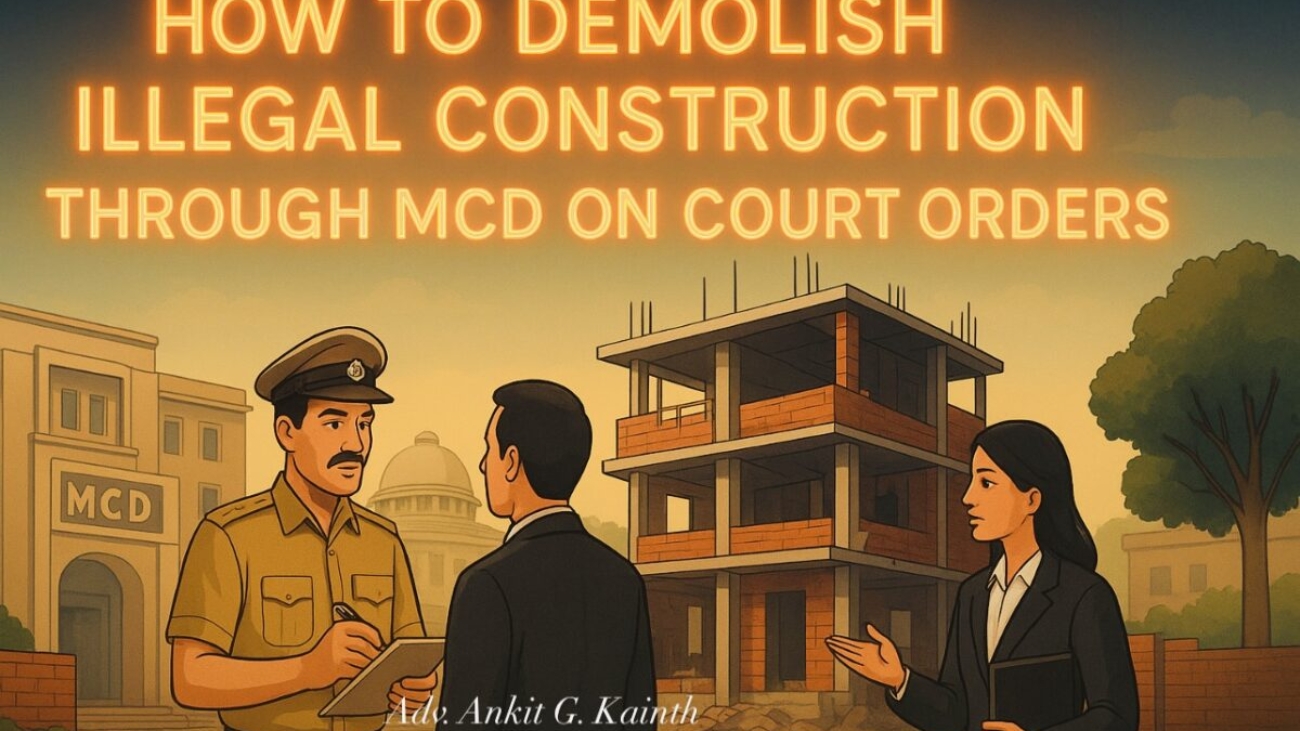
🚧 How to Get Illegal Construction Demolished Through MCD on Court Directions — A Complete Guide for Dwarka Court Litigants

Blog By Civil Advocate in Dwarka Court with 18+ years of Practical Knowledge in New Delhi.

Illegal construction has become one of the biggest civic challenges in New Delhi. Every lane has at least one neighbour raising extra floors, covering balconies, extending walls, or encroaching public spaces—completely ignoring safety norms and municipal laws. After working for more than 18+ years in Civil & Criminal litigation in District Courts & Delhi High Court, I can confidently say one thing:

Courts take illegal construction very seriously — and the law is completely on your side.

If your neighbour has raised an illegal structure, you can get it demolished. The process is systematic, legally strong, and absolutely effective when done correctly.

Why Illegal Construction Is Treated So Strictly

Illegal construction affects:

  • Structural safety of neighbouring buildings
  • Ventilation & sunlight
  • Fire safety and evacuation
  • Property valuation
  • Public pathways and civic amenities

This is why both MCD and Courts treat such violations as a zero-tolerance issue.

Step-by-Step Legal Procedure to Get Illegal Construction Removed

1️⃣ File a Complaint Before MCD (Chairman + Area Executive Engineer)

Your first mandatory step is to file a written complaint with:

  • MCD Chairman
  • Executive Engineer (Building) of your Zone
  • Copy to Deputy Commissioner

Why this is required?

Under municipal rules, MCD gets 90 days to inspect the property, issue notices under Section 343/344 DMC Act, and take demolition action.

Important Tip:

Always file complaints:

✔️ By speed post

✔️ Through online MCD portal

✔️ Maintain photocopies & receipts

These documents become crucial evidence in Court.

2️⃣ After 90 Days, You Have Two Remedies

(A) File a Writ of Mandamus in Delhi High Court

You can approach High Court seeking directions to MCD to:

  • Conduct inspection
  • Pass demolition orders
  • Remove the illegal structure

High Court is extremely strict on illegal construction and often issues time-bound directions to MCD.

(B) File a Suit Before Civil Court, Dwarka

In many cases, a Civil Suit is the more suitable and immediate remedy.

You may file:

  • Suit for Mandatory Injunction (for demolition)
  • Suit for Permanent Injunction (to restrain further construction)
  • Suit for Declaration (if property rights need clarification)

Dwarka District Court has repeatedly passed strong orders directing demolition and restraining illegal constructions.

3️⃣ Urgent Situations — Waiver of 90 Days Waiting Period

If the construction is:

  • Happening rapidly
  • Causing structural threat
  • Blocking light/air
  • Causing privacy issues
  • Endangering your property

…you are entitled to apply for waiver of 90-day MCD waiting period.

Courts may grant urgent interim relief like:

  • Stay on further construction
  • Immediate inspection by MCD
  • Status-quo orders
  • Time-bound demolition directions

You only need to provide justified reasons in writing.

My 18+ Years of Practical Courtroom Experience

From my practice in District Courts & Delhi High Court, I have observed that:

  • Courts are extremely fair and balanced.
  • MCD is bound to follow Court orders—no excuses.
  • Illegal construction cases move quickly when filed properly.
  • Documentary proof and timely complaints make the case strong.
  • Justice is always delivered, even if delayed.

Procedure is simple, effective, and 100% result oriented — never lose hope.

5 Supra Judgments on Illegal Construction & Demolition

1️⃣ M.I. Builders Pvt. Ltd. v. Radhey Shyam, (1999) 6 SCC 464

Relevance:

Supreme Court held that no authority can allow illegal construction; demolition is the rightful remedy to restore rule of law.

2️⃣ Friends Colony Development Committee v. State of Orissa, (2004) 8 SCC 733

Relevance:

Court emphasized strict action against builders violating sanctioned plans; illegal structures must be removed irrespective of investment.

3️⃣ Dipak Kumar Mukherjee v. Kolkata Municipal Corp., (2013) 5 SCC 336

Relevance:

SC directed Municipal authorities to act immediately against illegal construction without waiting for complaints.

4️⃣ Delhi Development Authority v. Skipper Construction, (1996) 4 SCC 622

Relevance:

Courts may pass harsh directions, including demolition, if construction violates building norms or misuses permissions.

5️⃣ A.P. Pollution Control Board v. Prof. M.V. Nayudu, (1999) 2 SCC 718

Relevance:

Reinforces the principle that environmental and structural safety must prevail over individual convenience — illegal structures must be removed.

  • How to Stop Illegal Construction by Neighbour in Delhi
  • How to Demolish Illegal Building Through Court Orders
  • MCD Demolition Procedure Explained
  • Dwarka Court Guide for Civil Suits on Illegal Construction
  • Mandatory Injunction Suits for Removing Illegal Construction

“How to Get Illegal Construction Demolished Through MCD on Court Orders – Complete Guide for Dwarka Court Litigants”

#IllegalConstruction #MCDActions #DwarkaCourt #DelhiHighCourt #CivilLitigation #PropertyLaw #DemolitionOrders #MandatoryInjunction #NeighbourDisputes #LegalAdviceDelhi

Consult an experienced advocate to determine the most suitable mode of service based on the facts of your case and court practice.

Contact me for Consultation :- 9899085554, 9811885554

Ankit Gaurav Kainth Advocate, Dwarka Court, Chamber No.728, 7th Floor, Dwarka, New Delhi

https://share.google/4r7kHm3s4da3OS9rS

Follow us for more Legal & Recent Updates :-
3470BA4D-3C01-4A1E-8F5F-7EF9DE44D00D

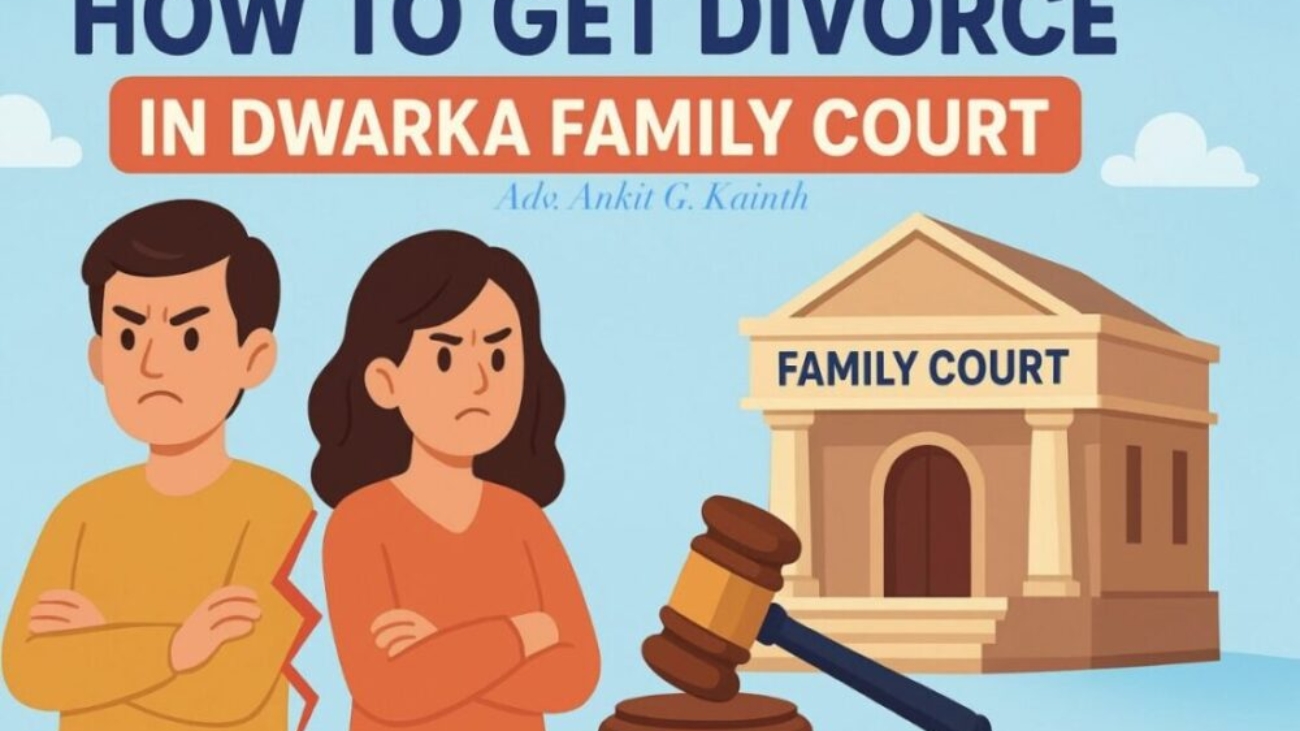
“How to Get Divorce in Dwarka Court: Top 10 Supreme Court Citations Every Client Must Know”

Divorce in Dwarka Court, Family Cases: Expert Guide + 10 Most Important Supreme Court Judgments.

Top Supreme Court Judgments on Divorce | Complete Guide for Dwarka Family Court Clients

Best 10 Supreme Court Judgments for Divorce | Guide to Filing Divorce in Dwarka Family Court, Delhi.

Introduction

Divorce is never easy — emotionally, socially or legally. But if a marriage becomes unworkable, sometimes ending it with dignity is the only practical solution. For those approaching a family court such as the one in Dwarka Court (New Delhi), knowing the landmark rulings of Supreme Court of India (SC) can make a big difference. These judgments shape how divorce petitions are framed, argued, and decided.

Here I outline ten of the most important Supreme Court judgments / principles that influence divorce law in India — particularly under the Hindu Marriage Act, 1955 (HMA) — along with “important notes” on each, and then offer my practical view and guidance: how a client in Dwarka Family Court may approach divorce “like a pro.”

Top 10 Supreme Court Judgments / Principles for Divorce

1. Irretrievable Breakdown / Irreconcilable Differences — Judicial Recognition

  • In a recent ruling, SC held that even though “irretrievable breakdown of marriage” is not explicitly a ground under HMA, the Court — under its constitutional powers (Article 142) — can dissolve a marriage when it is “emotionally perished, dead, unworkable and beyond repair.”  
  • The Court emphasized that forcing a couple to continue living together when there is no possibility of reconciliation serves no purpose and only prolongs agony.  
  • Important Note: This judgment is a game-changer because it moves jurisprudence beyond the rigid “fault-based” grounds (cruelty, desertion, adultery), by recognizing “no-fault but failed marriage” as a valid basis for divorce — provided facts justify it. Courts will evaluate: period of separation, when last cohabited, attempts at reconciliation, gravity of allegations, etc.  

2. Long Separation + Mental Cruelty / Failed Marital Relationship — Naveen Kohli v. Neelu Kohli (2006, 4 SCC 558)

  • In this case, SC noted that when parties have lived separately for a “sufficient length of time,” petition for divorce may be granted — since continuation of an unworkable marriage causes more misery.  
  • The Court observed that “cruelty” under HMA need not always be active; prolonged hostility, humiliation, false accusations, separation etc., may cumulatively amount to mental cruelty.  
  • Important Note: This helps clients who may not have overt “violent cruelty” but have undergone years of alienation, neglect or irreparable breakdown. Long separation with no hope of reconciliation becomes a valid ground.

3. Definition of “Mental Cruelty” — Samar Ghosh v. Jaya Ghosh (2007, 4 SCC 511)

  • In this landmark case, SC provided “illustrative guidelines” of what may constitute mental cruelty under Section 13(1)(i-a) of HMA. These are not exhaustive, but indicative.  
  • Examples include: sustained abusive or humiliating behaviour; refusal to fulfil marital obligations; public humiliation; false accusations of immorality; refusal to have children; long separation making cohabitation impossible.  
  • The Court also stressed that “cruelty” must be evaluated from the perspective of a “reasonable” spouse — not by sensitivity of petitioner. Everyday conflicts, small irritations or normal wear-and-tear do not count.  
  • Important Note: This case is often the foundation when clients come with allegations of “emotional cruelty,” “mental harassment,” “denial of marital rights,” especially where there are no physical abuses but persistent neglect, hostility or alienation.

4. Broad Application of “Cruelty” — V. Bhagat v. D. Bhagat (1994, 1 SCC 337)

  • In this older but foundational case, the Court held that mental cruelty under HMA must be considered in light of the social status, background, capacity to endure, and individual circumstances. What is cruelty in one context may not be in another.  
  • The Court observed that cruelty does not require physical violence or injury; mental pain, suffering, anguish, intolerability of continued cohabitation suffice.  
  • Important Note: This judgment remains relevant — especially in Delhi courts — for clients whose suffering is intangible (emotional neglect, humiliation, pattern of hostility). It ensures that courts do not look only for physical abuses.

5. Adultery / Extramarital Relations as Component of Cruelty — e.g. Savitri Pandey v. Prem Chandra Pandey (AIR 2002 SC 591)

  • In this case (and related jurisprudence), extramarital affairs, if proved, have been held to amount to mental cruelty, causing indignity, social humiliation, breach of trust, and therefore valid ground for divorce.  
  • Important Note: For clients in Dwarka, if there is credible evidence (phone records, testimonies, etc.) of infidelity, this ground remains viable — though courts today treat allegations carefully, and a mere suspicion may not suffice.

6. Provision for Alimony / Maintenance even in Void / Voidable or Broken Marriages — Sukhdev Singh v. Sukhbir Kaur (2025) (recent)

  • In a 2025 decision, SC ruled that even when a marriage is declared void under HMA, a spouse may be entitled to interim maintenance or permanent alimony under Sections 24/25 of HMA.  
  • Important Note: This judgment brings hope to people whose marriage may be void or voidable (for example due to earlier existing marriage, bigamy, etc.) — they may still claim financial relief even if the marriage is annulled.

7. Preventing Misuse — Void Second Marriages / Bigamy and Legal Consequences — Sarla Mudgal v. Union of India (1995, AIR 1995 SC 1531)

  • In this important precedent, the SC held that a second marriage obtained via conversion (to Islam) without dissolving the first marriage remains void, and such bigamy constitutes an offence under Indian Penal Code — thus emphasizing the sanctity of the first marriage and need for formal dissolution.  
  • Important Note: For clients in Dwarka (or elsewhere), this serves as caution: one cannot “escape” first marriage by conversion or back-door mechanisms — formal divorce/decree of annulment must precede any new marriage.

8. Judicial Finality — SC Encouraging “Quietus” to Prolonged Matrimonial Litigation: e.g. Manju Kumari Singh v. Avinash Kumar Singh (2018 SCC OnLine SC 739)

  • In this case, SC observed that where parties have lived separately for long, all mediation / conciliation attempts failed, and litigation has dragged on, giving a final decree may bring peace and closure — especially when there are children grown-up and settlement is possible.  
  • Important Note: This demonstrates the Court’s sensitivity to mental distress, social impact and future of children; showing that SC can — and will — intervene to end “never-ending matrimonial warfare.”

9. Cooling-Off Period (Mutual Consent) Can Be Waived — Role of Consent under HMA’s Section 13B

  • Under HMA, mutual-consent divorce typically requires a waiting (cooling) period (six months). But SC has held that in appropriate, exceptional situations — such as irretrievable breakdown, long separation and mutual agreement — this waiting period can be waived.  
  • Important Note: For couples seeking amicable separation and divorce by mutual consent, this flexibility helps expedite the process — especially useful in a busy family court like Dwarka, saving time, cost and emotional burden.

10. “Fault Theory” Remains, but Courts Interpret It Broadly — Understanding Statutory vs Judicial Grounds

  • Under the HMA, Section 13(1) lists “fault-based” grounds (adultery, cruelty, desertion, etc.) for divorce. SC judgments — such as those above — show that fault need not be only physical or obvious; mental cruelty, desertion, prolonged separation, breakdown of relationship may all count.  
  • The Court’s jurisprudence reflects that “fault” is not narrowly defined; courts must look at totality of conduct, whether continued cohabitation is reasonable, and whether marriage has become a mere formality.  
  • Important Note: Clients should not assume that only dramatic events (violence, bigamy etc.) give grounds for divorce — repeated neglect, emotional cruelty, or long separation also qualify.

My View (as a Practitioner) — Divorce Cases in Dwarka Court, Delhi: How I Would Approach Them

Having seen several cases in Delhi’s Family Courts (including Dwarka), I believe that these developments make divorce more accessible — but proper strategy, documentation, and realistic expectations are essential. Here is how I would guide a client “like a pro”:

  1. Frame the Petition Based on Facts, Not Emotions Alone
    • Use facts to show prolonged separation, breakdown of marriage, lack of cohabitation, no chance of reconciliation.
    • If there is cruelty — whether mental, emotional, neglect, indifference — gather evidence: WhatsApp messages/chats, proof of separation, statements of friends/family, mail records, financial neglect, refusal to fulfil marital obligations, etc.
  2. Decide Between “Contested Divorce” vs “Mutual Consent / Waiver”
    • If both spouses agree, a mutual-consent divorce could be fastest; but ensure consent is free, informed, documented.
    • If there are differences or disputes (custody, alimony, behaviour), go the contested route — but anchor it on SC precedents (e.g. modern broad definition of cruelty / irretrievable breakdown).
  3. Prepare for Alimony / Maintenance — Even in Void / Voidable Cases
    • If marriage is being annulled or declared void (void second marriage, bigamy, etc.), you can still claim maintenance / interim alimony under law as per recent SC judgment. This matters in Delhi, where cost of living is high.
  4. Use Separation/Cohabitation Gap Strategically
    • Long separation itself is a strong ground now (see Naveen Kohli, Samar Ghosh). Many clients underestimate this. Show evidence of no cohabitation, no contact, estrangement, efforts of reconciliation failed — this helps even if there is no clear “violence.”
  5. Avoid “Over-Legalising” — But Don’t Under-Document Either
    • Courts dislike petty “non-cooperation” or trivial complaints — they expect a threshold for cruelty. But also avoid vague allegations. Present well-documented, concrete behaviour that objectively shows breakdown.
  6. Be Realistic — Litigation Takes Time; But With Right Approach, Family Court in Dwarka Can Be Approached Confidently
    • Family courts in Delhi are busy. But if the case is built properly, based on SC precedents, with clarity of facts and reasonable expectations, one can aim for a solid hearing.

How to File a Divorce “Like a Pro” in Dwarka / Delhi: Step-by-Step Guide

  1. Consult an experienced family-law lawyer. Review facts, documents, separation history, communications, behaviour.
  2. Decide grounds: cruelty, irretrievable breakdown, mutual consent, desertion, etc., whichever fits facts.
  3. Draft the petition under HMA (or relevant law) citing relevant SC judgments (as above) for support.
  4. Attach affidavits, proof of separation/cohabitation gap, correspondence, evidence of conduct, assets/income for alimony.
  5. Attend mandatory processes (reconciliation attempts, mediation if required), but be prepared to push for scrutiny under SC precedents.
  6. Be prepared for cross-examination if allegations involve cruelty / misconduct — ensure evidence backing.
  7. If mutual consent divorce, document voluntary agreement, settlement of alimony, custody, assets — and consider requesting waiver of cooling period if justified.
  8. After decree, complete ancillary proceedings (alimony, property settlement, custody, maintenance) — courts in Delhi generally respect SC-based precedents.

Conclusion

Divorce law in India has evolved significantly — from rigid fault-based grounds to a more realistic and humane jurisprudence recognising irretrievable breakdown, mental cruelty, long separation and overall unworkability of marriage. If you (or your client) are approaching a family court such as in Dwarka, New Delhi, understanding the key judgments of the Supreme Court is not just academic — it is strategic and practical.

With proper facts, documentation, and realistic strategy — built on the pillars of precedent such as Naveen Kohli, Samar Ghosh, V. Bhagat, Sukhdev Singh v. Sukhbir Kaur, Sarla Mudgal, among others — one can approach divorce proceedings confidently, with clarity, and a fair chance for a just outcome.

  • Divorce in Dwarka CourtDivorce lawyer in Dwarka
  • How to file divorce in Dwarka Family Court
  • Supreme Court judgments on divorce
  • Best divorce lawyer in Delhi
  • Divorce on the ground of cruelty
  • Irretrievable breakdown of marriage judgments
  • Mutual consent divorce Dwarka
  • Contested divorce Delhi
  • Important divorce citations
  • IndiaSupreme Court rulings on marital cruelty
  • Dwarka Family Court legal advice
  • Divorce case procedure Delhi
  • Divorce filing process step by step
  • Mental cruelty divorce case laws
  • Separation and divorce Delhi
  • Best Supreme Court judgments for divorce
  • Filing divorce like a pro
  • Legal guide for divorce clients Delhi

Consult an experienced advocate to determine the most suitable mode of service based on the facts of your case and court practice.

Contact me for Consultation :- 9899085554, 9811885554

Ankit Gaurav Kainth Advocate, Dwarka Court, Chamber No.728, 7th Floor, Dwarka, New Delhi

https://share.google/4r7kHm3s4da3OS9rS

FOLLOW US FOR MORE LEGAL AND RECENT UPDATES:-

https://www.linkedin.com/embed/feed/update/urn:li:share:7413981654014328832?collapsed=1

203C31DB-43CE-4594-AB30-B815EABD675C

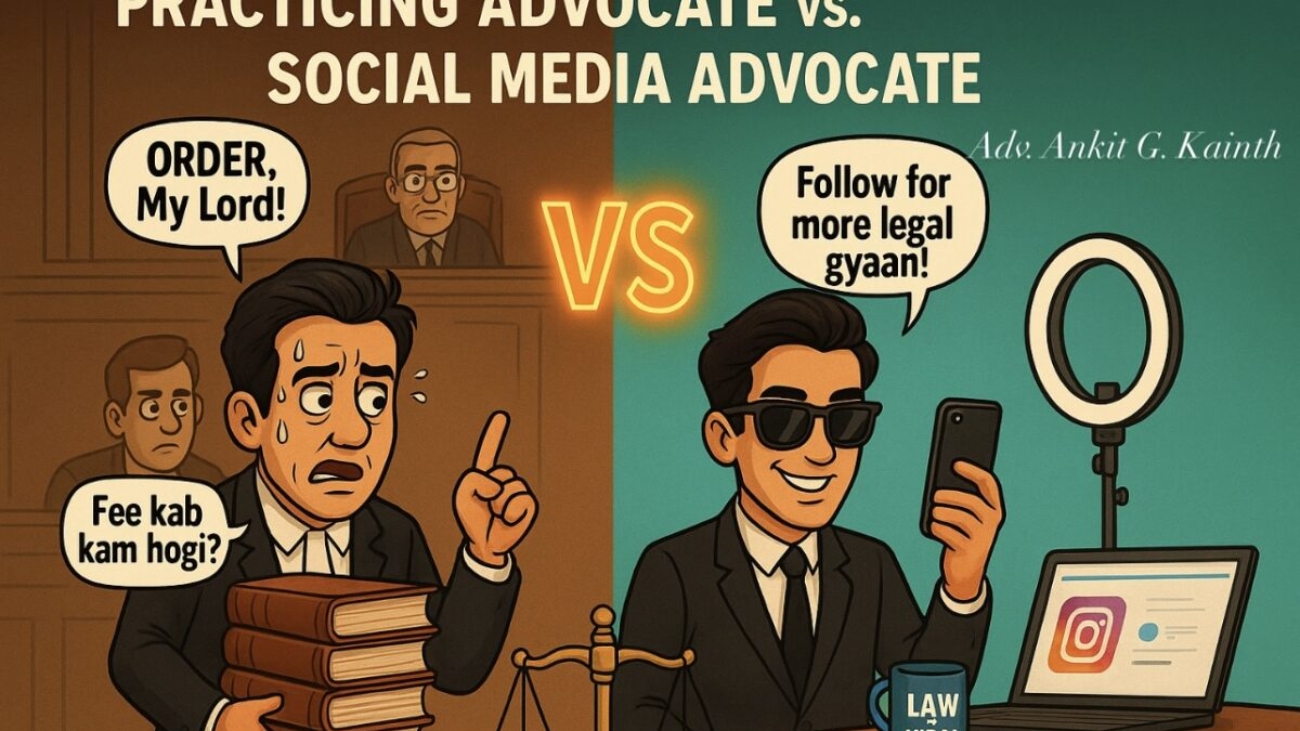
Practicing Advocate vs. Social Media Advocate 🤓📱⚖️

In today’s era, there are two species of lawyers roaming freely—
1. Practicing Advocates: Found in courts, drenched in sweat, burdened with files.
2. Social Media Advocates: Found online, drenched in filters, burdened with hashtags.

Let’s decode the epic differences between the two—because trust me, it’s more entertaining than any Netflix drama.

  1. Workstation 🏛️ vs. 📱
    • Practicing Advocate: Courtrooms, bar libraries, dusty registers.
    • Social Media Advocate: Cafés with Wi-Fi, reels with trending songs.
    👉 One-liner: “Court mein date milti hai, Insta pe followers!”

  1. Uniform 👔 vs. 👕
    • Practicing Advocate: Black coat, band, sweaty face.
    • Social Media Advocate: Blazer for DP, T-shirt for reel.
    👉 One-liner: “Practicing advocate wears black, social media advocate adds filters to black.”

  1. Arguments 🎤 vs. 🎶
    • Practicing Advocate: Argues before judges with citations.
    • Social Media Advocate: Argues before comments section with emojis.
    👉 One-liner: “One needs case laws, other just needs good captions.”

  1. Reality ⏳ vs. Views 👀
    • Practicing Advocate: Waits 4 hours for their matter to be called.
    • Social Media Advocate: Waits 4 seconds for likes to roll in.
    👉 One-liner: “Court ka patience > Insta ka algorithm.”

  1. Income 💰 vs. 💕
    • Practicing Advocate: Fee comes late, after multiple reminders.
    • Social Media Advocate: Payment? Nah, just “exposure” and “collabs.”
    👉 One-liner: “Advocate paisa ke liye fight karta hai, influencer spotlight ke liye.”

  1. Clients 👨‍👩‍👦 vs. 👥
    Practicing Advocate: Handles emotional clients shouting “Humari izzat ka sawal hai!”
    • Social Media Advocate: Handles followers shouting “Next reel kab aayegi?”
    👉 One-liner: “One manages affidavits, other manages aesthetics.”

  1. Legacy 📚 vs. 📸
    • Practicing Advocate: Builds reputation after years in court.
    • Social Media Advocate: Builds reputation after one viral reel.
    👉 One-liner: “Court mein senior ban’ne mein 20 saal, Insta pe sirf 20 seconds.”

Final Verdict ⚖️😂

Both are advocates in their own kingdoms. The practicing advocate fights for justice, while the social media advocate fights for attention. One seeks judgments, the other seeks engagement. Yet both remind us—law is not just about black coats, but also about adapting with time.

👉 Closing one-liner: “Courtroom ho ya Instagram, sabko apni audience chahiye!”

Consult an experienced advocate to determine the most suitable mode of service based on the facts of your case and court practice.

Contact me for Consultation :- 9899085554, 9811885554

Ankit Gaurav Kainth Advocate, Dwarka Court, Chamber No.728, 7th Floor, Dwarka, New Delhi

https://share.google/4r7kHm3s4da3OS9rS

FOLLOW US FOR MORE LEGAL & RECENT UPDATES:-

7B3359CC-2D29-4C7D-80E5-3D9CA472EF3A

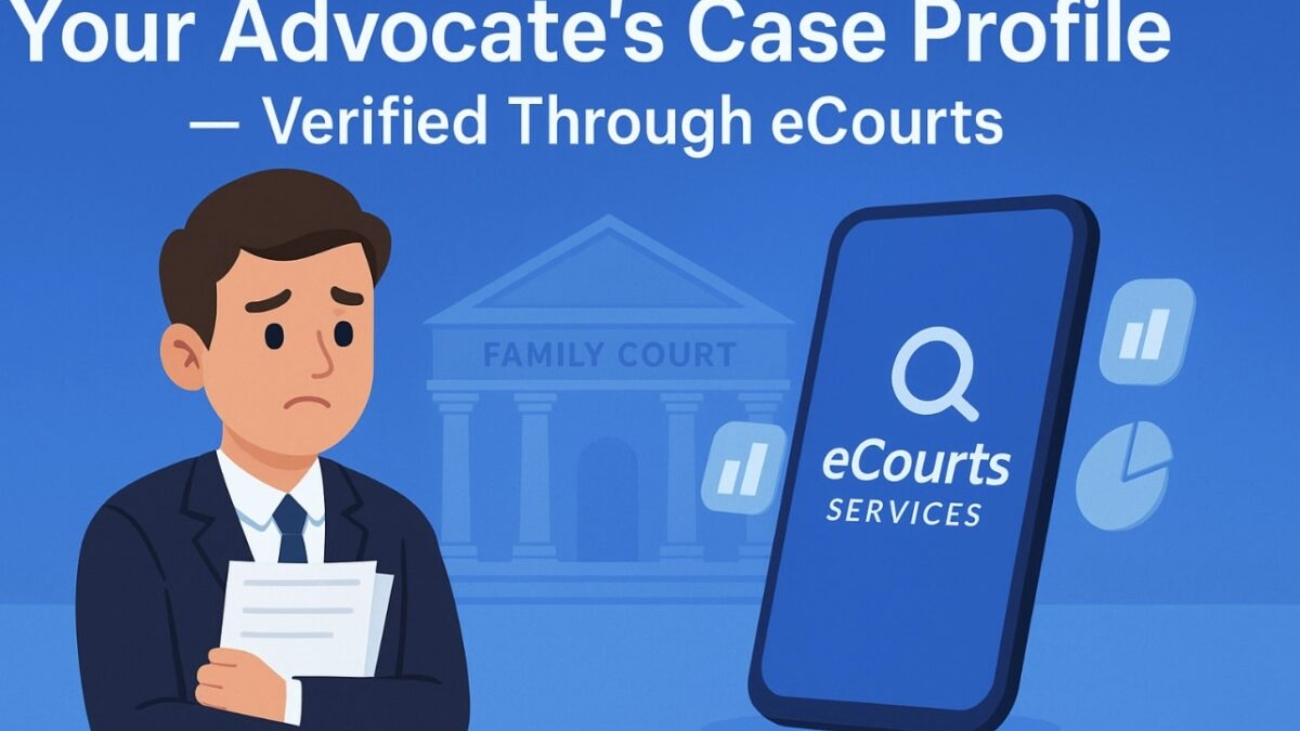
How to Check eCourts Services App to See an Advocate’s Pending & Disposed Cases in Dwarka Court🧑‍💼📊✨

Yes, you read it right—you can check the total number of cases presently filed by any Advocate in any District Court or dwarka court across India through the eCourts Services App. This simple check can give clients a major boost of confidence and helps them understand the actual practice profile of the lawyer they intend to engage.

Most clients feel confused while choosing the right advocate. Some rely on word of mouth, others rely on online profiles. But the most authentic data is available directly from the judicial system itself. The eCourts App allows you to see how many cases an Advocate has filed, in which courts they appear frequently, and how active their litigation practice really is.


How to Check an Advocate’s Case Data on eCourts Services App 🏛️📱
1. Download the “eCourts Services” App from Play Store or App Store.
2. Open the app and select ‘Search by Advocate Name’.
3. Choose the State and the District Court.
4. Enter the Advocate’s Name exactly as registered on court records.
5. Instantly, you’ll see the details of:
• Pending cases
• Disposed cases
• Court number & case type
• Year of filing

This tool reveals an Advocate’s primary practice area, the type of matters they handle, and the courts where they consistently appear.


Example: My Case Data from Dwarka District Court, New Delhi 🏛️📍

For illustration, here is my own active filing record as visible on eCourts:
1. Chief Metropolitan Magistrate (South-West) DWK – 16 Cases
2. Senior Civil Judge-cum-RC (South-West) DWK – 14 Cases
3. Principal Judge Family Court (South-West) DWK – 22 Cases
4. District & Sessions Judge (South-West) DWK – 22 Cases

Total: 16 + 14 + 22 + 22 = 74 cases
This reflects only my filed matters in Dwarka Courts.
In addition, I regularly appear in:
✔ All Six Delhi District Courts
✔ Delhi High Court
✔ All Haryana District Courts
✔ Chandigarh High Court
✔ Nainital High Court
✔ Jaipur High Court

Do note: The app shows only cases filed by the lawyer, not the matters where the lawyer appears as counsel for defendants or accused.


Why This Data Matters for Clients & Advocates 🔍💡
• Authenticity: You get court-verified information—not marketing claims.
• Transparency: Clients can see where the advocate genuinely practices.
• Specialization Insight: More filings in a particular court show a strong command in that jurisdiction.
• Referral Decisions: Even advocates can verify the presence and experience of fellow lawyers before referring matters.
• Confidence Building: When clients see real data, decision-making becomes easier, faster, and more trust-based.


In today’s digital era, knowledge empowers clients. The eCourts App is a simple yet powerful tool that helps you understand an advocate’s real-world litigation footprint and ensures you engage someone truly active and experienced in the relevant court.

#Law
#BestAdvocateinDwarkaCourtdelhi

Consult an experienced advocate to determine the most suitable mode of service based on the facts of your case and court practice.

Contact me for Consultation :- 9899085554, 9811885554

Ankit Gaurav Kainth Advocate, Dwarka Court, Chamber No.728, 7th Floor, Dwarka, New Delhi

https://share.google/4r7kHm3s4da3OS9rS

7271315D-29F9-417E-AFA8-6E8B3C833448

How to Read a Cheque Like a Pro Advocate 🏁✨-Blog by an Cheque Case Expert 18+ years of Experienced Advocate in Dwarka Court

Blog by a Cheque Case Expert | Practical Guide for Litigants in Dwarka Court

A cheque is not just a piece of paper. In Court, it is powerful evidence. One small mistake in reading a cheque can decide the fate of a case under Section 138 of the Negotiable Instruments Act. Therefore, whether you are a complainant or an accused, you must learn how to read a cheque like a seasoned advocate appearing daily before Dwarka Court.

With 18+ years of hands-on experience handling cheque bounce litigation in Court, I have seen cases won and lost purely on technical interpretation. This guide will help you understand what courts really look at.

📌 Why Reading a Cheque Properly Matters in Dwarka Court

Cheque bounce cases form a significant portion of criminal dockets in Dwarka Court. However, many litigants focus only on the amount. That is a mistake. Judges in Dwarka Court carefully analyse:

  • Date of cheque
  • Signature authenticity
  • Amount in words and figures
  • Bank branch details
  • Alterations or overwriting
  • Account status at presentation

Therefore, professional reading of a cheque strengthens your case before Court.

🏦 1️⃣ Date – The Starting Point of Limitation

First, check the date. In cheque litigation before Court, limitation is everything.

A cheque is valid for three months. If presented late, your complaint may fail in Court. Additionally, the legal notice must be sent within 30 days of dishonour. Thus, reading the date accurately protects your limitation rights.

✍️ 2️⃣ Signature – The Heart of Defence

Next, verify the drawer’s signature. In many matters before Court, accused persons admit the signature but dispute liability.

If the signature matches, a legal presumption arises under law. However, if it is disputed, handwriting examination may become necessary in Court proceedings.

This is where an experienced Criminal Lawyer Dwarka plays a crucial role.

💰 3️⃣ Amount in Words vs Figures

Always compare both carefully.

If there is a mismatch, banks generally honour the amount written in words. Yet, defence counsel in Court often challenge inconsistencies to create doubt.

Small technical discrepancies can influence the outcome in Court.

🖊️ 4️⃣ Overwriting & Alterations

Look for cutting, correction fluid, or different ink.

Judges in Dwarka Court examine whether alterations were authenticated by signature. If not, the cheque may be considered materially altered.

Therefore, before filing a case in Court, inspect the instrument professionally.

🏛️ 5️⃣ Reason for Dishonour

The bank return memo is equally important. Common reasons include:

  • Insufficient funds
  • Account closed
  • Payment stopped
  • Signature differs

Each reason carries different legal implications in Court. For example, “account closed” strengthens the complainant’s case in Court.

📜 6️⃣ Legally Enforceable Debt – The Core Issue

Even if the cheque is valid, the complainant must prove legally enforceable debt.

In Dwarka Court, courts evaluate:

  • Loan agreements
  • Property transactions
  • Friendly loans
  • Business invoices

Here, a Property Lawyer Dwarka may assist where cheques arise from real estate transactions. Similarly, matrimonial settlements may require guidance from a Divorce Lawyer Dwarka.

🚨 7️⃣ Defence Strategies in Dwarka Court

As someone practicing for 18+ years in Dwarka Court, I advise clients:

  • Preserve WhatsApp and email conversations
  • Maintain account statements
  • Avoid blank cheque misuse
  • Respond to legal notices properly

Strong documentation improves your standing before Court.

🎯 Common Mistakes Litigants Make

  • Filing complaint beyond limitation
  • Ignoring statutory notice defects
  • Failing to prove financial capacity
  • Not appearing regularly in Dwarka Court
  • Underestimating cross-examination

Because cheque cases are criminal in nature, non-appearance can even lead to coercive steps. In some situations, Bail Matters Court may arise if warrants are issued.

🌍 Jurisdictional Advantage

Clients from Janakpuri, Vikaspuri, Dwarka North, Dwarka South, Najafgarh, Uttam Nagar, Bindapur and surrounding areas approach Dwarka Court for cheque litigation. Territorial jurisdiction depends on bank presentation and notice compliance.

Regular practice in Dwarka Court ensures:

  • Proper drafting of complaints
  • Quick listing
  • Effective evidence strategy
  • Confident cross-examination

🏆 Why Experience Matters

If you are searching for the Top and Best Advocate in Dwarka Court for cheque cases, choose someone who:

  • Understands criminal procedure
  • Has trial experience in Dwarka Court
  • Handles both prosecution and defence
  • Advises strategically, not emotionally

With 18+ years of courtroom presence in Dwarka Court, I have successfully handled hundreds of cheque bounce cases, ensuring compliance with every procedural detail.

❓ FAQ – Cheque Cases in Dwarka Court

1️⃣ Is cheque bounce a criminal offence?

Yes. It is tried as a criminal complaint before Court.

2️⃣ Can I settle the case?

Yes. Settlement is possible at any stage in Dwarka Court.

3️⃣ What if cheque was given as security?

Security cheque defence can be taken, but evidence must support it before Dwarka Court.

4️⃣ Can arrest happen in cheque cases?

Normally summons are issued first. However, non-appearance may lead to warrants, requiring attention in Bail Matters Dwarka Court.

5️⃣ How long does a case take?

Timelines vary, but regular follow-up in Court ensures faster disposal.

🏛️ Final Words

A cheque speaks volumes. However, only a trained legal eye can read it like a pro advocate appearing daily in Dwarka Court.

If you want strategic advice from a cheque case expert with 18+ years of experience in Court, consult before taking any step. Early legal intervention often decides success.

📞 Call to Action

Facing cheque bounce litigation? Need expert guidance in Court?

Book a confidential consultation today. Protect your rights with experienced representation in Dwarka Court. ⚖️

Contact me for Consultation :- 9899085554, 9811885554

Ankit Gaurav Kainth Advocate, Dwarka Court, Chamber No.728, 7th Floor, Dwarka, New Delhi

https://share.google/4r7kHm3s4da3OS9rS

FOLLOW US FOR MORE LEGAL UPDATES ON :-

E4B4257A-3947-4C1B-AD60-BF927DE34E5C

How to Release the Amount Freeze by Cyber Police from Dwarka Court?💰👮🚨

🚨 Is your bank account frozen by Cyber Police?

If yes, don’t panic. In most cases, the amount can be legally released through proper proceedings before Dwarka Court. With the right legal strategy, timely filing, and proper documentation, relief is absolutely possible.

As an advocate practicing for 18+ years in Dwarka Court, I have successfully handled multiple cyber freeze matters, cheque bounce disputes, property litigation, divorce cases, and bail matters. This guide explains the step-by-step process to unfreeze your bank account through Dwarka Court in 2026.

Why Does Cyber Police Freeze Bank Accounts?

Usually, Cyber Police freeze accounts under suspicion of:

  • Online fraud or phishing complaints
  • Suspicious UPI or wallet transactions
  • Alleged involvement in money laundering
  • Transfer of disputed funds

Often, innocent account holders suffer because someone else transferred disputed funds into their account. In such cases, immediate legal action in Dwarka Court becomes essential.

Legal Provision to Release Frozen Amount in Dwarka Court ⚖️

The remedy generally lies under:

  • Section 102 CrPC (Police power to seize property)
  • Application for release before the concerned Magistrate

You must file an Application for De-freezing/Release of Bank Account before the concerned Metropolitan Magistrate in Dwarka Court.

Step-by-Step Process to Unfreeze Account in Dwarka Court

1️⃣ Obtain Freeze Intimation

First, collect:

  • Bank freeze email/letter
  • Transaction statement
  • FIR copy (if registered)

Without documents, Dwarka Court will not grant relief.

2️⃣ Draft Proper Application

Your advocate files an application before Dwarka Court stating:

  • You are a bona fide account holder
  • No involvement in alleged fraud
  • Funds are legitimate earnings
  • Financial hardship due to freeze

This stage is crucial. A well-drafted petition increases success chances in Dwarka Court.

3️⃣ Attach Supporting Documents 📑

  • ITR / Salary slips
  • Business invoices
  • GST returns
  • Bank statements
  • Affidavit of innocence

Strong documentation helps convince Dwarka Court that the freeze is unjustified.

4️⃣ Notice to IO & Cyber Cell

The Magistrate in Dwarka Court issues notice to:

  • Investigating Officer
  • Cyber Police Station

The IO may file a reply supporting or opposing release.

5️⃣ Arguments Before Dwarka Court

After hearing both sides, Dwarka Court may:

✔ Release entire amount

✔ Release partial amount

✔ Allow operation with restrictions

✔ Direct furnishing of surety/bond

Every case depends on facts. However, experienced representation in Dwarka Court makes a major difference.

Important Practical Tips 💡

  • Do not ignore freeze notices
  • Avoid direct confrontation with police
  • Never admit liability without legal advice
  • File application promptly in Dwarka Court
  • Keep transaction records ready

Delay reduces chances of quick relief from Dwarka Court.

Time Frame to Get Relief from Dwarka Court

Normally:

  • Filing to first hearing: 3–7 days
  • Final order: 2–4 weeks (depending on complexity)

Urgent matters can be mentioned before Dwarka Court for faster listing.

Why Experience Matters in Dwarka Court

Cyber cases require:

  • Knowledge of criminal procedure
  • Drafting precision
  • Strategic arguments
  • Understanding of digital evidence

With 18+ years of courtroom experience in Dwarka Court, I have handled:

Being regularly present in Dwarka Court helps in faster coordination with court staff, prosecution, and registry.

Common Mistakes People Make ❌

  • Waiting for police to “automatically” unfreeze
  • Submitting incomplete documents
  • Filing wrong type of application
  • Hiring inexperienced counsel

Remember, proper legal filing before Dwarka Court is the only reliable solution.

Areas We Serve

If your account is frozen and you reside in:

  • Janakpuri
  • Vikaspuri
  • Dwarka North
  • Dwarka South
  • Najafgarh
  • Uttam Nagar
  • Bindapur

You can seek remedy before Dwarka Court depending on jurisdiction.

FAQs – Release of Frozen Amount in Dwarka Court

Q1. Can Cyber Police freeze account without notice?

Yes, under Section 102 CrPC. However, you can challenge it before Dwarka Court.

Q2. How long does Dwarka Court take to unfreeze account?

Usually 2–4 weeks, depending on complexity.

Q3. Can partial amount be released?

Yes. Dwarka Court may allow partial withdrawal subject to conditions.

Q4. Is personal appearance mandatory?

In most cases, advocate appearance before Dwarka Court is sufficient.

Q5. What if FIR is false?

You can seek remedy before Dwarka Court and also pursue quashing or discharge separately.

Why Choose a Top Advocate in Dwarka Court?

✔ 18+ years experience in Dwarka Court

✔ Regular practice in criminal & cyber matters

✔ Transparent strategy

✔ Strong courtroom presence

✔ Quick drafting & urgent listing

If you are searching for the Top and Best Advocate in Janakpuri, Vikaspuri, Dwarka North, Dwarka South, Najafgarh, Uttam Nagar or Bindapur practicing in Dwarka Court, professional guidance can protect both your money and reputation.

📞 Call to Action

Your hard-earned money should not remain frozen due to procedural delay.

If Cyber Police has frozen your bank account, take immediate legal action in Dwarka Court.

📍 Chamber Practice: Dwarka Court

🎓 18+ Years Courtroom Experience

⚖ Criminal, Cyber, Bail, Property & Matrimonial Matters

Book a consultation today and get expert legal assistance for release of frozen amount from Dwarka Court.

#Cyberfraudcaseadvocateindwarkadelhi

https://share.google/KRffktBcT1l1YIFSI

https://www.linkedin.com/embed/feed/update/urn:li:share:7397134118628593664?collapsed=1

Consult an experienced advocate to determine the most suitable mode of service based on the facts of your case and court practice.

Contact me for Consultation :- 9899085554, 9811885554

Ankit Gaurav Kainth Advocate, Dwarka Court, Chamber No.728, 7th Floor, Dwarka, New Delhi

https://share.google/4r7kHm3s4da3OS9rS

https://share.google/avNVyQWfcW0BaoArn

Follow Us for more Legal Updates :-

https://www.instagram.com/reel/DTOCNLhgbRF/?utm_source=ig_web_copy_link&igsh=MzRlODBiNWFlZA==

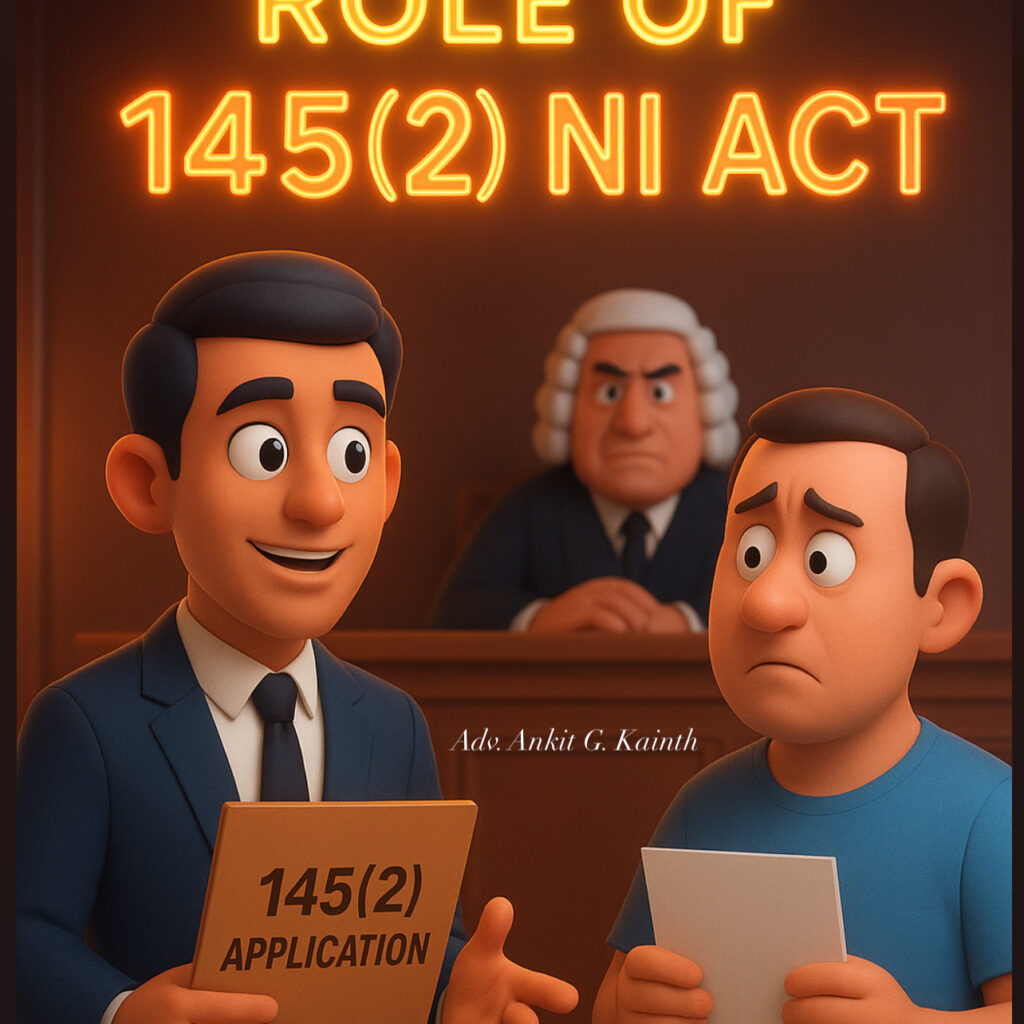
📌Role of Application U/s 145(2) in NI Act (Cheque Case) Dwarka Court — Important or Negligible? (2026)

In cheque bounce cases under the Negotiable Instruments Act, one small application often decides the entire direction of the trial — the Application U/s 145(2). Many treat it casually, and surprisingly, some courts even allow the accused to proceed without filing it. But if you appear for the complainant, this practice can seriously weaken your case.

So the real question is — Is Section 145(2) important?

👉 Absolutely. Extremely. Unavoidably. Important.

⚖️ What is Section 145(2)?

Section 145(1) NI Act permits evidence-by-affidavit of the complainant.

But Section 145(2) empowers the accused to seek permission to cross-examine the complainant/witnesses.

In simple terms:

📝 No 145(2) = No Cross-Examination.

🎯 Why Filing 145(2) is Mandatory (in complainant’s interest)

🛡️ 1. Accused Must Disclose Defence

A 145(2) application is not a formality — it forces the accused to reveal:

    •    What is his defence?

    •    Which parts of the complainant’s affidavit he disputes?

    •    On which points he wants to cross-examine?

This removes surprise elements and prevents ambush strategies.

🎯 2. Cross-Examination Cannot Go Beyond What’s Mentioned

This is the most powerful reason for complainants.

If the accused does not mention specific points in the 145(2) application:

❌ He cannot cross-examine on those points later.

❌ He cannot introduce new defences halfway.

❌ He cannot go on “fishing inquiries”.

This gives the complainant a strong procedural shield.

⚠️ 3. Silent or Vague Application = No Right to Ask Questions

If the application is vague like:

“I want to cross-examine”

…without explaining why and on what issues, then:

👉 The accused loses the right to question on undisclosed points.

This helps advocates maintain a disciplined and focused trial.

📚 4. Helps Court Understand the Scope of Trial

Judges can clearly see:

    •    What is admitted

    •    What is disputed

    •    What requires adjudication

It narrows down the controversy and speeds up the trial.

🔍 Then Why Are Some Courts Allowing Cross-Examination Without It?

Because many courts prioritize speed over procedure.

But speed cannot override statutory safeguards.

If a court allows cross-examination without a 145(2) application, the complainant should object — politely but firmly.

💡 Final Thoughts

For a complainant’s advocate, never waive the requirement of a properly drafted 145(2) application.

It ensures:

✔️ clarity

✔️ discipline

✔️ limited defences

✔️ focused cross-examination

✔️ stronger complainant case

Section 145(2) isn’t negligible —

✨ It’s a strategic weapon. Use it wisely.

#AdvocateinDwarkaCourt

#BestAdvocateinDwarkaCourt

#DivorceAdvocateLaw

#MatrimonialAdvocateinDwarkaCourt

#Dwarkacourtadvocatecontactnumber

#Divorcelawyerindwarka

#BestAdvocatenearme

#BestLawyernearme

#NegotiableInstrumentsAct #Section145(2)#ChequeBounceCase #NIACT #LegalProcedures #TrialStrategy #CrossExamination #1452Application

https://www.linkedin.com/posts/ankitgauravkainthandassociates_advocateindwarkacourt-bestadvocateindwarkacourt-activity-7395771749780504576-4-rP?utm_source=share&utm_medium=member_desktop&rcm=ACoAAFkUbj0BMjOviULod04rtCj5qsR03cu3OTY


https://share.google/WYmmToovotFnMEHrl

View this post on Instagram

A post shared by Ankit Gaurav Kainth & Associates (@ankit_gaurav_kainth_advocate)

Consult an experienced advocate to determine the most suitable mode of service based on the facts of your case and court practice.

Contact me for Consultation :- 9899085554, 9811885554

Ankit Gaurav Kainth Advocate, Dwarka Court, Chamber No.728, 7th Floor, Dwarka, New Delhi

https://share.google/4r7kHm3s4da3OS9rS

https://share.google/EI77lPy4DcIiIYGhd

60239-adobestock_542324899-00858439

Top 5 Legal Mistakes People Make During Property Disputes in Dwarka Court (And How to Avoid Them)

Property disputes are one of the most common types of cases in Dwarka District Court. Most people make avoidable mistakes, which delay their case or weaken their position.

1. Not Keeping Proper Property Documents

Many disputes arise simply because owners do not maintain documents like sale deeds, GPA, agreements, and tax receipts.

2. Verbal Agreements with No Written Proof

Never rely on “bol diya toh ho gaya.” Legal documents are the backbone of any property transaction.

3. Not Verifying Ownership Before Purchase

People often skip title verification, which leads to fraud, double selling, or disputes with family members.

4. Delaying Legal Action

The longer you wait, the stronger the other party’s position becomes. Early consultation prevents bigger problems later.

5. Not Hiring a Professional Lawyer

Attempting to handle complex property cases without expert guidance leads to avoidable losses, delays, and stress.

Property disputes are emotionally exhausting and legally complex. Whether it is ancestral property, jointly purchased property, illegal possession, or builder disputes, one wrong step can weaken your entire case.

After 18+ years of continuous practice before Dwarka Court, I have seen a clear pattern — most people lose advantage not because their case is weak, but because they commit avoidable legal mistakes.

Let us understand the top 5 mistakes and how you can avoid them.


1️⃣ Delaying Legal Action

Many property owners wait too long, hoping the dispute will “settle itself.” Unfortunately, delay creates complications:

  • Opposite party strengthens possession
  • Evidence disappears
  • Limitation issues arise
  • Illegal construction gets completed

How to avoid it:
The moment you receive a legal notice, threat, or see unlawful construction, consult a lawyer immediately. Early injunction applications often protect ownership rights effectively.


2️⃣ Ignoring Proper Documentation

In property disputes, documents decide everything.

Common problems include:

  • Missing original sale deed
  • Unregistered agreements
  • No mutation records
  • Incomplete chain of title

Courts rely heavily on documentary evidence. Emotional claims without paperwork rarely succeed.

How to avoid it:
Maintain a complete property file including sale deed, GPA (if any), previous ownership documents, tax receipts, electricity bills, and possession proof.


3️⃣ Turning a Civil Dispute into an Emotional Battle

Family property matters often become personal. People start:

  • Blocking entry
  • Changing locks
  • Making threats
  • Filing exaggerated criminal complaints

Such actions sometimes weaken your civil case and create unnecessary criminal exposure.

How to avoid it:
Let the dispute remain legal, not personal. File appropriate civil suits for injunction, possession, or partition instead of reacting emotionally.


4️⃣ Filing the Wrong Case

Many litigants file only an injunction suit when possession relief is actually required. Later, courts dismiss such cases on technical grounds.

For example:
If construction is already complete and possession is lost, a mere injunction may not be sufficient.

How to avoid it:
Before filing, assess whether your case requires:

  • Suit for possession
  • Partition suit
  • Declaration suit
  • Permanent injunction
  • Criminal complaint (if cheating or trespass involved)

Correct remedy selection saves years of litigation.


5️⃣ Hiring a Lawyer Without Court-Specific Experience

Property litigation is procedural and technical. A lawyer unfamiliar with the working pattern of Dwarka Court may overlook registry objections, limitation issues, or strategic timing.

Regular court presence matters because:

  • Filing defects are cleared faster
  • Interim relief applications are moved effectively
  • Local judicial approach is understood

Experience inside the same court environment creates a practical advantage.


Practical Advice for Property Owners

✔ Never sign blank papers
✔ Avoid verbal settlements without documentation
✔ Do not ignore legal notices
✔ Preserve all digital and physical records
✔ Act before the opposite party strengthens possession

Property cases are rarely won by aggression. They are won by documentation, procedure, and timing.


Final Thoughts

Property disputes are about rights — but courts decide them on proof, not emotions. With proper documentation, timely filing, and strategic planning, even complex matters can be handled effectively.

After 18+ years of litigation practice, I firmly believe one principle:
Preparation prevents property loss.

If you are facing a property dispute, seek structured legal guidance before taking any step. A carefully planned approach today can prevent years of unnecessary litigation tomorrow.

⚖️ Experience. Strategy. Protection of Rights.

Final Advice:

Whether it’s a family dispute, partition matter, or property possession issue, timely legal guidance is the key to a faster and favourable outcome.

Consult an experienced advocate to determine the most suitable mode of service based on the facts of your case and court practice.

Contact me for Consultation :- 9899085554, 9811885554

Ankit Gaurav Kainth Advocate, Dwarka Court, Chamber No.728, 7th Floor, Dwarka, New Delhi

https://share.google/4r7kHm3s4da3OS9rS

Follow Us for more Legal Updates :-

https://www.threads.com/@ankit_gaurav_kainth_advocate/post/DU2YeFWmksMXGTXcX3vs5YeW9CTOV_MJ-6ukx40?xmt=AQF06I364Ei7RNwUiXX4giiQO0rEjazc9_LEnImTL_CyvQ

Delhis-Dwarka-Court-complex (1)

Don’t Risk Your Case – Choose a Lawyer Who Lives and Breathes Dwarka Court (2026)

People often underestimate how important it is to hire a lawyer who regularly practices in the same court where their case is filed.

1. Understanding of Court Environment

A local lawyer is familiar with Dwarka Court’s procedures, staff, filing etiquettes, and judge-specific working styles.

2. Faster Filing & Case Movement

Since the lawyer is available on-site, filing documents, case follow-ups, and urgent applications happen quickly.

3. Practical Knowledge Matters

Local practitioners know which arguments work better, how to navigate complex court days, and how to avoid unnecessary delays.

4. Easy Availability for Clients

Meeting, discussing strategies, or submitting documents becomes easier when the lawyer is close to the court.

5. Better Representation & Confidence

A lawyer who appears daily in Dwarka Court is more confident with court timings, cause-lists, and judge behaviour—leading to better results.

Consult an experienced advocate to determine the most suitable mode of service based on the facts of your case and court practice.

Contact me for Consultation :- 9899085554, 9811885554

Ankit Gaurav Kainth Advocate, Dwarka Court, Chamber No.728, 7th Floor, Dwarka, New Delhi

https://share.google/4r7kHm3s4da3OS9rS

Follow us for more Legal Updates:-

⚖️ Why Choose a Local Lawyer for District Court Dwarka? (2026 Practical Insight)

When a legal dispute arises, most clients focus only on “Who is the best lawyer?”
But an equally important question is — “Does the lawyer regularly practice in the same court where my case is filed?”

If your matter is before Dwarka Court, choosing a lawyer who appears there daily can make a measurable difference in strategy, speed, and results.

With 18+ years of continuous practice in Dwarka Court, I have personally observed how local courtroom experience impacts outcomes.

Let us understand this practically.


🏛️ 1️⃣ Understanding the Court Environment

Every court has its own functioning style.

A local lawyer practicing regularly in Dwarka Court understands:

✔ Filing procedures and registry objections
✔ Court staff coordination
✔ Daily cause-list patterns
✔ Bench-specific working styles
✔ Practical courtroom discipline

These are not written in books — they are learned through consistent physical presence.


📂 2️⃣ Faster Filing & Quicker Case Movement

Legal strategy is not just about arguments. It is also about timing.

When your advocate is regularly present at Dwarka Court:

  • Urgent applications can be filed immediately
  • Defects can be removed the same day
  • Case status can be checked personally
  • Listing issues can be followed up promptly

Outstation lawyers may need coordination time. A local lawyer acts instantly.

In bail matters, stay orders, and injunctions — speed often determines success.


⚖️ 3️⃣ Practical Knowledge Beyond Theory

Courtroom litigation is not academic law — it is applied law.

A regular practitioner at Dwarka Court knows:

  • Which arguments receive judicial attention
  • How evidence is typically scrutinized
  • How to structure anticipatory bail
  • How mediation trends work in matrimonial disputes
  • How property disputes often convert into criminal complaints

This practical knowledge cannot be replaced by reputation alone.


👥 4️⃣ Easy Accessibility for Clients

Clients often need:

  • Quick meetings
  • Urgent documentation review
  • Strategy discussions before hearing
  • Immediate response in emergencies

When your lawyer’s chamber is in Dwarka Court premises, coordination becomes seamless.

No delays. No long scheduling gaps. No communication hurdles.


📑 5️⃣ Confidence in Representation

A lawyer who appears daily before the same benches develops:

✔ Courtroom confidence
✔ Familiarity with judicial expectations
✔ Better anticipation of queries
✔ Stronger oral advocacy

This comfort level translates into effective representation.

Whether it is:

  • Divorce litigation
  • Bail matters
  • Cheque bounce cases
  • Domestic violence proceedings
  • Property disputes

Confidence matters inside the courtroom.


🎯 6️⃣ Strategic Advantage in Complex Cases

In 18+ years of regular appearance before Dwarka Court, I have seen that:

  • Timing of filing anticipatory bail is critical
  • Drafting errors delay relief
  • Registry objections can derail urgent cases
  • Procedural compliance avoids dismissal

A local lawyer anticipates these hurdles in advance.


📍 Serving Dwarka Court Jurisdiction

Clients from:

  • Janakpuri
  • Vikaspuri
  • Dwarka North
  • Dwarka South
  • Najafgarh
  • Uttam Nagar
  • Bindapur

often prefer representation by a lawyer who understands the local litigation pattern of Dwarka Court.

Consistency builds courtroom familiarity.

https://www.facebook.com/share/p/1bgNRat17N


🧠 Final Thoughts – Experience + Proximity = Stronger Representation

Choosing a lawyer is not only about qualifications — it is about regular presence, procedural awareness, and strategic clarity.

If your matter is pending in Dwarka Court, selecting a local advocate ensures:

⚖ Faster procedural movement
⚖ Better courtroom confidence
⚖ Immediate accessibility
⚖ Practical litigation strategy
⚖ Reduced unnecessary delays

Legal success is rarely accidental. It is prepared.


📞 Consultation

If you are seeking representation in District Court Dwarka, feel free to consult for structured and strategic guidance.

Ankit Gaurav Kainth
Advocate, Dwarka Court
Chamber No. 728, 7th Floor
New Delhi

📱 9899085554
📱 9811885554

Experience. Preparation. Professionalism.

https://www.instagram.com/reel/DUhlx6xCUSn/?utm_source=ig_web_copy_link&igsh=MzRlODBiNWFlZA==

https://share.google/n2yJmIruGDzESNyTs

Anticipatory-Bail-Application-Lawyers-in-Chennai

Understanding Bail Procedure in Dwarka Court: A Complete Step-By-Step Guide

If you or someone you know has been arrested, understanding the bail procedure becomes extremely important. In Dwarka District Court, the process is straightforward, but knowing the right steps can save both time and stress.

1. What Is Bail?

Bail is a legal process that allows an arrested person to remain free while their case is ongoing, by submitting a bond or surety.

2. Types of Bail in Dwarka Court

  • Regular Bail – applied after arrest
  • Anticipatory Bail – applied before arrest
  • Interim Bail – temporary bail until a regular hearing

3. Documents Required

  • Aadhar Card / ID Proof
  • Surety documents
  • FIR copy
  • Personal bond
  • Arrest memo (in some cases)

4. How the Bail Hearing Works

Your lawyer files the bail application → Matter is listed before the judge → Arguments from both sides → Judge grants or denies bail.

5. Why Legal Help Matters

When an arrest happens, panic spreads faster than facts. Families rush to Dwarka Court with one urgent question — “How do we get bail?”

After 18+ years of continuous practice in Dwarka Court, I can confidently say this: timely strategy matters more than emotional reaction. If you understand the procedure clearly, the process becomes structured, manageable, and far less stressful.

Let us break it down step-by-step.


📌 What Is Bail?

Bail is a legal mechanism under the Code of Criminal Procedure that allows an accused person to remain free during investigation or trial, subject to conditions imposed by the court.

In simple words:
Custody is the exception. Liberty is the rule — subject to judicial discretion.


🏛️ Step 1: Identify the Type of Bail Required

Before filing anything in Dwarka Court, the first question is — what kind of bail applies?

1️⃣ Anticipatory Bail

Filed before arrest when apprehension exists.

2️⃣ Regular Bail

Filed after arrest when the accused is already in custody.

3️⃣ Interim Bail

Temporary protection granted until final hearing.

Choosing the correct category is the first strategic decision.


📄 Step 2: Collect Essential Documents

Documentation strength often determines success. Typically required:

  • FIR copy
  • Arrest memo (if applicable)
  • ID proof of accused
  • Surety documents
  • Previous case details (if any)
  • Medical documents (if relevant)

Incomplete paperwork delays relief in Dwarka Court.


🖊️ Step 3: Drafting the Bail Application

This is not a routine formality.

A professionally drafted bail application must include:

✔ Brief facts of case
✔ False implication or defence theory
✔ Lack of criminal antecedents
✔ Cooperation with investigation
✔ Legal grounds under CrPC
✔ Judicial precedents (if required)

In my experience, weak drafting is one of the most common reasons for rejection.


⚖️ Step 4: Filing Before the Appropriate Court

Most bail matters first come before the Metropolitan Magistrate in Dwarka Court.

Serious offences may require filing before the Sessions Court.

Correct forum selection prevents technical objections.


🗣️ Step 5: Bail Hearing & Arguments

On the hearing date:

  • Prosecution presents objections
  • Defence counters allegations
  • Court examines gravity, evidence, and conduct

Judges in Dwarka Court carefully evaluate:

  • Nature of offence
  • Role attributed to accused
  • Possibility of tampering evidence
  • Flight risk
  • Criminal history

Calm, structured arguments always perform better than emotional pleas.


🧾 Step 6: Bail Order & Conditions

If granted, the Court may impose:

  • Personal bond
  • Surety bond
  • Travel restrictions
  • No contact with complainant
  • Regular investigation attendance

Compliance is critical. Violation may lead to cancellation.


⏳ Step 7: Post-Bail Responsibility

Many accused believe bail means the case is over. That is incorrect.

After bail:

  • Attend all court dates
  • Avoid influencing witnesses
  • Maintain clean conduct
  • Stay in coordination with your lawyer

Bail is liberty with responsibility.


🔎 Common Bail Trends in Dwarka Court (2026)

Based on recent courtroom experience:

  • Digital evidence is heavily scrutinized
  • Delay in FIR sometimes strengthens defence
  • Matrimonial disputes often receive balanced approach
  • First-time offenders get reasonable consideration
  • Strong documentation improves chances significantly

Judicial reasoning is structured, not sentimental.


🎯 Why Experience Matters

In 18+ years of practice at Dwarka Court, I have observed:

✔ Each judge has a distinct courtroom style
✔ Filing defects delay urgent matters
✔ Timing of anticipatory bail is crucial
✔ Coordination with investigation officers helps

Bail strategy is courtroom science — not guesswork.


📌 Practical Advice for Families

👉 Do not delay consultation
👉 Do not hide facts from your lawyer
👉 Preserve digital communication
👉 Avoid media or social confrontation
👉 Stay patient and disciplined

Prepared clients always stand stronger in Dwarka Court.


❓ Frequently Asked Questions

Q1. How long does bail take in Dwarka Court?

Usually 1–3 hearings, depending on seriousness and prosecution response.

Q2. Can bail be rejected?

Yes. However, remedy lies before a higher court.

Q3. Is anticipatory bail easy?

It depends on allegations, evidence, and timing of filing.

Q4. Does court consider settlement?

In matrimonial or minor disputes, settlement discussions help.


🌟 Final Words

Arrest creates fear. Law provides structure.

Understanding the bail procedure at Dwarka Court reduces uncertainty and builds confidence.

If you or your family member requires urgent bail assistance, professional guidance makes a decisive difference.

With over 18 years of active courtroom experience, I ensure:

⚖️ Strong drafting
⚖️ Strategic arguments
⚖️ Timely filing
⚖️ Ethical representation

Act quickly. Prepare properly. Protect your liberty.

https://share.google/ywohvkWHTpzh387qV

 Consult an experienced advocate to determine the most suitable mode of service based on the facts of your case and court practice.

Contact me for Consultation :- 9899085554, 9811885554

Ankit Gaurav Kainth Advocate, Dwarka Court, Chamber No.728, 7th Floor, Dwarka, New Delhi

https://share.google/4r7kHm3s4da3OS9rS

https://www.linkedin.com/embed/feed/update/urn:li:share:7413981654014328832?collapsed=1

https://www.linkedin.com/posts/ankitgauravkainthandassociates_advocateindwarkacourt-bestadvocateindwarkacourt-activity-7413981656459706368-8Ezb?utm_source=share&utm_medium=member_desktop&rcm=ACoAAFkUbj0BMjOviULod04rtCj5qsR03cu3OTY