
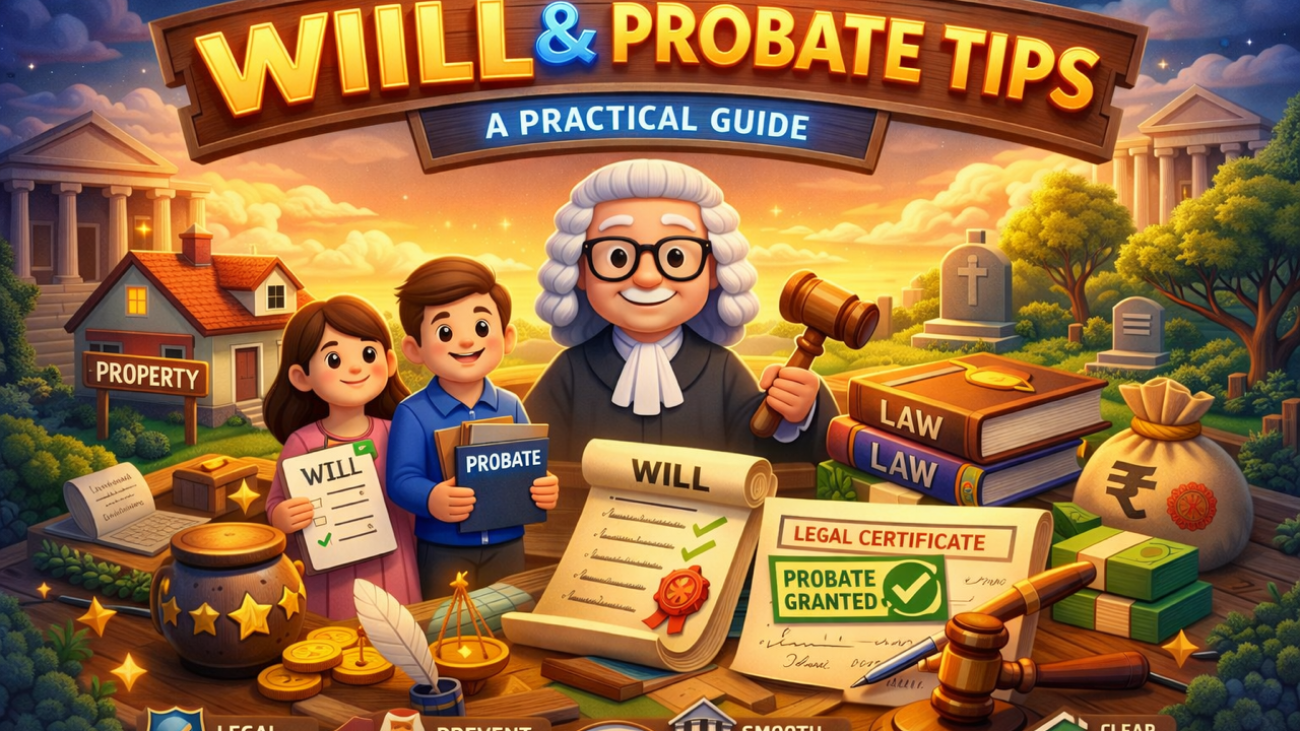
In earlier times, when families lived together and values were passed orally from one generation to another, the word of elders carried great sanctity. Property, responsibilities, and legacies were understood, respected, and rarely questioned. With changing times, nuclear families, growing assets, and increasing disputes, the law stepped in to preserve certainty. This is where the concept of a Will and its Probate assumes great importance.
A Will is the final declaration of a person’s wishes regarding his property, assets, and responsibilities after his death. It is not merely a document; it is the voice of the testator speaking even after life has ended. In olden days, this voice was honoured without question. Today, however, written law and judicial confirmation are necessary to give that voice legal authority.
📜 Meaning of Probate – In the Classical Sense
Probate is the formal recognition of a Will by a competent court. It is a judicial seal certifying that the Will placed before the court is genuine, valid, and the last testament of the deceased. Once probate is granted, the Will stands on the highest legal footing, beyond suspicion or casual challenge.
Traditionally, courts have treated probate proceedings with seriousness and reverence. The objective is not to decide ownership disputes but to ensure that the intent of the deceased is respected and lawfully executed.
⚖️ Why Probate Becomes Essential After the Death of the Testator
🕯️ Respecting the Dead, Protecting the Living
In earlier times, a man’s word was his bond. Probate today plays the same role—it gives dignity to the wishes of the departed and protection to those left behind.
📖 Authenticity and Finality
Probate establishes that the Will was executed voluntarily, in sound mind, and without coercion. This prevents fabricated claims, forged documents, and false assertions by interested parties.
🔑 Legal Authority to the Executor
Without probate, an executor remains powerless. With probate, he is clothed with legal authority to manage, distribute, and safeguard the estate exactly as directed by the testator.
🏛️ Acceptance by Authorities
Banks, municipal bodies, revenue departments, and registrars rely on probate as conclusive proof. Property mutation, transfer of shares, release of fixed deposits, and execution of documents become smooth and unquestionable.
🏠 Mandatory Nature in Traditional Jurisdictions
In cities like Delhi, Mumbai, Chennai, and Kolkata, probate has long been treated as essential, especially for immovable property. Courts have consistently held that probate removes uncertainty and prevents future litigation.
⚠️ Consequences of Ignoring Probate
In earlier times, disputes were settled within families. Today, absence of probate often leads to:
❌ Endless litigation
❌ Objections by legal heirs
❌ Refusal by authorities
❌ Delay in enjoying one’s rightful inheritance
❌ Emotional and financial strain
A Will without probate is like a letter without a seal—written with intent but lacking authority.
🧠 Wisdom from Experience
Those who understand law in its traditional sense know that prevention is better than cure. Applying for probate at the right time avoids suspicion, safeguards property, and preserves family harmony. It also reflects respect towards the wishes of the testator, who trusted the legal system to carry forward his intent.
🪔 Conclusion
In the old days, honour was enough. In modern times, probate is honour recognised by law. It transforms a Will into an enforceable command, protected by judicial wisdom. Probate is not a mere technicality—it is a bridge between the past wishes of the deceased and the future security of the living.
A Will speaks once. Probate ensures it is heard forever.
📍 About the Author
Ankit Gaurav Kainth, Advocate
Practicing in Dwarka Court, New Delhi
18+ years of court experience
📞 Contact:
9899085554 | 9811885554
https://share.google/jq7eWMAHxwAfckZHG
check my listing on Just Dial https://jsdl.in/DT-23EJAE2U