

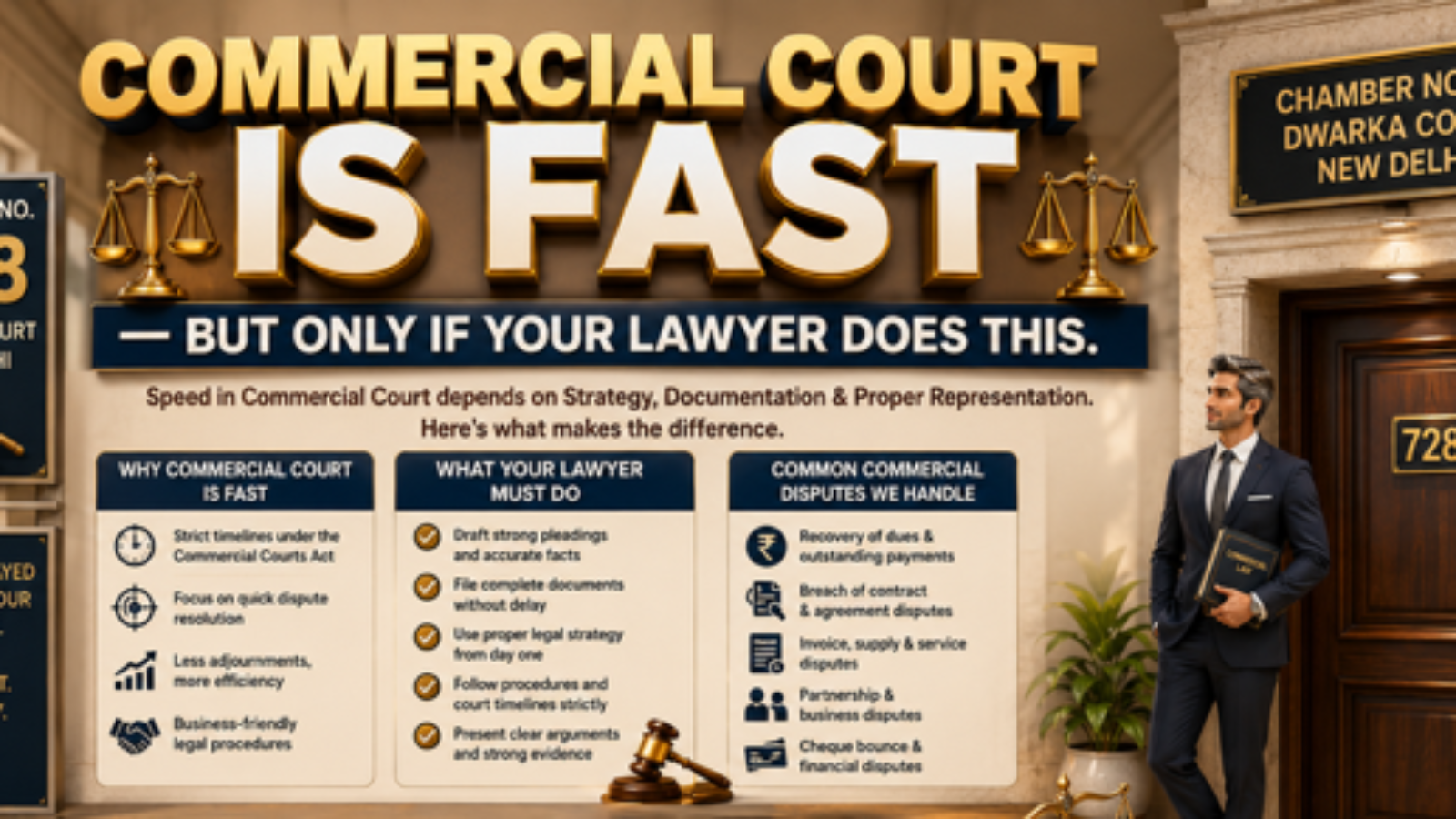

⚖️ Introduction – Commercial Court Procedure in Delhi
Commercial Courts were created to provide a specialised procedural framework for commercial disputes. But this does not mean that every commercial case will automatically finish quickly.
The real difference lies in the procedure.
Commercial litigation under the Commercial Courts Act, 2015 and the Code of Civil Procedure, 1908, as amended for commercial disputes, places greater emphasis on:
- pre-institution mediation;
- complete disclosure of documents;
- strict timelines for the Written Statement;
- admission and denial of documents;
- Statement of Truth;
- summary judgment in appropriate cases;
- active case management; and
- disciplined progression of the suit.
For a business, company, partnership, trader, contractor or professional involved in a commercial dispute in Delhi, understanding these procedural requirements can be just as important as understanding the underlying claim.
A Commercial Court case should therefore not be approached as an ordinary money-recovery suit with a different label.
What Makes Commercial Court Procedure Different?
Ordinary civil litigation and commercial litigation both operate within the broader framework of the Code of Civil Procedure. However, commercial suits are subject to important procedural modifications intended to make litigation more structured and document-focused.
The emphasis is not simply on filing a plaint and waiting for trial.
At an early stage, the parties may have to confront questions relating to:
jurisdiction → limitation → Section 12A mediation → urgent interim relief → disclosure → Written Statement → admission/denial → summary judgment → case management → evidence → final arguments → decree and execution.
Ignoring one of these stages can materially affect the conduct of the proceedings.
First Question: Is It Actually a Commercial Dispute?
Not every case involving money or a company becomes a Commercial Court matter.
The Commercial Courts Act contains a statutory definition of a commercial dispute. Depending upon the facts, it may include disputes arising from commercial transactions, supply of goods or services, business agreements, construction and infrastructure contracts, partnership arrangements, mercantile documents and other categories specifically recognised by the Act.
The dispute must also satisfy the applicable requirement relating to specified value, and the proceeding must be instituted before the court having territorial and pecuniary jurisdiction.
Accordingly, before filing, three separate questions should ordinarily be examined:
- Does the dispute fall within the statutory definition of a commercial dispute?
- What is the specified value of the dispute?
- Which court in Delhi has territorial and pecuniary jurisdiction?
Filing before the wrong forum can result in objections, return of the plaint and avoidable delay.
1. Section 12A Pre-Institution Mediation Cannot Be Ignored
One of the most important differences in commercial litigation arises before the suit is filed.
Section 12A of the Commercial Courts Act provides for pre-institution mediation where the suit does not contemplate urgent interim relief.
The Supreme Court in Patil Automation Pvt. Ltd. v. Rakheja Engineers Pvt. Ltd. treated compliance with Section 12A as mandatory in cases to which the provision applies.
Therefore, before filing a commercial recovery or contractual suit, the plaintiff should examine:
- whether Section 12A applies;
- whether pre-institution mediation has been initiated and completed as required;
- whether genuine urgent interim relief is necessary; and
- whether the pleadings and documents support that urgency.
Simply adding an interim-relief prayer should not be treated as a routine method of avoiding the mediation requirement.
The issue should be examined from the facts of the actual dispute.
Why this matters
If Section 12A applies and the statutory requirement is ignored, maintainability objections can arise at the very beginning of the case.
Proper commercial litigation therefore starts before the plaint is drafted.
2. A Commercial Plaint Requires More Than a Basic Recovery Story
Commercial pleadings should clearly present the complete transaction.
Depending upon the case, the plaint may need to explain:
- contractual relationship between the parties;
- purchase orders or work orders;
- invoices;
- supply or performance;
- payment terms;
- default;
- correspondence;
- acknowledgments;
- part-payments;
- cause of action;
- limitation;
- territorial jurisdiction;
- specified value;
- Section 12A compliance;
- interest claimed; and
- relief sought.
Commercial pleadings are also accompanied by the procedural requirements applicable to commercial suits, including verification through a Statement of Truth.
A vague plaint supported by an unorganised bundle of invoices and emails can create disputes that should have been identified before filing.
A useful commercial plaint should allow the court and the defendant to understand the transaction from the pleadings and supporting documents without having to reconstruct the entire business relationship later.
3. Order XI Makes Document Disclosure Extremely Important
Commercial litigation is heavily document-driven.
Order XI of the CPC, as applicable to commercial disputes, contains a substantially more rigorous disclosure regime than parties may expect from ordinary civil proceedings.
A commercial case may involve:
- agreements;
- amendments and addenda;
- purchase orders;
- work orders;
- invoices;
- delivery challans;
- e-way bills;
- GST-related records;
- emails;
- WhatsApp or other electronic correspondence;
- ledger statements;
- bank entries;
- debit or credit notes;
- account confirmations;
- legal notices;
- replies;
- minutes of meetings; and
- documents that may adversely affect a party’s own case.
The important point is not merely to collect documents that support the client’s version.
The litigation team should identify the entire documentary trail relevant to the transaction.
This exercise should preferably begin before the plaint or Written Statement is finalised.
Practical preparation
Create a chronological document index containing:
date | document | sender | recipient | relevance | disputed/admitted status
For a substantial commercial dispute, this exercise can reveal limitation issues, admissions, inconsistencies, payment history and possible defences before the first substantive hearing.
4. Defendant’s Written Statement: The 120-Day Rule Is Critical
For a defendant served in a commercial suit, one of the first dates to calculate is the date of service of summons.
Commercial suits follow a strict regime for filing the Written Statement.
The Supreme Court in SCG Contracts (India) Pvt. Ltd. v. K.S. Chamankar Infrastructure Pvt. Ltd. affirmed the mandatory character of the statutory outer limit applicable to filing a Written Statement in commercial proceedings.
The defendant should therefore not treat the first summons as something that can be attended to after several months.
Immediately after service, the defendant should ordinarily:
- preserve the summons and service details;
- obtain the plaint and complete document set;
- calculate the Written Statement deadline;
- examine jurisdiction and limitation;
- reconstruct the commercial transaction;
- identify payments and adjustments;
- check rejected goods or defective performance issues;
- consider set-off or counterclaim;
- prepare disclosure; and
- identify admissions and denials.
Waiting for negotiations or assuming that repeated extensions will automatically be available can expose the defendant to serious procedural consequences.
This is one of the clearest examples of why commercial litigation requires early preparation.
5. Admission and Denial Can Narrow the Entire Dispute
A commercial suit may contain hundreds of pages of documents.
That does not mean every document must necessarily be proved through a lengthy trial.
The commercial procedure places importance on admission and denial of documents.
The parties should examine each document carefully and determine whether its:
- existence;
- execution;
- contents;
- receipt;
- authenticity; or
- legal effect
is admitted or disputed.
An indiscriminate denial of every invoice, email, agreement or payment document may not be an effective litigation strategy.
Likewise, careless admissions can damage a defence.
A proper admission-and-denial exercise helps identify what genuinely requires proof and what does not.
6. Order XIII-A Summary Judgment Can Avoid a Full Trial in Appropriate Cases
One of the most significant features of commercial litigation is summary judgment under Order XIII-A CPC.
The mechanism permits the Commercial Court, in an appropriate case, to decide a claim without recording oral evidence where the statutory test is satisfied.
Broadly, the court considers whether:
- the plaintiff has no real prospect of succeeding on the claim, or the defendant has no real prospect of successfully defending it; and
- there is no other compelling reason why the claim should proceed to a full trial.
The application is subject to the procedural stage prescribed under Order XIII-A.
Summary judgment should therefore not be confused with an automatic shortcut for every invoice-recovery matter.
Some disputes contain genuine factual controversies requiring witnesses, cross-examination or expert evidence.
Others may turn substantially on documents and admitted transactions.
The question should be examined from the pleadings and evidentiary record.
Example
Suppose a purchaser admits receiving goods and repeatedly acknowledges the outstanding amount through emails but subsequently raises a defence inconsistent with the contemporaneous documents.
Depending on the complete facts, pleadings and evidence, the plaintiff may examine whether Order XIII-A is relevant.
Conversely, a defendant may also invoke the summary-judgment framework where the plaintiff has no real prospect of succeeding on the claim.
7. Order XV-A Case Management Is a Major Difference
Commercial litigation does not contemplate an uncontrolled progression from one adjournment to another.
Order XV-A provides for Case Management Hearings.
The court can organise the future conduct of the suit by fixing timelines relating to matters such as:
- completion of pleadings;
- admission and denial;
- framing of issues;
- filing of evidence;
- examination of witnesses;
- written arguments;
- oral arguments; and
- other steps required for progression of the trial.
The statutory framework contemplates the first Case Management Hearing within the period prescribed after completion of the admission/denial stage.
This enables the court to identify how the case should proceed instead of allowing the parties to control the pace indefinitely.
For lawyers and litigants, the practical lesson is straightforward:
Preparation for a Commercial Court matter should be done several hearings ahead, not one hearing at a time.
8. Commercial Litigation Requires a Case Theory From the Beginning
A strong commercial case is not simply a collection of invoices.
Before filing or defending proceedings, the advocate should ordinarily understand:
What exactly is the contractual obligation?
When did it become enforceable?
What constitutes the alleged breach?
Which documents prove that breach?
What is the limitation position?
What is the other party’s likely defence?
What amount is genuinely recoverable?
What contractual or statutory interest can be claimed?
Is there a jurisdiction clause?
Is arbitration provided for?
Is there a counterclaim or set-off?
Is urgent interim protection necessary?
When these questions are identified early, pleadings, disclosure and evidence can be organised around the actual issues in controversy.
Commercial Recovery Suits: Documents Often Decide the Direction of the Case
Many Commercial Court matters in Delhi concern unpaid business dues.
Examples include:
- unpaid invoices;
- goods supplied but payment withheld;
- services rendered but invoices unpaid;
- consultancy fees;
- construction or contractual dues;
- running business accounts;
- vendor disputes;
- purchase-order disputes; and
- breaches of commercial agreements.
In such cases, a plaintiff should not rely only upon the final ledger balance.
The complete transaction may have to be established through the agreement, invoices, purchase orders, delivery proof, correspondence, payment history and acknowledgments.
Similarly, the defendant may rely upon documents showing:
- prior payment;
- defective supply;
- rejected goods;
- failure of performance;
- contractual deductions;
- debit notes;
- adjustment;
- limitation;
- absence of jurisdiction;
- set-off; or
- another legally sustainable defence.
Commercial recovery litigation is therefore often won or lost on the transaction history, not on the amount printed on the final invoice.
Plaintiff Strategy Before Filing a Commercial Suit
A plaintiff considering commercial litigation should ordinarily complete a structured pre-filing review.
The review should cover:
Transaction: What created the liability?
Evidence: What documents establish performance and default?
Limitation: When did the cause of action arise and are there valid acknowledgments or part-payments?
Jurisdiction: Which Delhi court can entertain the claim?
Section 12A: Is pre-institution mediation required?
Interim Relief: Is urgent protection genuinely necessary?
Disclosure: Are all relevant documents available?
Relief: Principal amount, interest, injunction, declaration or other appropriate relief.
Recovery: If a decree is obtained, what assets or enforcement options may realistically exist?
The last question is frequently overlooked.
Obtaining a decree and recovering money under the decree are not always the same exercise.

Defendant Strategy After Receiving Commercial Court Summons
A defendant should not wait until the next court date to begin preparing the defence.
The initial review should normally examine:
Date of service: Calculate the Written Statement timeline immediately.
Contract: Read every operative clause, including jurisdiction, payment, termination and dispute-resolution clauses.
Transaction: Reconstruct what was supplied, performed, accepted or rejected.
Payments: Match bank entries and ledger records against the plaintiff’s claim.
Correspondence: Identify admissions as well as contemporaneous objections.
Limitation: Check whether the claim was filed within time.
Counterclaim: Determine whether the defendant has an independent claim arising from the transaction.
Set-off: Examine whether an amount legally due to the defendant can be raised.
Disclosure: Preserve all relevant documents and electronic records.
A commercial defence drafted without this exercise may miss arguments that later become difficult to introduce.
Can Commercial Court Cases Still Take Time?
Yes.
The Commercial Courts Act creates a more structured procedural framework, but no responsible lawyer should promise that every Commercial Court case will conclude within a fixed number of months.
The actual duration may depend on:
- service of summons;
- number of parties;
- volume of documents;
- interim applications;
- jurisdictional objections;
- complexity of the contract;
- admission and denial disputes;
- number of witnesses;
- expert evidence;
- court workload;
- settlement discussions;
- appeals; and
- enforcement proceedings after decree.
Therefore, it is more accurate to say that Commercial Courts provide procedural tools intended to reduce unnecessary delay rather than saying that every commercial dispute will automatically be decided quickly.
Commercial Court Jurisdiction in Delhi
Commercial litigation in Delhi requires careful forum selection.
The correct court depends upon the nature of the dispute, specified value, applicable pecuniary jurisdiction and territorial jurisdiction.
Territorial jurisdiction may arise from matters such as:
- where the contract was executed;
- where contractual obligations were performed;
- where goods or services were supplied;
- where payment was required to be made;
- where the cause of action arose;
- where the defendant carries on business; and
- whether the agreement contains a legally effective jurisdiction clause.
The correct forum should therefore be identified from the contract and transaction rather than merely from the plaintiff’s preferred location.
Our litigation practice is based at Dwarka Courts, Delhi, and commercial matters are assessed according to jurisdiction, documentary record and the applicable Commercial Courts framework.
Important Commercial Court Provisions at a Glance
| Stage | Important Provision | Practical Importance |
| Before filing | Section 12A, Commercial Courts Act | Pre-institution mediation where applicable |
| Pleadings | Order VI Rule 15A CPC | Statement of Truth |
| Documents | Order XI CPC | Detailed disclosure and discovery regime |
| Defence | Order V / Order VIII as amended | Strict Written Statement timeline |
| Document stage | Order XI | Admission and denial |
| Early disposal | Order XIII-A | Summary judgment in appropriate cases |
| Trial planning | Order XV-A | Case Management Hearing |
| Costs | Section 35 CPC as applicable | Commercial litigation costs regime |
| After decree | CPC execution provisions | Enforcement of the decree |
Frequently Asked Questions
Is Commercial Court always faster than an ordinary civil court?
Not necessarily. Commercial Courts follow a specialised procedural framework intended to make commercial litigation more structured and efficient, but actual duration depends upon the facts, parties, evidence, applications and court schedule.
Is Section 12A mediation compulsory before every commercial suit?
Section 12A applies to commercial suits that do not contemplate urgent interim relief. Whether the requirement applies should be assessed from the facts and relief claimed.
What happens if a defendant does not file the Written Statement within 120 days?
The commercial-suit framework imposes a strict outer limit. The Supreme Court has treated the 120-day limit as mandatory for commercial suits governed by that regime.
What is Order XI in a Commercial Court case?
Order XI contains the special disclosure, discovery, inspection and admission/denial framework applicable to commercial disputes. Parties should organise the complete documentary record from the beginning.
What is summary judgment under Order XIII-A?
It allows a Commercial Court, where the statutory requirements are satisfied, to decide a claim without a full trial. It is not appropriate in every dispute.
What is a Case Management Hearing?
Under Order XV-A, the Commercial Court can actively structure the progress of the suit and prescribe timelines for procedural stages, evidence and arguments.
Can a defendant file a counterclaim in a Commercial Court case?
Depending on the facts and applicable CPC provisions, a defendant may consider a counterclaim or set-off. These should be evaluated while preparing the Written Statement.
Does sending a legal notice extend limitation?
A demand notice does not automatically restart limitation. Limitation depends upon the cause of action, applicable provision of the Limitation Act and legally relevant events such as qualifying acknowledgments or payments.
What Businesses Should Do Before Commercial Litigation Starts
Commercial litigation becomes easier to manage when the documentary and legal position is examined early.
Before filing or defending a case, businesses should preserve the agreement, purchase orders, invoices, correspondence, delivery records, bank statements, ledgers, acknowledgments, notices and electronic communications.
They should also avoid deleting emails or WhatsApp conversations merely because the correspondence appears unfavourable. Disclosure obligations and evidentiary considerations should be discussed with the advocate handling the matter.
The objective should be to understand the entire transaction—not merely to collect documents supporting one side of the dispute.
Conclusion
Commercial Courts are different from ordinary civil courts because the procedural framework expects greater discipline at an earlier stage.
Section 12A pre-institution mediation, Statement of Truth, Order XI disclosure, strict Written Statement timelines, admission and denial of documents, Order XIII-A summary judgment and Order XV-A case management all demonstrate the same principle:
commercial litigation should be prepared comprehensively from the beginning.
For a plaintiff, that means identifying jurisdiction, limitation, documentary proof, mediation requirements and appropriate relief before filing.
For a defendant, it means acting immediately after service, preserving documents, calculating the Written Statement deadline and identifying every genuine defence, set-off or counterclaim.
The Commercial Courts Act provides mechanisms intended to make commercial dispute resolution more structured and efficient. Whether those mechanisms assist a particular case depends upon the facts, documents and procedural history of that dispute.
Commercial Litigation Consultation in Delhi
Ankit Gaurav Kainth & Associates handles civil and commercial litigation from Dwarka Courts, Delhi, including matters relating to commercial recovery, contractual disputes, business dues, Commercial Court defence, interim applications, evidence and execution proceedings.
A consultation in a commercial matter should ordinarily begin with examination of the contract, invoices, transaction history, correspondence, limitation and jurisdiction rather than with an assumption about the eventual result or duration.
Chamber No. 728, Lawyers’ Chambers Block
District Court Dwarka, Sector-10, New Delhi
Legal Disclaimer
This article is intended for general legal information and educational purposes. Commercial Court jurisdiction, limitation, Section 12A requirements, procedural timelines and available remedies depend upon the facts and applicable law of each case. Nothing in this article should be treated as a guarantee regarding the outcome or duration of any proceeding.
Author
Ankit Gaurav Kainth, Advocate
Litigation practice based at Dwarka Courts, Delhi
Civil & Commercial Litigation
| No. | Supporting Page / Blog | Recommended Anchor Text | Why It Supports This Article | Suggested Placement | URL |
|---|---|---|---|---|---|
| 1 | Commercial Court Advocate in Dwarka Court Delhi | Commercial Court Advocate in Dwarka Court Delhi | Main commercial litigation service page covering jurisdiction, recovery, contracts and defence strategy. | Introduction and conclusion | https://ankitgauravkainth.in/best-commercial-court-advocate-in-dwarka-court-2026/ |
| 2 | Written Statement – 120 Days in Commercial Court | 120-day Written Statement rule in Commercial Court | Provides a detailed explanation of one of the most important statutory deadlines for defendants. | Section on defendant’s Written Statement | https://ankitgauravkainth.in/2026/09/01/written-statement-120-days-in-commercial-court/ |
| 3 | Commercial Court Recovery Suit – Limitation Period | limitation period in a Commercial Court recovery suit | Supports the discussion on cause of action, acknowledgments, part-payments and limitation. | Plaintiff strategy / limitation section | https://ankitgauravkainth.in/2026/08/29/commercial-court-recovery-suit-when-does-the-limitation-period-start/ |
| 4 | How Summary Judgment Works in Commercial Courts | summary judgment under Order XIII-A | Expands the explanation of early disposal without a full trial in an appropriate commercial case. | Order XIII-A section | https://ankitgauravkainth.in/how-summary-judgment-works-in-commercial-courts/ |
| 5 | Commercial Money Recovery Suit in Delhi | Commercial Money Recovery Suit in Delhi | Supports invoice, contractual dues and business recovery search intent, including cross-border clients. | Commercial recovery section | https://ankitgauravkainth.in/2026/08/27/commercial-money-recovery-suit-in-delhi/ |
| 6 | Legal Notice in a Commercial Matter | legal notice in a commercial dispute | Connects the pre-litigation stage with notices, replies, settlement and later Commercial Court proceedings. | Pre-litigation / Section 12A section | https://ankitgauravkainth.in/2026/05/11/what-happens-after-receiving-a-legal-notice-in-a-commercial-matter/ |

[…] international clients, having a Commercial Civil Litigation Lawyer in Delhi who understands both the legal process and local court working system can make communication and […]
[…] in South West Delhi, Civil Litigation Lawyer in Delhi, Property Dispute Advocate, or Commercial Court Advocate Delhi should consider experience, communication, transparency, and the nature of the […]
[…] But Only If Your Lawyer Does This in Delhi Court […]
[…] Commercial Court Litigation in Delhi […]
[…] Commercial Court Litigation in Delhi […]
[…] Commercial Court Litigation in Delhi […]
[…] Commercial Court Litigation in Delhi […]
[…] But Only If Your Lawyer Does This in Delhi Court […]