

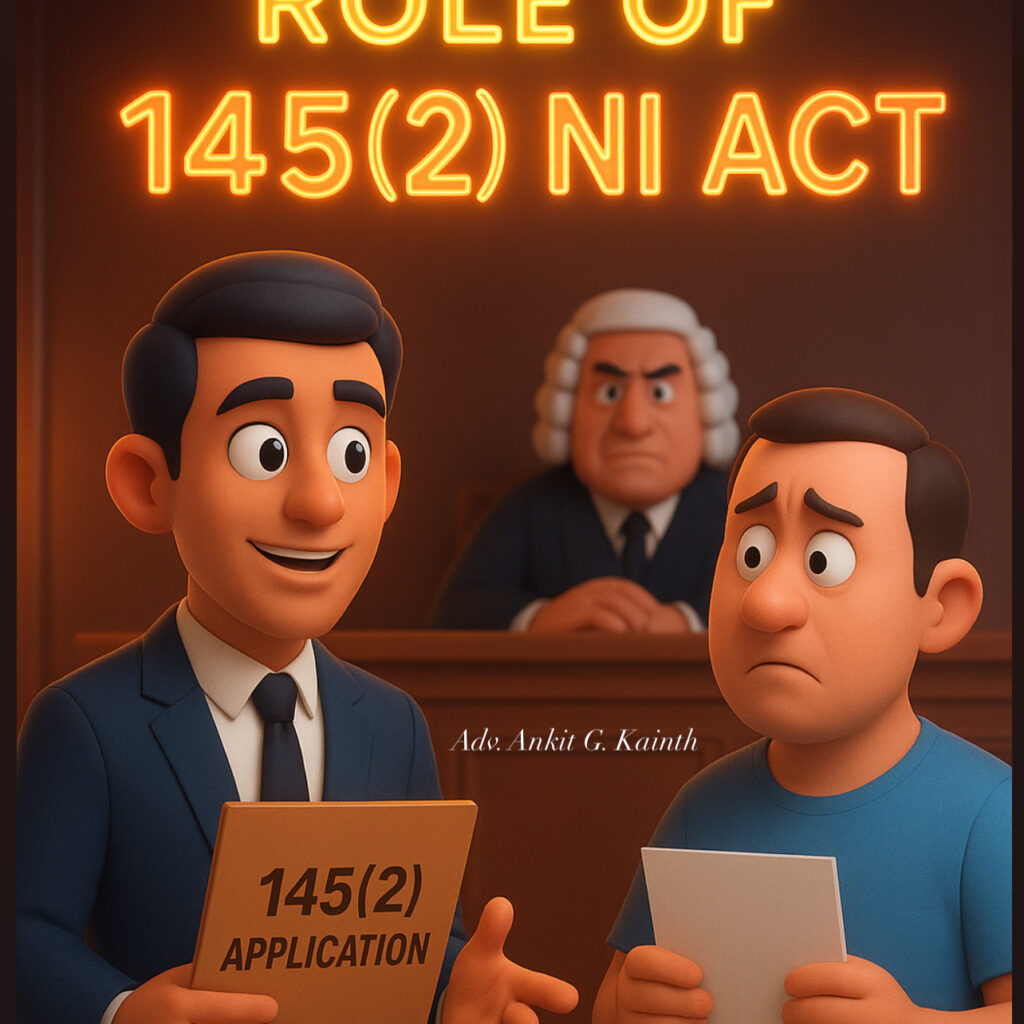
In cheque bounce cases under the Negotiable Instruments Act, one small application often decides the entire direction of the trial — the Application U/s 145(2). Many treat it casually, and surprisingly, some courts even allow the accused to proceed without filing it. But if you appear for the complainant, this practice can seriously weaken your case.
So the real question is — Is Section 145(2) important?
👉 Absolutely. Extremely. Unavoidably. Important.
⸻
⚖️ What is Section 145(2)?
Section 145(1) NI Act permits evidence-by-affidavit of the complainant.
But Section 145(2) empowers the accused to seek permission to cross-examine the complainant/witnesses.
In simple terms:
📝 No 145(2) = No Cross-Examination.
⸻
🎯 Why Filing 145(2) is Mandatory (in complainant’s interest)
🛡️ 1. Accused Must Disclose Defence
A 145(2) application is not a formality — it forces the accused to reveal:
• What is his defence?
• Which parts of the complainant’s affidavit he disputes?
• On which points he wants to cross-examine?
This removes surprise elements and prevents ambush strategies.
⸻
🎯 2. Cross-Examination Cannot Go Beyond What’s Mentioned
This is the most powerful reason for complainants.
If the accused does not mention specific points in the 145(2) application:
❌ He cannot cross-examine on those points later.
❌ He cannot introduce new defences halfway.
❌ He cannot go on “fishing inquiries”.
This gives the complainant a strong procedural shield.
⸻
⚠️ 3. Silent or Vague Application = No Right to Ask Questions
If the application is vague like:
“I want to cross-examine”
…without explaining why and on what issues, then:
👉 The accused loses the right to question on undisclosed points.
This helps advocates maintain a disciplined and focused trial.
⸻
📚 4. Helps Court Understand the Scope of Trial
Judges can clearly see:
• What is admitted
• What is disputed
• What requires adjudication
It narrows down the controversy and speeds up the trial.
⸻
🔍 Then Why Are Some Courts Allowing Cross-Examination Without It?
Because many courts prioritize speed over procedure.
But speed cannot override statutory safeguards.
If a court allows cross-examination without a 145(2) application, the complainant should object — politely but firmly.
⸻
💡 Final Thoughts
For a complainant’s advocate, never waive the requirement of a properly drafted 145(2) application.
It ensures:
✔️ clarity
✔️ discipline
✔️ limited defences
✔️ focused cross-examination
✔️ stronger complainant case
Section 145(2) isn’t negligible —
✨ It’s a strategic weapon. Use it wisely.
#AdvocateinDwarkaCourt
#BestAdvocateinDwarkaCourt
#DivorceAdvocateLaw
#MatrimonialAdvocateinDwarkaCourt
#Dwarkacourtadvocatecontactnumber
#Divorcelawyerindwarka
#BestAdvocatenearme
#BestLawyernearme
#NegotiableInstrumentsAct #Section145(2)#ChequeBounceCase #NIACT #LegalProcedures #TrialStrategy #CrossExamination #1452Application
https://share.google/WYmmToovotFnMEHrl
A post shared by Ankit Gaurav Kainth & Associates (@ankit_gaurav_kainth_advocate)
Consult an experienced advocate to determine the most suitable mode of service based on the facts of your case and court practice.
Contact me for Consultation :- 9899085554, 9811885554
Ankit Gaurav Kainth Advocate, Dwarka Court, Chamber No.728, 7th Floor, Dwarka, New Delhi
[…] A strongly contested case, when handled by a Cheque Bounce Cross Examination Advocate Dwarka, can lead to […]