
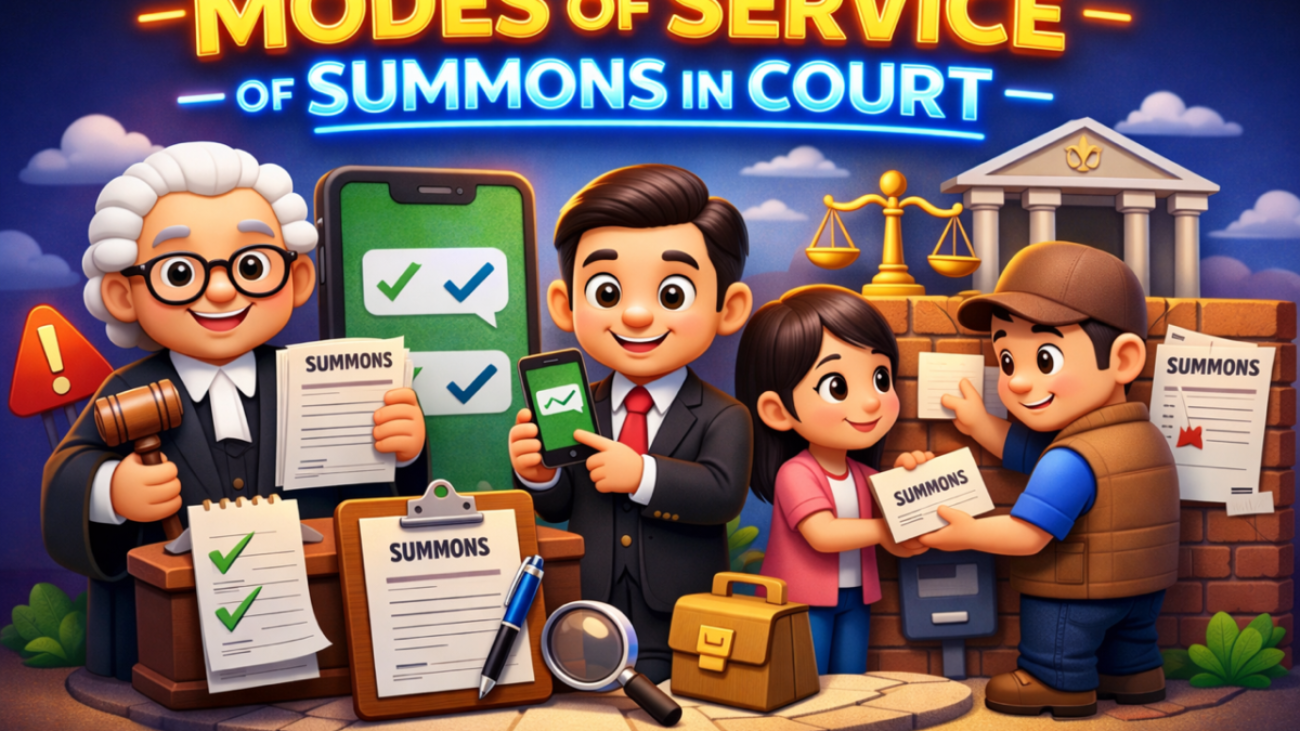
Service of summons is the foundation of every judicial proceeding. No civil or criminal case can effectively proceed unless the opposite party is duly served and given a fair opportunity to appear before the court. The entire object of service is to ensure knowledge of the case, not to defeat justice by technical objections. Over time, Indian courts have evolved from rigid traditional methods to modern, technology-driven modes of service, ensuring speed, transparency, and accountability.
This article explains the legally recognized modes of service of summons, commonly used in district courts, including Dwarka Courts, in a practical and easy-to-understand manner.
📱 Service of Summons through WhatsApp to the Party
With the growing misuse of avoidance tactics by defendants, courts have acknowledged WhatsApp service as a valid and effective mode of service.
When summons are sent to the mobile number of the concerned party, and the message shows double tick (✓✓), service is treated as complete. It is important to note that blue tick is not mandatory. The purpose of law is not to insist on proof of reading, but proof of delivery.
Screenshots showing:
✔ Mobile number
✔ Date and time of delivery
✔ Double tick confirmation
are placed on court record. This method is now widely accepted as it prevents deliberate evasion and ensures speedy progress of the case.
👨⚖️ Service of Summons through WhatsApp to Counsel
Courts also recognize service through WhatsApp to the Advocate of the opposite party, especially when the counsel has already appeared or is known to represent the party.
Service to counsel is considered valid intimation because an advocate is duty-bound to inform his client about court proceedings. This mode reduces unnecessary adjournments, saves court time, and promotes professional accountability.
📄 Dasti Service of Summons
Dasti service refers to personal service of summons directly handed over to the opposite party by the serving party, with prior permission of the court.
This mode is commonly used in urgent matters such as:
✔ Interim relief applications
✔ Injunction matters
✔ Maintenance and domestic violence cases
Once served, the serving party files an affidavit or report confirming delivery. Dasti service is fast, reliable, and minimizes procedural delay.
🏠 Service of Summons by Affixation
When the opposite party deliberately avoids service or remains unavailable despite repeated attempts, courts may order service by affixation.
Under this mode:
✔ Summons are affixed at the last known residential or business address
✔ Affixation is done at a conspicuous place
✔ The process server files a detailed report
Affixation is treated as valid service once the court is satisfied that avoidance was intentional.
⚖️ Importance of Proper Service of Summons
Improper or defective service can delay proceedings and may even render subsequent orders vulnerable to challenge. Hence, courts focus on effective service rather than mere formality. The trend clearly shows that substance prevails over technical objections.
A party cannot take advantage of its own wrong by deliberately avoiding service.
⚖️ Conclusion
Modern courts have adapted to practical realities by recognizing electronic service, including WhatsApp, alongside traditional methods like Dasti service and affixation. These modes ensure that justice is not stalled by procedural abuse.
For litigants, understanding the correct mode of service is crucial. For advocates, selecting the most effective mode saves time, cost, and unnecessary litigation.
📌 Consult an experienced advocate to determine the most suitable mode of service based on the facts of your case and court practice.
Contact me for Consultation :- 9899085554, 9811885554
Ankit Gaurav Kainth Advocate, Dwarka Court, Chamber No.728, 7th Floor, Dwarka, New Delhi
https://share.google/4r7kHm3s4da3OS9rS
Our Business Profile Link :-