

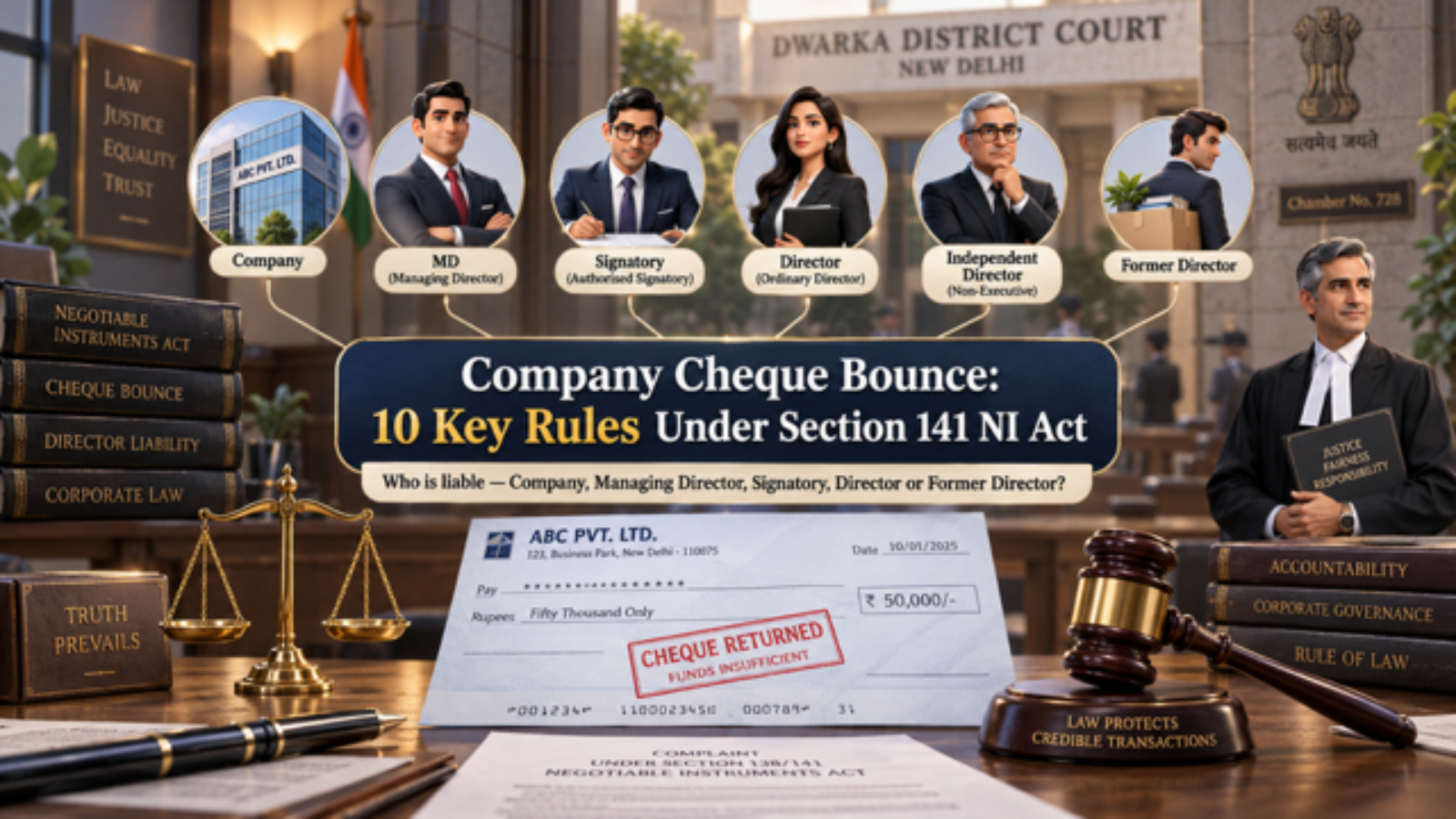

Introduction – Cheque Bounce by a Company or Director
When Can a Director, Managing Director, Authorised Signatory or Former Director Be Personally Prosecuted for a Company Cheque?
A cheque issued by a company may carry the name of the company, but when that cheque is dishonoured, an important question immediately arises:
Can every director of the company also be prosecuted under Section 138 of the Negotiable Instruments Act, 1881?
The answer is no.
Section 141 NI Act creates a special form of vicarious liability in cases where the cheque is issued by a company. However, merely describing someone as a “Director” does not automatically make that person criminally liable for every cheque issued by the company.
The legal position depends upon the person’s designation, actual role, responsibility for the company’s business, involvement in the transaction, whether the person signed the cheque, the allegations made in the complaint and the relevant documentary record.
The Supreme Court has repeatedly emphasised that Section 141 is a provision creating vicarious criminal liability and its statutory requirements must therefore be satisfied before liability can be imposed.
For businesses, companies, directors and complainants dealing with cheque-bounce litigation before courts in Delhi, including Dwarka Courts, understanding these distinctions can fundamentally affect how a Section 138 complaint should be filed or defended.
1. What Is Section 141 of the Negotiable Instruments Act?
Section 138 NI Act deals with dishonour of cheques issued toward discharge of a legally enforceable debt or liability, subject to fulfilment of the statutory requirements.
Section 141 deals specifically with offences committed by companies.
Broadly, where a company commits an offence under Section 138, liability may extend beyond the company to persons who, at the relevant time, were in charge of and responsible to the company for the conduct of its business.
Section 141 also separately deals with situations where the offence occurred with the consent or connivance of, or because of neglect attributable to, a director, manager, secretary or other officer.
The Negotiable Instruments Act continues to contain Sections 138 to 148 as the principal statutory framework governing cheque-dishonour proceedings, with Section 141 specifically titled “Offences by companies.”
This distinction is important because criminal liability of company officials cannot ordinarily be presumed merely from their designation.
2. Is Every Director Liable When a Company Cheque Bounces?
No.
One of the most important principles under Section 141 is that:
Directorship alone does not automatically create criminal liability.
The Supreme Court has distinguished between a person who merely holds the office of director and a person who was actually in charge of and responsible for conducting the company’s business at the relevant time.
The complaint must therefore contain legally sufficient allegations against the director sought to be prosecuted.
In K.S. Mehta v. M/s Morgan Securities and Credits Pvt. Ltd., 2025 INSC 315, the Supreme Court reiterated that non-executive and independent directors cannot be made vicariously liable merely because they are directors. The Court examined whether there were specific allegations connecting the directors with the company’s financial affairs and the transaction underlying the dishonoured cheques.
Therefore, simply writing:
“Accused Nos. 2 to 5 are directors of the company”
may not, by itself, establish the statutory basis required for prosecution.
3. What About a Managing Director or Joint Managing Director?
The position of a Managing Director or Joint Managing Director is materially different from that of an ordinary director.
The Supreme Court has recognised that the very designation of Managing Director or Joint Managing Director ordinarily indicates that the person is in charge of and responsible for the conduct of the company’s business.
Accordingly, the pleading requirement applicable to an ordinary director is not identical.
In S.P. Mani and Mohan Dairy v. Dr. Snehalatha Elangovan, the Supreme Court discussed earlier authorities including K.K. Ahuja v. V.K. Vora and reiterated the distinction between Managing Directors, cheque signatories, ordinary directors and other company officers.
This is why a complaint should not treat every person associated with a company as belonging to the same legal category.
4. Is the Person Who Signed the Company Cheque Personally Liable?
The authorised signatory occupies another important category.
Where a director or officer has actually signed the dishonoured cheque on behalf of the company, his or her position is materially different from a non-signatory director.
The Supreme Court has consistently recognised that a person who signs the cheque on behalf of the company can be proceeded against in accordance with Section 141.
In K.K. Ahuja, as discussed by the Supreme Court in S.P. Mani, the Court explained that a director or officer who signed the cheque does not stand in the same position as an ordinary non-signatory director.
Therefore, while reviewing a company cheque-bounce case, one of the first documents that should be examined is the cheque itself:
Who actually signed it?
That answer may substantially affect the legal analysis.
5. What Must Be Alleged Against an Ordinary Director?
For an ordinary director who did not sign the cheque, Section 141 requires careful scrutiny of the complaint.
The Supreme Court has repeatedly emphasised the requirement that the person sought to be made vicariously liable must have been both:
in charge of the company, and
responsible to the company for the conduct of its business
at the relevant time.
The Supreme Court’s 2025 discussion in K.S. Mehta referred to Hitesh Verma v. Health Care At Home India Pvt. Ltd. and emphasised these as twin requirements under Section 141(1).
A complainant should therefore avoid mechanically arraying every individual whose name appears in the company’s corporate records.
The complaint should be drafted after examining the actual roles of the persons sought to be prosecuted.
Similarly, a director receiving summons should closely examine whether the complaint contains the necessary allegations concerning his or her role.
6. Can a Non-Executive or Independent Director Be Prosecuted?
A non-executive or independent director does not enjoy absolute immunity merely because of that designation.
However, the Supreme Court has made it clear that mere designation is not enough.
In K.S. Mehta v. Morgan Securities, the appellants were non-executive directors. The Supreme Court considered factors including their lack of involvement in the financial transaction, absence of signatures on the dishonoured cheques, corporate records reflecting their non-executive roles and absence of specific allegations connecting them with the company’s financial affairs.
The Court held that mere attendance at board meetings did not automatically establish control over financial operations and quashed the proceedings against them.
This makes the 2025 judgment particularly important for current Section 141 litigation.
A complaint should identify the factual basis for alleging responsibility.
A director, on the other hand, should examine whether corporate records contradict the allegations made in the complaint.
7. What If the Director Resigned From the Company?
Resignation can be highly relevant, but the date and documentary record must be carefully examined.
The important question is not merely:
“Did the person resign?”
The more important questions include:
When did the person resign?
When did the relevant transaction take place?
When was the cheque issued?
Who authorised the transaction?
What was the person’s role at the relevant stage?
What do the Registrar of Companies records show?
Was the person involved in the financial decision or cheque issuance?
Documents such as MCA/ROC records, Form DIR-12, board resolutions, appointment and resignation documents, bank mandates and corporate governance records may therefore become important.
The Supreme Court’s analysis in K.S. Mehta demonstrates the importance that contemporaneous corporate records can assume when examining whether a director was genuinely involved in the relevant financial affairs.
A resignation defence should therefore be supported by documentary evidence rather than merely asserted orally.
8. Must the Company Itself Be Made an Accused?
This is another fundamental issue in Section 141 litigation.
The Supreme Court in Aneeta Hada v. Godfather Travels & Tours Pvt. Ltd. held that, for prosecution based on vicarious liability under Section 141, arraigning the company is ordinarily imperative because commission of the offence by the company is the condition precedent for fastening vicarious liability on others.
The Supreme Court has subsequently reiterated this principle while recognising that legally exceptional situations may require separate consideration.
Therefore, before filing a complaint involving a company, the complainant should carefully determine:
Who is the drawer of the cheque?
Is the company properly described and arrayed?
Who signed the cheque?
Which directors or officers are sought to be prosecuted?
What is the legal basis for proceeding against each of them?
A drafting error at this stage can create substantial litigation later.
9. What Is the Difference Between Section 141(1) and Section 141(2)?
Section 141 operates through more than one route of liability.
Under Section 141(1), liability may extend to a person who was in charge of and responsible to the company for the conduct of its business when the offence occurred.
Section 141(2), however, deals with circumstances where the offence is shown to have been committed with the consent or connivance of, or is attributable to neglect by, a director, manager, secretary or other officer.
The Supreme Court has explained that officers who do not fall within the first category may still attract liability where the necessary allegations and evidence concerning consent, connivance or neglect bring the case within Section 141(2).
Therefore, the precise allegations in the complaint matter.
It is not enough to merely reproduce everyone’s designation from the MCA website.
10. Can a Director Approach the High Court for Quashing?
Potentially, yes—but quashing is not automatic merely because the accused describes himself or herself as a sleeping, independent or non-executive director.
The High Court examines the complaint, allegations and, in appropriate cases, reliable documentary material.
Older Supreme Court judgments refer to petitions under Section 482 CrPC because those proceedings arose under the Code of Criminal Procedure, 1973.
The Bharatiya Nagarik Suraksha Sanhita, 2023 came into force on 1 July 2024, and the corresponding provision preserving the High Court’s inherent powers is Section 528 BNSS.
A director considering such proceedings may need to examine material including:
the complaint, summoning order, cheque, bank documents, company master data, Form DIR-12, board resolutions, bank-authorisation documents, resignation records, corporate filings and correspondence relating to the underlying transaction.
Whether quashing is appropriate depends upon the facts and legal position of the individual case.
Company Cheque Bounce: Role-Based Liability at a Glance
| Person | General Section 141 Issue |
| Company | Primary corporate drawer/offender where statutory requirements are satisfied |
| Managing Director / Joint Managing Director | Position itself ordinarily indicates responsibility for conduct of business |
| Cheque Signatory | Signature on behalf of company creates a materially different basis of liability |
| Ordinary Director | No automatic liability merely because of designation |
| Non-Executive Director | Requires examination of specific allegations and actual involvement |
| Independent Director | Mere status or board attendance does not automatically create liability |
| Former Director | Relevant dates, role and resignation records must be examined |
| Manager/Secretary/Other Officer | Liability depends upon requirements of Section 141(1) or allegations under Section 141(2), as applicable |
Important Documents in a Company Cheque Bounce Case
Whether representing the complainant or the accused, company cases should ordinarily be examined through the documentary record rather than merely from the names mentioned in the complaint.
Important material may include the dishonoured cheque, return memo, statutory notice, company master data, Form DIR-12, board resolutions, bank mandate, authorised-signatory documents, loan or supply agreements, invoices, ledger accounts, emails, WhatsApp communications, resignation records, annual returns and other corporate filings.
These documents may help answer three central questions:
Who incurred the liability?
Who authorised or signed the cheque?
Who was actually responsible for the company’s business at the relevant time?
Supreme Court’s 2025 Judgment: Why K.S. Mehta Matters
K.S. Mehta v. M/s Morgan Securities and Credits Pvt. Ltd., 2025 INSC 315 is particularly relevant because it reinforces the distinction between corporate designation and actual responsibility.
The Supreme Court noted that the appellants had neither issued nor signed the dishonoured cheques and there was no material connecting them with their execution. Their role was non-executive and their corporate records supported that position.
The Court also observed that mere attendance at board meetings did not automatically establish control over financial operations. The criminal proceedings against them were therefore quashed.
The practical lesson is important for both sides.
A complainant should carefully plead the role of every director sought to be prosecuted.
An accused director should examine whether the allegations actually satisfy Section 141 and whether reliable corporate records contradict those allegations.
Frequently Asked Questions
Can all directors be named as accused in a cheque-bounce complaint?
Merely being a director does not automatically establish liability. The role of each person and the requirements of Section 141 should be examined independently.
Is an authorised signatory liable if the company cheque bounces?
A person who actually signed the cheque on behalf of the company stands on a materially different footing from an ordinary non-signatory director.
Can an independent director be prosecuted?
The designation itself does not determine the issue. Specific allegations, actual responsibility and involvement at the relevant time must be examined. K.S. Mehta is an important 2025 Supreme Court authority on this issue.
Does resignation automatically end liability?
Not necessarily. The relevant dates, nature of involvement and documentary record should be examined. A genuine resignation predating the relevant events may be significant, particularly where supported by statutory company records.
Can the company be omitted and only the director prosecuted?
Where liability is sought to be imposed vicariously under Section 141, the rule laid down in Aneeta Hada makes arraignment of the company ordinarily imperative, subject to legally recognised exceptional situations.
Can proceedings against a director be quashed by the High Court?
In an appropriate case, the High Court may exercise its inherent jurisdiction. For proceedings governed by the present procedural law, the relevant provision is Section 528 BNSS; older judgments commonly refer to Section 482 CrPC.
| Cheque Bounce Guide | What You Will Learn | Read Guide |
|---|---|---|
| Cheque Bounce Lawyer in Dwarka Court | Complete guidance on Section 138 NI Act cases, legal notices, complaints, defence, evidence, settlement and court proceedings in Dwarka Court. | Read Complete Guide → |
| Section 138 NI Act Defence | 15 important mistakes accused persons should avoid, including summons, Section 139 presumptions, Section 145(2), cross-examination, defence evidence and Section 143A. | Section 138 Defence → |
| Defence Evidence in Cheque Bounce Cases | Understand when an accused should lead defence evidence, which documents may matter and how defence evidence fits into a Section 138 trial. | Defence Evidence Guide → |
| Section 143A Interim Compensation | Understand interim compensation under Section 143A NI Act, the 20% provision and issues relevant to complainants and accused persons. | Section 143A Guide → |
| Complete Section 138 NI Act Guide | A practical overview of cheque dishonour, statutory notice, complaint filing, summons, evidence, hearings and Section 138 proceedings. | Section 138 Guide → |
| Digital Guide to Section 138 Cases | Practical defence issues involving disputed liability, blank cheques, statutory presumptions, documentary evidence and cross-examination. | Read Digital Guide → |
| Supreme Court Judgments on Cheque Bounce Acquittal | Important Supreme Court principles concerning statutory presumptions, legally enforceable debt, financial capacity and defence in cheque bounce cases. | Supreme Court Judgments → |
| Cheque Bounce Advocate in Dwarka Court | Information for complainants and accused persons seeking assistance in Section 138 NI Act proceedings before Dwarka Court, Delhi. | Cheque Bounce Advocate → |
Conclusion
A company cheque-bounce case should never be approached on the assumption that every director is automatically liable.
Section 141 NI Act requires a role-specific examination.
The company, Managing Director, authorised signatory, ordinary director, independent director and former director may each occupy a different legal position.
For a complainant, careful drafting at the beginning can prevent avoidable objections later.
For a director receiving legal notice or Court summons, the first step should be to examine the complaint alongside the company’s records, transaction documents and the person’s actual role.
The central question is not simply:
“Was this person a director?”
The more important question is:
“What was this person’s legally relevant role in the company when the transaction and offence occurred?”
That distinction lies at the heart of Section 141 NI Act litigation.
Ankit Gaurav Kainth & Associates
Advocates — Dwarka Courts, Delhi
Chamber No. 728, Dwarka District Court
Disclaimer: This article provides general legal information and does not constitute advice for any individual dispute. Liability under Sections 138 and 141 NI Act depends upon the complaint, statutory compliance, role of the accused, corporate records, evidence and facts of the particular case.
Add a Comment