
Introduction – Traffic Challan Settlement
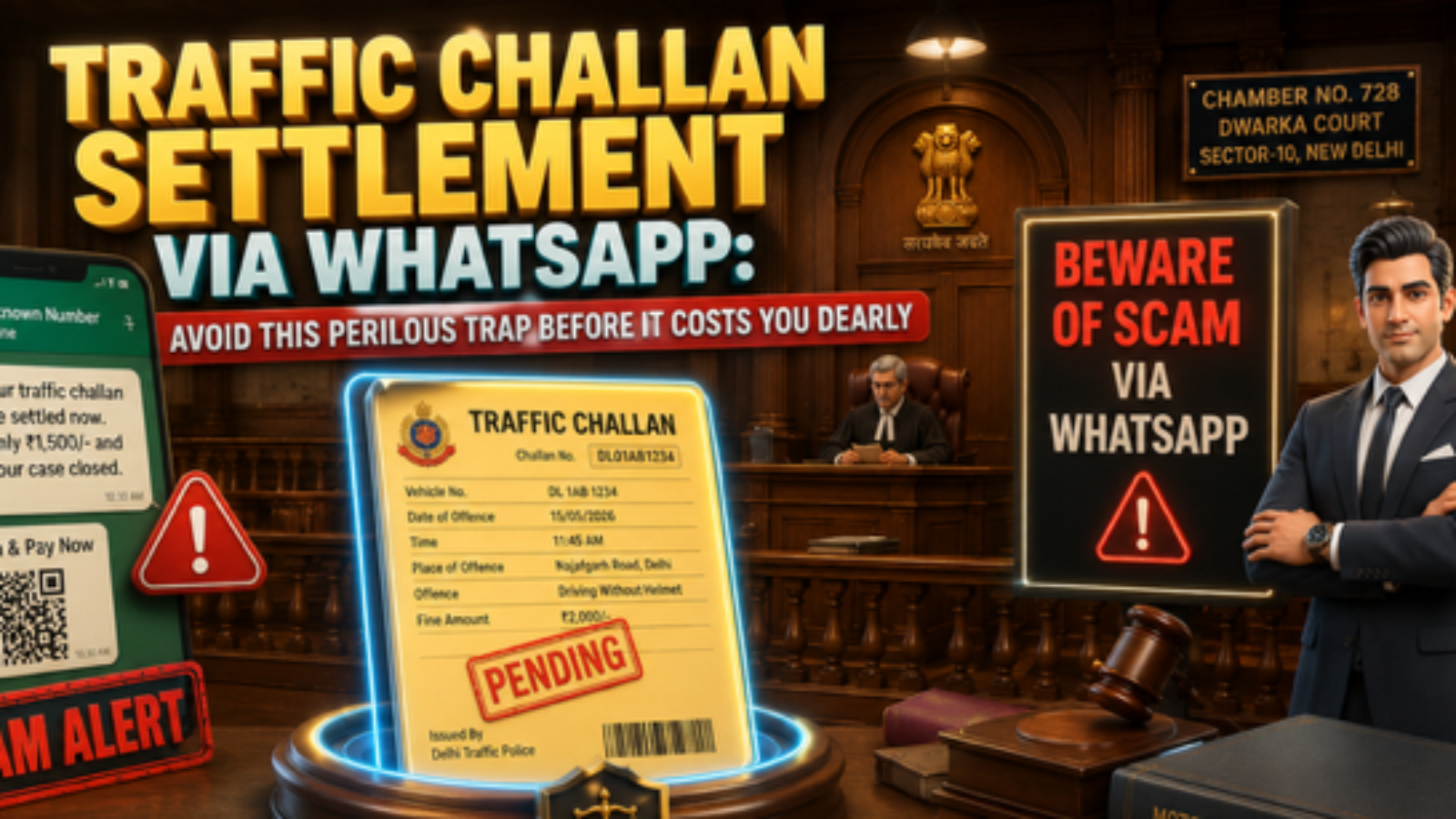
Receiving a WhatsApp message saying “Your traffic challan can be settled immediately” may look convenient. However, it can also be a warning sign.
A message may contain a challan number, vehicle details, a QR code, a payment link, or even the name and photograph of a person claiming to be connected with the police or court. Therefore, never assume that a WhatsApp message is genuine merely because it contains correct vehicle information.
The official eChallan portal itself warns users about fraudulent websites and mobile applications impersonating eChallan services. It also states that users should access the official portal and that it does not request passwords, OTPs, payment details or sensitive information through calls, emails, messages or links.
This article explains Traffic Challan Settlement, the major warning signs of a WhatsApp scam, and what a vehicle owner should do when a challan is pending or has been sent to court.
⚖️ What Does Traffic Challan Settlement Actually Mean?
In simple terms, Traffic Challan Settlement means dealing with a traffic offence through the lawful process applicable to that challan.
Depending on the status and nature of the challan, a person may be able to:
- Pay the applicable fine through an authorised online system.
- Check the challan status.
- Use the Virtual Courts system where the challan is available there.
- Request to contest the matter.
- Appear before the court to contest the allegation.
- Engage an advocate where legal representation is appropriate.
The official Virtual Courts platform allows users to search by challan number, vehicle number, CNR, party name or mobile number. It also provides options to pay the fine or request to contest the case.
Therefore, a genuine Traffic Challan Settlement should be connected with an identifiable official process. It should not depend upon secretly transferring money to an unknown individual.
🚨 Why Are WhatsApp Challan Messages Dangerous?
Scammers often use urgency and fear.
A message may say:
“Pay immediately or your driving licence will be cancelled.”
Another may state:
“Your challan has gone to court. Pay now to avoid arrest.”
Some messages may ask you to:
- Scan a QR code.
- Click a payment link.
- Download an APK.
- Share an OTP.
- Share your driving licence details.
- Send money to a personal UPI account.
- Contact an unknown “court representative”.
- Pay a person for “Traffic Challan Settlement”.
The purpose is often to make you act before you verify the information.
The safest rule is simple:
STOP → VERIFY → THEN ACT
🔟 10 Red Flags of a Traffic Challan WhatsApp Scam
| Red Flag | What It May Indicate | What You Should Do |
| 1. Unknown WhatsApp Number | Identity is not established | Do not trust the message |
| 2. Immediate Payment Demand | Pressure tactic | Verify first |
| 3. Personal UPI Account | Payment may not be official | Do not transfer money |
| 4. Unknown QR Code | Could redirect payment | Do not scan without verification |
| 5. APK/App Download | Malware risk | Never install an unknown app |
| 6. OTP Request | Attempt to access an account/transaction | Never disclose OTP |
| 7. Threat of Arrest | Fear-based pressure | Verify the actual case status |
| 8. “Guaranteed Settlement | Suspicious promise | Ask for official case details |
| 9. Fake Court Identity | Possible impersonation | Verify court information independently |
| 10. Fake Payment Link | Could imitate an official portal | Use the official website yourself |
The official eChallan system specifically warns about fraudulent websites and mobile applications and tells users not to provide sensitive information through suspicious communications.
⚠️ Red Flag No. 1: “Pay Me Personally”
One of the biggest warning signs is a person saying:
“Send the amount to my UPI. I will settle your challan.”
A genuine legal process should have a traceable and verifiable basis.
A private person claiming that he can personally “clear” a challan should not be trusted merely because he uses words such as:
Police • Court • Advocate • Traffic Department • Lok Adalat • Settlement Officer
Verify the claim independently.
📱 Red Flag No. 2: “Click This Link”
A WhatsApp message may contain a link that looks official.
However, the safest approach is not to use the link provided by an unknown sender.
Instead, manually open the official eChallan service and check your challan using the available search options. The official portal allows challan status to be checked using information such as the challan number, vehicle number or driving licence number.
Official eChallan Status Portal
🚨 Red Flag No. 3: “Download This App”
This is particularly dangerous.
A scammer may send an APK or ask you to install an application to “complete Traffic Challan Settlement”.
❌ Do not install an unknown APK.
It may expose your:
- Banking information
- OTPs
- Personal data
- Contacts
- Messages
- Device information
The official eChallan website has itself issued warnings about fraudulent websites and mobile applications impersonating its services.
🔐 Red Flag No. 4: OTP or Banking Details
Never share:
OTP + UPI PIN + Card PIN + Net Banking Password
with someone claiming to be arranging your Traffic Challan Settlement.
An OTP is not proof that the person contacting you is from the police or court.
It is an authentication mechanism.
Therefore, keep your OTP private.
⚖️ What Is the Correct Way to Check a Challan?
Start with verification.
Step 1 — Check the Challan
Use the official eChallan system.
Step 2 — Check the Status
See whether the challan is:
- Pending
- Paid
- Sent to court
- Available through Virtual Courts
- Otherwise requiring further action
Step 3 — Check the Court Status
If the challan has been forwarded to a court or Virtual Court, verify the relevant details through the official system.
The eChallan system can display court-related information for challans that have been forwarded to court.
Step 4 — Decide Whether to Pay or Contest
If the person accepts the offence and the official system provides a lawful payment route, payment may be appropriate.
If the person wishes to contest the allegation, the Virtual Courts system provides a “Request to Contest” route where applicable. The official Virtual Courts guidance states that, after choosing to contest, the user is informed of the physical court and date.
🏛️ A Genuine Advocate Does Not “Secretly Settle” a Challan Through WhatsApp
This point is important.
A genuine advocate may communicate with a client through WhatsApp for convenience. However, WhatsApp itself is not the legal forum for disposing of a traffic case.
Where a matter requires court intervention, the advocate represents the client through the relevant court or authorised legal process.
In other words:
❌ WhatsApp message ≠ Court proceeding
❌ WhatsApp payment request ≠ Court settlement
❌ Unknown person ≠ Authorised representative
✅ Official challan record + authorised process + proper legal representation = safer approach
Virtual Courts is itself an official judicial service. It allows certain challan matters to be searched online and provides a route to pay or contest, depending on the case.
Therefore, the better statement is not that every traffic challan must physically go before a regular court. Some matters can be dealt with through authorised online or Virtual Court mechanisms. But where court representation is required, a genuine Advocate represents the client through the respective court and lawful procedure—not through an unofficial WhatsApp “settlement”.
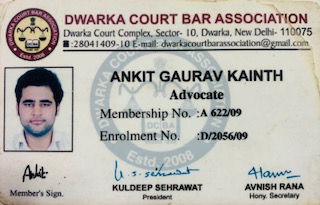
👨⚖️ How We Assist Clients With Traffic Challan Matters
At Ankit Gaurav Kainth & Associates, we assist clients at both the pre-litigation stage and litigation stage, depending on the status and nature of the challan.
🔹 Before Court / Pre-Litigation Stage
We may assist with:
- Understanding the challan.
- Checking the available case status.
- Reviewing the alleged traffic violation.
- Understanding whether payment or contest is appropriate.
- Explaining the applicable procedure.
- Checking whether the matter is available through an authorised online process.
- Advising the client before taking further action.
This stage is important because many people pay money to unknown persons simply because they do not understand the actual status of their challan.
⚖️ Litigation Stage
Where the matter requires court proceedings, we can assist with:
- Court appearance.
- Representation before the appropriate court.
- Challan-related applications.
- Contesting the allegation where legally appropriate.
- Explaining court orders.
- Monitoring dates.
- Advising on the next procedural step.
Our objective is to ensure that the client understands where the case is pending, what the next date means and what action is required.
📊 WhatsApp Scam vs Genuine Legal Process
| WhatsApp Settlement | Genuine Process |
| Unknown individual | Identifiable official system/lawyer |
| Personal UPI payment | Authorised payment mechanism |
| Threats and urgency | Verifiable case information |
| Unknown link | Official portal accessed independently |
| APK installation | No suspicious application |
| OTP demanded by stranger | Authentication only through authorised process |
| Guaranteed settlement | Lawful procedure |
| No proper case details | Challan/CNR/court details can be verified |
| No receipt or unreliable receipt | Official acknowledgement/receipt |
| Pay me and case is closed | Status verified after lawful disposal/payment |
📍 Traffic Challan Lawyer Near Dwarka Court
Clients from Dwarka Sector 6, Sector 10, Sector 12, Dwarka North, Dwarka South and Dwarka Sector-23 may have traffic-related legal concerns connected with different courts and authorities.
We also receive enquiries from areas such as:
Janakpuri, Vikaspuri, Uttam Nagar, Najafgarh, Bindapur, Baba Haridas Nagar, Mohan Garden, Palam Village, Chhawla, Delhi Cantonment, Samalka, Dabri, Jaffarpur Kalan and Kapashera.
Chamber No. 728, District Court Dwarka, Sector-10, New Delhi
Being a local Advocate in Dwarka Court gives us practical familiarity with court procedures, filing systems, listing processes and day-to-day court functioning.
However, location alone should never be the only reason for selecting an advocate. Clients should also consider experience, professional conduct, communication, case preparation and transparency.
⭐ 18+ Years of Court Practice
With 18+ years of litigation experience in Dwarka Court, New Delhi, our practice includes criminal and civil litigation along with traffic challan-related legal assistance.
Our wider legal practice also includes matters handled by a Criminal Advocate in Dwarka, Criminal Disputes Advocate Dwarka Court, Regular Bail & Anticipatory Bail Lawyer Dwarka, Cheque Bounce Lawyer in Dwarka Court, Civil Litigation Lawyer in Delhi, Property Dispute Advocate, Recovery Suit Counsel and Commercial Litigation Lawyer.
However, every matter is assessed according to its own facts.
🤝 Why Client Trust Matters
Legal representation should be based on clarity and professional responsibility.
Our client-handling approach focuses on:
⚖️ Professional Standards
We aim to maintain proper professional conduct in every engagement.
📞 Quick Responsiveness
Clients can communicate regarding important developments and procedural requirements.
💬 Dedicated WhatsApp Support
WhatsApp may be used for client communication and sharing documents or updates. It should not be confused with an official court process.
📄 Lawyer-Client Fee Agreement
Professional terms and fees should be clearly understood before engagement.
🧾 Fee Receipts & Acknowledgements
Clients should receive appropriate documentation regarding professional payments.
💰 Transparent Fee Structure
Fees should be discussed clearly instead of being presented as an unexplained “settlement amount”.
🤝 Honest & Fair Dealings
No responsible lawyer should promise a guaranteed result in a contested legal matter.
🚗 What Should You Do If You Already Paid a WhatsApp Scammer?
If you have already transferred money, do not delete the conversation.
Preserve:
- WhatsApp screenshots.
- Phone number.
- Payment details.
- UPI ID.
- Bank transaction reference.
- QR code.
- Website address.
- APK/application information.
- Voice messages.
- Documents sent by the person.
- Challan number.
Then contact your bank/payment provider and use the appropriate cyber-fraud reporting mechanism without delay.
Also verify the actual challan independently.
Most importantly, do not send additional money merely because the same person threatens you again.
🛡️ 7 Golden Rules to Remember
1️⃣ Never panic.
Fear is often what makes people act without checking.
2️⃣ Never trust an unknown WhatsApp link.
Open the official portal independently.
3️⃣ Never share an OTP or UPI PIN.
4️⃣ Never install an unknown APK.
5️⃣ Never pay a stranger for “guaranteed settlement”.
6️⃣ Verify whether the challan is actually pending.
7️⃣ If the matter is in court, take advice from a genuine Advocate.
❓ Frequently Asked Questions
1. Can a traffic challan be settled through WhatsApp?
WhatsApp itself is not the legal forum for disposing of a traffic case. Depending on the challan, authorised online payment or Virtual Courts processes may be available. Always verify the case through official systems.
2. Is every WhatsApp challan message fake?
Not necessarily. However, an unsolicited message should not be trusted merely because it contains your vehicle or challan details. Verify the information independently through the official eChallan or Virtual Courts system.
3. Can I contest a traffic challan?
Where the applicable system provides a contest option, a person may request to contest the matter. Virtual Courts states that a user can select “Request to Contest” and receive information about the assigned court and date.
4. Should I give my OTP to a person claiming to be a lawyer?
No. Do not share OTPs, UPI PINs or banking credentials with an unknown person merely because they claim to be an advocate, police officer or court representative.
5. Can an Advocate handle a traffic challan case?
Where legal representation is permitted or required, an Advocate can assist the client through the applicable court process. The actual procedure depends upon the challan, offence, court and status of the case.
Written by Advocate Ankit Gaurav Kainth, Dwarka Court | 18+ Years of Legal Experience
Add a Comment