

Introduction – Written statement 120 days in Commercial Court
Commercial recovery suits move under a stricter procedural framework than ordinary civil litigation. Therefore, a defendant who receives summons from a Commercial Court should not treat the matter casually. One of the most important deadlines concerns the written statement 120 days in Commercial Court rule.
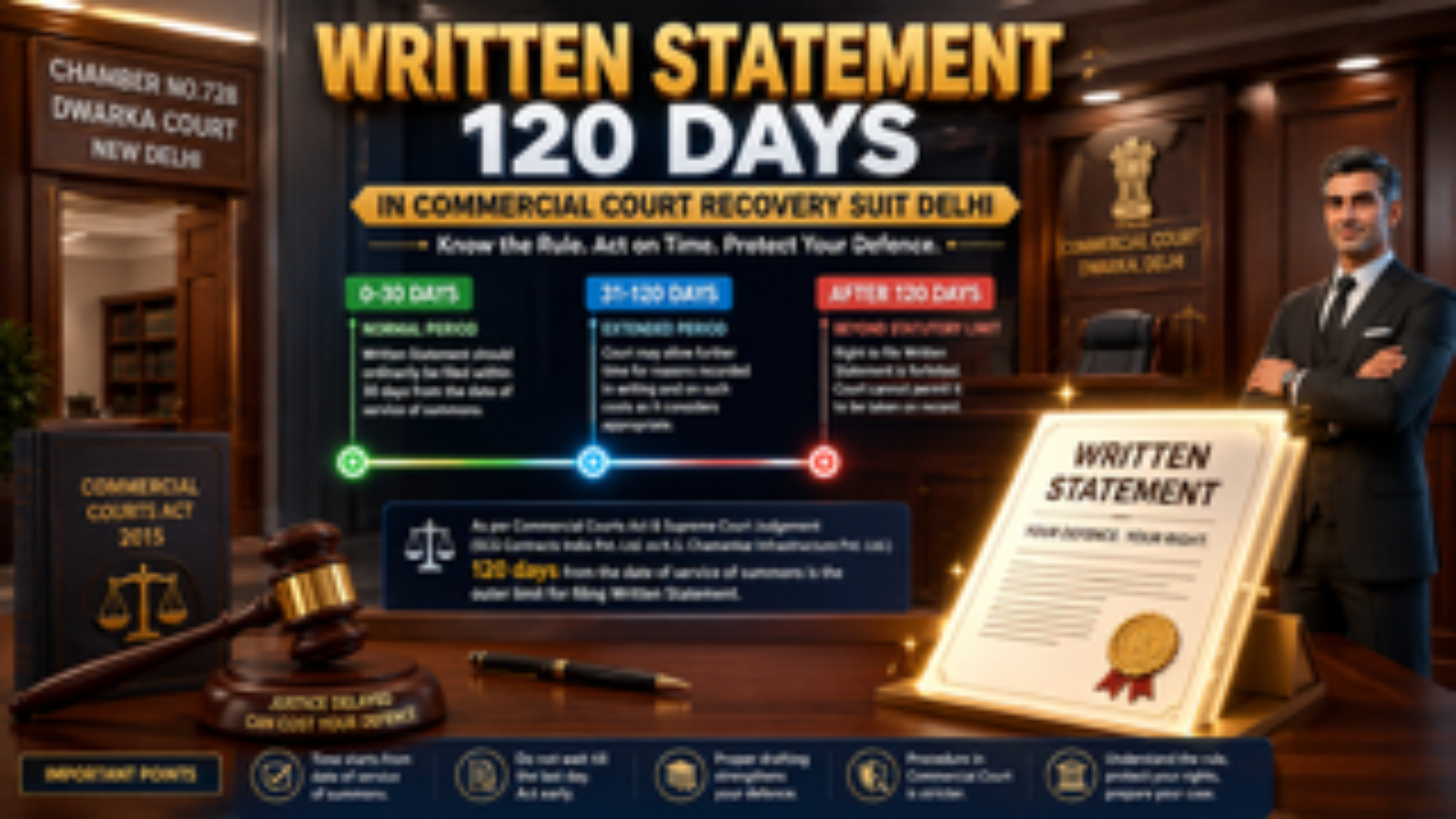
In a commercial dispute, the written statement is ordinarily required within 30 days from service of summons. The Commercial Courts framework permits the Court, for reasons recorded and ordinarily subject to costs, to allow filing beyond 30 days. However, the outer limit is 120 days from the date of service of summons. After expiry of that period, the defendant forfeits the right to file the written statement and the Court cannot permit it to be taken on record.
For businesses, companies, proprietorships, partnerships and individuals involved in recovery litigation in Delhi, this deadline can substantially affect the defence.
With 18+ years of litigation experience, our practice at Dwarka Court deals with civil and commercial disputes from the pre-litigation stage through trial and related proceedings. This article explains the rule, its practical effect, and why both plaintiffs and defendants should act quickly.
⚖️ What Is the Written Statement 120 Days Rule in Commercial Court?
A written statement is the defendant’s formal defence to the plaintiff’s suit.
It is not simply a general reply. It ordinarily contains preliminary objections, paragraph-wise responses, admissions and denials, the defendant’s factual case, legal objections and other relevant defences.
Under the CPC as amended for commercial disputes, the normal period is 30 days from service of summons. If the written statement is not filed within 30 days, the Court may permit further time for reasons recorded in writing and on such costs as it considers appropriate.
However, the crucial point is this:
120 days is the outer statutory limit in a commercial suit.
The Supreme Court in SCG Contracts India Pvt. Ltd. v. K.S. Chamankar Infrastructure Pvt. Ltd. explained that after 120 days from service of summons, the defendant forfeits the right to file the written statement and the Court has no power to extend that period.
Therefore, the written statement 120 days in Commercial Court rule requires immediate attention after service.
📊 Written Statement Timeline at a Glance
| Stage | Time Period | Practical Position |
| Service of summons | Day 0 | Timeline begins from service |
| Normal filing period | Up to 30 days | Written statement should ordinarily be filed |
| Extended period | Day 31–120 | Court may permit filing, for recorded reasons and potentially costs |
| After 120 days | Beyond statutory limit | Right to file written statement is forfeited |
| Defendant’s priority | Immediately after service | Consult counsel and organise defence documents |
| Plaintiff’s priority | Track service carefully | Monitor expiry of defendant’s filing period |
Thus, parties should never assume that adjournments will automatically protect the defendant’s right to file a defence.
🚨 Why 120 Days Can Change a Commercial Recovery Case
Commercial litigation is designed around stricter timelines and structured case management. Therefore, delays that may appear routine in ordinary litigation can carry serious consequences.
Suppose a company files a commercial recovery suit based on invoices, purchase orders and unpaid bills. The defendant receives summons but spends several weeks internally discussing the dispute.
Another month passes while documents are collected.
The defendant then changes counsel.
Meanwhile, the statutory clock continues to run.
This is why a Commercial Court Lawyer in Dwarka Court should ideally be approached immediately after the summons and complete case papers are received.
The first question should often be:
When and how were the summons served?
That date can be crucial.
⚖️ Supreme Court on the 120-Day Deadline
The leading authority is SCG Contracts India Pvt. Ltd. v. K.S. Chamankar Infrastructure Pvt. Ltd.
The Supreme Court examined the amendments applicable to commercial disputes and held, in substance, that the written statement should ordinarily be filed within 30 days. A further period can be allowed within the statutory framework. However, after 120 days from service of summons, the defendant forfeits the right to file the written statement.
Accordingly, the written statement 120 days in Commercial Court requirement is not an ordinary procedural deadline that parties should expect to be extended indefinitely.
Interestingly, the Supreme Court also dealt with an Order VII Rule 11 application in that case. The decision makes an important practical point: pursuing such an application cannot be used as a device to recover a lost opportunity to file the written statement.
Therefore, defence strategy and written-statement preparation should ordinarily proceed without unnecessary delay.

📑 What Should a Defendant Do After Receiving Summons?
First, preserve the summons, envelope, electronic communication and other material relevant to service.
Next, collect the complete commercial record.
This may include:
✅ Agreements and contracts
✅ Purchase orders
✅ Invoices
✅ Delivery challans
✅ Bank statements
✅ Ledger accounts
✅ Emails and correspondence
✅ WhatsApp communications
✅ Notices and replies
✅ GST-related records where relevant
✅ Payment acknowledgements
✅ Settlement communications
✅ Board or company records, where applicable
A Recovery Suit Commercial Court Counsel should then study the plaint and documents before preparing the defence.
Every material allegation should be addressed carefully. Moreover, admissions and denials should not be drafted casually.
🔎 A Written Statement Is More Than a Simple Denial – Written statement 120 days in Commercial Court
A weak defence often says:
“Wrong and denied.”
That may not adequately deal with a detailed commercial claim.
A properly prepared written statement may require examination of issues such as:
- Whether the alleged transaction took place as pleaded
- Whether goods or services were actually supplied
- Whether invoices were accepted
- Whether payments were already made
- Whether there were defective goods or deficient services
- Whether accounts were reconciled
- Whether there was a settlement
- Whether the claim is within limitation
- Whether the Court has territorial jurisdiction
- Whether the dispute falls within commercial jurisdiction
- Whether interest claimed is contractual or otherwise legally sustainable
- Whether necessary parties have been impleaded
- Whether the plaintiff’s documents support the amount claimed
Therefore, the written statement 120 days in Commercial Court issue is not merely about filing something before the deadline. The defence should also be properly prepared.

🏢 Commercial Recovery Suits: Assistance to the Plaintiff
The 120-day rule is important to plaintiffs as well.
A business seeking recovery should prepare its case before litigation wherever possible. A Commercial Court Advocate Delhi may first examine the transaction, contractual documents, limitation, jurisdiction, correspondence and available evidence.
Where applicable, the requirement of pre-institution mediation under Section 12A of the Commercial Courts Act must also be considered, subject to the statutory framework and the nature of relief sought.
Pre-Litigation Assistance for Plaintiffs
Before filing, we may assist a client in:
- Reviewing contracts and commercial documents
- Calculating the recoverable amount
- Examining limitation
- Checking territorial and pecuniary jurisdiction
- Reviewing invoices and ledgers
- Organising electronic evidence
- Assessing legal notices and replies
- Considering pre-institution mediation where applicable
- Preparing the commercial suit and supporting documents
A strong recovery case starts with documents, not merely allegations.
🛡️ Pre-Litigation Assistance for Defendants
Businesses sometimes know about a potential recovery dispute even before the suit is filed.
For example, they may receive a legal demand notice or a mediation notice.
That stage can be valuable.
We may review the alleged liability, obtain the client’s version, organise correspondence and identify possible defences before litigation begins.
Thus, early consultation with a Commercial Disputes Advocate Dwarka Court can reduce last-minute drafting after summons are served.
⚔️ Assistance During an Ongoing Commercial Recovery Suit
Once proceedings begin, the strategy changes.
For the Plaintiff
Our work may include:
- Filing and representation
- Tracking service upon defendants
- Replying to applications
- Preparing replication where legally required
- Admission and denial of documents
- Interim applications
- Evidence preparation
- Cross-examination
- Final arguments
- Execution-related proceedings, where required
Importantly, the plaintiff should track the defendant’s written-statement timeline.
If the statutory period expires, the legal effect of the written statement 120 days in Commercial Court rule should be brought before the Court appropriately.
For the Defendant
The immediate priority is often the defence.
We examine the date of service, pleadings, documents, limitation, jurisdiction, commercial nature of the dispute and the plaintiff’s calculation.
Thereafter, the written statement and connected documents should be prepared without waiting for the outer deadline.
In commercial litigation, 120 days should be treated as the outer boundary, not the target filing date.
⏰ Do Not Wait Until Day 119 – Written statement 120 days in Commercial Court
This is a simple but important point.
A defendant may have 120 days as an outer limit, but that does not mean waiting until the last few days is good litigation strategy.
Documents may be missing. Company officials may need to provide instructions. Bank records may take time. Old emails may need to be retrieved. Accounts may require reconciliation.
Moreover, the Court may require reasons for delay beyond the initial 30-day period.
Therefore, early preparation is safer and more efficient.
📍 Why a Local Advocate in Dwarka Court Can Help
Commercial litigation involves more than drafting.
Daily procedural work matters too.
As local Advocates in Dwarka Court, we regularly work within the court system and understand filing procedures, scrutiny, listing practices, case files and day-to-day court processes.
Our Chamber is situated in Dwarka Court, Delhi. Therefore, urgent procedural issues can often be attended to efficiently, subject of course to court working, filing requirements and applicable rules.
For a client searching for a Commercial Court Lawyer in Dwarka Court, local accessibility can be especially useful when a statutory deadline is approaching.
📞 Client Communication and Professional Working
Commercial disputes often involve substantial financial records. Consequently, communication between client and counsel is important.
Our professional working system focuses on:
✅ Quick responsiveness
✅ Dedicated WhatsApp communication
✅ Availability on call, subject to professional commitments
✅ Clear discussion of litigation stages
✅ Reasonable and transparent fee structure
✅ Proper Lawyer-Client Fee Agreements
✅ Fee receipts and acknowledgements
✅ Honest and transparent professional dealings
✅ Regular sharing of important case updates
We believe clients should understand what is being filed, why it is being filed and what the next procedural stage is.
⚖️ 18+ Years of Litigation Experience in Dwarka Court
Commercial litigation requires knowledge of civil procedure, evidence, contracts, recovery law and courtroom strategy.
With 18+ years of experience in Dwarka Court and litigation practice, we assist clients in commercial recovery matters as well as connected civil disputes.
Our work may overlap with areas handled by a Civil Litigation Lawyer in Delhi, Property Dispute Advocate, Commercial Litigation Lawyer, Recovery Suit Commercial Court Counsel, Lawyer in South West Delhi, and Advocate in Dwarka Court, depending upon the nature of the dispute.
Each matter, however, must be assessed on its own facts and documents.

📍 Commercial Court Assistance Near Dwarka Court
Clients approach Dwarka Court from several parts of South West and West Delhi.
These include Dwarka Sector 6, Dwarka Sector 10, Dwarka Sector 12, Dwarka Sector 23, Dwarka North, Dwarka South, Janakpuri, Vikaspuri, Uttam Nagar, Najafgarh, Palam Village, Delhi Cantonment, Chhawla, Bindapur, Baba Haridas Nagar, Mohan Garden, Samalka, Dabri, Jaffarpur Kalan and Kapashera.
Accordingly, parties searching online for a commercial lawyer near Dwarka Court may find local representation convenient for conferences, document review and court appearances.
Jurisdiction, however, depends upon the facts and applicable law, not simply the client’s residence.
🌍 Commercial Clients Outside Delhi and India – Written statement 120 days in Commercial Court
Commercial disputes in Delhi may involve companies, NRIs, overseas directors, exporters, importers or parties living outside India.
Subject to the facts, procedural requirements and need for personal appearance, coordination can also be undertaken with clients based elsewhere in India or abroad.
International clients may approach from countries such as:
United States, United Kingdom, Canada, Australia, United Arab Emirates, Singapore, Germany, France, New Zealand and Saudi Arabia.
Documents and conferences can often be coordinated electronically. However, every case has different procedural requirements.
❓ Frequently Asked Questions – Written statement 120 days in Commercial Court
1. What is the written statement 120 days in Commercial Court rule?
In a commercial suit, the written statement should ordinarily be filed within 30 days from service of summons. The statutory framework permits further time in appropriate circumstances, but not beyond the outer limit of 120 days from service.
2. Can a Commercial Court accept a written statement after 120 days?
The Supreme Court in SCG Contracts India Pvt. Ltd. v. K.S. Chamankar Infrastructure Pvt. Ltd. held that after 120 days from service of summons, the defendant forfeits the right to file the written statement and the Court cannot extend that period.
3. From which date are the 120 days calculated?
The statutory language refers to the date of service of summons. Therefore, determining the legally relevant service date can be extremely important in a disputed case.
4. Can filing an Order VII Rule 11 application stop the written-statement deadline?
A defendant should not assume so. SCG Contracts specifically indicates that an Order VII Rule 11 application cannot be used as a device to retrieve a lost opportunity to file the written statement.
5. Should I wait until 120 days to file my written statement?
No. The normal filing period is 30 days. The 120-day period is the outer limit under the commercial procedure. Early drafting gives counsel time to examine documents, prepare proper admissions and denials, and formulate the defence.
🏁 Conclusion – Written statement 120 days in Commercial Court
The written statement 120 days in Commercial Court rule can have a decisive procedural impact on a commercial recovery suit.
For defendants, delay can result in forfeiture of the right to place the written statement on record. Therefore, summons should never be ignored.
For plaintiffs, careful tracking of service and procedural deadlines can be equally important.
Commercial litigation rewards preparation. Contracts, invoices, ledgers, emails, payment records and pleadings should be examined early. Moreover, parties should understand the stricter procedure applicable to commercial disputes rather than treating them like ordinary civil suits.
Whether you are seeking recovery of commercial dues or defending a commercial recovery claim, timely legal advice can help identify the correct procedural strategy.

📞 Commercial Court Legal Consultation – Dwarka Court, Delhi
For consultation regarding a commercial recovery suit, written statement, business dispute or related commercial litigation before the competent courts in Delhi:
Ankit Gaurav Kainth & Associates
⚖️ Advocates – Dwarka Court, Delhi
📞 9899085554 | 9811885554
📍 Chamber No. 728, Dwarka Court, New Delhi
Clients may contact the office for an appointment and document review. The legal strategy and fee structure are discussed according to the nature and requirements of each matter.
Disclaimer: This article is published solely for general legal information and awareness. It does not constitute legal advice, solicitation or an assurance of any result. Commercial disputes depend on their individual facts, documents, limitation, jurisdiction and applicable law. Readers should obtain independent legal advice based on the facts of their case.
| Important Topics | Text |
| Commercial Court practice page | Commercial Court Lawyer in Dwarka Court |
| Commercial Court Recovery Suit: | When Does the Limitation Period Start? |
| Commercial Lease Dispute Dwarka | Powerful Ground Every Client Should Know |
| Written Statement 120 Days in Commercial Court Recovery Suit | Important Law |
| Commercial Money Recovery Suit in Delhi | A Complete Guide for International Clients & Foreign Companies |
| The Unassailable Blueprint to Lead Defence Evidence Like a Professional in Commercial Court Cases | Advanced Litigation Strategies Every Lawyer Should Master |
| Commercial Court Is Fast | But Only If Your Lawyer Does This in Delhi Court |
| Why Businesses Lose Strong Commercial Cases Despite Having Agreements? | Experienced Commercial Court Advocate Dwarka Delhi |
| Powerful Commercial Court Recovery Case | Acquittal Strategies for Fearless Defence |
| What Happens After Receiving a Legal Notice | in a Commercial Matter? |
[…] Important Law […]
[…] Important Law […]
[…] Important Law […]
[…] Important Law […]
[…] Important Law […]
[…] Important Law […]
[…] Important Law […]