
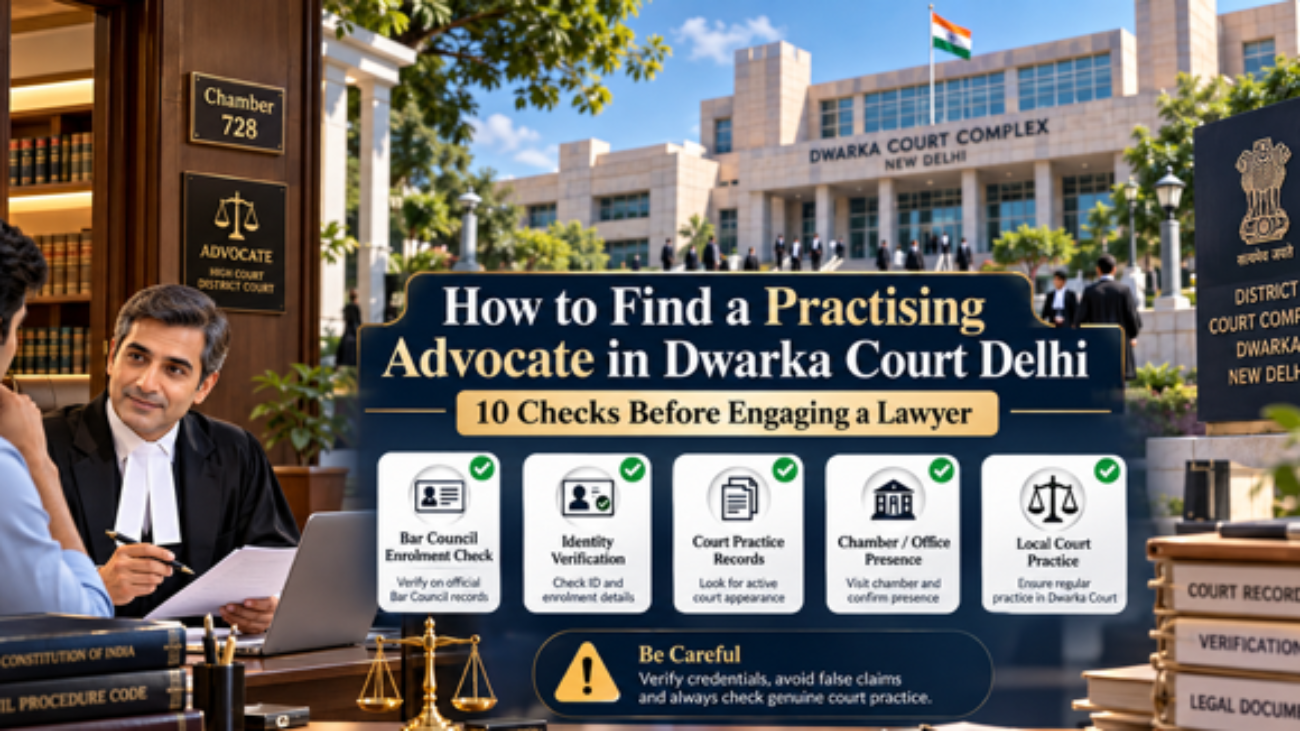

Introduction – Practising Advocate in Dwarka Court Delhi
Searching online for an advocate in Dwarka Court is easy.
Verifying whether the person you find actually practises law and has a genuine professional connection with Dwarka Courts requires a little more care.
A search for terms such as “Advocate in Dwarka Court”, “Lawyer Near Dwarka Court” or even “Best Advocate in Dwarka Court Delhi” can produce websites, advertisements, directory listings, social-media profiles and business listings.
However, appearing prominently on Google is not the same thing as having an established litigation practice before Dwarka Courts.
A prospective client should therefore look beyond rankings, photographs, reviews and promotional claims.
The more useful questions are:
Is the person enrolled as an advocate?
Can the enrolment details be independently verified?
Does the advocate actually practise before Dwarka Courts?
Is there evidence of an established professional presence in the court?
Can the advocate explain the court, jurisdiction and procedure relevant to my case?
This practical guide explains 10 checks a client can make before engaging an advocate in Dwarka Court, Delhi.
1. Start With the Most Important Check – Bar Council Enrolment
The first question should not be:
“How many Google reviews does the advocate have?”
It should be:
“What is the advocate’s Bar Council enrolment number?”
An advocate enrolled with the Bar Council of Delhi ordinarily has an enrolment number that can be checked through the Bar Council’s official records.
The Bar Council of Delhi presently provides an online Enrolment Status facility through which enrolment details can be searched using the enrolment number and year.
This is substantially more meaningful than relying only on:
- a Google Business Profile;
- an Instagram account;
- a legal-directory listing;
- a website;
- photographs in a lawyer’s gown; or
- claims such as “top lawyer” or “best advocate”.
These things may form part of an advocate’s online presence, but they are not substitutes for professional enrolment.
Practical client question
Before paying substantial professional fees, ask:
“May I have your Bar Council enrolment number for my records?”
A client can then independently verify the information through the appropriate official source.
2. Understand the Difference Between Bar Council Enrolment and Bar Association Membership
This distinction is extremely important.
The Bar Council of Delhi and the Dwarka Court Bar Association do not perform the same function.
Bar Council enrolment concerns the advocate’s professional enrolment.
The Dwarka Court Bar Association is a local association connected with advocates practising at the Dwarka Courts Complex.
Therefore, a person should not be described as an unauthorised advocate merely because he or she is not a member of a particular local Bar Association.
At the same time, where somebody represents that they have an established and regular Dwarka Court practice, membership or registration with the local Bar Association can be a useful additional indicator of their professional connection with that court.
Official Dwarka Court material itself distinguishes between a BCD enrolment number and a DCBA registration number.
Clients should therefore understand the difference:
Bar Council enrolment → professional enrolment
Local Bar Association membership → evidence of association with a particular court Bar
The second should not be mistaken for the first.
3. Ask Whether AIBE / Certificate of Practice Requirements Apply
Clients sometimes hear expressions such as:
“Certificate of Practice”
“AIBE certificate”
“Bar Council licence”
and assume that they all mean exactly the same thing.
They do not.
The All India Bar Examination framework and Certificate of Practice requirements apply according to the applicable Bar Council of India rules and the advocate’s enrolment circumstances.
The Bar Council of Delhi presently also provides an online AIBE-data search showing whether its records reflect the relevant AIBE status.
Therefore, where applicable, a client may ask the advocate about:
Bar Council enrolment + AIBE status + Certificate of Practice requirements.
At the same time, a client should not assume that a particular AIBE entry is required in exactly the same manner for every advocate irrespective of when and under what regime the advocate was enrolled.
Verification should be based on the rules applicable to that advocate.
4. Does the Advocate Actually Practise in Dwarka Court?
This is a different question from enrolment.
An advocate may be legally enrolled but primarily practise somewhere else.
There is nothing improper about an advocate appearing in different courts.
However, if a professional profile specifically represents the person as an established Dwarka Court advocate, a client may reasonably ask about the advocate’s regular practice there.
Useful questions include:
Which types of matters do you regularly handle in Dwarka Courts?
Where is your chamber or regular meeting place?
Do you regularly appear before the Civil, Criminal, Family, Commercial or NI Act Courts here?
Can you explain where my type of case is ordinarily dealt with?
Someone who regularly litigates before a particular court will generally understand its working environment, filing process, court structure and procedural requirements.
5. Check for a Genuine Professional Presence at Dwarka Court
Dwarka Courts Complex is situated at Sector 10, Dwarka, New Delhi and serves, among other matters, cases connected with the South-West District and IGI Airport jurisdiction.
A litigant searching specifically for a lawyer established at Dwarka Court can ask where the advocate normally works from.
Evidence of an established local professional presence may include:
- an allotted or shared chamber;
- an office regularly used for the practice;
- local Bar Association membership;
- regular court appearances;
- professional staff or associates;
- case files and litigation infrastructure; and
- an established history of conducting matters in that court.
However, one important qualification is necessary:
Having a chamber is not compulsory proof of being a genuine advocate.
Not every practising advocate has an allotted court chamber.
Therefore:
No chamber ≠ fake advocate.
But where someone specifically represents that they have a long-established practice inside Dwarka Court, asking for the location of that professional establishment is perfectly reasonable.
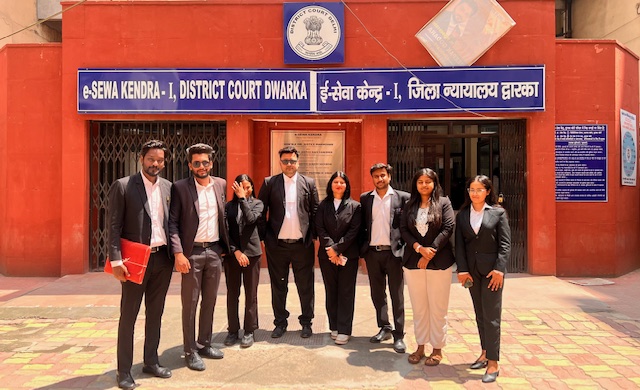
6. Ask for the DCBA Registration Details Where Local Membership Is Claimed
Dwarka Court has its own recognised Bar Association.
Official court material records the Dwarka Court Bar Association, and its office is situated in the Lawyers Chamber Block at the court complex.
Where an advocate claims to be a member of the Dwarka Court Bar Association, the prospective client can ask for the relevant membership or registration details.
This is especially useful where a website or profile repeatedly represents the person as:
“Dwarka Court Advocate”
“Practising in Dwarka Court”
or
“Based at Dwarka Courts.”
Again, this requires an important distinction:
DCBA membership should be treated as supporting evidence of local professional association—not as the sole legal test of whether a person is entitled to practise law.
7. Look for Evidence of Actual Court Work—Not Merely Online Marketing
An attractive website can be created quickly.
An Instagram page can be created in minutes.
Hundreds of articles can now be produced with digital tools.
Actual litigation practice leaves a different professional footprint.
Depending upon the case and availability of public records, a client may find an advocate’s name appearing in:
- judicial orders;
- case records;
- cause lists;
- court proceedings;
- reported matters;
- mediation proceedings;
- professional court documentation; or
- other legitimate public legal records.
Delhi District Courts and the eCourts system provide considerable public case information.
No single order proves the scale or quality of someone’s practice.
Likewise, absence from a simple internet search does not prove that an advocate is not practising.
But a consistent court record can provide stronger evidence of actual litigation activity than marketing claims alone.
8. Ask the Advocate to Explain Your Case Before Discussing Promises
A useful test of professional experience is surprisingly simple:
Ask the advocate to explain the legal process.
For example, if the dispute concerns property, ask:
Which court has jurisdiction?
Do I require injunction, possession, declaration, partition or another remedy?
For a criminal matter:
Is anticipatory bail, regular bail, quashing, discharge or trial defence presently relevant?
For a cheque-bounce case:
Are we at notice, summoning, appearance, Section 145(2), evidence, arguments or appeal stage?
For a commercial recovery dispute:
Does the Commercial Courts Act apply? Is pre-institution mediation relevant? What documents need disclosure?
A genuine practising lawyer should be able to explain:
facts → jurisdiction → legal remedy → documents → procedure → possible risks → next step.
That is considerably more valuable than hearing:
“Don’t worry, I will win the case.”
No responsible advocate can guarantee what a court will ultimately decide.
9. Treat “Best Advocate” Rankings, Reviews and Social Media as Secondary Information
Online information is useful.
Clients routinely use:
- Google;
- legal directories;
- LinkedIn;
- YouTube;
- Instagram;
- Facebook;
- websites; and
- client reviews
to discover advocates.
There is nothing inherently wrong with that.
The problem arises when online visibility is treated as professional verification.
A high-ranking website does not establish Bar Council enrolment.
A five-star review does not prove regular appearances before a particular court.
A photograph outside a court building does not establish an office or chamber there.
A social-media following does not establish litigation experience.
Therefore, use online information as the starting point—not the final verification test.
A sensible verification sequence is:
Online Search
↓
Advocate’s Full Name
↓
Bar Council Enrolment
↓
Applicable AIBE/COP Status
↓
Actual Area of Practice
↓
Dwarka Court Connection
↓
Court Record / Local Presence
↓
Consultation
↓
Fee & Scope of Engagement

10. Insist on Professional Transparency About Fees and Case Handling
Before formally engaging an advocate, clients should understand who will handle the matter and how professional fees will operate.
Ask:
Who will primarily handle my case?
Who will appear on the next date?
What work is included in the professional fee?
Are drafting, filing and hearings charged separately?
Will additional applications involve additional fees?
How will I receive court orders and information about the next date?
Where appropriate, obtain the fee understanding in writing and retain receipts or payment records.
Clients should also maintain their own copies of:
- petitions;
- replies;
- applications;
- affidavits;
- evidence;
- court orders;
- receipts; and
- important correspondence.
Professional transparency is often a much better indicator than advertising language.
Red Flags Clients Should Not Ignore
No single factor automatically establishes misconduct or lack of professional status.
However, additional verification may be sensible where somebody:
refuses to disclose an enrolment number;
provides professional details that cannot be independently matched;
claims to have a chamber but refuses to identify it;
claims long-established Dwarka Court practice but cannot clearly explain the relevant court procedure;
uses different professional names across different platforms without explanation;
pressures the client to immediately transfer substantial money without explaining the scope of work;
makes guaranteed-result claims;
claims special personal influence over judges, police officers or court staff;
or discourages the client from independently checking court and professional records.
The correct response to doubt is not accusation.
It is independent verification.
Is Delhi Bar Association Membership Necessary for a Dwarka Court Advocate?
This is another common source of confusion.
Delhi has different Bar Associations connected with different court complexes.
For example, the Delhi Bar Association is associated with Tis Hazari Courts, while Dwarka has the Dwarka Court Bar Association.
Accordingly, a client should not ask:
“Are you a member of Delhi Bar Association?”
as though this were a universal licensing requirement for every practising advocate in Delhi.
A more accurate question is:
“Where are you enrolled, and which local Bar Association or court do you ordinarily practise with?”
The regulator and the local professional association should not be confused.
Can You Verify an Advocate Through Google Reviews?
Reviews can help a client understand other people’s reported experiences.
They may provide information about:
communication;
accessibility;
professional manner;
responsiveness; or
the kind of cases a lawyer handles.
But reviews cannot independently prove professional enrolment or regular court practice.
Therefore:
Reviews should supplement verification—not replace it.
Does a Dwarka Court Chamber Prove Someone Is a Practising Advocate?
An established chamber inside the court complex is useful evidence of professional presence, particularly when combined with Bar Council enrolment and local court practice.
However, chamber allotment is not the statutory test of whether someone is an advocate.
A genuine advocate may practise without an allotted chamber.
The better approach is to consider several pieces of information together:
Enrolment + professional identity + local practice + court activity + office/chamber + consultation quality + transparent engagement.
Why Local Court Practice Can Matter
Different courts operate under the same substantive and procedural laws, but regular litigation before a particular court gives an advocate familiarity with practical matters such as:
filing;
scrutiny;
listing;
court locations;
certified copies;
administrative branches;
video-conferencing arrangements;
record inspection;
mediation;
process service; and
day-to-day procedural requirements.
Local familiarity should never be portrayed as special access or influence.
Its legitimate value is procedural familiarity and accessibility.
That distinction is important.
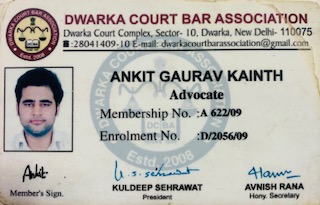
10-Point Checklist Before Engaging an Advocate in Dwarka Court
Before finalising your advocate, check:
1. Full professional name
2. Bar Council enrolment number
3. Enrolment status through an official source
4. AIBE / Certificate of Practice position where applicable
5. Actual areas of litigation practice
6. Regular connection with Dwarka Courts
7. DCBA membership details if local membership is claimed
8. Chamber, office or other professional establishment
9. Evidence of genuine court practice where reasonably available
10. Clear consultation, fee structure and case-handling process
None of these factors should be considered in isolation.
Together, however, they can help a litigant make a substantially better-informed decision.
| Supporting Page / Blog | Suggested Anchor Text | Where to Place the Link | Search Intent | Why It Supports This Article | Internal Link |
|---|---|---|---|---|---|
| Advocate Near Dwarka Court | Advocate Near Dwarka Court | Section: Does the Advocate Actually Practise in Dwarka Court? | Local / Commercial | Connects the verification guide with your principal local-practice service page. | Read Page |
| Before Filing a Case in Dwarka Court Delhi | questions to consider before filing a case in Dwarka Court | Section: Ask the Advocate to Explain Your Case | Informational | Moves clients from advocate verification to jurisdiction, limitation, evidence and case preparation. | Read Guide |
| Criminal Defence Lawyer in Dwarka | criminal defence practice in Dwarka Court | Example concerning bail, FIR, discharge and criminal trial | Service / Criminal | Supports the point that clients should verify relevant subject-matter experience. | Read Page |
| Property Lawyer in Dwarka Court | property litigation in Dwarka Court | Example concerning injunction, possession, declaration and partition | Service / Property | Demonstrates why selecting an advocate with relevant litigation practice matters. | Read Page |
| Cheque Bounce Lawyer Dwarka Court | Section 138 NI Act practice in Dwarka Court | Example concerning cheque-bounce procedure | Service / NI Act | Supports your discussion about checking whether the advocate regularly handles the relevant case category. | Read Page |
| Traffic Challan Cases in Dwarka Court | traffic challan proceedings in Dwarka Court | Section discussing actual local court procedure | Informational / Service | Adds another concrete example of court-specific procedure and local litigation practice. | Read Page |
Frequently Asked Questions
How can I check whether somebody is enrolled as an advocate in Delhi?
The Bar Council of Delhi provides an online facility for searching enrolment information using the advocate’s enrolment number and year.
Is Dwarka Court Bar Association registration compulsory to appear in Dwarka Court?
Local Bar Association membership and professional Bar Council enrolment are different matters. DCBA membership can provide useful evidence of association with the local Bar, but it should not be represented as the sole statutory requirement for appearing before Dwarka Courts.
Should I ask an advocate for his or her enrolment number?
Yes. There is nothing unreasonable about a client asking for professional identification before establishing a professional relationship.
Is having a chamber in Dwarka Court compulsory?
No. A chamber can demonstrate an established professional presence, but not every genuine practising advocate has an allotted chamber.
Can I check whether a lawyer regularly appears in court?
Depending upon the matter and availability of public information, judicial orders, eCourts records and other court documents may provide useful information about appearances.
Should I choose a lawyer merely because Google shows the lawyer first?
No. Search position can help you discover a professional, but it should not replace verification of enrolment, experience, relevant practice and professional identity.
Is the lawyer with the highest number of reviews necessarily the most appropriate lawyer for my matter?
Not necessarily.
A client’s requirements depend upon the nature of the case.
A lawyer handling criminal bail every day may not be the appropriate choice for a complicated commercial dispute, just as a matrimonial lawyer may not necessarily conduct cheque-bounce appeals regularly.
Look for relevant practice, not merely visibility.
Final Takeaway
Finding an advocate online has become easier.
Verifying the advocate remains the client’s responsibility.
Do not select an advocate merely because a profile repeatedly uses expressions such as:
“Best Advocate in Dwarka Court”
“Top Lawyer in Delhi”
or
“No. 1 Advocate.”
Instead, verify what can actually be verified.
Start with:
Bar Council enrolment.
Then examine:
applicable AIBE/COP position → relevant practice → Dwarka Court connection → Bar Association association → professional establishment → court work → consultation quality → fee transparency.
A professional legal practice should be capable of standing on verifiable credentials, actual litigation work and transparent client communication—not merely advertising claims.
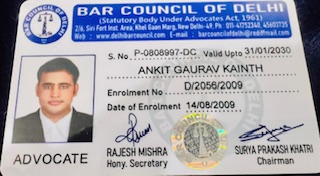
About the Practice
Ankit Gaurav Kainth & Associates is a litigation practice based at Dwarka Courts, Sector-10, New Delhi.
The practice handles civil, criminal, matrimonial, property, cheque-bounce, commercial and connected litigation before Dwarka Courts and other courts in Delhi.
Clients seeking representation may independently verify professional credentials and discuss the nature, jurisdiction and procedural requirements of their matter during consultation.
Professional verification should always come before professional engagement.
Disclaimer
This article is intended for general legal awareness and client education. It does not allege that any particular advocate, website, profile or legal-service provider is unauthorised or engaged in misconduct. Bar Council enrolment, AIBE/Certificate of Practice requirements and Bar Association membership are distinct matters and should be verified through the relevant official authority. Local Bar Association membership or possession of a chamber should not, by itself, be treated as the legal test of entitlement to practise. The article does not constitute legal advice or guarantee any legal outcome.