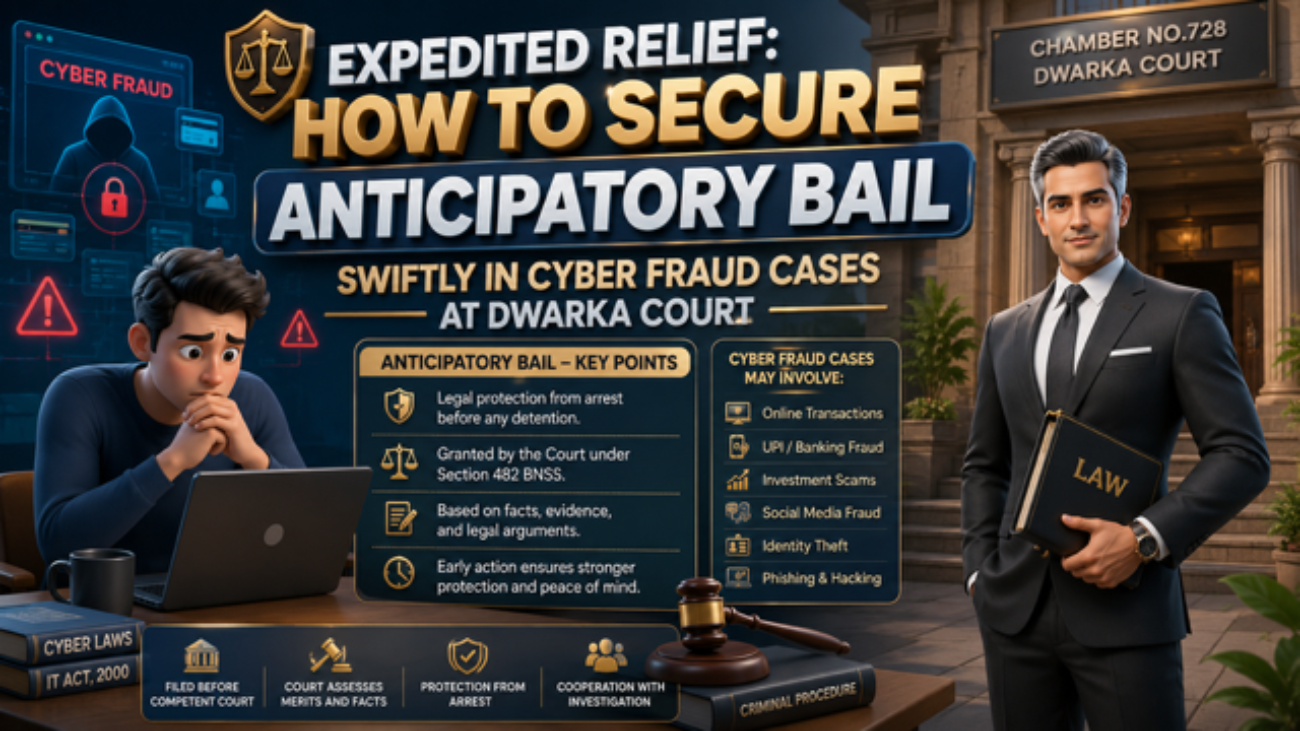
⚖️ Introduction – Anticipatory Bail Swiftly in Cyber Fraud
In recent years, cyber fraud complaints have increased significantly across Delhi. Consequently, many individuals receive notices from police stations, cyber cells, or investigating agencies. In such situations, the fear of arrest often creates immense stress and uncertainty. Therefore, obtaining Anticipatory Bail Swiftly in Cyber Fraud matters becomes crucial for protecting personal liberty and ensuring legal representation from the very beginning.
If you are facing allegations related to online fraud, UPI scams, phishing, investment fraud, cryptocurrency disputes, social media offences, or cybercrime investigations, understanding the anticipatory bail process can make a significant difference.
As local advocates practicing in Dwarka Court for more than 18 years, we regularly assist clients seeking Anticipatory Bail Swiftly in Cyber Fraud cases arising from Dwarka, Janakpuri, Uttam Nagar, Najafgarh, Vikaspuri, Palam, Dabri, Kapashera, Chhawla, and nearby areas.
📌 What is Anticipatory Bail?
Anticipatory Bail is a legal protection granted under Section 482 of the Bharatiya Nagarik Suraksha Sanhita (BNSS), enabling a person to seek bail before arrest.
Simply put, if a person reasonably believes that they may be arrested in connection with a criminal case, they can approach the court and seek protection through anticipatory bail.
Therefore, obtaining Anticipatory Bail Swiftly in Cyber Fraud cases helps individuals avoid unnecessary custody while cooperating with the investigation.
Cybercrime investigations move quickly. Moreover, investigating agencies often freeze bank accounts, issue notices, and seek custodial interrogation.
Common allegations include:
✅ Online Banking Fraud
✅ UPI Fraud
✅ Investment Scam Cases
✅ Cryptocurrency Transactions
✅ Social Media Fraud
✅ E-Commerce Fraud
✅ Identity Theft
✅ Financial Cyber Offences
Consequently, delays in seeking legal assistance may adversely affect your defence strategy. Hence, obtaining Anticipatory Bail Swiftly in Cyber Fraud matters should be a priority.
Trust is the foundation of every successful lawyer-client relationship.
⭐ High Professional Standards
We maintain ethical and professional conduct in every matter.
⭐ Quick Responsiveness
Urgent criminal cases require immediate attention. Therefore, we respond promptly.
⭐ Dedicated WhatsApp Support
Clients receive regular updates through WhatsApp communication.
⭐ Availability on Call
Legal emergencies cannot wait. Consequently, we remain accessible whenever required.
⭐ Transparent Fee Structure
We explain fees clearly before accepting assignments.
⭐ Proper Lawyer-Client Fee Agreements
Every engagement is documented properly.
⭐ Fee Receipts and Acknowledgements
Clients receive receipts and confirmations for payments.
⭐ Honest and Fair Dealings
We provide practical legal advice rather than unrealistic promises.
As a result, many clients searching for a Criminal Advocate Dwarka, Best Crime Lawyer Dwarka, Top Regular Bail & Anticipatory Bail Lawyer Dwarka, Best Criminal Disputes Advocate Dwarka Court, and Top and Best Advocate in Dwarka Court choose our services.
🔍 Factors Courts Consider While Granting Anticipatory Bail
While deciding applications, courts commonly examine:
Nature of allegations
Role of the accused
Previous criminal history
Requirement of custodial interrogation
Cooperation during investigation
Risk of absconding
Available documentary evidence
Therefore, professional legal preparation significantly improves the chances of securing Anticipatory Bail Swiftly in Cyber Fraud matters.
⚖️ Importance of Early Legal Representation
Many individuals approach lawyers only after receiving repeated notices.
However, early intervention often provides substantial benefits.
For example:
✅ Better preparation
✅ Stronger documentation
✅ Improved defence strategy
✅ Timely filing
✅ Reduced legal risks
Hence, seeking legal advice at the earliest opportunity remains the most effective approach when pursuing Anticipatory Bail Swiftly in Cyber Fraud cases.
Cyber fraud allegations can have serious legal consequences. Nevertheless, timely legal action, proper documentation, and professional representation can significantly strengthen your position.
Whether you are facing an ongoing investigation or anticipate legal action, obtaining Anticipatory Bail Swiftly in Cyber Fraud matters should be addressed without delay. Furthermore, engaging experienced local advocates familiar with Dwarka Court procedures can streamline the entire process.
With more than 18 years of experience before Dwarka Court, we provide strategic guidance during both pre-litigation and litigation stages while maintaining transparency, professionalism, and client-focused service.
FAQ Section
Q1. How quickly can anticipatory bail be filed in a cyber fraud case? Depending on the facts and documents available, an anticipatory bail application can often be prepared and filed promptly before the competent court.
Q2. Is anticipatory bail available in all cyber fraud cases? Availability depends upon the allegations, evidence, and legal circumstances of each case.
Q3. Can anticipatory bail prevent arrest? Yes. If granted, anticipatory bail provides protection against arrest subject to court-imposed conditions.
Q4. Why should I hire a local Dwarka Court advocate? A local advocate is familiar with court procedures, filing systems, and judicial processes, helping ensure efficient representation.
Q5. What documents are generally required for anticipatory bail? Typically, notices, FIR details (if available), identity documents, bank records, and relevant communications may be required.
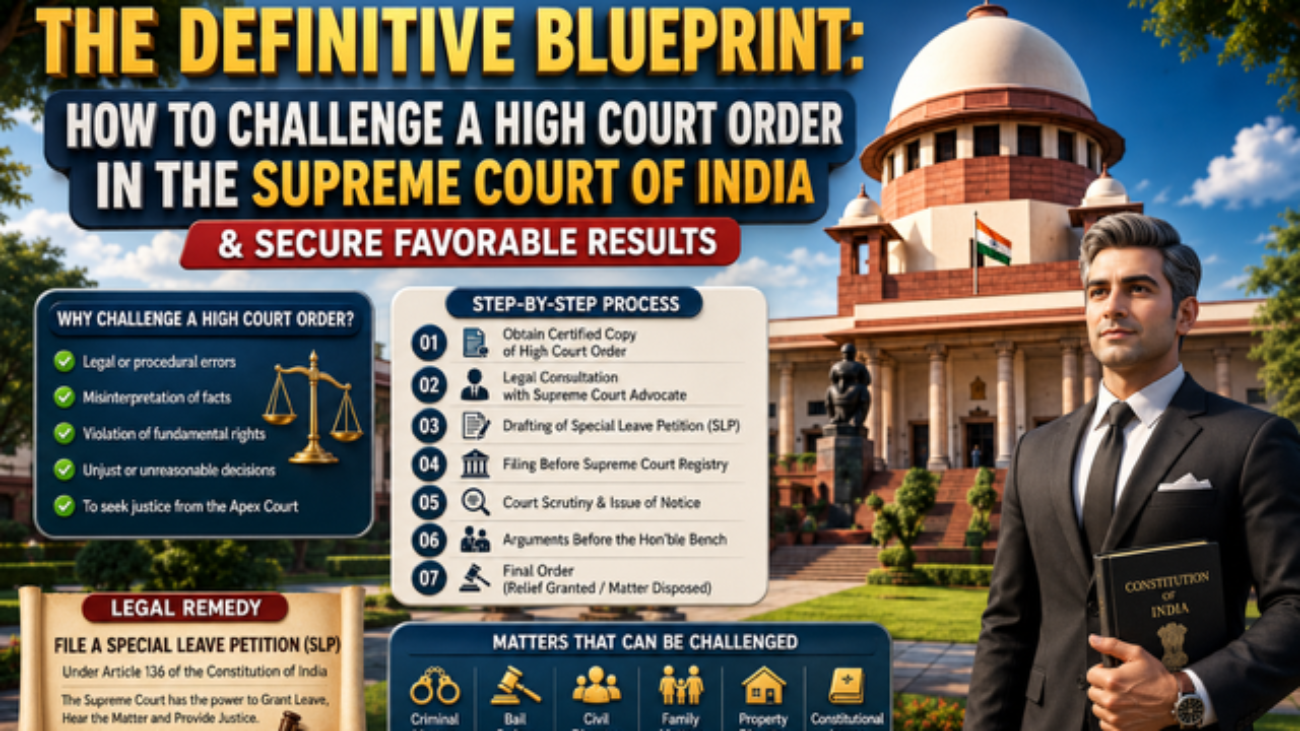
Definitive Roadmap for Filing a Petition in the Supreme Court
📞 Contact Us Today
Need urgent assistance regarding cyber fraud investigations, anticipatory bail, or criminal defence?
⚖️ Experienced Criminal Litigation Team
📍 Near Dwarka Court, New Delhi
📞 Mobile: 9899085554
📞 Mobile: 9811885554
✅ Anticipatory Bail
✅ Regular Bail
✅ Criminal Defence
✅ Cyber Fraud Cases
✅ Immediate Legal Consultation
Call now for prompt legal assistance and case evaluation.
⚖️ Anticipatory Bail in Cyber Fraud Cases – Dwarka Court
Introduction – About How to Challenge a High Court Order in the Supreme Court
A High Court order can significantly impact your rights, liberty, property, business, or family matters. However, many people are unaware that an unfavorable judgment or order of a High Court can often be challenged before the Supreme Court of India through appropriate legal remedies.
Understanding How to Challenge a High Court Order in the Supreme Court of India is essential because even a small procedural mistake can affect the outcome of your case. Therefore, proper legal guidance becomes crucial from the very beginning.
Whether the matter relates to criminal law, bail, property disputes, matrimonial disputes, commercial litigation, constitutional issues, or service matters, the Supreme Court provides an opportunity to seek justice against erroneous High Court decisions.
With more than 18 years of legal experience, our team assists clients across India in understanding How to Challenge a High Court Order in the Supreme Court of India and pursuing effective legal remedies before the Apex Court.
⚖️ Why Do People Challenge High Court Orders Before the Supreme Court?
The Supreme Court of India is the highest judicial authority in the country. Therefore, if a person believes that a High Court has committed an error in law, procedure, or appreciation of facts, an appeal or Special Leave Petition (SLP) may be filed.
Common reasons include:
✅ Rejection of Regular Bail
✅ Rejection of Anticipatory Bail
✅ Criminal Convictions
✅ Quashing Petitions Dismissed
✅ Property Disputes
✅ Family Court Matters
✅ Service Matters
✅ Commercial Disputes
✅ Constitutional Issues
Consequently, knowing How to Challenge a High Court Order in the Supreme Court of India can help protect valuable legal rights.
Our office regularly assists clients in criminal litigation matters including:
✅ Regular Bail Matters
✅ Anticipatory Bail Matters
✅ FIR Quashing Matters
✅ Criminal Appeals
✅ NDPS Cases
✅ Economic Offence Cases
✅ White Collar Crime Cases
✅ Cheating and Fraud Cases
✅ POCSO Matters
Clients searching for a Criminal Advocate for Supreme Court of India, Crime Lawyer for Supreme Court of India, Regular Bail & Anticipatory Bail Lawyer for Supreme Court of India, or Criminal Disputes Advocate Supreme Court of India often require immediate legal intervention due to strict timelines.
🏛️ Why Our Presence in Dwarka Court Benefits Clients
We are local advocates practicing in Dwarka Court with over 18 years of experience.
This provides significant advantages:
✔️ Familiarity with Court Procedures
✔️ Understanding of Filing Processes
✔️ Faster Documentation Management
✔️ Efficient Coordination
✔️ Practical Litigation Experience
✔️ Immediate Client Accessibility
Moreover, our experience within the Dwarka Court system helps us manage litigation efficiently while coordinating Supreme Court matters across India.
🤝 Why Clients Trust Us
Trust is the foundation of every lawyer-client relationship.
Our clients appreciate:
✅ High Professional Standards
✅ Quick Response Time
✅ Availability on Call
✅ Dedicated WhatsApp Support
✅ Transparent Communication
✅ Reasonable Fee Structure
✅ Written Lawyer-Client Fee Agreements
✅ Fee Receipts and Acknowledgements
✅ Honest Legal Assessment
✅ Fair and Transparent Dealings
Therefore, many clients searching for a Top and Best Advocate in Supreme Court of India choose firms that prioritize transparency and accountability.
How to Challenge a High Court Order in the Supreme Court
🌎 We Assist Clients Across India
Our legal assistance extends to matters originating from:
Delhi, Haryana, Punjab, Rajasthan, Uttar Pradesh, Uttarakhand, Himachal Pradesh, Gujarat, Maharashtra, Goa, Madhya Pradesh, Chhattisgarh, Bihar, Jharkhand, West Bengal, Odisha, Assam, Arunachal Pradesh, Meghalaya, Manipur, Mizoram, Nagaland, Tripura, Sikkim, Telangana, Andhra Pradesh, Karnataka, Kerala, Tamil Nadu, Jammu & Kashmir, Ladakh and all Union Territories.
Therefore, regardless of location, individuals seeking guidance on How to Challenge a High Court Order in the Supreme Court of India can obtain professional assistance.
Conclusion
Understanding How to Challenge a High Court Order in the Supreme Court of India requires careful planning, timely action, proper documentation, and effective legal representation. While every case is unique, a well-prepared strategy significantly improves the likelihood of obtaining favorable relief.
Whether the matter concerns bail, criminal litigation, property disputes, constitutional issues, family matters, or commercial disputes, obtaining experienced legal guidance at the earliest stage can make a substantial difference.
1. Can a High Court order be challenged in the Supreme Court of India?
Yes. Most High Court orders can be challenged through a Special Leave Petition (SLP) under Article 136 of the Constitution.
2. What is the time limit for filing an SLP?
Generally, an SLP should be filed within the prescribed limitation period, though delays may sometimes be condoned by the Court.
3. Can the Supreme Court grant bail after a High Court rejects bail?
Yes. The Supreme Court has the power to grant regular bail or anticipatory bail in appropriate cases.
4. Is a Supreme Court lawyer mandatory for filing an SLP?
Supreme Court filings generally require compliance with Supreme Court Rules and are usually handled through Advocates-on-Record and Supreme Court practitioners.
5. Can criminal, civil, family, and property matters be challenged before the Supreme Court?
Yes. Subject to maintainability and legal grounds, various categories of High Court orders may be challenged.
If you need professional assistance regarding How to Challenge a High Court Order in the Supreme Court of India, our team is available to guide you through every stage of the process.
Commercial Court procedure in Delhi explained: Section 12A mediation, 120-day written statement, Order XI disclosure, summary judgment and case management.
⚖️ Introduction– Commercial Court Procedure in Delhi
Commercial Courts were created to provide a specialised procedural framework for commercial disputes. But this does not mean that every commercial case will automatically finish quickly.
The real difference lies in the procedure.
Commercial litigation under the Commercial Courts Act, 2015 and the Code of Civil Procedure, 1908, as amended for commercial disputes, places greater emphasis on:
pre-institution mediation;
complete disclosure of documents;
strict timelines for the Written Statement;
admission and denial of documents;
Statement of Truth;
summary judgment in appropriate cases;
active case management; and
disciplined progression of the suit.
For a business, company, partnership, trader, contractor or professional involved in a commercial dispute in Delhi, understanding these procedural requirements can be just as important as understanding the underlying claim.
A Commercial Court case should therefore not be approached as an ordinary money-recovery suit with a different label.
What Makes Commercial Court Procedure Different?
Ordinary civil litigation and commercial litigation both operate within the broader framework of the Code of Civil Procedure. However, commercial suits are subject to important procedural modifications intended to make litigation more structured and document-focused.
The emphasis is not simply on filing a plaint and waiting for trial.
At an early stage, the parties may have to confront questions relating to:
jurisdiction → limitation → Section 12A mediation → urgent interim relief → disclosure → Written Statement → admission/denial → summary judgment → case management → evidence → final arguments → decree and execution.
Ignoring one of these stages can materially affect the conduct of the proceedings.
First Question: Is It Actually a Commercial Dispute?
Not every case involving money or a company becomes a Commercial Court matter.
The Commercial Courts Act contains a statutory definition of a commercial dispute. Depending upon the facts, it may include disputes arising from commercial transactions, supply of goods or services, business agreements, construction and infrastructure contracts, partnership arrangements, mercantile documents and other categories specifically recognised by the Act.
The dispute must also satisfy the applicable requirement relating to specified value, and the proceeding must be instituted before the court having territorial and pecuniary jurisdiction.
Accordingly, before filing, three separate questions should ordinarily be examined:
Does the dispute fall within the statutory definition of a commercial dispute?
What is the specified value of the dispute?
Which court in Delhi has territorial and pecuniary jurisdiction?
Filing before the wrong forum can result in objections, return of the plaint and avoidable delay.
1. Section 12A Pre-Institution Mediation Cannot Be Ignored
One of the most important differences in commercial litigation arises before the suit is filed.
Section 12A of the Commercial Courts Act provides for pre-institution mediation where the suit does not contemplate urgent interim relief.
The Supreme Court in Patil Automation Pvt. Ltd. v. Rakheja Engineers Pvt. Ltd. treated compliance with Section 12A as mandatory in cases to which the provision applies.
Therefore, before filing a commercial recovery or contractual suit, the plaintiff should examine:
whether Section 12A applies;
whether pre-institution mediation has been initiated and completed as required;
whether genuine urgent interim relief is necessary; and
whether the pleadings and documents support that urgency.
Simply adding an interim-relief prayer should not be treated as a routine method of avoiding the mediation requirement.
The issue should be examined from the facts of the actual dispute.
Why this matters
If Section 12A applies and the statutory requirement is ignored, maintainability objections can arise at the very beginning of the case.
Proper commercial litigation therefore starts before the plaint is drafted.
2. A Commercial Plaint Requires More Than a Basic Recovery Story
Commercial pleadings should clearly present the complete transaction.
Depending upon the case, the plaint may need to explain:
contractual relationship between the parties;
purchase orders or work orders;
invoices;
supply or performance;
payment terms;
default;
correspondence;
acknowledgments;
part-payments;
cause of action;
limitation;
territorial jurisdiction;
specified value;
Section 12A compliance;
interest claimed; and
relief sought.
Commercial pleadings are also accompanied by the procedural requirements applicable to commercial suits, including verification through a Statement of Truth.
A vague plaint supported by an unorganised bundle of invoices and emails can create disputes that should have been identified before filing.
A useful commercial plaint should allow the court and the defendant to understand the transaction from the pleadings and supporting documents without having to reconstruct the entire business relationship later.
3. Order XI Makes Document Disclosure Extremely Important
Commercial litigation is heavily document-driven.
Order XI of the CPC, as applicable to commercial disputes, contains a substantially more rigorous disclosure regime than parties may expect from ordinary civil proceedings.
A commercial case may involve:
agreements;
amendments and addenda;
purchase orders;
work orders;
invoices;
delivery challans;
e-way bills;
GST-related records;
emails;
WhatsApp or other electronic correspondence;
ledger statements;
bank entries;
debit or credit notes;
account confirmations;
legal notices;
replies;
minutes of meetings; and
documents that may adversely affect a party’s own case.
The important point is not merely to collect documents that support the client’s version.
The litigation team should identify the entire documentary trail relevant to the transaction.
This exercise should preferably begin before the plaint or Written Statement is finalised.
Practical preparation
Create a chronological document index containing:
date | document | sender | recipient | relevance | disputed/admitted status
For a substantial commercial dispute, this exercise can reveal limitation issues, admissions, inconsistencies, payment history and possible defences before the first substantive hearing.
Commercial Court Procedure in Delhi: Why These Cases Can Move Faster
4. Defendant’s Written Statement: The 120-Day Rule Is Critical
For a defendant served in a commercial suit, one of the first dates to calculate is the date of service of summons.
Commercial suits follow a strict regime for filing the Written Statement.
The Supreme Court in SCG Contracts (India) Pvt. Ltd. v. K.S. Chamankar Infrastructure Pvt. Ltd. affirmed the mandatory character of the statutory outer limit applicable to filing a Written Statement in commercial proceedings.
The defendant should therefore not treat the first summons as something that can be attended to after several months.
Immediately after service, the defendant should ordinarily:
preserve the summons and service details;
obtain the plaint and complete document set;
calculate the Written Statement deadline;
examine jurisdiction and limitation;
reconstruct the commercial transaction;
identify payments and adjustments;
check rejected goods or defective performance issues;
consider set-off or counterclaim;
prepare disclosure; and
identify admissions and denials.
Waiting for negotiations or assuming that repeated extensions will automatically be available can expose the defendant to serious procedural consequences.
This is one of the clearest examples of why commercial litigation requires early preparation.
5. Admission and Denial Can Narrow the Entire Dispute
A commercial suit may contain hundreds of pages of documents.
That does not mean every document must necessarily be proved through a lengthy trial.
The commercial procedure places importance on admission and denial of documents.
The parties should examine each document carefully and determine whether its:
existence;
execution;
contents;
receipt;
authenticity; or
legal effect
is admitted or disputed.
An indiscriminate denial of every invoice, email, agreement or payment document may not be an effective litigation strategy.
Likewise, careless admissions can damage a defence.
A proper admission-and-denial exercise helps identify what genuinely requires proof and what does not.
6. Order XIII-A Summary Judgment Can Avoid a Full Trial in Appropriate Cases
One of the most significant features of commercial litigation is summary judgment under Order XIII-A CPC.
The mechanism permits the Commercial Court, in an appropriate case, to decide a claim without recording oral evidence where the statutory test is satisfied.
Broadly, the court considers whether:
the plaintiff has no real prospect of succeeding on the claim, or the defendant has no real prospect of successfully defending it; and
there is no other compelling reason why the claim should proceed to a full trial.
The application is subject to the procedural stage prescribed under Order XIII-A.
Summary judgment should therefore not be confused with an automatic shortcut for every invoice-recovery matter.
Some disputes contain genuine factual controversies requiring witnesses, cross-examination or expert evidence.
Others may turn substantially on documents and admitted transactions.
The question should be examined from the pleadings and evidentiary record.
Example
Suppose a purchaser admits receiving goods and repeatedly acknowledges the outstanding amount through emails but subsequently raises a defence inconsistent with the contemporaneous documents.
Depending on the complete facts, pleadings and evidence, the plaintiff may examine whether Order XIII-A is relevant.
Conversely, a defendant may also invoke the summary-judgment framework where the plaintiff has no real prospect of succeeding on the claim.
Commercial Court Procedure in Delhi: Why These Cases Can Move Faster
7. Order XV-A Case Management Is a Major Difference
Commercial litigation does not contemplate an uncontrolled progression from one adjournment to another.
Order XV-A provides for Case Management Hearings.
The court can organise the future conduct of the suit by fixing timelines relating to matters such as:
completion of pleadings;
admission and denial;
framing of issues;
filing of evidence;
examination of witnesses;
written arguments;
oral arguments; and
other steps required for progression of the trial.
The statutory framework contemplates the first Case Management Hearing within the period prescribed after completion of the admission/denial stage.
This enables the court to identify how the case should proceed instead of allowing the parties to control the pace indefinitely.
For lawyers and litigants, the practical lesson is straightforward:
Preparation for a Commercial Court matter should be done several hearings ahead, not one hearing at a time.
8. Commercial Litigation Requires a Case Theory From the Beginning
A strong commercial case is not simply a collection of invoices.
Before filing or defending proceedings, the advocate should ordinarily understand:
What exactly is the contractual obligation?
When did it become enforceable?
What constitutes the alleged breach?
Which documents prove that breach?
What is the limitation position?
What is the other party’s likely defence?
What amount is genuinely recoverable?
What contractual or statutory interest can be claimed?
Is there a jurisdiction clause?
Is arbitration provided for?
Is there a counterclaim or set-off?
Is urgent interim protection necessary?
When these questions are identified early, pleadings, disclosure and evidence can be organised around the actual issues in controversy.
Commercial Recovery Suits: Documents Often Decide the Direction of the Case
Many Commercial Court matters in Delhi concern unpaid business dues.
Examples include:
unpaid invoices;
goods supplied but payment withheld;
services rendered but invoices unpaid;
consultancy fees;
construction or contractual dues;
running business accounts;
vendor disputes;
purchase-order disputes; and
breaches of commercial agreements.
In such cases, a plaintiff should not rely only upon the final ledger balance.
The complete transaction may have to be established through the agreement, invoices, purchase orders, delivery proof, correspondence, payment history and acknowledgments.
Similarly, the defendant may rely upon documents showing:
prior payment;
defective supply;
rejected goods;
failure of performance;
contractual deductions;
debit notes;
adjustment;
limitation;
absence of jurisdiction;
set-off; or
another legally sustainable defence.
Commercial recovery litigation is therefore often won or lost on the transaction history, not on the amount printed on the final invoice.
Plaintiff Strategy Before Filing a Commercial Suit
A plaintiff considering commercial litigation should ordinarily complete a structured pre-filing review.
The review should cover:
Transaction: What created the liability?
Evidence: What documents establish performance and default?
Limitation: When did the cause of action arise and are there valid acknowledgments or part-payments?
Jurisdiction: Which Delhi court can entertain the claim?
Section 12A: Is pre-institution mediation required?
Interim Relief: Is urgent protection genuinely necessary?
Disclosure: Are all relevant documents available?
Relief: Principal amount, interest, injunction, declaration or other appropriate relief.
Recovery: If a decree is obtained, what assets or enforcement options may realistically exist?
The last question is frequently overlooked.
Obtaining a decree and recovering money under the decree are not always the same exercise.
Commercial Court Procedure in Delhi: Why These Cases Can Move Faster
Defendant Strategy After Receiving Commercial Court Summons
A defendant should not wait until the next court date to begin preparing the defence.
The initial review should normally examine:
Date of service: Calculate the Written Statement timeline immediately.
Contract: Read every operative clause, including jurisdiction, payment, termination and dispute-resolution clauses.
Transaction: Reconstruct what was supplied, performed, accepted or rejected.
Payments: Match bank entries and ledger records against the plaintiff’s claim.
Correspondence: Identify admissions as well as contemporaneous objections.
Limitation: Check whether the claim was filed within time.
Counterclaim: Determine whether the defendant has an independent claim arising from the transaction.
Set-off: Examine whether an amount legally due to the defendant can be raised.
Disclosure: Preserve all relevant documents and electronic records.
A commercial defence drafted without this exercise may miss arguments that later become difficult to introduce.
Can Commercial Court Cases Still Take Time?
Yes.
The Commercial Courts Act creates a more structured procedural framework, but no responsible lawyer should promise that every Commercial Court case will conclude within a fixed number of months.
The actual duration may depend on:
service of summons;
number of parties;
volume of documents;
interim applications;
jurisdictional objections;
complexity of the contract;
admission and denial disputes;
number of witnesses;
expert evidence;
court workload;
settlement discussions;
appeals; and
enforcement proceedings after decree.
Therefore, it is more accurate to say that Commercial Courts provide procedural tools intended to reduce unnecessary delay rather than saying that every commercial dispute will automatically be decided quickly.
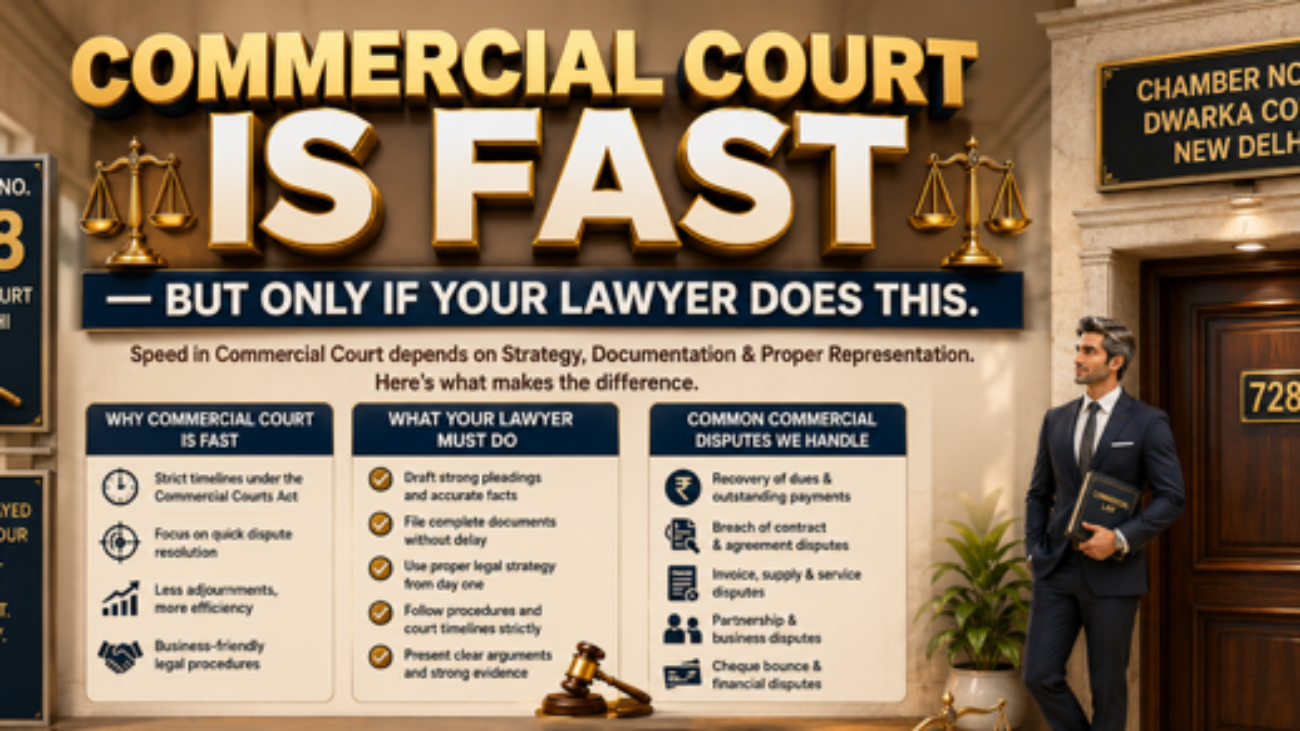
Commercial Court Is Fast — But Only If Your Lawyer Does This
Commercial Court Jurisdiction in Delhi
Commercial litigation in Delhi requires careful forum selection.
The correct court depends upon the nature of the dispute, specified value, applicable pecuniary jurisdiction and territorial jurisdiction.
Territorial jurisdiction may arise from matters such as:
where the contract was executed;
where contractual obligations were performed;
where goods or services were supplied;
where payment was required to be made;
where the cause of action arose;
where the defendant carries on business; and
whether the agreement contains a legally effective jurisdiction clause.
The correct forum should therefore be identified from the contract and transaction rather than merely from the plaintiff’s preferred location.
Our litigation practice is based at Dwarka Courts, Delhi, and commercial matters are assessed according to jurisdiction, documentary record and the applicable Commercial Courts framework.
Important Commercial Court Provisions at a Glance
Stage
Important Provision
Practical Importance
Before filing
Section 12A, Commercial Courts Act
Pre-institution mediation where applicable
Pleadings
Order VI Rule 15A CPC
Statement of Truth
Documents
Order XI CPC
Detailed disclosure and discovery regime
Defence
Order V / Order VIII as amended
Strict Written Statement timeline
Document stage
Order XI
Admission and denial
Early disposal
Order XIII-A
Summary judgment in appropriate cases
Trial planning
Order XV-A
Case Management Hearing
Costs
Section 35 CPC as applicable
Commercial litigation costs regime
After decree
CPC execution provisions
Enforcement of the decree
Frequently Asked Questions
Is Commercial Court always faster than an ordinary civil court?
Not necessarily. Commercial Courts follow a specialised procedural framework intended to make commercial litigation more structured and efficient, but actual duration depends upon the facts, parties, evidence, applications and court schedule.
Is Section 12A mediation compulsory before every commercial suit?
Section 12A applies to commercial suits that do not contemplate urgent interim relief. Whether the requirement applies should be assessed from the facts and relief claimed.
What happens if a defendant does not file the Written Statement within 120 days?
The commercial-suit framework imposes a strict outer limit. The Supreme Court has treated the 120-day limit as mandatory for commercial suits governed by that regime.
What is Order XI in a Commercial Court case?
Order XI contains the special disclosure, discovery, inspection and admission/denial framework applicable to commercial disputes. Parties should organise the complete documentary record from the beginning.
What is summary judgment under Order XIII-A?
It allows a Commercial Court, where the statutory requirements are satisfied, to decide a claim without a full trial. It is not appropriate in every dispute.
What is a Case Management Hearing?
Under Order XV-A, the Commercial Court can actively structure the progress of the suit and prescribe timelines for procedural stages, evidence and arguments.
Can a defendant file a counterclaim in a Commercial Court case?
Depending on the facts and applicable CPC provisions, a defendant may consider a counterclaim or set-off. These should be evaluated while preparing the Written Statement.
Does sending a legal notice extend limitation?
A demand notice does not automatically restart limitation. Limitation depends upon the cause of action, applicable provision of the Limitation Act and legally relevant events such as qualifying acknowledgments or payments.
What Businesses Should Do Before Commercial Litigation Starts
Commercial litigation becomes easier to manage when the documentary and legal position is examined early.
Before filing or defending a case, businesses should preserve the agreement, purchase orders, invoices, correspondence, delivery records, bank statements, ledgers, acknowledgments, notices and electronic communications.
They should also avoid deleting emails or WhatsApp conversations merely because the correspondence appears unfavourable. Disclosure obligations and evidentiary considerations should be discussed with the advocate handling the matter.
The objective should be to understand the entire transaction—not merely to collect documents supporting one side of the dispute.
Conclusion
Commercial Courts are different from ordinary civil courts because the procedural framework expects greater discipline at an earlier stage.
Section 12A pre-institution mediation, Statement of Truth, Order XI disclosure, strict Written Statement timelines, admission and denial of documents, Order XIII-A summary judgment and Order XV-A case management all demonstrate the same principle:
commercial litigation should be prepared comprehensively from the beginning.
For a plaintiff, that means identifying jurisdiction, limitation, documentary proof, mediation requirements and appropriate relief before filing.
For a defendant, it means acting immediately after service, preserving documents, calculating the Written Statement deadline and identifying every genuine defence, set-off or counterclaim.
The Commercial Courts Act provides mechanisms intended to make commercial dispute resolution more structured and efficient. Whether those mechanisms assist a particular case depends upon the facts, documents and procedural history of that dispute.
Commercial Litigation Consultation in Delhi
Ankit Gaurav Kainth & Associates handles civil and commercial litigation from Dwarka Courts, Delhi, including matters relating to commercial recovery, contractual disputes, business dues, Commercial Court defence, interim applications, evidence and execution proceedings.
A consultation in a commercial matter should ordinarily begin with examination of the contract, invoices, transaction history, correspondence, limitation and jurisdiction rather than with an assumption about the eventual result or duration.
Chamber No. 728, Lawyers’ Chambers Block District Court Dwarka, Sector-10, New Delhi
Legal Disclaimer
This article is intended for general legal information and educational purposes. Commercial Court jurisdiction, limitation, Section 12A requirements, procedural timelines and available remedies depend upon the facts and applicable law of each case. Nothing in this article should be treated as a guarantee regarding the outcome or duration of any proceeding.
Author
Ankit Gaurav Kainth, Advocate Litigation practice based at Dwarka Courts, Delhi Civil & Commercial Litigation
No.
Supporting Page / Blog
Recommended Anchor Text
Why It Supports This Article
Suggested Placement
URL
1
Commercial Court Advocate in Dwarka Court Delhi
Commercial Court Advocate in Dwarka Court Delhi
Main commercial litigation service page covering jurisdiction, recovery, contracts and defence strategy.
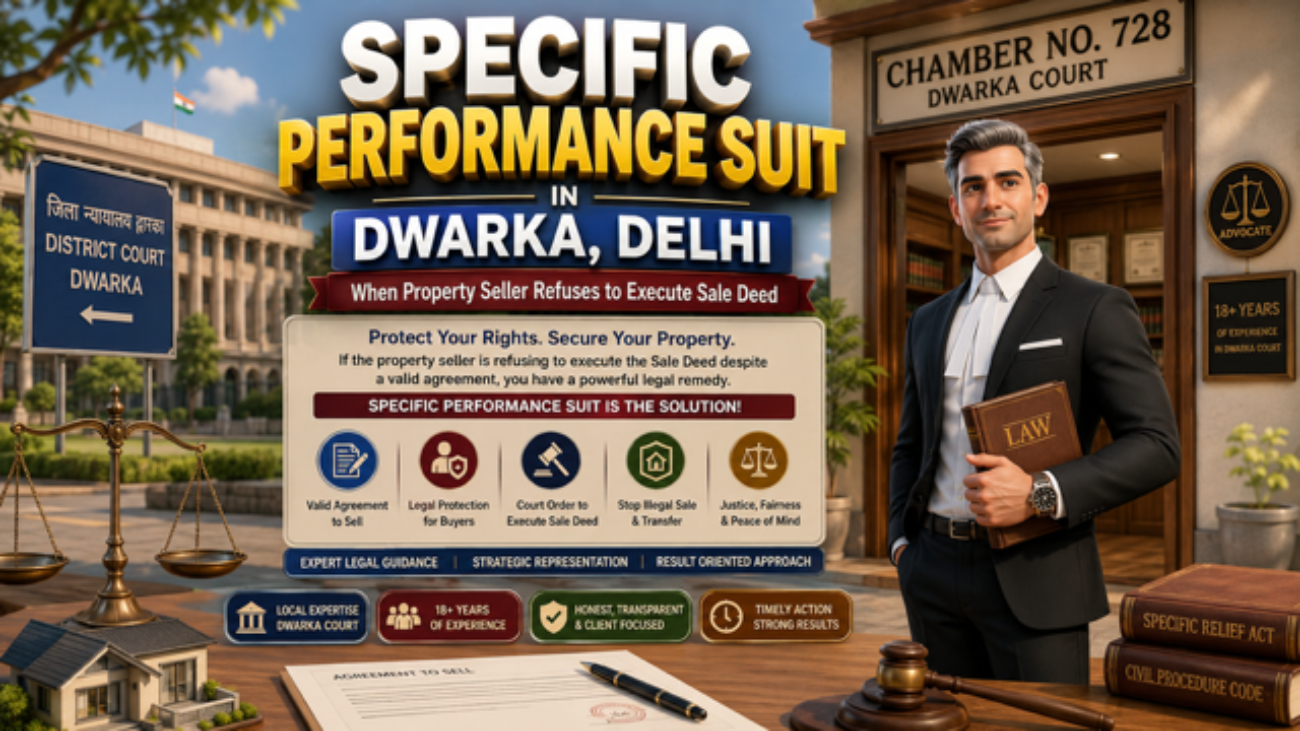
⚖️ Specific Performance Suit in Dwarka — A Complete Legal Guide
Property disputes are increasing rapidly in Delhi. Many buyers pay huge amounts for a property. However, after taking money, some sellers refuse to execute the final Sale Deed. As a result, buyers suffer financial loss, mental stress, and legal uncertainty.
If you are facing a similar issue in Dwarka, Janakpuri, Uttam Nagar, Najafgarh, Vikaspuri, Palam Village, Dwarka Sector-23, Dabri, Chhawla, Samalka, Kapashera, Mohan Garden, Bindapur, Baba Haridas Nagar, or nearby Dwarka Court areas, understanding your legal rights becomes extremely important.
With more than 18+ years of experience in Dwarka Court, we regularly assist clients in handling complex property disputes, agreement disputes, and civil litigation matters.
A Specific Performance Suit in Dwarka is filed when a property seller refuses to honour a legally valid Agreement to Sell.
Instead of merely seeking refund of money, the buyer approaches the court and requests the court to direct the seller to execute the Sale Deed as originally agreed.
Therefore, this remedy protects genuine buyers from dishonest conduct.
Under the Specific Relief Act, courts may order the seller to complete the property transaction if the buyer proves:
✅ Valid Agreement to Sell ✅ Readiness and willingness to pay ✅ Genuine intention to complete the deal ✅ Seller’s refusal or avoidance
Consequently, a Specific Performance Suit in Dwarka becomes highly effective in property disputes involving flats, plots, builder floors, commercial shops, and residential properties.
🏛️ Common Situations Where Specific Performance Suit in Dwarka is Filed
A Specific Performance Suit in Dwarka is commonly filed in situations such as:
✅ Seller takes advance payment but refuses registration
✅ Property prices increase and seller backs out
✅ Seller delays execution repeatedly
✅ Seller tries to sell property to another person
✅ Builder refuses possession after agreement
✅ Co-owner disputes arise after agreement
✅ Family pressure causes seller to cancel deal
In many cases, buyers from Dwarka North, Dwarka South, Uttam Nagar, Janakpuri, Najafgarh, and Vikaspuri face such problems after investing their lifetime savings.
⚖️ Why Early Legal Advice Matters in Specific Performance Suit in Dwarka
Many clients approach advocates only after the matter becomes complicated. However, taking legal advice during the pre-litigation stage can save significant time and money.
As experienced local advocates near Dwarka Court, we first evaluate:
Thereafter, we guide clients regarding legal strength, risks, and possible outcomes.
Moreover, we also issue professionally drafted legal notices before filing a Specific Performance Suit in Dwarka. In several cases, disputes get resolved even before litigation begins.
Therefore, proper legal strategy at the initial stage often prevents future complications.
🏛️ Litigation Support in Specific Performance Suit in Dwarka
Once litigation becomes necessary, our office handles the entire process professionally and transparently.
Being local advocates practising regularly in Dwarka Court helps us understand:
✅ Court procedures ✅ Filing systems ✅ Documentation process ✅ Registry objections ✅ Urgent mentioning procedures ✅ Court working patterns
Therefore, cases can often be filed and handled more efficiently.
Our litigation assistance includes:
⚖️ Drafting Civil Suits
⚖️ Filing Interim Injunction Applications
⚖️ Stay Orders Against Property Transfer
⚖️ Evidence and Cross-Examination
⚖️ Final Arguments
⚖️ Execution Proceedings
Consequently, clients receive complete legal assistance throughout the case.
🌟 Why Clients Trust Us for Specific Performance Suit in Dwarka
Trust is one of the most important elements in legal practice.
Over the years, clients across Dwarka Sector-6, Dwarka Sector-10, Dwarka Sector-12, Janakpuri, Palam Village, Uttam Nagar, Chhawla, Najafgarh, Dabri, and nearby Dwarka Court areas have trusted us because of our professional approach.
✅ High Professional Standards
Every matter is handled seriously and ethically.
✅ Quick Responsiveness
Clients receive timely updates regarding hearings and developments.
✅ Dedicated WhatsApp Support
We remain available for coordination and communication.
✅ Availability on Calls
Proper communication helps clients stay informed and confident.
✅ Transparent Fee Structure
We believe in honest and reasonable professional fees.
✅ Lawyer-Client Fee Agreements
Clear written fee arrangements avoid confusion later.
✅ Fee Receipts and Acknowledgements
Transparency builds long-term trust.
✅ Honest Legal Advice
We do not create false expectations merely to attract clients.
Therefore, many clients consider us among the Top and Best Advocate in Dwarka Court for property and civil disputes.
Property disputes can become emotionally and financially exhausting. However, timely legal action can protect your investment and legal rights.
A properly drafted and strategically handled Specific Performance Suit in Dwarka can help genuine buyers secure justice against dishonest sellers.
Moreover, choosing experienced local advocates near Dwarka Court provides an added advantage because of familiarity with court procedures, filing systems, and litigation practices.
With 18+ years of experience, we continue to assist clients with honesty, professionalism, transparency, and dedicated legal support.
🔍 FAQ Section
1. What is a Specific Performance Suit in Dwarka?
It is a legal case filed when a property seller refuses to execute the Sale Deed despite a valid agreement.
2. How long does a Specific Performance Suit in Dwarka take?
The duration depends upon facts, evidence, and court proceedings. However, timely filing improves legal protection.
3. Can I get stay orders in property disputes?
Yes. Courts may grant injunctions to prevent illegal sale or transfer during litigation.
4. Is legal notice necessary before filing the suit?
Although not mandatory in every case, sending a legal notice is generally advisable.
5. Which court handles Specific Performance Suit in Dwarka?
Depending on jurisdiction and property location, such matters are generally handled before competent civil courts near Dwarka Court.
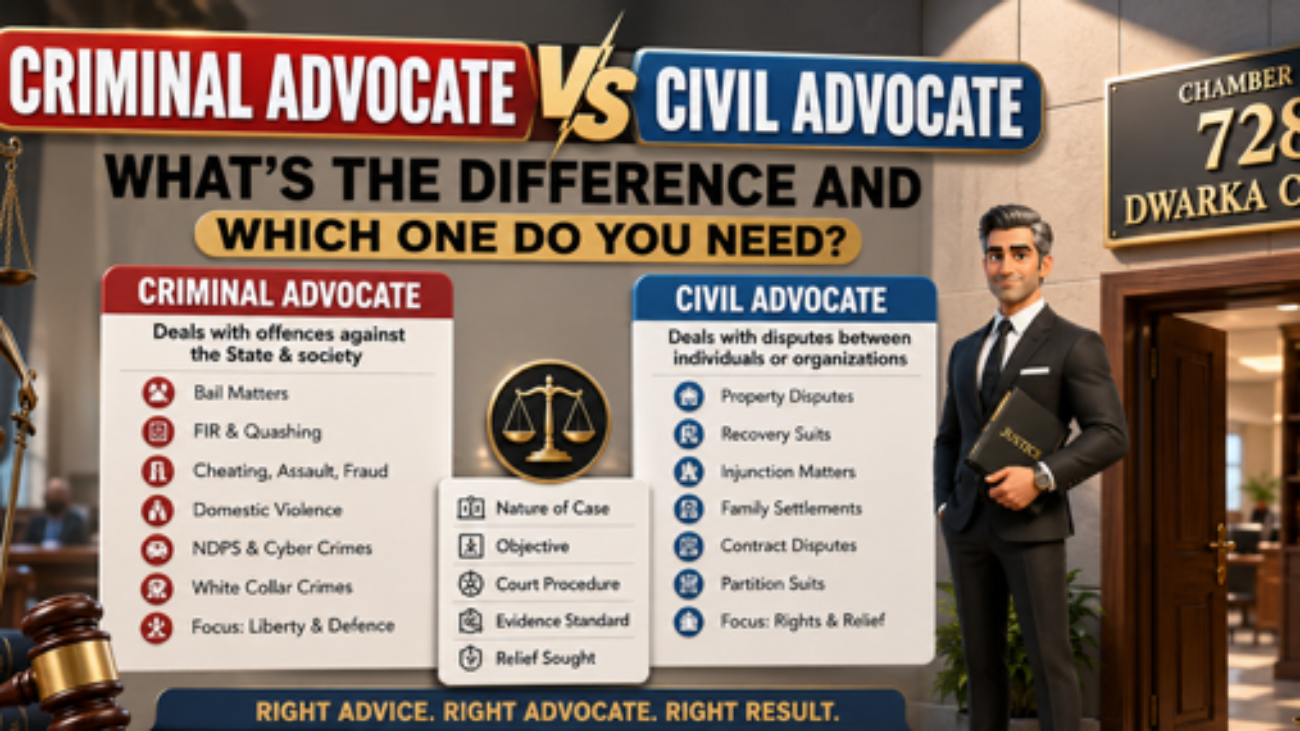
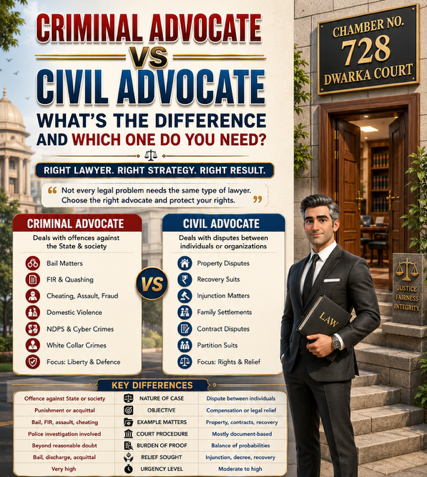
⚖️ “Not every legal problem needs the same type of lawyer. Choosing the right advocate can save your time, money, and peace of mind.” Let us know more about Criminal Advocate vs Civil Advocate.
Many people believe that every lawyer handles every type of case. However, that is not true. The legal field is vast. Therefore, advocates usually develop experience in specific areas such as criminal litigation or civil litigation. As a result, understanding the difference between a Criminal Advocate vs Civil Advocate becomes extremely important before filing or defending any legal matter.
Today, clients often search online for terms like “Best Crime Lawyer Dwarka,” “Top Criminal Advocate Dwarka Court,” “Property Dispute Lawyer Near Dwarka Court,” or “Best Advocate for Recovery Suit.” Yet, many still remain confused about whom they actually need.
This detailed guide explains the complete difference between a Criminal Advocate vs Civil Advocate, how litigation works, and why choosing an experienced local advocate in Dwarka Court can make a significant difference.
⚖️ What is a Criminal Advocate?
A Criminal Advocate handles matters where a person is accused of committing an offence against the State or society. In such cases, liberty, reputation, and even future career opportunities may be at stake. Therefore, criminal litigation requires strategy, urgency, and deep courtroom experience.
A skilled Criminal Advocate Dwarka usually handles:
Moreover, criminal cases often move quickly. Police procedures, investigation stages, remand hearings, and bail hearings require immediate legal action. Consequently, hiring a Top Regular Bail & Anticipatory Bail Lawyer Dwarka becomes extremely important in urgent situations.
At times, even a delay of a few hours can affect the outcome of a criminal matter. Therefore, experienced criminal litigation advocates remain accessible and responsive throughout the process.
A Civil Advocate deals with disputes between individuals, businesses, family members, or organizations where the primary objective is legal relief, compensation, declaration, recovery, or injunction.
Unlike criminal cases, civil disputes generally focus on rights, obligations, property, money, or agreements.
An experienced Civil Litigation Advocate commonly handles:
For example, if someone illegally occupies your property in Dwarka Sector-10 or refuses to repay business dues in Janakpuri, you may need a civil litigation advocate rather than a criminal lawyer.
Similarly, clients searching for the “Best Advocate for Recovery Suit” usually require a strong civil litigation strategy.
Many litigants make the mistake of hiring an advocate merely based on advertisements, social media claims, or unrealistic guarantees. However, litigation is serious. Every case requires proper legal understanding and courtroom experience.
For instance:
📌 A property dispute may fail if handled like a criminal complaint. 📌 A bail matter may suffer if immediate strategy is missing. 📌 A recovery suit may become weak due to improper documentation. 📌 A criminal defence may collapse because of poor cross-examination.
Therefore, selecting the correct professional for a Criminal Advocate vs Civil Advocate issue becomes crucial.
⚖️ Can One Advocate Handle Both Criminal and Civil Cases?
Yes. Many experienced advocates handle both criminal and civil litigation. However, courtroom experience, drafting skills, procedural understanding, and practical exposure matter more than labels alone.
An advocate with strong trial court experience can effectively manage:
Moreover, advocates with over 18+ years of experience in Dwarka Court often understand local court functioning, filing procedures, administrative systems, and practical litigation strategies better than outsiders.
For example, a properly drafted legal notice by a skilled legal notice lawyer can sometimes resolve disputes without lengthy litigation.
Similarly, settlement discussions in property disputes or recovery matters often save years of court proceedings.
⚖️ Litigation Stage – How Professional Representation Helps
Once litigation begins, every procedural step matters. Filing defects, delayed appearances, incomplete pleadings, or weak documentation can damage the case significantly.
Therefore, experienced local advocates near Dwarka Court help clients with:
⚖️ Conclusion – Criminal Advocate vs Civil Advocate
The debate around Criminal Advocate vs Civil Advocate does not have a one-size-fits-all answer. The right advocate depends entirely upon the nature of your legal issue.
If your matter involves FIRs, arrests, bail, criminal complaints, or police investigation, you may need an experienced criminal litigation advocate.
However, if your issue relates to property, contracts, recovery suits, injunctions, or partition disputes, a civil litigation advocate may be more suitable.
Ultimately, success in litigation depends upon preparation, strategy, courtroom experience, honesty, and timely legal action.
Therefore, always choose an advocate who understands your matter carefully and guides you with professionalism and transparency.
1. What is the main difference between a Criminal Advocate vs Civil Advocate?
A criminal advocate handles offences like bail, FIR, cheating, or assault matters. A civil advocate handles property disputes, recovery suits, contracts, and injunction cases.
2. Can one advocate handle both criminal and civil matters?
Yes. Many experienced trial court advocates handle both criminal and civil litigation effectively.
3. When should I contact a criminal lawyer?
You should immediately contact a criminal lawyer if there is an FIR, arrest risk, police inquiry, or criminal complaint.
4. What does a civil litigation advocate do?
A civil litigation advocate handles property disputes, injunctions, money recovery cases, contract disputes, and partition matters.
5. Why should I hire a local advocate near Dwarka Court?
Local advocates understand filing systems, court procedures, jurisdictional practice, and courtroom functioning more efficiently.
Marriage is built on trust, emotional support, companionship, and loyalty. However, sometimes a third person enters the relationship and damages the marital bond. This situation often causes emotional trauma, mental stress, social humiliation, and family breakdown.
Many people from Dwarka, Janakpuri, Uttam Nagar, Vikaspuri, Najafgarh, Palam Village, Mohan Garden, Dabri, Samalka, Kapashera, and nearby Dwarka Court areas often ask:
❓ “Can I file a case against my spouse’s boyfriend or girlfriend?” ❓ “Can I claim compensation or damages?” ❓ “Is there any legal remedy for emotional suffering caused by a third party?”
The answer may depend upon facts, evidence, and circumstances. Therefore, understanding the legal position is extremely important.
As an experienced legal team practicing for 18+ years in Dwarka Court, we assist clients in handling sensitive matrimonial and civil disputes professionally and confidentially.
⚖️ What is an Alienation of Affection Case?
An Alienation of Affection case generally refers to a civil claim where one spouse alleges that a third person intentionally interfered in the marriage and caused loss of affection, companionship, emotional stability, or marital harmony.
In simple language:
👉 A husband or wife claims that another person knowingly damaged their marriage.
Although Indian law does not have a specific statute exclusively named “Alienation of Affection case,” courts have discussed the concept under civil damages, mental cruelty, loss of consortium, emotional injury, and matrimonial disputes.
Therefore, such matters are handled carefully based on facts and available legal remedies.
⚖️ Can You Claim Damages in an Alienation of Affection Case?
In certain situations, yes.
If proper evidence exists, a spouse may seek: ✅ compensation for emotional suffering ✅ damages for mental agony ✅ civil remedies ✅ injunction reliefs ✅ matrimonial remedies ✅ protection from harassment
However, every Alienation of Affection case depends heavily on: 📂 evidence 📜 conduct of parties ⚖️ surrounding circumstances 👨⚖️ judicial interpretation
That is why proper legal consultation is essential before initiating litigation.
⚖️ Important Reality Clients Must Understand
Many emotional disputes become legally weak because clients act only on assumptions or anger.
For example: ❌ suspicion without proof ❌ fake screenshots ❌ illegally recorded material ❌ social media rumours ❌ emotional allegations without evidence
cannot automatically succeed in court.
Therefore, an ethical advocate always examines: ✔️ available evidence ✔️ legal sustainability ✔️ risks involved ✔️ privacy concerns ✔️ possible counter-cases
As ethical professionals, we believe: ⚖️ law should solve disputes, not increase bitterness.
That is why we maintain: ✅ honest legal guidance ✅ transparent fee structure ✅ proper lawyer-client fee agreements ✅ fee receipts and acknowledgements ✅ dedicated WhatsApp support ✅ responsiveness on calls ✅ fair and professional dealings
This approach has helped us build client trust over 18+ years in Dwarka Court.
⚖️ Evidence Required in Alienation of Affection Case
Evidence plays a major role in every Alienation of Affection case.
Useful evidence may include: 📂 chats or messages 📸 photographs 📞 call records 📑 emails 📜 witness statements 📍 travel details 📱 social media activity 📄 admissions or documents
However, illegally obtained evidence may create additional legal complications.
Therefore, always consult an experienced advocate before collecting or using sensitive material.
Hiring a local advocate near Dwarka Court often provides practical advantages.
An advocate regularly practicing in Dwarka Court understands: ✅ local filing process ✅ urgency handling ✅ procedural expectations ✅ court working system ✅ document scrutiny process ✅ daily litigation management
Therefore, clients receive quicker procedural assistance and smoother case coordination.
An Alienation of Affection case is a sensitive legal issue involving emotional, matrimonial, and civil consequences.
Although Indian law treats such matters carefully, legal remedies may be available depending upon: 📂 evidence 📜 conduct ⚖️ legal rights 👨⚖️ judicial evaluation
Therefore, clients should avoid emotional decisions and seek proper legal guidance before initiating litigation.
An experienced and ethical advocate can help: ✅ evaluate the case honestly ✅ preserve evidence properly ✅ plan legal strategy ✅ protect rights professionally ✅ avoid unnecessary legal complications
Ultimately, the goal should always be lawful resolution, dignity, and fair legal protection.
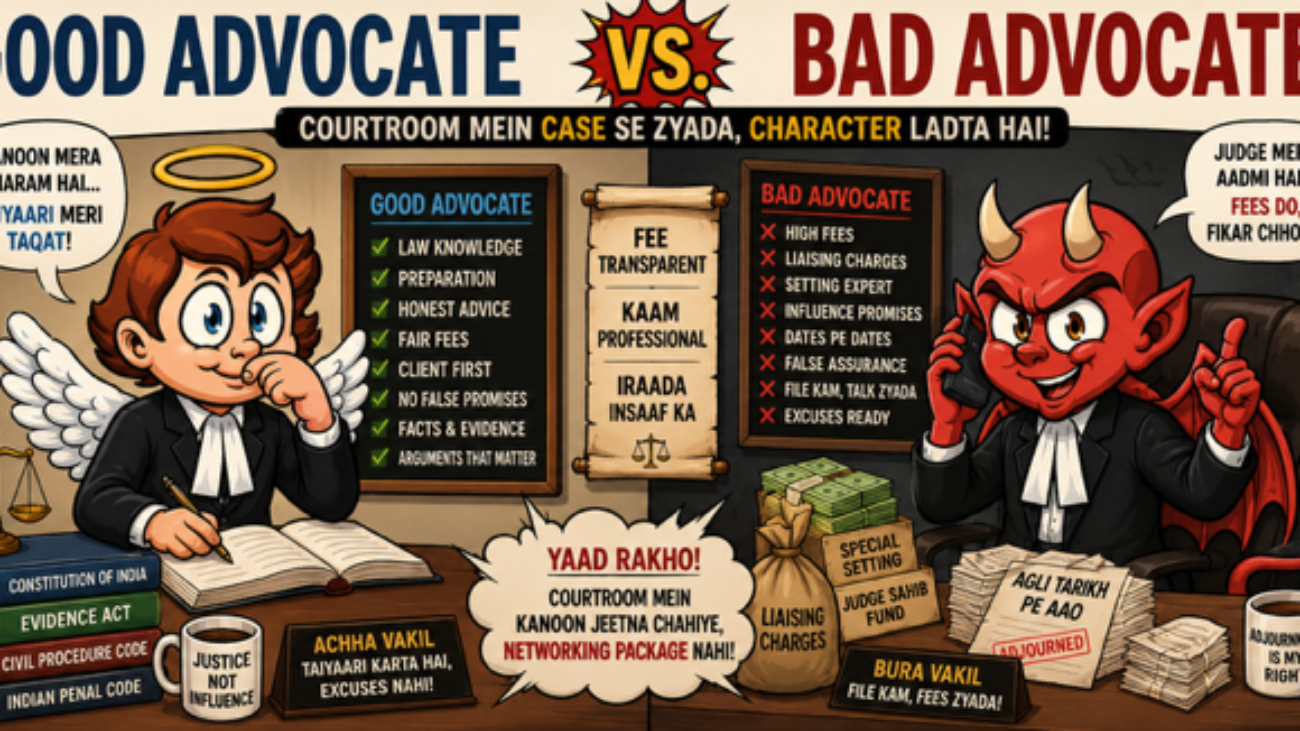
“Court mein sirf case nahi, character bhi ladta hai!”- Experienced & Ethical Advocate in Dwarka Court
In today’s legal world, every litigant wants a strong, intelligent, and trustworthy lawyer. However, many people unknowingly fall into the trap of flashy promises, fake influence claims, and unnecessary legal expenses. Therefore, choosing an Experienced & Ethical Advocate in Dwarka Court becomes one of the most important decisions for any client.
Every litigant dreams of hiring a “Sher Advocate.” Sadly, instead of a lion, some people end up hiring a “WhatsApp University Legal Expert” who treats litigation like a crime web series.
A good advocate studies the file.
A bad advocate studies the client’s wallet.
A good advocate says:
“Let me check the law first.”
A bad advocate says:
“Judge mera aadmi hai… bas fees bhejo.”
And thus begins the legendary battle — Good Advocate Vs. Bad Advocate.
⚖️ The Good Advocate – Preparation, Ethics & Transparency
A truly Experienced & Ethical Advocate in Dwarka Court arrives prepared. He studies judgments, evidence, documents, and legal strategy carefully. Moreover, he explains both strengths and weaknesses honestly.
He never says:
“Case 100% jeet jayega.”
Instead, he says:
“Law aur evidence strong hai. We will fight properly.”
This honesty builds trust.
Furthermore, a professional advocate maintains transparency in fees. There are no mysterious “special expenses,” no fake “setting charges,” and no imaginary “judge management fees.”
Punch Line:- “Good advocate law padhta hai, bad advocate hawa baantta hai.”
Most importantly, a good advocate understands that courtrooms run on preparation, arguments, and evidence — not gossip and networking packages.
💼 The Bad Advocate – Drama, Fear & Endless Expenses
Now comes the superstar advocate.
His office has more attitude than legal books. Instead of discussing sections of law, he talks about “contacts,” “sources,” and “upar tak setting.”
His favourite dialogues include:
– “Mera system strong hai.”
– “Judge ko main jaanta hoon.”
– “Police manage ho jayegi.”
– “Bas thoda aur kharcha lagega.”
Suddenly, the client feels he hired a lawyer mixed with politician, astrologer, RAW agent, and Bollywood fixer.
Punch Line:- “File kam khulti hai, payment zyada.”
Unfortunately, many clients become emotionally and financially exhausted because of such unethical practices.
An Experienced & Ethical Advocate in Dwarka Court never guarantees illegal influence or manipulated outcomes. Instead, he relies upon legal merit, proper drafting, strong arguments, and evidence.
However, some unethical lawyers scare clients intentionally:
– “Judge strict hai.”
– “Opposite party powerful hai.”
– “System aise hi chalta hai.”
– “Police ko manage karna padega.”
As a result, innocent clients start paying money for imaginary influence instead of genuine legal work.
Punch Line:- “Jab advocate evidence se zyada influence ki baat kare, samajh jao meter client ka chal raha hai.”
Today, clients want more than courtroom appearances. They want honesty, guidance, responsiveness, and legal clarity.
Therefore, an Experienced & Ethical Advocate in Dwarka Court focuses on professional legal service before litigation as well as during ongoing court proceedings.
Most importantly, we treat every client matter seriously and professionally.
Punch Line:- “Achha vakil tareekh pe tayyar milta hai. Bura vakil sirf payment reminder bhejta hai.”
🏛️ 18+ Years of Experience in Dwarka Court
With 18+ years of courtroom experience, we understand how litigation impacts families, businesses, careers, and peace of mind.
Therefore, our focus remains simple:
– Honest guidance
– Ethical advocacy
– Strong legal strategy
– Transparent communication
– Professional representation
Whether you need a Criminal Advocate Dwarka, Best Crime Lawyer Dwarka, Top Regular Bail & Anticipatory Bail Lawyer Dwarka, or Best Criminal Disputes Advocate Dwarka Court, professional ethics and experience always matter.
⚖️ The Real Difference
A good advocate builds trust.
A bad advocate builds invoices.
A good advocate prepares arguments.
A bad advocate prepares excuses.
A good advocate respects the profession.
A bad advocate treats litigation like a subscription service.
Not every expensive lawyer is bad. Similarly, not every affordable lawyer is good. However, clients should always stay alert when an advocate discusses “setting” more than legal strategy.
A genuine Experienced & Ethical Advocate in Dwarka Court focuses on law, preparation, transparency, and client trust.
After all, litigation is not only about winning a case. It is also about protecting dignity, rights, finances, and peace of mind.
Because in court:
“Sirf case nahi, character bhi ladta hai.”
❓ Frequently Asked Questions (FAQs)
1. Why should I hire a local advocate near Dwarka Court?
A local advocate understands filing systems, court procedures, registry practices, and daily functioning of Dwarka Court, which helps in faster and smoother case handling.
2. Do ethical advocates guarantee case results?
No genuine advocate guarantees outcomes. Ethical lawyers provide honest legal opinions based on law and evidence.
3. What is the advantage of proper fee agreements?
Written fee agreements maintain transparency, reduce confusion, and build trust between lawyer and client.
4. Do you handle Regular Bail and Anticipatory Bail matters?
Yes. We regularly handle Regular Bail and Anticipatory Bail matters near Dwarka Court.
5. Which areas near Dwarka Court do you serve?
We assist clients from Janakpuri, Uttam Nagar, Najafgarh, Dwarka, Vikaspuri, Palam, Dabri, Chhawla, Kapashera, and nearby areas.
📞 Contact – Experienced & Ethical Advocate in Dwarka Court
Need honest legal guidance near Dwarka Court?
⚖️ Experienced Legal Assistance
⚖️ Criminal Cases
⚖️ Bail Matters
⚖️ Property Disputes
⚖️ Court Representation
⚖️ Transparent Fee Structure
📞 Mobile: 9899085554
📞 Mobile: 9811885554
Your rights deserve preparation, professionalism, and ethical advocacy.
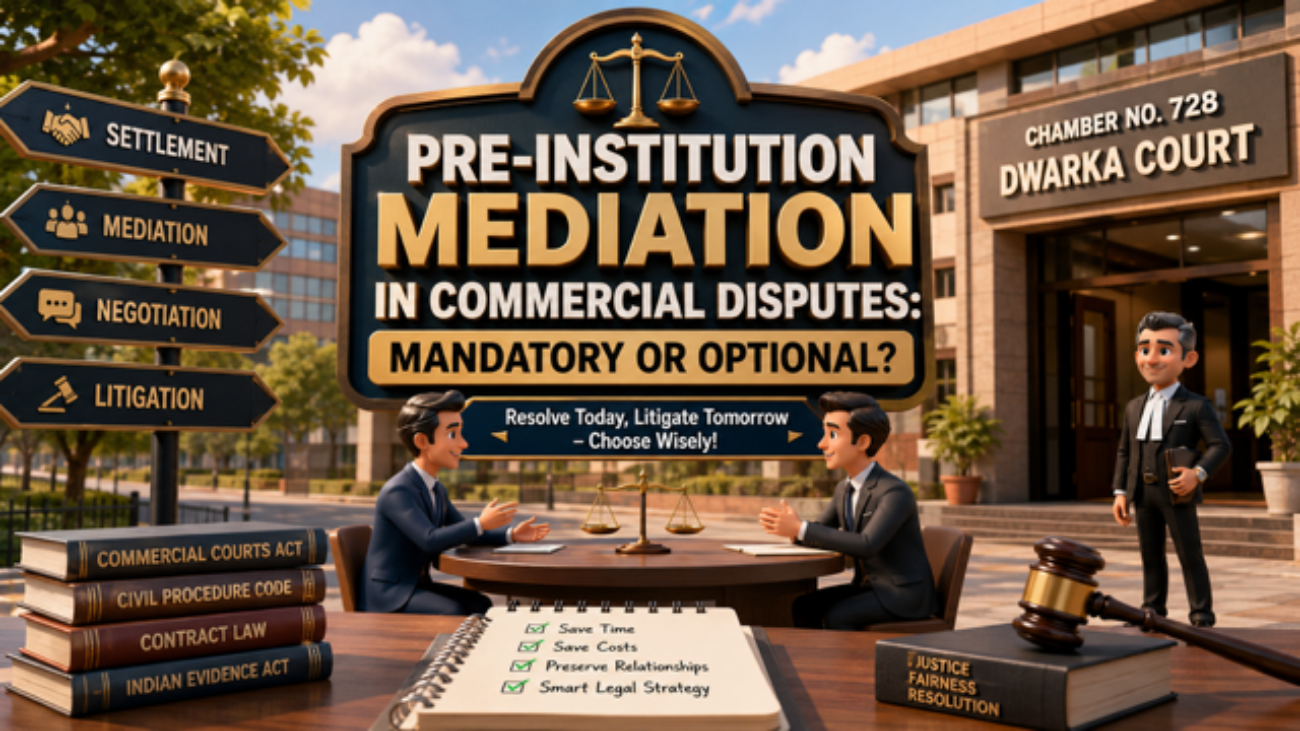
⚖️ Commercial disputes can seriously affect a business. Delayed payments, breach of contracts, partnership conflicts, supplier disputes, and recovery issues often lead to expensive litigation. Therefore, businesses today want faster and practical legal solutions. Pre-Institution Mediation in Commercial Disputes
One important question many clients ask is:
Is Pre-Institution Mediation in Commercial Disputes Mandatory or Optional?
As a Commercial Court Advocate in Dwarka Court Delhi, we regularly guide clients through both pre-litigation and litigation stages. Moreover, our local presence near Dwarka Court helps clients receive quick legal assistance and effective representation.
With more than 18+ years of experience in Dwarka Court, we understand the court system, filing process, procedural requirements, and commercial litigation strategy in detail.
What is Pre-Institution Mediation in Commercial Disputes?
⚖️ Pre-Institution Mediation is a legal process where parties attempt settlement before filing a commercial case in court.
Under Section 12A of the Commercial Courts Act, many commercial disputes require mediation before filing a suit. Therefore, parties must first try to resolve the dispute peacefully.
In simple words, before starting a commercial court case, the law encourages businesses to sit together and attempt settlement through a mediator.
Hence, the question “Pre-Institution Mediation in Commercial Disputes: Mandatory or Optional?” becomes very important for business owners.
Is Pre-Institution Mediation Mandatory or Optional?
✅ In many commercial disputes, Pre-Institution Mediation is mandatory.
However, there is one important exception.
If the matter requires urgent interim relief, parties may directly approach the Commercial Court without mediation.
Before filing any commercial case, proper legal planning is extremely important.
Therefore, we assist clients in:
✅ Legal Notice Drafting
A strong legal notice often helps parties settle disputes quickly.
✅ Contract Review
We carefully examine agreements, invoices, emails, and business records.
✅ Settlement Negotiation
Many disputes can be resolved without court proceedings.
✅ Mediation Representation
We represent clients during mediation proceedings professionally.
✅ Risk Assessment
We advise clients about legal strengths, weaknesses, timelines, and recovery possibilities.
As a Best Commercial Court Lawyer in Dwarka Court sector-10, Delhi, we believe that smart legal strategy before litigation can save substantial time and money.
Therefore, clients searching for a Commercial Court Disputes Expert Advocate Dwarka Court often prefer experienced local lawyers who know the court system well.
Our office near Dwarka Court helps clients receive quicker coordination and regular updates.
Client Trust is Our Priority
⚖️ Legal matters require trust, transparency, and responsiveness.
Therefore, we focus strongly on professional ethics and client communication.
We Maintain:
✅ High Professional Standards
Every matter receives careful legal attention.
✅ Quick Responsiveness
Clients receive timely updates and support.
✅ Dedicated WhatsApp Support
Easy communication helps clients stay informed.
✅ Availability on Call
We remain accessible for urgent legal discussions.
✅ Transparent Fee Structure
We clearly explain legal fees and expenses.
✅ Proper Lawyer-Client Fee Agreements
Professional documentation creates clarity and confidence.
✅ Fee Receipts and Acknowledgements
We maintain transparent financial practices.
✅ Honest Legal Advice
We provide fair and realistic legal guidance.
As a Commercial Court Advocate in Dwarka Court and Delhi, we believe transparency builds long-term professional relationships.
Important Documents Required for Commercial Mediation
📄 Clients should usually keep:
Agreements and contracts
GST invoices
Ledger accounts
Payment records
WhatsApp chats
Email communications
Bank statements
Delivery proofs
Legal notices
Proper documentation significantly improves legal strength during mediation and litigation.
What Happens if a Party Refuses Mediation?
⚖️ If one party refuses mediation, the authority issues a non-settlement report.
Thereafter, the plaintiff may file a commercial suit before the Commercial Court.
Therefore, even failed mediation helps satisfy legal requirements.
This is another reason why understanding Pre-Institution Mediation in Commercial Disputes: Mandatory or Optional? is very important before filing a case.
Time Limit for Pre-Institution Mediation
⏳ Mediation generally concludes within a few months.
Moreover, if parties settle successfully, the settlement agreement becomes legally binding.
Therefore, mediation often saves years of litigation time.
https://pin.it/2Qv1zOJWw
Conclusion
⚖️ Today, commercial disputes require strategic legal handling. Businesses cannot afford unnecessary procedural delays or weak legal planning.
Therefore, understanding Pre-Institution Mediation in Commercial Disputes: Mandatory or Optional? is extremely important before filing a commercial suit.
In many commercial matters, mediation is mandatory. However, urgent relief cases may directly proceed before the Commercial Court.
With 18+ years of experience near Dwarka Court, we assist clients during both pre-litigation and litigation stages. Moreover, our local court experience helps clients receive effective legal representation with practical procedural guidance.
Whether you are facing a recovery dispute, contract breach, partnership issue, or business litigation, professional legal advice at the right stage can protect your commercial interests effectively.
Frequently Asked Questions (FAQs)
1. Is Pre-Institution Mediation compulsory before filing a commercial suit?
Yes, in many commercial disputes it is mandatory unless urgent interim relief is required.
2. How long does Pre-Institution Mediation take?
Usually, the process completes within a few months depending on cooperation between parties.
3. Can parties settle disputes during mediation?
Yes. If settlement succeeds, the agreement becomes legally binding.
4. What happens if mediation fails?
The plaintiff can proceed with filing a commercial suit before the Commercial Court.
5. Why should I hire a local Commercial Court Advocate in Dwarka Court Delhi?
Local advocates understand court procedures, filing systems, and practical functioning, which helps in faster and smoother case handling.
⚖️ For professional assistance in commercial disputes, mediation matters, recovery suits, and business litigation near Dwarka Court, feel free to contact:
Building Trust, Professional Connections & Legal Awareness as an Advocate in Dwarka Court ⚖️
Reaching 10,000 LinkedIn followers in just 10 months is not merely a social media milestone. Instead, it reflects years of trust, consistency, professionalism, and meaningful legal service. 🙏
At Ankit Gaurav Kainth & Associates, our journey on LinkedIn started with a simple goal — to spread legal awareness, share courtroom experiences, and help people understand their legal rights in a practical way. Today, this growing professional community motivates us to continue serving clients with honesty, dedication, and professional excellence.
As an experienced Advocate in Dwarka Court, I sincerely thank every client, follower, colleague, and well-wisher who supported and appreciated our work throughout this journey. Your encouragement inspires us to create more valuable legal content and continue assisting individuals and businesses across Delhi.
🎉 10,000 LinkedIn Followers in Just 10 Months! 🚀
Ankit Gaurav Kainth & Associates 18+ Years of Practice in Criminal & Civil Chamber No.728, Dwarka court, New Delhi Contact us :- 9899085554
Legal disputes can create stress, uncertainty, and financial pressure. Therefore, choosing the right Advocate in Dwarka Court becomes extremely important.
With more than 18+ years of courtroom experience, our legal team understands the complete functioning, procedures, filing systems, and daily working style of Dwarka Court. Consequently, we help clients save valuable time while ensuring proper legal representation.
Being a local Advocate in Dwarka Court also helps us provide faster coordination, urgent filings, immediate legal drafting, and efficient case management.
We regularly handle matters from:
✅ Dwarka Sector 6
✅ Dwarka Sector 10
✅ Dwarka Sector 12
✅ Dwarka Sector-23
✅ Uttam Nagar
✅ Najafgarh
✅ Janakpuri
✅ Vikaspuri
✅ Bindapur
✅ Palam Village
✅ Mohan Garden
✅ Dabri
✅ Delhi Cantonment
✅ Samalka
✅ Kapashera
✅ Chhawla
✅ Baba Haridas Nagar
✅ Jaffarpur Kalan
✅ Dwarka North
✅ Dwarka South
✅ Nearby Dwarka Court jurisdictions
As a result, clients searching for an experienced Advocate in Dwarka Court often prefer local representation for smooth communication and quick legal action.
📚 Pre-Litigation Legal Assistance – Solving Problems Before Court Cases
Many disputes can be resolved before reaching the courtroom. However, people often ignore legal advice during the early stage of disputes. Consequently, minor issues become major litigation matters later.
At Ankit Gaurav Kainth & Associates, we strongly focus on pre-litigation legal support.
Moreover, proper legal strategy before litigation often saves money, time, and emotional stress.
Therefore, consulting an experienced Advocate in Dwarka Court at the initial stage can prevent unnecessary litigation complications.
🏛️ Litigation Services in Dwarka Court
When litigation becomes unavoidable, professional courtroom representation becomes essential.
Our office regularly handles litigation matters before Dwarka Court and nearby jurisdictions. Furthermore, we focus on strategic case preparation, strong drafting, timely filings, and effective arguments.
As a professional Advocate in Dwarka Court, we handle:
✅ Criminal Cases
✅ Bail Matters
✅ Anticipatory Bail
✅ Regular Bail
✅ Commercial Disputes
✅ Property Litigation
✅ Civil Suits
✅ Injunction Matters
✅ Recovery Cases
✅ Cheque Bounce Cases
✅ Family Disputes
✅ Domestic Violence Matters
✅ Police Complaint Matters
✅ Arbitration Support
Clients searching for a Criminal Advocate Dwarka, Best Crime Lawyer Dwarka, or Top Regular Bail & Anticipatory Bail Lawyer Dwarka often approach us because of our practical courtroom experience and responsive legal support.
Additionally, our office also handles complex commercial litigation. Hence, businesses looking for a Top and Best Advocate in Dwarka Court (Commercial Court Expert) trust our legal strategies and professional handling.
Success in the legal profession depends heavily on trust. Therefore, we always maintain high professional ethics and transparent dealings.
As a dedicated Advocate in Dwarka Court, we believe clients deserve honesty, clarity, and proper legal guidance.
Our professional approach includes:
✅ Quick responsiveness
✅ Dedicated WhatsApp support
✅ Availability on call
✅ Transparent legal consultation
✅ Reasonable fee structure
✅ Proper Lawyer-Client Fee Agreements
✅ Issuing fee receipts and acknowledgements
✅ Honest legal opinion
✅ Fair professional conduct
✅ Timely case updates
Because of this transparent system, many clients recommend our services to friends, relatives, and business associates.
Moreover, strong communication helps clients feel confident during difficult legal situations.
10,000 LinkedIn Followers Advocate in Dwarka Court
⚖️ Criminal Litigation & Bail Matters in Dwarka Court
Criminal litigation requires immediate legal action and strategic courtroom handling. Therefore, timely consultation becomes extremely important.
As an experienced Criminal Advocate Dwarka, we regularly assist clients in:
⚖️ Regular Bail Applications
⚖️ Anticipatory Bail Matters
⚖️ FIR-related legal strategy
⚖️ Criminal complaints
⚖️ Trial representation
⚖️ Police investigation assistance
⚖️ Settlement discussions
⚖️ Cross-examination preparation
Individuals searching online for the Best Criminal Disputes Advocate Dwarka Court often require urgent legal assistance. Consequently, our office remains accessible for immediate consultation and emergency case coordination.
Furthermore, strong local court experience helps in understanding procedural requirements efficiently.
🌟 LinkedIn Growth Reflects Professional Trust
Growing to 10,000 LinkedIn followers within 10 months was possible because people value practical legal knowledge and genuine professional guidance.
Every post shared on LinkedIn focused on:
📌 Legal awareness
📌 Real courtroom learning
📌 Practical legal tips
📌 Client education
📌 Professional ethics
📌 Litigation strategy insights
Instead of promotional content alone, we focused on adding real value. As a result, thousands of professionals, entrepreneurs, clients, and legal learners connected with our content.
This achievement motivates us to continue growing as a responsible Advocate in Dwarka Court while contributing positively to the legal community.
📍 Why Local Experience in Dwarka Court Makes a Difference
Every court has its own working style, filing system, procedural expectations, and administrative structure.
Therefore, hiring a local Advocate in Dwarka Court provides several practical advantages:
✅ Faster filing support
✅ Better procedural understanding
✅ Quick coordination
✅ Local court familiarity
✅ Better case management
✅ Immediate physical availability
✅ Strong drafting support
Moreover, local legal experience helps avoid procedural delays and unnecessary confusion.
This is why many individuals searching for an experienced Advocate in Dwarka Court near Dwarka Court prefer lawyers who regularly practice in the same jurisdiction.
⚖️ Conclusion
This milestone of 10,000 LinkedIn followers is not only a social achievement. Instead, it represents years of professional dedication, client trust, courtroom experience, and meaningful legal contribution.
At Ankit Gaurav Kainth & Associates, we remain committed to providing honest legal guidance, practical solutions, and professional representation for every client.
Whether you need pre-litigation advice, criminal defense, bail assistance, commercial litigation support, or civil dispute representation, our office is always ready to assist you professionally and transparently.
Thank you once again for being part of this incredible journey. 🤝
1. Why should I hire a local Advocate in Dwarka Court?
A local Advocate in Dwarka Court understands court procedures, filing systems, and courtroom practices, which helps in faster and smoother legal representation.
2. Do you handle criminal and bail matters in Dwarka Court?
Yes. We regularly handle criminal litigation, anticipatory bail, regular bail, and police complaint matters in Dwarka Court.
3. Do you provide pre-litigation legal consultation?
Absolutely. We assist clients with legal notices, settlements, documentation review, mediation, and dispute resolution before litigation begins.
4. Do you provide fee receipts and written fee agreements?
Yes. We maintain transparent professional practices by issuing proper fee receipts and Lawyer-Client Fee Agreements.
5. Which areas near Dwarka Court do you serve?
We regularly assist clients from Dwarka, Janakpuri, Uttam Nagar, Vikaspuri, Najafgarh, Palam, Dabri, Chhawla, Kapashera, and nearby areas.
📞 Contact Ankit Gaurav Kainth & Associates
⚖️ Advocate in Dwarka Court
📍 Chamber No. 728, District Court Dwarka, New Delhi
📞 Mobile: 9899085554, 9811885554
📲 WhatsApp Support Available
✅ Professional Consultation | Honest Guidance | Transparent Fees
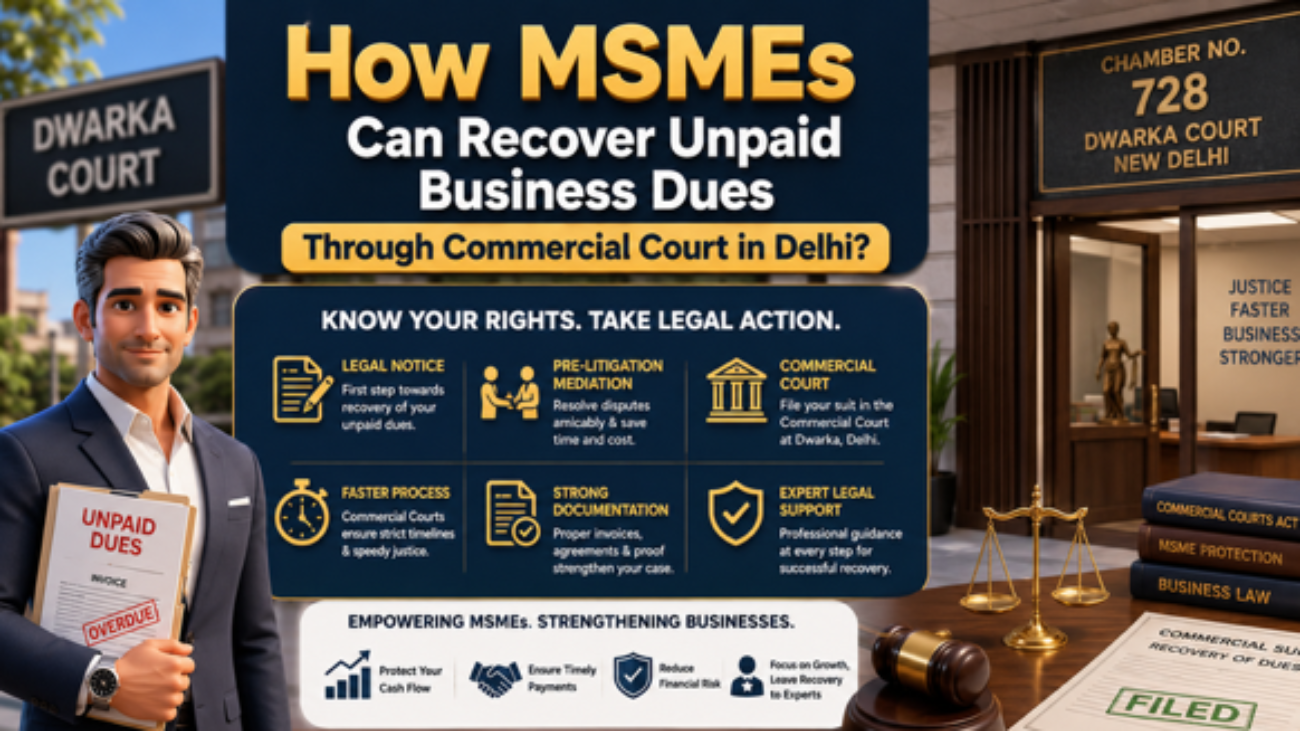
In today’s competitive market, delayed payments and unpaid invoices have become a serious problem for MSMEs. Many small businesses, suppliers, traders, manufacturers, contractors, and service providers struggle because clients fail to clear payments on time. Therefore, understanding How MSMEs Can Recover Unpaid Business Dues Through Commercial Court in Delhi? is extremely important for every business owner.
The good news is that the law provides strong remedies for businesses. Moreover, the Commercial Courts Act has made recovery cases faster, more structured, and more effective. If handled properly, MSMEs can legally recover outstanding payments through the Commercial Court system in Delhi.
As experienced local advocates practicing for more than 18+ years in Dwarka Court, New Delhi, we regularly assist businesses in commercial recovery matters across Dwarka, Janakpuri, Vikaspuri, Uttam Nagar, Najafgarh, Palam Village, Kapashera, Dabri, Samalka, Bindapur, Chhawla, Baba Haridas Nagar, Jaffarpur Kalan, Mohan Garden, Dwarka Sector-6, Dwarka Sector-10, Dwarka Sector-12, Dwarka North, Dwarka South, and nearby areas.
⚖️ What Is a Commercial Recovery Case?
A commercial recovery case is a legal proceeding filed to recover unpaid business dues arising from commercial transactions. These disputes usually involve:
Many MSMEs suffer because clients delay payments intentionally. Sometimes, businesses continue waiting for months without taking legal action. However, delay can weaken the recovery process.
Common reasons include:
No proper legal notice
Weak agreements
Poor documentation
Fear of litigation
Lack of legal guidance
Delay in filing recovery proceedings
Therefore, timely legal action becomes very important in commercial disputes.
📌 How MSMEs Can Recover Unpaid Business Dues Through Commercial Court in Delhi?
The process generally begins with legal evaluation and documentation review. Thereafter, proper legal steps are initiated before the Commercial Court.
Step 1: Review of Business Documents
First, all documents are examined carefully, including:
In many cases, businesses recover payments after receiving a professionally drafted notice. Therefore, pre-litigation strategy plays a major role in How MSMEs Can Recover Unpaid Business Dues Through Commercial Court in Delhi?
⚖️ Pre-Institution Mediation in Commercial Matters
Under commercial laws, pre-institution mediation may be mandatory in certain matters before filing the suit. This process gives parties an opportunity to settle disputes peacefully.
Moreover, mediation can save:
Time
Litigation expenses
Business relationships
Court delays
As a result, many MSMEs prefer attempting mediation before lengthy litigation.
🏛️ Filing a Commercial Recovery Suit in Dwarka Court
If the opposite party still refuses payment, a commercial suit can be filed before the appropriate Commercial Court.
Every case depends on facts and complexity. However, commercial courts are generally faster than ordinary civil courts because they follow stricter timelines.
Moreover, timely legal strategy can reduce unnecessary delays.
Therefore, early legal action is always advisable in commercial disputes.
📌 Common Mistakes MSMEs Should Avoid
Many businesses unintentionally weaken their cases by:
❌ Delaying legal action ❌ Ignoring written agreements ❌ Accepting verbal promises only ❌ Not preserving invoices ❌ Avoiding professional legal advice
Therefore, businesses should seek legal guidance at an early stage.
🏛️ Choosing the Right Commercial Court Advocate
Selecting the right advocate can make a major difference in commercial litigation outcomes.
Businesses generally look for:
Court experience
Local knowledge
Transparent dealing
Responsive communication
Strategic litigation approach
Therefore, many clients searching for the Commercial Court Advocate in Dwarka Court and Delhi prefer experienced local professionals familiar with commercial court procedures.
Understanding How MSMEs Can Recover Unpaid Business Dues Through Commercial Court in Delhi? is essential for protecting business interests. Commercial litigation provides MSMEs with a powerful legal remedy against delayed payments and dishonest business practices.
However, success in commercial recovery depends upon timely action, proper documentation, strategic legal guidance, and effective court representation.
With more than 18+ years of experience in Dwarka Court, New Delhi, we assist MSMEs, contractors, traders, suppliers, startups, and businesses at both the pre-litigation and litigation stages. Moreover, our local presence near Dwarka Court helps clients receive quick filing support, practical legal solutions, and efficient representation.
📞 Contact for Commercial Court Matters in Dwarka Court, Delhi
If your business is facing payment delays or commercial disputes, professional legal guidance can help protect your financial interests.