
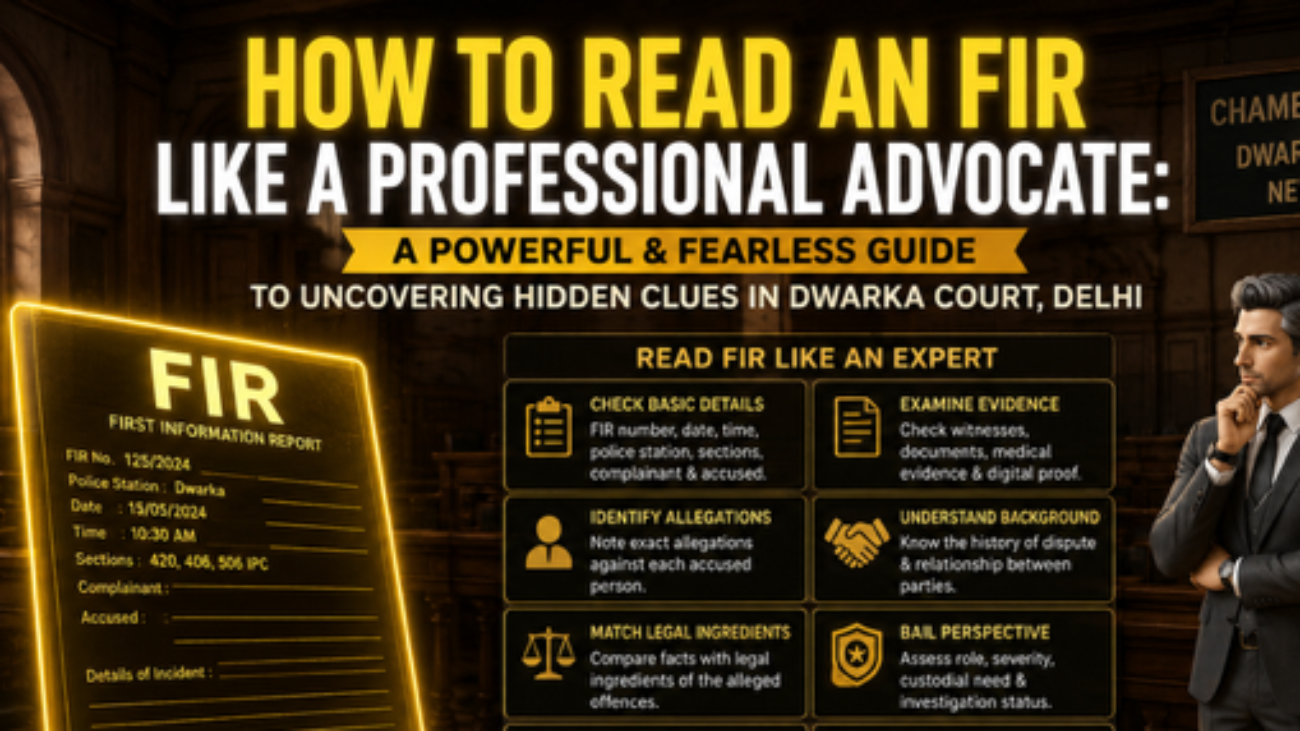

How to Read an FIR with a professional advocate in Dwarka Court Delhi

How to Read an FIR Like a Professional Advocate: A Powerful & Fearless Guide to Uncovering Hidden Clues in Dwarka Court, Delhi

⚖️ Introduction: How to Read an FIR/ Why Reading an FIR Correctly Matters

An FIR is often the first major document in a criminal case. It records the information given to the police about an alleged offence. However, an FIR is not the final proof of guilt. It is a starting point for investigation and legal action.

Therefore, how to read an FIR is an important legal skill. A professional advocate does not read it only once. Instead, the advocate studies its facts, dates, allegations, sections, witnesses, documents and omissions.

A careful reading can reveal:

  • Important factual inconsistencies.
  • Delay in reporting the incident.
  • Unclear or general allegations.
  • Missing facts about the alleged offence.
  • Contradictions between different parts of the FIR.
  • Questions about the ingredients of the alleged offences.
  • Issues relevant to bail, investigation or further legal remedies.

For a person facing criminal proceedings, this analysis can be extremely important.


🔍 How to Read an FIR Like a Professional Advocate

The first principle is simple: do not read an FIR emotionally. Read it legally.

A complainant may use strong words. The FIR may contain serious allegations. However, the advocate must separate allegations from legally relevant facts.

When considering how to read an FIR, a professional advocate normally asks:

Who? What? When? Where? How? Why? What evidence? What offence?

These questions help convert a long narrative into a structured legal analysis.

1. Check the Basic Details

Start with the basic information:

  • FIR number.
  • Police Station.
  • Date of registration.
  • Date and time of occurrence.
  • Sections invoked.
  • Name of complainant.
  • Names of accused persons.
  • Place of alleged occurrence.
  • Investigating Officer, where available.

These details create the basic framework of the case.

For example, if the FIR mentions an incident on a particular date but registration took place after a significant delay, the reason for that delay may require examination.

However, delay alone does not automatically make an FIR false or legally invalid. The circumstances and explanation for the delay must be considered.

2. Identify the Exact Allegation Against Each Person

A professional advocate does not treat every accused person in the same manner.

Instead, ask:

What exactly has been alleged against each accused?

This is especially important where several family members, directors, partners, employees or associates have been named.

Look for specific acts attributed to each person.

An FIR may contain a general allegation against several persons. Therefore, the advocate should examine whether the FIR actually describes the individual role attributed to each accused.

This approach is useful while considering appropriate legal remedies, including bail or other proceedings, depending upon the facts and applicable law.

3. Match the Allegations With the Ingredients of the Offence/How to Read an FIR

This is one of the most important steps in understanding how to read an FIR.

Every criminal offence has legal ingredients. The allegations should therefore be compared with those ingredients.

For example, merely using the word “cheating” does not by itself establish the offence of cheating. The factual allegations must be examined against the legal requirements of the offence.

Similarly, in cases involving alleged criminal breach of trust, intimidation, assault, forgery, misappropriation or other offences, the advocate should identify the facts supporting each required ingredient.

A Simple FIR Reading Table

FIR PointWhat an Advocate ChecksWhy It Matters
Date of incidentExact date and timelineTests chronology
FIR registrationDate and timeHelps examine delay
AccusedIndividual rolePrevents assumptions
AllegationSpecific act attributedIdentifies actual case
Offence sectionsLegal ingredientsTests applicability
WitnessesNames and roleAssesses supporting material
DocumentsNature and relevanceIdentifies evidence
Place of occurrenceJurisdiction and factsChecks territorial issues
Medical evidenceInjury and timingCorrelates allegations
Prior disputeEarlier relationship or conflictProvides background
ContradictionsDifferences within recordHelps legal analysis
OmissionsImportant facts missingMay require explanation
Investigation statusStage of investigationGuides next legal step

4. Study the Timeline Carefully

A strong criminal defence often begins with chronology.

When learning how to read an FIR, prepare a simple timeline:

Alleged incident → communication → complaint → FIR → investigation → notice/arrest → recovery → chargesheet

Then compare every date.

For instance, examine whether the FIR was lodged immediately or after a substantial interval. Check whether the complainant refers to earlier complaints, calls, messages or meetings.

Moreover, compare the FIR with other available material.

A timeline does not prove a case by itself. However, it can expose questions that require further investigation or legal consideration.

5. Look for Omissions, Improvements and Contradictions/ How to Read an FIR

One of the most useful aspects of how to read an FIR is learning to distinguish between an omission and a contradiction.

An omission occurs when an important fact is absent from an earlier version but appears later.

A contradiction occurs when two versions contain materially different facts.

Therefore, the FIR should not be examined in isolation. Where legally permissible and available, an advocate may compare it with:

  • Complaint.
  • Statements.
  • Medical records.
  • Messages.
  • Emails.
  • Agreements.
  • Bank records.
  • CCTV footage.
  • Call records.
  • Other documentary material.

The significance of any inconsistency depends upon the facts, stage of proceedings and applicable law.

6. Examine the FIR From a Bail Perspective

For an accused person, FIR analysis can be particularly important before seeking legal relief.

A Regular Bail & Anticipatory Bail Lawyer Dwarka will generally examine factors such as:

  • Nature of allegations.
  • Punishment prescribed for the alleged offence.
  • Specific role attributed to the accused.
  • Need for custodial interrogation.
  • Possibility of tampering with evidence.
  • Possibility of influencing witnesses.
  • Previous criminal history, where relevant.
  • Cooperation with investigation.
  • Recovery requirements.
  • Stage of investigation.

The precise legal strategy depends on the facts and the applicable provisions.

Therefore, an FIR should never be assessed only by looking at the number of sections mentioned in it.

7. Do Not Assume That More Sections Mean a Stronger Case

Sometimes several penal sections appear in an FIR.

That can look alarming to an accused person. However, the number of sections does not, by itself, determine the strength of the prosecution case.

A Criminal Advocate Dwarka should examine whether the factual allegations actually correspond to the ingredients of each invoked offence.

This is why professional legal analysis is different from simply reading an FIR.

8. Examine the Background of the Dispute

The surrounding circumstances can be highly relevant.

For example, a criminal complaint may arise from:

  • Business disagreements.
  • Property disputes.
  • Matrimonial conflict.
  • Financial transactions.
  • Employment disputes.
  • Partnership disagreements.
  • Contractual disputes.
  • Family disagreements.

However, the existence of a civil or commercial dispute does not automatically make a criminal case invalid.

A professional advocate therefore studies the complete factual background instead of reaching a conclusion from the FIR alone.

This approach is also useful when advising clients who are dealing with overlapping civil and criminal proceedings.

FIR Analysis in Financial and Cheque Bounce Disputes

Not every financial dispute is identical.

A Cheque Bounce Lawyer in Dwarka Court may need to examine the underlying transaction, documents, payment history, notices, bank records and the nature of the allegations.

Likewise, where a financial disagreement develops into multiple proceedings, the advocate should map the entire dispute.

The same principle applies to property and commercial matters.

A Property Dispute Advocate, Recovery Suit Counsel or Commercial Litigation Lawyer may need to study the criminal allegations alongside agreements, receipts, correspondence and other documents.


Why Local Legal Experience in Dwarka Court Matters

Local court experience can make the legal process more efficient.

We are local Advocates in Dwarka Court, Delhi, with 18+ years of professional experience in Dwarka Court.

Our familiarity with local court procedures, filing practices, listing processes, documentation requirements and day-to-day working systems helps us respond promptly to litigation requirements.

This local experience is particularly useful when a matter requires urgent filing, appearance, procedural follow-up or coordination.

We assist clients at both stages:

🔹 Pre-Litigation Stage

Before litigation begins, we help clients understand their legal position and available options.

Depending on the matter, assistance may include:

  • Reviewing documents.
  • Examining notices and complaints.
  • Analysing potential criminal exposure.
  • Preparing legal replies.
  • Advising on evidence preservation.
  • Assessing settlement or negotiation options.
  • Planning appropriate legal proceedings.
  • Identifying procedural risks.

Early legal advice can help a client make an informed decision before a dispute becomes more complicated.

🔹 Litigation Stage

Once proceedings begin, legal assistance may include:

  • Bail proceedings.
  • Anticipatory bail matters.
  • Criminal complaints.
  • Trial proceedings.
  • Evidence and cross-examination.
  • Applications before the court.
  • Procedural objections.
  • Civil and commercial proceedings connected with the dispute.
  • Appeals, revisions or other appropriate remedies.

A Criminal Disputes Advocate Dwarka Court must therefore look beyond the FIR and understand the complete litigation strategy.


📍 Serving Clients Across Dwarka and South-West Delhi

Our practice is focused on clients appearing before or dealing with matters connected with Dwarka Court and nearby areas.

Clients may approach us from:

Dwarka Sector 6, Sector 10, Sector 12, Dwarka Sector-23, Dwarka North, Dwarka South, Janakpuri, Vikaspuri, Uttam Nagar, Najafgarh, Palam Village, Dabri, Bindapur, Mohan Garden, Delhi Cantonment, Chhawla, Baba Haridas Nagar, Samalka, Jaffarpur Kalan, Kapashera and other nearby areas.

If you are searching for a Lawyer in South West Delhi or an Advocate in Dwarka Court near Dwarka Court, local professional assistance can help you understand the procedure and practical steps involved.


🤝 Building Client Trust Through Professional Standards

Legal representation requires more than legal knowledge. It also requires trust, communication and professional discipline.

We focus on:

✅ High professional standards
✅ Quick responsiveness
✅ Availability on call, subject to professional commitments
✅ Dedicated WhatsApp support for case-related communication
✅ Reasonable and transparent fee structure
✅ Proper Lawyer-Client Fee Agreements
✅ Fee receipts and acknowledgements
✅ Honest and fair dealings
✅ Clear communication about the legal process

A written fee arrangement helps both sides understand the professional engagement, scope of work and applicable charges.

Likewise, fee receipts and acknowledgements promote transparency and proper record keeping.

📞 What Should You Do After Receiving an FIR?

If you or someone close to you has received information about an FIR, do not panic.

First, obtain a copy of the FIR and related documents where legally available.

Next, avoid making statements or taking legal steps without understanding the situation.

Then prepare all relevant documents and communicate the complete facts to your advocate.

Finally, obtain advice on the appropriate legal remedy based on the actual allegations and procedural stage.

The objective is not simply to find a “loophole.” The objective is to understand the case accurately and respond according to law.


Five Questions Every Accused Person Should Ask

Before taking the next legal step, ask:

  1. What exactly is alleged against me?
  2. Which legal ingredients are being relied upon?
  3. What evidence is presently available?
  4. What is the current stage of investigation or proceedings?
  5. What legal remedy is appropriate at this stage?

These questions make how to read an FIR much easier for a person who is unfamiliar with criminal law.


Frequently Asked Questions

1. How to Read an FIR for the first time?

Start with the basic details, then identify the allegations, accused persons, dates, witnesses, documents and invoked offences. Finally, compare the factual allegations with the legal ingredients of the offences.

2. Does an FIR prove that a person is guilty?

No. An FIR contains information regarding an alleged offence and sets the criminal process in motion. Guilt must be determined through the legally applicable process and evidence.

3. Can an advocate identify weaknesses in an FIR?

An advocate can identify factual inconsistencies, omissions, unclear allegations, procedural issues and questions concerning the ingredients of alleged offences. Their legal significance depends on the complete facts and stage of the case.

4. Can I seek bail after an FIR is registered?

Depending on the offence, circumstances and procedural stage, a person may have remedies such as regular bail or anticipatory bail. The appropriate remedy must be assessed on the specific facts.

5. Why choose a local Advocate in Dwarka Court?

A local advocate familiar with Dwarka Court can provide practical assistance based on knowledge of local filing procedures, court processes, listing practices and day-to-day litigation requirements.


📊 Quick Professional FIR Review Checklist

StageKey Question
1️⃣ Basic detailsIs the FIR number, police station and date correct?
2️⃣ TimelineWhat happened, and when?
3️⃣ RoleWhat specific act is attributed to each accused?
4️⃣ SectionsDo the allegations contain the ingredients of the offences?
5️⃣ EvidenceWhat documents or witnesses support the allegation?
6️⃣ ContradictionsAre there material inconsistencies?
7️⃣ DelayIs there a delay, and is there an explanation?
8️⃣ BackgroundWhat is the history of the dispute?
9️⃣ InvestigationWhat stage has the investigation reached?
🔟 RemedyWhat legal step is appropriate now?

Conclusion

Learning how to read an FIR is not merely about understanding legal language. It is about analysing facts, chronology, allegations, evidence and legal ingredients with a disciplined approach.

A professional advocate reads the FIR carefully, verifies the surrounding material and then develops advice based on the actual circumstances.

For persons facing criminal allegations in Dwarka Court, early legal guidance can be valuable. Whether the matter involves bail, a criminal dispute, a financial disagreement, a property issue or connected civil proceedings, the first step is to understand the case clearly.
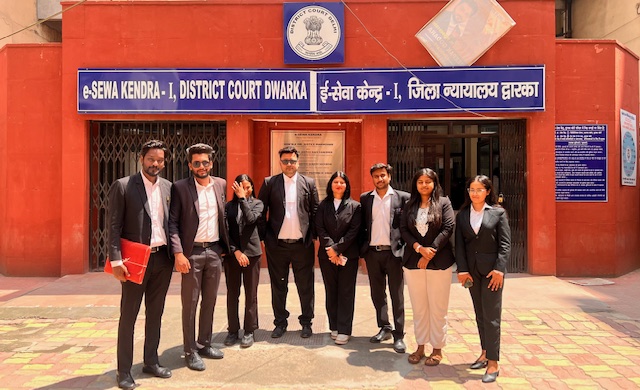
With 18+ years of experience in Dwarka Court, we assist clients during both the pre-litigation and litigation stages with a focus on professional standards, transparent communication and proper documentation.

📞 Need Legal Assistance in a Criminal Matter?

If you have received an FIR, police notice or complaint connected with Dwarka Court, take timely legal advice and understand your legal position before taking the next step.

Ankit Gaurav Kainth & Associates
Advocates in Dwarka Court, Delhi
📍 Chamber No. 728, 7th Floor, Lawyers Chambers Block, District Court Dwarka, Sector-10, New Delhi

📞 9899085554 | 9811885554

Disclaimer: This article is intended solely for general legal information and educational purposes. It does not constitute legal advice, does not create an advocate-client relationship and should not be treated as a substitute for examination of the facts and documents of an individual case. Legal remedies and procedures may vary according to the facts, applicable law and stage of proceedings.
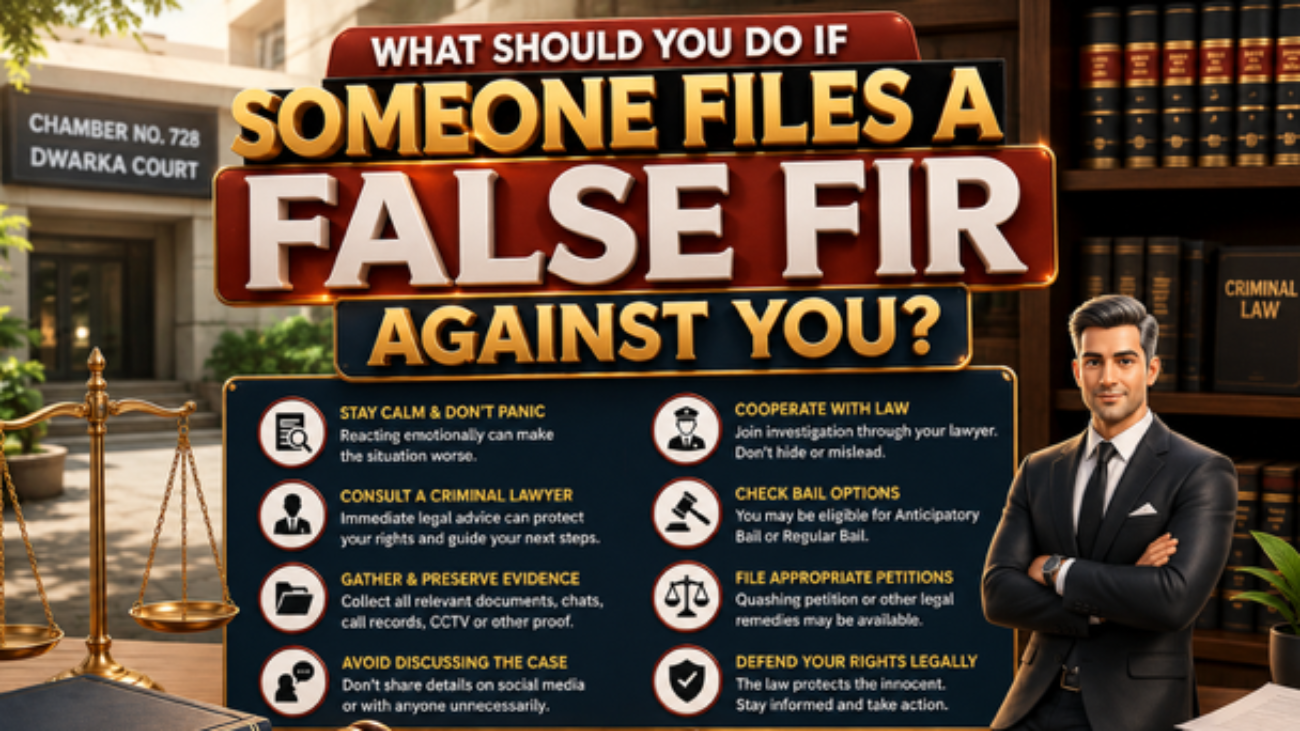

Advocate explaining legal remedies available when a false FIR is filed against a person in Dwarka Court Delhi.

What Should You Do If Someone Files a False FIR Against You? | Complete Legal Guide by an Advocate in Dwarka Court

Introduction – False FIR Against You

A False FIR Against You can be one of the most stressful situations a person may face. It may affect your reputation, employment, business, family life, and mental peace. However, receiving information about a False FIR Against You does not automatically mean that you are guilty.

The law provides several legal remedies to protect innocent persons from malicious or fabricated criminal allegations. Therefore, understanding your legal rights and taking timely legal advice is extremely important.

If you are facing a False FIR Against You in Delhi, especially within the jurisdiction of Dwarka Court, this guide explains the legal process, available remedies, and practical steps that should be taken immediately.


📌 What is a False FIR?

A False FIR Against You generally refers to a First Information Report containing allegations that are incorrect, exaggerated, fabricated, or motivated by personal disputes, family conflicts, business rivalry, property disputes, financial disagreements, or matrimonial litigation.

However, every allegation must be examined according to its own facts and evidence. Therefore, every FIR cannot automatically be described as false merely because the accused denies the allegations.


🚨 Immediate Steps to Take If There is a False FIR Against You

Instead of reacting emotionally, take legally informed steps.

SituationWhat You Should DoWhy It Matters
Learn about the FIRObtain complete details through lawful meansUnderstand the allegations accurately
Consult a lawyer immediatelyTake legal advice before making any statementAvoid legal mistakes
Preserve evidenceSave messages, emails, CCTV, bank records, documents and call records where legally availableSupports your defence
Avoid contacting the complainant unnecessarilyCommunicate only through lawful channels when advisedPrevents unnecessary complications
Cooperate through legal adviceFollow lawful investigation proceduresDemonstrates responsible conduct
Apply for appropriate bail if requiredConsider anticipatory or regular bail depending upon circumstancesProtects personal liberty where legally available
Maintain confidentialityAvoid discussing the case publicly or on social mediaPrevents misuse of statements

⚖️ Can You Get Bail in a False FIR?

Yes. Depending upon the nature of allegations, the applicable law and the facts of the case, you may seek:

✅ Anticipatory Bail

✅ Regular Bail

An experienced Regular Bail & Anticipatory Bail Lawyer Dwarka can examine whether immediate protection should be sought before arrest or whether regular bail becomes necessary after arrest.

Every case is different. Therefore, legal advice should always be based upon the specific facts.


📖 Can a False FIR Be Quashed?

In appropriate cases, legal remedies may include approaching the competent High Court for quashing of criminal proceedings where the law permits.

Courts generally examine factors such as:

  • Whether the allegations disclose a cognizable offence.
  • Whether the complaint appears malicious.
  • Whether continuation of proceedings would amount to abuse of legal process.
  • Whether documentary evidence clearly contradicts the allegations.

The availability of this remedy depends entirely upon the facts of each case.


🛡️ Common Reasons Behind a False FIR Against You

A False FIR Against You may sometimes arise because of:

  • Matrimonial disputes
  • Property disputes
  • Family disagreements
  • Business rivalry
  • Financial transactions
  • Employment conflicts
  • Neighbourhood disputes
  • Personal vengeance

Nevertheless, every complaint deserves careful legal evaluation before any conclusion is drawn.


⚖️ Our Role Before Litigation (Pre-Litigation Assistance)

Many disputes can be better managed before formal court proceedings begin.

Our legal assistance includes:

✅ Legal consultation

✅ Case evaluation

✅ Examination of documents

✅ Drafting replies to legal notices

✅ Complaint strategy

✅ Evidence preservation guidance

✅ Representation before police authorities wherever legally permissible

✅ Negotiation and lawful settlement discussions where appropriate

Early legal advice often helps clients understand their rights and available legal options before litigation progresses.


🏛️ Our Role During Litigation

Once court proceedings begin, proper legal representation becomes even more important.

Our litigation services include:

⚖️ Bail applications

⚖️ Court appearances

⚖️ Criminal defence

⚖️ Filing replies

⚖️ Cross-examination strategy

⚖️ Legal research

⚖️ Drafting petitions

⚖️ Criminal revisions

⚖️ Appeals

⚖️ Quashing petitions where legally maintainable

Every matter is handled after evaluating the applicable law and the available evidence.


📍 Why Choose an Advocate in Dwarka Court?

Choosing a local Advocate in Dwarka Court offers practical advantages.

For more than 18+ years, our office has been regularly appearing before courts functioning in the Dwarka Court Complex.

Our familiarity with local procedures, filing systems, court practice and administrative processes helps us represent clients efficiently while ensuring procedural compliance.

We regularly assist clients from:

📍 Dwarka Sector 6

📍 Dwarka Sector 10

📍 Dwarka Sector 12

📍 Dwarka Sector 23

📍 Dwarka North

📍 Dwarka South

📍 Janakpuri

📍 Vikaspuri

📍 Uttam Nagar

📍 Najafgarh

📍 Mohan Garden

📍 Palam Village

📍 Dabri

📍 Bindapur

📍 Chhawla

📍 Delhi Cantonment

📍 Baba Haridas Nagar

📍 Samalka

📍 Kapashera

📍 Jaffarpur Kalan

and other nearby areas falling within or near Dwarka Court jurisdiction.


🤝 Why Clients Trust Us

Professional relationships are built on transparency.

Our office focuses on:

✅ High professional standards

✅ Honest legal advice

✅ Prompt response to client queries

✅ Availability through phone consultation

✅ Dedicated WhatsApp support

✅ Proper Lawyer–Client Fee Agreements

✅ Transparent fee structure

✅ Fee receipts and acknowledgements

✅ Ethical and fair professional dealings

Every client receives clear communication regarding the legal process, documentation and professional fees.


⚖️ Practice Areas

Apart from defending matters involving a False FIR Against You, we also provide legal assistance as:


📚 Frequently Asked Questions

1. What should I do immediately after a False FIR Against You is registered?

Consult an experienced lawyer immediately, preserve all relevant evidence, avoid making unnecessary statements, and understand the allegations before taking further legal steps.

2. Can I get anticipatory bail in a false FIR?

Depending on the offence, applicable law and case facts, anticipatory bail may be available through the competent court.

3. Can a false FIR be cancelled?

Certain legal remedies, including quashing proceedings before the competent High Court, may be available in appropriate cases. The remedy depends on the facts and applicable law.

4. Should I contact the complainant directly?

Generally, it is advisable to seek legal guidance before communicating with the complainant, particularly during an ongoing investigation.

5. Why should I engage a local Advocate in Dwarka Court?

A local advocate familiar with Dwarka Court procedures, filing systems and day-to-day practice can assist in handling procedural requirements efficiently while providing regular case updates.


📝 Conclusion

A False FIR Against You should never be ignored. At the same time, it should not lead to panic. Timely legal advice, careful preservation of evidence and an informed legal strategy can help you understand your rights and respond appropriately under the law.

Every criminal case depends upon its unique facts, available evidence and applicable legal provisions. Therefore, obtaining professional legal guidance at the earliest stage is often beneficial.


📞 Contact for Legal Consultation

If you require legal guidance regarding a False FIR Against You, bail matters, criminal defence, cheque bounce cases, property disputes or civil litigation, you may contact our office.

📱 Mobile: 9899085554, 9811885554

Office: Near Dwarka Court, Sector-10, New Delhi

Our office provides legal consultation and representation in accordance with applicable law and professional ethics.


⚠️ Disclaimer

This article is intended solely for general legal awareness and informational purposes. It does not constitute legal advice, create an advocate–client relationship, or guarantee any legal outcome. Every case depends on its own facts, evidence and applicable law. Readers should obtain professional legal advice specific to their circumstances before taking any legal action.

Criminal Advocate Dwarka explaining FIR Registration Guide in Dwarka Delhi near Dwarka Court

⚖️ The Ultimate FIR Registration Guide in Dwarka, Delhi

Introduction – FIR Registration Guide in Dwarka, Delhi

An FIR (First Information Report) is often the first step in the criminal justice system. However, many citizens are unaware of their rights, the registration process, and the legal remedies available if the police refuse to register an FIR.

This FIR Registration Guide in Dwarka, Delhi explains the entire process in simple language. Whether you live in Dwarka Sector 6, Dwarka Sector 10, Dwarka Sector 12, Dwarka North, Dwarka South, Janakpuri, Vikaspuri, Uttam Nagar, Najafgarh, Palam Village, Chhawla, Samalka, Dabri, Mohan Garden, Bindapur, Kapashera, Baba Haridas Nagar, Jaffarpur Kalan, or nearby areas near Dwarka Court, understanding FIR registration can protect your legal rights.

Moreover, timely legal guidance can help avoid procedural mistakes that may affect your case later.


What is an FIR?

An FIR or First Information Report is a written document prepared by the police when information about a cognizable offence is received.

Examples include:

✅ Theft

✅ Cheating

✅ Criminal Breach of Trust

✅ Assault

✅ Kidnapping

✅ Criminal Intimidation

✅ Dowry Harassment

✅ Cyber Crime

Once an FIR is registered, the police gain authority to investigate the matter according to law.

Therefore, FIR registration is a critical step in criminal proceedings.


Why is FIR Registration Important?

This FIR Registration Guide in Dwarka, Delhi would be incomplete without understanding its importance.

An FIR:

  • Creates an official record of the incident.
  • Starts police investigation.
  • Preserves evidence.
  • Protects legal rights of victims.
  • Helps courts understand the facts from the beginning.

Consequently, delaying FIR registration may sometimes weaken evidence and affect the overall case.


FIR Registration Process in Dwarka, Delhi

Step 1: Visit the Police Station

The complainant should approach the concerned police station having jurisdiction over the incident.

Step 2: Provide Complete Information

Clearly explain:

  • Date of incident
  • Time of incident
  • Place of occurrence
  • Names of accused (if known)
  • Witness details
  • Supporting evidence

Step 3: Verification by Police

The police officer records the information and verifies basic details.

Step 4: FIR Registration

After recording the complaint, the FIR is registered.

Step 5: Obtain FIR Copy

A free copy of the FIR should be provided to the complainant.

Accordingly, citizens should always preserve this document carefully.


Easy FIR Registration Table

StageAction RequiredOutcome
ComplaintInform police about offenceInformation recorded
VerificationPolice review factsInitial assessment
FIR RegistrationFIR number generatedInvestigation starts
InvestigationEvidence collectionCase development
Court ProceedingsCharge-sheet filedTrial begins
JudgmentCourt decisionFinal outcome

What if Police Refuse to Register an FIR?

Many citizens face this challenge.

Fortunately, the law provides remedies.


You May:

✅ Approach the SHO in writing

✅ Submit complaint to the DCP

✅ Send complaint through registered post

✅ File an application before the Magistrate

✅ Seek legal assistance from a Criminal Advocate Dwarka

Therefore, refusal by police does not mean your legal rights end.


Why Legal Assistance Before FIR Registration Matters

Many people approach lawyers only after problems arise.

However, legal advice at the pre-litigation stage often prevents future complications.


We Assist Clients By:

✅ Reviewing facts

✅ Examining available evidence

✅ Drafting complaints

✅ Preparing representations

✅ Advising on legal strategy

✅ Protecting legal rights from the beginning

As a result, the case proceeds in a structured and legally sound manner.


Pre-Litigation Assistance in Criminal Matters

Our team provides comprehensive pre-litigation support.

Services Include:

  • FIR drafting assistance
  • Police complaint preparation
  • Legal notices
  • Settlement discussions
  • Documentation review
  • Evidence preservation guidance

Moreover, proper pre-litigation planning often strengthens future litigation.


Litigation Support During Court Cases

Once a case reaches court, professional representation becomes essential.

We assist clients throughout:

Criminal Litigation Services

✅ Regular Bail Applications

✅ Anticipatory Bail Applications

✅ Criminal Complaints

✅ Quashing Petitions

✅ Trial Representation

✅ Evidence Stage Assistance

✅ Appeal Proceedings

Consequently, clients receive complete legal support from start to finish.


Local Advantage: Advocates Practicing Near Dwarka Court

One of the biggest benefits of hiring local advocates is familiarity with court procedures.

Having more than 18 years of experience in Dwarka Court, we understand:

  • Court filing procedures
  • Registry requirements
  • Documentation standards
  • Court practices
  • Case management systems

Therefore, cases can often be filed and processed more efficiently.

People searching for an Advocate in Dwarka Court, Criminal Disputes Advocate Dwarka Court, or Crime Lawyer Dwarka often prefer advocates who regularly practise near Dwarka Court.


Why Clients Trust Us

Trust is built through consistent professional conduct.

Our Professional Standards

✅ Honest legal advice

✅ Transparent communication

✅ Ethical representation

✅ Professional conduct


Quick Responsiveness

📞 Calls answered promptly

📱 Dedicated WhatsApp support

📧 Timely updates


Transparent Fee Structure

✅ Reasonable fees

✅ Clear fee discussions

✅ Proper Lawyer-Client Fee Agreements

✅ Fee receipts and acknowledgements

✅ No hidden charges

As a result, clients remain informed throughout the legal process.


Criminal Law Services We Handle

If you are searching for a Criminal Advocate Dwarka, we assist in matters relating to:

  • FIR Registration
  • Criminal Complaints
  • Bail Matters
  • Anticipatory Bail
  • Cheating Cases
  • Property Disputes
  • Cyber Crime Cases
  • Domestic Violence Matters
  • Criminal Breach of Trust
  • Assault Cases

Accordingly, clients receive complete criminal law support under one roof.


Areas We Serve

This FIR Registration Guide in Dwarka, Delhi is relevant for residents of:

  • Dwarka Sector 6
  • Dwarka Sector 10
  • Dwarka Sector 12
  • Dwarka Sector 23
  • Dwarka North
  • Dwarka South
  • Janakpuri
  • Vikaspuri
  • Uttam Nagar
  • Najafgarh
  • Palam Village
  • Chhawla
  • Samalka
  • Dabri
  • Mohan Garden
  • Bindapur
  • Kapashera
  • Baba Haridas Nagar
  • Delhi Cantonment
  • Jaffarpur Kalan

and all nearby areas near Dwarka Court.


Conclusion

Understanding the FIR process is essential for protecting your legal rights. This FIR Registration Guide in Dwarka, Delhi aims to simplify the procedure and help citizens make informed decisions.

Furthermore, obtaining timely legal advice can significantly improve the handling of a criminal matter. Whether you need assistance before filing a complaint or representation during court proceedings, professional guidance can make the process smoother and more effective.


📞 Contact Us Today

Need help regarding FIR registration, criminal complaints, regular bail, anticipatory bail, or criminal litigation?

⚖️ 18+ Years of Experience in Dwarka Court

📞 Mobile: 9899085554

📞 Mobile: 9811885554

📍 Near Dwarka Court, New Delhi

Call today for professional legal guidance and representation

Also Read:-