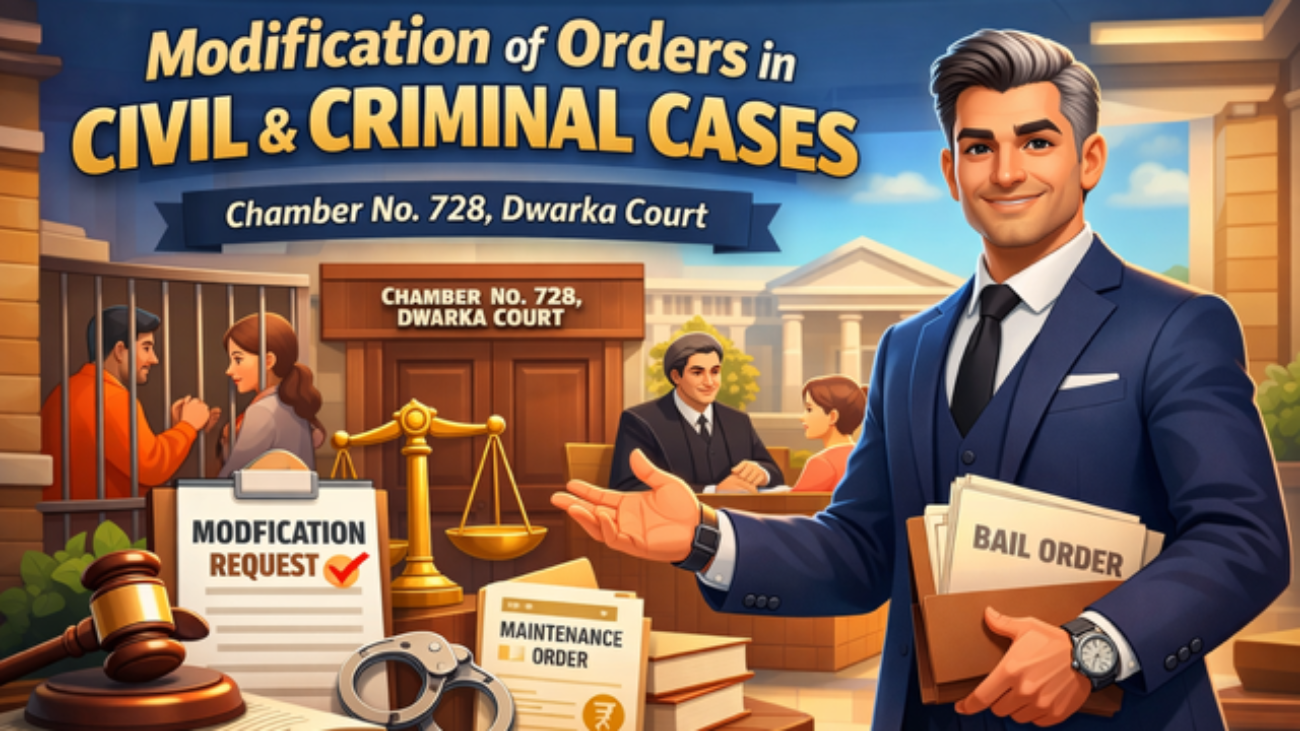
Court orders are not always final. In many situations, circumstances change, new evidence emerges, or errors need correction and one should know “How to Modify Court Orders in Dwarka Court”? Through Criminal Case Advocate Dwarka, In such cases, the law provides an important remedy—modification of court orders.
Section 439 CrPC – Modification of bail conditions
Section 482 CrPC – Inherent powers of High Court
Section 362 CrPC – Restriction on alteration (with exceptions)
Important Judgments (Supra Law)
State of Madhya Pradesh vs. Kajad (2001) Court held that bail conditions can be modified depending on conduct and circumstances.
Dolat Ram vs. State of Haryana (1995) Bail once granted can be modified or cancelled if misuse is proved.
Sushila Aggarwal vs. State (NCT of Delhi) (2020) Landmark judgment clarifying anticipatory bail can continue without time limits, subject to modification.
As a Criminal Case Advocate Dwarka Court, we frequently handle such applications, especially for clients seeking relief from strict bail conditions.
Modification in Civil Cases 📜
In civil matters, modification arises in:
Interim injunction orders
Maintenance or alimony
Custody orders
Execution proceedings
Relevant Legal Provisions
Order 39 Rule 4 CPC – Modification of injunction
Section 151 CPC – Inherent powers of court
Key Judgment
Manohar Lal Chopra vs. Rai Bahadur Rao Raja Seth Hiralal (1962)
The Supreme Court recognized inherent powers of civil courts to modify orders to meet ends of justice.
Why Modification is Important?
However, orders passed at one stage may not remain practical later. Therefore:
Financial situations may change
New evidence may arise
Harsh conditions may need relaxation
Errors may require correction
A skilled Criminal Case Advocate Dwarka Court ensures timely and strategic filing to protect your rights.
💼 Why Professional Legal Help Matters
Many clients make the mistake of filing incomplete or weak applications, leading to rejection.
An experienced lawyer ensures:
Strong legal grounds
Proper drafting
Strategic argument
Faster resolution
📍 Local Advantage – Dwarka Court Practice
Being a local practitioner in Dwarka Court provides:
Better understanding of court procedures
Familiarity with judges’ approach
Faster case handling
Criminal lawyer in Dwarka court
Modification of Orders in Civil & Criminal Cases in Dwarka Court ⚖️
Introduction
In legal practice, orders passed by courts are not always final. Circumstances change, facts evolve, and sometimes justice demands reconsideration. Therefore, modification of orders becomes a crucial legal remedy in both civil and criminal cases.
As a Criminal Case Advocate Dwarka Court, with 18+ years of experience, we regularly assist clients in modifying court orders efficiently and lawfully. Whether it is bail condition modification, interim order alteration, or correction of judicial errors—understanding the right legal approach is essential.
What is Modification of Orders?
Modification means altering, revising, or amending a court order due to change in facts, law, or circumstances. It is not an appeal but a request before the same court or a higher court.
In both civil and criminal cases, courts retain inherent powers to ensure justice.
Modification in Criminal Cases ⚖️
In criminal law, modification commonly applies to:
Section 439 CrPC – Modification of bail conditions
Section 482 CrPC – Inherent powers of High Court
Section 362 CrPC – Restriction on alteration (with exceptions)
Important Judgments (Supra Law)
State of Madhya Pradesh vs. Kajad (2001) Court held that bail conditions can be modified depending on conduct and circumstances.
Dolat Ram vs. State of Haryana (1995) Bail once granted can be modified or cancelled if misuse is proved.
Sushila Aggarwal vs. State (NCT of Delhi) (2020) Landmark judgment clarifying anticipatory bail can continue without time limits, subject to modification.
As a Criminal Case Advocate Dwarka Court, we frequently handle such applications, especially for clients seeking relief from strict bail conditions.
Modification in Civil Cases 📜
In civil matters, modification arises in:
Interim injunction orders
Maintenance or alimony
Custody orders
Execution proceedings
Relevant Legal Provisions
Order 39 Rule 4 CPC – Modification of injunction
Section 151 CPC – Inherent powers of court
Key Judgment
Manohar Lal Chopra vs. Rai Bahadur Rao Raja Seth Hiralal (1962)
The Supreme Court recognized inherent powers of civil courts to modify orders to meet ends of justice.
Why Modification is Important?
However, orders passed at one stage may not remain practical later. Therefore:
Financial situations may change
New evidence may arise
Harsh conditions may need relaxation
Errors may require correction
A skilled Criminal Case Advocate Dwarka Court ensures timely and strategic filing to protect your rights.
Our Role in Pre-Litigation Stage ✅
Before filing any case, we assist clients by:
Evaluating legal strength
Advising whether modification is required or fresh filing
Drafting strong legal notices
Negotiating settlements to avoid litigation
This proactive approach saves time, cost, and stress.
Our Role During Litigation ⚖️
During ongoing cases, we:
File modification applications promptly
Present strong legal arguments backed by judgments
Ensure compliance with court procedures
Represent clients effectively before Dwarka Courts
Being a Criminal Case Advocate Dwarka Court, we understand courtroom dynamics, which helps in quick relief.
Why Choose a Local Dwarka Court Advocate? 📍
Being local advocates in Dwarka Court offers major advantages:
Faster filing and urgent mentioning
Strong familiarity with court staff and procedures
This local expertise makes us a trusted Criminal Case Advocate Dwarka Court.
Client Trust & Professional Commitment 🤝
Our practice is built on:
✅ High professional standards
✅ Quick response to calls and messages
✅ Dedicated WhatsApp legal support
✅ Transparent and reasonable fee structure
✅ Proper Lawyer-Client Fee Agreements
✅ Issuance of receipts and acknowledgments
✅ Honest and ethical legal advice
This is why many clients consider us a Top and Best Advocate in Dwarka Court and a reliable Best Criminal Disputes Advocate Dwarka Court.
Specialized Criminal Practice 🔍
We are recognized as:
Criminal Advocate Dwarka
Best Crime Lawyer Dwarka
Top Regular Bail & Anticipatory Bail Lawyer Dwarka
From bail modifications to complex criminal litigation, our approach is strategic and result-oriented.
Strategic Approach to Modification Applications
A successful modification requires:
Strong legal drafting
Proper documentation
Reliance on case laws
Clear demonstration of changed circumstances
As a Criminal Case Advocate Dwarka Court, we ensure every application is legally sound and persuasive.
Conclusion & Call to Action 📞
Modification of orders is a powerful legal remedy—but only when used correctly. A minor mistake can lead to rejection or delay.
If you are facing issues with court orders or need urgent modification:
👉 Consult an experienced Criminal Case Advocate Dwarka Court today.
👉 Get clear, honest, and practical legal guidance.
👉 Protect your rights with confidence.
📞 Call now or connect on WhatsApp for immediate assistance :- 9899085554, 9811885554.
👨⚖️ About the Advocate
With 18+ years of experience in Dwarka Court, we are known as a Criminal Case Advocate Dwarka Court delivering fast, transparent, and result-driven legal solutions.
🏁 Final Words
Lending money to relatives is common. However, ignoring legal rules can be costly. Therefore, always follow proper legal channels and documentation.
If you need guidance, consult a trusted Criminal Case Advocate Dwarka Court to stay safe and legally protected.
🧾 Introduction& Explanation by Criminal Case Advocate Dwarka Court
Many people in India casually lend money to relatives during emergencies . However, what seems like a simple family transaction can sometimes attract serious legal consequences. Therefore, understanding the law—especially Section 269SS of the Income Tax Act—is extremely important through a Criminal Case Advocate Dwarka Court.
As a Criminal Case Advocate Dwarka Court, I often see clients facing penalties simply because they were unaware of these rules. Hence, this blog explains everything in a simple, practical, and legally accurate manner.
Criminal lawyer in dwarka court
📜 What is Section 269SS of the Income Tax Act?
Section 269SS restricts acceptance of loans or deposits in cash beyond ₹20,000. In other words:
👉 If you lend or accept ₹20,000 or more in cash, it may be illegal.
👉 The transaction must be done through:
Bank transfer
Account payee cheque
Digital payment
Therefore, even if the money is given to a relative, the law still applies.
Top Advocate in Dwarka Court
⚠️ Is Lending Cash to Relatives Illegal?
👉 Short Answer: Yes, it can be illegal.
However, it depends on the amount and mode of transaction.
✔️ Legal Situations
Lending below ₹20,000 in cash
Lending any amount via bank transfer
❌ Illegal / Risky Situations
Giving ₹20,000+ in cash
Taking large cash loans without documentation
Repeated small cash transactions to bypass the law
As a Criminal Case Advocate Dwarka Court, I strongly advise clients to avoid cash dealings, even within families.
🚨 Penalty Under Section 271D
If you violate Section 269SS:
👉 Penalty = 100% of the loan amount
For example:
If ₹2,00,000 is given in cash → ₹2,00,000 penalty
Therefore, the consequences are extremely serious.
Advocate in Dwarka Court
❌ What NOT to Do (Very Important)
Avoid these common mistakes:
🚫 Do not give ₹20,000+ cash even to close relatives
With 18+ years of experience in Dwarka Court, we are known as a Criminal Case Advocate Dwarka Court delivering fast, transparent, and result-driven legal solutions.
🏁 Final Words
Lending money to relatives is common. However, ignoring legal rules can be costly. Therefore, always follow proper legal channels and documentation.
In the legal profession, integrity is not just a virtue—it is the foundation. Especially when you are working as an Advocate Dwarka Court, handling sensitive criminal and civil cases, the pressure can be immense. Stakes are high, emotions run deep, and sometimes, the opposition may attempt to influence the outcome through unethical means.
However, the real test of a lawyer is not in easy victories—but in standing firm when challenged.
A Real Incident That Defined My Journey 💼🔫
Back in 2010, when I had just started my journey as an Advocate Dwarka Court, I was representing a client in a farmhouse land dispute in Rajokri.
One day, without any appointment, the opposing party walked into my office. I clearly told him that I could not discuss anything without my client’s instructions. However, what followed was shocking.
He carried a bag full of money 💼—an attempt to influence me. When I refused, he tried to intimidate me with a weapon 🔫.
Strangely, in that moment, the gun didn’t scare me—it looked almost “beautiful” 🤭 because it revealed the weakness of the other side.
In criminal and civil litigation, situations may arise where the opposite party tries to influence your case through unfair means—sometimes with money 💼, sometimes with pressure 🔫. https://t.co/vMagn8oorB
Being an Advocate Dwarka Court, we strongly believe in:
Transparency 🤝
Accountability 📊
Professional Excellence ⚖️
Client Satisfaction ⭐
Because when you stay loyal to your profession, success naturally follows.
Conclusion ✨
The legal path is not always easy. There will be pressure, challenges, and even threats. However, what defines a true Advocate Dwarka Court is courage and integrity.
👉 Remember:
If a lawyer sells his conscience, he loses respect. If he fears pressure, he loses purpose.
Facing an FIR is stressful. However, what truly damages a case is what an accused does after the FIR. Many people unknowingly make critical mistakes that weaken their defence. Therefore, understanding the correct approach is essential.
Advocate in Dwarka Court
With 18+ years of experience as a Criminal Case Advocate Dwarka Court, I have seen how small errors can turn a manageable case into a serious legal problem.
⚠️ Common Mistakes After FIR (With Practical Examples)
🚫 1. Speaking to Police Without Legal Advice
Firstly, many accused persons try to “explain their side” to police. However, statements given without guidance can be used against them.
👉 Example: A person casually admits presence at the spot. Later, this becomes key evidence.
The only reason we file and represent cases quickly is because we are local advocates in Dwarka Court. We understand procedures, filing systems, and courtroom functioning in depth.
Clients trust us because:
✅ High professional standards
✅ Always responsive on call & WhatsApp
✅ Dedicated communication channels
✅ Reasonable and justified fees
✅ Lawyer-Client Fee Agreement
✅ Fee receipts & acknowledgements
✅ Honest, fair & transparent approach
Therefore, we are recognised as a Top and Best Advocate in Dwarka Court and a reliable Criminal Case Advocate Dwarka Court.
In today’s fast-paced legal environment, even a small mistake in a criminal case can lead to serious consequences. Whether it is a matter of bail, FIR, or trial, the right legal strategy at the right time is critical. As an experienced Criminal Lawyer Dwarka Court with 18+ years of practice, I have seen how avoidable errors can weaken even strong cases.
Advocate in Dwarka court
Therefore, understanding these mistakes is essential before taking any legal step.
Avoid costly criminal case mistakes with expert legal guidance in Dwarka Court
⚖️ 1. Delaying Legal Consultation
First and foremost, many accused persons delay contacting a Criminal Lawyer Dwarka. Consequently, valuable time is lost. Early legal advice helps in protecting rights, preparing anticipatory bail, and avoiding unnecessary arrest.
Often, individuals unknowingly give statements to police without consulting a Criminal Lawyer Dwarka Court. As a result, such statements may be used against them later during trial.
🚫 3. Ignoring Notices or Summons
Ignoring police notices or court summons can worsen the situation. Instead, timely response through a Criminal Lawyer Dwarka ensures compliance and avoids coercive action.
📉 4. Filing Poorly Drafted Bail Applications
A weak bail application can lead to rejection. Therefore, engaging a Top Regular Bail & Anticipatory Bail Lawyer Dwarka ensures strong legal grounds and proper documentation.
⚠️ 5. Not Preserving Evidence
Another common mistake is failing to collect or preserve evidence. On the contrary, a skilled Criminal Lawyer Dwarka Court builds a strong defence using facts and documentation.
📱 6. Misuse of Social Media
Posting about the case on social media can backfire. Hence, it is always advisable to act cautiously under guidance of a Best Crime Lawyer Dwarka.
🧾 7. Signing Documents Blindly
Many clients sign documents without understanding implications. However, every document must be reviewed by a Criminal Lawyer Dwarka before signing.
⏳ 8. Delay in Filing Legal Remedies
Delay in filing bail, quashing, or appeals reduces chances of success. Therefore, prompt action by a Criminal Lawyer Dwarka Court is crucial.
Finally, absence of a clear legal strategy leads to confusion and weak defence. A professional Criminal Lawyer Dwarka ensures a structured and result-oriented approach.
🛡️ How We Assist Clients (Pre-Litigation & During Litigation)
The only reason we are able to file and represent cases quickly is because we are local advocates in Dwarka Court. We are deeply familiar with court procedures, filing systems, and practical workings.
Yes. We provide dedicated communication support for our clients.
📢 Call to Action
With 18+ years of experience in Dwarka Court, we have successfully handled numerous criminal matters with professionalism and integrity. If you are facing any criminal issue, do not take risks.
👉 Consult a trusted Criminal Lawyer Dwarka Court today for immediate legal assistance:- 9899085554, 9811885554.
In today’s legal landscape, cheque bounce litigation under Section 138 of the NI Act has become one of the most frequently filed cases in Dwarka Court. However, not every case is handled with the same level of strategy, commitment, and expertise.
With my 18+ years of experience in Civil & Criminal litigation at Dwarka Court, I have closely observed a concerning trend. Many advocates often prefer unnecessary adjournments in cheque bounce cases. Thereafter, they advise their clients to settle—sometimes even when a strong defence exists.
⚠️ Unfortunately, such settlements are often forced, impractical, and sometimes not even honoured by the opposite party.
Facing a criminal case can be overwhelming. However, understanding the police investigation process in Dwarka Court can make a significant difference in protecting your rights. With 18+ years of experience, we, as a trusted Criminal Case Advocate Dwarka Court, guide clients at every stage—right from pre-litigation to trial.
⚖️ What is Police Investigation in Criminal Cases?
Police investigation is the process through which authorities collect evidence, examine witnesses, and determine whether an offence has been committed. Importantly, this stage lays the foundation of the entire case.
Understanding the investigation process helps you:
Avoid self-incrimination
Respond correctly to police notices
Build a strong defense early
Protect your reputation and rights
Therefore, always consult a Criminal Case Advocate Dwarka Court before taking any step.
❓ Frequently Asked Questions (FAQs)
Q1. Can police arrest without notice?
Yes, in serious offences. However, in many cases, notice under Section 41A CrPC is required.
Q2. When should I contact a lawyer?
Immediately after FIR or even before. Early guidance from a Criminal Case Advocate Dwarka Court is crucial.
Q3. What is anticipatory bail?
It is pre-arrest bail granted by court. A Top Regular Bail & Anticipatory Bail Lawyer Dwarka can assist you.
Q4. Can false cases be challenged?
Yes, false FIRs can be quashed or defended effectively with proper legal strategy.
Q5. How long does investigation take?
It depends on the case, but timely legal intervention can speed up the process.
📢 Final Words & CTA
If you or your loved one is facing a criminal investigation, do not delay. With 18+ years of experience in Dwarka Court, we provide strategic, reliable, and result-oriented legal assistance.
👉 Consult a Criminal Case Advocate Dwarka Court today
📞 Call / WhatsApp now for immediate legal help:- 9899085554, 9811885554.
Facing the fear of arrest in a criminal case can be overwhelming. However, with the right legal approach, timely action, and guidance from a Criminal Case Advocate Dwarka Court, you can avoid arrest and protect your rights effectively.
With 18+ years of experience as a Criminal Case Advocate Dwarka Court, we have consistently helped clients navigate such critical situations with confidence and strategy.
🚔 Understanding Arrest & Legal Protection
Firstly, it is important to understand that arrest is not mandatory in every criminal case. The law provides safeguards such as:
Notice under Section 41A CrPC
Anticipatory Bail
Interim Protection
Therefore, consulting a Criminal Case Advocate Dwarka Court at the earliest stage is crucial.
⚡ Stay Calm & Act Proactively
Whenever you find yourself in such harsh conditions, do not panic. Instead:
👉 Act quickly
👉 Stay informed
👉 Seek professional legal advice
Only an experienced Criminal Case Advocate Dwarka Court can guide you properly, because experience comes from handling real cases over years, not just theoretical knowledge.
👨⚖️ Choose Experience Over Appearance
Today, many dummy advocates appear confident but lack real courtroom experience. Therefore:
Always ask about years of practice
Check court experience
Prefer a regular Criminal Case Advocate Dwarka Court
👉 An experienced lawyer understands:
Police behaviour
Court procedures
Bail strategies
This makes a huge difference in avoiding arrest.
📍 Importance of Local Advocate in Dwarka Court
Choosing a local Criminal Case Advocate Dwarka Court gives you a strong advantage.
✔ Why Local Matters:
Familiarity with Dwarka Court procedures
Understanding of police station functioning
Coordination with court staff & bar association
The only reason we are able to file and represent cases in a very short time is because we are regular Criminal Case Advocate Dwarka Court, deeply aware of local processes.
🛡️ Legal Ways to Avoid Arrest
With proper guidance from a Criminal Case Advocate Dwarka Court, you can:
🔹 Apply for Anticipatory Bail
Protection before arrest in serious cases.
🔹 Respond to 41A Notice Properly
Avoid escalation by cooperating legally.
🔹 File Counter Complaint
If falsely implicated, take immediate legal action.
🔹 Prepare Documentation
Strong defence reduces chances of arrest.
👉 Therefore, timely legal strategy is the key.
⚖️ Prompt Action is the Key
In criminal matters, delay can be dangerous. On the other hand, quick legal action can:
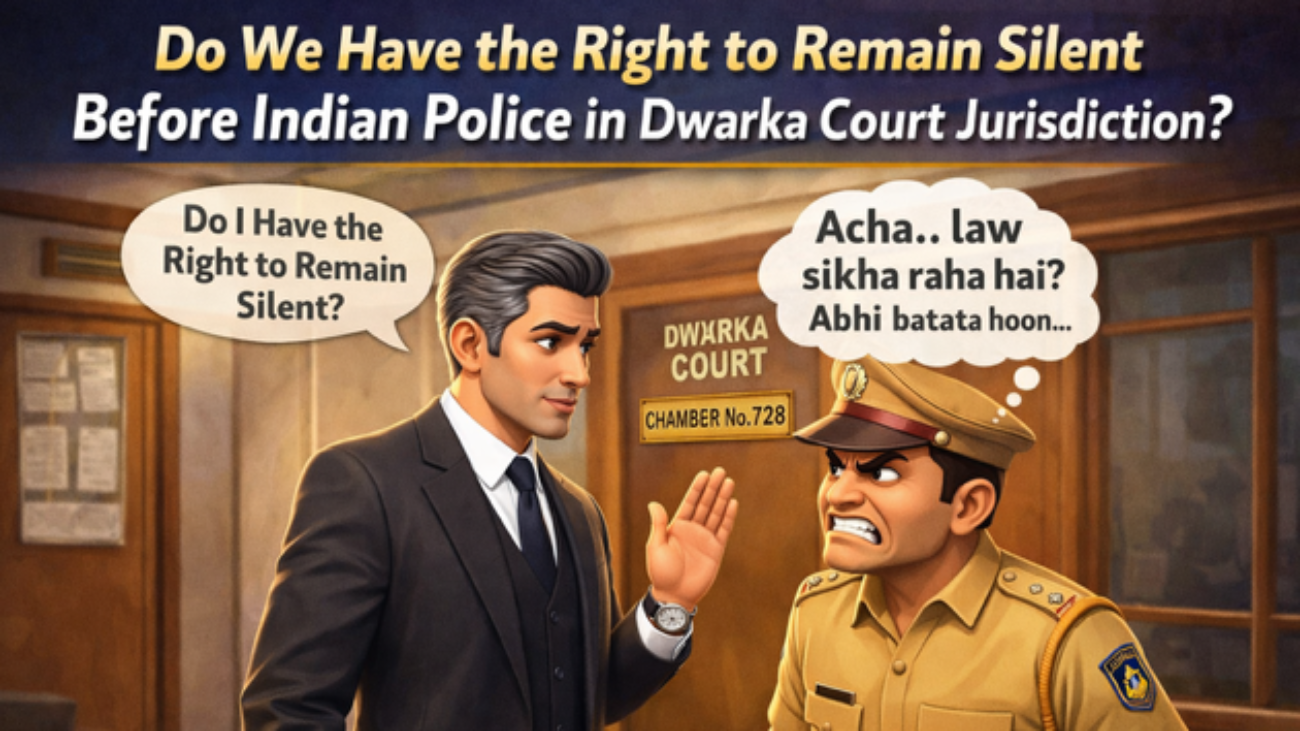
“Do I have the right to remain silent?” — sounds cool, right? Straight out of a Hollywood movie. You imagine yourself as Harvey Specter, confidently handling the situation in Dwarka Court.
Now, let’s land back in India — especially within the Dwarka Court jurisdiction.
⚖️ Legal Reality: Yes, You Have the Right
Legally speaking, yes — you do have the right to remain silent. Under Article 20(3) of the Constitution of India, no accused person can be compelled to be a witness against themselves.
In simple terms, you cannot be forced to confess or say something that may harm your case. Therefore, every Criminal Case Advocate Dwarka Court will advise you to understand and exercise this right wisely.
😂 Practical Reality in India
However, let’s talk about reality.
Imagine you’re sitting in a police station under the Dwarka Court jurisdiction. The officer asks you questions. You calmly say,
“Sir, do I have the right to remain silent?”
At that exact moment, somewhere in the officer’s mind:
“Acha… law sikha raha hai? Abhi batata hoon…”
Of course, this is a humorous exaggeration. Yet, it reflects the gap between legal rights and ground reality. While the system is improving, experiences still vary.
🌍 India vs Foreign Practice
In countries like the United States, police officers inform you of your rights upfront.
However, in India, especially within the Dwarka Court jurisdiction, you are generally expected to already know your rights or be guided by a Criminal Case Advocate Dwarka Court.
⚡ The Smart Approach: Silence + Strategy
So yes, you can remain silent — but silence alone is not enough.
✔️ Stay calm and respectful
✔️ Do not volunteer unnecessary information
✔️ Ask for legal assistance immediately
✔️ Contact a Criminal Case Advocate Dwarka Court
Because while silence is your right, guided communication is your protection.
👨⚖️ Why Legal Assistance Matters in Dwarka Court
The reality is simple — criminal law is not just about rights; it is about timely action.
A skilled Criminal Case Advocate Dwarka Court ensures:
Proper handling of police interaction
Immediate protection in FIR cases
Strong defence strategy
Timely filing of bail applications
Whether you are looking for a Criminal Advocate Dwarka, Best Crime Lawyer Dwarka, or Top Regular Bail & Anticipatory Bail Lawyer Dwarka, professional guidance makes all the difference.
📂 Our Expertise in Dwarka Court
With 18+ years of experience, we are recognized as a Top and Best Advocate in Dwarka Court for criminal matters.
We specialise in:
FIR case handling
Bail Matters (Regular & Anticipatory)
Criminal disputes
Police complaint matters
As a dedicated Criminal Case Advocate Dwarka Court, we understand the system, procedures, and practical challenges of Dwarka Court deeply.
We provide services across all areas under Dwarka Court, including:
Janakpuri, Vikaspuri, Dwarka North, Dwarka South, Dwarka Sector-23, Delhi Cantonment, Chhawla, Bindapur, Baba Haridas Nagar, Mohan Garden, Palam Village, Najafgarh, Uttam Nagar, Samalka, Dabri, Kapashera, Jaffarpur Kalan, and Airport Police Station (Domestic & International).
🌟 Why Choose a Criminal Case Advocate Dwarka Court?
✔️ Local court expertise
✔️ Strong police coordination
✔️ Faster legal response
✔️ Practical courtroom strategy
✔️ Trusted by clients for years
A knowledgeable Criminal Case Advocate Dwarka Court ensures your rights are not just theoretical — but effectively protected.
📊 Final Thought
So next time you feel like saying,
“I choose to remain silent,”
Remember — in India, especially within Dwarka Court jurisdiction, it is not just a legal right… it is a strategic decision guided by a Criminal Case Advocate Dwarka Court.
❓ FAQ Section
Q1. Can I refuse to answer police questions in Dwarka Court jurisdiction?
Yes, you have the right to remain silent. However, always consult a Criminal Case Advocate Dwarka Court before taking any step.
Q2. Is silence enough to protect me?
No. Silence must be supported by proper legal guidance from a Criminal Case Advocate Dwarka Court.
Q3. When should I contact a lawyer?
Immediately after police contact or FIR registration in Dwarka Court jurisdiction.
Q4. Can police force me to confess?
No, as per Article 20(3). A Criminal Case Advocate Dwarka Court can ensure your rights are protected.
Q5. Do you handle bail matters?
Yes, we are experienced as a Top Regular Bail & Anticipatory Bail Lawyer Dwarka.
📞 Call to Action
If you are facing any criminal issue, FIR, or police inquiry, do not take risks.
With 18+ years of experience, we are your trusted Criminal Case Advocate Dwarka Court for effective and timely legal solutions.
👉 Contact now for expert assistance from a Top & Best Advocate in Dwarka Court- 9899085554, 9811885554.
Introduction – Police Notice under Section 35(3) BNSS
Receiving a police notice asking you to appear before an Investigating Officer can immediately raise concerns about arrest, questioning, an FIR and the future of the criminal case.
The first thing to understand is that a notice under Section 35(3) of the Bharatiya Nagarik Suraksha Sanhita, 2023 (BNSS) is not the same as an arrest warrant.
It is a statutory notice requiring a person to appear before the police and cooperate with an investigation where the police do not consider immediate arrest necessary at that stage.
should understand that in current proceedings the relevant provision is ordinarily Section 35(3) BNSS.
For a person who has received such a notice in Delhi, the correct response is neither panic nor disregard. The notice should be examined carefully, the allegations should be understood and the person should comply with the investigation while protecting his or her legal rights.
What Is a Notice Under Section 35(3) BNSS?
Section 35 BNSS deals with situations in which police may arrest a person without warrant.
Section 35(3) provides that where arrest is not required under Section 35(1), the police officer shall issue a notice directing a person against whom a reasonable complaint has been made, credible information has been received or reasonable suspicion exists of involvement in a cognizable offence to appear before the police officer or at another place specified in the notice.
This has an important practical consequence.
The police may investigate a person without immediately taking that person into custody.
A notice to join investigation is therefore an important procedural stage and should be treated seriously.
Section 41A CrPC vs Section 35(3) BNSS
The terminology changed after the introduction of the BNSS.
Earlier Law
Present Law
Section 41 CrPC
Section 35 BNSS
Section 41A CrPC
Section 35(3)–35(6) BNSS
Section 41D CrPC
Section 38 BNSS
Notice of appearance before police
Notice requiring appearance during investigation
Delhi Police’s own BNSS forms identify the notice for appearance under Section 35(3) BNSS as corresponding to the erstwhile Section 41A CrPC.
Therefore, an old article referring only to Section 41A CrPC is no longer sufficient for a person facing a current investigation.
Is a Section 35(3) BNSS Notice an Arrest Notice?
No.
A notice under Section 35(3) ordinarily indicates that, at the stage when the notice is issued, the Investigating Officer has chosen the notice-and-cooperation route rather than immediate arrest.
However, this should not be misunderstood to mean that arrest becomes legally impossible in every circumstance.
Section 35(5) BNSS provides an important protection where the person:
complies with the notice; and
continues to comply with its terms.
In such circumstances, the person should not be arrested in relation to the offence mentioned in the notice unless the police officer records reasons for forming the opinion that arrest has become necessary.
This makes continued compliance extremely important.
Supreme Court’s 2026 Clarification on Section 35 BNSS
The legal position was further clarified by the Supreme Court in Satender Kumar Antil v. Central Bureau of Investigation & Anr., 2026 INSC 115, decided on 15 January 2026.
The Supreme Court examined the relationship between:
Section 35(1)(b) BNSS;
Section 35(3) BNSS;
compliance with a police notice; and
subsequent arrest.
For offences punishable with imprisonment up to seven years, the Supreme Court clarified that issuance of notice under Section 35(3) is the rule, while arrest is an exception.
The Court further emphasised that arrest cannot be treated as a routine method merely for questioning a person.
The Investigating Officer must consider whether custody is objectively necessary for the investigation and comply with the safeguards contained in Section 35.
For a person who has already received a notice and continues to comply with it, the statutory protection under Section 35(5) therefore assumes substantial importance.
At the same time, the judgment should not be misunderstood as providing absolute protection from arrest in every case. Arrest can still arise where the statutory requirements are met and legally sufficient reasons exist.
What Should You Do Immediately After Receiving a Section 35(3) Notice?
The safest approach is to deal with the notice methodically.
1. Read the Entire Notice
Check:
FIR number;
date of FIR;
police station;
sections mentioned;
name of Investigating Officer;
date and time for appearance;
place where appearance is required;
documents, devices or information requested.
Do not rely only upon what somebody tells you verbally about the case.
Understanding the precise contents of the notice is the first step.
2. Verify the FIR and Allegations
Where an FIR number is mentioned, obtain and examine the FIR wherever legally accessible.
You need to understand:
who has made the complaint;
what acts are attributed to you;
which offences are alleged;
whether you are specifically named;
whether the dispute has documentary, financial, matrimonial, property, cyber or commercial background;
whether other accused persons are involved.
A police notice should be considered in the context of the entire case, not in isolation.
3. Do Not Ignore the Notice
Section 35(4) BNSS places a duty upon the noticee to comply with the terms of the notice.
Ignoring repeated notices without lawful justification can create unnecessary complications.
At the same time, non-compliance does not automatically mean arrest in every case. The Supreme Court has clarified that even arrest following non-compliance is not meant to operate mechanically.
Nevertheless, voluntarily creating a record of non-compliance is rarely a sensible litigation strategy without proper legal advice.
4. Preserve All Relevant Evidence
Before joining investigation, identify and preserve material relevant to the allegations, including where applicable:
WhatsApp conversations;
emails;
contracts;
bank statements;
payment records;
invoices;
photographs;
call records available with you;
property documents;
employment records;
business correspondence;
screenshots;
electronic transaction details;
earlier complaints and representations.
Do not delete, modify or fabricate digital evidence after receiving a police notice.
The surrounding electronic record may later become important both during investigation and during bail or trial proceedings.
5. Prepare a Chronology
A concise chronology often helps in understanding the case.
Record:
when the relationship or transaction began;
important dates;
payments made or received;
relevant meetings or communications;
emergence of the dispute;
earlier notices or complaints;
police communications;
filing of FIR, if known;
subsequent developments.
This helps distinguish relevant facts from assumptions and emotional responses.
Should You Take an Advocate to the Police Station?
A person receiving a notice can seek legal advice before joining investigation.
An advocate can assist by examining:
the FIR or complaint;
offences invoked;
arrest exposure;
documents relevant to the defence;
need for written representation;
bail implications;
manner in which investigation should be joined.
However, it is important not to overstate the advocate’s role.
The law does not necessarily give an advocate a right to sit beside a noticee throughout the entire police interrogation.
Section 38 BNSS provides that an arrested person is entitled to meet an advocate of his or her choice during interrogation, though not throughout interrogation.
Accordingly, professional legal assistance before and during the investigation stage can be valuable, but the precise extent of the advocate’s presence during questioning depends upon applicable law and circumstances.
The correct objective is to obtain lawful legal assistance—not to obstruct the investigation.
Can Police Arrest You After You Comply With the Notice?
Compliance provides an important statutory safeguard, but the answer is not an unconditional “no.”
Under Section 35(5), a person complying and continuing to comply with the notice should not be arrested for the offence referred to in the notice unless the police officer records reasons for concluding that arrest is necessary.
The Supreme Court’s January 2026 decision further emphasised that subsequent arrest should not become routine.
Therefore, factors such as the following can become relevant:
nature of allegations;
seriousness of offence;
punishment prescribed;
availability of evidence;
possibility of evidence being destroyed;
threat or influence upon witnesses;
likelihood of absconding;
cooperation with investigation;
requirement of custodial investigation;
developments discovered after issuance of notice.
Each case therefore requires an individual assessment.
What If You Cannot Appear on the Date Mentioned?
Do not simply remain absent.
If there is a genuine difficulty—such as illness, unavoidable travel, another court appearance or other legitimate circumstances—it may be appropriate to promptly communicate with the Investigating Officer and seek another date.
The communication should preferably create a proper record.
A request for another date is different from deliberately avoiding investigation.
Should You Give Documents to Police?
That depends upon what has been requested and the nature of the investigation.
Before handing over important original documents or electronic material, understand:
what is being requested;
under which authority;
whether originals are required;
whether copies can be provided;
whether an acknowledgment or seizure memo should be obtained;
whether the device or document contains unrelated confidential information.
Never fabricate or alter records in response to a police notice.
Should You Sign a Statement at the Police Station?
Do not sign documents blindly.
Read every document placed before you and understand its nature before signing.
There is an important distinction between:
acknowledging receipt or attendance;
handing over documents;
a seizure memo;
a written representation submitted by you;
a police-recorded statement;
other investigation documents.
These documents can have different legal consequences.
If uncertain, obtain legal advice before signing.
What About Self-Incrimination?
Article 20(3) of the Constitution provides protection against compelled self-incrimination to a person accused of an offence.
At the same time, receiving this constitutional protection does not mean that a person can simply disregard every lawful investigation requirement.
The distinction between lawful cooperation, production of material and compelled testimonial self-incrimination can be legally significant.
That is why case-specific legal advice becomes particularly important where questioning involves financial transactions, electronic evidence, passwords, business records or potentially incriminating circumstances.
Do You Need Anticipatory Bail After Receiving a Section 35(3) Notice?
Not automatically.
The fact that a Section 35(3) notice has been issued generally indicates that immediate arrest was not considered necessary when the notice was issued.
However, whether anticipatory bail should still be considered depends upon factors such as:
offences alleged;
maximum punishment;
conduct of investigation;
previous attempts at arrest;
allegations against co-accused;
changed circumstances;
previous notices;
nature of evidence;
actual apprehension of arrest.
Filing anticipatory bail mechanically merely because a police notice has been issued is not necessarily the correct approach.
Conversely, a genuine and reasonable apprehension of arrest should not be ignored merely because the person has earlier received a notice.
The strategy must depend upon the facts.
What If the Complaint Is False?
Receiving a police notice does not establish guilt.
If the allegations are demonstrably incorrect, useful material may include:
contemporaneous communications;
financial records;
location or transaction records;
contractual documents;
prior disputes;
earlier complaints;
photographs or recordings lawfully available;
independent witnesses.
A written representation may sometimes be appropriate.
A counter-complaint should not be filed automatically merely because someone has lodged an FIR against you. It should be considered only where the facts independently disclose a legal basis for such a complaint.
Retaliatory complaints without factual foundation can complicate the dispute rather than assist the defence.
Police Notice in Cheating and Financial Disputes
Section 35(3) notices frequently arise in disputes involving allegations of:
cheating;
breach of trust;
business transactions;
investment disputes;
property transactions;
loan disputes;
partnership disagreements;
online fraud;
cyber transactions.
In such cases, one of the central legal questions may be whether the material discloses a criminal offence or whether the dispute substantially arises from contractual or civil obligations.
For example, in a cheating allegation, the existence of dishonest intention at the relevant stage may become important.
Bank records, agreements, invoices, communications and transaction chronology can therefore be highly relevant.
Section 35 Notice in Matrimonial Cases
Investigation notices can also arise in matrimonial FIRs.
Relevant material may include:
marriage-related documents;
communications between spouses;
financial records;
previous litigation;
maintenance proceedings;
domestic violence proceedings;
complaints exchanged between parties;
settlement discussions.
The existence of matrimonial litigation does not by itself prove or disprove criminal allegations. Each proceeding must be assessed independently.
Cyber Crime and Digital-Evidence Cases
Where the investigation concerns cybercrime or online financial fraud, noticees should take particular care to preserve electronic evidence.
Relevant material may include:
bank transaction trails;
UPI details;
email headers;
device records;
account ownership details;
IP-related material where lawfully available;
screenshots;
cryptocurrency transaction details;
communications with banks and payment platforms.
Deleting accounts or resetting devices after receiving an investigation notice may create evidentiary complications.
Jurisdiction of Dwarka Courts and South-West Delhi
Criminal cases connected with police stations in South-West Delhi may ultimately be placed before courts at the Dwarka Courts Complex depending upon territorial jurisdiction, offence, police station and administrative assignment.
The correct court should always be verified from the:
FIR;
police station;
offence;
applicable jurisdiction; and
court allocation.
Merely residing in Dwarka does not by itself determine which court will hear every criminal case.
How a Criminal Defence Advocate Can Assist at the Investigation Stage
Legal assistance at this stage may include:
examining the police notice;
reviewing FIR and allegations;
explaining Section 35 BNSS;
assessing arrest exposure;
reviewing documents and electronic evidence;
preparing a chronology;
drafting an appropriate representation where required;
advising on compliance with investigation;
assessing anticipatory bail where justified;
appearing before the competent court where proceedings require;
advising on subsequent chargesheet, bail, discharge, trial, revision or quashing remedies.
The purpose of investigation-stage legal advice should be to help a person understand and exercise lawful rights while complying with legal obligations.
No lawyer can guarantee that an FIR will be cancelled, that arrest will never occur, or that a particular investigation will result in a specific outcome.
Practical Checklist Before Joining Investigation
Before going to the police station, verify:
Have I read the complete notice?
Do I know the FIR number and sections?
Have I obtained legal advice where necessary?
Have I prepared a truthful chronology?
Have I preserved relevant electronic evidence?
Do I know which documents have been requested?
Have I avoided contacting witnesses improperly?
Have I avoided deleting chats or transaction records?
Do I understand my arrest exposure?
Do I have a record showing my compliance with the notice?
Proper preparation is generally more useful than panic or avoidance.
Near conclusion or “what happens after investigation”
Post-investigation criminal procedure
Creates a natural investigation → chargesheet → trial content journey.
Frequently Asked Questions
Is Section 35(3) BNSS the same as old Section 41A CrPC?
Section 35 BNSS now substantially incorporates the framework that was earlier associated with Sections 41 and 41A CrPC. A present-day notice to appear during investigation is ordinarily issued under Section 35(3) BNSS.
Does receiving the notice mean I am guilty?
No. A police notice is part of an investigation. Guilt or innocence is not determined merely because a notice has been issued.
Does the notice mean police cannot arrest me?
Not absolutely. Continued compliance provides substantial statutory protection, but arrest may still occur if the legal requirements are satisfied and reasons are recorded.
Can police arrest me only because they want to question me?
The Supreme Court in Satender Kumar Antil v. CBI, 2026 INSC 115 emphasised that arrest should be based upon objective necessity and should not be treated merely as a convenient method of questioning.
What happens if I comply with the notice?
Section 35(5) provides that a person who complies and continues to comply should not be arrested in respect of the offence referred to in the notice unless reasons are recorded for concluding that arrest is necessary.
What happens if I miss one notice?
Non-compliance should not be treated casually. At the same time, the Supreme Court has clarified that failure to comply does not automatically mandate arrest. The circumstances and necessity of arrest must still be considered.
Can I ask for another date?
Where there is a genuine reason for inability to appear, the Investigating Officer may be approached promptly with a request for another date. The reason and communication should preferably be properly documented.
Can an advocate accompany me?
Legal assistance can be taken before joining investigation and an advocate may accompany the person where legally and practically permissible. However, an advocate does not automatically have a right to remain present throughout police questioning.
Should I immediately file anticipatory bail?
Not in every case. The appropriate remedy depends upon the offences, investigation history, actual apprehension of arrest and surrounding facts.
Can I file a complaint against the complainant?
Only if independent facts disclose an offence or other lawful basis for proceedings. A counter-complaint should not be filed merely as retaliation.
Can police ask for my phone or documents?
Investigating agencies have statutory powers relating to evidence and investigation, but the precise legal position depends upon what is demanded and under which provision. Obtain legal advice where sensitive documents or electronic devices are involved.
Conclusion
A Police Notice under Section 35(3) BNSS should be taken seriously, but receipt of the notice should not automatically be equated with arrest or guilt.
The present legal framework encourages investigation through cooperation where immediate arrest is not necessary.
The most important practical steps are to:
read the notice carefully;
understand the FIR and allegations;
preserve documents and electronic evidence;
comply with lawful investigation requirements;
maintain a record of compliance;
obtain case-specific legal advice where arrest, bail or evidentiary issues arise.
The Supreme Court’s decision in Satender Kumar Antil v. CBI, 2026 INSC 115 reinforces an important principle: for offences punishable up to seven years, notice is ordinarily the rule and arrest the exception, subject always to the statutory requirements and facts of the particular investigation.
FIR quashing proceedings where legally maintainable.
Every criminal case depends upon its own allegations, documents, evidence and applicable statutory provisions. No outcome should be assumed merely from receipt of a police notice.
Disclaimer: This article provides general legal information and does not constitute legal advice for any particular matter. Criminal investigations are fact-specific. Readers should obtain advice based upon the FIR, notice, allegations and current law applicable to their individual case.