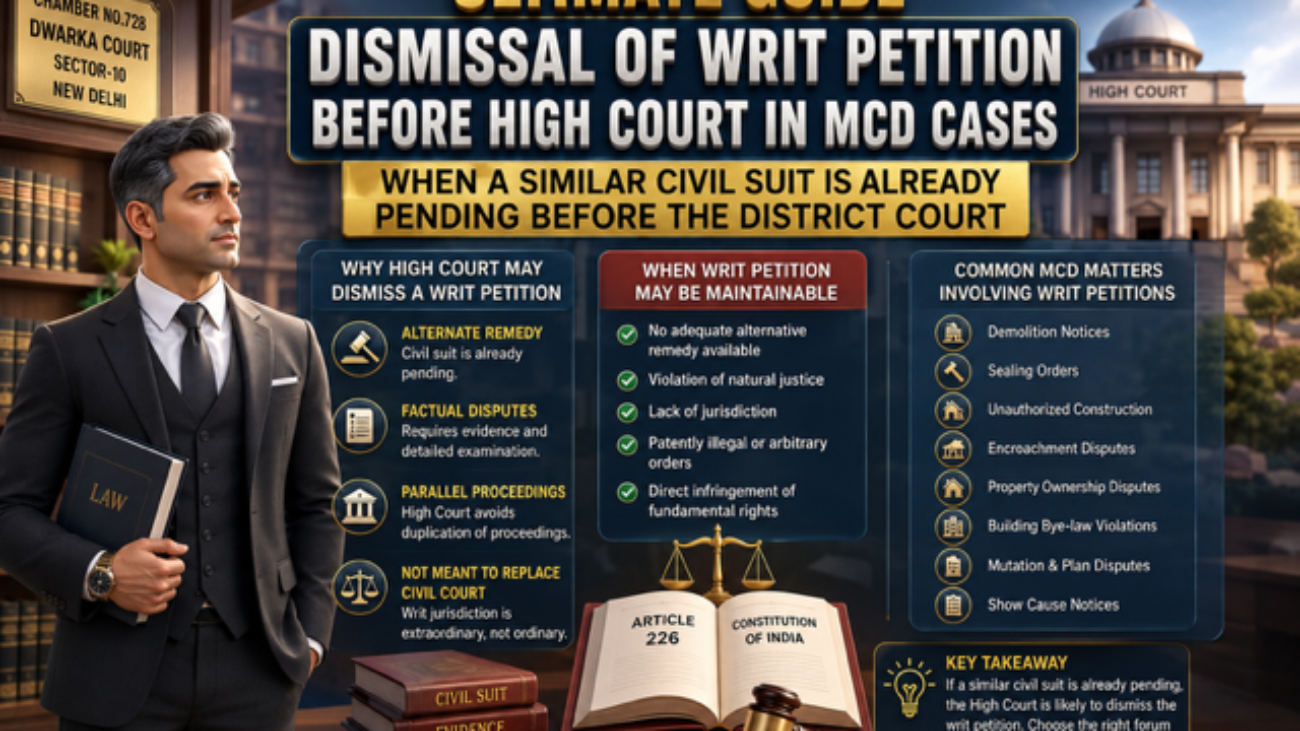
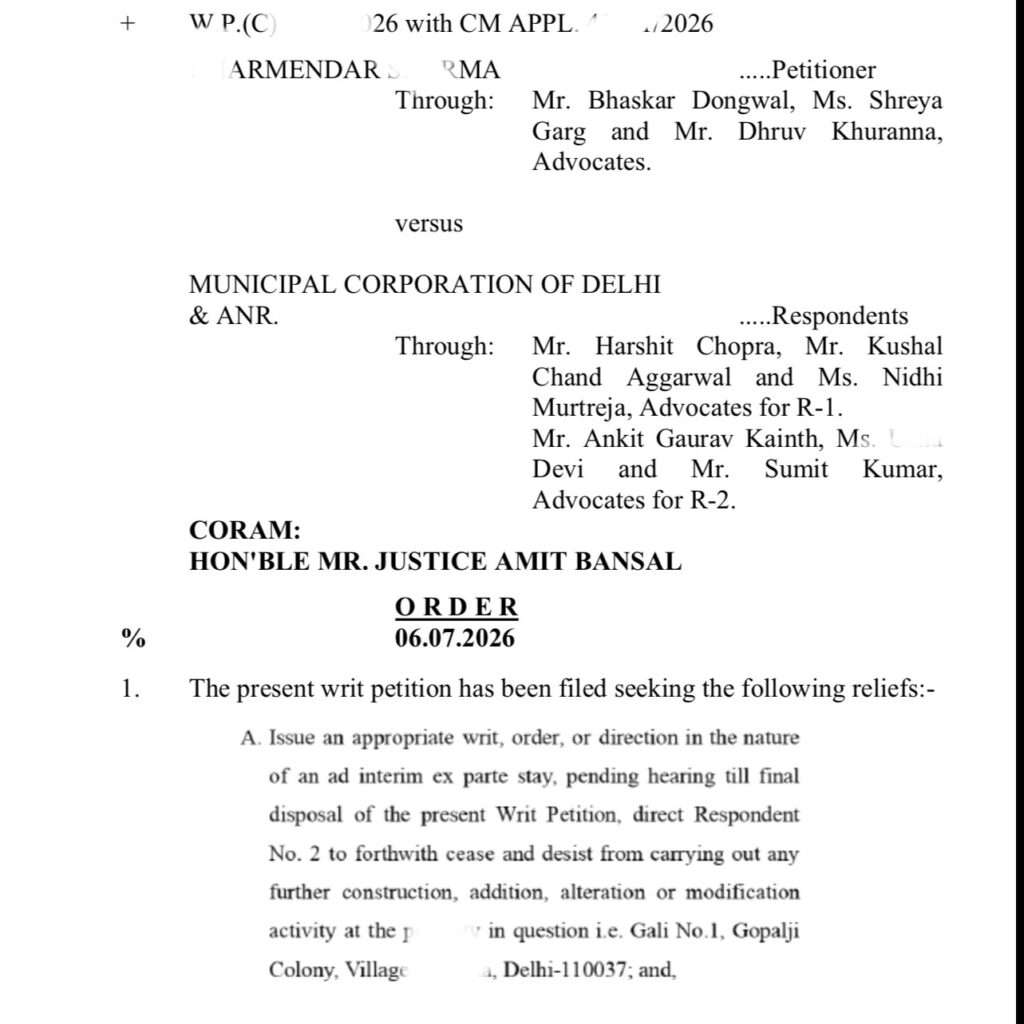
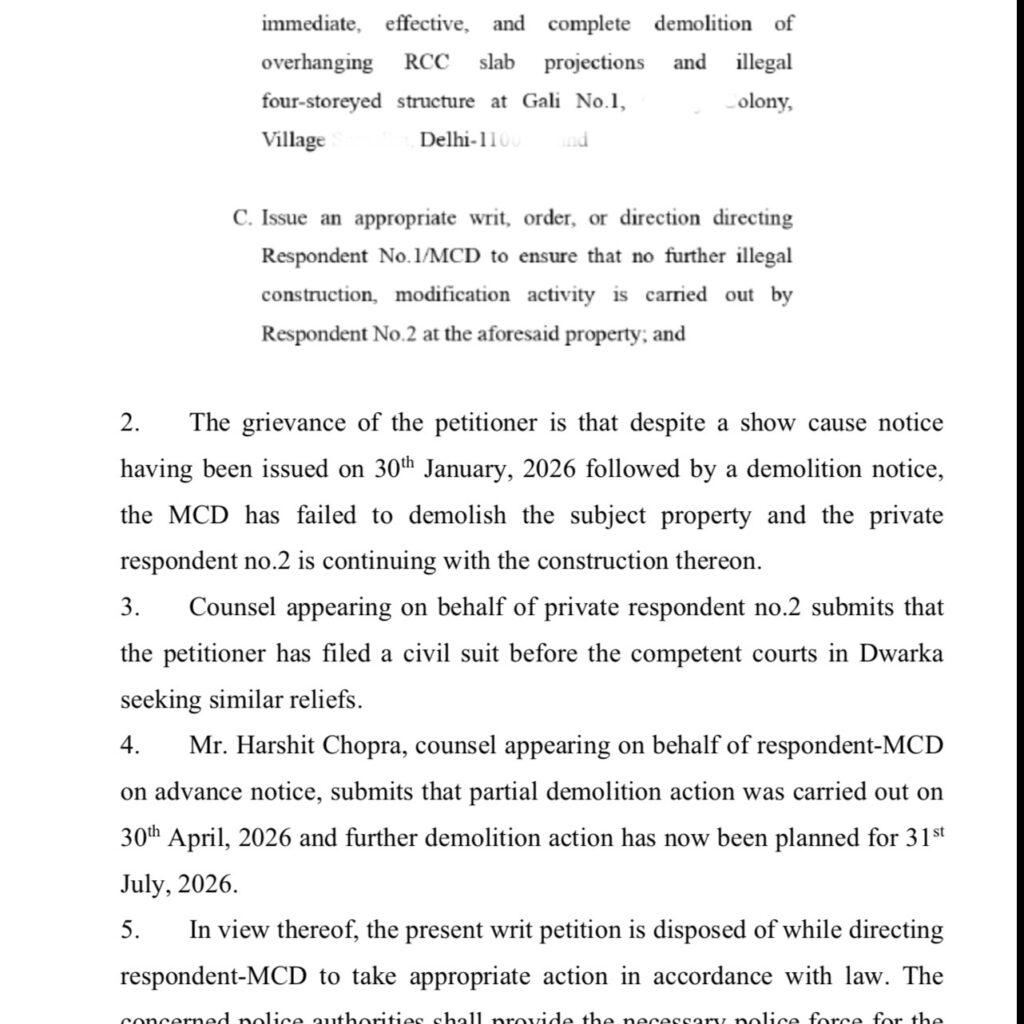
Municipal disputes involving the Municipal Corporation of Delhi (MCD) frequently result in demolition notices, sealing orders, unauthorized construction disputes, and property-related litigation. In many such matters, affected parties directly approach the High Court under Article 226 of the Constitution by filing a writ petition. However, the Dismissal of Writ Petition is a common outcome when a similar civil suit is already pending before the competent District Court.
Therefore, understanding when the High Court may refuse to exercise its extraordinary jurisdiction becomes essential. This article explains the legal principles governing the Dismissal of Writ Petition, the doctrine of alternative remedy, relevant judicial reasoning, and practical guidance for property owners, builders, residents, and businesses facing MCD actions.
Dismissal of Writ Petition in MCD Cases – Advocate in Dwarka Court DelhiDismissal of Writ Petition in MCD Cases – Advocate in Dwarka Court DelhiDismissal of Writ Petition in MCD Cases – Advocate in Dwarka Court Delhi
⚖️ What Is a Dismissal of Writ Petition?
A Dismissal of Writ Petition means that the High Court declines to entertain or continue the writ proceedings. The Court may dismiss the petition either on merits or because another equally effective legal remedy already exists.
Importantly, Article 226 provides extraordinary jurisdiction. It is not intended to replace ordinary civil remedies.
Consequently, where a civil suit involving identical issues is already pending before the District Court, the High Court often declines interference.
📚 Why Does the High Court Dismiss a Writ Petition?
The principle is simple.
When an effective statutory or civil remedy is available, the High Court generally expects litigants to pursue that remedy first.
🏠 Why MCD Property Cases Usually Belong Before Civil Courts
Many MCD disputes involve factual controversies.
For example:
Who owns the property?
Whether construction is authorized?
Whether sanctioned plans exist?
Whether demolition notice is valid?
Whether possession is lawful?
These issues require documentary evidence and witness examination.
Therefore, Civil Courts are generally considered the proper forum.
As a result, the possibility of Dismissal of Writ Petition increases significantly when similar issues are already pending before the District Court.
⚖️ How We Assist Clients Before Litigation
Every successful case begins with proper legal planning.
Therefore, our office assists clients even before litigation starts.
Our pre-litigation services include:
✅ Legal consultation
✅ Property document verification
✅ MCD notice analysis
✅ Reply drafting
✅ Legal notices
✅ Settlement discussions
✅ Negotiation with authorities
✅ Strategy planning
Early legal advice often prevents unnecessary litigation and protects valuable legal rights.
🏛️ How We Assist During Litigation
Once litigation becomes necessary, we represent clients at every stage.
Our litigation services include:
Drafting civil suits
Filing written statements
Injunction applications
Appeals
Writ petitions
MCD litigation
Evidence recording
Final arguments
Execution proceedings
Whether you require a Civil Litigation Lawyer in Delhi, a Property Dispute Advocate, a Recovery Suit Counsel, or a Commercial Litigation Lawyer, our office provides comprehensive representation.
✔️ Dismissal of Writ Petition often occurs when a similar civil suit is pending.
✔️ Civil Courts remain the proper forum for disputed factual issues.
✔️ High Courts generally avoid parallel proceedings.
✔️ Proper legal strategy should be planned before filing any writ petition.
✔️ Early consultation can save significant litigation costs and time.
✅ Conclusion
The Dismissal of Writ Petition in MCD matters is largely based on the well-established principle that extraordinary writ jurisdiction should not replace ordinary civil remedies. When a similar civil suit is already pending before the District Court, the High Court generally expects parties to pursue that remedy unless exceptional circumstances exist, such as lack of jurisdiction, violation of natural justice, or infringement of fundamental rights.
Choosing the correct legal forum at the beginning is therefore crucial. A carefully planned litigation strategy can avoid procedural setbacks, reduce unnecessary costs, and improve the likelihood of obtaining effective relief. Seeking timely legal advice from an experienced advocate helps ensure that the most appropriate remedy is pursued from the outset.
📞 Contact Us
If you have received an MCD demolition notice, sealing notice, or are concerned about the Dismissal of Writ Petition, consult our office for a detailed legal evaluation.
1. Can the High Court dismiss my writ petition if my civil suit is already pending?
Yes. The High Court may dismiss the writ petition if an effective civil remedy is already being pursued before the District Court.
2. What is the main reason for the dismissal of a writ petition?
The most common reason is the availability of an efficacious alternative remedy, especially where factual disputes require evidence.
3. Can I challenge an MCD demolition notice through a writ petition?
Yes, but maintainability depends on the facts. If no adequate alternative remedy exists or exceptional circumstances are present, the High Court may entertain the petition.
4. Do I need a lawyer experienced in MCD litigation?
Yes. MCD matters involve procedural and technical issues. An advocate familiar with municipal laws and court practice can help choose the correct legal remedy.
5. Do you represent clients before both Dwarka Court and the High Court?
Yes. We advise clients at the pre-litigation stage and represent them before the District Courts as well as the High Court, depending on the nature of the dispute.
⚖️ A writ petition is not always maintainable. If a similar civil suit is already pending before the District Court, the High Court may dismiss the writ on the ground of an effective alternative remedy.